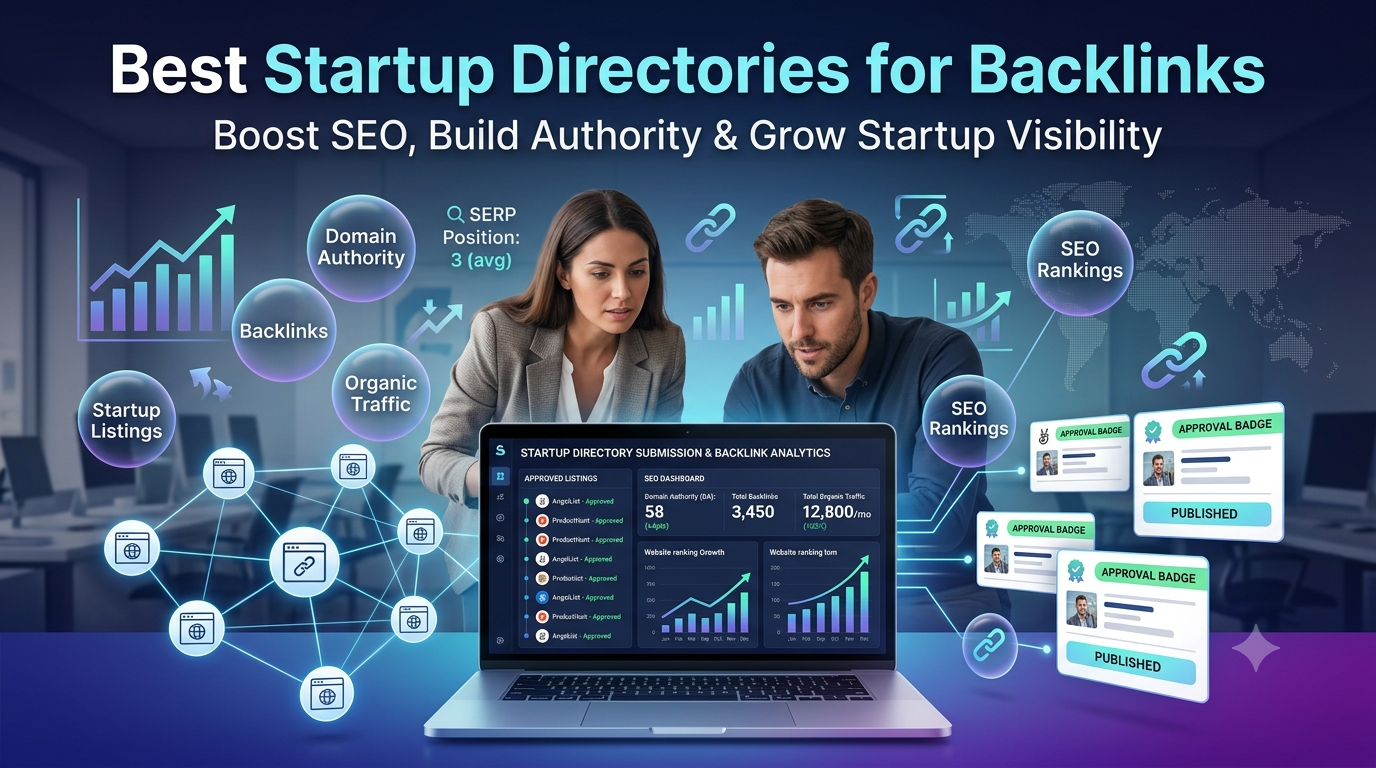
Best Startup Directories for Backlinks in 2026: The Complete List for SaaS & AI Founders
Here’s a number that should stop you cold: 92.3% of top-ranking websites have at least one backlink — yet most early-stage startups launch with absolutely zero. No domain authority. No external signals. No reason for Google to trust them yet.
You’ve built the product. You’ve written the copy. Your website is live. But without backlinks, search engines treat your startup like it doesn’t exist — and your potential customers never find you organically.
The Good News? Directory Backlinks Fix This Fast.
Startup directories are one of the few legitimate, scalable, and genuinely free ways to build your backlink foundation from day one. Ten well-chosen directory listings can replace thousands of dollars worth of paid link-building — and they compound in value for years after you submit.
However, not all directories are created equal. The old approach — submitting to every directory in sight — died with Google’s Penguin update. Today, quality beats quantity every single time. A single dofollow backlink from G2 (DR 92) or Crunchbase (DR 90) delivers more SEO value than fifty links from low-DA directories nobody visits.
Who This Guide Is For
This guide is built specifically for SaaS founders, AI startup teams, and early-stage builders targeting customers in the United States, United Kingdom, Canada, Australia, and New Zealand. Whether you launched last week or six months ago, this is your no-fluff, fully vetted directory backlink playbook for 2026.
You’ll walk away with a curated list of the best startup directories for backlinks, organized by tier, type, and target market — plus a clear submission strategy that actually moves your rankings.
If you’d rather skip the manual grind entirely, StartupSubmit.app handles all 200+ submissions for you with a full tracking report. But understanding the landscape still matters — so let’s get into it.
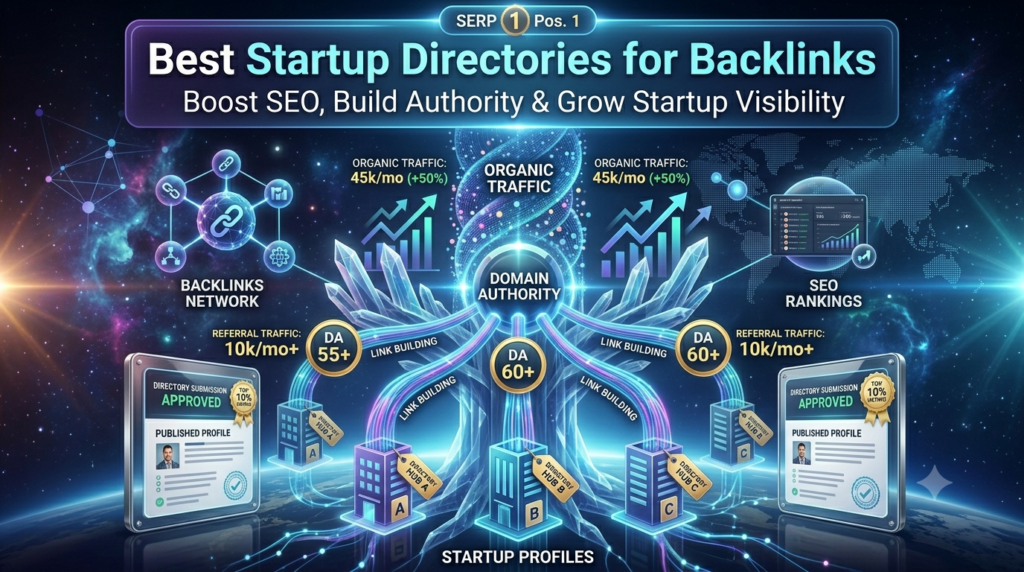
Why Startup Directories Still Matter for SEO in 2026
Some founders assume directory backlinks are outdated. They’re wrong — and that misconception is quietly handing their competitors a compounding SEO advantage.
Here’s the reality: backlinks remain one of Google’s top 3 ranking factors in 2026. Furthermore, the #1 Google result has 3.8× more backlinks than pages ranking in positions 2 through 10. For a startup sitting at DR 0–20, directory submissions are the fastest legitimate way to close that gap.
Industry-Specific Directories Now Outperform Generic Ones
Google has grown significantly smarter about topical relevance. Consequently, a listing on a SaaS-specific directory like SaaSHub carries more weight than a generic web directory with ten times the traffic. The signal isn’t just “someone linked to you” — it’s “a relevant, trusted source in your space linked to you.” That distinction matters enormously for early-stage SEO.
Directories Build Your Backlink Foundation
Think of directory backlinks as the base layer of a healthy link-building strategy. They establish your startup’s presence across the web, create consistent entity signals, and give Google multiple reference points to verify your brand exists and operates legitimately.
Consistent listings also function as NAP citations — Name, URL, and Product description — that reinforce your startup’s identity across markets like the US, UK, Canada, Australia, and New Zealand.
The AI Discovery Angle Nobody Is Talking About
Here’s what competing guides completely miss. Directory presence now directly influences how ChatGPT, Perplexity, and Google AI Overviews surface startup recommendations. When someone asks “best CRM for small SaaS teams,” AI engines pull from indexed, authoritative directories to build their answers.
In fact, 73.2% of marketers confirm that directory and listing presence influences AI-generated search recommendations. Therefore, getting listed today means getting recommended by AI engines tomorrow — a compounding moat that costs nothing but time.
Dofollow vs. Nofollow — What SaaS Founders Actually Need to Know
Most founders submit to directories without ever checking one critical detail: whether the link is dofollow or nofollow. That single oversight can mean the difference between building real SEO authority and simply adding your name to a list nobody reads.
The Core Difference
Dofollow links pass PageRank directly to your site — they’re votes of confidence that Google uses to calculate your domain authority and ranking potential. Nofollow links, by contrast, were historically ignored by Google. However, a 2019 algorithm update changed that significantly.
Today, Google treats nofollow as a “hint” rather than a hard directive. As a result, 78.8% of SEO professionals believe nofollow links still impact rankings indirectly — through brand signals, referral traffic, and crawl discovery.
Why You Need Both — But Not Equally
Here’s what many founders miss entirely. An all-dofollow backlink profile actually triggers Google’s spam detection. It looks manipulated, because organic link profiles are naturally mixed. Therefore, aim for roughly 20–40% nofollow links within your overall backlink mix — that ratio signals genuine, earned growth.
The practical rule is straightforward. Prioritize dofollow directories first to build foundational authority. Then layer in high-DR nofollow platforms like Crunchbase and Indie Hackers for referral traffic and brand visibility.
Consider this perspective on ROI: the average cost of buying one quality backlink is $508.95. Meanwhile, dozens of high-DR directories offer free dofollow listings. Consequently, directory submission is the single highest-ROI link-building move available to early-stage SaaS and AI startups.
How to Check if a Directory Gives Dofollow Links
Never assume — always verify before investing time in a submission. Here’s how:
• Inspect Element method: Right-click any outbound link on the directory → Inspect → look for rel=”nofollow” in the HTML. If it’s absent, the link is dofollow.
• Ahrefs Site Explorer: Enter the directory URL → go to Outgoing Links → filter by link type to see dofollow vs. nofollow ratios instantly.
• Semrush Backlink Audit: Run the directory domain through Backlink Audit → filter by “Follow” attribute to confirm link type before submitting.
Check this before submitting to any new platform. It takes thirty seconds and saves hours of wasted effort.
How to Choose the Right Startup Directories: The Quality Filter
Submitting to the wrong directories doesn’t just waste time — it can actively damage your SEO. Therefore, before you submit anywhere, run every platform through this quality filter first.
The 7-Point Directory Evaluation Framework
Use this quick-scan checklist before submitting to any directory:
| Criterion | Why It Matters |
| Domain Rating (DR) 30+ | Passes meaningful link equity to your site |
| Dofollow Link Type | Transfers direct ranking authority to your domain |
| Editorial Standards | Reduces spam association risk with Google |
| Topical Relevance | Strengthens your SaaS/tech topical authority cluster |
| Indexed Listing Pages | Google must crawl the page for the link to count |
| Real Referral Traffic | Validates directory quality beyond raw link value |
| Free vs. Paid Options | Critical ROI consideration for bootstrapped founders |
Apply this framework consistently. Consequently, your backlink profile will reflect genuine quality rather than volume — and Google rewards that distinction significantly.
Topical Relevance Matters More Than Ever
A DR 40 SaaS-specific directory will outperform a DR 70 generic web directory every single time in 2026. Google’s algorithms now weigh topical cluster signals heavily. Therefore, always prioritize directories built specifically for startups, SaaS products, and AI tools over broad, catch-all submission sites.
Warning Signals to Avoid
Not every directory deserves your time. Watch for these red flags before submitting:
• No visible submission standards — if anyone can list anything instantly, the directory has zero editorial value
• Link farms — hundreds of listings with no curation, no categories, and no real traffic; these signal manipulation to Google
• Bot-based mass submission services — these trigger Google’s spam detection and can result in manual penalties that take months to recover from
The rule is simple: if a directory wouldn’t impress a smart investor looking at your backlink profile, skip it entirely. StartupSubmit.app applies this exact framework across every directory in its 200+ vetted network — so every submission serves both your SEO and your brand reputation simultaneously.
The Best Startup Directories for Backlinks in 2026: The Master List
This is the list most founders waste weeks building manually. It’s organized into four tiers — by authority, relevance, and target market — so you can prioritize submissions strategically and start with the platforms that move the needle fastest.
Tier 1 — High-Authority Platforms (DR 70+)
These are non-negotiable. Every SaaS and AI startup should be listed here before submitting anywhere else.
| Platform | DR | Link Type | Cost | Best For |
| Crunchbase | 91 | Mix | Free | Investor discovery + editorial citations |
| Product Hunt | 90+ | Nofollow | Free | Launch day traffic + AI recommendations |
| G2 | 90 | Dofollow | Free | B2B SaaS social proof + review backlinks |
| AngelList / Wellfound | 85+ | Nofollow | Free | Investor signals + hiring visibility |
| F6S | 83 | Dofollow | Free | Accelerator & grant pipeline (1.6M+ startups) |
| Capterra | 88 | Dofollow | Free | SaaS buyer intent traffic |
| Reddit (r/startups, r/SaaS) | 95 | Nofollow | Free | Community trust + referral traffic |
Submission Tip: Complete every field on Tier 1 profiles fully. Incomplete listings rank lower within the directory itself — and that means less referral traffic reaching your site.
Tier 2 — Mid-Authority Directories (DR 40–70)
These platforms deliver strong topical signals and consistent referral traffic. Furthermore, many offer dofollow links that meaningfully support your domain authority growth.
| Platform | DR | Link Type | Cost | Best For |
| BetaList | 65 | Dofollow | Free / $129 | Pre-launch early adopters |
| Indie Hackers | 72 | Mix | Free | Build-in-public community + brand mentions |
| SaaSHub | 65+ | Dofollow | Free | SaaS discovery + alternative tracking |
| AlternativeTo | 78 | Dofollow | Free | Comparison searches + organic discovery |
| StackShare | 65 | Dofollow | Free | Dev tools + tech stack signals |
| Startup Ranking | 50+ | Mix | Free/Paid | Global startup rankings + directory reach |
| KillerStartups | 45+ | Mix | Free | Editorial features + hybrid blog directory |
| SubmitHunt | 37+ | Dofollow | Free | Early-stage SEO-focused submissions |
Submission Tip: On AlternativeTo and SaaSHub, list your closest competitors as alternatives. This captures high-intent comparison traffic from buyers already evaluating tools in your category.
Tier 3 — Niche and Emerging Directories (AI/SaaS-Specific)
If your product has an AI component, this tier is critical. These platforms drive topical authority signals specifically within the AI and SaaS verticals — and they’re where AI search engines increasingly look for tool recommendations.
| Platform | DR | Link Type | Cost | Best For |
| There’s An AI For That (TAAFT) | 65+ | Mix | Free/Paid | 2M+ monthly users; AI tool discovery |
| Futurepedia | 60+ | Mix | Free/Paid | AI tool database + category rankings |
| AI Tool Hunt | 40+ | Mix | Free | AI-specific directory submissions |
| uNeed | — | Mix | Free | Design-forward listing; less crowded |
| Foundigy | — | Mix | Free | 2-day homepage feature + permanent listing |
Submission Tip: On TAAFT and Futurepedia, choose your category carefully. Niche subcategories have less competition and rank faster than broad “AI Tools” catch-all listings.
Tier 4 — Location-Based and Regional Directories
Regional directories are where most founders leave significant SEO value on the table. Consequently, location-specific listings help Google associate your startup with target markets — which directly strengthens local organic rankings across the US, UK, Canada, Australia, and New Zealand.
United States
• AngelList (US) — Filter specifically for the US investor community
• Crunchbase (US Hub) — Tag US market and headquarters location
• TechCrunch Startup Battlefield — Earned media citations with high-authority backlinks
Canada
• Startup Canada Directory — CA-specific entrepreneur and founder ecosystem
• MaRS Discovery District — Toronto-based; strong visibility for Canadian SaaS
United Kingdom
• Tech Nation — UK government-backed startup ecosystem with editorial credibility
• Startups.co.uk — UK-focused startup media platform and listing directory
Australia and New Zealand
• StartupAUS — National advocacy database and startup directory
• iStart.co.nz — NZ-specific tech startup listings with regional SEO value
• LaunchVic — Victorian government startup support program and directory
Manually submitting to 200+ directories across all four regions takes weeks of research, form-filling, and follow-up. StartupSubmit.app’s done-for-you service handles location-specific submissions for the US, Canada, UK, Australia, and New Zealand — so your listings go live on the right platforms without the research overhead.
How to Prepare the Perfect Startup Directory Submission
Preparation separates founders who get approved quickly from those who get rejected or ignored. Build your submission kit once — then reuse it across every directory on this list.
What Every Directory Requires
Gather these assets before submitting a single listing:
☐ Startup name + tagline — under 100 characters, clear and specific
☐ Website URL — live, fast-loading, and mobile-optimized
☐ Short description — 100–200 words, keyword-rich but naturally readable
☐ Long description — 300–500 words for premium and featured listings
☐ Logo — 200×200px minimum, PNG with transparent background
☐ Screenshots or demo video — MP4 file or YouTube link preferred
☐ Pricing information — free tier, paid plans, and enterprise options
☐ Founder name + LinkedIn profile URL
☐ Social media links — Twitter/X, LinkedIn, GitHub if relevant
☐ Launch date + current funding status
☐ Category tags — SaaS, AI, Productivity, B2B, and any niche verticals
SEO Optimization Tips for Your Directory Listings
Completing the form is only half the job. Additionally, optimize each listing for both directory ranking and Google indexation:
• Place your primary keyword within the first 50 words of every description
• Include your city and country when targeting local startup ecosystems in the US, UK, Canada, Australia, or New Zealand
• Link to a specific landing page rather than your homepage where relevant — it passes more targeted link equity
• Keep NAP consistency — Name, URL, and product description must match identically across every listing
• Add UTM parameters to every submission URL: ?utm_source=directory_name&utm_medium=referral — this tells you exactly which directories drive real traffic
The Right Submission Strategy — Quality Over Quantity
Submitting to 500 directories in one weekend doesn’t build authority — it signals manipulation. Therefore, a disciplined, staged approach consistently outperforms mass submission every time.
Submit Smart, Not Fast
Start with 10–15 high-DR, dofollow directories that are directly relevant to your vertical. Then build outward systematically. A backlink profile made up entirely of directory links looks artificial to Google — so layer in content marketing, strategic partnerships, and PR mentions alongside your directory submissions for a natural, compounding authority mix.
Submit quarterly or during key launch phases rather than all at once. Furthermore, always track every submission in a dedicated spreadsheet logging the platform name, submission date, live profile URL, link type, and DR score. Use Ahrefs or Semrush to confirm each backlink is indexed within 2–4 weeks of going live.
Your 30-Day Startup Directory Submission Roadmap
Follow this proven weekly plan to build authority without triggering spam signals:
| Week | Action |
| Week 1 | Tier 1 platforms — Crunchbase, Product Hunt, G2, F6S, Capterra |
| Week 2 | Tier 2 platforms — BetaList, Indie Hackers, SaaSHub, AlternativeTo |
| Week 3 | Tier 3 niche AI/SaaS platforms + regional directories for your target market |
| Week 4 | Monitor backlink indexation; optimize underperforming profiles and follow up on pending submissions |
This roadmap keeps your link velocity natural, your profile diverse, and your submissions organized — exactly the pattern Google rewards with sustained ranking improvements.
Manual vs. Automated Startup Directory Submission — What Actually Works
Founders often ask the same question: should I submit manually or use an automated tool to save time? The answer matters more than most people realize — because choosing wrong can actively hurt your SEO rather than help it.
Why Automated Submissions Fall Short
Automated and bot-based submission tools move fast. However, speed is the only advantage they offer. In practice, automated tools produce inconsistent descriptions across listings, trigger rejection filters on editorially curated directories, and create the kind of footprint Google’s spam detection algorithms flag during routine crawls.
Furthermore, directories with real editorial standards — G2, Product Hunt, BetaList, and Capterra — reject automated submissions entirely. Consequently, you end up with dozens of low-quality listings on directories nobody visits and zero presence on the platforms that actually move your rankings.
Why Manual Submission Consistently Wins
Manual submissions take longer. Nevertheless, the results are significantly stronger across every metric that matters. Each listing is tailored to its specific directory audience, descriptions stay on-brand and keyword-optimized, and editorial compliance rates are dramatically higher.
Additionally, manual submissions protect your brand reputation. Every listing that goes live represents your startup — and a poorly formatted, auto-generated profile on a high-DA platform does more damage than no listing at all.
The Hybrid Approach That Works Best
The smartest approach combines manual submissions with structured reporting. Specifically, look for a service that delivers:
• Custom descriptions tailored per directory — never copy-pasted
• Logo optimization formatted to each platform’s exact specifications
• Regional targeting across US, UK, Canada, Australia, and New Zealand
• Progress reporting with live URLs, DR scores, and link types confirmed
Red Flags to Avoid in Submission Services
Not every done-for-you service delivers genuine value. Watch for these warning signs before paying anyone:
• No reporting or tracking sheet provided after completion
• Bot-based tools with no human editorial review
• Identical descriptions submitted across every platform
• No mention of editorial compliance or directory-specific guidelines
StartupSubmit.app offers 100% manual directory submissions across 200+ high-authority platforms — including Product Hunt, G2, Indie Hackers, and BetaList — with a specific focus on SaaS and AI startups. No bots. No shortcuts. Real listings that search engines trust and buyers actually find.
Start Building Your Backlink Foundation — One Directory at a Time
Directory backlinks aren’t a magic bullet. However, they are the most accessible, cost-effective, and genuinely compounding SEO foundation available to early-stage SaaS and AI startups in 2026.
The Right Stack Recap
Here’s what a winning directory backlink strategy actually looks like:
• Tier 1 high-authority platforms — Crunchbase, G2, Product Hunt, Capterra, F6S
• Niche SaaS and AI directories — TAAFT, Futurepedia, SaaSHub, AlternativeTo
• Regional listings — targeted platforms for your specific markets across the US, UK, Canada, Australia, and New Zealand
The Compound Effect Is Real
A handful of strong directory backlinks submitted today will still drive referral traffic, domain authority growth, and AI search visibility twelve to eighteen months from now. Unlike paid ads that stop the moment your budget runs out, directory listings are permanent assets that appreciate quietly over time.
Furthermore, as AI engines like ChatGPT and Perplexity increasingly reference authoritative directories to answer product recommendation queries, your early listings become a growing source of zero-cost discovery.
Start This Week — Not Next Month
Don’t wait until everything is perfect. Start with just five Tier 1 directories this week — Crunchbase, Product Hunt, G2, F6S, and Capterra. Then build systematically through Tiers 2, 3, and 4 over the following month using the 30-day roadmap above.
Every day you delay is a day your competitors are compounding authority you haven’t built yet.
Ready to skip the spreadsheet and get listed across 200+ vetted startup directories — done manually, optimized for SaaS and AI? StartupSubmit.app handles the entire submission pipeline so you can focus entirely on building your product.
Get Listed on 200+ Directories →
Frequently Asked Questions
Are startup directories still worth it for SEO in 2026?
Yes — quality startup directories with DR 30+ remain effective foundational SEO tools. The key is relevance and editorial standards. A handful of strong, relevant directory backlinks outperform hundreds of low-quality submissions every time.
What’s the difference between startup submission sites and regular business directories?
Startup submission sites are curated for early-stage companies and typically reach investors, early adopters, and tech journalists. Regular business directories serve broader local audiences. For SaaS and AI startups, startup-specific platforms carry stronger topical relevance signals.
Do directory backlinks still work for SaaS companies in 2026?
How many startup directories should I submit to?
Start with 10–15 high-authority, relevant directories. Expand to 50+ over time. Submitting to 200+ curated directories — as services like StartupSubmit.app offer — is viable when done manually with quality control. Avoid bot-based mass submission at all costs.
Which startup directories give dofollow backlinks for free?
F6S (DR 83), G2 (DR 90), SaaSHub, AlternativeTo, StackShare, Capterra, and SubmitHunt all provide free dofollow backlinks. Crunchbase (DR 91) provides mixed link types with strong editorial citation value.
How do startup directory backlinks help with AI search results?
73.2% of marketers now believe directory listings influence AI search results. Platforms like ChatGPT, Perplexity, and Google AI Overviews use directory data to surface tool recommendations — making your listing a signal not just for Google, but for AI-driven discovery.
Is it safe to submit to startup directories in bulk?
Safe when done manually with curated, editorial-standard directories. Bulk bot submissions to low-quality link farms can trigger Google spam penalties. Manual submission services that vet every directory remain the safest and most effective approach.
One thing I appreciate here is the emphasis on quality over quantity. A lotBlog Comment Strategy of founders still assume directory submissions are a numbers game, but focusing on a handful of relevant, trusted directories makes much more sense for long-term SEO. It would also be interesting to see how you prioritize directories based on niche relevance versus domain authority when resources are limited.