Directory Submission Service: The SaaS Founder’s Guide
You launched. Product Hunt sent a burst of traffic. A few people signed up, a few friends shared it, and your analytics looked alive for a day.
Then the graph flattened.
That post-launch drop is where most startup SEO decisions go sideways. Founders either overcorrect into content they won't sustain, or they buy some cheap backlink package that leaves a trail of junk across the web. Neither helps much when your real problem is simpler: the internet barely knows your company exists.
A good directory submission service solves that basic discovery problem first.
For a new SaaS or AI startup, directory listings aren't a retro SEO trick. They're foundational distribution. They create profiles on sites people already trust, they add relevant referring domains, and they give Google, AI search systems, and buyers more places to verify that your company is real.
That matters more now because discovery isn't limited to ten blue links anymore. Google AI Overview, ChatGPT, Perplexity, and other answer engines pull from a broader web footprint. If your brand has no structured presence outside your own site, you're asking those systems to trust a single source.
The Post-Launch Traffic Slump and Where to Go Next
The painful part of an early launch isn't that traffic drops. It's that the drop makes founders chase the wrong channel.
They spend the next week tweaking homepage copy, redesigning pricing cards, or posting every day on X. Those things can help, but none of them fixes the underlying issue if your startup has almost no off-site presence. Your brand needs durable mentions, profile pages, backlinks, and category placements that keep working after launch day fades.
That's where directory work earns its keep.
Launch spikes don't compound
A Product Hunt launch, a Reddit thread, or a founder's LinkedIn post can create attention. It rarely creates infrastructure. Once the spike passes, you're left with whatever long-term assets got built during that window.
Directory profiles are one of those assets.
They do three useful jobs at once:
- They confirm your company exists: Buyers, journalists, and investors often Google a startup before replying.
- They create crawlable brand references: Search engines can connect your company name, URL, category, and product description across multiple trusted properties.
- They keep sending small, persistent signals: Not every listing drives referral traffic, but together they build a broader footprint.
Practical rule: Treat directory submissions like setting up rails for future discovery, not like buying instant traffic.
Founders usually underestimate the trust layer
For early-stage SaaS, trust often matters before volume. If someone searches your product and finds your website plus a handful of strong external profiles, the business feels more established. If they only find your domain and a dead launch page, the opposite happens.
I've seen this pattern in startup marketing again and again. The founders who treat off-page visibility as part of launch prep usually recover from the traffic slump faster. Not because every listing sends users. Because the combined footprint makes every other channel work better. Paid traffic converts better when users can verify you. Outreach lands better when your brand looks real. Content performs better when your domain already has some external support.
Directory submission sits near the bottom of the funnel for hype, but near the top for foundational SEO work.
What Directory Submission Means for a Startup in 2026
Most founders hear "directory submission" and think spam. That reaction made sense if your reference point is old SEO playbooks built on low-grade, auto-approved link farms.
That isn't the version worth doing now.
Before Google's major algorithm updates, directory submissions were a dominant SEO tactic, but post-updates, most low-quality directories lost measurable SEO value. Legitimate directories with human editorial oversight and stricter selection processes, including examples like Product Hunt and SaaSHub, still generate backlinks that help search rankings, according to Webmastersun's discussion of modern directory SEO.
The modern version is curated, manual, and selective
A real directory submission service in 2026 isn't software blasting your URL into random forms. It's operational marketing work done by hand.
That means:
- Choosing sites with editorial review
- Matching your startup to the right categories
- Adapting descriptions to each platform
- Checking whether a listing already exists
- Submitting complete, consistent business data
The best platforms are discerning, not indiscriminate repositories for backlinks. G2, Capterra, Product Hunt, AlternativeTo, BetaList, SaaSHub, and niche AI or SaaS directories each possess distinct formatting, approval rules, taxonomy, and content expectations.
A weak submission gets ignored, rejected, or published in the wrong place.
Why this matters for AI search visibility
Search isn't just a ranking problem anymore. It's a citation and entity problem.
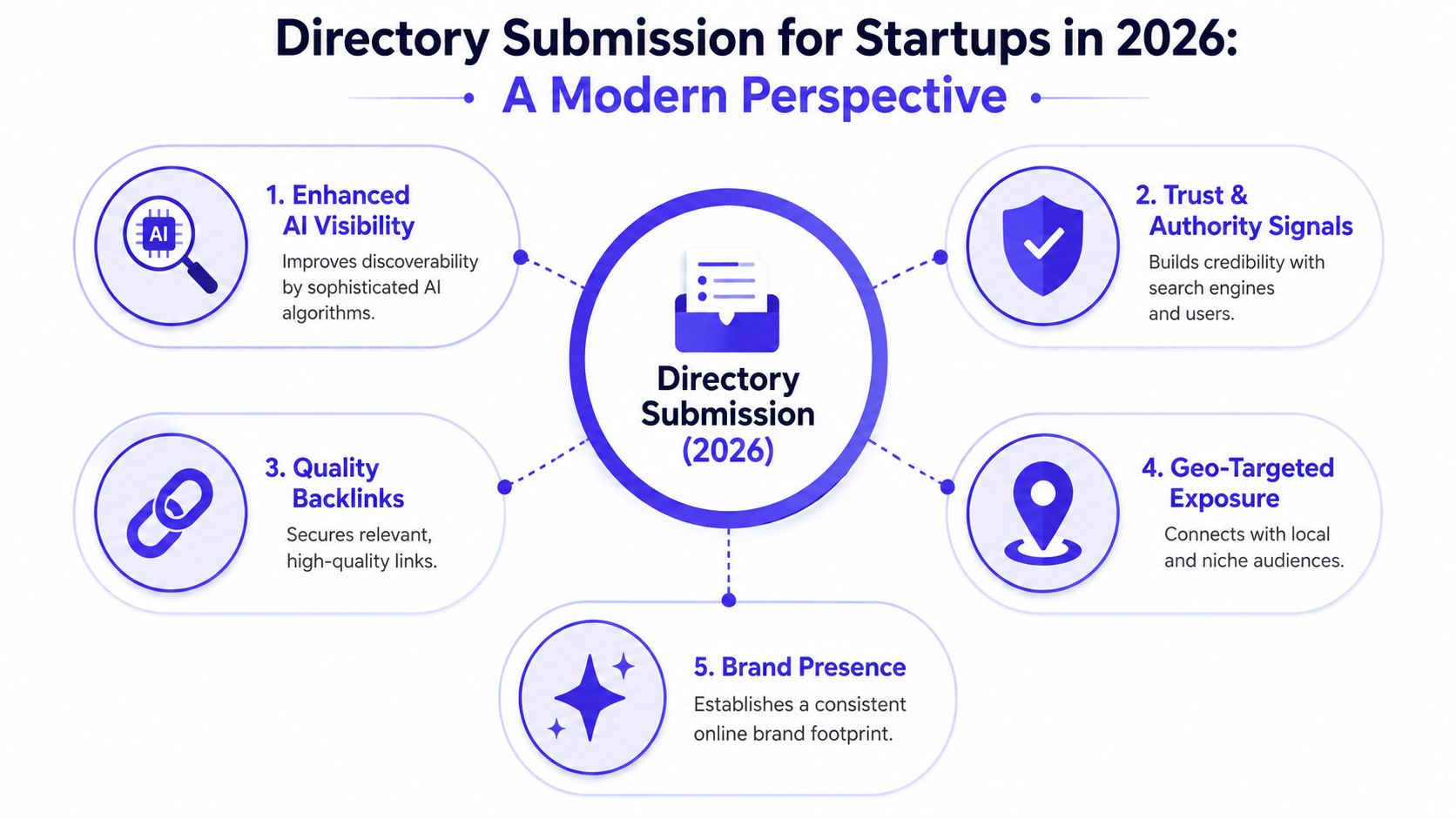
AI systems look for corroboration. If your startup appears across credible software directories, review sites, launch platforms, and category-specific listings, you give those systems more structured evidence about your product, use case, and market. That's especially useful for branded queries, comparison prompts, and category searches where answer engines synthesize from multiple sources.
A manual service is really outsourcing the repetitive part of that visibility work.
If you want a concrete example of that workflow, StartupSubmit's process overview shows the kind of manual, startup-focused submission model that's aligned with how serious founders should think about this channel.
The old version tried to manufacture link volume. The current version builds a verifiable brand footprint.
What founders should stop expecting
Don't expect directory submissions to replace content, product marketing, or customer acquisition.
Do expect them to help with:
| Outcome | What directory listings can do |
|---|---|
| Brand verification | Give searchers more trusted pages about your company |
| Backlink foundation | Add relevant referring domains early |
| Category discovery | Put your product in places users browse intentionally |
| AI discoverability | Create more machine-readable references to your brand |
| Reputation control | Fill page one with better external properties |
For an early-stage company, that's a strong return from a relatively simple off-page move.
Manual vs Automated Submissions A Founder's Breakdown
This is the decision that matters most.
A manual service can help. Automation can create a mess that takes months to unwind.
The difference isn't cosmetic. It's the difference between brand-building and footprint-spamming.
Why automation keeps failing serious startups
Automated tools look attractive because they promise speed and scale. But speed is exactly what makes them risky. The moment a provider advertises huge overnight volume, they're telling you the process isn't selective enough.
Expert benchmarks for directory quality call for a minimum Domain Authority of 30, with the strongest performance usually in the 50 to 80 range, plus human editorial review. The same benchmark warns that bulk tools promising 500+ overnight links have been flagged as penalty triggers since 2012, as described in this directory quality benchmark write-up.
That matches what founders run into in practice. High-value directories usually ask for cleaner descriptions, better category choices, and more complete business details. Bots don't handle that well.
Manual submissions behave like real marketing work
When a human submits your startup, they can tailor the listing to fit the site.
That sounds minor. It isn't.
A SaaS company may need one positioning angle on G2, another on Product Hunt, and another on an AI tool directory where users browse by use case. Good submissions account for:
- Category fit: Listing an AI sales assistant under the wrong software category wastes the placement.
- Description quality: A flat, duplicated blurb lowers approval chances and weakens conversion.
- Asset formatting: Logos, screenshots, tags, and links often need adjustment platform by platform.
- Duplicate prevention: Existing profiles need to be claimed or updated, not recreated.
Founder's shortcut: If a provider can't explain how they handle moderation, duplicates, and category mapping, they probably aren't doing meaningful manual work.
Manual vs. Automated Directory Submission
| Factor | Manual Submission | Automated Submission |
|---|---|---|
| Directory selection | Curated for relevance, authority, and editorial quality | Broad lists, often mixed with low-quality sites |
| Approval odds | Higher, because entries are adapted to each platform | Lower, because generic data gets rejected or filtered |
| Brand consistency | Stronger control over descriptions, categories, and assets | Often inconsistent or duplicated across listings |
| SEO risk | Lower when focused on trusted directories | Higher when submitted to spammy or de-indexed sites |
| Time investment | Slower, but intentional | Fast, but shallow |
| Best fit | Founders who care about long-term authority | People chasing cheap link counts |
The trade-off founders should actually care about
Manual work costs more effort per listing. That's the point.
You're not buying form fills. You're buying judgment. A human can skip weak sites, rewrite low-quality copy, and make sure your brand doesn't get sprayed into irrelevant categories. That's why a manual workflow is the only sensible approach for a startup that wants durable SEO gains without looking like it hired a bargain-bin link vendor.
The Real SEO and Trust Benefits for Your SaaS
If you're paying for submissions, the outcome you want isn't "we got listed in a lot of places."
You want stronger off-page signals that help your domain, support rankings, and make your company look more credible when someone checks you out.
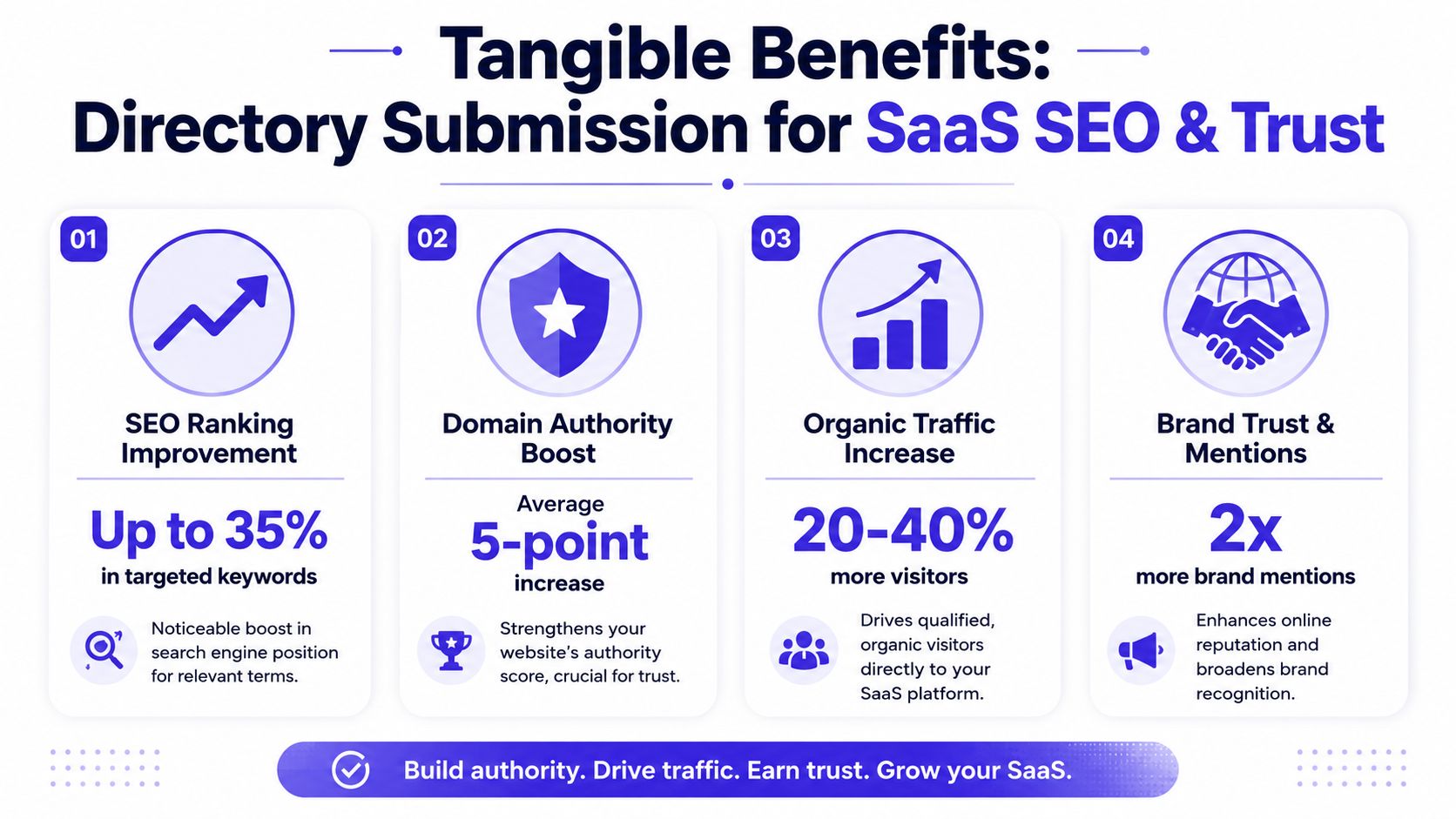
Manual directory submission to high-authority platforms in the DA 40 to 80+ range can produce a Domain Rating increase of 15 to 25 points within 3 to 5 weeks for new domains, with ranking improvements often showing up in weeks 4 to 8 post-campaign, according to ListMySite's timeline breakdown.
Backlinks matter most when you have almost none
For a newer SaaS site, the first meaningful referring domains often do more than the fiftieth blog link you'll someday earn.
That's why startup directory work can punch above its weight early. A handful of trusted software and startup profiles can help Google understand your site faster, associate your brand with a category, and give your domain a cleaner backlink base to build on. If you want a plain-English refresher on how backlinks boost SEO, Rebus has a useful explanation of how authority and referral signals work together.
Trust is part of SEO now
This gets missed all the time. SEO isn't only about ranking pages. It's also about reducing doubt.
When a prospect Googles your startup, they're asking silent questions:
- Is this company real?
- Has anyone else listed or reviewed it?
- Does it show up on software sites I recognize?
- Can I trust this enough to book a demo or enter a card?
Directory profiles help answer those questions before your homepage has to do all the work.
That matters for:
| Searcher | What they notice |
|---|---|
| Buyers | Recognized software profiles and consistent positioning |
| Investors | A legitimate footprint beyond the company website |
| Partners | Clear category placement and company information |
| AI systems | Multiple corroborating references to the same entity |
Good directory profiles don't just pass link equity. They reduce skepticism.
Why this affects AI Overview and ChatGPT visibility
Google AI Overview and large language models often synthesize from a wider web context than a normal organic click path. They look for signals that a company belongs in a category and can be described consistently.
Directories help because they package your startup into structured public entries: name, website, category, summary, pricing hints, reviews, integrations, screenshots, and alternatives. Even when a user never clicks the directory itself, those pages can influence how your brand gets surfaced and framed in answer-driven search.
If you're evaluating whether this is worth doing, StartupSubmit's benefits page captures the practical appeal of that kind of broader visibility work for SaaS and AI companies.
Evaluating a Service Deliverables Reports and Timelines
Most directory submission offers sound similar until you ask for proof.
That's where weak providers fall apart. They sell "exposure" but can't tell you exactly where they submitted, what got approved, what's pending, or what they skipped.
A service worth paying for should leave an audit trail.
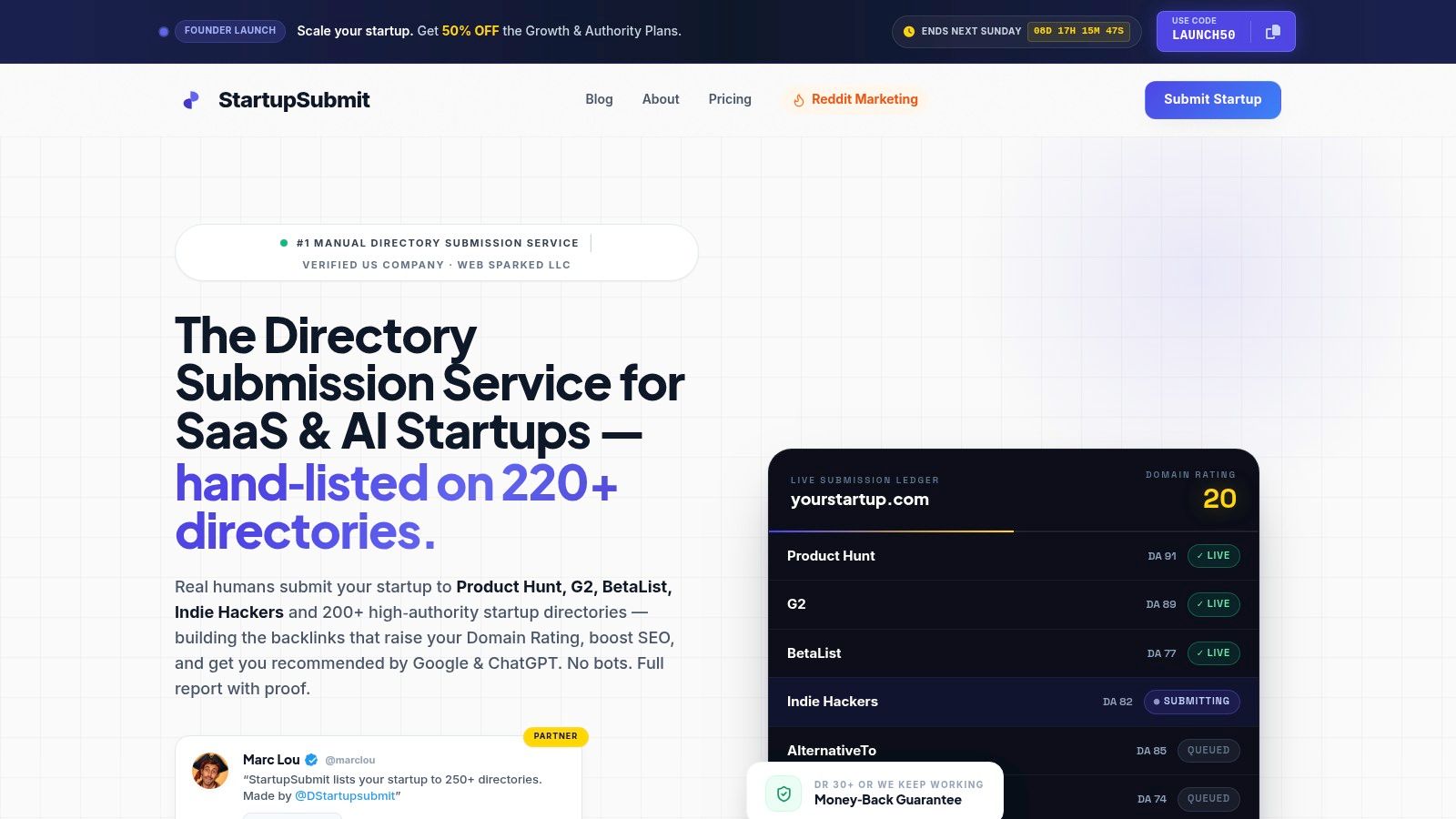
What you should receive after the work is done
At minimum, ask for a report with these items:
- Submitted directory list: You need to know which platforms were targeted.
- Live profile links: If a listing is approved, the URL should be included.
- Approval or moderation notes: Some directories review manually and take time.
- Rejected or skipped entries: Good operators explain why a site wasn't used.
- Screenshots where useful: Helpful for internal tracking and stakeholder updates.
If the provider only sends a spreadsheet of domain names without profile URLs, that's not enough. A domain list is not evidence that your startup was listed.
Timelines should sound boring, not magical
Quality directory submission services typically produce measurable SEO results within 30 to 90 days, and higher-authority directories in the DA 50 to 80 range tend to move faster. For budgeting, small businesses commonly spend $300 to $800 for a one-time or monthly service, based on Active Marketing's review of directory submission outcomes and pricing.
Those numbers matter because they reset expectations.
A credible provider won't promise instant rankings. They should talk about a submission window first, then moderation lag, then indexing, then SEO movement. That's how the work proceeds.
Questions I'd ask before hiring anyone
Use this as a quick filter:
- Which directories are included? Ask for examples, not just a count.
- How many are manually submitted? "Partially automated" usually means low control.
- Will I get final live links? If not, walk away.
- How do you handle duplicates and category matching?
- What happens if a platform rejects the listing?
For founders comparing providers, StartupSubmit's pricing page is the kind of page that should exist. Not because you must use that service, but because transparent scope and deliverables should be standard.
How to Spot Risky Services and Avoid SEO Penalties
The fastest way to waste money on off-page SEO is to buy certainty from someone who can't control the outcome.
Penalty-prone services always sound confident. They promise guaranteed rankings, giant link volume, or instant authority. That's exactly what should make you nervous.
Manual submission to 30 to 50 high-DA directories is described as the fastest way for a new SaaS to build foundational trust signals, while the old tactic of blasting to 500 auto-approval link farms now flags sites for spam in ListMySite's startup directory guidance.
Red flags that should stop the conversation
If you see any of these, move on:
"Thousands of submissions overnight"
No legitimate startup-focused directory campaign needs that volume.Guaranteed ranking claims
Nobody controls Google's response, moderation decisions, or crawl timing.No mention of editorial review
If they don't talk about moderation, they're likely targeting weak sites.No examples of actual directories
Good providers can name platforms and explain why they matter.No reporting beyond a generic completion email
If there's no audit trail, there's no accountability.
Risk usually hides behind cheap convenience
Early-stage founders are especially vulnerable here because they're busy and price-sensitive. A package that promises hundreds of backlinks for very little money feels efficient.
It usually means one of three things:
| Risk pattern | What it usually means |
|---|---|
| Massive volume | Mostly low-value or irrelevant sites |
| Very low pricing | Little manual review or quality control |
| "Proprietary network" language | Often a black-box link scheme or private network |
If a provider talks more about link quantity than directory quality, they're solving the wrong problem.
What safe looks like instead
A safer service does fewer things, more carefully.
Look for providers that emphasize:
- Human review of each submission
- Reputable startup and software directories
- Accurate NAP and brand consistency
- Category relevance for your product
- Clear reporting on what was accepted
The key mindset shift is simple. You're not trying to create as many links as possible. You're trying to build a believable, defensible digital footprint that helps your startup look more established to search engines and real people.
That's a narrower goal, but it's the one that tends to hold up.
Your Action Plan Before Starting Directory Submissions
Most submission projects slow down for a boring reason. The founder doesn't have the assets ready.
Then the service starts chasing missing logos, inconsistent taglines, half-finished descriptions, and social links that still point to personal profiles. You can avoid all of that by preparing the inputs first.
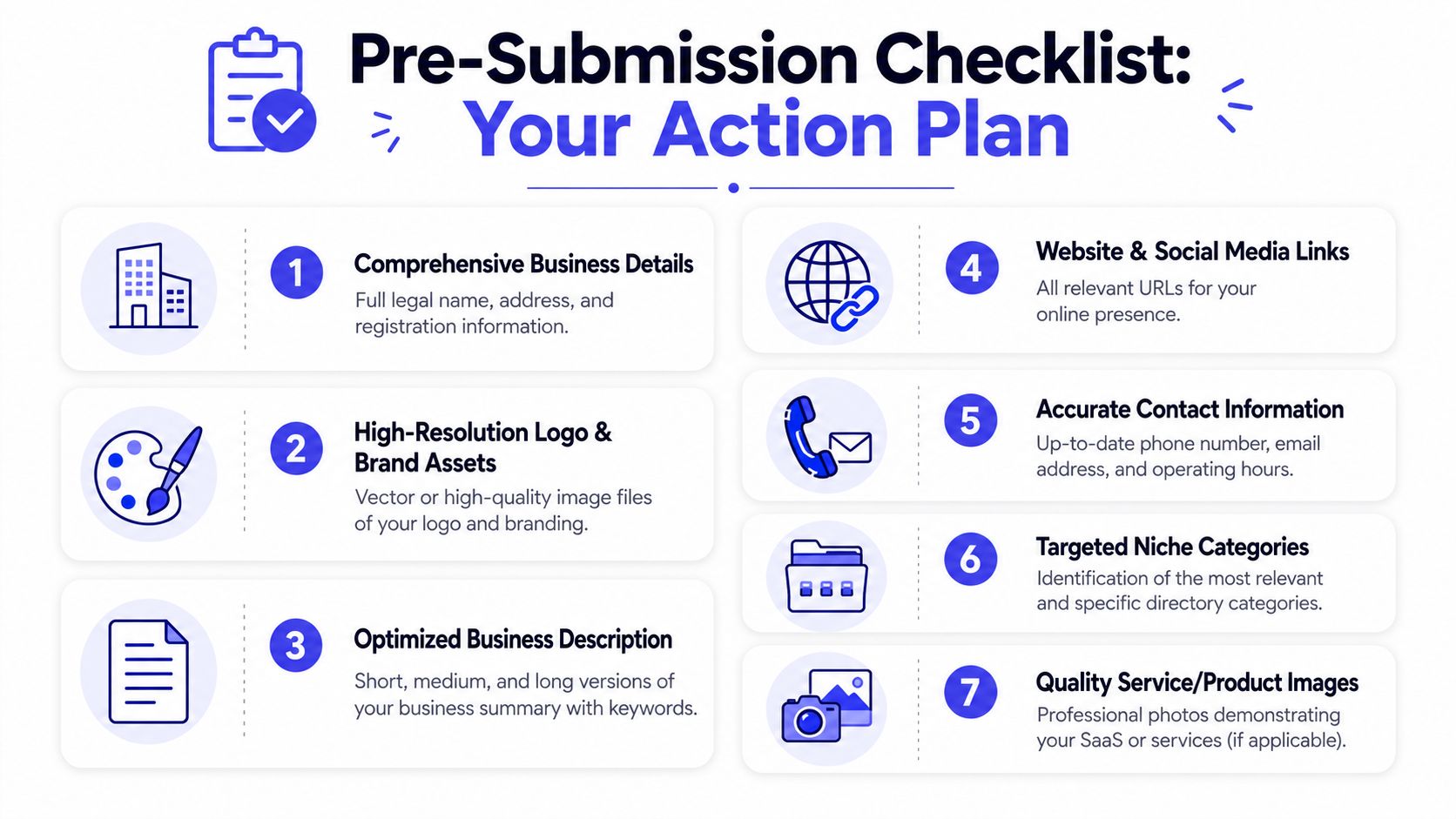
Gather these assets before you start
Company basics
Final legal or public-facing business name, website URL, launch status, and contact email.Brand files
Use a clean logo, square logo variant, favicon, and at least one product screenshot.Three versions of your description
Write a short, medium, and longer summary. That makes it easier to fit different directory forms without stuffing the same paragraph everywhere.Category and keyword inputs
Define your core use case. "AI tool" is too vague. "AI sales call assistant for B2B teams" is usable.Founder's social and company profiles
Gather LinkedIn, X, GitHub, YouTube, or demo links if relevant.
Write your positioning once, then adapt it
One thing I'd strongly recommend is creating a simple source-of-truth doc before any listings go live.
Include:
- One-sentence positioning
- Who it's for
- Main problem solved
- Top features
- Primary category
- Secondary categories
- Call to action
That document prevents the drift that happens when descriptions get rewritten from memory across dozens of platforms.
Keep the profile believable
Don't oversell the company in directory copy. Founders often try to sound bigger than they are. That usually hurts more than it helps.
If you're early, say what the product does clearly, show the interface well, and keep your messaging consistent. A modest but credible profile converts better than a flashy one full of claims you can't support.
If you want to hand the repetitive work off once your materials are ready, StartupSubmit is one option for manual submission across startup and software directories.
A practical next step is simple: prepare your company description doc, gather your logo and product screenshots, make sure your contact details are consistent, and then choose a service that can show you exactly where it will submit, how it handles moderation, and what report you'll receive at the end.