LLM Visibility Optimization: A Complete Startup Guide
A top-ranking page can lose 34.5% of its average click-through rate when a Google AI Overview appears, based on Ahrefs' analysis of 300,000 informational keywords. Ahrefs later reported an even steeper decline across a larger measurement window, with top-ranking-page CTR 58% lower when an AI Overview appeared. Ahrefs' click study makes the strategic shift hard to ignore: ranking still matters, but being selected and cited inside the answer may matter more.
For SaaS founders, this changes the job. Buyers increasingly ask Google AI Overviews, ChatGPT, and Perplexity to define categories, compare vendors, explain integrations, and recommend tools before they visit a company website. A page can rank well and still lose the moment because the answer engine resolves the buyer's question without requiring a click.
AI answer optimization is the discipline built for that environment. It combines startup SEO, SaaS SEO, entity clarity, structured content, authoritative backlinks, directory listings, and measurement that tracks answer presence rather than rankings alone.
Why Blue Links Are No Longer the Whole Game
Pew's March 2025 panel study of 900 U.S. adults found that users clicked a traditional result 8% of the time when an AI summary appeared, compared with 15% without one. Users clicked a link inside the AI summary only 1% of the time. Pew's search behavior analysis is reflected in the verified findings summarized by Ahrefs, and it points to a blunt reality for SaaS teams: the answer layer can absorb demand before a prospect reaches the organic results.
The old SEO win condition was straightforward. Reach position one, earn the click, and convert the visitor on your site. AI search breaks that sequence by placing interpretation before navigation. The model decides which sources support the answer, summarizes the category, and may mention vendors without sending the user to any of them.
The new search result is an answer with evidence
Ahrefs found that position-one CTR for keywords with AI Overviews fell from 0.073 in March 2024 to 0.026 in March 2025. A later Ahrefs update reported a decline from 0.073 in December 2023 to 0.016 in December 2025 across its larger analysis window. These figures aren't interchangeable, because the study windows differ, but both show why SaaS marketers can't treat organic rank as the complete visibility picture.
| Metric | Traditional SERP | AI Overview SERP |
|---|---|---|
| Traditional result click behavior | 15% | 8% |
| Link clicked inside the AI summary | Not applicable | 1% |
| Position-one CTR in Ahrefs' earlier window | 0.073 | 0.026 |
A SaaS buyer asking “best customer feedback tools for B2B teams” may never inspect ten blue links. They may ask follow-up questions in ChatGPT, check cited sources in Perplexity, or compare the vendors named by Google. Your product needs to appear in that conversation with an accurate category, a clear use case, and evidence that the model can safely reuse.
Three implications for startup marketing
- Discoverability is mediated by language models. Search intent now includes conversational prompts, product comparisons, and category explanations rather than isolated keywords.
- Citations become a new form of top placement. A source inside the answer can influence consideration even when the prospect doesn't click immediately.
- Brand mentions can assist pipeline. A prospect may encounter your name in an answer, return through branded search, and convert through a later direct session. That path requires clean attribution, not assumptions.
Off-site presence becomes relevant. A consistent profile on a startup directory, review site, or software marketplace can support the entity signals that answer engines use when they decide whether a young company is real, relevant, and worth mentioning. A manual startup directory submission service can be one part of that footprint, but it won't compensate for a confusing product description or weak evidence.
Practical rule: Treat every important page as both a destination for people and a potential evidence block for an answer engine.
What AI Answer Optimization Actually Means
AI answer optimization is the practice of making a brand, its content, and its supporting evidence easier for answer engines to retrieve, trust, and cite. It overlaps with traditional SEO, but its optimization unit is often a claim, definition, comparison, or product relationship rather than an entire page.
A useful analogy is a library. Retrieval is the librarian finding the right shelf. Ranking is choosing which book to pull. Citation is selecting the passage that can be quoted or attributed in the answer. Entities tell the librarian what the book, author, subject, and relationships are.
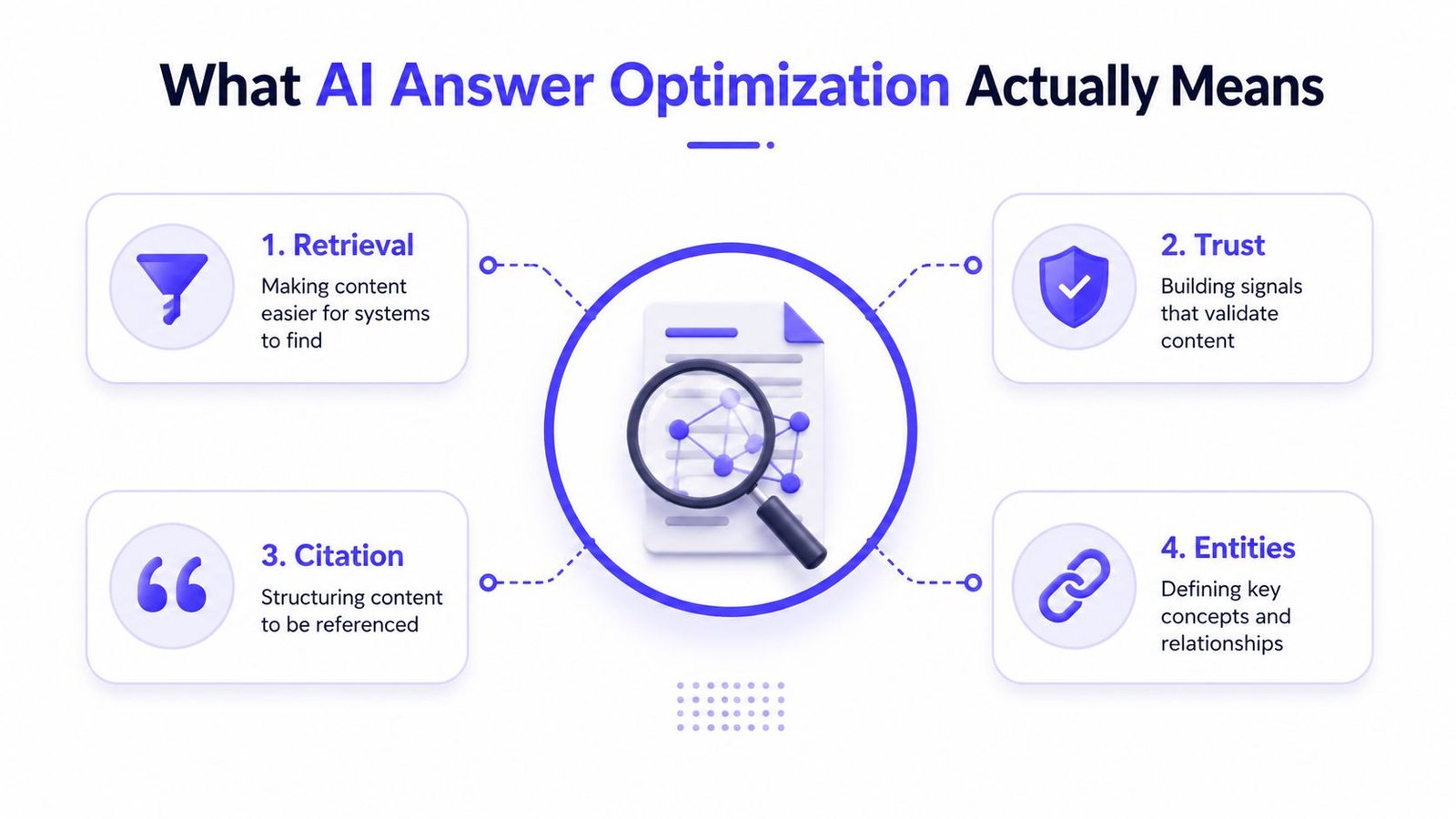
Retrieval, trust, and citation solve different problems
A page can rank for a keyword and still provide poor citation material. If its definition is buried, its pricing is absent, or its product category changes from paragraph to paragraph, the model has less usable evidence.
The reverse problem also occurs. A concise, well-written explanation on an unknown or weakly corroborated domain may be semantically relevant, but the answer engine may choose a source with stronger authority signals. Good AEO therefore needs both extractable content and credible context.
A 252,000-trial citation study found that topical relevance and list position were the strongest predictors of whether a source was cited first. The same study found that explicit pricing and a recent timestamp improved citation likelihood across all six tested models, while formatting had negligible impact. The study's published findings support a practical priority order: match the question, state important facts clearly, keep them current, and place them where retrieval systems can find them.
How AEO relates to LLM SEO and GEO
The terminology overlaps:
- Answer engine optimization, or AEO, focuses on being selected and cited in direct answers.
- LLM SEO usually describes visibility across large language models, including their web-connected and memory-based experiences.
- Generative engine optimization, or GEO, is the broader practice of influencing generated responses across AI search products.
- AI search optimization is the plain-language umbrella term many startup teams use internally.
The distinction matters less than the operating model. For SaaS buyers, the central problem is often entity-level clarity. The model needs to understand that your company, product, category, integrations, audience, and alternatives belong together. Formatting helps, but it can't repair contradictory identity signals.
How AI Overviews, ChatGPT, and Perplexity Pick Sources
Google AI Overviews, ChatGPT, and Perplexity don't expose an identical source-selection process, so a single AEO tactic won't perform consistently across all three. Google tends to connect its answer layer to search infrastructure and established authority signals. ChatGPT and Perplexity can surface a broader mix of editorial pages, community discussions, reviews, and fresh sources depending on the prompt and browsing mode.
A recent measurement study describes Google AI Overviews as narrowing roughly 200 to 500 candidate documents down to about 5 to 15 cited sources through semantic retrieval, authority filtering, language-model reranking, and data fusion. The study of Google AI Overview source selection frames citation as a mechanics problem. Your page must be crawlable and relevant, but it also has to survive filtering and final selection.
| Signal | Google AI Overviews | ChatGPT with web | Perplexity |
|---|---|---|---|
| Core advantage | Search visibility, entity context, trusted sources | Broad web footprint and useful cited pages | Fresh, diverse sources with claim-level citations |
| Strong prompt fit | Definitions, categories, comparisons | Explanations, recommendations, research tasks | Comparisons, current research, niche questions |
| Useful evidence | Clear pages, recognized entities, third-party corroboration | Editorial mentions, discussions, reviews, linked references | Recent pages, review platforms, multiple independent sources |
| Founder priority | Strengthen SEO and entity consistency | Build a recognizable footprint beyond owned media | Publish specific, current, well-sourced answers |
Match the surface to the buyer's prompt
A buyer asking “What is usage-based billing?” may trigger a different source pattern from someone asking “Which usage-based billing platform works with Stripe?” Definitions often reward clean explanatory pages. Comparisons need explicit alternatives, pricing context, integrations, and limitations. How-to prompts need procedural passages that can stand alone when extracted.
For a deeper explanation of the search implications, AutoSEO's guide to what Google's AI Overview means for SEO offers useful context on how the answer layer changes the role of organic visibility.
Don't build one generic “AI-friendly” template and expect uniform results. Google inclusion may depend heavily on conventional search strength and entity confidence, while Perplexity may reward a niche review page that Google overlooks. ChatGPT may reflect the wider web footprint of your brand, including editorial references and public discussions.
AEO is a portfolio of surface-aware bets, not a single checklist.
Core Levers That Move AI Citations
Four levers give SaaS teams the most control over citation eligibility: entity clarity, structured metadata, authoritative mentions, and prompt-aligned content. They reinforce one another, but they solve different failure modes.
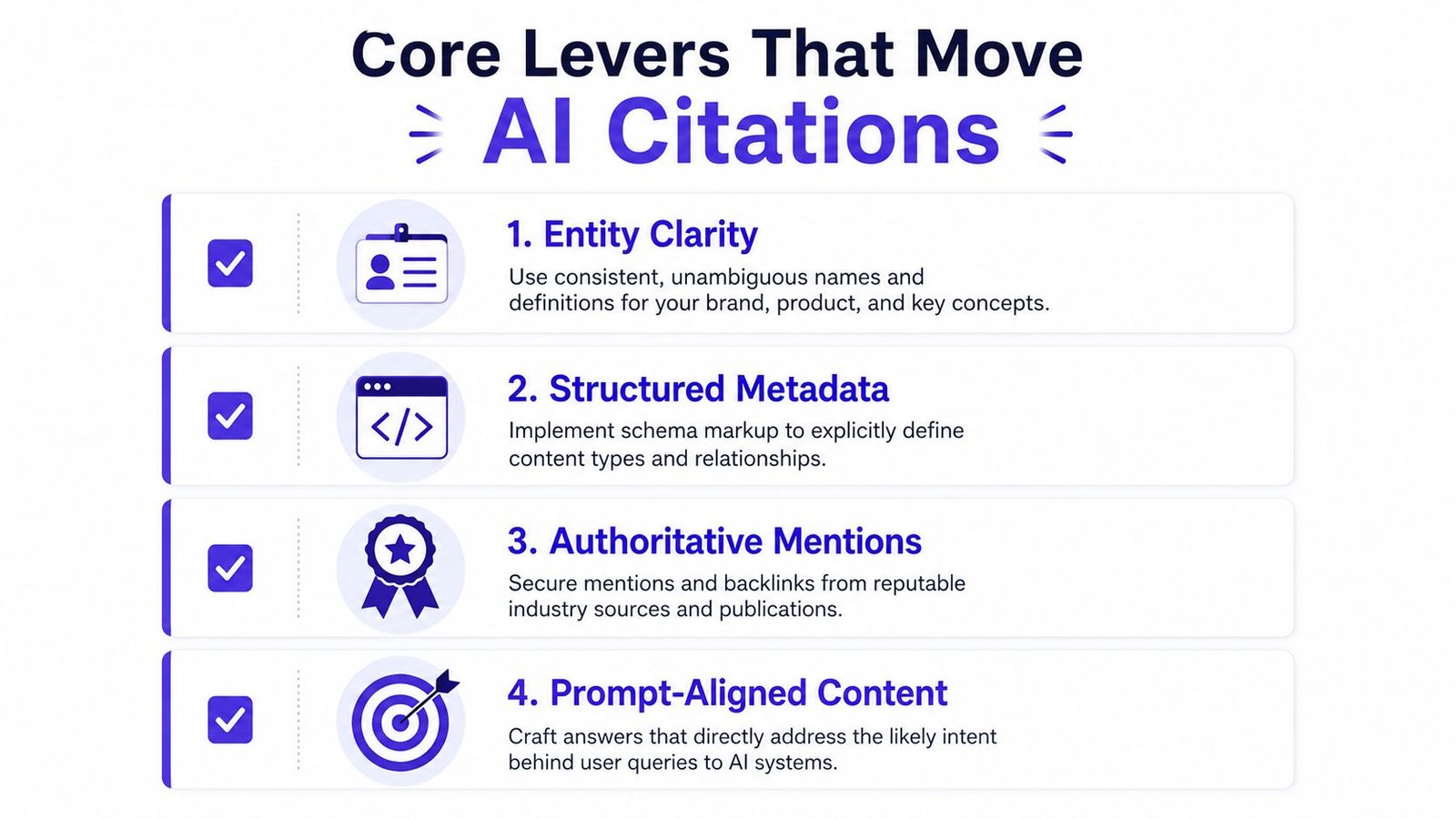
Start with one unambiguous entity
Use one canonical company name, product name, logo, short description, category, target user, and relationship to the parent company. Repeat those facts consistently across your website, LinkedIn, G2, Capterra, Product Hunt, Crunchbase, and relevant startup directories.
Don't describe a product as “an AI workspace,” “a collaborative operating system,” and “a knowledge automation platform” on three different profiles unless those labels explain the same category. Ambiguity makes it harder for retrieval systems to connect mentions.
Give machines a map
Use Organization, Product, and relevant FAQPage structured data where the visible page content supports it. Schema doesn't manufacture authority, and it shouldn't be used to mark up claims users can't see. Its value is clearer classification and relationships, especially when a page contains product facts, FAQs, or organization details.
A benchmark on automated citation generation found that richer page metadata improved citation quality. Adding title and abstract information uniformly improved citation generation for indirect queries across public and proprietary language models. The metadata retrieval research reinforces a point founders often miss: passage quality matters, but page-level context helps the system understand what that passage belongs to.
Earn evidence outside your domain
Ten internal articles won't always beat one authoritative third-party mention. Review sites, comparison pages, software directories, founder interviews, and industry publications can corroborate your category and product claims where your own website can't.
For a focused execution option, StartupSubmit's AI directory submission service describes manual placement work for startup and software directories. Treat directory submission as evidence-building, not a substitute for product-market clarity.
Write for actual prompts
Build pages around questions buyers ask:
- Definition: What does the product category mean, and who needs it?
- Comparison: How does your product differ from named alternatives?
- Evaluation: What integrations, pricing model, limitations, and implementation requirements matter?
- How-to: What steps should a team follow, and which tools support them?
Lead with a self-contained answer, then add qualification and detail. Comparison tables work when they state the comparison criteria plainly. Unsupported superlatives, vague “next-generation” language, and buried product facts waste writing time.
A founder's one-hour audit
- Entity check: Compare the company and product descriptions across owned and third-party profiles.
- Retrieval check: Search priority pages for clear definitions, headings, internal links, and crawlable HTML.
- Evidence check: List claims that need independent support or citations.
- Prompt check: Run real category, comparison, and integration prompts through several answer engines.
- Measurement check: Record whether the brand appears, which page is cited, and how the answer describes it.
Listings, Reviews, and Third-Party Trust Signals
A startup's off-site footprint often determines whether an answer engine can corroborate its identity. G2 and Capterra can validate software category and use case. Product Hunt can reinforce launch context. Crunchbase and LinkedIn can support company identity. Industry articles and comparison platforms can connect the product to a market narrative.
Independent citation-pattern research found that review and comparison platforms accounted for 22% of citations in one AI Overview dataset, with G2 and Capterra named among the key examples. Another source reported that about a third of AI Overview responses cited a review platform, particularly for B2B software. The citation-pattern research gives SaaS founders a practical warning: the homepage isn't the only page representing the company.
Treat every listing as an entity record
A listing should answer the same questions everywhere:
| Platform | Signal AI engines extract | Highest-leverage field | Cadence |
|---|---|---|---|
| G2 | Category, buyer feedback, use case | Product category and review detail | Review regularly |
| Capterra | Software classification and alternatives | Category, pricing context, integrations | Review regularly |
| Product Hunt | Launch identity and positioning | One clear product description | Update after major changes |
| Crunchbase | Company identity and business context | Company name, website, category | Update when facts change |
| Founder, company, and product relationship | Canonical company description | Update after rebrand or repositioning |
The fields that matter most are usually practical: category, target user, integrations, pricing band, use case, and alternatives. If one profile calls the product a CRM and another calls it a data warehouse, the conflict creates friction for both buyers and retrieval systems.
A directory campaign should also include duplicate checks. Multiple abandoned profiles with different descriptions dilute the entity instead of strengthening it. Manual directory submission work for startups can include categorization and duplicate review, but your team still needs to supply the canonical positioning.
A worked example without vanity metrics
Suppose a workflow automation startup appears under “developer tools” on one platform and “marketing automation” on another. The founders consolidate the category tags, close duplicate Capterra entries, standardize the product description, and add missing integration details. They then monitor the same buyer prompts in Perplexity before and after the cleanup.
The useful outcome isn't a dramatic inclusion claim that can't be verified. It's a clearer diagnostic: if the product begins appearing with the correct category and fewer conflicting descriptions, the entity work likely removed a retrieval obstacle. Review velocity and sentiment can influence which sources feel safer to cite, but founders should validate that assumption through prompt logs rather than treating reviews as an automatic ranking factor.
Measuring AI Visibility Beyond Rankings
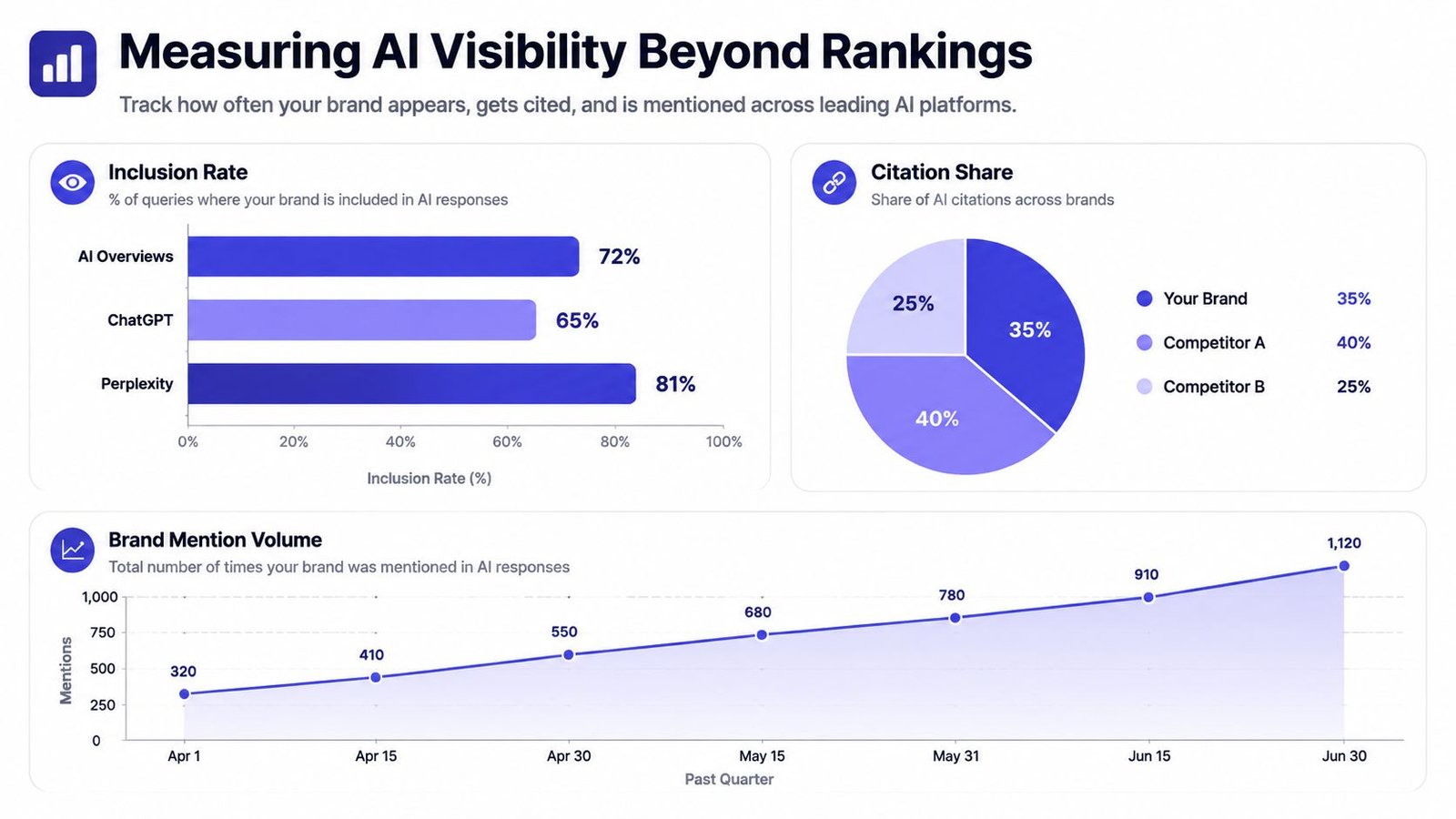
AEO needs a KPI stack that answers five separate questions: Did the brand appear? Was it cited? How did the answer frame it? Did anyone visit? Did the exposure assist conversion? Rankings alone can't answer those questions, especially when AI summaries reduce traditional clicks.
Pew's July 2025 analysis found that users clicked a traditional result 8% of the time when an AI summary appeared, compared with 15% without one. The same analysis found that 26% ended the session after seeing an AI summary, compared with 16% without one. The measurement discussion and source context show why traffic loss shouldn't be interpreted as visibility loss without checking answer presence.
Build a dashboard that drives decisions
| Metric | What to record | Decision it should drive |
|---|---|---|
| Inclusion rate | Prompts where the brand appears in the answer | Whether the entity is discoverable |
| Citation share | Brand citations compared with named competitors | Whether authority or coverage is weak |
| Answer sentiment | Positive, neutral, negative, or missing | Whether positioning needs correction |
| AI-referred traffic quality | Landing page, engagement, and UTM-tagged sessions | Whether citations attract useful visitors |
| Assisted conversions | Leads or opportunities influenced by AI exposure | Whether visibility contributes to pipeline |
Sample 30 to 50 buyer prompts weekly, using the same wording across Google AI Overviews where available, ChatGPT, and Perplexity. Log the answer, cited URLs, competitor mentions, product description, sentiment category, and any factual errors. Consistency matters more than pretending the observations are perfectly comparable across products.
Use GA4 to inspect referral traffic from answer surfaces, and add UTM parameters wherever your distribution workflow allows them. For assisted conversions, compare self-reported attribution, first-touch data, and CRM notes. Don't force every lead into an AI channel because the buyer says they used ChatGPT.
What not to measure yet
Avoid a vanity “share of voice” number without prompt context or revenue relevance. Mention volume can rise while the model describes the product incorrectly. Citation count can increase through low-intent informational prompts that never influence a buying decision.
A useful directory framework for startup visibility can support the off-site evidence layer, but the dashboard should connect listings to answer presence and downstream outcomes. If inclusion rises but sentiment stays negative, fix positioning. If sentiment is positive but citations remain absent, improve evidence and page retrieval. If citations rise but qualified traffic doesn't, revisit prompt selection and conversion paths.
A 90-Day AEO Roadmap for SaaS Founders
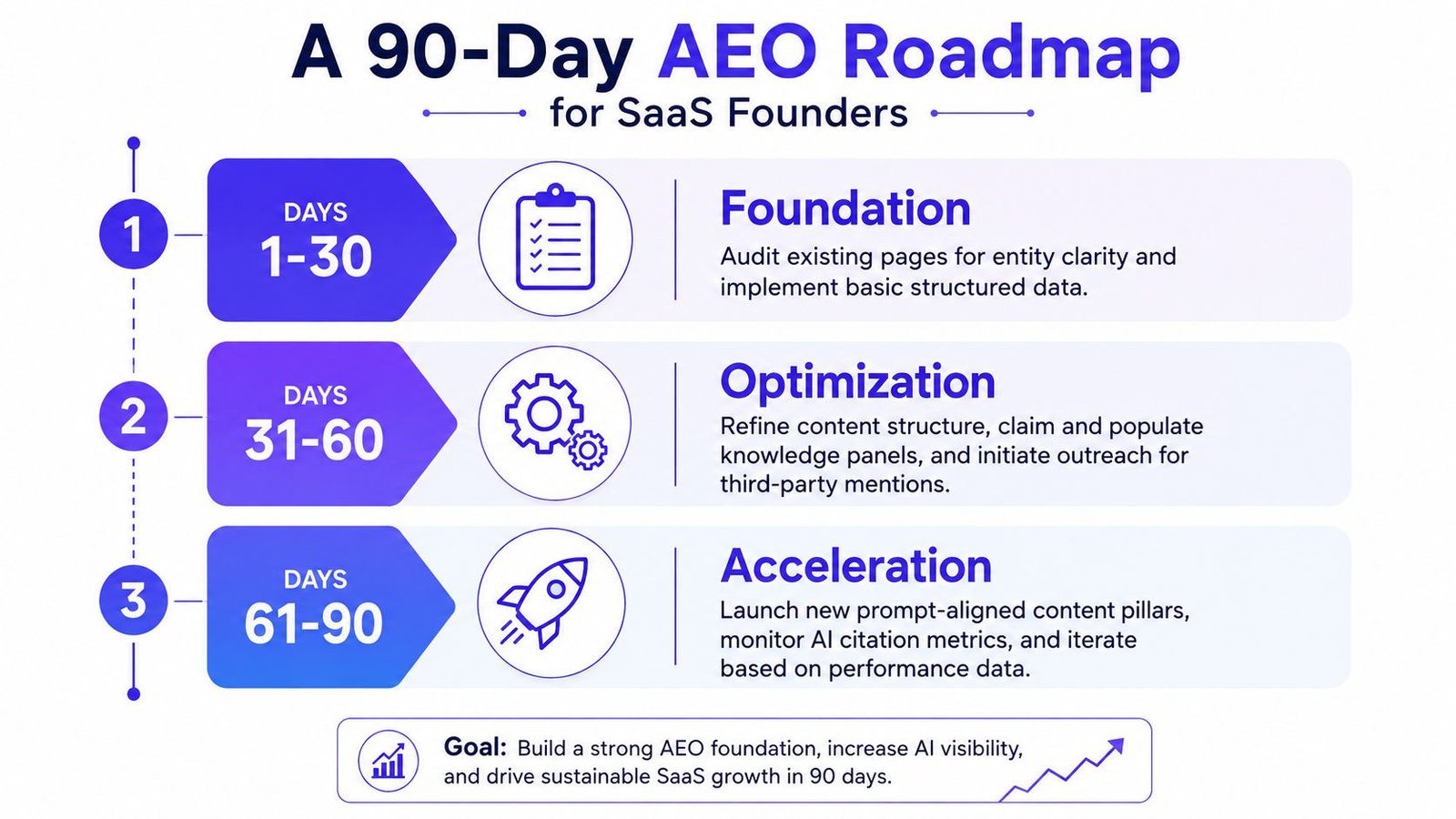
A founder-marketer and a fractional writer can ship a credible AEO program without rebuilding the site or hiring an agency. The sequence should move from identity cleanup, to citation-ready content, to measurement and iteration.
Days 1 to 30 build the foundation
Start with an inventory of pages and profiles. Mark every inconsistent company name, product description, category, integration list, pricing reference, and founder relationship. Choose a canonical version and update the website, G2, Capterra, Product Hunt, Crunchbase, and LinkedIn.
Add Organization, Product, and FAQPage schema to priority URLs where the visible content supports those types. Check that important information exists in crawlable HTML rather than only in images, PDFs, or interface elements that may not render reliably.
Create a baseline prompt set covering:
- Category questions: What is the product category, and which teams need it?
- Comparison questions: Which alternatives should a buyer consider?
- Use-case questions: How does the product solve a specific workflow?
- Trust questions: Is the company credible, established, or suitable for a particular buyer?
End each Friday with a short dashboard review. Record what changed, not just what appeared.
Days 31 to 60 make pages quotable
Rewrite high-value comparison and how-to pages so each section opens with a direct answer. Add explicit product facts, limitations, integrations, audience definitions, and source links. Create a statistics layer only from claims your team can verify and maintain.
Build content around prompt clusters rather than keyword lists. A page titled “Best customer onboarding tools” needs evaluation criteria and alternatives. A page titled “How to reduce onboarding friction” needs an actionable process and clear tool relationships.
Pitch two to three authoritative listicles during this phase, but don't buy indiscriminate links or submit to every low-quality directory. Relevance and editorial review matter more than raw volume. A data-driven directory analysis reported an average gain of 4.7 DA points over 90 days for domains with 11 to 40 editorially reviewed directory citations, compared with 1.9 points for a comparable group with no directory citations. The directory authority analysis provides directional evidence for curated placements, not a guarantee for every startup.
Days 61 to 90 operationalize the loop
Instrument AI referral tracking in GA4, run the weekly prompt sample, and classify each answer as positive, neutral, negative, or missing. Compare the cited page with the page you expected to earn the citation. When a page receives impressions or conventional traffic but never appears in answers, inspect its entity context, claim structure, freshness, and external corroboration.
Use SaaS directory submission support as one possible way to standardize third-party profiles during this phase, alongside direct review requests, founder-led outreach, and useful editorial contributions. Keep the Friday review to one page. If a tactic doesn't improve inclusion, citation quality, answer accuracy, or qualified downstream action within the cycle, pause it and test a different lever.
The fastest AEO programs don't publish more by default. They remove ambiguity, add evidence, and measure what the answer engines actually use.
StartupSubmit offers manual submission and profile management across startup, SaaS, and software directories, with duplicate checking, categorization, and a final report of submitted URLs and acceptance details. If your AEO work is blocked by an inconsistent off-site footprint, visit StartupSubmit and review whether its directory placements fit your entity and citation strategy.