
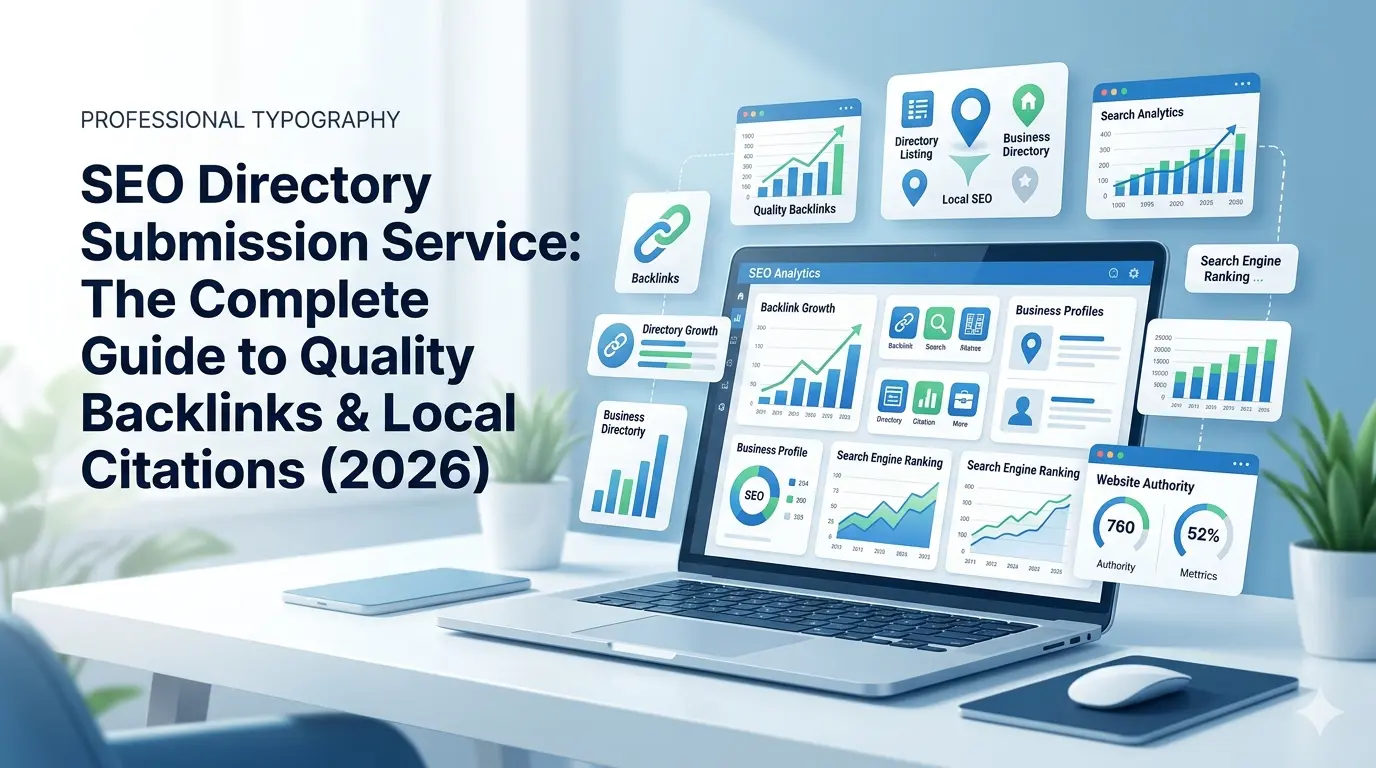
SEO Directory Submission Service: The Complete Guide to Quality Backlinks & Local Citations (2026)
Author James Written by an SEO specialist with 10+ years of experience in off-page SEO, citation building, and local search optimization. All strategies reflect current Google guidelines and 2026 industry data.
What Is an SEO Directory Submission Service?
An SEO directory submission service is a professional service that submits your website’s information name, URL, description, and category to high-authority online directories to build backlinks, create local citations, and improve search engine visibility.
Directory submission is one of the oldest off-page SEO techniques still in active use today. It involves submitting your website’s core details to an online directory a curated platform that organizes websites and businesses by category, industry, or location.
While directory submission has evolved significantly since the early 2000s, the real SEO benefit today comes from citations with correct business information listed across reputable directories like Google Business Profile or Yelp, rather than simply collecting links in bulk.
Why Directory Submission Still Matters in 2026
A common question business owners ask is whether directory submission for Search Engine Optimization is outdated. The data-backed answer is clear: directory submission for SEO absolutely still works, but only if you approach it strategically — focusing on a smaller number of high-quality directories rather than mass submissions.
The Three Core Benefits
1. Backlink Acquisition Each approved listing creates a backlink pointing to your website. Search engines like Google use backlinks as trust signals — each link from a reputable site tells Google that your site deserves more credibility.
2. Faster Search Engine Indexing Search engine crawlers frequently visit popular directories because they update regularly, so when you list your site in a reputable directory, Googlebot often discovers that URL much faster than if it were sitting alone waiting to be crawled. This is especially valuable for new websites.
3. Local Citation & Trust Building A strong business listing helps people trust your brand, keeps your brand details consistent across the web, builds mentions, brings referral traffic, and helps people find your business in search and AI tools.
Directory Submission vs. Link Building: Understanding the Relationship
Directory submission is a specific tactic that sits underneath the broader umbrella of Link Building, which itself is a core pillar of Off-Page SEO.
| Concept | Definition |
| Off-Page SEO | All optimization activities that happen outside your own website to improve rankings |
| Link Building | The practice of acquiring backlinks from other websites |
| Directory Submission | A specific link building method using structured online directories |
| Citation Building | A specialized form of directory submission focused on local business data (NAP) rather than just links |
Understanding this hierarchy helps clarify why directory submission alone is not a complete SEO strategy — it cannot replace content, links from real websites, digital PR, brand mentions, or technical SEO, but it does help support trust, diversity, and discoverability.
Backlinks From Directories: Dofollow vs. Nofollow
When a business directory submission is approved, the resulting link can be either a dofollow link or a nofollow link.
Dofollow Link Passes direct ranking authority (link equity) from the directory’s Domain Authority to your website. These are the most valuable links from an SEO standpoint.
Nofollow Link Does not pass direct ranking signals to Google, but still provides real value. Even nofollow links from high-DR sites provide value through referral traffic and brand visibility, though the direct SEO impact is smaller.
Why This Matters for Strategy
Don’t dismiss directories simply because they offer nofollow links. A nofollow listing on a high-traffic, high-authority platform (like Yelp or Bing Places for Business) can still drive meaningful referral traffic and reinforce your business’s legitimacy in Google’s eyes.
Citation Building & NAP Consistency: The Local SEO Connection
For businesses targeting Local SEO, directory submission shifts from being primarily about links to being primarily about citation building.
What Is NAP Consistency?
NAP stands for Name, Address, and Phone Number. NAP needs to appear identically across every directory listing, citation, and business profile your company owns. When your NAP data is consistent across Google Business Profile, Yelp, Bing Places, and other directories, Google gains confidence in your business’s legitimacy and rewards you with higher local pack rankings.
Why NAP Consistency Is Non-Negotiable
Even a small inconsistency — “St.” vs. “Street,” or an outdated phone number — can weaken your local citation profile. Google cross-references this data across the web to verify your business is real and operating at the location you claim.
Best Practices for NAP Consistency:
- Create a single source-of-truth document with your exact business name, address, and phone format
- Use this exact format across every business listing — never vary spelling, abbreviations, or punctuation
- Audit existing listings quarterly and correct any discrepancies immediately
- Update all platforms simultaneously if your business moves or changes its phone number
The Most Important Directories for Business Listings
Not all online directories carry equal weight. Strategic citation building means prioritizing platforms that genuinely influence local and organic search visibility.
Tier 1: Essential Local Platforms
Google Business Profile The single most important citation for any local business. It directly powers your appearance in Google’s Local Pack and Google Maps results. These citations may not provide dofollow links, but they help Google confirm that your business is legitimate and the location is real.
Yelp A high-authority review and business listing platform that strongly influences local trust signals, particularly for service-based and hospitality businesses.
Bing Places for Business Bing’s equivalent to Google Business Profile. While Bing holds a smaller search market share, it remains an important citation source, especially since AI-powered search tools increasingly pull data from Bing’s index.
Foursquare Originally a check-in app, Foursquare’s underlying location database now powers numerous other apps and services, making it a valuable foundational citation.
Yellow Pages One of the longest-standing business directories, still carrying meaningful Domain Authority and serving as a trusted, recognizable citation source.
Tier 2: Industry & General Directories
High-authority directories like Yelp, Yellow Pages, Foursquare, Hotfrog, and Bing Places carry strong Domain Authority scores, making them safe, reliable choices for both link building and citation purposes.
Manual Directory Submission vs. Automated Tools
One of the most important decisions in any SEO citation service is choosing between manual and automated submission methods.
Manual Directory Submission
Manual directory submission offers precision and control. It allows experts to craft unique, tailored listings, choose the most relevant categories, and maintain editorial quality, reducing the risk of spam penalties and ensuring long-term SEO value. However, it’s time-consuming and costly, making it ideal only for a few high-authority directories that truly move the SEO needle.
Automated Submission: Two Very Different Categories
It’s critical to distinguish between two types of automation:
High-Risk Automation (Mass Scrapers) Tools that blast submissions to thousands of random directories are risky, outdated, and likely to trigger Google penalties.
Low-Risk Automation (Citation Aggregators) Trusted citation aggregator services focus on data accuracy rather than link building. They distribute and maintain consistent NAP data across reputable local platforms, saving time and reducing manual effort.
Which Should You Choose?
| Approach | Best For | Risk Level |
| Manual Submission | High-authority, niche-relevant directories | Low |
| Citation Aggregators | Maintaining NAP consistency at scale | Low |
| Mass Automated Tools | Avoid entirely | High |
How to Avoid Google Penalties From Directory Submission
Directory submission carries genuine SEO risk if done carelessly. Understanding what triggers penalties protects your investment.
What Triggers a Penalty
If you submit your website to 500 random directories with low Domain Rating scores, you are building exactly the kind of unnatural link profile that triggers algorithmic penalties. Google’s spam-detection systems are specifically designed to identify this pattern.
Some directories have high spam scores that will impact your site and can cause a drop in ranking. Before submitting your site, always check the directory’s spam score using tools like Moz, since links from spammy directories can hurt your Google rankings.
Reciprocal Link Directories: A Hidden Risk
Directories that ask for a reciprocal link in exchange for a listing act like link farms in many cases. These directories offer very little real SEO value with a high risk of Google penalties.
Safe Directory Submission Checklist
- ✅ Check the directory’s spam score before submitting
- ✅ Avoid directories requiring reciprocal links
- ✅ Choose the most relevant category — never force-fit your listing
- ✅ Write a unique description for every submission (never duplicate content)
- ✅ Prioritize quality over quantity — 30-50 strong directories beats 500 weak ones
- ✅ Maintain a diverse backlink profile beyond directories alone
Off-Page SEO Services: Where Directory Submission Fits
A comprehensive Off-Page SEO Services package should treat directory submission as one component among several, not a standalone strategy.
Building a Balanced Off-Page Strategy
When you treat directory submission as part of a long-term, well-rounded off-page SEO strategy — alongside content marketing, editorial link building, and consistent local citation management — it delivers compounding results that hold up over time.
A balanced off-page SEO approach includes:
- Strategic directory listing service submissions (30-50 high-quality platforms)
- Editorial backlinks through guest posting and digital PR
- Ongoing local citation building and NAP audits
- Business profile creation on platforms relevant to your industry
- Brand mention monitoring and link reclamation
Measuring the ROI of Directory Submission
To justify investment in an SEO citation service, track these specific metrics:
Key Metrics to Monitor
Domain Authority Movement SaaS products that submit to 30-50 quality directories typically see Domain Rating lifts of 5-15 points over 3-6 months. Track this using Ahrefs, Semrush, or Moz before and after your submission campaign.
Local Pack Rankings Monitor your Google Business Profile rankings and local pack positions before and after a structured directory submission campaign to see measurable movement.
Referral Traffic Track visitors arriving directly from directory listings using Google Analytics. High-traffic platforms like Yelp can send meaningful direct visitors, independent of any SEO value.
Search Engine Indexing Speed For new websites or new pages, monitor how quickly Google indexes URLs that were first discovered through a directory listing versus pages with no external links pointing to them.
Realistic Expectations
Directory listings usually create foundational backlinks that sit near the base of your link profile. They are not the kind of links that move a tough keyword from page three to page one by themselves. Instead, they help support trust, diversity, and discoverability.
Who Benefits Most From a Directory Submission Service
This tactic usually helps local businesses, startups, agencies, SaaS tools, professional service firms, and smaller ecommerce brands that need a broader web presence. It is especially useful when the brand has little off-page footprint and needs more discoverability.
Conversely, it is less useful when treated as a shortcut by brands that already have strong authority but weak content or poor site quality — no directory campaign can fix a weak website.
Best-Fit Scenarios for Directory Submission Services
- New local businesses establishing their first citations (Google Business Profile, Yelp, Bing Places)
- Startups with minimal existing backlink profiles
- Multi-location businesses needing consistent NAP across dozens of listings
- Service-based businesses relying heavily on local search visibility
- E-commerce brands expanding into niche, industry-specific directories
Step-by-Step: How a Professional Directory Submission Works
Step 1 — Audit Current Citations Identify existing listings across the web, checking for NAP inconsistencies, duplicate listings, and outdated information.
Step 2 — Build a Source-of-Truth Document Create a master file with your exact business name, address, phone number, website URL, category, short description, and long description — version-controlled for consistency.
Step 3 — Prioritize Directories by Tier Rank target directories: Tier 1 (Google Business Profile, Yelp, Bing Places, Foursquare, Yellow Pages), Tier 2 (relevant industry-specific directories), Tier 3 (smaller, well-vetted general directories).
Step 4 — Submit With Unique Descriptions Write a distinct description for each submission. Duplicate content across listings weakens their individual value and can appear manipulative.
Step 5 — Verify and Monitor Confirm each listing goes live, check for accuracy after publication, and revisit quarterly to update any changed business information.
Step 6 — Track Results Monitor Domain Authority changes, local pack rankings, referral traffic, and indexing speed over a 3-6 month period.
Frequently Asked Questions (FAQ)
Is directory submission still effective for SEO in 2026?
Yes. Directory submission sites still have a place in SEO, but only when used with care they are not a magic trick or a shortcut, and should never be spammed at scale. Focused on quality, relevant directories, it remains a valuable foundational tactic.
What’s the difference between directory submission and citation building?
Directory submission is the broader practice of listing your website on online directories, primarily for backlinks. Citation building is a specialized subset focused specifically on consistent local business data (NAP) across platforms like Google Business Profile and Yelp, aimed at improving local search rankings rather than just acquiring links.
How many directories should I submit to?
Quality matters far more than quantity. Most successful campaigns focus on 30-50 carefully selected, high-authority, relevant directories rather than hundreds of low-quality ones.
Can directory submission hurt my SEO?
Yes, if done incorrectly. Submitting to spammy directories, using reciprocal link directories, or mass submitting through automated scraper tools can trigger algorithmic penalties from Google’s spam-detection systems.
Do nofollow links from directories still have value?
Yes. While they don’t pass direct link equity, nofollow links from high-authority, high-traffic directories still provide referral traffic, brand visibility, and contribute to your business’s overall trust signals.
How long does it take to see results from directory submission?
Most businesses see measurable improvements in Domain Authority and local rankings within 3-6 months of a structured, quality-focused submission campaign.
Conclusion
A professional SEO directory submission service remains a relevant and valuable component of modern Search Engine Optimization — but only when executed with discipline. The strategy has shifted decisively away from mass, low-quality submissions toward a selective approach centered on citation building, NAP consistency, and genuine Domain Authority.
When integrated into a broader off-page SEO strategy alongside content marketing and editorial link building, directory submission strengthens your business listing footprint across platforms like Google Business Profile, Yelp, Bing Places for Business, Foursquare, and Yellow Pages — building the kind of consistent, verifiable online presence that both search engines and customers trust.
The brands that succeed with directory submission in 2026 are not the ones submitting everywhere. They are the ones submitting selectively, accurately, and consistently — treating every business profile creation as an opportunity to reinforce legitimacy, not just collect another link.





I just could not go away your web site prior to suggesting
that I actually enjoyed the standard information a person supply for your visitors?
Is gonna be back ceaselessly in order to investigate cross-check
new posts
Premier EBONY PORN
websites provide premium content for mature audiences. Explore trusted
sources for quality and privacy.