
What Is Directory Submission? A 2026 SEO Guide
You had a launch. Product Hunt sent a burst of traffic. A few people signed up, a few friends shared it, and your analytics finally looked alive.
Then the next day arrived.
Traffic dropped, branded search stayed flat, and most of the pages ranking for your category were still review sites, software directories, and company profiles you hadn't claimed yet. That's the moment most founders realize launch buzz isn't distribution. It's a spark. If you want durable visibility, you need assets that stay live, get indexed, and keep sending trust signals long after launch week ends.
That's where directory submissions matter. Not as a gimmick. Not as a bulk SEO trick from the early 2000s. Used correctly, they give a young SaaS company a broader digital footprint across places buyers already search, compare, and validate vendors. They also help shape what people see when they Google your brand, check alternatives, or look for proof that your product is real.
Founders usually come to this late. They've already spent time on launch threads, content, or outreach, then realize they still haven't built a stable layer of profiles around the brand. If that's where you are, a manual directory workflow is one of the cleanest ways to fix the gap. For a concise overview of what a managed workflow looks like in practice, this about page for StartupSubmit gives a useful reference point.
Table of Contents
- Beyond the Launch Day Spike
- Adopting a Quality Over Quantity Strategy
- Preparing Your Submission Toolkit
- Executing the Manual Submission Workflow
- Tracking Timelines and Measuring SEO Impact
- DIY vs Managed Service When to Get Help
- Conclusion Your Next Steps
Beyond the Launch Day Spike
You launch on a Tuesday, traffic jumps, signups come in, and Slack stays busy for half a day. By Friday, the spike is gone. What remains is what shows up when someone searches your company name, compares you to alternatives, or tries to verify that your product is real.
That is the job directory submissions need to do.
A strong directory program extends the life of launch attention by turning a short burst of interest into durable visibility. Profiles on Product Hunt, Crunchbase, G2, SaaSHub, AlternativeTo, and credible niche directories can keep ranking for branded searches, category terms, and comparison queries long after the launch post stops getting clicks. They also give your company more indexed pages that you control indirectly, which matters when your own site is still young.
I do not treat this as a one-time promotion task. I treat it as search surface area. If a founder wants the practical workflow behind that approach, the StartupSubmit team and process overview lays out the kind of manual system that keeps submissions organized instead of turning them into random admin work.
The payoff is broader than backlinks. A good listing helps with discovery, yes, but it also supports trust. Buyers check third-party profiles. Investors do it. Journalists and potential hires do it too. A search result page filled only with your own pages looks thin. A page that also includes respected profiles looks established.
Practical rule: Submit anywhere a real prospect might discover, compare, or validate your product. Skip directories that exist only to host low-value listings.
There is also a timing advantage here. Launch day gives you attention. Directory pages give you persistence. They can send referral traffic months later, appear in "best alternatives" research, and reinforce category relevance while your main site is still building authority.
This work is not glamorous. It does compound.
A durable post-launch submission strategy usually supports four things:
- Brand validation: Prospects can confirm your company across known platforms.
- Ongoing discovery: You appear where users browse categories and alternatives.
- Search support: Credible profiles strengthen entity consistency and can add useful referral links.
- Reputation control: You have more influence over what ranks for your brand.
One more inside-baseball point. Distribution is not limited to classic startup directories. If your product has an open-source angle, developer audience, or public repo, a github free promotion tool can help extend visibility in a channel that attracts a different kind of searcher than a standard business listing.
The mistake is treating directory work like cleanup after launch. The better play is to build it into the post-launch workflow, then judge each submission by whether it improves visibility, trust, or qualified discovery over time.
Adopting a Quality Over Quantity Strategy
A founder submits to 60 directories in a weekend, sees a spreadsheet full of green checkmarks, and assumes the job is done. Three months later, almost none of those listings send traffic, several never indexed, and a few sit on pages you would not want associated with the brand. The problem was never effort. The problem was picking directories by count instead of by expected return.
Why mass submission stopped working
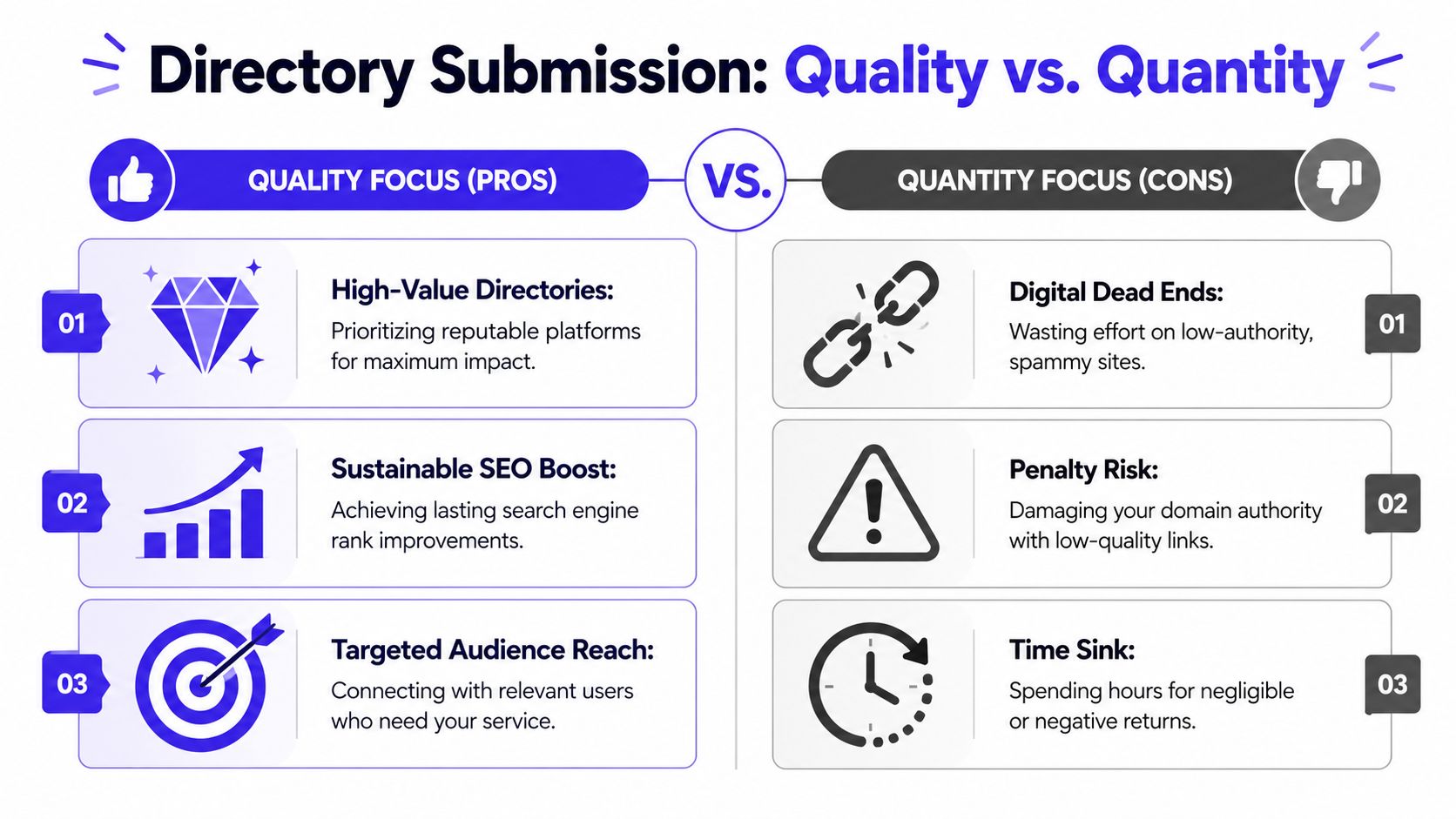
Directory submissions still work when the listing appears on a site that real buyers, reviewers, investors, or partners already use. They stop working when the directory exists only to sell placements or publish thin profile pages with no audience and no standards.
Analysts at Smol Launch's directory strategy roundup found that a small set of high-authority, audience-aligned directories often produces better ROI than broad submission campaigns. That tracks with what I see in live campaigns. A strong profile on Product Hunt, Crunchbase, G2, Capterra, or a niche directory people in your category browse can justify the effort. A weak listing on a low-trust directory usually creates one of two outcomes. Nothing happens, or you create a backlink cleanup task for later.
Selectivity also improves operations. Good directories have some editorial friction. They reject vague copy, thin profiles, and inconsistent company details. That slows you down in the short term, but it is usually a good sign. If a site will publish anything with a URL field, it rarely earns attention from serious users or search engines.
Good directory work looks selective from the outside because it is selective on purpose.
If you're also building trust around reviews, tools like ZenX Testimonials can help keep review collection and reputation signals organized alongside your listing strategy. Directory visibility works better when prospects can also find current proof that customers trust the product.
For a simple explanation of why a curated submission approach works better than a bulk one, this directory submission benefits overview is a useful companion.
How to vet a directory in minutes
The fastest filter is commercial intent plus page quality. Open the directory, click three category pages, then click five company profiles. If the site helps a buyer compare tools, understand categories, or validate vendors, keep evaluating it. If every page looks auto-generated, loaded with ads, or abandoned, skip it.
Use these checks:
- Audience fit: Identify the actual user. Buyers, founders, developers, investors, procurement teams, or local customers. Relevance beats raw domain metrics.
- Editorial standards: Check whether listings are reviewed, categorized properly, and written for humans. Light moderation is better than none.
- Search visibility: Search Google for the directory's brand plus a category term. If category and listing pages are indexed, the site has at least some organic footprint.
- Listing quality: Read a handful of profiles. Strong directories tend to have screenshots, categories, pricing context, reviews, or comparison data.
- Neighborhood quality: Look at the companies listed beside you. Bad company weakens trust, even if the directory itself has decent authority.
- Maintenance signals: Check dates, active social links, current branding, and whether the site still approves new submissions. Dead directories waste follow-up time.
I also use one blunt question before I submit anywhere: would I be comfortable sending a prospect to this profile page during a sales process? If the answer is no, the listing has no business in the campaign.
That standard cuts a lot of junk. It also helps decide where manual effort belongs. Top-tier directories deserve polished copy, screenshots, review seeding, and follow-up. Mid-tier niche sites deserve a lighter version of the same package. Everything else goes into the discard pile.
Preparing Your Submission Toolkit
Manual submission gets slow when you build every listing from scratch. It gets fast when you prepare once and reuse everything.
The best operators create a single folder and one master document before they touch any submission form. That removes the worst kind of friction. Hunting down the square logo. Rewriting the same short description. Wondering which version of the tagline is the “real” one. Those tiny delays are why submissions drag on for days.

Build one folder before you submit anywhere
Set up a shared folder with subfolders for logos, screenshots, founder photos, brand copy, and proof assets. Then create a master submission sheet that holds your approved text variants.
This matters more than many teams realize. Common submission failures come from sloppy preparation. According to SubmitSaaS's directory submission guide, 65% of directory rejections stem from NAP mismatches or missing UVPs, and profiles that lack screenshots or clear CTAs see 50% lower user engagement and review conversion.
That tells you two things. First, consistency isn't cosmetic. It affects whether a listing goes live at all. Second, incomplete profiles don't just look weaker. They perform worse once approved.
What goes in the kit
Your toolkit should include:
- Company identity: Exact company name, website URL, support email, and any business details you'll use consistently.
- Core positioning: One-line tagline, short description, and a longer description with room to adapt by directory type.
- Value proposition variants: A few versions for startup directories, software directories, review sites, and niche communities.
- Visual assets: Horizontal logo, square logo, favicon, product screenshots, founder headshot, and a simple product graphic if you have one.
- Social proof assets: Review links, short testimonial snippets if you have permission, launch mentions, and demo video URL.
- CTA library: “Start free,” “Book demo,” “Try the product,” and any supporting landing page URLs.
- Tag and category list: Your preferred categories, secondary categories, and keywords you're comfortable using repeatedly.
Field note: Most founders don't get rejected because their product is weak. They get rejected because their profile looks unfinished or inconsistent.
One useful add-on is a lightweight publishing workflow for side assets, especially if you use GitHub as part of your brand presence. A tool like github free promotion tool can help support that broader visibility layer without forcing you to rebuild the same promotional setup every time.
Two final rules keep the toolkit clean:
- Lock the canonical brand details. If your name, URL, or company description changes every few submissions, you'll create inconsistency fast.
- Don't copy the exact same long description everywhere. Keep the facts consistent, but adjust the framing to fit the audience and moderation style of each directory.
Executing the Manual Submission Workflow
A bad submission run usually starts the same way. Someone opens ten tabs, copies the same description into every form, guesses at categories, and calls it done. Two weeks later, half the listings are still pending, one links to the wrong page, and another went live with an outdated logo.
Manual submission works when the process is tight.
The goal is not to submit everywhere as fast as possible. The goal is to get accurate listings live on the directories that can send referral traffic, branded search visibility, or a worthwhile backlink. That means working in a fixed order, using the same source of truth, and leaving a trail your team can audit later.
Build the queue before you submit anything
Start with a working list of directories that already passed your quality filter. Then sort them into three buckets:
- Foundational profiles with high trust or strong branded search visibility
- Priority industry directories that match your product category and buyer
- Long-tail niche sites that are only worth the time once the first two groups are clean
That order saves time because each approved listing becomes a reference point for the next one. Reviewers often check whether your product looks real, active, and consistent across the web. If your earlier profiles are incomplete or contradictory, later approvals get harder.
For local businesses or companies with location pages, citation-heavy work belongs in its own stream. LocalHQ's platform for citations is relevant there because local directory work has different QA rules than SaaS or startup listing sites.
Run each submission the same way
A reliable operator does not improvise field by field. They follow a checklist.
Open the directory. Scan the form once. Confirm whether it is free, moderated, paid, or requires an account. Then map the fields to your toolkit before typing anything. That sounds slow, but it prevents the rework that eats these campaigns.
A solid manual pass looks like this:
- Confirm the canonical URL and destination page before pasting anything
- Choose one primary category, then add a secondary one only if it is clearly supported
- Adapt the description to the directory's audience and tone
- Upload screenshots that show the product in use
- Fill optional reviewer notes if the directory provides them
- Save the submitted copy or final live URL in your tracker immediately
The reviewer note is underused. A single sentence such as "Customer support platform for Shopify stores, best listed under Help Desk rather than Live Chat" can prevent a weak category match and speed up approval.
Handle field variation without creating inconsistency
Directories ask for different things, but the patterns repeat. The trick is to standardize your answers by field type, not by site.
| Form element | What to do |
|---|---|
| Short tagline | Keep one approved version that fits tight character limits |
| Long description | Use a base draft, then change the opening and audience framing |
| Categories | Pick the narrowest accurate fit first |
| Pricing field | Keep a clean, current summary ready |
| Founding story | Use a short version with no fluff |
| Screenshots | Lead with the clearest product-use image |
The main trade-off is consistency versus relevance. If every listing uses identical copy, you save time but increase the odds of sounding generic or tripping moderation filters. If every listing gets fully custom copy, quality can improve, but throughput drops and teams start introducing factual drift. The middle ground works best. Keep the facts fixed, then adapt the framing.
Use moderator judgment, not submission volume
Directories like BetaList, SaaSHub, startup galleries, and niche communities all have different tolerance for marketing language. Some accept polished copy. Others reject anything that reads like an ad.
Write for approval first. Clear beats clever.
If a form asks for a pitch, explain the product in plain English. If it asks for keywords, use the terms a buyer would search. If it asks for a founder bio, keep it factual and short. The goal is to reduce reviewer doubt. Every extra claim, vague buzzword, or inflated category choice gives a moderator another reason to pause.
Later in the workflow, it helps to watch another team's interface or process just to calibrate expectations. This walkthrough gives that kind of context:
Know when to keep it manual and when to use a service
Founders usually underestimate the labor here. Fifty decent submissions can take hours of focused work once account creation, email verification, formatting quirks, and moderation follow-ups are included.
Do it in-house if you have a tight list, a stable positioning, and someone who can judge category fit well. Use a service if the opportunity cost is higher than the submission cost, or if the team keeps stalling after the first ten. For teams comparing costs, the manual submission service pricing is a practical benchmark for what this work is worth when handled as a repeatable process rather than ad hoc admin.
Speed matters less than control. Clean submissions, saved records, and consistent reviewer-facing copy beat a rushed blast every time.
Tracking Timelines and Measuring SEO Impact
A directory campaign usually looks fine on submission day. Then the actual work starts. Listings sit in review, some go live with the wrong category, some publish without the link you asked for, and some never get indexed at all. If you are not tracking those outcomes, you cannot tell the difference between activity and impact.
Use a simple tracker with one row per directory. A spreadsheet is enough if it helps you answer three questions: Did the listing go live, did it link to the right page, and did anything useful happen after that?
What to track after you click submit
Track these fields for every submission:
- Directory name
- Submission date
- Profile URL
- Status
- Approval date
- Live link verified
- Category used
- Primary landing page linked
- Notes from moderators
- Referral or visibility observations
The landing page column matters more than teams expect. Homepage links are fine for brand coverage. Feature pages can support category intent. Comparison or use-case pages often make more sense if the directory audience is evaluating options. If you do not record that detail, you cannot look back later and see which page type benefited.
Once a listing is approved, verify it by hand.
- Is the listing live and public?
- Is the business information correct?
- Does the link point to the intended page?
- Does the page appear in search after indexing?
This step catches the insidious mistakes that kill ROI. I have seen listings go live with broken URLs, nofollowed profile links where a followed link was expected, and weak category placement that buried the profile where no one would find it. Approval alone is not the win. A correct, visible, indexed listing is the win.
When results usually show up
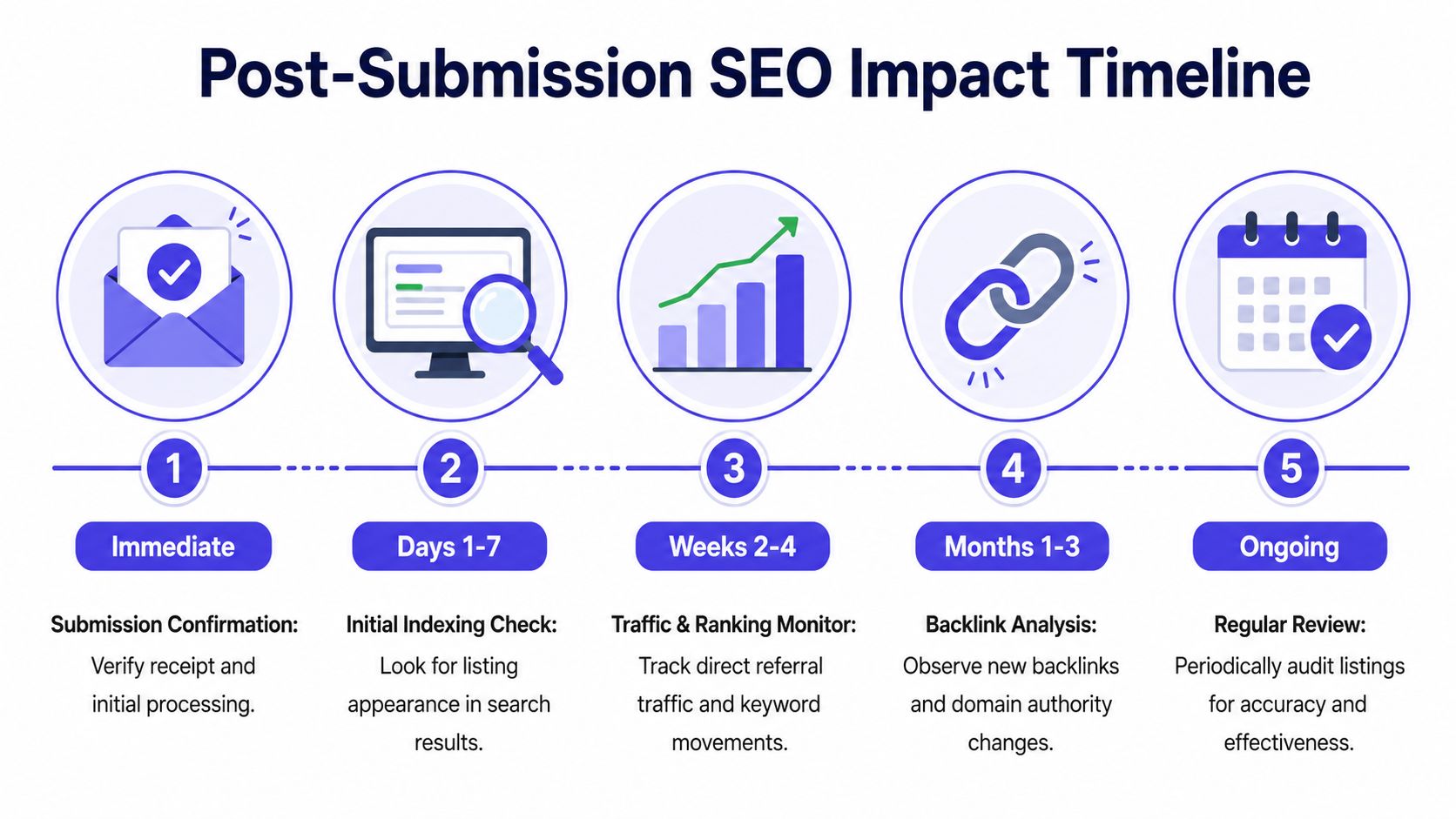
Directory SEO rarely behaves like paid acquisition. You do not submit on Tuesday and get a clean causal result by Friday. The sequence is slower: approval, publication, crawl, indexing, then any downstream effect on branded search visibility, referral traffic, or page-level rankings.
A practical review cadence looks like this:
- First week: Confirm submission status, approvals, and any moderator requests.
- First month: Check which listings are live, indexed, and linking to the right destination.
- Next review window: Look for changes in referring domains, branded SERP coverage, and movement on the pages that received those links.
Patience matters, but vague waiting does not help. Review on a schedule and compare the results against a baseline from before the campaign. Watch Search Console for impressions and queries on linked pages. Watch analytics for referral visits from the stronger directories. Watch your backlink tool for whether the profile page is being counted as a referring domain.
Direct signups are only one outcome. Some directories send qualified traffic. Others mostly strengthen your brand footprint in search. Others are useful because they add another legitimate citation and link source to the profile of your site. A good tracker makes those roles visible, which helps you decide what to keep, what to stop, and what to outsource next time.
DIY vs Managed Service When to Get Help
Founders usually don't need help because directory forms are complicated. They need help because repetitive, detail-sensitive work keeps getting deprioritized.
That creates a genuine trade-off. DIY gives you full control and low out-of-pocket cost. A managed manual service saves time and usually improves consistency. Automated bots promise scale, but they often create the exact quality problems you're trying to avoid.
Where DIY makes sense
DIY is the right choice when you have a small target list, a clean submission kit, and someone on the team who can own the work carefully.
It's a solid fit if:
- You only need a curated set: A handful of strong directories is manageable in-house.
- Your messaging is still changing: Direct control helps while positioning is in flux.
- You want to learn the ecosystem: Early manual work teaches you which platforms matter in your category.
When a managed workflow is worth it
If your team keeps delaying submissions, outsourcing the task can be rational. Manual services exist because the work is repetitive, error-prone, and easy to leave half-finished.
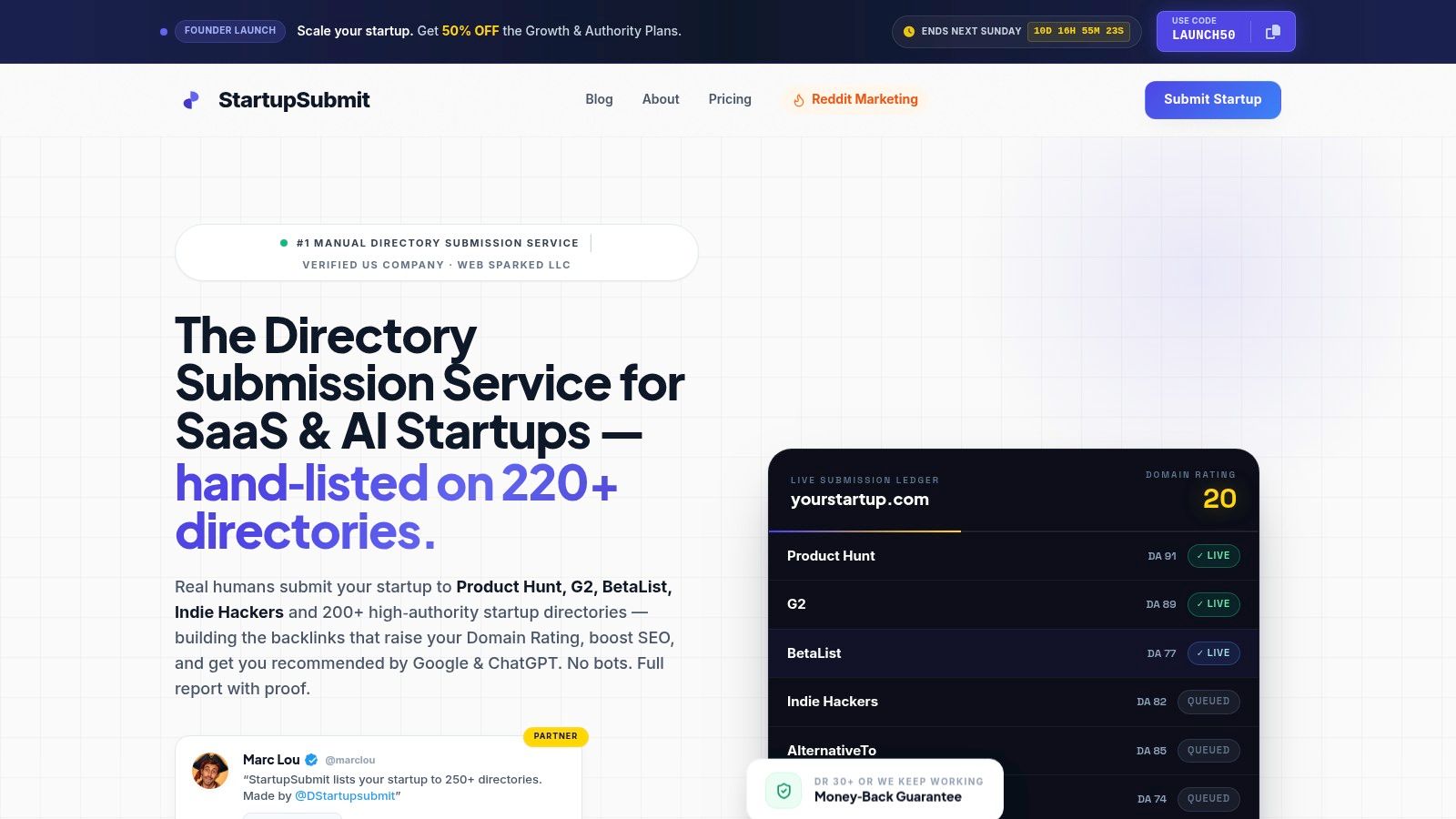
For example, some founders use a manual submission provider such as StartupSubmit, which handles submissions across a vetted directory set and reports back with live placements and notes. If you're comparing service scope or budget against your own available time, the StartupSubmit pricing page is a practical reference.
For local and citation-heavy businesses, a specialized workflow can matter too. In that context, LocalHQ's platform for citations is a relevant example of a more citation-focused option.
Here's the clean comparison:
Directory Submission Approach Comparison
| Factor | DIY Approach | Managed Manual Service | Automated Bots |
|---|---|---|---|
| Time investment | High. Someone has to prepare assets, fill forms, follow up, and track approvals | Lower for the internal team after onboarding | Low at the start, but cleanup can get expensive in time |
| Cost | Lower direct spend | Higher direct spend | Usually lower upfront than managed service |
| Quality control | High if the owner is careful | Often strong when the provider uses a manual workflow | Usually inconsistent |
| Acceptance odds | Good on a curated list if details are accurate | Good when the service understands moderation patterns | Weaker on reviewed directories |
| Brand consistency | Depends on discipline | Usually steadier across many listings | Often poor |
| Best use case | Early-stage team with time and a short target list | Founder-led team that needs leverage | Almost never for serious brand-building |
Outsource when the work is operationally important but strategically routine. Keep it in-house when the learning itself is still valuable.
The wrong move is not DIY. The wrong move is pretending you'll do it manually, then leaving half your profiles incomplete for months.
Conclusion Your Next Steps
If you want to submit to directories in a way that helps SEO, trust, and discovery, the playbook is straightforward.
Pick fewer directories. Vet them hard. Prepare your assets before touching any forms. Submit manually with category-specific positioning. Then track what goes live and give the work enough time to compound.
That approach solves the actual problem most founders have after launch. Not lack of exposure for one day. Lack of durable presence after the attention fades.
The highest-return habit here is discipline. Clean data. Consistent profiles. Relevant categories. Good screenshots. Real follow-through. That's what separates a useful directory campaign from a pile of weak listings nobody visits and search engines barely value.
You can start this yourself today with a spreadsheet and a submission kit. That's the right move if you have the time to stay consistent and the patience to do the work properly.
If you don't, don't default to bots. Either shrink the target list and do it well, or hand the task to a manual service that can execute the process cleanly while you stay focused on product, customers, and sales.
If you'd rather skip the repetitive submission work and use a manual process instead, StartupSubmit handles directory listings for SaaS and AI startups across vetted platforms, with reporting that makes the placements easy to review and track internally.