Directory Link Building: Boost Your Startup SEO
Directory links get mocked because many use them badly. They spray a startup across low-quality lists, repeat the same bio everywhere, and then act surprised when nothing moves. That's not directory link building, that's sloppy distribution.
Used properly, directories are a practical trust-building layer for a new SaaS or AI product. They help populate branded search results, create clean citation trails, and give Google, customers, and investors a few obvious places to verify that your company is real. In the startup world, that matters more than the old “link juice” framing that is still commonly repeated.
The strongest directory work is curated, not massive. A tight set of relevant profiles beats a pile of junk submissions, especially when the goal is to support startup SEO, SaaS SEO, and AI search visibility without wasting founder time.
Why Most Startups Get Directory Links Wrong
Most founders hear “directory submissions” and think of spam. That reaction makes sense, because a lot of directory work still looks like it was designed to game search engines in 2012. The core mistake, though, is assuming all directory placement is equal.
A better way to think about it is foundational visibility. A startup's first directory profiles often become the first third-party proof points that show up when someone searches the brand name. That can matter for startup marketing, investor diligence, customer trust, and the clean-up job of filling page one with profiles you control. If you're launching a new SaaS or AI tool, those listings can act like a credibility floor, not a growth engine by themselves.
Practical rule: if a directory feels like an internet graveyard, it probably is. If real companies maintain their profiles there, it can be worth your time.
The pricing spread in link economics explains why startups still use directories at all. A survey cited by LinkQuest says 28% of a typical SEO budget goes to link building, and the same compilation shows cost per link ranging from £61 for paid links to £950 for digital PR and £267 for guest posts (LinkQuest's link building statistics). That spread is why curated directories are often treated as a lower-cost way to earn backlinks at scale.
For early-stage teams, this is also a visibility play in a world shaped by Google AI Overview and LLM SEO. Structured listings give search systems clean company data to work with, and that can help with discoverability beyond classic rankings. If you want a fast starting point for your own shortlist, this free startup directory list is a useful place to begin.
How to Find Directories That Actually Matter
Stop collecting giant spreadsheets of random directories. The right filter set is simple, and it saves hours. A directory is worth considering only if it has real relevance, moderation, and enough authority to justify the submission work.
Score the directory before you fill anything out
A practical cutoff is Domain Authority above 30, with a sweet spot between 40 and 70. One guide warns that sources above 70 may be too selective for new businesses, so high authority alone isn't the win you think it is (Jasmine Directory guide). Relevance still matters more than vanity metrics.
Look at the directory category structure next. A good directory makes it easy to place a SaaS, AI, or B2B software company in the right lane. A bad one throws every industry into the same bucket, which usually means weak editorial standards and little user trust.
Then inspect the outbound-link environment. If a listing page is overloaded with junk or has obviously auto-approved entries, move on. You're not buying volume, you're buying placement in a place a human would use.
| Signal | What to Look For, Green Flag | What to Avoid, Red Flag |
|---|---|---|
| Authority | DA above 30, especially in the 40 to 70 range | Very low authority or inflated-looking metrics |
| Moderation | Human review, clear guidelines, active curation | Instant auto-approval or no review process |
| Relevance | SaaS, AI, startup, or software-specific categories | Generic catch-all folders with no audience fit |
| Outbound links | Clean pages with limited clutter | Spam-heavy pages with obvious link farms |
| User value | Real companies, real descriptions, active listings | Empty profiles, duplicates, broken pages |
If you want to pre-check candidate sites faster, practical scraping capabilities like those explained by MarTech Do can help you collect listing patterns without hand-copying every detail.
For startup founders, the shortlist usually starts with sites people already recognize. Product Hunt, G2, and Capterra are the obvious names because they combine discoverability with user trust. For a broader startup list, this best startup directories resource is a cleaner starting point than a random Google search.
The Manual Submission Workflow That Prevents Errors
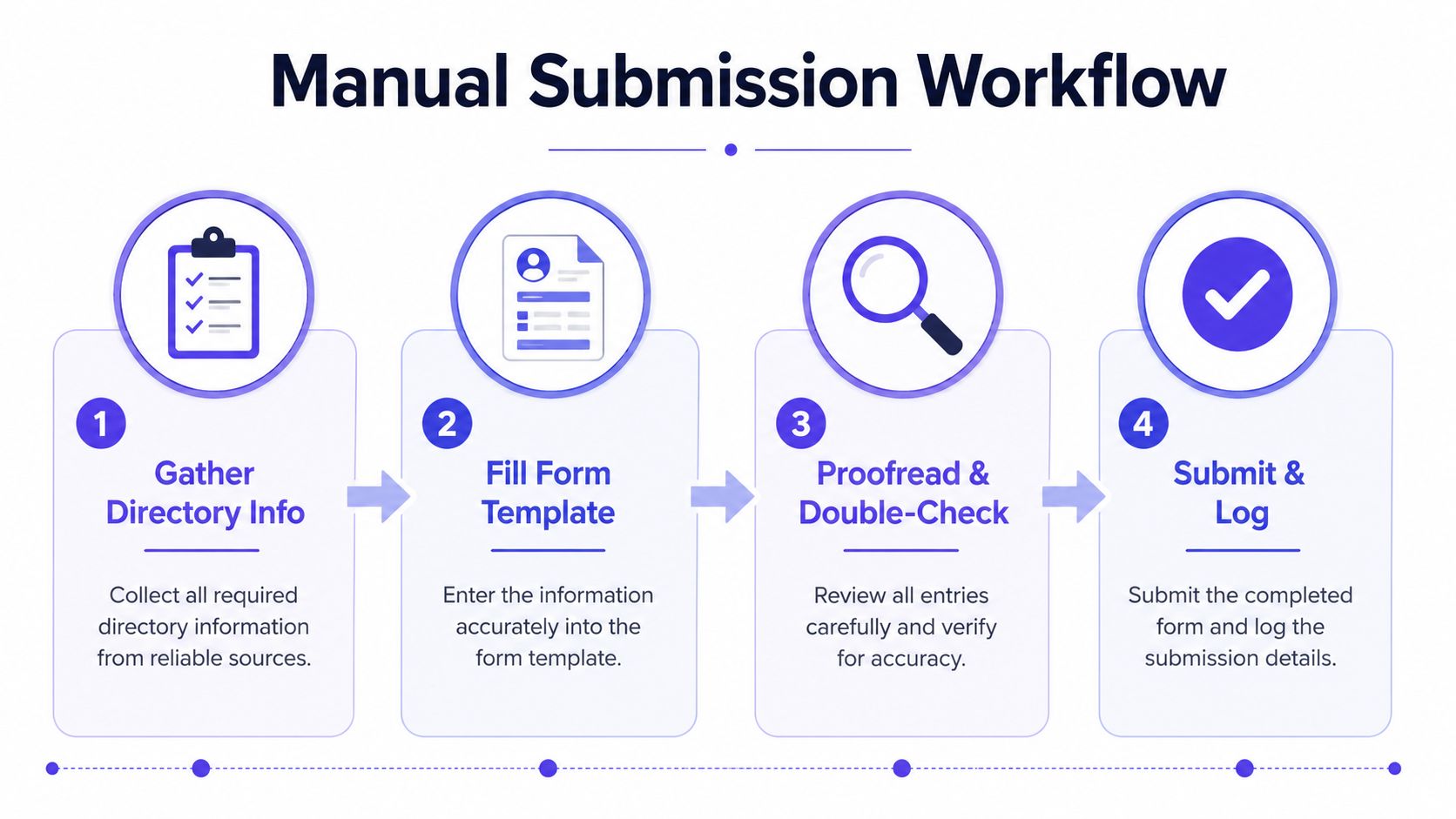
The bottleneck isn't finding directories. It's filling them out without introducing mistakes that create cleanup work later. Manual submission only works when the process is boring, repeatable, and consistent.
Before submission
Build a master sheet before you touch any form. Include your startup name, exact URL, one-line pitch, longer description, founder name, social links, logo file, and preferred category. That single source of truth keeps you from rewriting the same details badly on every platform.
Consistency isn't cosmetic. Search Engine Journal says if you use multiple business directories, every detail, name, address, descriptions, links, needs to stay accurate, on-brand, and current to avoid weakening trust signals over time (Search Engine Journal on online directories). That's especially important for startups that pivot fast or still tweak positioning every week.
Also check whether the startup is already listed. Duplicate profiles waste time and can create messy brand footprints. When I've seen founders skip this step, they usually end up with multiple half-finished entries on the same platform and no clean way to manage them later.
During submission
Write unique descriptions for the most important directories. Don't paste the same paragraph everywhere, especially on high-value platforms where a reviewer can spot duplication instantly. For niche directories, make the category choice precise, not broad.
A lot of teams also forget that different directories reward different language. A software review platform wants product utility and audience fit. A startup directory wants a concise positioning statement. If you need help tightening the copy across those variations, you can use discover more ranking keywords as a reminder to shape descriptions around the terms people search.
Don't treat the form like a checkbox exercise. Reviewers can tell when the listing was rushed, and rushed profiles get weaker approval rates in practice.
For teams that don't want founders stuck in form-filling for days, a service like StartupSubmit's directory submission service handles the repetitive work while keeping the data structure consistent. That's useful when the goal is controlled coverage instead of random mass posting.
After submission
Log what you sent, where you sent it, and which version of the copy you used. If a platform asks for edits, keep the revised text in the same record. That way, approval, indexation, and live URL tracking don't become a scavenger hunt later.
Use small batches, too. The point isn't speed, it's looking natural and avoiding the kind of duplicate-content footprint that comes from blasting the same listing across every site in one afternoon. That operational discipline is what separates a real directory link building workflow from a bulk-upload mess.
Tracking Submissions and Troubleshooting Acceptance
Submitting a directory profile without tracking it is just unpaid admin work. You can't measure ROI, spot duplicate entries, or troubleshoot rejection reasons if the status lives only in your inbox. A simple tracker fixes that.
What to track
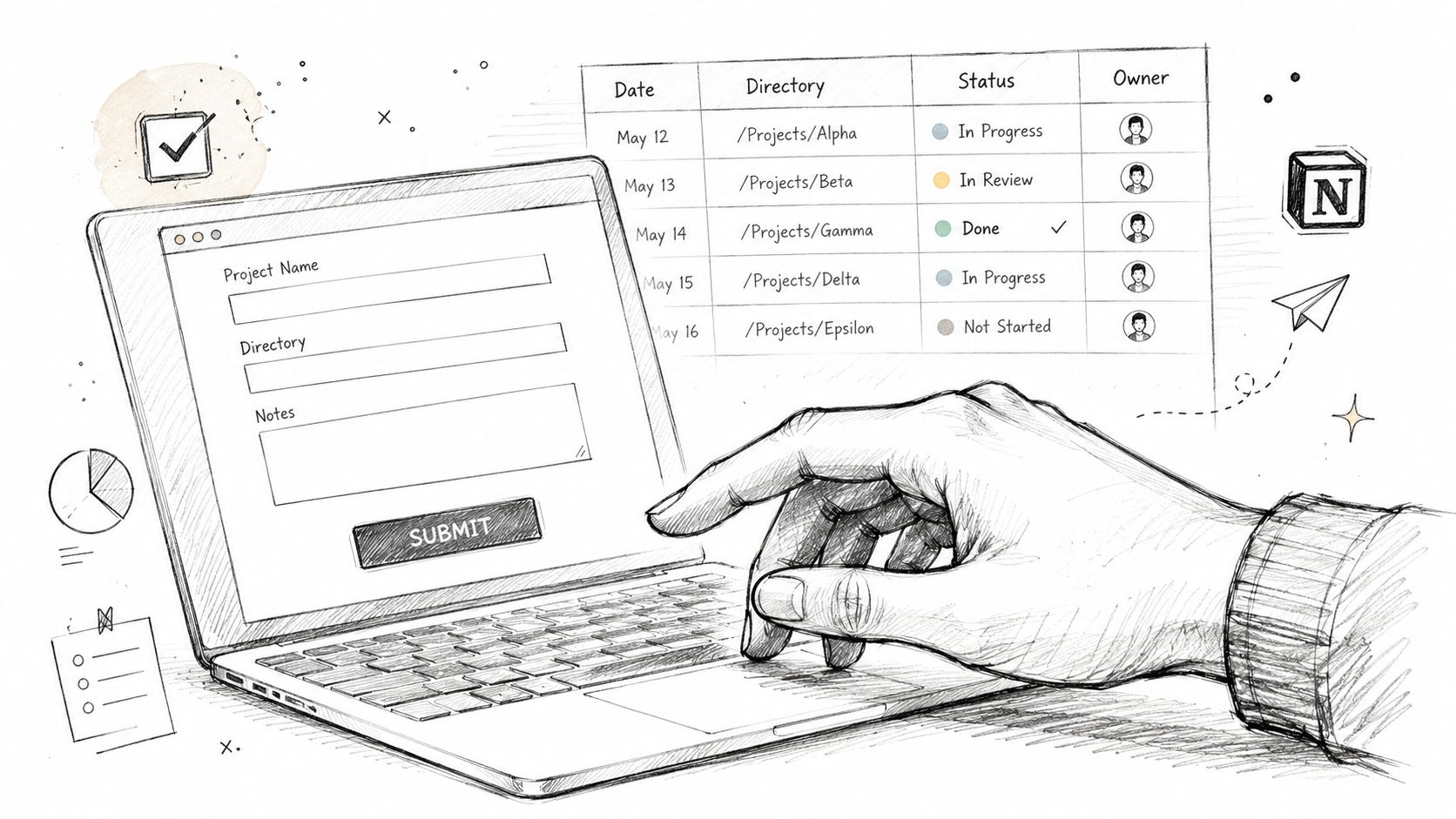
A spreadsheet or Notion board is enough. Keep columns for Directory Name, URL, Submission Date, Status, Live URL, and Notes. That gives you a clean pipeline from draft to approved.
A good status system keeps the work readable at a glance. Use simple labels like Submitted, Approved, Rejected, or Needs Revision. If the listing is approved but not yet live, note that separately so you don't confuse moderation delay with a failed submission.
Here's the part most founders miss. The tracker becomes the memory of your campaign, not just an admin file. If someone on the team later updates the brand description, you can see which directories still use the older copy and avoid mismatched branding across the web.
How to handle rejections
A rejection isn't always a dead end. First, check the directory's guidelines and compare them against what you sent. Many denials come from a wrong category, missing details, or a description that feels too promotional.
If the directory is valuable, send a short, polite follow-up asking whether the listing failed because of formatting, relevance, or an existing profile. Keep the message short. Reviewers don't owe you a long explanation, but many will tell you whether a revision is worth making.
Practical rule: if the rejection reason is vague, fix the obvious issues once, resubmit once, and move on. Don't spend a week arguing with a directory editor.
Tracking also helps you avoid duplicate submissions. That matters more than many realize, because duplicate entries make profile management harder and increase the chance of conflicting brand details. For a startup with limited bandwidth, the log is the difference between a tidy system and a pile of forgotten forms.
Measuring the Real Impact of Directory Backlinks
Directory work should be measured like a startup growth channel, not a vanity project. If you're doing the submissions right, the first wins show up in referring domains, cleaner branded search, and a more controlled company footprint across the web. That's a better signal than obsessing over a single metric.
SEO and authority signals
Track referring domains and your domain authority or domain rating trend in Ahrefs or Semrush. Directory links won't rocket a new site upward overnight, but they can add the first layer of referring-domain diversity that newer sites usually lack. That matters because search engines use the broader pattern, not just one link.
One useful mindset shift is to treat directories as part of a trust stack. Bird Marketing notes that modern directory links serve three main purposes, traditional SEO backlinks, branded trust signals, and discoverability in search engines and large language models, and that the best directories are scored by topical relevance and real user engagement, not just DA or DR (Bird Marketing on directory submissions). That's the right lens for startup teams.
A simple way to evaluate the work is to ask whether your branded search results look cleaner after the campaign. When someone searches your startup name, do they see your site, product profile, and review pages near the top? If yes, the directory work is doing more than passing link equity.
Engagement and discovery
Don't ignore referral traffic, even if it's modest. Some directories send qualified visitors who are already comparing tools. Others barely send clicks but still help with trust and entity clarity.
This is also where AI Search Optimization and ChatGPT visibility enter the picture. Structured startup profiles give models and search systems more stable company data to work with, especially when those profiles are maintained and consistent. That doesn't guarantee inclusion in answers, but it improves the quality of the information ecosystem around your brand.
If you want a lightweight benchmark, compare three things over time, approved listings, branded search cleanliness, and whether your startup is being mentioned in more structured places than it was before. That's enough to tell whether the channel is earning its keep without pretending it's the entire SEO strategy.
Risks to Avoid and How to Mitigate Them
The biggest mistake is trying to scale directory submissions like a growth hack. Automated tools, bulk uploads, and junk directories leave footprints that make the whole profile look unnatural. If you care about the site long term, don't use software that sprays listings everywhere.
Pacing matters for the same reason. One guide says to spread submissions over 3–6 months and warns that directory submissions must not be the primary element of the link strategy (Linkbuildingbogen on link directories). That's the right default for startups, because a natural backlink profile builds over time.
A few practical guards keep the work safe:
- Use human-reviewed directories: Auto-approve networks are where quality usually collapses.
- Vary the cadence: Small batches look normal. Huge bursts don't.
- Keep the mix broad: Directories can support startup SEO, but they shouldn't replace editorial links, product mentions, or partnerships.
- Review every profile later: A live listing can drift if the directory changes your category or truncates your copy.
Quality beats volume here in a very literal sense. Ten relevant, maintained profiles are more useful than hundreds of low-value entries that nobody visits and no one trusts. That's especially true for SaaS founders trying to build durable authority, not just tick off a backlink count.
The safest directory strategy is also the dullest. Pick good platforms, submit carefully, log everything, and leave the spammy shortcuts to people who don't care what their site looks like six months from now.
Your Questions on Directory Link Building Answered
How many directory links does a new SaaS site need
There isn't a universal number, and anyone giving you one is guessing. Start with a curated set of relevant startup, SaaS, and product directories, then stop when the profiles are clean, consistent, and no longer the most efficient use of your time. The core question is whether you've covered the main branded touchpoints people are likely to check.
Are directory backlinks still worth it in 2026
Yes, but only in the right context. Directory links are no longer a core ranking lever on their own, yet they still help with trust, discovery, and a healthier early link profile when the placements are relevant and maintained. They're a support channel, not the whole strategy.
Should I pay for directory submissions
Pay only when the directory has actual audience value, moderation, and a clear reason for being in your mix. If the site is just a list of outbound links, pass. If it helps with discoverability, reputation, or niche authority, the fee can make sense.
What's better, niche directories or general business directories
Niche directories usually win for SaaS and AI startups because relevance is easier to prove. General business directories still matter when you need broad brand coverage and cleaner search results, but they shouldn't crowd out more specific placements. The strongest mix usually includes both, with niche sites carrying more weight.
Can directory links help with AI search visibility
They can help indirectly. Structured profiles give AI systems and search engines more consistent data to interpret, which is useful for branded visibility and entity clarity. That doesn't mean every directory will show up in an answer, but the overall footprint becomes easier to understand.
Is StartupSubmit just for backlinks
No, and that's the wrong way to think about it. It's a manual directory submission service that places startup and software listings across curated directories, keeps details consistent, and returns reporting on live placements, which is useful if you want the process handled without losing control of the brand data.
If you want the manual work handled without turning your launch into a spreadsheet marathon, StartupSubmit submits startup and AI listings across curated directories and returns live placement reporting. It's a practical fit when you want cleaner branded search results, consistent profiles, and a managed workflow instead of batch-filling forms yourself.