
SaaS SEO Strategy: The Founder’s Playbook for Organic Growth
Organic search is still the place SaaS buyers show their intent, and the numbers make that hard to ignore. Multiple industry sources put organic at roughly 53% of total SaaS website visits in 2025, while one tracked dataset puts it at 26.4% of traffic across SaaS sites, which still leaves search as the biggest single source in the mix. If you're building a software company and treating SEO like a blog calendar, you're aiming at the wrong part of the market.
The traffic that changes a pipeline sits on pricing pages, comparison pages, feature pages, and integrations. That's where buyers are already narrowing the field, not casually reading about a category. The first organic result in Google averages a 27.6% CTR, and only 0.63% of users click results on the second page, which means ranking isn't a vanity game, it's a distribution game Exalt Growth's SaaS SEO statistics.
Why Your SaaS SEO Strategy Should Start Away from the Blog
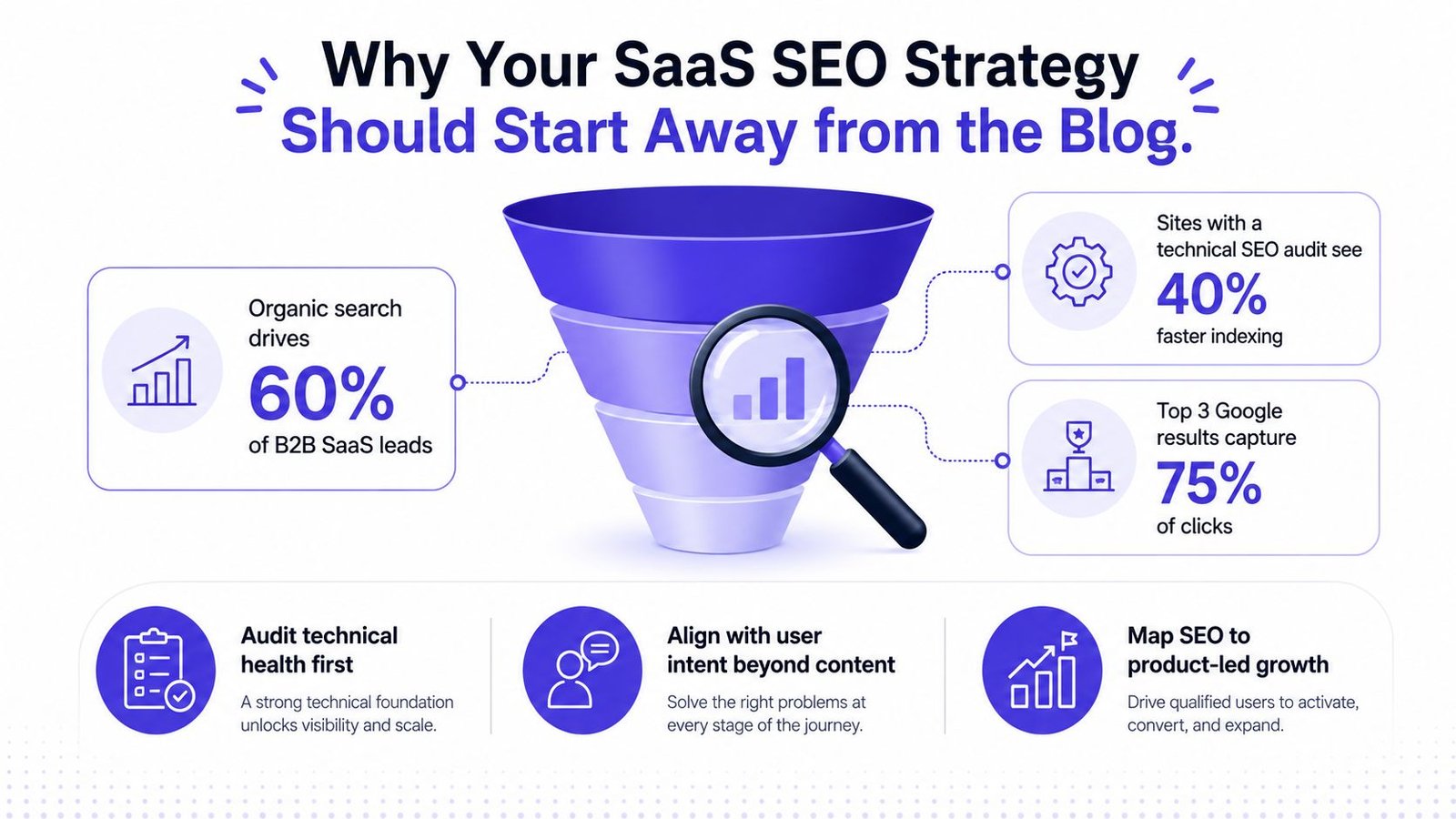
A lot of SaaS founders start with blog posts because blogs are easy to ship. You can publish something, watch impressions climb, and feel like SEO is moving while pipeline barely changes. That misses the problem. Blog-first SEO usually starts too far from purchase intent.
The searches that matter most are rarely broad educational queries. They are alternatives, pricing, vs., best software for, and integration searches, the exact moments when buyers compare vendors and decide whether your product belongs on the shortlist. SaaS SEO works better when it aims at pages that can influence demos, trials, and signups. That means product pages, comparison pages, and integration pages deserve attention before a long editorial calendar does.
Practical rule: if a page cannot plausibly help a buyer choose, it probably should not be your first SEO priority.
Founders often overbuild top-of-funnel content because it feels safer than writing pages that point straight at revenue. That creates traffic without much commercial value. The better order is simple. Build the pages that sit close to revenue first, then add educational content after the money pages have technical support, internal links, and some authority behind them. A page that helps a buyer compare your product to another tool usually earns attention faster than a generic explainer ever will.
The click data backs that up. If the first result gets most of the attention and page two is nearly invisible, then ranking for intent-rich terms is a distribution problem, not a vanity project Exalt Growth's SaaS SEO statistics. That is why the right order is usually technical readiness, intent mapping, money pages, then supporting content.
There is also a practical distribution angle outside Google. If you are trying to seed demand in communities, a guide on how to use Reddit for startup marketing can support awareness while your core pages do the heavy lifting in search. That matters because SaaS SEO works best when organic search and community visibility support the same buyer journey.
Use this test before you publish another blog post. If you removed your blog tomorrow, would search still help buyers choose your product? If the answer is no, the strategy depends too much on content that does not close. The shift founders need is simple, stop chasing pageviews first and build an organic system that supports pipeline.
Technical SEO Foundations Every SaaS Needs Before Publishing Content
A SaaS site can publish plenty of content and still miss the point if crawlers waste time on the wrong URLs. Technical SEO for software products is really a crawl-budget optimization program, because apps, docs, auth walls, and duplicate paths create more waste than a normal marketing site ever does. The goal is simple, get crawlers onto revenue pages first, not dead weight SerpSculpt's enterprise SaaS technical SEO guide.
Start with index coverage and rendering
The first audit needs two answers, what is indexed, and what is rendering. If JavaScript content never shows up in rendered HTML, Google can miss the page you think you shipped. That shows up often on React and Next.js sites with dynamic components, gated content, or front-end builds that look clean to humans and messy to search engines.
The failure modes are plain, but the cleanup takes discipline. Blocked or incomplete XML sitemaps, orphaned pages, and canonicals that point to noindexed or redirected URLs all waste authority. For marketing pages, keep the bar practical, LCP under 2.5 seconds, INP under 200 ms, and CLS under 0.1, then confirm the fixes in Google Search Console, URL Inspection, and PageSpeed Insights LaunchDirectories' SaaS SEO guide.
Fix the structure before you scale the library
A flat architecture usually beats a deep, messy one because crawlers can reach it faster and your team can reason about it without guesswork. Revenue pages should sit close to the root where possible, and duplicate paths should be consolidated with canonicals before they split authority. If your product pages already feel slow, a practical resource like speed up your app helps teams treat performance as a product issue, not just an SEO metric.
Crawl what matters first, then publish more.
That line sounds blunt because the work is blunt. If the site cannot be crawled cleanly, every new blog post adds more surface area for problems instead of more reach. Founders usually want more content at this stage, but clean indexing and fast rendering do more for pipeline than another batch of pages that search engines struggle to process.
Keyword and Intent Mapping That Actually Moves Pipeline
Keyword research gets weird in SaaS because the biggest-looking terms are often the least useful. A founder can spend weeks chasing broad category keywords and still miss the queries where buyers are closest to buying. That's why the best SaaS teams start with intent, not volume.
Split the search universe by buying stage
There are really only a few keyword types that matter for pipeline:
- Alternatives and versus queries, where buyers are comparing vendors.
- Pricing and plan searches, where they're checking whether the product fits budget or packaging.
- Category and use-case terms, where they're choosing a solution class.
- Integration searches, where they're checking compatibility with the stack they already use.
The cleanest way to build this map is to use actual sales language. Pull competitor names from demo calls, support tickets, onboarding notes, and lost-deal feedback. Those are better inputs than keyword tools because they reflect how buyers describe the problem in the wild.
Don't ignore the retention stage
A lot of SaaS SEO stops at acquisition. That's a mistake. Onboarding guides, feature documentation, and FAQ pages can support retention and product-led search because they help users adopt more features and reduce churn risk. One practical SaaS SEO guide explicitly calls out this overlooked stage, and it's the part many teams never operationalize WebTonic's SaaS SEO guide.
Customer-led keyword mapping works best when it comes from workflows, not generic industry terms. If customers are searching for help inside the product experience, those queries deserve indexable pages too, especially if they can be tied to expansion or lower churn.
For deeper research on long-tail and adjacent query discovery, techniques for deeper keyword research is a useful reference point.
Decision rule: if a query sits close to a buying or usage decision, it deserves a page. If it only attracts curiosity, it can wait.
The practical outcome is a keyword map that links search intent to revenue impact. That's the difference between a content backlog and a pipeline plan.
Building Topical Authority with a Hub-and-Spoke Content Architecture
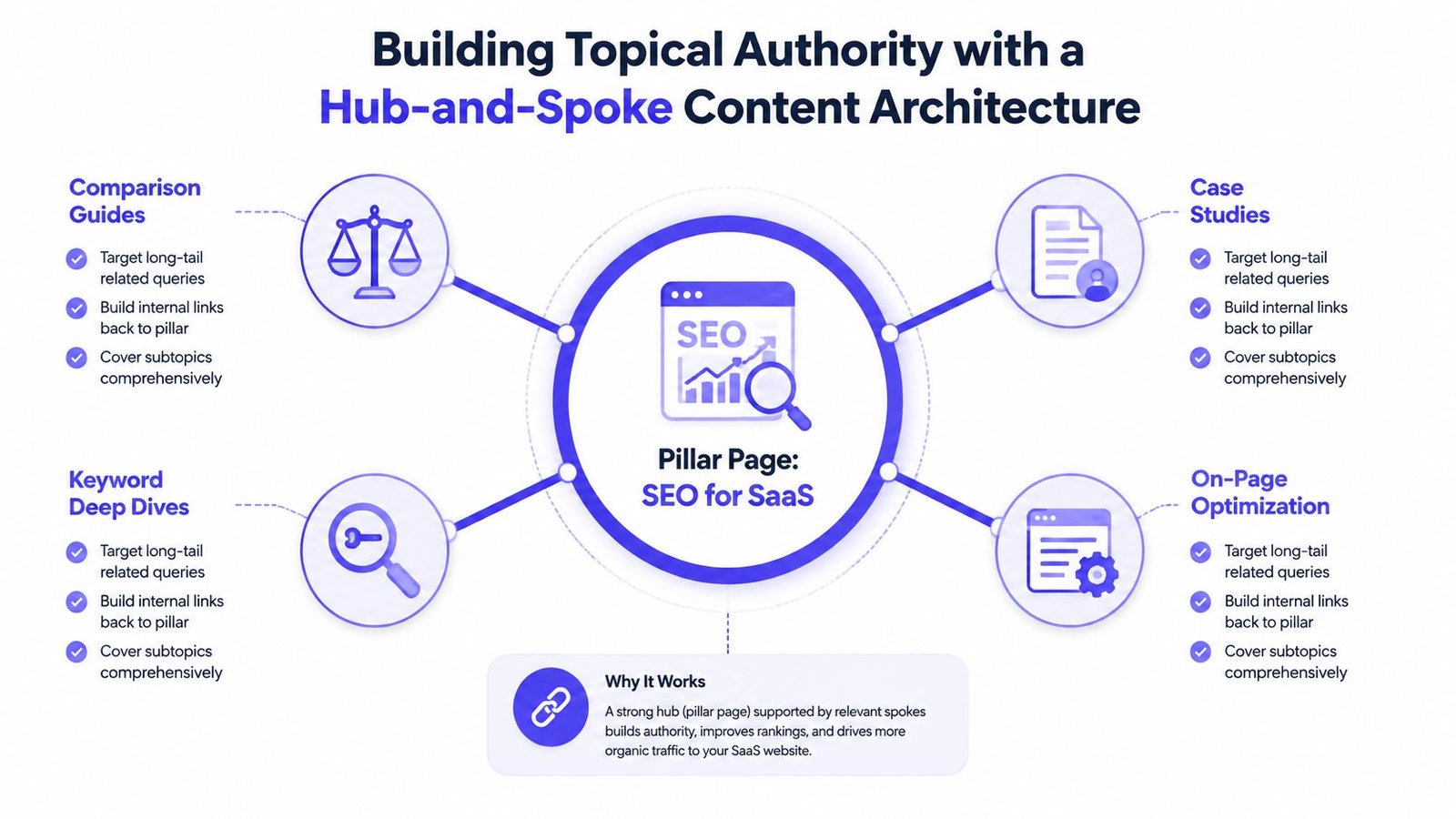
Isolated posts do not build authority. They create noise. SaaS search gains usually come from a hub-and-spoke structure where one strong category page sits at the center and supporting pages reinforce it through internal links and semantic coverage DesignRevision's SaaS SEO guide.
Pick one page to own the category
The hub should be the page you want search engines to treat as the main authority. For many SaaS companies, that is a core category page, a major solution page, or a product-led “best fit” landing page. Around it, build spokes that cover comparison guides, alternatives, pricing, use cases, integration tutorials, and the pages people need before they buy.
The point is not content volume. It is page hierarchy. If your site has ten loosely related articles and no clear center of gravity, rankings get spread across weak pages. If you build one strong hub and route everything back to it with descriptive anchors, the whole cluster becomes easier to understand. The payoff is clearer intent mapping and fewer orphaned pages that never do useful work.
Internal linking should be deliberate, not decorative
Every spoke should do three jobs. It should answer a specific intent, link back to the hub, and link laterally when the reader needs a next step. That means a comparison page should point to pricing, a use-case guide should point to the product page, and a documentation article should reinforce the feature page it supports.
A simple structure looks like this:
| Page type | Purpose | Link behavior |
|---|---|---|
| Core category page | Owns the topic | Receives links from all spokes |
| Comparison page | Captures evaluation intent | Links to category and pricing |
| Use-case page | Captures workflow intent | Links to feature and docs |
| Integration page | Captures ecosystem intent | Links to relevant product pages |
That structure turns a content library into topical authority. It also makes it easier for search engines to see which page should rank for what, which saves you from the usual startup mistake of publishing too many pages with no clear role.
Directory pages can fit into this same system if you treat them as authority signals, not link dumps. A curated page like best startup directories for SaaS visibility can support a broader trust-building strategy by showing where your brand should appear across the web.
Directory Submissions and Backlink Playbook for Early-Stage SaaS
A lot of founders either ignore directories or abuse them. Both are bad moves. The useful middle ground is manual, high-signal directory work that builds trust, creates legitimate backlinks, and helps a new brand show up across the web without looking spammy.
Clean the listing assets before you submit anything
Directory work gets messy when the basics are inconsistent. Decide on one company name, one product description, one category label, one logo file, and one URL set before you start. If your profiles vary across platforms, you dilute the trust signal and create cleanup work later.
You also want to avoid automated submission footprints. Spam networks and bulk tools can create a pile of low-value links fast, but they don't do much for credibility. Manual placement is slower, and it lets you choose reputable listings and keep the data clean.
Use reputable directories, not random volume
For early-stage SaaS, the useful directories are the ones buyers already trust or search. That includes product and startup directories, review platforms, and comparison surfaces. The point is to get authoritative profiles into places where prospects look before they sign up.
One practical workflow is a manual submission service like directory submission service, which can take the repetitive work off a small team. StartupSubmit performs manual submissions to 200+ startup and software directories, including Product Hunt, G2, Capterra, BetaList, Indie Hackers, AlternativeTo, and SaaSHub, with typical execution in 5 to 14 days and a final report that includes submitted backlink URLs, acceptance notes, and screenshots StartupSubmit. For founders who do not want to spend days inside repetitive forms, that kind of workflow is easier to audit than a black-box automation stack.
Practical rule: one accurate listing on a trusted directory beats five sloppy profiles on weak ones.
A quick comparison makes the trade-off clear:
| Approach | Strength | Weakness |
|---|---|---|
| Automated bulk submission | Fast volume | Higher spam risk, weaker quality control |
| Manual submission | Better accuracy and trust | Slower, more founder time |
| Curated service workflow | Consistent execution | Still needs clean inputs from your team |
Directory submissions do not carry a full SEO strategy on their own. They are a foundation layer, useful for links, discovery, and brand validation, especially when the site is new.
A useful backlink target in this stage is a page that connects directory work to the wider visibility effort, like B2B SaaS AI visibility. That gives the directory profile a real place in the rest of the growth system instead of leaving it as a dead-end citation.
Measuring SaaS SEO and Optimizing for AI Search Visibility
A lot of SaaS teams still measure SEO as if blue links are the whole funnel, but that leaves out how buyers now discover products in AI answers and summaries. Google's AI Overviews are used by over a billion people globally, and Google has said those summaries are driving more complex query behavior rather than replacing search altogether. SaaS teams need to know whether they show up in traditional search and in AI-driven surfaces, because the two do not always move together ALM Corp's SaaS SEO and AI overview guide.
Track whether the brand gets mentioned, cited, or skipped
A simple AI visibility routine works better than most dashboards here. Pick the 15 to 20 questions buyers ask, run them across major AI engines on a monthly cadence, and log whether your brand is mentioned, cited, or absent. That gives you a clean baseline for where the product appears, where it gets summarized without attribution, and where it never enters the answer at all. Most SEO tools do not surface that split, but buyers feel it.
Use the result set to look for patterns, not just wins. If the same page keeps getting cited, it usually has the kind of structure AI systems can extract cleanly. If the page is ignored, the problem is often weak sourcing, thin product proof, or content written around broad claims instead of specific use cases. Kaleigh Moore's guide on AI Overviews makes the same point from a different angle, content that is easier to quote tends to get cited more often Kaleigh Moore's guide on AI Overviews.
Measure search and AI together
The old reporting stack still matters, but it is incomplete on its own. Keep rankings, organic traffic, and conversions in the same view, then add AI-specific checks for snippet capture and answer inclusion. If a page wins a featured snippet but your brand never shows up in AI summaries, you still have a visibility gap.
A practical measurement stack looks like this:
- Track rankings for money pages and support pages.
- Check snippet ownership on high-intent queries.
- Audit answer extraction for pages AI tools can summarize cleanly.
- Review branded mention frequency in category prompts.
- Refresh content when product positioning or market language changes.
The pages that perform best in both search and AI answer boxes usually share the same traits. They use original data, named sources, expert quotes, and concrete benchmarks. They are also easier for a founder or marketer to defend internally, because there is evidence behind the claim rather than a polished-sounding paragraph. Scalerrs' SaaS SEO guide makes that trade-off clear, concrete proof gets cited, vague claims get skipped.
AI visibility workflows need the same discipline you already use for directory work. If you want a structured way to handle that side of the process, StartupSubmit's AI directory submission service fits into the measurement loop without turning it into guesswork. For a wider view of how search and AI overlap, B2B SaaS AI visibility is a useful reference point.
Your Next 30 Days for SaaS SEO Execution
Start with the pages that can bring in revenue. Audit index coverage, rendering, canonicals, and sitemap health first, then pick one core category page and two or three high-intent spokes to support it. If the site already has some authority, add comparison and alternative pages before broad educational content.
Use manual directory work where the listing quality matters. For repetitive submissions that would otherwise pull founder time away from product and customer work, use a service like StartupSubmit 的 SaaS 目錄提交服務. The goal is clean profiles and credible backlinks without turning your team into form-fillers.
A strong first month usually looks like this:
- Week 1: technical audit, index cleanup, and page architecture review.
- Week 2: keyword map tied to buying intent and retention use cases.
- Week 3: launch or refresh one hub page and supporting spokes.
- Week 4: submit core directory listings and start AI visibility checks.
Consistency beats bursts of effort here. A SaaS SEO strategy only works when technical health, intent mapping, authority building, and measurement all move together. Keep those four pieces in motion, and the site stops acting like a blog and starts behaving like a growth channel.