
10 Best Free Business Listing Sites for 2026
Most founders hear brand reputation management and think “collect more five-star reviews.” That advice is incomplete, and for SaaS and AI startups, it can be dangerously narrow. Buyers now form opinions from review sites, startup directories, founder profiles, comparison pages, community discussions, search results, and summaries generated by Google AI Overviews or ChatGPT.
A polished homepage only tells people what you want them to believe. Reputation is shaped by whether independent sources describe the same company, product, category, use cases, and customer experience. The practical job is to make those sources accurate, credible, current, and easy for both buyers and discovery systems to interpret.
Why Brand Reputation Management Is Not Just About Reviews
Online reviews still sit close to the buying decision. Pew Research Center found that 82% of U.S. adults at least sometimes read online ratings or reviews before buying something new, while 40% always or almost always do so. Among people who read reviews, 51% said reviews generally provide an accurate picture of product quality, but 48% said it's often difficult to tell whether reviews are truthful and unbiased. Pew Research Center's analysis of online reviews explains the tension clearly. Reviews influence confidence, but buyers also evaluate whether the evidence looks authentic.
That's why reputation work isn't the same as asking every happy customer for a perfect rating. It's the process of managing the public evidence around your brand, including what appears on page one, which directories describe you, how customers discuss your product, and whether third-party pages reinforce or contradict your positioning.
For a SaaS company, that evidence might include a G2 profile, a Product Hunt launch page, a Capterra listing, a founder interview, a comparison article, and a support discussion. For an AI startup, it may also include technical explainers, community threads, benchmark references, and citations used by an LLM when it summarizes the company.
Reputation is an entity problem
Search engines and language models need to understand that different references point to the same entity. Inconsistent company names, vague product descriptions, outdated pricing language, or mismatched category claims make that harder. A startup may be described as an automation platform on one site, an AI assistant on another, and a generic productivity tool elsewhere. Human buyers can reconcile that. Machines often produce a muddled summary.
The strongest reputation system creates consistency without manufacturing consensus. Your own site should establish the facts, while independent sources should validate the product's category, audience, capabilities, and limitations.
Founder visibility matters here too. Practical guidance such as SupaBird's brand strategy tips can help founders build a clearer public identity that supports, rather than competes with, the company entity. Directory profiles can reinforce that same identity, particularly when a startup is still building authority. A useful starting point is to review the free startup directories where your company may already be listed or eligible for inclusion.
Practical rule: Treat every public profile as a sentence in the story a buyer or AI system will assemble about your company.
This reframing changes the work. Reputation management supports conversion, sales enablement, investor diligence, startup SEO, and AI search optimization. It's not a cleanup task reserved for the week after a crisis.
What Ignoring Your Online Reputation Actually Costs
A strong product does not automatically create a strong public record. Customers may value the software and still leave no review, update no directory profile, mention the company nowhere, or correct no outdated description. Without a system for managing those signals, the public record stays thin while negative or inaccurate pages gain disproportionate visibility.
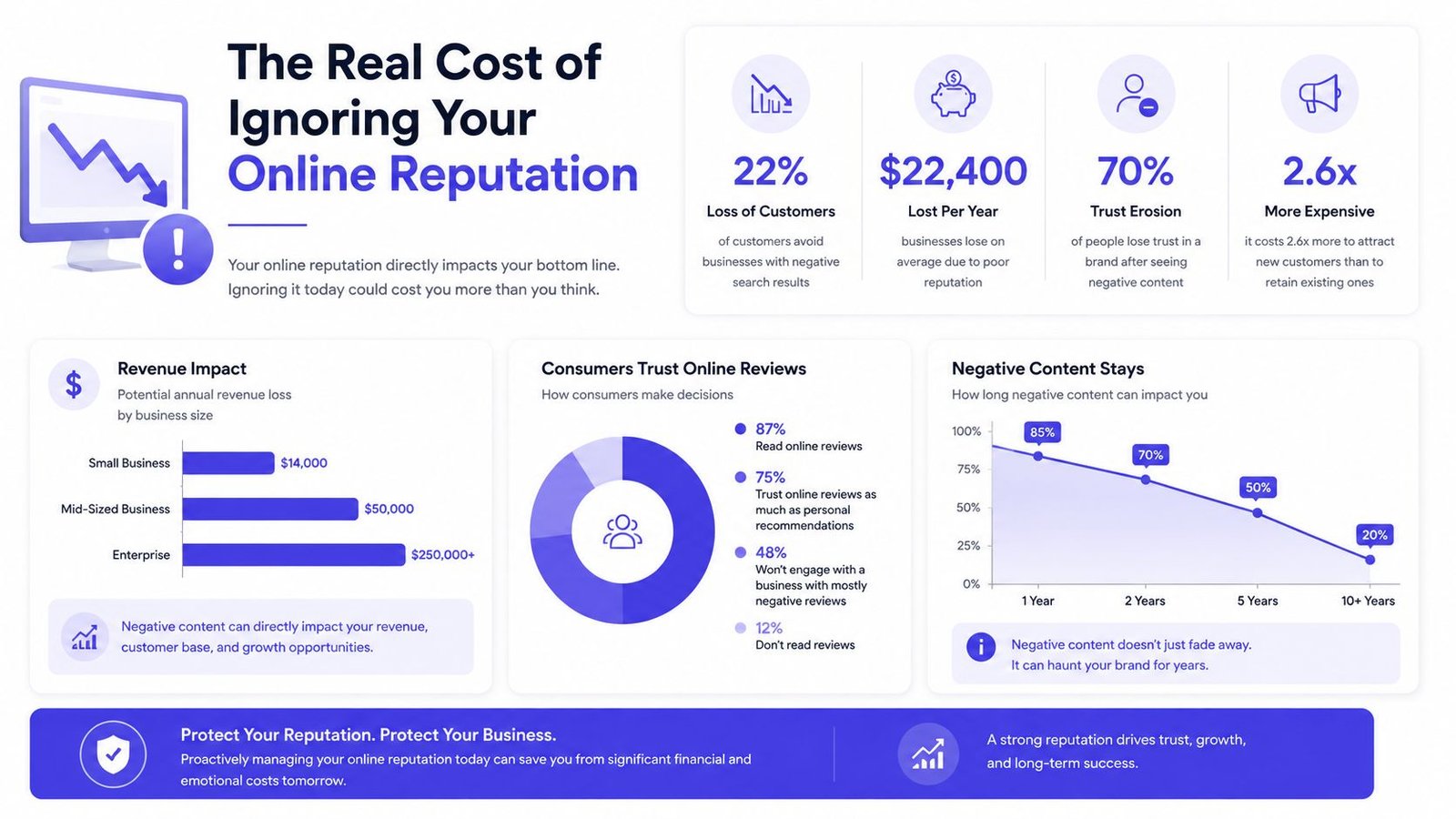
The financial risk can appear quickly. A 2026 reputation-management statistics summary reported that 41% of companies experiencing a reputation crisis saw a direct loss of brand value and revenue within the first year. The figure appears in New Media's reputation management statistics summary. Reputation protection directly safeguards revenue. It also reduces the chance that a preventable trust problem reaches sales conversations, renewals, or investor diligence.
Search visibility adds another layer. One 2026 report states that a single negative review on page one can cause a business to lose 22% of potential customers, while four or more negative reviews can reduce sales by 70%. Those figures come from SHNO's online reputation management statistics. The impact varies by category, search intent, and buyer sophistication, but the mechanism is consistent. A damaging result can intercept a prospect before the sales team gets an opportunity to explain the product.
Stale trust signals create quiet doubt
Review freshness matters even when the average rating looks excellent. Multiple 2026 reputation datasets report that consumers disproportionately trust reviews written within the last month, and one cited benchmark says 73% only trust reviews from that window. BizIQ's online review statistics provides that benchmark. A profile with a strong historical average but no recent activity can look abandoned, particularly for software that changes quickly.
A separate 2026 consumer-trust survey found that a 4.7-star profile with reviews from the last 30 days was trusted more than a 4.9-star profile whose newest review was 6 months old. BGR Review's consumer trust analysis uses that comparison to show why freshness deserves its own metric.
Informal diligence creates another exposure point. Prospects, partners, and investors often search the company name, founder name, product name, and terms such as “reviews,” “pricing,” or “scam” before committing time. Empty directory profiles, conflicting descriptions, and unresolved complaints force buyers to fill gaps with their own assumptions.
A good product helps only after the surrounding evidence earns trust. That evidence now includes the pages and references that Google AI Overviews and language models may use when summarizing a company, making entity credibility part of revenue protection.
Core Components of a Startup Reputation System
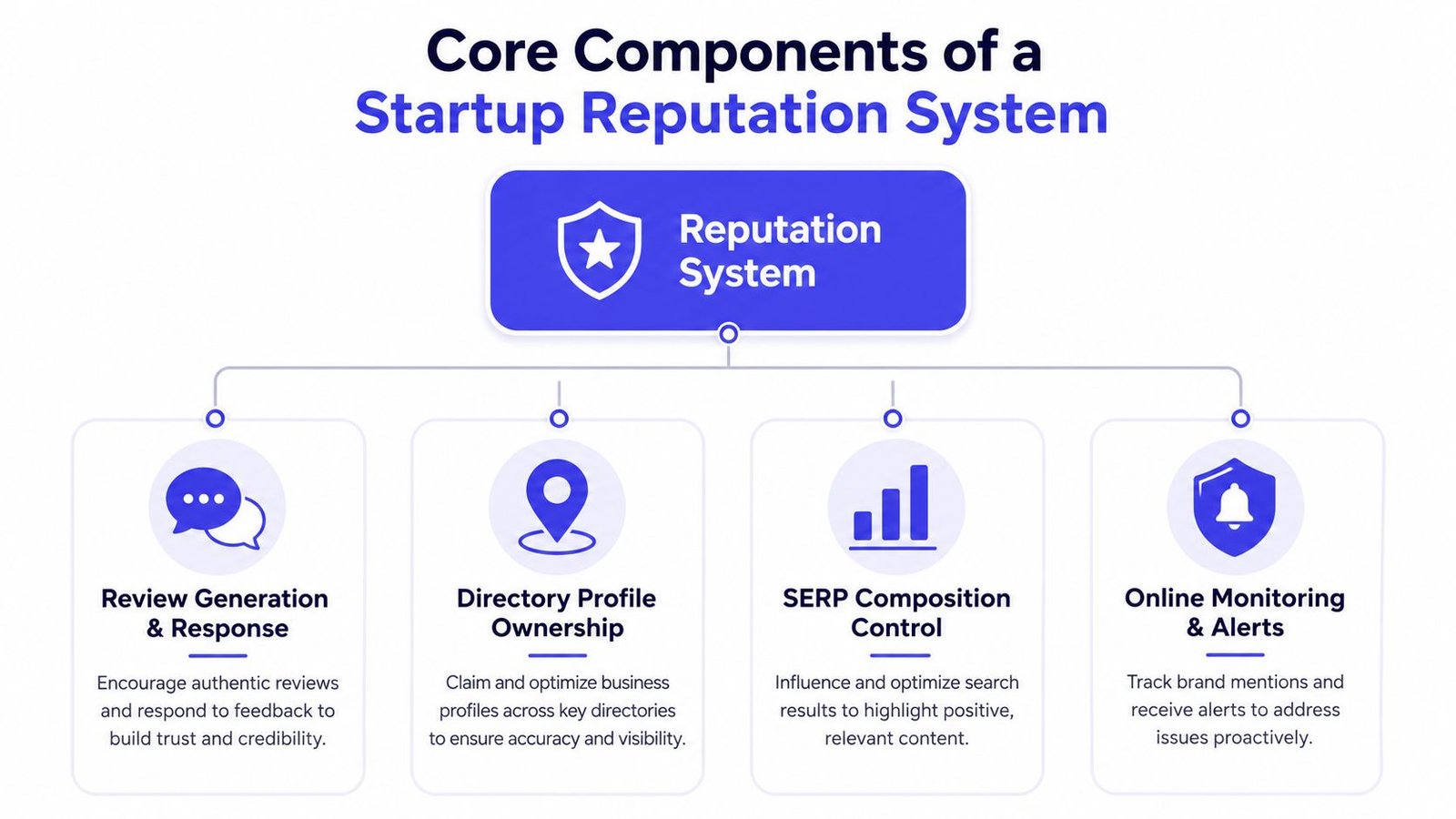
A startup reputation system has four connected parts. Reviews create customer evidence, directory profiles establish discoverable entity references, SERP composition determines what people see first, and monitoring catches changes before they become expensive.
Review generation and response
Review generation works best when it follows a meaningful customer milestone. For SaaS, that might be a successful onboarding, a completed implementation, a useful support resolution, or a customer reaching a clear product outcome. The request should be easy to complete and should invite honest feedback rather than imply a desired rating.
Responses are part of the signal. A thoughtful reply shows future readers how the company handles friction. A defensive response can turn a contained complaint into a more damaging discussion. Publicly acknowledge the issue, avoid exposing private customer information, and move detailed troubleshooting into the appropriate support channel.
Directory profile ownership
Directories provide more than backlinks. A well-maintained G2, Product Hunt, Crunchbase, or SaaSHub profile gives search engines and AI systems another structured reference for the company. It also gives buyers a place to verify basic facts outside your marketing site.
Claim existing profiles before creating new ones. Correct the company name, category, URL, product description, founder information, and social links. The SaaS directory submission service category is useful context for founders comparing this work with broader startup marketing tasks, but the quality of each listing matters more than the number of forms submitted.
SERP composition control
You can't guarantee every result that ranks for your brand, but you can build a stronger set of relevant assets. Your homepage, documentation, pricing page, social profiles, directory listings, customer stories, press mentions, and founder content should make up a coherent branded search environment.
This isn't about hiding legitimate criticism. It's about ensuring a useful, accurate profile isn't buried beneath outdated pages or thin references. Search visibility and reputation are connected because buyers rarely inspect every result with equal attention.
Third-party citation quality
AI-mediated discovery raises the standard. A language model may summarize your company from several sources, and those sources won't all carry equal credibility. A detailed profile on a respected software platform can contribute more useful context than a cluster of low-quality directory pages.
Operational details support this system too. Even a small startup can improve consistency by standardizing team-facing assets, including ways to manage email signatures without IT, so employees point prospects toward current company information rather than outdated pages.
Building Authoritative Directory Profiles That Rank
Directory submissions are often treated as repetitive link building. That misses the strategic value. A strong profile gives a third-party site enough accurate information to explain who you serve, what problem you solve, and how your product differs from nearby alternatives.
Start with a source-of-truth document. Include the approved company name, short description, long description, product categories, target users, founder details, website URL, social profiles, screenshots, logo files, and a consistent explanation of the product's main use cases. Keep the language specific. “AI-powered platform for modern teams” says almost nothing. “An AI support workspace that helps B2B SaaS teams organize customer questions and draft answers” gives both readers and crawlers a clearer entity relationship.
Choose platforms for trust, not volume
A profile on a relevant, moderated platform is more valuable than a listing on a generic network that exists mainly to publish links. Product Hunt can support launch discovery and community validation. G2 and Capterra can support software comparison and review intent. BetaList can suit early products. Indie Hackers can add founder and maker context. AlternativeTo and SaaSHub can clarify product alternatives and category relationships.
| Directory | Best For | Submission Type | Trust Signal Strength |
|---|---|---|---|
| Product Hunt | Product launches and community discovery | Product submission and profile | Strong for launch context |
| G2 | Software evaluation and customer reviews | Company profile and review platform | Strong for buyer validation |
| Capterra | Software comparisons and category discovery | Vendor profile and reviews | Strong for commercial research |
| BetaList | Early-stage product discovery | Startup submission | Useful for launch-stage visibility |
| Indie Hackers | Founder-led products and maker stories | Community profile and discussion | Useful for founder credibility |
| AlternativeTo | Product alternatives and switching intent | Product listing | Useful for category association |
| SaaSHub | SaaS discovery and comparison | Product profile | Useful for software entity coverage |
Manual work matters because each platform has different fields, categories, moderation standards, and duplicate policies. An automated submission tool may create inconsistent descriptions, select irrelevant categories, or submit a profile that already exists. A focused directory submission service should check for duplicates, tailor each listing, and document what was accepted rather than treating every submission as a guaranteed placement.
Write for the profile's audience
Don't paste the homepage hero section into every platform. Keep the facts consistent, but adapt the emphasis. A G2 profile should clarify workflows and customer outcomes. Product Hunt needs a concise launch narrative. Indie Hackers readers may care about the problem, founder perspective, and product evolution.
Avoid exaggerated claims, keyword stuffing, and unsupported superlatives. Profiles that read like advertisements are less useful to buyers and less credible as machine-readable references.
Review Generation Strategies That Build Authentic Trust
The best review pipeline starts with product experience, not a campaign calendar. Ask customers after they've received value, then make the request direct, optional, and easy to complete. A customer who has just completed onboarding may be able to describe the implementation experience. Someone who has resolved a difficult support issue can speak to responsiveness. Someone who has used the product over time can evaluate reliability and fit.
Different approaches produce different signals:
| Approach | What Works | What Fails |
|---|---|---|
| Broad review request | A simple request sent after a meaningful milestone | Sending the same message to every user regardless of experience |
| Rating optimization | Encouraging honest, detailed feedback | Asking only for five-star reviews |
| Review incentives | Removing friction and providing a clear link | Offering rewards for positive ratings, edits, or removals |
| Negative feedback handling | A public acknowledgment followed by private resolution | Arguing, blaming, or requesting deletion before fixing the issue |
| Review reuse | Turning real comments into testimonials and sales proof | Publishing snippets without context or permission |
A perfect rating isn't always the most persuasive outcome. One 2026 reputation-statistics roundup reports that 31% of consumers will only patronize businesses rated 4.5 stars or higher, while related analysis notes that buyers may trust a 4.5-star profile more than a perfect 5.0 because flawless feedback can trigger suspicion. Digital Applied's consumer trust data covers that threshold and the authenticity trade-off.
Freshness beats a frozen average
A review profile should show that customers still use the product and that the company still engages with feedback. The 73% recent-review benchmark cited earlier reinforces why review velocity and recency deserve attention alongside the average score. Don't wait for a quarterly push if your customer base has regular success moments.
For SaaS, build requests into lifecycle events:
- After activation: Ask users to describe setup and first value.
- After a support win: Invite an honest account of how the issue was handled.
- After expansion: Request feedback from customers who adopted additional workflows.
- After renewal: Ask what made the product worth continuing.
Critical reviews can increase credibility when the company responds with specifics and follows through. Independent 2026 industry data reports that 68% of consumers are more likely to trust a business with both positive and negative reviews, while 82% have changed a purchase decision because of negative online reviews. World Metrics' online reputation management statistics highlights why authenticity and resolution matter more than cosmetic perfection.
How AI Discovery Is Changing Reputation Management
Google AI Overviews, ChatGPT, and other language-model interfaces change the buyer's first question from “Which result should I click?” to “What does this system say about the company?” The answer may combine your website with directory pages, review platforms, community discussions, news coverage, and comparison content.
That creates a new reputation problem. A startup can have accurate messaging on its own site and still receive an incomplete or incorrect summary if third-party sources use old names, unclear categories, broken links, or contradictory descriptions. The task isn't to manipulate an answer. It's to improve the quality and consistency of the evidence available for synthesis.
Build a clean entity record
Create a factual reference page that explains the company, product, category, audience, core features, founders, locations where relevant, and common questions. Keep the About, Press, pricing, documentation, and contact pages aligned. Use organization and product structured data where appropriate, but don't treat schema as a substitute for credible external references.
Then audit the sources an AI system might encounter:
- Company profiles: Check names, descriptions, URLs, categories, and founding details.
- Review platforms: Look for unresolved complaints, outdated screenshots, and stale product information.
- Founder references: Correct inconsistent bios and company affiliations.
- Community discussions: Answer factual questions without turning every thread into promotion.
- Comparison pages: Verify that competitors, alternatives, and product capabilities are represented accurately.
Earn citations through useful information
AI systems need information they can summarize. A thin “we're the best” profile gives them little substance. A detailed directory entry, a technical explanation, a transparent product comparison, or a customer story gives them more context, particularly when independent publishers repeat the same facts.
The same editorial discipline applies to social content. Founders evaluating whether to compare designer and AI social posts should apply that comparison to reputation work too. Automation can help with drafting and monitoring, but high-stakes responses, founder commentary, and explanations of product limitations need human review.
AI discovery doesn't make reviews or SEO irrelevant. It increases the cost of inconsistency. A practical AI search optimization program should track whether systems describe your category correctly, identify the sources they cite, and improve those source pages rather than obsessing over one generated answer.
For startups building this footprint, an AI directory submission service can be evaluated as one part of a broader citation and entity-consistency plan. Directory coverage won't guarantee ChatGPT visibility, but credible, accurate profiles give discovery systems better material to work with.
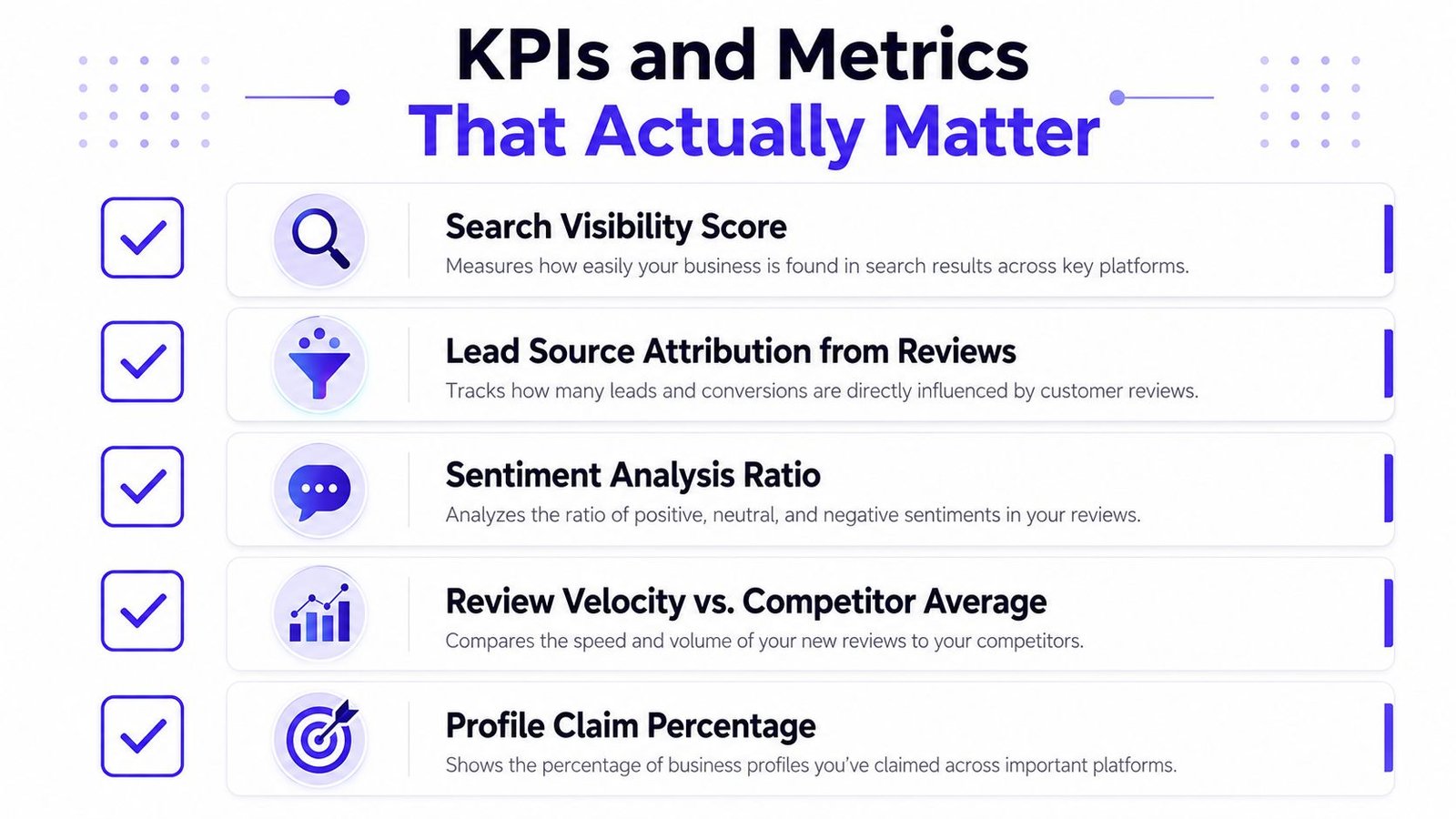
KPIs and Metrics That Actually Matter
A reputation dashboard should connect public trust signals to commercial behavior. Total review count and average rating are useful, but they don't explain whether buyers can find credible information or whether that information influences pipeline.
Track five layers:
- SERP composition: Search the brand, product, founder, and high-intent variations in a neutral browser. Record which page-one results are owned, earned, review-based, community-based, or negative.
- Review freshness: Track the date of the newest review and the flow of new feedback by platform. The earlier recency evidence shows why a historical rating alone is incomplete.
- Profile coverage: Maintain a list of relevant directories, then mark each profile as found, claimed, complete, accurate, and recently reviewed.
- Citation quality: Record which independent sites mention the company, how they categorize it, and whether their descriptions match the source of truth.
- Pipeline influence: Ask leads how they found you, annotate CRM opportunities that mention reviews or directory pages, and monitor referral traffic from platforms such as G2, Product Hunt, and comparison sites.
Use a lightweight operating rhythm
A spreadsheet is enough at the beginning. Add columns for platform, profile URL, owner, status, last review date, description accuracy, response status, referring page, and notes. Connect referral traffic to analytics and add a simple CRM field for “trust source” when a prospect mentions a review, directory, community, or AI answer.
Measure the composition and usefulness of reputation signals, not just their quantity.
Review the dashboard on a regular cadence. If complaints cluster around onboarding, give the product and customer success teams the pattern. If a directory profile contains an outdated category, fix the source. If a negative result gains visibility, publish or promote a more useful, authoritative page instead of reacting emotionally.
Your 90-Day Reputation Building Playbook
A founder can establish the foundation in three phases. The sequence matters because publishing more profiles won't solve an unresolved product issue, and review requests won't compensate for contradictory company information.
Days 1 to 30, audit and claim
Search the brand, product, founder, and intent variations. Capture page-one results and note inaccurate, outdated, missing, or negative references. Claim existing profiles on relevant software, startup, founder, and community platforms. Create one source-of-truth document and assign owners for reviews, directory records, support escalation, and AI discovery checks.
Fix the basics first. Update titles, descriptions, logos, URLs, founder affiliations, product categories, and contact paths. Write response guidance for praise, reasonable criticism, suspected spam, and issues that require private support.
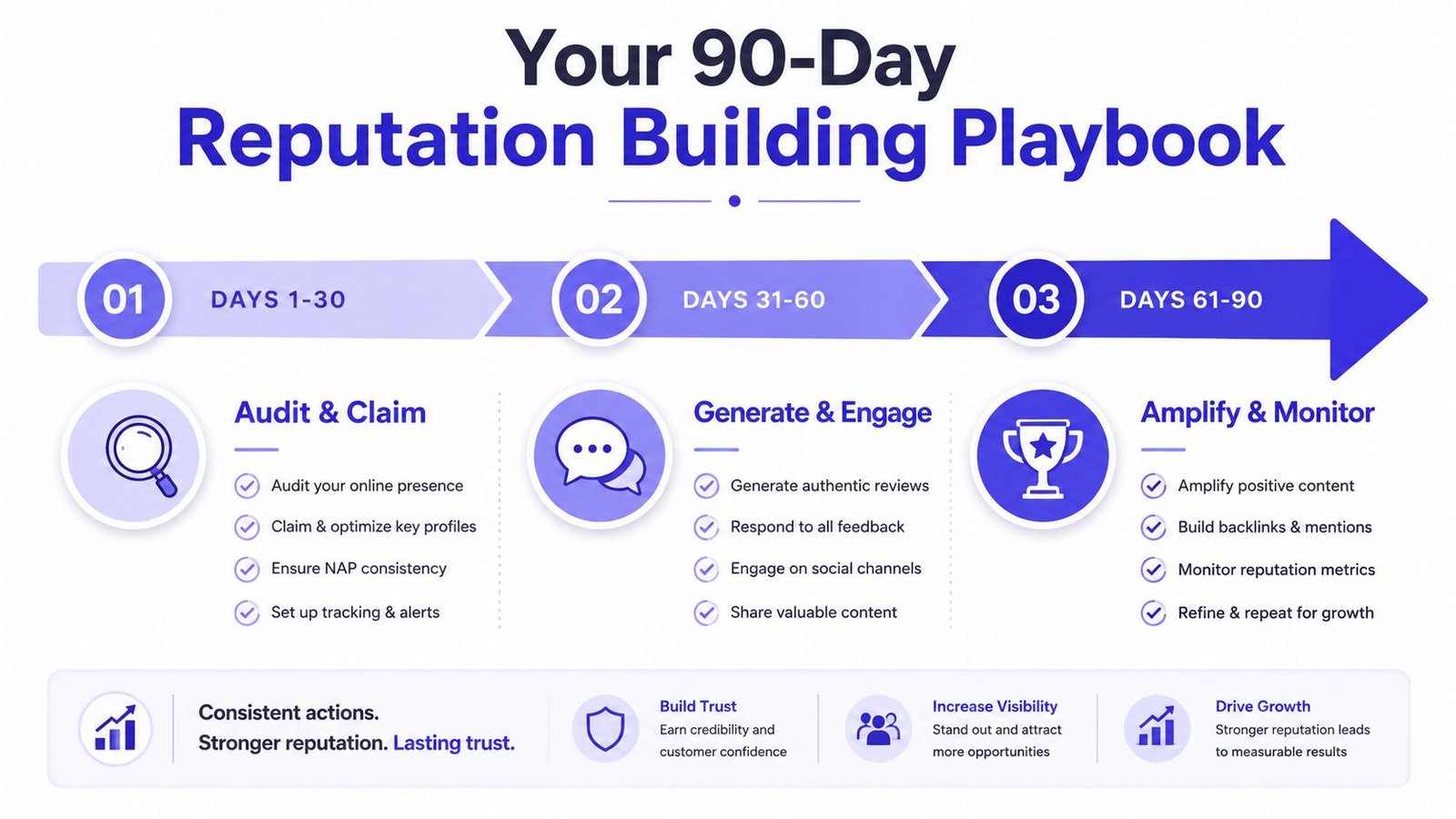
Days 31 to 60, generate and engage
Submit the company to relevant authoritative platforms, prioritizing fit and profile quality. Launch a review request process tied to customer milestones. Ask for honest feedback across appropriate platforms, respond to every substantive review, and route recurring complaints to the team that can fix the cause.
At this stage, publish useful supporting assets, such as a customer story, product comparison, founder interview, or technical explanation. Link those assets from relevant pages and ensure the company description matches the directory profiles.
Founders comparing platforms can use this guide to evaluate the best startup directories by audience, moderation quality, relevance, and search visibility rather than chasing a raw submission count.
Days 61 to 90, amplify and monitor
Review which profiles were accepted, which pages receive referral visits, and which sources appear in branded searches or AI-generated summaries. Correct weak listings, improve descriptions, and promote the strongest independent references through sales collateral, social posts, and founder content.
Keep the system running after the initial push. Assign a weekly profile check, a regular review-response routine, and a monthly SERP and citation audit. Bring in specialist help when manual directory work, source auditing, or crisis response consistently competes with product and customer responsibilities. Keep strategic ownership in-house even when execution is delegated.
The first action is simple. Search your brand today, document what a buyer sees, and fix the most visible inconsistency before creating another marketing asset.
StartupSubmit helps SaaS and AI founders build a stronger external reputation footprint through manual submissions across relevant startup and software directories, with duplicate checking, profile categorization, and a final report containing submitted URLs and placement evidence. Visit StartupSubmit to review the directory submission options and turn your reputation audit into a practical visibility project.