How Many Directory Submissions? Exhaust These 3 Tiers First
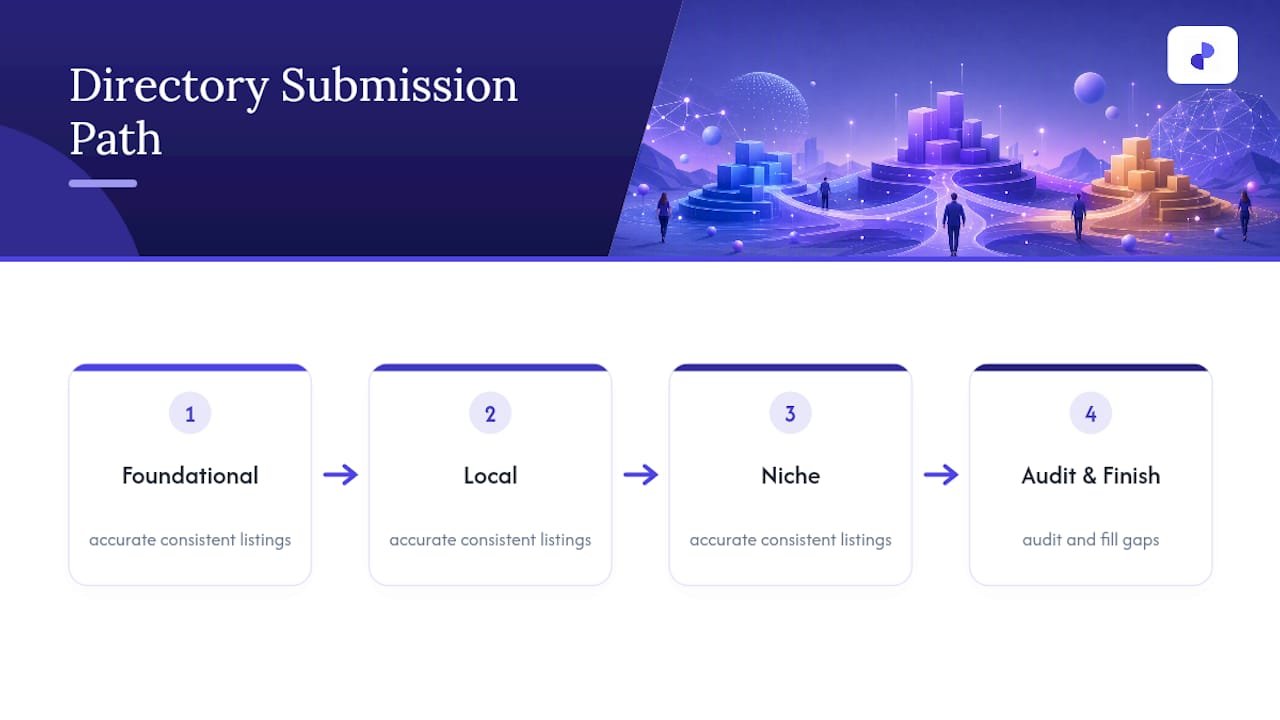
Yes, directory submissions still work, but only when the directories are genuine, relevant to your business, and listed with consistent information. The number that matters isn’t a count, it’s a rule: submit to every foundational, local, and niche directory that’s a real fit, then stop. Once those three tiers are exhausted, more submissions add risk without adding value.
How Many Directory Submissions Should You Aim For?
Forget the round numbers you’ve seen tossed around like “submit to 100 directories” or “50 is the sweet spot.” A working heuristic that shows up across practitioner guidance is a few dozen genuine listings for most sites; however, the real answer depends on how many directories legitimately fit your business across three tiers.
Foundational directories are the major platforms almost every business should be on: Google Business Profile, Crunchbase, industry-agnostic startup directories, and similarly high-authority general listings. Local directories cover city or regional chambers of commerce, local business associations, and geography-specific listing sites. Niche directories are the ones specific to your industry, whether that’s a SaaS directory, an AI tools index, or a trade association listing.
Before submitting anywhere, run each candidate through a quick check:
- Does it have an active audience, not just an archived list of dead links?
- Does it enforce any editorial standard, or does it accept anything for a fee?
- Has it been updated or maintained within the last year?
- Is there evidence of real referral traffic or search visibility, not just a domain rating number?
Once you’ve exhausted all three tiers using that filter, you’re done. That’s the whole formula.
How Directory Backlinks Actually Move Rankings
Directory listings work through two separate mechanisms, and conflating them is where most confusion about “how many submissions” comes from. The first is link value, the authority a backlink passes to your domain. The second is citation value, the consistency of your business name, address, and phone number (NAP) across the web, which search engines and AI systems use to corroborate that your business is real and current.
Relevance changes the math on both. A high-authority general directory that has nothing to do with your industry passes less contextual value than a smaller, topically matched one. That’s why a niche SaaS directory can outperform a generic business listing site with triple the domain rating.
There’s a third, newer layer: structured data feeding AI and mapping systems. Business NAP data remains the foundation of how organizations get found consistently online, and that foundation now extends into how large language models assemble answers about local businesses.
Practical expectations to track:
- Domain rating movement, typically gradual, not overnight
- Local visibility in map packs and “near me” queries
- Referral traffic directly from directory listing pages
A small number of major platforms account for the largest share of citations that AI systems actually pull from, according to BrightLocal’s directory-source research, which means prioritizing those platforms beats spreading effort thin across hundreds of minor ones.
What the 2026 Data Says About Directory Submissions
The Local Search Ranking Factors report from Whitespark is compiled by invited local-search experts and remains the closest thing the industry has to a consensus scorecard. Citation consistency and NAP accuracy show up as foundational, not optional, year after year.
BrightLocal’s research identified 415 directories that large language models actually pull from when assembling local-business answers, but that number is deceptive on its own. A small cluster of major platforms accounts for a disproportionate share of the citations LLMs rely on.
| Data point | What it shows | Source |
|---|---|---|
| 415 directories | Identified as LLM citation sources | BrightLocal |
| Small cluster of major platforms | Drives most citation share | BrightLocal |
| NAP accuracy | Rated a top-tier ranking factor for maps and organic results | Whitespark / AdviceLocal |
The practitioner consensus lines up with the data: quality over quantity isn’t a hedge, it’s the actual strategy that survives contact with how these systems weigh sources.
Why Bulk Directory Submissions Backfire
Submitting to a low-quality directory farm doesn’t just waste time. It can actively work against you. Spammy, unmoderated directories dilute your citation profile, and search engines have gotten better at treating listings on link-farm-style sites as low-value or ignorable rather than helpful.
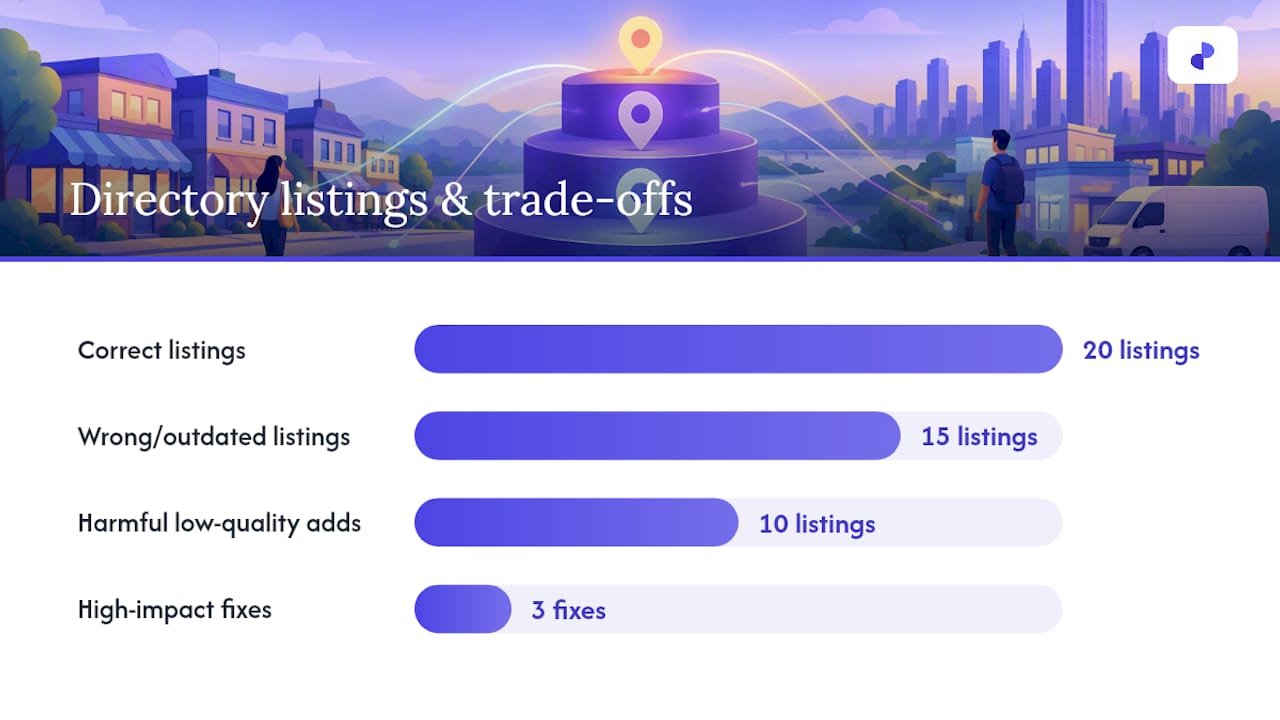
Inconsistent NAP data across dozens of thin directories creates a worse problem than having no listing at all. If your business address is right on 20 directories and wrong or outdated on 15 others, that mismatch erodes trust signals that map-pack algorithms and AI systems use to verify your business is legitimate.
There’s also a straightforward opportunity cost. Every hour spent submitting to a directory nobody visits is an hour not spent on:
- Fixing NAP inconsistencies on your existing high-value listings
- Pursuing a genuinely relevant niche directory you haven’t tried yet
- Any other SEO task with a clearer return
Pro Tip: Before submitting anywhere new, audit your existing listings first. Fixing three inconsistent NAP entries usually does more for your visibility than adding ten new low-quality ones.
A Practical Workflow for Directory Submissions
Treat this as a repeatable process, not a one-time sprint.
- Audit your existing footprint. List every directory you’re already on and flag any NAP inconsistencies.
- Build your tiered target list. Pull foundational, local, and niche directories, filtering each through the vetting checklist above.
- Prepare your submission assets. Nail down your canonical URL, complete NAP, a category that actually matches your business, and a unique description for every listing (never copy-paste the same paragraph 30 times).
- Submit in priority order. Foundational first, then local, then niche.
- Log everything. Track the directory name, submission date, acceptance status, and listing URL in a single sheet.
- Recheck quarterly. Directories change ownership, get deprecated, or quietly drop listings. A curated directory list helps you avoid submitting to sites that have already gone stale.
Watch for duplicate listings your business didn’t create, they show up more often than people expect, and monitor reviews on any directory that accepts them.
| Metric | What it tells you |
|---|---|
| Referral traffic | Whether directory visitors are converting |
| Local search impressions | Whether map-pack visibility is improving |
| NAP consistency rate | Whether your citation profile is trustworthy |
| Domain rating movement | Whether backlink authority is compounding |
What a Managed Submission Service Actually Delivers
Startupsubmit builds every listing manually rather than through automated bot submissions, which the company states leads to higher acceptance rates because categories and descriptions are matched to each directory’s actual editorial standards. That process includes manual category selection, unique listing copy per directory, and placement reporting so founders can see exactly where they landed. Startupsubmit’s own reporting cites a 338% increase in organic traffic for one client following submissions across 220-plus directories, a result the company presents as illustrative rather than a guaranteed outcome for every business.
A DIY approach makes sense for teams with time and someone dedicated to tracking submissions carefully. A managed service earns its cost when internal capacity is thin, launch timelines are tight, or the risk of inconsistent NAP data across dozens of manual submissions outweighs the cost of paying someone to do it correctly the first time.
The Bottom Line on Directory Submission Volume
Stop counting directories and start exhausting tiers: foundational, then local, then niche. When you’ve genuinely covered all three with accurate, consistent listings, you’re finished. Audit what you have, fill the real gaps, and either submit yourself or bring in help. The number was never the point, coverage and consistency are.
What SEO Practitioners Get Wrong About Directory Volume
The obsession with hitting a target number is a holdover from an era when directory submission meant mass-blasting the same description to hundreds of low-effort sites. That era is over, and the data backing citation-based ranking factors makes it clear that consistency now beats volume by a wide margin.
What surprises a lot of practitioners is how long the payoff actually takes. Realistic timelines run three to six months before you see measurable movement in rankings or referral traffic, not the two weeks some automated tools promise. Manual submissions also tend to clear editorial review at meaningfully higher rates than bot-driven ones, because a human reviewer can tell the difference between a description written for their specific audience and a generic paragraph pasted everywhere.
If you’re weighing whether your current directory strategy needs an overhaul or just a cleanup, that’s worth a direct conversation rather than guesswork.
— Danish
Get Your Startup Listed the Right Way
Some directory submission services offer alternatives to spending weeks manually vetting and submitting to directories one by one, handling category selection, writing unique listing copy, and reporting back on placements across many high-authority directories, without bots or automated blasting that risk rejection or inconsistent NAP data.
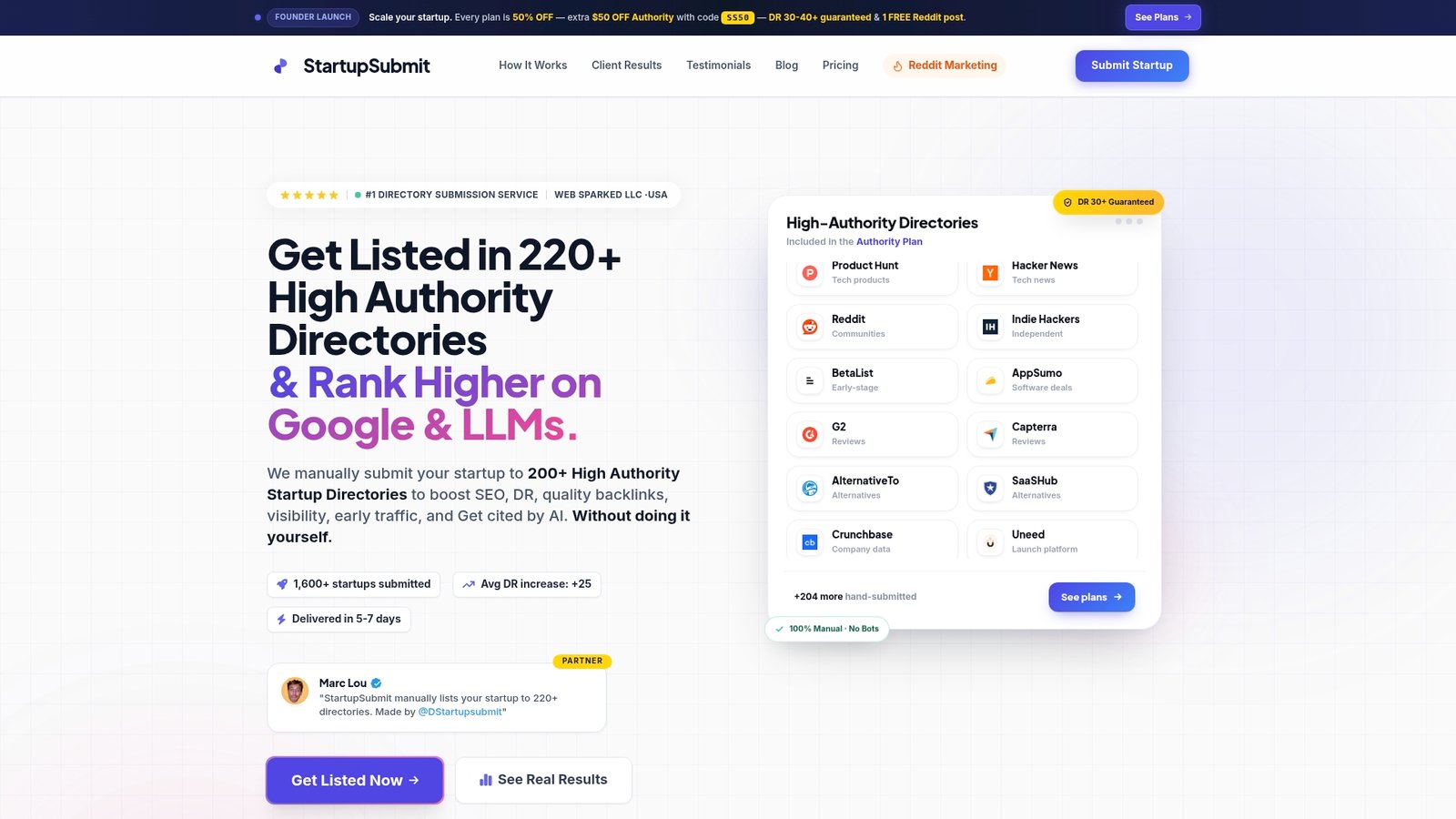
If you’re a startup founder trying to build early visibility fast, the Starter, Growth, and Authority packages cover different levels of coverage depending on how aggressively you want to build your footprint. Founders looking to extend visibility into community-driven channels can also add targeted Reddit posts or comments as a complementary push. Check the directory submission service page to see which package matches your launch timeline, then get your listings moving before your competitors take the good ones.
Sources
For deeper detail on the ranking factors and data referenced above, see the 2026 Local Search Ranking Factors report, BrightLocal’s research on AI directory sources, Whitespark’s Local Search Ranking Factors, and this breakdown of the quality-over-quantity submission approach. For a broader view of how citations feed AI search visibility, this partner analysis on AI-driven search is also worth a read.
- The 2026 Local Search Ranking Factors on Maps, Organic & AI – Advice Local
- Where to get local citations for AI search – BrightLocal
- Local Search Ranking Factors – Whitespark
- Quality Over Quantity: How Many Directories to Submit To
FAQ
What Does “Directory Submission” Mean in SEO?
Directory submission means listing your business or website on an online directory, a curated site that organizes businesses by category, location, or industry. In SEO, the goal is twofold: earning a backlink for authority and establishing a consistent citation (your business name, address, and phone number) that search engines and AI systems can verify.
How Many Directory Submissions Do I Actually Need?
There’s no fixed number. The working approach is to submit to every genuine, relevant directory across three tiers: foundational, local, and niche, then stop once those are exhausted. For many businesses that lands somewhere in the range of a few dozen quality listings, but the real target is coverage, not a count.
What Are the Best Directories to Submit To First?
Start with foundational platforms like Google Business Profile and major industry-agnostic directories, since these account for the largest share of citations that AI systems and search engines pull from. Startupsubmit maintains a curated list of top startup directories if you need a starting point.
How Do I Actually Submit to a Directory Correctly?
Use a canonical URL, complete and accurate NAP data, the most relevant category available, and a unique description written for that specific directory’s audience. Skipping any of these, especially reusing the same copy everywhere, is what causes inconsistent citations and lower acceptance rates.
How Much Does a Directory Submission Service Cost?
Startupsubmit’s manual submission packages are priced at $199 for Starter, $399 for Growth, and $299 for Authority, covering manual category selection, unique listing copy, and placement reporting across 220-plus directories.