Safe White-Hat Link Building Tactics That Scale Fast
A startup can have solid on-page SEO and still appear in only 11% of relevant AI answers if it belongs to the niche or small-brand tier, compared with 44% for established mid-market and regional brands and 73% for global household names, according to recent research on brand visibility in AI answers. That gap changes how founders should think about LLM visibility optimization.
The objective isn't to force a page into a traditional ranking position. It's to make the company recognizable, correctly described, and repeatedly supported across the sources that answer engines retrieve. Your website matters, but so do G2, Capterra, Product Hunt, Reddit, YouTube, review pages, comparison articles, newsletters, and earned media.
Google AI Overviews already appeared on 30% of U.S. desktop keywords in September 2025, and more than 99% of those overviews used sources from the top 10 organic results, according to seoClarity's study. Meanwhile, a Semrush analysis measured more than 126 million real U.S. AI search prompts across 22 industries and four AI platforms.
This is no longer a speculative extension of startup SEO. It's a cross-surface visibility problem, with probabilistic results and delayed feedback. The founders who treat it like entity building will make better decisions than those who keep polishing title tags and waiting for ChatGPT to behave like Google.
Why Most Founders Are Optimizing the Wrong Layer
Most founders approach ChatGPT visibility as if it were a second Google ranking system. They adjust keyword density, rewrite meta descriptions, add a few FAQ sections, and expect the model to move their product into a recommendation.
That approach misses the layer where many young companies are weak. AI systems need to connect a brand entity with a category, audience, use case, product attributes, and evidence. A homepage can state that connection, but third-party sources help validate it.
The research behind Generative Engine Optimization describes visibility as a sequence involving discoverability, contextual rank, citation, prominence, absorption, and traffic, rather than one fixed ranking number. The same critical survey of GEO explains that visibility changes by engine, date, location, query wording, search activation, and generation randomness. It also identifies topical relevance and position within context as more reproducible levers than generic optimization rules.
The entity problem behind weak AI visibility
A startup can publish an excellent product page and still lack enough external context for an answer engine to select it. The model may know the category but not associate your brand with the specific problem a buyer is asking about.
That's why a founder searching for “best workflow automation tool for small agencies” may see established products, even when a newer competitor has a faster product or a more focused feature set. The established products have accumulated descriptions, reviews, comparisons, interviews, and community discussions. Their entity footprint is easier to resolve.
The visibility ladder makes this structural disadvantage clear. A niche brand doesn't need better copy. It needs more consistent, independently published evidence that connects the brand to relevant buying situations.
Practical rule: Treat every important off-site profile as part of your product's machine-readable identity, not as a disposable launch task.
Why page-level polish has diminishing returns
On-site work still matters. Clear product pages help retrieval systems understand what you offer, and traditional rankings influence Google AI Overviews. But another round of copy edits won't solve an authority deficit if no independent source confirms your positioning.
For early-stage teams, the more useful question is: where can an answer engine find a consistent description of this company outside the domain we control? That question leads naturally to startup directories, review platforms, earned media, video transcripts, and relevant communities.
A manual startup directory submission service can support the repetitive part of this work, but directory volume alone isn't the strategy. The goal is to build a coherent entity across trustworthy surfaces, then measure whether that entity appears in the answers your buyers request.
How LLMs Decide What to Cite
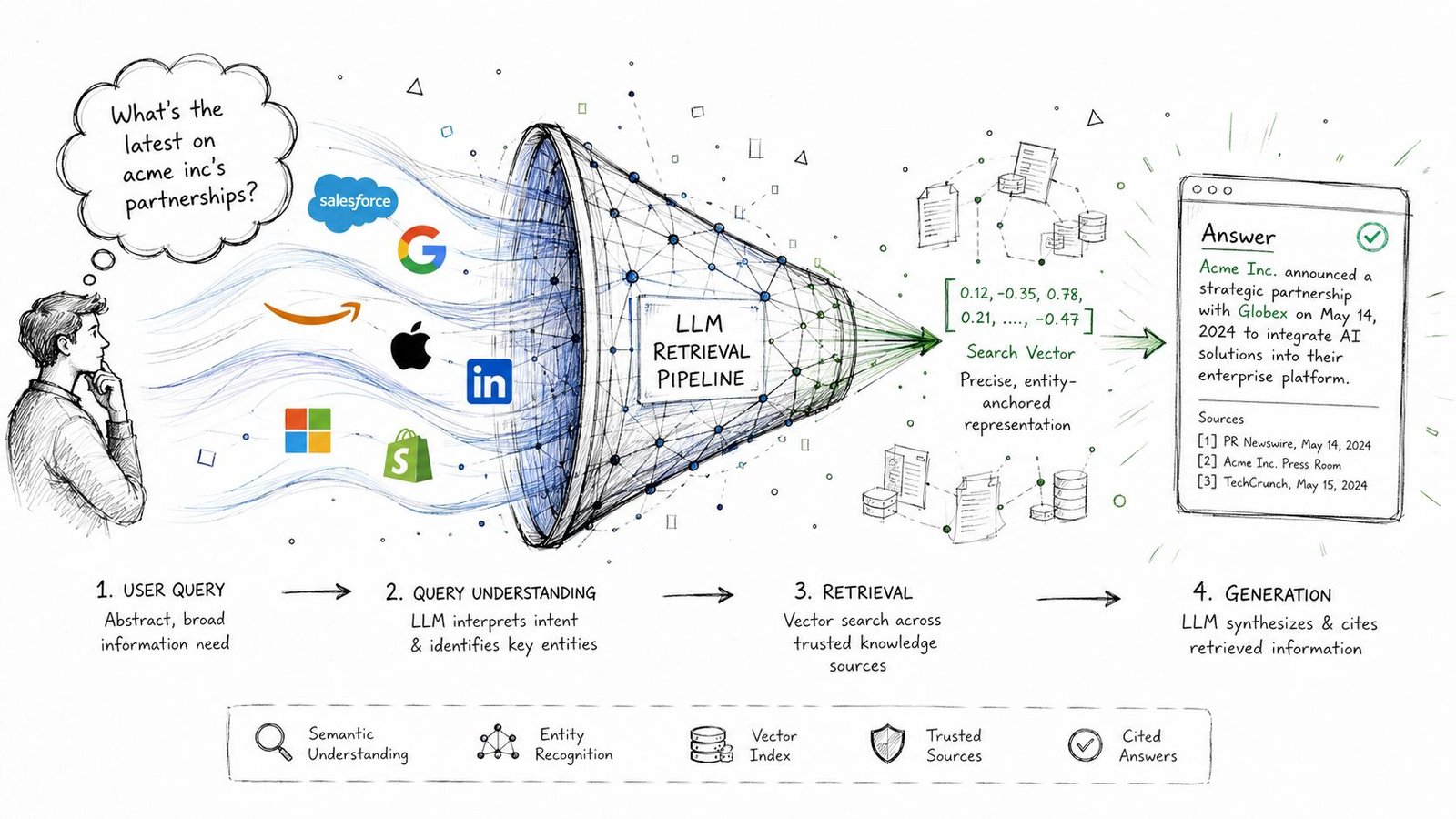
An LLM answer begins with interpretation, not sentence generation. The system expands a user prompt into entities, attributes, and evidence needs. A request for the “best AI note-taking app for engineering teams” can imply several questions: which products serve engineering teams, which support technical workflows, which have credible user feedback, and which sources can substantiate the recommendation.
The retrieval layer then gathers candidate evidence. Depending on the product and query, candidates may come from search indexes, retrieval-augmented generation systems, live web results, or curated data feeds. The generation model does not treat every page equally. It selects a smaller group of documents that appear relevant, attributable, and usable for the answer.
What the retrieval pipeline evaluates
Suppose the candidate set contains a G2 profile, a comparison article, a Reddit discussion, and a YouTube review. Each source supplies a different type of evidence:
- G2 and Capterra profiles provide structured category and customer context.
- Comparison articles place the product beside alternatives.
- Reddit threads show how users describe trade-offs and real-world fit.
- YouTube transcripts add demonstrations, opinions, and repeated product language.
- The company's own pages state official features, pricing, and positioning.
Clear entity names improve attribution. A page that repeatedly identifies the product, explains who uses it, and separates facts from promotion gives the retrieval system cleaner material to extract. The same principle applies across directories, review platforms, media coverage, and community discussions. LLM visibility is a multi-surface entity problem, so page-level polish cannot supply every signal alone.
Freshness also affects live search systems. A current pricing page or recent review may influence a dynamically retrieved answer sooner than an association held in a model's training corpus. Training-corpus influence is slow and difficult to control, while live retrieval influence can change as external pages are crawled and selected.
For founders planning earned media, this guide to press release SEO with AI Overviews connects media distribution, search visibility, and AI-generated summaries without reducing the work to keyword placement.
Citation is a selection problem, not a ranking guarantee
The model chooses which sources to cite or summarize, and that choice remains probabilistic. A relevant page may be excluded because another source offers clearer attribution, stronger context, or better coverage of the exact question.
An AI directory submission service should therefore be judged by the quality and relevance of the resulting entity signals, not by completed forms. A listing with inconsistent positioning, weak category alignment, or little trust may add limited evidence.
The practical sequence is clear: increase the odds that the brand enters the candidate set, then make the retrieved evidence easy to interpret and cite. Directory work can support discoverability, while reviews and earned media strengthen independent validation. Measure both outcomes separately.
On-Site Signals Versus Off-Site Citations
On-site and off-site optimization operate at different points in the retrieval process. On-site signals improve interpretation after retrieval. Off-site signals help determine whether the brand gets considered in the first place.
That distinction prevents a common allocation mistake. Founders often spend another week refining headings while their company has incomplete profiles, inconsistent descriptions, and no third-party evidence connecting the product to its category.
A practical comparison
| Signal Type | Example | Effort | Time-to-Impact | Citation Influence |
|---|---|---|---|---|
| On-site | Organization schema and clear About page | Low to medium | Variable | Helps attribution and extraction |
| On-site | Product schema, pricing, and feature pages | Medium | Variable | Clarifies product facts |
| On-site | FAQ formatting and comparison tables | Low to medium | Variable | Creates extractable answer blocks |
| Off-site | Startup directory profiles | Medium | Delayed and variable | Builds entity discoverability |
| Off-site | G2, Capterra, and Trustpilot presence | Medium to high | Delayed and variable | Adds structured validation |
| Off-site | Editorial coverage and podcast mentions | High | Delayed and variable | Strengthens independent authority |
| Off-site | YouTube reviews and transcripts | Medium to high | Variable | Associates the brand with use cases |
The exact impact depends on the engine and query. The GEO survey emphasizes that topical relevance and contextual position are more reproducible than broad, transferable heuristics. That means no signal should be treated as a guaranteed switch.
For startups with fewer than 50 referring domains, the case for off-site work is particularly strong. A new schema implementation can make an existing page cleaner, but it can't create the independent references that help an unfamiliar brand become a candidate.
The useful heuristic: If a signal appears on a domain you don't control, it may be doing more retrieval work than your homepage.
Where founders should spend limited time
Technical cleanup comes first when the site is difficult to crawl, pages contradict one another, or important product facts are hidden behind scripts. After that, prioritize external surfaces that match the buyer's research behavior.
A focused SaaS team might claim its startup directory profiles, standardize descriptions, collect genuine reviews, and pursue one or two relevant editorial mentions before investing in more elaborate on-page experimentation.
This isn't an argument against startup SEO. Traditional rankings remain a direct input into Google AI Overviews, and search visibility can support retrieval. It's an argument for treating technical SEO as one layer in a wider entity system.
The Core Signals LLM Visibility Optimization Depends On
A startup can improve its basic machine readability within a week. The practical goal is to remove conflicting descriptions and give search engines and answer systems a stable set of facts to retrieve. This work supports the wider entity system, but it does not replace external citations, reviews, or earned media.
Start with the entity definition. Keep the company name, product name, category, audience, use cases, and differentiators consistent across the website and external profiles. If the product is described as an “AI sales assistant” in one place and a “revenue intelligence platform” in another, explain how those terms relate instead of presenting them as unrelated products.
A one-week implementation checklist
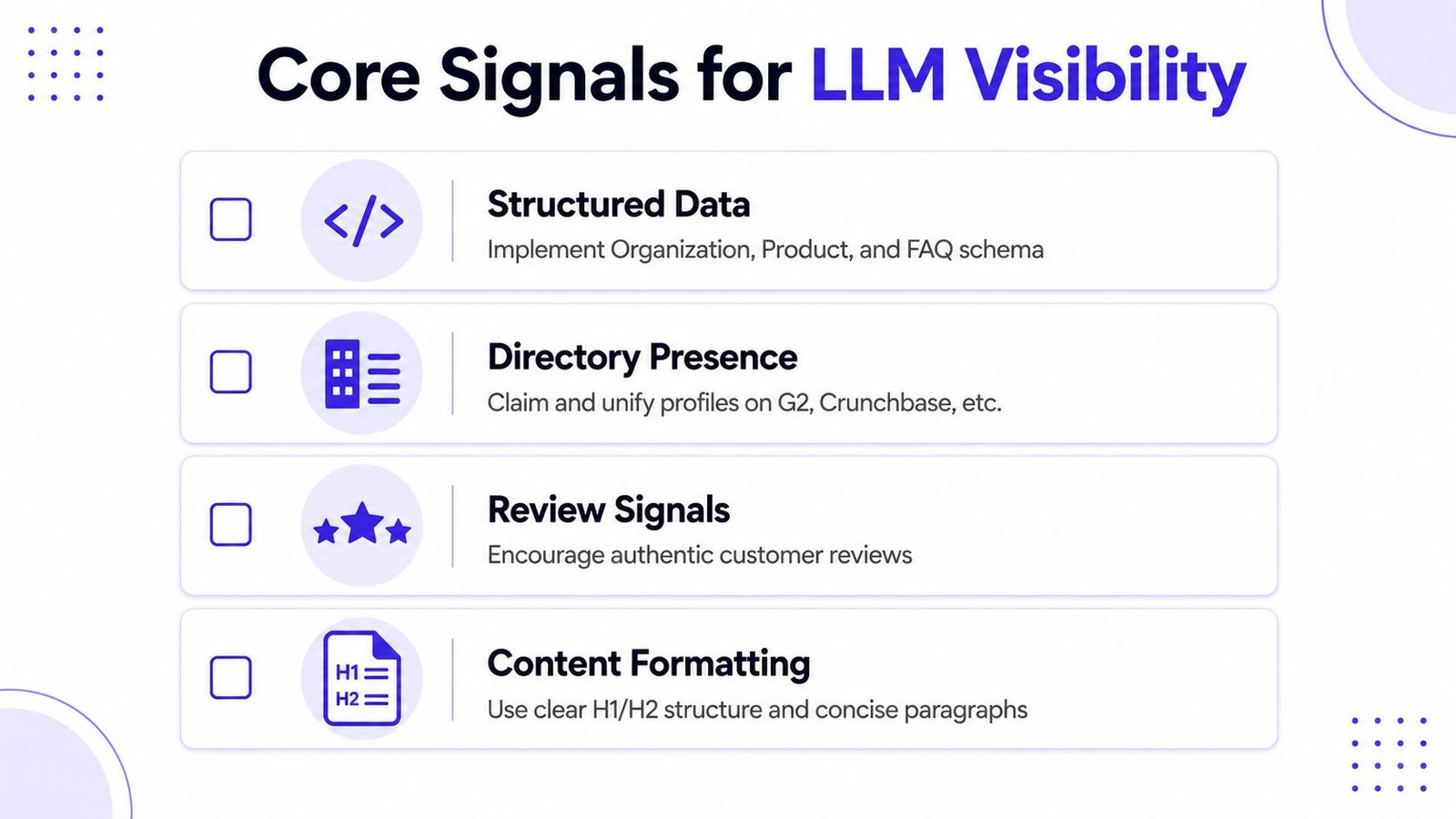
Add Organization schema. Identify the legal or operating entity, logo, official site, social profiles, and brand name. Use
sameAsto connect official accounts and reputable profiles. Validate the markup against Google's structured data guidelines.Add Product schema where appropriate. Describe the product, brand, offers, and relevant specifications. Keep every field aligned with content that visitors can see on the page.
Clean up the homepage, About page, and product page. State what the product does, who it serves, and which problem it solves. Put the direct answer near the top, before broad positioning language.
Create a canonical description. Write one concise company description, then adapt it carefully for G2, Capterra, Crunchbase, Product Hunt, and relevant vertical directories. Preserve the same category and use-case language across those profiles.
Use FAQ and comparison structures. Questions such as “Who is this product for?” and “How does it compare with alternative tools?” create clear retrieval units. Tables are useful when they show factual differences rather than vague marketing claims.
Formatting that supports extraction
Fact-dense paragraphs give models specific material to reuse. “Acme records customer calls, creates searchable transcripts, and sends summaries to Slack” is easier to extract than “Acme transforms collaboration through intelligent productivity.”
Use the exact product name consistently. Make statistics visibly distinct, identify the subject of every claim, and place supporting context close to the statement. For customer quotes, name the customer and clarify the product context.
A clean heading hierarchy, descriptive links, author information, and visible update dates help readers judge the page. They do not guarantee a citation. They reduce ambiguity after a crawler or retrieval system reaches the content, while off-site references determine whether the brand is considered in the first place.
Why Off-Site Authority Beats On-Site Tweaks for Early-Stage Brands
A startup's website is necessary evidence, but it is also a controlled source. Review platforms, editorial coverage, community discussions, videos, and software directories add independent context. That distinction matters when an answer engine evaluates whether a company belongs in a recommendation, comparison, or category response.
An analysis of more than 23,000 AI citations found that earned media sources represented nearly half of citations for brand-named queries, according to TopCited's citation tracking analysis. Early-stage companies rarely need a large public relations operation to apply this lesson. They do need a visibility plan that gives retrieval systems several credible places to confirm the same entity, category, audience, and use case.
The surfaces that influence different buying questions
Each off-site surface contributes different evidence. G2 and Capterra can provide structured product information and customer reviews for B2B software research. Product Hunt can connect a product with a launch moment and category language. AlternativeTo and SaaSHub can support alternative and comparison searches. YouTube can show the product in use through demonstrations, walkthroughs, founder interviews, and transcripts. Reddit can expose practical sentiment around switching costs, reliability, and product trade-offs.
A 75,000-brand analysis found that YouTube mentions correlated more strongly with AI brand visibility than any other metric examined. The finding does not make video a universal shortcut. It shows why a directory-only campaign can leave important evidence missing. Profiles help establish what a company is. Demonstrations, discussions, and reviews help establish how buyers understand it.
Directory work still has a place, especially for a young company with few recognizable references. A manual directory submission service can help validate and scale this process while maintaining consistent categories, descriptions, URLs, and profile details across listings. The service handles distribution work, while the founder remains responsible for choosing accurate platforms and supplying language that reflects the product.
| Platform | Likely role in LLM visibility | Effort to maintain |
|---|---|---|
| G2 or Capterra | Structured product validation and review evidence | Medium, particularly when reviews are required |
| Product Hunt | Launch context and category association | Medium |
| AlternativeTo or SaaSHub | Alternative and comparison discovery | Low to medium |
| YouTube | Product demonstrations, transcripts, and repeated entity language | Medium to high |
| Independent discussion and product sentiment | High, because relevance and authenticity matter | |
| Earned media | Third-party framing and authority | High |
These roles describe practical use cases rather than guaranteed ranking gains. Citation patterns vary by engine, query wording, geography, retrieval timing, and the sources available for a particular answer.
What moved in real startup campaigns
Directory campaigns I have managed produced limited change when they consisted of isolated submissions. The clearer shifts appeared after profiles used consistent category language, credible customer references appeared outside the company site, and external content described the product in terms buyers already used.
A podcast appearance helped when the episode page named the company, explained the founder's relevant expertise, and published a transcript. A directory listing helped when its category matched the product, its description matched the company's site, and the linked product page supported the same claims. Thin listings with inconsistent descriptions added little useful evidence.
The strongest early-stage campaigns connect surfaces rather than treating each placement as a separate task. A directory confirms the entity. A review supports the buying experience. A video demonstrates the use case. An editorial mention supplies independent framing. Together, these references give answer engines more consistent material to retrieve and cite.
Off-site authority requires consistent repetition across meaningful placements rather than unchecked volume.
Measuring LLM Visibility Across Engines
There isn't one universal visibility score that founders can trust across ChatGPT, Gemini, Perplexity, and Google AI Overviews. The GEO research describes visibility as variable by engine, time, location, query formulation, search activation, and generation randomness. Measurement has to preserve those conditions instead of pretending that one prompt produces a permanent result.
Tier one creates a usable baseline
Start manually. Build a fixed set of 20 to 30 buyer-intent prompts, covering category, alternative, feature, use case, and competitor questions. Run the same prompts across ChatGPT, Gemini, Perplexity, and Google AI Overviews when the query triggers an overview.
Record:
- Brand mention: Was the company named?
- Citation presence: Was a source linked or identified?
- Context: Was the brand recommended, merely listed, or described inaccurately?
- Competitor set: Which alternatives appeared?
- Factual accuracy: Were pricing, features, audience, and positioning correct?
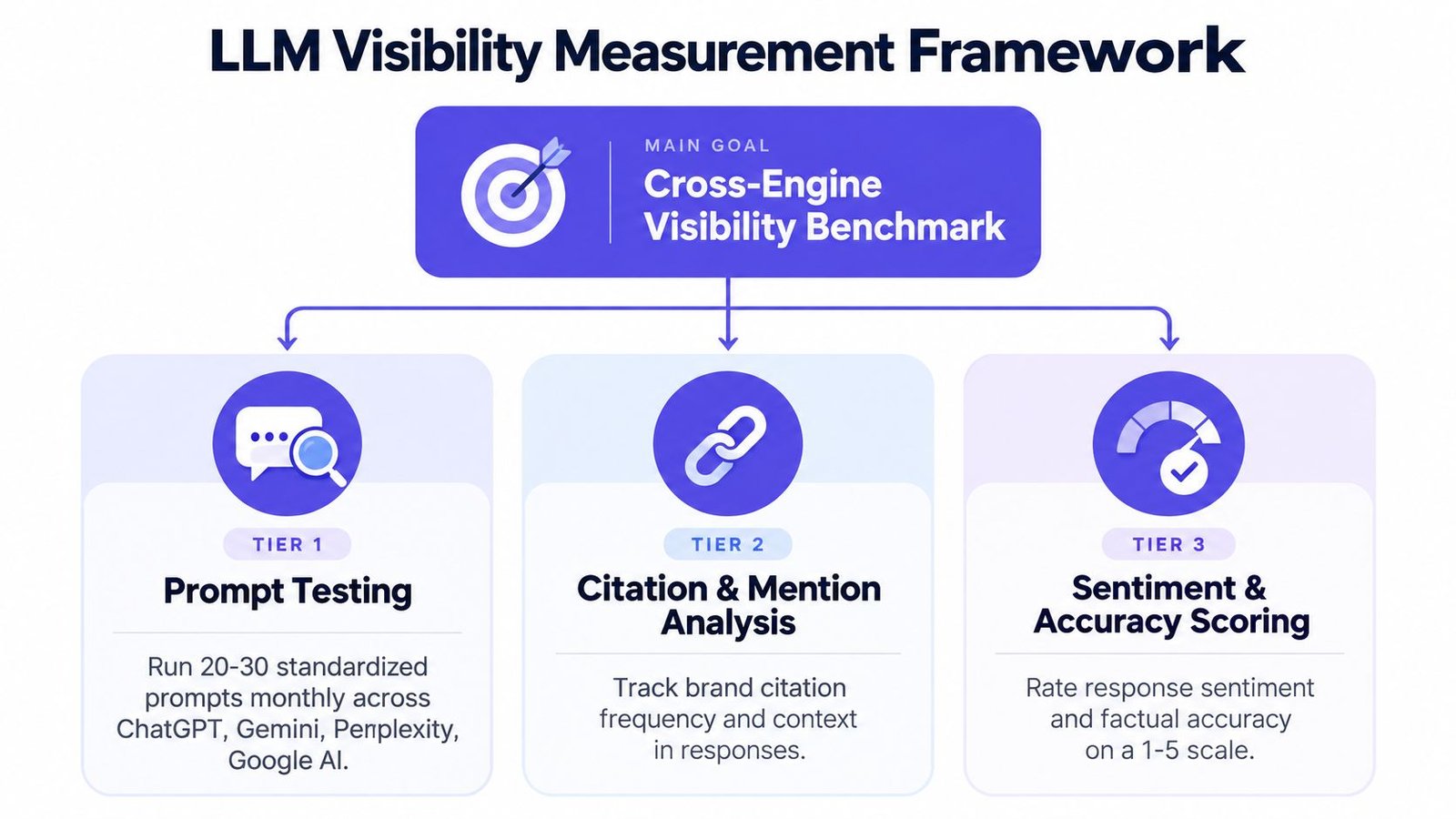
Run the baseline under consistent conditions and save the exact outputs. Don't average away important differences. A brand can be mentioned frequently but described incorrectly, which is a reputation problem rather than a success.
Tiers two and three connect visibility to business value
Once manual testing becomes repetitive, tools such as Otterly, Profound, and Peec can automate parts of mention and citation monitoring. Use them to identify changes, not to replace judgment. A dashboard can't tell you whether a citation came from a relevant review page or an irrelevant listing.
The final tier connects citation velocity with qualified visits, branded search behavior, demos, signups, and pipeline. Traffic alone can mislead because citations don't automatically create clicks. Pew Research Center found that users clicked an external link in only 8% of visits with an AI Overview, compared with 15% when an overview wasn't present, and clicked a cited link inside the AI summary only 1% of the time, according to coverage of the Pew analysis.
A sensible cadence is monthly baseline testing for a small team and weekly monitoring once a campaign produces enough changes to analyze. At 90 days, good progress means more accurate entity descriptions, appearances on relevant prompts, stronger source coverage, and a clear view of which surfaces are being retrieved. It doesn't mean a permanent rank.
A Practical 30-60-90 Plan for Startup Founders
A solo founder shouldn't begin by trying to optimize every platform. Start with identity, add evidence, then measure which sources appear in answers.
Days one through 30, lock down the entity
Claim profiles on G2, Capterra, Product Hunt, Crunchbase, and relevant vertical directories. Use one approved company description, a consistent product name, accurate categories, and matching links.
Publish or improve the About, Pricing, and Use Cases pages. Add Organization and Product schema where it matches visible information. Create three detailed comparison or alternative pages that answer questions buyers already ask, such as “best alternative to [competitor] for small teams.”
Keep a record of every profile, description variant, category, and publication date. That spreadsheet becomes the foundation for later citation analysis.
Days 31 through 60, add independent evidence
Ask real customers for detailed, honest reviews on relevant platforms. Don't script praise or manufacture consensus. A useful review explains the customer's situation, the problem they solved, and the product capability they used.
Pitch podcast hosts and niche newsletters that already reach your buyers. Aim for conversations where the product can be described in context, not shallow mentions that add another logo to a press page. Publish transcripts or clear summaries when permitted, so the external reference contains understandable text.
Use Reddit carefully. Answer relevant questions with practical information, disclose your affiliation when appropriate, and avoid turning community participation into link dropping. The source needs to look like a useful discussion, not a distribution channel.
Days 61 through 90, test and reallocate
Run your standardized prompts across ChatGPT, Perplexity, Gemini, and Google AI Overviews. Compare the answers with your initial baseline and identify the sources that appear when your brand is mentioned.
Double down on channels producing useful retrieval evidence. If G2 appears repeatedly but a low-quality directory never does, improve G2 and stop treating the directory as an equal investment. If YouTube transcripts appear in relevant answers, create more educational demonstrations. If a podcast episode is cited, pursue similar shows.
A directory service can make sense after the DIY loop reveals which categories and platforms matter. For example, StartupSubmit describes a free startup directories resource, while its paid workflow focuses on manual submissions, duplicate checks, categorization, and reporting. The decision should come after you understand your signal gaps, not before.
Don't buy submissions for volume alone. Spend when the service saves founder time, covers relevant reputable platforms, and gives you itemized placements that can be monitored. The return comes from compounding useful entity signals, not from collecting profile URLs.
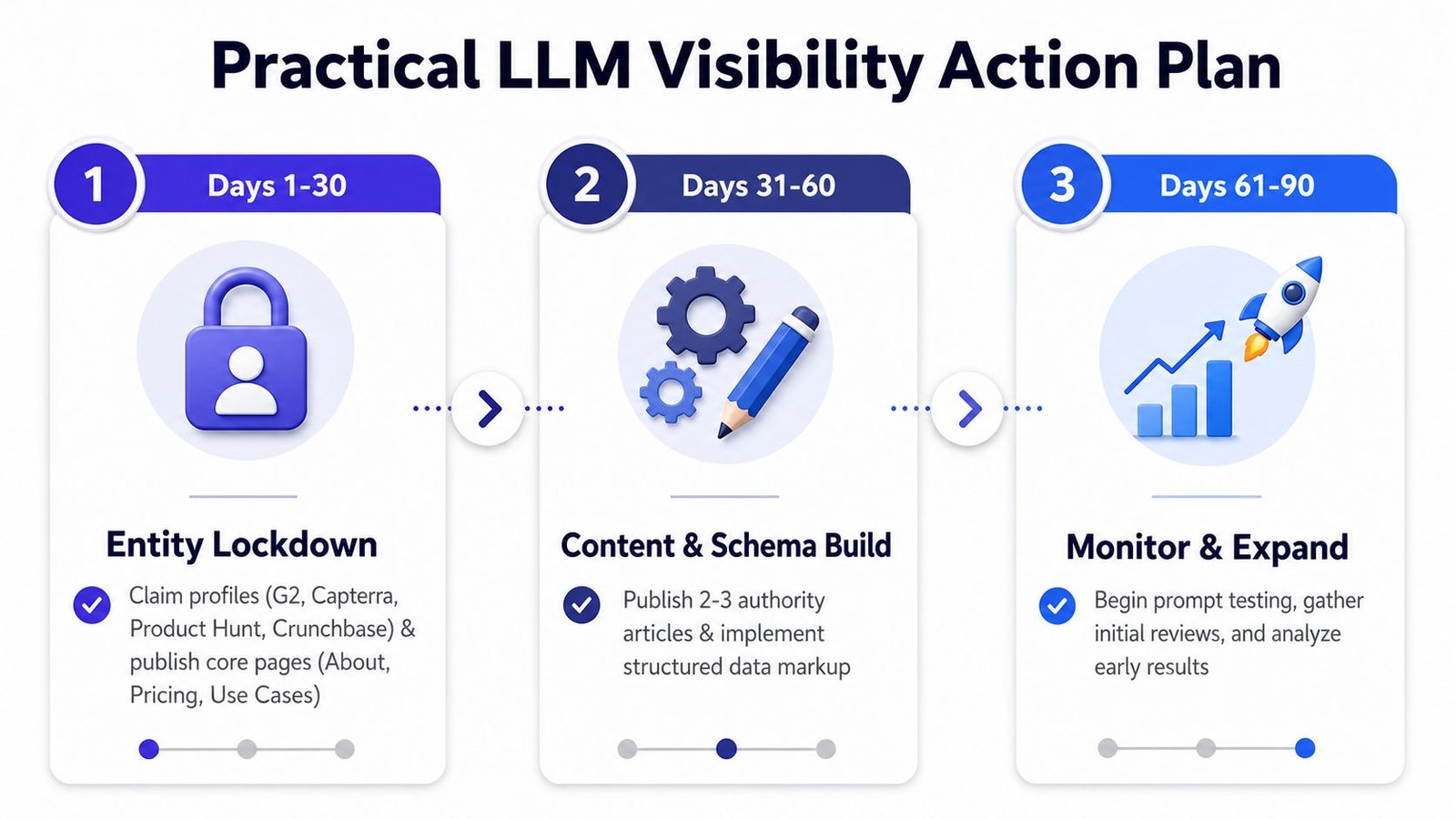
Founder checkpoint: At the end of 90 days, you should know which prompts matter, which platforms feed citations, which descriptions are inaccurate, and where the next hour of marketing effort belongs.
StartupSubmit offers manual submission to more than 200 startup and software directories, with duplicate checking, categorization, and a final report of submitted URLs and placement details. If your prompt testing shows that directory coverage is part of your entity gap, visit StartupSubmit to review the available submission options and decide whether outsourcing that repetitive work fits your growth plan.