
7 IT Staffing Agency Miami Options for Tech Teams
You need three engineers, a technical lead, and someone who can speak comfortably with customers in Latin America. Your product launch is approaching, the hiring manager is already overloaded, and every recruiter says they can deliver “top tech talent.” You still can't tell whether a Miami boutique, a national staffing firm, or an enterprise delivery partner will solve the underlying problem.
The right choice depends on role complexity, hiring volume, geography, engagement model, and the support your team needs after the introduction. A local executive search partner may be ideal for a CTO. A national provider may be better for a rapid team build. A firm with U.S. and LATAM reach may fit a bilingual engineering group.
This guide compares seven IT staffing agency Miami options through actual hiring situations. It covers TekRecruiter, StevenDouglas, Insight Global, TEKsystems, Kforce, Randstad USA, Robert Half, and Akkodis. You'll find verified website links, practical trade-offs, contract questions, and a final hiring checklist.
StartupSubmit can also help a young SaaS or AI company look more established through credible external directory profiles. That visibility supports startup SEO and brand discovery, but it doesn't replace technical screening or a qualified staffing partner. Directory placement is a marketing task. Hiring accountability stays with you and the agency you select.
1. TekRecruiter fits technical searches that need real engineering judgment
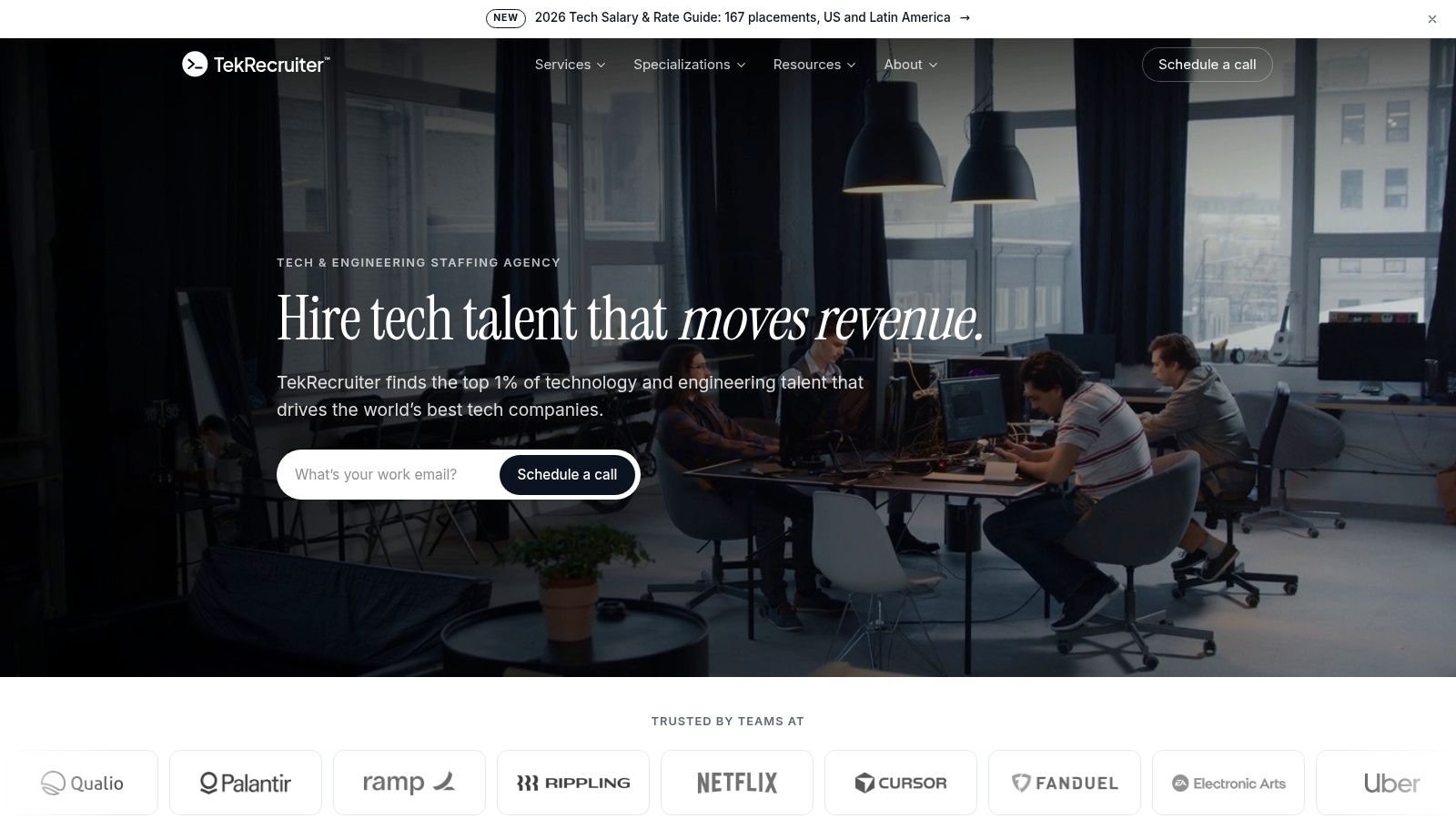
TekRecruiter is the strongest choice on this list when you need a recruiting partner that can discuss the work behind a job title. The firm serves technology and engineering teams across startups, SaaS companies, and enterprises, with a Miami base and relationships in markets including New York. Its coverage extends from software engineers and product owners to GTM engineers, technical account executives, and technology leaders.
That range matters for a growth-stage company. Your first technical hire may be a backend engineer, but the next search could involve a product manager, solutions engineer, or VP of Engineering. Using one specialist can reduce the context loss that happens when each search goes to a different generalist recruiter.
TekRecruiter was founded by Ron Smith, a former software engineer who moved into technical recruiting after building data systems at a startup. The company positions technical understanding as part of its operating model, rather than as a marketing label. Its stated areas include software engineering, AI engineering, cloud infrastructure, DevOps, SRE, data, cybersecurity, product, revenue operations, and technology leadership. You can review its positioning on the best IT staffing firm in Miami page.
Why technical screening is the deciding factor
TekRecruiter describes an AI-native operating system for sourcing, pipeline management, screening, and matching. The useful distinction is that automation supports the workflow while recruiters still hold candidate conversations and make judgments about ownership, execution, resourcefulness, accountability, and transparency.
That approach is particularly relevant for AI and SaaS founders. A resume can mention AWS, Kubernetes, Python, or LLM integrations without proving that the candidate made sound architectural decisions. Ask the agency to require candidates to explain what they built, why they built it, how it affected the business, and what trade-offs they accepted.
The firm reports that it has made 167 technology and engineering placements in 2026 so far, and that 82% of submitted candidates get interviewed, according to its supplied company information. Treat those as claims to validate with a current report, references, and a definition of “submitted candidate.” Ask whether the interview figure applies to all clients, a particular practice, or a selected group of searches.
Practical rule: Ask for the screening rubric before you judge the candidate pipeline. A strong rubric should test production context, not just technology keywords.
Where TekRecruiter makes the most sense
Choose TekRecruiter for a senior engineering search, an AI platform hire, a technical go-to-market role, or a startup that needs one partner across several specialist functions. Its direct-hire offering includes a 90-day placement guarantee, while contract-to-hire and staff augmentation create a path for teams that need flexibility before committing to a permanent hire.
The agency also offers nearshore recruiting for English-speaking engineers in Latin America, including Brazil. The supplied information describes those hires as working in the client's time zone at about 50% lower cost than a U.S. hire, but you should request the assumptions behind that comparison before using it in a budget.
For staff augmentation, TekRecruiter states that contractors can start in as little as three days and that there's no minimum term. Those terms should appear in the proposal, not remain verbal promises.
Its supplier-search service is another unusual option. When outsourcing a product or AI build makes more sense than hiring individuals, the firm can identify managed service providers, software development companies, AI engineering firms, and fractional technology leaders. The client contracts directly with the supplier, while TekRecruiter says suppliers pay a 10% finder's fee. Ask how conflicts are handled, how suppliers are evaluated, and whether the proposed vendor's technology stack matches the talent you may need to hire later.
2. StevenDouglas is a strong fit for local leadership and mixed-level hiring
StevenDouglas makes sense when your hiring problem includes both hands-on technology roles and leadership or interim coverage. The Miami-founded firm has deep South Florida roots and supports contract, contract-to-hire, direct hire, executive search, and interim staffing. That combination is useful when a company needs an engineering manager now but also expects to hire a permanent technology leader later.
The firm's local presence is relevant for searches involving Brickell, Doral, Coral Gables, and other South Florida business centers. It also has experience with organizations that operate across the U.S. and Latin America. For a Miami company hiring people who need to understand local customers, regional operations, or cross-border communication, that context can improve the initial shortlist.
StevenDouglas is a reasonable choice for a local VP of Engineering search, an interim technology leader, or a company that wants to avoid managing separate vendors for contract and permanent positions. Its model feels more personal than a global staffing platform, which can help when the hiring manager needs frequent calibration.
The trade-off for niche technical roles
A local boutique or mid-sized firm may not have the same immediately available bench as a national staffing giant. That doesn't make it a poor option, but it changes the question you should ask. Don't ask only whether StevenDouglas recruits software engineers. Ask which recruiter will own your specific stack and how that person validates architecture experience.
For a narrow search involving an unusual data platform, advanced security environment, or specialized cloud architecture, request:
- Named recruiter ownership: Identify the person responsible for sourcing and the person responsible for technical qualification.
- Search geography: Confirm whether the agency will look beyond Miami when local supply is thin.
- Leadership calibration: Ask how the recruiter separates a strong individual contributor from a manager who has built and retained a team.
- Interim conversion terms: Get the path from temporary or interim work to permanent employment in writing.
The firm may be selective with very early-stage budgets, especially when the role is difficult to define or the compensation is not competitive. Be transparent about runway, decision speed, interview stages, and the authority of the hiring manager. A recruiter can't compensate for an unclear job scope.
Use StevenDouglas when relationship quality and local leadership judgment matter more than maximum sourcing volume. Don't choose it automatically for a high-volume hiring campaign where you need many recruiters working in parallel.
3. Insight Global is built for rapid team expansion
Insight Global is the practical option when your company needs several people across software, infrastructure, data, or security and can't afford a slow, one-recruiter search. Its Miami presence connects local recruiting with a broader candidate network, and the firm supports short-term, long-term, and permanent IT hiring.
That breadth suits a product company moving from prototype to production. You may need a cloud engineer, QA specialist, data analyst, and project support at roughly the same time. A large provider can coordinate those searches more easily than a boutique that specializes in one or two senior placements.
Insight Global also supports enterprise programs and scalable delivery. That matters when the staffing need is attached to a rollout, migration, or operational deadline rather than a single open requisition.
When capacity beats customization
The main advantage is capacity. The main risk is variability. Your experience can depend heavily on the local desk, the assigned account team, and how clearly the firm transfers your technical requirements to its recruiters.
Before signing, ask for a sample candidate profile for the exact role. The profile should explain the candidate's production environment, team size, responsibilities, employment preferences, location, and reason for considering a move. A resume with a list of technologies isn't enough.
You should also define the reporting cadence. For a multi-role build, request a weekly report that separates sourced candidates, screened candidates, submitted candidates, interviews, offers, and withdrawals. That prevents an impressive volume of resumes from hiding a weak qualification process.
A fast pipeline is valuable only when the hiring manager can trust the filter.
Insight Global is best for multi-role hiring, rapid team builds, and organizations that need staffing capacity. It's less attractive when the search depends on a founder-level relationship, highly unusual technical judgment, or a bespoke assessment process. If you're preparing the broader acquisition and visibility work for a young software company, keep startup directory submissions separate from the staffing decision. A stronger external profile won't fix poor candidate matching.
4. TEKsystems suits enterprise programs and managed delivery
A company coordinating a cloud migration, data initiative, or infrastructure change may need more than several contractors. It may need project leadership, reporting, vendor coordination, and compliance support alongside the technical team. TEKsystems is a strong fit for that situation. Its South Florida presence serves the Miami metro, while its model combines IT staffing with managed services and project delivery.
A startup hiring one engineer may find that structure excessive. An established organization building a cross-functional delivery team may value having one provider coordinate contractors, project services, and managed support. The trade-off is clear: broader delivery capacity can reduce vendor sprawl, but the account process may bring more approvals and oversight than a small company wants.
Ask for the proposed operating model before approving a search. Who owns the account? How many people will review the requisition? Who can change the search when the first candidates miss the brief? A defined answer matters more than a polished presentation.
Match the engagement to the program
TEKsystems makes the most sense when the work requires:
- Program scale: Build teams across cloud, data, infrastructure, security, or application delivery.
- Formal reporting: Track sourcing, staffing, delivery milestones, and ownership through a defined program structure.
- Managed support: Decide whether an ongoing service provider fits better than separate individual contractors.
- Enterprise compliance: Coordinate onboarding, documentation, and vendor requirements across a larger organization.
For a startup, compare the agency's operating burden with the value of its scale. If TEKsystems proposes managed services, require written deliverables, staffing assumptions, escalation rules, service levels, and exit rights. If it proposes contract staffing, confirm who supervises the contractors, who reviews technical quality, and what happens when performance falls short.
Request a sample governance plan and a clear escalation path before signing. Those documents reveal whether the proposed service matches your organization's decision speed.
Use StartupSubmit's directory submission service for startup visibility work, not as proof that a staffing partner can deliver a technology program. Evaluate marketing and workforce deliverables separately.
5. Kforce works well for technology and finance crossover hiring
Kforce fits Miami hiring needs where technology work sits inside finance, analytics, or enterprise operations. The national firm has a Miami office and covers software, data, cloud, enterprise applications, and finance-related roles.
That matters for fintech firms, financial services teams, and SaaS companies hiring people who have to work across revenue operations and finance. A data engineer supporting risk analytics, a systems analyst tied to enterprise applications, or a technology project manager coordinating with finance all need a recruiter who understands the business context, not just the title.
The other advantage is flexibility. Kforce can support contract hiring, full-time searches, and project-based staffing, which helps when a team wants to test a role before making it permanent or needs coverage while internal hiring is still moving.
A common mistake is to brief the recruiter only on the technology stack. “Need a Salesforce developer” says almost nothing about the actual job. The recruiter also needs to know whether the person will support billing, customer operations, sales workflows, internal reporting, or an implementation program.
Give Kforce a short context brief that covers the business owner, the systems involved, the success definition for the role, the amount of contact with finance, sales, operations, or customers, and the work model, including location, time zone, travel, and collaboration needs.
Kforce is not the best fit for every niche stack. For highly unusual technical work, a smaller specialist may do a better job. Recruiter quality can also vary by team, so interview the actual person running the search, not only the sales contact.
Use Kforce when the hire sits at the intersection of technology and business operations. It makes the most sense for fintech, analytics, and enterprise application roles, especially for companies that want one Florida-centered partner with national reach. For local search consistency, a local citation service can help keep company details accurate, but it does not improve candidate quality.
6. Randstad USA is the practical choice for bilingual U.S. and LATAM hiring
A Miami company with teams on both sides of the border needs more than a resume match. Randstad USA fits that kind of search when the role blends IT, digital, product engineering, and support functions across a larger organization.
Its value is practical. The firm can help staff a bilingual customer-facing engineer, an implementation specialist, a technical support lead, or a product professional who must work across U.S. and Latin American teams. That requires more than basic Spanish fluency. The candidate has to handle customer expectations, internal handoffs, and the way work moves between countries.
Randstad also makes sense when the hiring need is wider than technology alone. A company in growth mode may be filling engineers, customer operations, finance, and administrative roles at the same time. One larger provider can keep that search organized under a single account.
Define the language job before you brief the recruiter
Avoid the word bilingual unless you explain the job in plain terms. State whether the person must write technical documentation in Spanish, lead client calls, support an internal team, speak with vendors, or switch languages during incident response.
Ask Randstad to show how it evaluates:
- Language proficiency: Confirm whether it tests speaking, writing, and technical vocabulary.
- Regional experience: Ask whether the candidate has worked with U.S. teams, LATAM teams, or both.
- Time-zone coverage: Set the overlap needed for standups, support, and escalation.
- Employment structure: Separate U.S. employment, contractor work, and international hiring arrangements.
- Cultural fluency: Ask for examples of how the recruiter checks communication style and working expectations.
For a very early-stage startup, a large-firm process can feel slow. Attention can also shift when demand is high. Set a response-time expectation, name the escalation contact, and require a weekly pipeline update.
Randstad is the right choice for bilingual hiring, cross-border operations, and multi-function growth. Use it when the search crosses departments or countries. For startup discovery work, best startup directories can help founders build consistent brand references, but those profiles should not be confused with employer branding or candidate qualification.
7. Robert Half is useful for quick backfills and mixed-function hiring
Robert Half gives Miami companies access to a large staffing brand with a Brickell office and a technology practice covering software engineering, data and AI, IT operations, security, enterprise resource planning, and project management. It also supports finance, administrative, and other business functions.
That breadth makes Robert Half useful when the technology role is only one part of the immediate hiring problem. A company may need a data professional, finance support, and an operations hire at the same time. One provider can simplify the intake process and reduce the number of separate relationships your team manages.
The firm also uses technology-enabled matching tools alongside recruiter expertise. That can help with common roles and rapid backfills, particularly when the requirements are clear and the hiring manager can respond quickly.
Protect quality when speed is the priority
The risk is familiar with large staffing brands. Service quality can vary by recruiter and team. You should evaluate the local contact, not rely on the national name.
Ask who will conduct the technical screen, whether the recruiter understands your stack, and how the firm handles candidate ownership if another recruiter or agency has already contacted the person. If you need a security engineer or senior data specialist, ask for a technical interviewer or subject-matter reviewer rather than accepting a resume-only screen.
Robert Half is not accredited by the local Better Business Bureau in Miami, so evaluate the specific team, references, contract terms, and delivery process instead of treating accreditation as a hiring-quality signal.
The best use case is a defined role that needs a quick backfill, especially when your company also needs non-IT staff. The weaker use case is a highly specialized search where the candidate must have unusual architecture experience and the recruiter needs to challenge the hiring manager's assumptions.
Choose the team that can show how it validates the role. Then use the free startup directories resource for your company's external visibility work, not as a substitute for recruiting diligence.
8. Akkodis fits IT and engineering programs that need global reach
Akkodis makes sense for enterprise IT and engineering work that spans systems, cloud, infrastructure, data, analytics, and program support. It offers contract staffing, staff augmentation, and project services, plus global delivery for companies that need more than one local hire.
Use Akkodis when the job is broader than a single requisition. It fits migrations, platform rollouts, managed services, and hybrid teams that need both IT professionals and engineering talent. A connected-device program is a good example, since it may need cloud infrastructure, data engineering, and systems integration at the same time.
The Miami delivery presence matters, but the global sourcing reach matters too. If local recruiting keeps producing too few qualified candidates, a firm with wider coverage can keep the search moving.
Make local ownership a contract requirement
Do not assume the national brand is the key point of contact. Ask for the Miami contact, the escalation path, and the person who will handle technical qualification. Coverage can shift, so judge the assigned team, not the logo.
Before you sign, ask for a clear delivery map that shows which work stays local, which work runs nationally, and which work uses global teams. Separate employees, contractors, subcontractors, and project resources in writing. For cloud, infrastructure, data, and engineering roles, identify who approves candidate fit. Spell out what happens if the recruiter or delivery lead leaves, and define how you can reduce staff, end a project, or transfer knowledge.
Akkodis is strongest for hybrid IT and engineering programs, especially migrations, rollouts, infrastructure work, and managed delivery. It is a weaker fit for a highly personal boutique search for one early startup hire. For that kind of role, TekRecruiter or StevenDouglas is usually the better comparison, because the named recruiter's technical depth matters more than global scale.
Miami IT Staffing, Top 8 Comparison
| Vendor | Implementation complexity | Resource requirements | Expected outcomes | Ideal use cases | Key advantages |
|---|---|---|---|---|---|
| TekRecruiter | Low to moderate, recruiter-led with AI-native sourcing | Moderate, client interviews, budget for premium tech hires; nearshore options reduce cost | High-quality, deeply screened technical hires; strong interview-to-submission rate | SaaS/engineering hires, specialized stacks, leadership roles, nearshore LATAM teams | Founder-engineer expertise, AI-native matching, HEART screening, nearshore vetted talent |
| StevenDouglas | Low, boutique/local processes | Moderate, focused recruiting with personalized attention | Nuanced matches for hands-on and leadership roles | Miami-focused hires, interim leadership, cross-border LATAM needs | Local market depth, seasoned recruiters, boutique attention |
| Insight Global | Moderate, enterprise processes for scalability | High, broad candidate sourcing and program support | Fast, scalable multi-role hiring; variable team-level experience | Large rollouts, multi-team staffing, enterprise programs | Large candidate network, scalable delivery, local Miami pipelines |
| TEKsystems | Moderate to high, enterprise delivery and PMO capabilities | High, program management, compliance and reporting needs | Reliable large-scale team builds, managed services and program delivery | Time-sensitive multi-hire initiatives, cloud/data programs, enterprise projects | Enterprise playbooks, vendor management, rapid scaling ability |
| Kforce | Low to moderate, regional processes with national reach | Moderate, access to both contract and full-time pipelines | Balanced technical and business-aligned hires | Tech + finance/analytics crossover roles, Florida-centric scaling | Florida presence with national scale, strength in tech+finance hiring |
| Randstad USA | Moderate to high, global workflows, compliance focus | High, global sourcing, bilingual and multinational placements | Bilingual and cross-border hires; departmental breadth | U.S.–LATAM hiring, bilingual roles, compliance-heavy environments | Global scale, cultural/language fluency, multi-department staffing |
| Robert Half (Technology) | Low to moderate, tech-enabled matching with national reach | Moderate, access to national candidate pool and AI tools | Quick backfills and cross-functional hires; variable by desk | Short-term fills, hybrid tech/finance roles, fast hires | Large network, proprietary matching tools, broad role coverage |
| Akkodis | Moderate to high, global delivery and project services | High, can supply large teams, augmentation and project support | Scalable engineering teams for migrations, cloud and analytics work | Enterprise migrations, infrastructure projects, multi-location teams | Global reach, hybrid IT+engineering services, fast team scaling |
Turn the shortlist into a hiring decision
The comparison table should help you narrow the field by Miami presence, specialties, role coverage, engagement models, scale, and best-fit scenario. Use it as a starting point, not as a ranking. The best IT staffing agency Miami choice depends on what must happen after the introduction.
For local leadership, start with StevenDouglas or TekRecruiter. For a technical search that requires serious engineering judgment, prioritize TekRecruiter. For a fast, multi-role build, compare Insight Global and TEKsystems. For a formal enterprise program, TEKsystems or Akkodis deserves the first conversation. For technology and finance crossover roles, include Kforce. For bilingual U.S. and LATAM hiring, speak with Randstad USA. For fast backfills across technology and business functions, consider Robert Half.
South Florida has a substantial technology labor pool, but the market extends beyond software engineering. A 2025 regional workforce analysis counted 31,872 software and web developers, programmers, and testers in 2024, along with 16,764 computer-support specialists, 10,480 computer and information analysts, 10,223 database and network administrators and architects, and 7,669 computer and information systems managers. Together, those groups represented 77,008 positions across the report's five-county regional definition, which included Miami-Dade, Broward, Palm Beach, Collier, and Monroe Counties. The analysis projected 6,670 additional software and web developer, programmer, and tester jobs between 2024 and 2034, and estimated approximately 2,700 openings for that occupation in 2024, the highest among the technology occupations examined. See the Bureau of Labor Statistics Miami regional workforce release for the full occupational breakdown.
That depth doesn't mean every agency has equal access to every candidate. South Florida is projected to have nearly 9,773 more technology openings than retained local graduates over the next decade, while 70.2% of employers identify a lack of qualified candidates as their biggest recruiting challenge, according to Miami Tech Works data summarized by Callings.ai's Miami technology labor-market analysis. Ask every agency whether it sources nationally, supports relocation, recruits internationally, and can place remote workers. A Miami-only search strategy may become a limitation when the shortage is concentrated in senior software, cloud, DevOps, cybersecurity, data engineering, data science, and AI/ML.
Use the same requisition with two or three agencies
Interview two or three agencies using the same requisition. Give each one the same job brief, compensation structure, work-location rules, interview process, and start-date target. You'll learn more from the differences in their candidate profiles and questions than from a polished sales presentation.
Request these materials before awarding the search:
- Sample candidate profile: Ask for a redacted example that shows how the agency explains technical depth, business impact, location, work authorization, and motivation.
- Screening rubric: Require the questions and pass criteria for the exact role.
- Reporting cadence: Define weekly or twice-weekly updates, pipeline stages, response times, and escalation.
- References or documented examples: Ask for examples involving comparable roles, company stage, hiring volume, and engagement model.
- Sample contract: Review the agreement before the search begins, not after a candidate is ready to start.
A good agency will ask about the architecture, product stage, team structure, decision rights, and failure modes of the role. A weak agency will ask for a job description and send resumes without challenging the brief.
Questions to resolve before signing
Don't guess pricing from generic market assumptions. Request a written structure that states the markup or fee, payment terms, minimum duration, conversion rules, and replacement guarantee.
For contract staffing, clarify the hourly billing cadence, overtime treatment, expense approval, timesheet process, contractor supervision, equipment, insurance, payroll responsibility, and employment-tax obligations. Ask whether the agency or your company handles background checks, work authorization, confidentiality agreements, and security training.
For direct hire, confirm when the fee becomes payable, what happens if the candidate declines, and how long the replacement guarantee lasts. A guarantee is only useful when the contract defines qualifying departure, excluded circumstances, replacement timing, and whether the agency will restart the search without another fee.
Protect candidate ownership. The agreement should explain how long an introduced candidate remains associated with the agency, what happens if the candidate applies directly later, and how duplicate submissions are resolved. Also address personal data handling, storage, deletion requests, access controls, and whether candidate information is shared with subcontractors.
Termination language deserves equal attention. State whether either party can end the engagement, how much notice applies, what happens to active contractors, how final invoices are calculated, and whether conversion fees survive termination.
Match the engagement model to the actual risk
Direct hire is best when the role is core to your company and you've already defined the long-term need. You receive a permanent employee directly, while the agency manages sourcing and qualification.
Contract staffing is better for temporary capacity, a project with an uncertain end date, or a skill gap you need to close immediately. Your team generally directs the work, but the agency handles the employment relationship according to the contract.
Contract-to-hire reduces commitment risk. You can observe how the person works with your team before making a permanent offer. Clarify the conversion fee, evaluation period, benefits, notice requirements, and whether the candidate can decline conversion without penalty.
Managed services or project delivery makes sense when you need an outcome owned by a supplier rather than individual workers managed by your team. Require deliverables, milestones, acceptance criteria, staffing assumptions, knowledge transfer, security controls, and exit rights.
Frequently asked questions
Should a startup use contract or direct hire for its first engineer?
Use direct hire when the engineer will own core architecture and work as a long-term member of the product team. Use contract staffing when you need immediate capacity, a defined build, or time to validate the scope. Contract-to-hire can work when collaboration and execution style are difficult to assess through interviews alone.
How does contract-to-hire work?
The agency employs or engages the worker for an initial period while your team evaluates performance. If you want to hire the person permanently, the conversion follows the contract's stated rules. Ask about conversion fees, timing, benefits, notice, candidate consent, and what happens if the role changes before conversion.
Which agency is best for bilingual hiring?
Start with Randstad USA for larger U.S. and LATAM hiring programs, then compare TekRecruiter when the bilingual role is highly technical or tied to engineering and SaaS. Define the required language behavior precisely. Speaking Spanish on a casual call is different from writing technical documentation, supporting customers, or leading an incident review.
Should a startup choose an enterprise staffing provider?
Choose an enterprise provider when you need multiple teams, formal reporting, compliance support, or managed delivery. Choose a specialist when you need one senior technical hire, close founder access, and fast iteration on a difficult brief. Ask the enterprise firm how much process your search will require.
How can you verify a staffing partner?
Speak with the actual recruiter and delivery lead, not only the sales representative. Request a screening rubric, sample profile, references, reporting plan, replacement terms, and sample contract. Then run the same requisition through two or three agencies and compare technical reasoning, sourcing geography, candidate quality, and responsiveness.
Do AI skills matter in every technology search?
They matter more often than many job descriptions suggest. A 2025 survey of 1,200 U.S. and U.K. executives and IT professionals found that 95% of organizations check for AI skills during hiring, while 70% classify those skills as mandatory or highly preferred. The same research reported that 86% of organizations have adopted or plan to adopt AI tools, while roughly two-thirds had abandoned an AI project because of insufficient internal skills. Review the 2025 AI Skills Report and ask your agency to test applied ability, not just AI keywords.
Practical next steps for your shortlist
Define the first role before contacting anyone. Write down the business outcome, technical environment, seniority, location, language requirements, interview stages, compensation structure, and deadline.
Choose evaluation criteria before the sales calls begin. Score each agency on technical screening, sourcing territory, recruiter ownership, engagement flexibility, reporting, replacement protection, and contract clarity.
Contact a focused shortlist through the verified links in this guide. Give each agency the same requisition and ask for a sample candidate profile, screening rubric, reporting cadence, references or documented examples, and sample contract.
Compare proposals side by side. Don't select the firm with the most resumes or the fastest unsupported promise. Select the partner that can explain where candidates will come from, how technical quality will be tested, who owns the relationship, and what happens when a placement fails.
Set a deadline for the first qualified candidates, put it in writing, and review the pipeline against that deadline every week. That process will tell you whether you've chosen a true hiring partner or merely added another inbox to manage.
Define your first role today, shortlist two or three agencies, and send each the same brief. Use the verified links above to request proposals, insist on written fee and replacement terms, and set a firm date for receiving the first technically qualified candidates.