Founders: Copyable Founder Bio Examples, 30/100/250 Templates
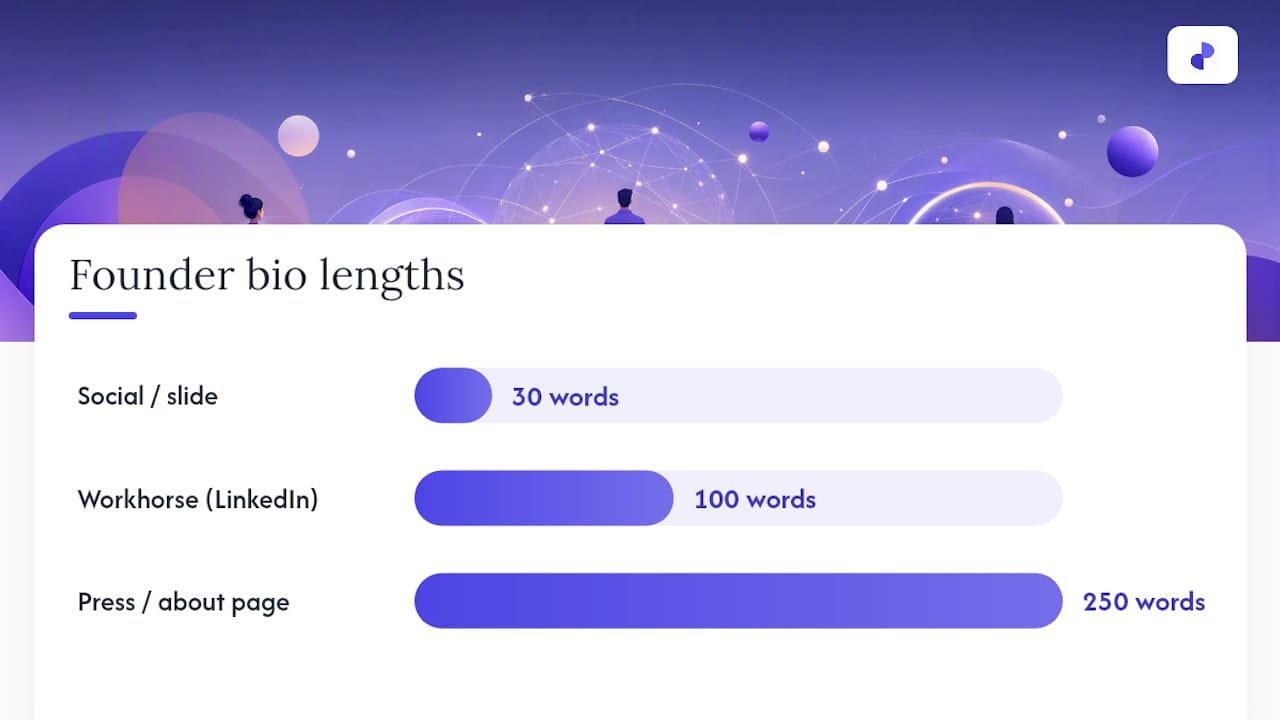
A founder bio is a short investment memo about you: it names who you help, what outcome you deliver, and one proof point that makes the claim believable. Every founder needs three versions ready at all times: a 30-word line for a pitch deck or social profile, a 100-word version for LinkedIn and your website, and a 250-word version for press requests and speaker applications.
TL;DR:
- A founder bio must open with a strong credibility marker, such as a key metric, company name, or a credible recognition, within the first sentence.
- The most effective bios lead with outcomes or proof points, then explain why the founder is specifically suited to solve the problem.
- Tailor bios to each platform by adjusting length, tone, and emphasis: third person for formal sites, first person for personal or relationship-driven channels.
- Including a vivid, specific detail or scene related to the founder’s motivation makes the bio memorable and credible.
- Always prioritize editing over creating from scratch, drafting the longer version first and ruthlessly cutting to ensure clarity and focus.
Founder Bio Examples That Actually Land, and Why
Most founder bios fail for the same reason: they describe a job title instead of making an argument. The ones that work read like a compressed pitch, not a resume. Below are patterns pulled from widely circulated public bios, annotated for what to steal.
- Neil Patel style (short, metric-first): “Neil Patel co-founded NP Digital and Crazy Egg, and has been named a top marketer by Forbes and the Wall Street Journal.” Why it works: it opens with two company names instead of adjectives, then backs them with third-party recognition instead of self-praise.
- Ann Handley style (voice-led, medium): “Ann Handley is the Chief Content Officer of MarketingProfs and a Wall Street Journal bestselling author who has spent two decades arguing that clear writing is a business advantage, not a nice extra.” Why it works: it states a specific point of view, not just a job history, which makes her instantly quotable.
- Long-form press style: A founder bio that opens with the problem the founder personally lived through (“After watching two small manufacturing clients lose six figures to invoice fraud, [name] built…”) before naming the company. This works because pain precedes the pitch, so the reader understands motive before mechanics.
- Quantified proof, short version: “Built and sold a logistics SaaS company to a public acquirer in four years; now applying the same playbook to healthcare scheduling.” One sentence, one metric, one forward statement.
- Team-quality proxy, medium version: For founders without a marquee exit, leaning on team pedigree works: “Founding engineer from [recognizable prior company], now applying that infrastructure experience to climate data.” This substitutes verified association for a personal track record.
- Consumer brand style: “A former restaurant operator who got tired of wasting food, [name] built [company] to turn unsold inventory into revenue instead of landfill.” This works because it names a visceral, relatable frustration before the solution.
The repeatable technique across all of these: lead with an outcome or a credible marker, not a description of daily duties. The Founder Bio Template guide frames this as an investment memo problem, where the first sentence has to carry the heaviest credibility load because many readers never get to sentence two. Curated lists like HubSpot’s professional bio roundup and MIT’s career office collection show the same pattern across dozens of industries: hook, proof, then a personal detail that makes the person memorable, in that order.
Copy-Ready Founder Bio Templates for Every Length
Use these as skeletons, not scripture. Fill each bracket with your own specifics, then cut anything that could apply to a stranger.
- 30-word deck or social bio: “[Name], [role] at [company]. Previously [one credibility marker]. Now building [company] to [outcome] for [audience].” This is the version that goes on a slide or under your LinkedIn headline photo.
- 100-word workhorse bio (LinkedIn, website): Sentence one is the hook (what the company does, who it serves). Sentence two is proof (a metric, prior company, or measurable result). Sentence three is founder-market fit (why you specifically are positioned to solve this). Sentence four, optional, adds one personal or origin detail.
- 250-word press or about-page bio: Open with the hook and proof from the 100-word version, then expand with the origin story: the specific moment or frustration that led to the company. Add a second proof point (funding, customer count, partnership) and close with a personal line, hobby, or affiliation that makes the founder feel human rather than assembled.
Pro Tip: Draft the 250-word version first, then cut it down to 100 and 30 words. Cutting is faster and more accurate than building up from a thin starting point, and it keeps your messaging consistent across every surface, an approach the founder bio template guide recommends explicitly.
Before publishing anywhere, run this 10-minute check: Does sentence one contain your strongest credibility marker? Is there at least one number in the bio? Does the last sentence tell the reader what to do next? Read it aloud once, since anything that sounds stiff on your tongue will read stiff on the page.
First Person or Third Person: Which Fits Your Bio?
The rule is simpler than most founders assume: third person suits formal, public-facing surfaces, while first person suits personal, relationship-driven ones. According to Indeed’s guide to writing a bio, website team pages and press materials read as more credible in third person, while first person on LinkedIn builds a direct, conversational connection with the reader.
- Third person: “Maria Chen founded Ridgeline in 2023 after a decade in supply chain software.” Reads as an institutional fact.
- First person: “I founded Ridgeline in 2023 after a decade in supply chain software.” Reads as a personal introduction.
To convert between the two, first swap every pronoun (Maria → I, her → my), then reread the verbs. Third person tolerates flatter, declarative verbs; first person needs slightly warmer phrasing or it sounds like you are narrating your own resume out loud.
The Hook, Proof, Why-You Formula for a Bio That Sells
Every strong founder bio compresses into three sentence jobs, a structure drawn directly from how investors read pitch materials. The founder bio template calls this the investment memo approach: hook, proof, and founder-market fit, in that order, because readers decide whether to keep reading within the first sentence.
- The Hook: What the company does and who it serves, in plain language. “Runs a payroll platform for restaurant chains with fewer than 50 locations.”
- The Proof: A concrete number or named outcome. “Grew from 12 to 400 paying locations in 18 months.”
- The Why You: The founder-market fit that explains why this person, specifically, should be trusted to solve this problem. “Spent six years managing payroll operations for a 200-location franchise before building the tool she wished she’d had.”
Across sectors, the shape holds: a SaaS founder might swap in ARR growth, a consumer founder might cite unit sell-through, and a creator-led founder might cite audience size or retention. If you lack a marquee metric or recognizable prior employer, lean on proxy proof instead, a growth percentage, a time-to-market win, or the caliber of your founding team. A HubSpot analysis of professional bios notes that concrete proxy metrics do the same credibility work as brand names when you present them with specific numbers instead of vague adjectives.
Bio Mistakes That Quietly Kill Credibility
Certain patterns show up so often that experienced readers, investors especially, skim right past them. The founder bio template guide flags several as automatic red flags: weasel verbs (“helped drive growth”), buzzword salad (“passionate, innovative disruptor”), full resume dumps, missing calls to action, and typos in the first two sentences.
- Weasel verbs: Replace “helped grow revenue” with the actual number or your actual role. If you cannot name the number, you probably should not claim the credit.
- Buzzword salad: Cut any adjective that could describe literally any founder. “Passionate” and “innovative” say nothing a reader can verify.
- Resume dumps: List one or two roles that matter to this specific pitch, not your entire career history.
- Missing CTA: Every bio needs a last line that tells the reader what to do: connect, reply, book a call, or read more.
- Typos in sentence one: A single error there undercuts every credibility claim that follows.
Match your closing line to the surface: investor bios end with a funding ask or meeting invite, prospect-facing bios end with a demo link, press bios end with a media contact line, and website bios end with a link to the fuller company story.
Tailoring a Founder Bio to Each Platform
The same person needs a different bio on every surface, not because the facts change, but because the reader’s attention span and expectations do.
- LinkedIn About: Roughly 100 words, first person, opens with a narrative hook rather than a title, ends with one clear call to action like “always happy to connect with fellow operators.”
- Website team page: 100 to 150 words, third person, weighted toward proof and current role, linking out to the fuller company story.
- Pitch deck slide: 20 to 40 words, third person, exactly one proof point. Investors are skimming, not reading.
- Press or speaker bio: 200 to 300 words, third person, with room for background and a media hook a journalist can quote directly.
Update every version after a funding round, a major hire, or a milestone. A bio that still says “pre-seed” two rounds later signals neglect more than modesty.
Why a Great Bio Still Needs Distribution
A polished bio does the persuasion work, but it only pays off if the right people see it. Press outreach and directory listings both lean on your bio as the first credibility check, and a tight founder-market-fit sentence often decides whether an editor or a directory reviewer keeps reading. Once your bio is sharp, getting it in front of more discovery surfaces, startup directories among them, is a distribution problem, not a writing one.
Adjusting Bios for Different Industries and Reader Expectations
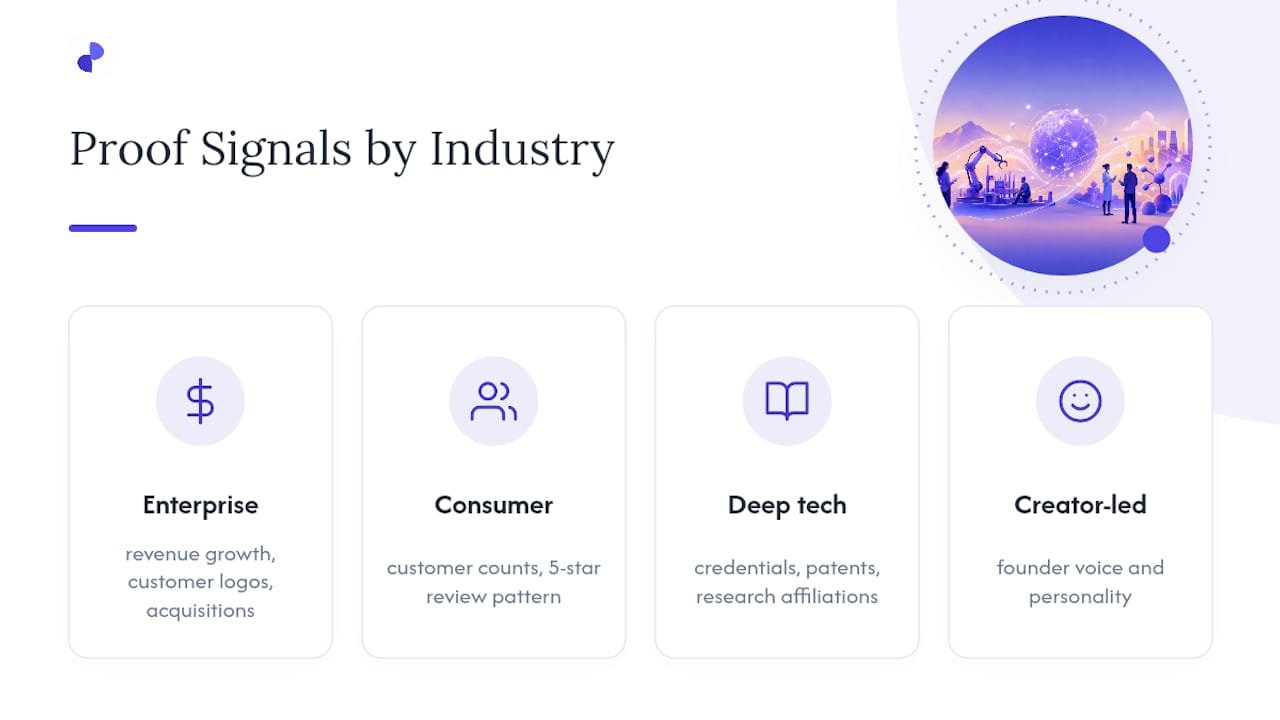
An investor reading a SaaS founder’s bio wants growth metrics and prior exits. A local customer reading a bakery founder’s bio wants warmth and a reason to trust the person behind the counter. The same three-sentence structure holds, but what counts as “proof” shifts by audience.
In enterprise software or fintech, proof means revenue growth, customer logos, or a prior acquisition, and the tone should stay clipped and factual. In consumer products or hospitality, proof can be a customer count, a five-star review pattern, or a specific problem solved for real people, and a slightly warmer, more personal tone reads better. In deep tech or biotech, proof often means academic credentials, patents, or research affiliations, since technical credibility matters more than charisma there. Creator-led and personal-brand businesses can lean harder on voice and personality, since the founder’s story is frequently the product’s main differentiator.
The test is simple: read your bio as your specific reader would. An investor skimming forty bios in an afternoon has different patience than a journalist deciding whether to quote you, and both differ from a customer deciding whether to trust a small business. Write one master version, then edit the emphasis, not the facts, for each audience.
Storytelling Techniques That Make a Bio Memorable
Facts alone rarely make a bio memorable. What sticks is a specific, concrete detail that turns a list of accomplishments into a story with a beginning. The strongest founder bios usually contain one vivid, particular moment, the exact problem the founder was solving, the specific frustration that triggered the company, or the number that made the founder quit a stable job.
Compare “passionate about solving supply chain inefficiencies” with “spent three years watching restaurant owners throw away food they had already paid for.” The second version is a scene, not a claim, and scenes are what readers remember and repeat. Structuring your bio as a compressed narrative, problem, insight, action, result, does the same persuasive work as a full origin story in a fraction of the space. Pairing that written narrative with a strong visual identity, a clear headshot and consistent brand imagery across your team page and social profiles, reinforces the same story instead of undercutting it with mismatched, generic stock photography.
Keep the story detail specific rather than universal. “I’ve always loved helping people” fits nearly anyone and therefore convinces no one. “I spent four years as a nurse before building software to fix the scheduling chaos I lived through every shift” fits exactly one person, and that specificity is what makes it credible.
Staying Authentic Without Oversharing
The line between a compelling bio and a dishonest one usually comes down to precision, not personality. Claiming you “led” a project you contributed to, rounding a modest metric into an impressive-sounding one, or borrowing a co-founder’s achievement as your own solo win are all forms of quiet exaggeration that tend to surface eventually, and they cost more credibility than a modest, accurate bio ever would.
Authenticity does not mean disclosing everything. You do not owe readers your full personal history, your failures in detail, or information irrelevant to the pitch. It means every claim you do make should hold up if someone checked it: the metric is real, the title is accurate, and the credit is shared honestly when a team earned it together. If you are still building toward a big outcome, say so plainly rather than implying it already happened. “Building toward” and “grew to” are different claims, and readers, especially investors and journalists, notice which one you chose.
The personal details worth including are the ones that explain your motivation, not the ones that just fill space. A hobby only belongs in your bio if it says something true about how you think or work. Otherwise it is filler dressed up as personality.
The Editorial Take: Stop Writing Bios From Scratch
The biggest mistake founders make with their bio is treating it as a writing exercise instead of an editing exercise. Nobody needs a blank page and inspiration here. What they need is a good annotated example, a template with the sentence-level logic already built in, and permission to cut ruthlessly. The conventional advice, “just be authentic” or “let your personality shine,” is true but useless without structure. Personality without a hook, proof, and founder-market fit is just noise with charm.
If you take one thing from this article, take the 10-minute edit habit: draft long, cut to length, and read the first sentence out loud before you publish anywhere. Most founders bury their strongest credibility marker in sentence three. Move it to sentence one. Once your bio earns attention on its own, the next problem is visibility, and that is a distribution question worth solving separately, sometimes with help from a service like Startupsubmit built specifically for that gap.
— Danish
Getting Your Polished Bio in Front of More People
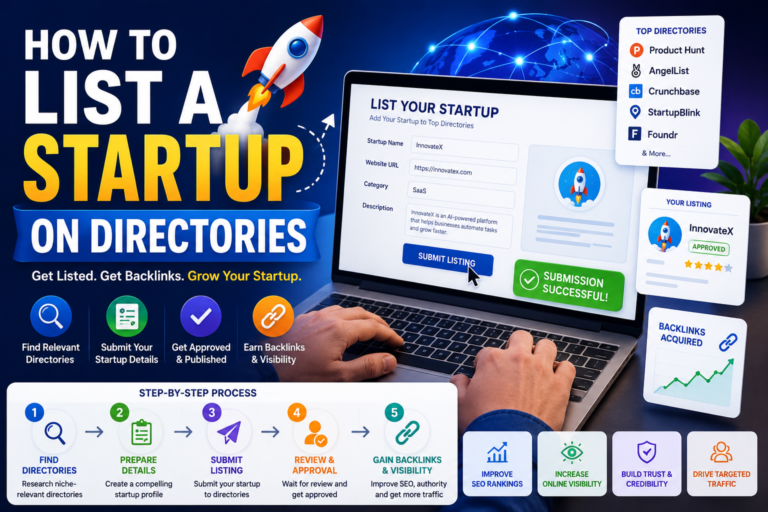
Once your founder bio is sharp, the next bottleneck is usually exposure, not writing. There are services that place startup profiles across many high-authority directories, using manual submissions and unique listings rather than automated bot submissions.
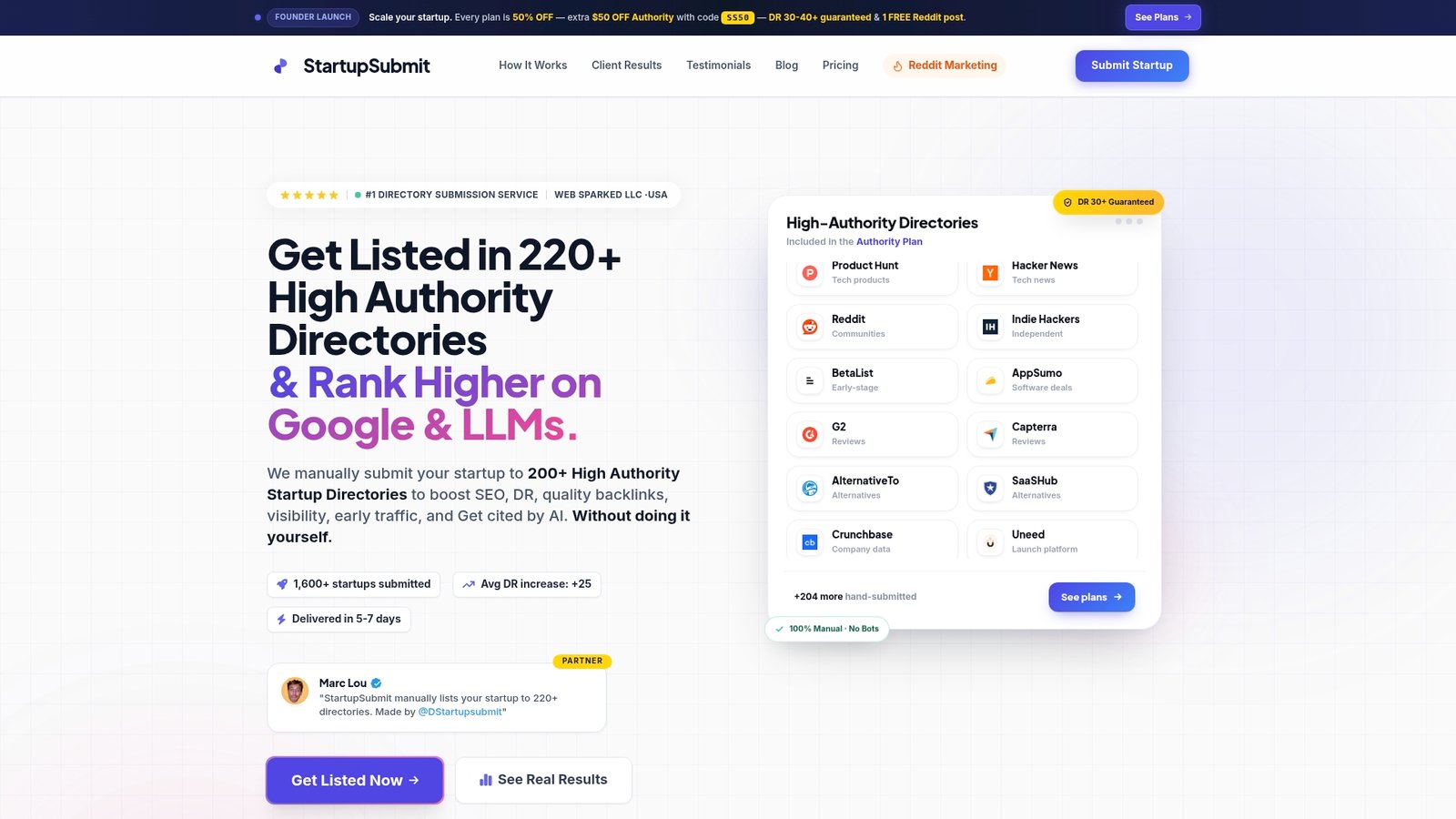
That manual approach matters because directories reject duplicate or thin listings, and a professionally written profile clears review far more reliably than a copy-pasted one. Some submission services handle duplicate checking, category selection, and placement reporting to help your bio reach relevant audiences searching those directories. If you want to see where your startup could realistically be listed, start with the best startup directories roundup or head straight to the Startupsubmit submission service to check current pricing and get your profile queued.
Sources
- Free AI Founder Bio Generator | Nautis
- Guide to writing a bio (Indeed)
- Founder Bio Template: Write a Bio That Gets Funded
- Professional Bio Examples: 29 Work Bios I Keep in My Back Pocket for Inspo + Templates
FAQ
What Is a Good Founder Bio Example?
A good founder bio example leads with a hook (what the company does), backs it with a proof point (a metric or named outcome), and closes with founder-market fit (why this founder specifically). The founder bio template guide frames this three-sentence structure as the core of any bio that needs to persuade rather than just inform.
What Is the Best Short Bio Length?
The best short bio is typically 30 words for a pitch deck or social profile, since that surface demands one proof point and nothing extra. For LinkedIn or a website, 100 words is the standard workhorse length, per common guidance on founder bio structuring.
How Do I Write a Short Bio of Myself?
Start with your strongest credibility marker as sentence one, add one quantified result as sentence two, and close with why you specifically are positioned to solve this problem. Write the longer 250-word version first, then cut it down, which is faster and more accurate than building up from nothing.
What Should I Write in My Business Bio?
A business or founder bio should state what the company does, who it serves, one proof point, and a closing line telling the reader what to do next. Third person tends to work better for formal business bios on team pages and press materials, while first person suits personal channels like LinkedIn, according to Indeed’s bio writing guide.
Recommended
- StartupSubmit vs ListingBott (2026): Honest Directory Submission Service Comparison
- StartupSubmit vs LaunchDirectories (2026): Honest Directory Submission Service Comparison
- StartupSubmit vs SubmitJuice (2026): Honest Directory Submission Service Comparison
- StartupSubmit vs AIDirectories (2026): Honest Directory Submission Service Comparison