Best Backlink Services for Early-Stage SaaS Founders
Most founder advice on backlinks is backwards. You're told to chase the highest count at the lowest price, then watch Domain Rating climb. I've run that play at early SaaS companies and paid for the cleanup later. The links that held value weren't the bulk packages. They were accurate, moderated profiles on distinct, relevant domains that stayed live and indexed. Treat the best backlink services as a discovery and entity asset, not a ranking lever you pull once. Judge every vendor by survival, indexing, and branded discovery, not by the size of the delivery spreadsheet.
Table of Contents
- Why Backlinks Still Matter for Early-Stage SaaS
- The Evaluation Criteria That Actually Predict Outcomes
- Manual Directory Services, Agencies, and Link Platforms Compared
- Best Backlink Services for SaaS Founders in 2026
- Why Manual Directory Submissions Are the Default for Pre-Seed Founders
- Backlinks and AI Search Visibility
- Reporting, Indexing, and Verification Checklist
- Your 30, 60, and 90 Day Backlink Plan
Why Backlinks Still Matter for Early-Stage SaaS
Backlinks still matter, but not for the reason most sales pages pitch. A large delivery count tells you almost nothing about quality. What matters is whether distinct, reputable sites reference the right product or company page with accurate context.
That distinction shows up in the research. Moz's 2015 ranking factors study found link-based features among the strongest associations with higher rankings, drawing on correlation analysis and survey input from more than 150 SEO professionals. Moz also warned that correlation doesn't prove Google uses any single factor directly. I take that seriously when I'm advising founders. Don't buy causation from a vendor who only sells correlation.
Why 200 Links Can Mean Two Different Things
A manually placed profile on a moderated SaaS directory isn't equivalent to a link on an irrelevant blog network, even if both reports show one URL. The first can validate your company name, category, logo, and product page. The second adds risk and teaches search systems nothing useful about what you sell.
Moz's later work also pointed to page-level links as a stronger predictor than links viewed only at domain or subdomain level. That's practical advice for Startup SEO. Point useful profiles to a clear product, pricing, or company page where it fits, and keep categories accurate. Don't dump every link at the homepage and call it diversification.
A backlink profile that helps a buyer, investor, or search system verify who you are is worth more than a bigger profile nobody can trust.
Founders also need advice that connects SEO to positioning, pricing, and launch work. I've found marketing advice for founders useful for that broader context, especially when a team is deciding whether link building should come before fixing messaging or onboarding.
What You're Actually Buying
You're buying one of three things. Manual directory work builds legitimate profiles and entity consistency. Agencies sell outreach, content, and digital PR relationships. Platforms sell scale and ordering speed, usually with less control. The right choice depends on stage, bandwidth, and how much proof you demand.
For pre-seed and seed teams, backlinks matter because you're unknown. Search engines, ChatGPT, and Google AI Overview systems need consistent third-party references before they'll describe you confidently. A thin website with no external footprint is easy to ignore. A clear product backed by accurate profiles across trusted startup directories gives those systems something stable to recognize.
The Evaluation Criteria That Actually Predict Outcomes
Don't start with price or promised DR. Start with evidence. Ask every vendor to show sample live placements, the report format, replacement terms, and how they handle domains where you already have a profile.
Google classifies buying or selling links that pass ranking credit as link spam, including paid posts and advertorials with optimized anchor text. Paid advertising placements need rel="sponsored" or rel="nofollow", and Google's spam policy documentation says sponsored is preferred for paid links. If a vendor promises every paid placement will pass PageRank, walk away. Manual work improves acceptance. It doesn't override that policy.
The Seven Checks I Use
- Moderation safety: Ask if a person completes each submission and how the team handles captchas, email verification, and category rules. Automated footprints get rejected or removed.
- Duplicate checking: Require a check for existing listings before submission. Duplicate profiles split reviews and create conflicting company data.
- Unique referring domains: Count distinct domains, not total URLs. Thirty relevant domains beat repeated pages from a small set of hosts.
- Indexing rate: Ask how the vendor verifies indexability after delivery. A live page blocked by noindex has limited discovery value.
- Anchor and rel reporting: Demand destination URL, source page, anchor text, HTTP status, indexability, and rel attribute for every placement.
- Topical fit over DR: A relevant SaaS, AI, or B2B software directory is usually more defensible than an unrelated high-DR site.
- Durability: Ask what happens when a listing is rejected, edited, or deleted. Get the replacement window in writing.
How to Read the Numbers
Domain diversity is useful, but don't treat it as proof of traffic. Ahrefs' guide to referring domains and backlinks describes a positive correlation between unique referring domains and organic traffic, without establishing causation. It also notes that referring-domain traffic showed little additional correlation compared with total referring-domain count. Translation for founders is simple. Don't overpay because a linking site looks busy in a screenshot.
Your scorecard after delivery should track new unique domains linking to you, accepted listing rate, indexed rate after 30 to 90 days, branded impressions, referral sessions, and movement on relevant non-branded queries. Separate homepage links from deep links and flag duplicates. That's SaaS SEO reporting an operator can act on.
Vendor test: If the report can't prove a placement is live, public, accurately categorized, and tied to a distinct domain, you didn't buy a backlink service. You bought a list of attempts.
Pricing comes last. A cheap package that produces unindexed, duplicated, or policy-risky placements isn't cheap. It's rework you'll pay for during your next launch.
Manual Directory Services, Agencies, and Link Platforms Compared
These models solve different problems. Confusing them is where founders waste money. A directory service won't earn a feature in an industry publication, and a digital PR agency is a poor tool for completing two hundred software profiles.
Manual directory submission services handle repetitive execution. They research eligibility, avoid duplicates, complete forms, choose categories, upload logos, write descriptions, verify emails, and report live URLs. The value is founder time saved and consistent data across startup directories. The limit is also clear. You're building foundational profiles, not editorial endorsements.
What Agencies Actually Bundle
Link-building agencies sell judgment and relationships. A good team plans target pages, creates assets, pitches publishers, writes guest content, handles niche edits, and runs digital PR. That work can produce stronger contextual placements when you have a story, data, or expert point of view worth citing.
It also demands more from you. Someone on your team must approve targets, review content, supply expertise, and judge relevance. Retainers make sense when content and product marketing are already moving. They don't make sense as a substitute for basic profiles, crawlability, and clear positioning.
Where Platforms Win and Lose
Platforms such as outreach and marketplace tools optimize for workflow. They help you find prospects, send sequences, track replies, and order placements faster. That speed is useful for a growth lead who knows how to vet domains.
It's dangerous for a founder who treats the marketplace score as due diligence. You still own relevance, anchor choices, rel attributes, and policy risk. Scale without moderation knowledge produces a footprint that looks manufactured because it is.
For a deeper model-by-model view of hands-on execution versus broader campaign support, see this comparison of directory submission and outreach-led approaches. Use it to clarify buying intent before you compare brand names.
My sequencing is blunt. New SaaS and AI companies should secure accurate directory coverage first, then add editorial outreach when they have pages and assets worth pitching. Mature teams with an SEO lead can use platforms to increase throughput. Teams chasing competitive category terms will eventually need agency-level PR and content, not more profile links.
Budget follows that sequence. One-time manual work is easier to justify before product-market fit because the deliverable is finite and auditable. Agency retainers need a longer horizon and internal owner. Platforms sit between them, but the subscription is only part of the cost. Your review time counts too.
Best Backlink Services for SaaS Founders in 2026
There's no universal winner. The best backlink services for a pre-seed AI tool, a funded B2B SaaS company, and an agency reselling fulfillment are different products. Match the model to your stage before you negotiate price.
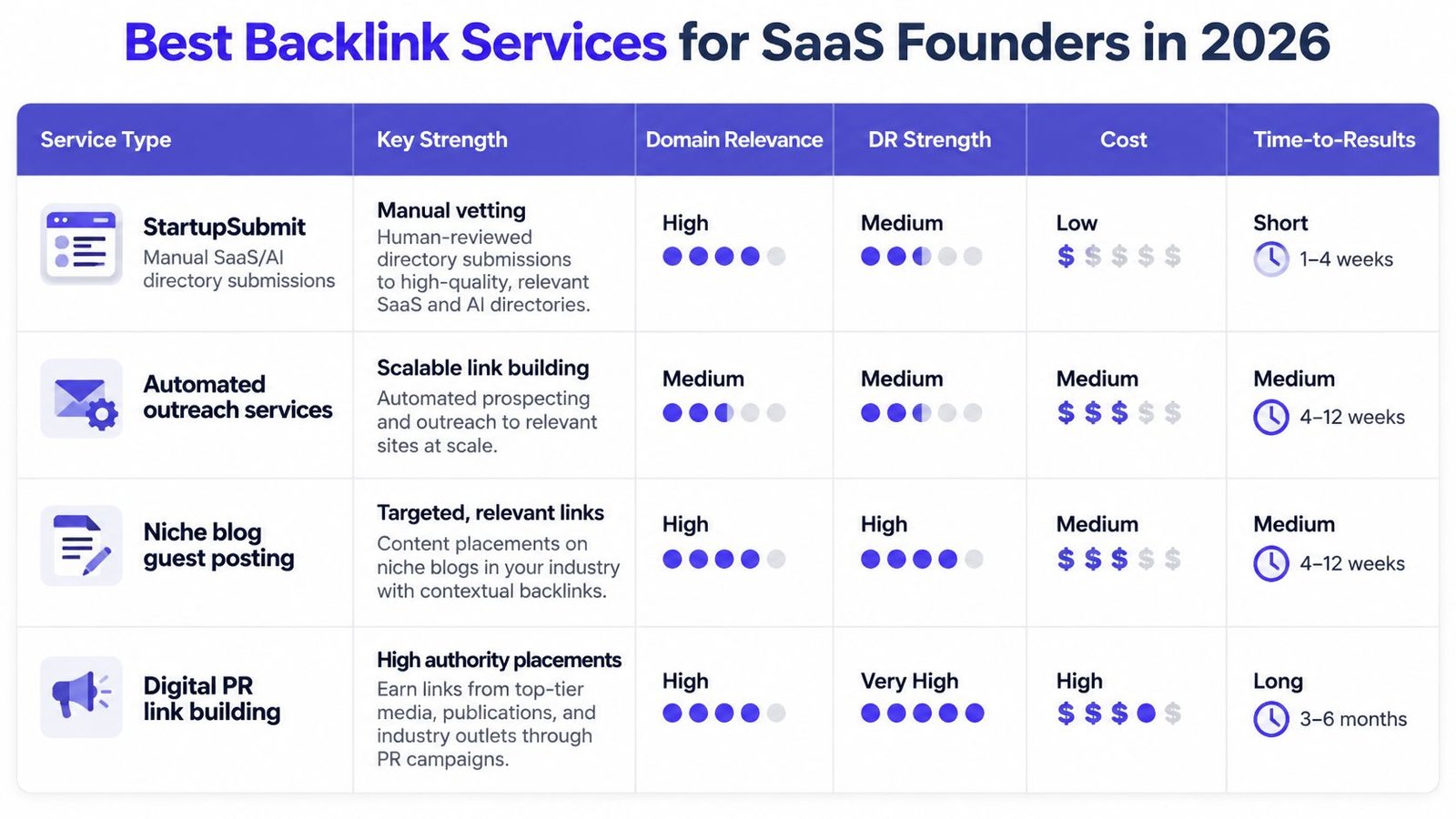
| Service Model | Best For | Typical Pricing | Execution Window | Key Risk |
|---|---|---|---|---|
| Manual SaaS and AI directory submissions | New products needing profiles, entity validation, and initial referring domains | One-time package | Short, finite campaign | Low editorial depth |
| Authority Builders style marketplaces | Operators who want to inspect placements before buying | Per link or managed credits | Depends on publisher approval | Paid-link policy and relevance risk |
| Editorial.Link style outreach services | Teams targeting contextual links to product or content pages | Per link or campaign | Slower than directory work | Variable publisher quality |
| Pitchbox and Respona platforms | In-house marketers running their own outreach | Software subscription plus labor | Ongoing | Requires skilled vetting and follow-up |
| Fat Joe style fulfillment | Agencies needing repeatable white-label volume | Per placement | Fast and standardized | Less startup-specific categorization |
Which Option Fits Your Stage
Choose a manual directory service when you're launching, rebranding, or missing basic profiles on software marketplaces. You need accurate categories, consistent descriptions, and a report your team can maintain. Start by reviewing the best startup directories for SaaS discovery and remove any where your product doesn't belong.
Choose a marketplace or outreach-led provider when specific pages need support and you can inspect each domain. Ask for topical relevance, live examples, traffic evidence, and rel treatment before payment. Don't accept a DR range as a substitute for seeing the actual site.
Choose Pitchbox or Respona when you already employ someone who can build prospect lists and write credible pitches. Software doesn't create publisher trust. It organizes the work of earning it.
Choose high-volume fulfillment only when standardized output matters more than startup-specific nuance. That can work for an agency portfolio. It's rarely my first recommendation for a founder-led SaaS launch.
The most underpriced lever for an early-stage founder is usually not a premium editorial link. It's a complete, accurate footprint across the directories buyers already use to compare software.
How Fast Should Links Accumulate
Ahrefs' backlink growth study analyzed 200,000 pages across 10,000 non-branded keywords and found most number-one pages gained new followed referring-domain links at roughly 5% to 14.5% per month. That's a benchmark for gradual diversification, not a target to manufacture. Content quality, search intent, technical health, and brand demand still decide whether growth becomes rankings.
Why Manual Directory Submissions Are the Default for Pre-Seed Founders
Pre-seed founders don't need a link-building department. They need to be findable and credible when a prospect, partner, or investor searches the company name. Manual directory submissions solve that narrow problem with a finite scope and clear evidence.
Think about the searches that happen before a demo. People look for alternatives, reviews, pricing, integrations, and launch history. Profiles on Product Hunt, G2, Capterra, BetaList, Indie Hackers, AlternativeTo, and SaaSHub can answer those questions from domains buyers already recognize. Even when a profile sends little direct traffic, it reinforces that your product exists in a real category.
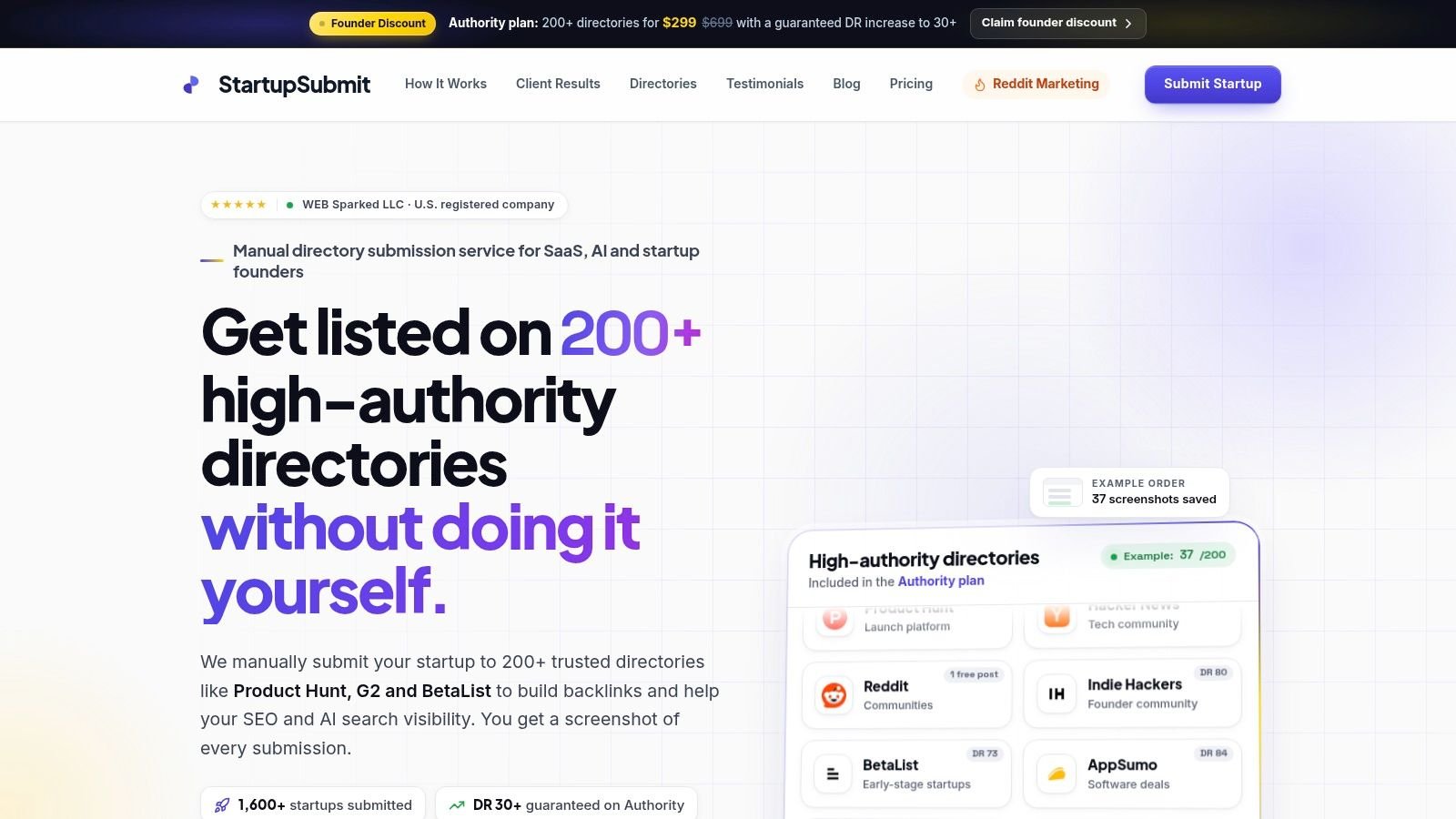
StartupSubmit is built for that specific job. It manually submits SaaS and AI startups to 200+ startup and software directories, checks for duplicates, categorizes profiles, and provides submitted URLs, acceptance notes, and screenshots in a final report. Its stated execution window is approximately 5 to 14 days, with work targeted to begin within 24 hours after onboarding. That's the operational profile I want at pre-seed stage: bounded, auditable, and off the founder's calendar.
The Relevance Argument
A smaller, accurately categorized B2B software profile can be more useful than a generic high-authority placement with the wrong audience. Category pages help users compare alternatives, and accurate tags reduce the chance that moderators reject or bury the listing. Relevance also makes the profile easier to maintain as pricing, screenshots, and positioning change.
Durability matters after launch day. Launch traffic decays, but a maintained profile can keep producing branded impressions, comparison visits, and review opportunities. Browse these free startup directories worth claiming yourself if you want to handle a short list in-house before outsourcing the long tail.
Manual moderation safety and one-time pricing make directories a defensible first spend, because you can verify every claimed placement without committing to a retainer.
Know the limits. Directory submissions won't rescue a thin product page, unclear positioning, blocked crawlers, or a product nobody wants. They also won't replace customer reviews, expert content, or digital PR as you grow. Use them to establish the footprint. Then earn stronger references with useful product pages, original data, integrations, and customer proof.
Backlinks and AI Search Visibility
AI search changes the value of a click, not the need to be recognized. Your prospect may read a summary, compare three vendors, and never visit the traditional results. That makes entity consistency more important, not less.
Pew Research's analysis of AI summaries and clicking behavior found users clicked a traditional result in only 8% of visits when an AI summary appeared, compared with 15% without one. Just 1% clicked a source link inside the summary. Pew also found 26% ended the session with an AI summary, versus 16% with traditional results only. If you judge every placement only by referral clicks, you'll undervalue discovery assets and overvalue hollow ranking claims.
ChatGPT Visibility Starts With Crawl Access
OpenAI says OAI-SearchBot surfaces websites in ChatGPT search features, and sites that opt out won't be shown in ChatGPT search answers. Its crawler documentation for OAI-SearchBot makes robots.txt a practical LLM SEO check. Confirm your product, documentation, pricing, and comparison pages are crawlable. Directory profiles can't compensate for blocking your own authoritative pages.
Google also treats links created primarily to manipulate generative AI responses as link spam under the policy discussed earlier. Don't buy directory coverage as a guaranteed route into AI answers. Buy it, when appropriate, for legitimate discovery, accurate third-party descriptions, and consistent brand references.
Make the Entity Easy to Read
Use the same legal and product name, logo, short description, category, and primary URL across your website and external profiles. Fix contradictions before you scale submissions. AI Search Optimization fails when one profile calls you an AI meeting tool, another calls you a CRM, and your homepage uses a third category.
An AI directory submission service for LLM-era discovery can help extend that consistency, but the source of truth must be your site. Publish clear pages for features, alternatives, integrations, security, and pricing. Answer the buyer's exact questions in plain language so Google AI Overview and ChatGPT systems have useful material to cite.
Measure branded query impressions, indexed profile pages, referral quality, direct traffic, demo assists, and whether your company appears accurately in relevant answer systems. DR alone won't tell you if AI search understands you.
Reporting, Indexing, and Verification Checklist
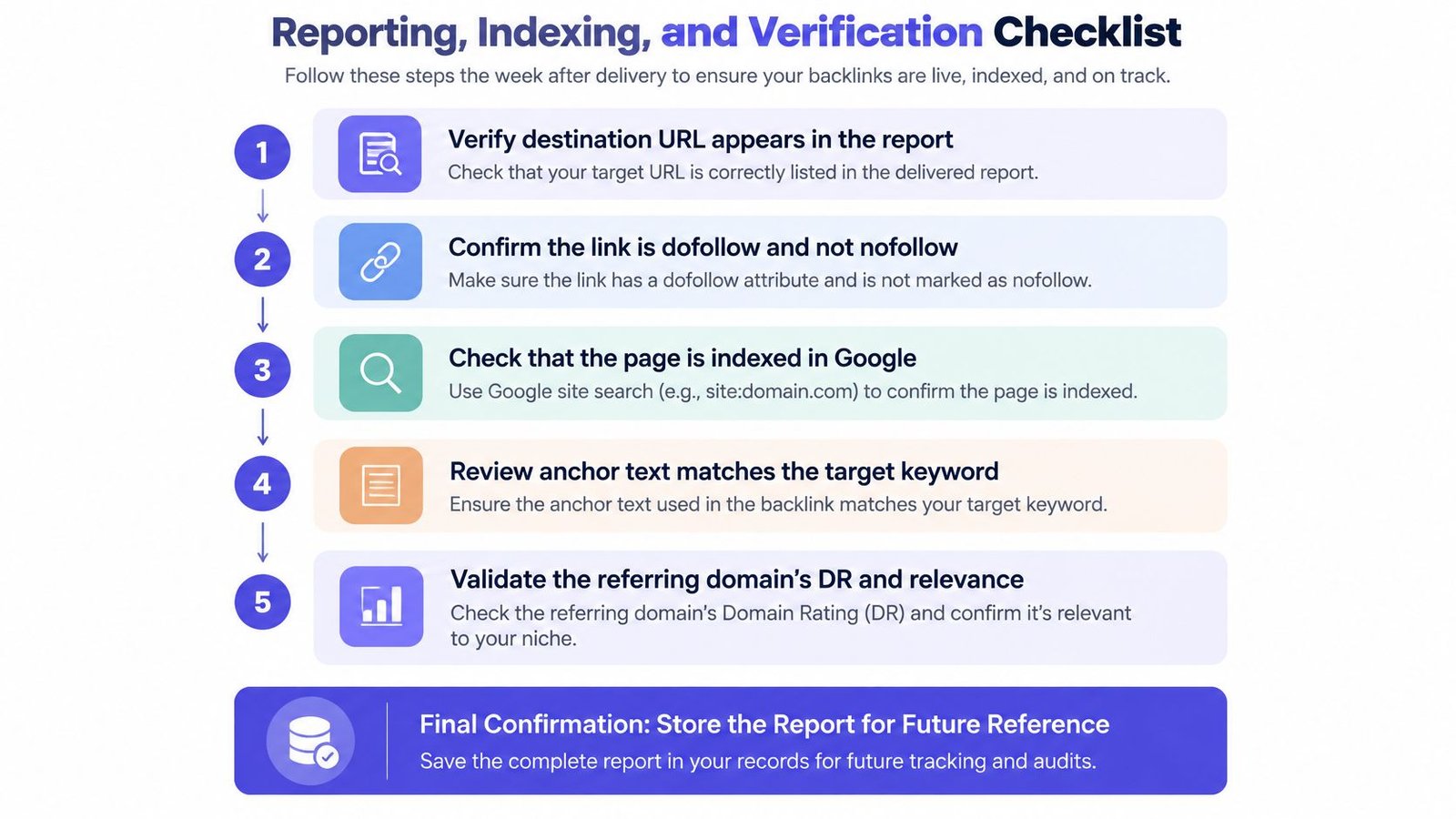
Verify delivery yourself. Don't forward the vendor spreadsheet to your board or co-founder until you've opened the pages, checked the links, and separated accepted placements from pending submissions.
The Week After Delivery
- Open every claimed URL: Confirm the page is public, returns a successful HTTP status, and describes the correct company.
- Check the destination: Verify the link points to the intended product, company, or category page, not a broken redirect or wrong locale.
- Record anchor and rel: Compare the live anchor text and rel attribute with the report. Flag sponsored or nofollow treatment accurately.
- De-duplicate domains: Group URLs by referring domain in Ahrefs or a spreadsheet. Your real diversification number is the distinct-domain count.
- Test indexability: Inspect representative pages, check robots and noindex signals, and note which profiles appear in search over the next 30 to 90 days.
- Save ownership details: Store login emails, profile owners, edit URLs, screenshots, and acceptance notes where your team can find them.
Use Google Search Console for branded impressions, referring page discovery, and index coverage on your own site. Use Ahrefs to confirm new referring domains and lost links. Neither tool replaces opening the placement. Crawlers miss pages, and screenshots can hide noindex or login walls.
Red flags should trigger rework or a refund conversation. Watch for submitted counted as live, duplicate domains padded with profile variations, wrong categories, copied descriptions with another company's name, links behind logins, and reports without source URLs. The same discipline applies to a local citation service for consistent business listings, where inaccurate names and addresses create a different kind of entity mess.
Create one internal tracker and update it monthly. Mark each profile as live, pending, rejected, edited, or lost. That record becomes valuable during rebrands, pricing changes, and future Startup Marketing campaigns.
Your 30, 60, and 90 Day Backlink Plan
Sequence the work. Technical clarity comes before submissions, and verification comes before scaling into outreach.
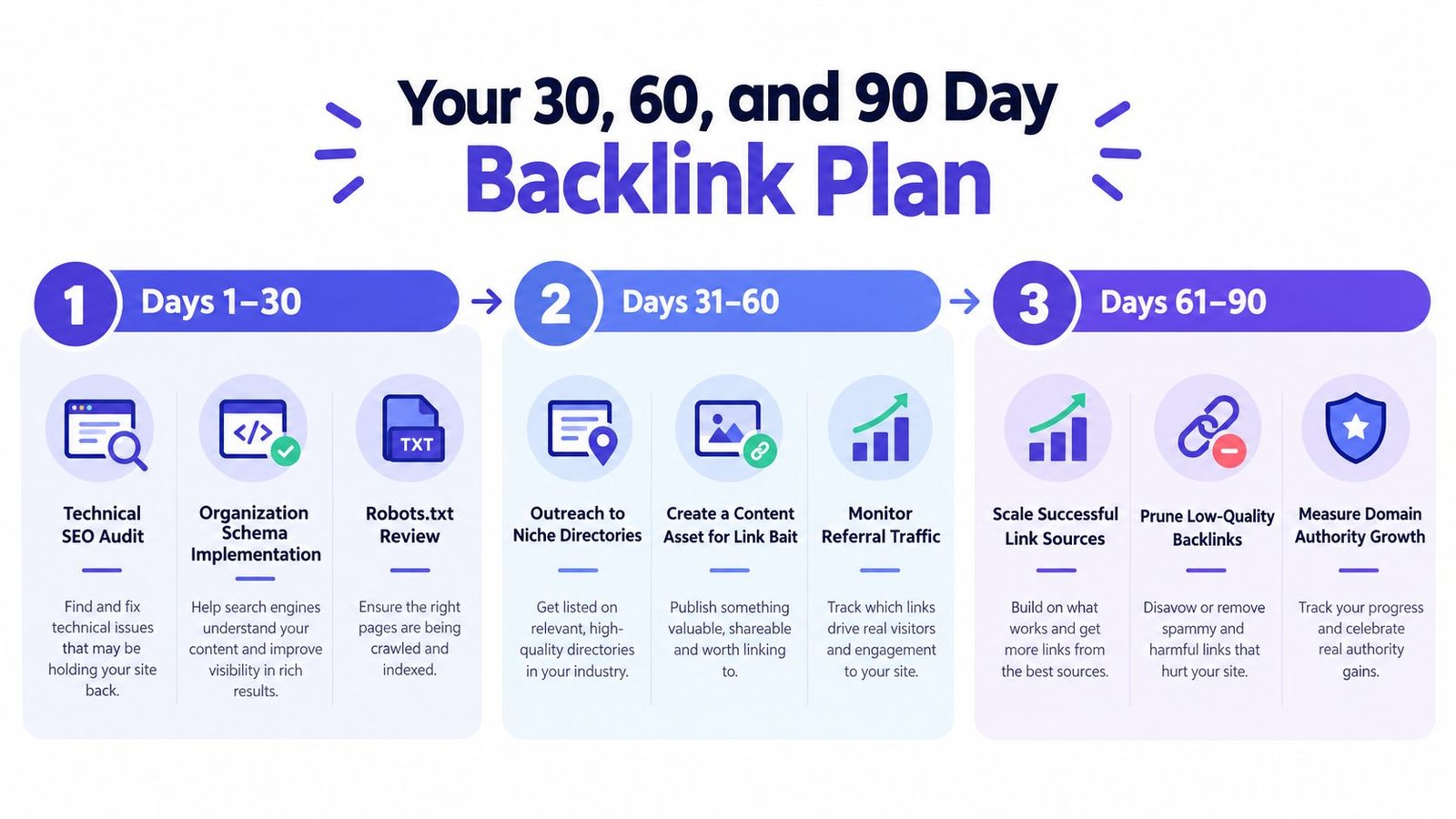
Days 1 to 30 Fix the Source of Truth
Audit indexability, broken pages, canonical URLs, and robots.txt. Confirm OAI-SearchBot can reach the pages you want considered for ChatGPT search. Rewrite thin product pages so each one states the audience, problem, outcome, pricing model, and proof clearly.
Add Organization structured data where it applies. Google's Organization structured data guidance says there are no required properties and recommends adding accurate details such as legal name, logo, contact information, address, and identifiers. Validate with the Rich Results Test, inspect the rendered page, confirm it isn't blocked, and submit your sitemap.
Days 31 to 60 Build the Foundational Footprint
Select the vendor using the criteria and sample evidence you defined. Supply one approved company description, category rules, logo files, screenshots, social links, and target URLs. Decide in advance which profiles you'll claim yourself because they're strategic, such as major review sites.
Review early submissions before the full batch is complete. Catching a wrong category or outdated tagline on day three is cheap. Correcting it across dozens of profiles later isn't.
Days 61 to 90 Verify and Decide What Earns More Budget
Run the reporting checklist, calculate accepted placements per unique referring domain, and record indexed profiles. Compare branded impressions, referral sessions, and demo sources with the pre-campaign baseline in Search Console and analytics. Update weak profiles with better screenshots, customers, integrations, and review requests.
Then make the next decision. If category pages are gaining impressions but lack authority, test a small outreach campaign around a useful asset. If profiles aren't indexed or your product pages aren't converting, fix those problems first. Link acquisition is continuous, but spending should only scale when the previous layer survived verification.
Ready to build that foundational footprint without spending weeks on repetitive forms? StartupSubmit manually places SaaS and AI startups across relevant startup and software directories with duplicate checks, accurate categorization, and itemized proof of placement. Visit StartupSubmit to choose a one-time submission plan and start turning directory coverage into a cleaner, more discoverable digital footprint.