
Top 10 Directory List SEO Services for Startups 2026
You launched. A few people signed up. Maybe Product Hunt sent a burst of traffic, maybe a founder post on LinkedIn got some clicks, maybe a niche Reddit thread brought in your best early users.
Then things flattened.
That's the point where most founders start collecting tactics instead of building a real system. They try SEO, then cold outreach, then paid ads, then a directory blast, then a referral loop. Nothing compounds because nothing connects.
A startup growth strategy fixes that. It turns scattered activity into a roadmap. You stop asking, “What should we try next?” and start asking, “What's the bottleneck, which channel can move it, and how will we know if it worked?”
For SaaS founders, AI founders, and indie hackers, that shift matters more than most advice admits. Growth isn't one channel. It's product relevance, clear positioning, smart distribution, and a measurement loop that tells you what deserves more attention.
A lot of teams also miss one practical lever early. They treat startup directories and backlink building as side chores. In practice, those listings can support startup SEO, SaaS SEO, Google indexation, trust signals, and even visibility in AI search systems like ChatGPT, Perplexity, and Google AI Overview when they're handled manually and selectively.
Understanding Startup Growth Strategy
A startup growth strategy is a structured plan for finding repeatable traction. Not occasional traction. Not launch-day traction. Repeatable traction.
That means three things need to line up:
- The product solves a problem people actually care about
- The message makes that value obvious
- The acquisition channels reach the right buyers at the right stage
When one of those breaks, growth stalls.
What founders usually get wrong
Most plateaus don't happen because founders lack hustle. They happen because teams confuse motion with progress. Publishing content without clear positioning, buying clicks before activation is stable, or submitting to weak directories just to “build backlinks” all create activity without gaining strategic advantage.
The harsh reality is simple. Only 10% of startups succeed past the 5-year mark, with 42% of failures directly attributed to building products that lack market need according to startup failure and validation data.
That's why a real startup growth strategy starts earlier than many founders expect. It starts with validating demand, pressure-testing the offer, and listening to users before scaling distribution.
Practical rule: If users don't quickly understand why your product matters, adding more channels usually magnifies the problem instead of fixing it.
What a real strategy looks like
A useful growth strategy isn't a giant spreadsheet no one opens again. It's a working operating model.
It usually includes:
- One core growth goal tied to user or revenue progress.
- A funnel view that shows where people drop off.
- A channel plan based on fit, not trendiness.
- An experiment cadence so the team learns fast.
- A trust layer built through reviews, mentions, backlinks, and listings.
Founders often underestimate that last point. Search engines and AI systems don't just evaluate your homepage. They look for corroboration across the web. That's one reason experienced teams pay attention to their external footprint early, whether they handle submissions internally or use a specialist service such as StartupSubmit's company background as a reference point for what a manual process looks like.
Understanding Key Growth Concepts
If your startup growth strategy feels fuzzy, it's usually because the team is mixing goals, metrics, and channels into one pile. Separate them and decisions get easier.
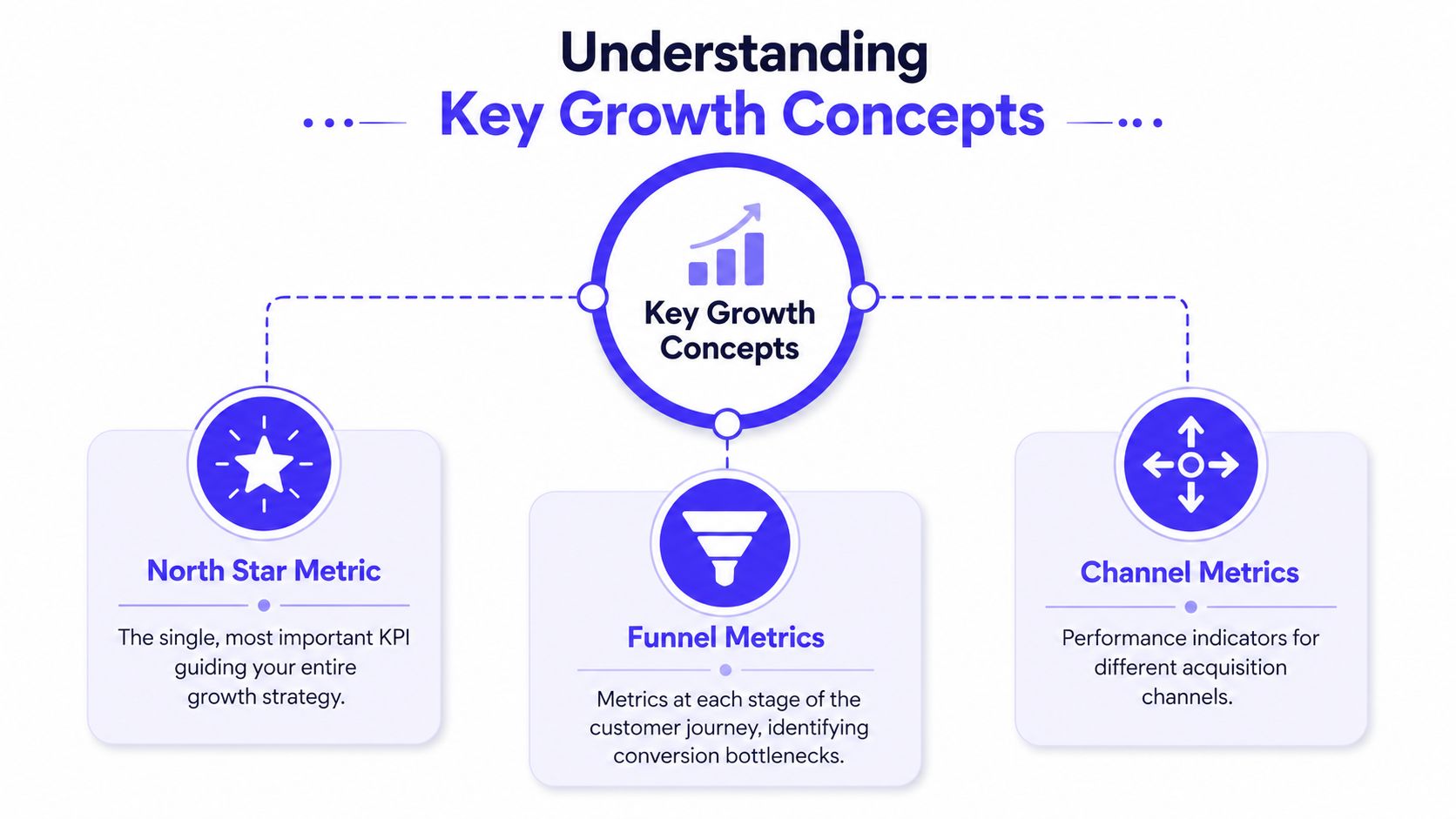
This visual helps anchor the basics:
Start with the North Star Metric
Your North Star Metric is the single KPI that best reflects customer value delivered.
For a project management SaaS product, it might be teams actively completing workflows. For an AI writing tool, it might be users generating useful outputs and returning to do it again. For a B2B analytics tool, it might be accounts reaching a meaningful reporting milestone.
The North Star Metric does two jobs. It keeps the team aligned, and it filters out vanity metrics.
A vanity metric is anything that looks impressive but doesn't reliably predict revenue or retention. Pageviews can be vanity. Trial signups can be vanity. Even directory impressions can be vanity if they don't lead to qualified visits, product activation, or brand trust.
Funnel metrics show where growth breaks
Once the North Star is clear, map the funnel around it.
A simple SaaS funnel often looks like this:
| Funnel stage | What to watch |
|---|---|
| Awareness | Which channels bring the right visitors |
| Acquisition | Visitor-to-signup quality |
| Activation | Time to first value |
| Retention | Repeat use and account expansion |
| Revenue | Upgrade behavior and payback quality |
The reason funnel metrics matter is practical. They stop you from solving the wrong problem.
If traffic is fine but activation is weak, content and backlinks won't rescue growth on their own. If activation is healthy but awareness is low, then search visibility, startup directories, partnerships, and long-tail content become more important.
When founders say “growth isn't working,” the useful follow-up is “which step isn't working?”
Channel metrics keep acquisition honest
Channel metrics tell you whether a source is worth more investment.
For startup SEO and directory-based discovery, that usually means asking:
- Does this channel attract the right audience
- Does it build trust signals beyond direct clicks
- Does it improve discoverability in search and AI search
- Can the team sustain it without operational drag
This is where market validation matters most. The strongest tactic in the wrong market is still weak strategy. As noted earlier, only 10% of startups succeed past the 5-year mark, with 42% of failures tied to products that lack market need, based on the same validation-focused startup dataset.
Experiments need a real hypothesis
Most startup experiments fail because they're not actual experiments. They're just activity with a time stamp.
A useful test has four parts:
- Hypothesis such as “buyers searching for alternatives terms will convert better than broad category traffic”
- Primary metric tied to the funnel stage you want to move
- Time boundary so the test doesn't drag forever
- Decision rule defining what happens next if the result is promising, mixed, or poor
That structure matters whether you're testing paid ads, AI onboarding flows, or directory submissions.
Building Your Growth Framework
Founders need a framework they can run every week, not a strategy deck that sounds smart and dies in a folder.
This is the simplest useful version:
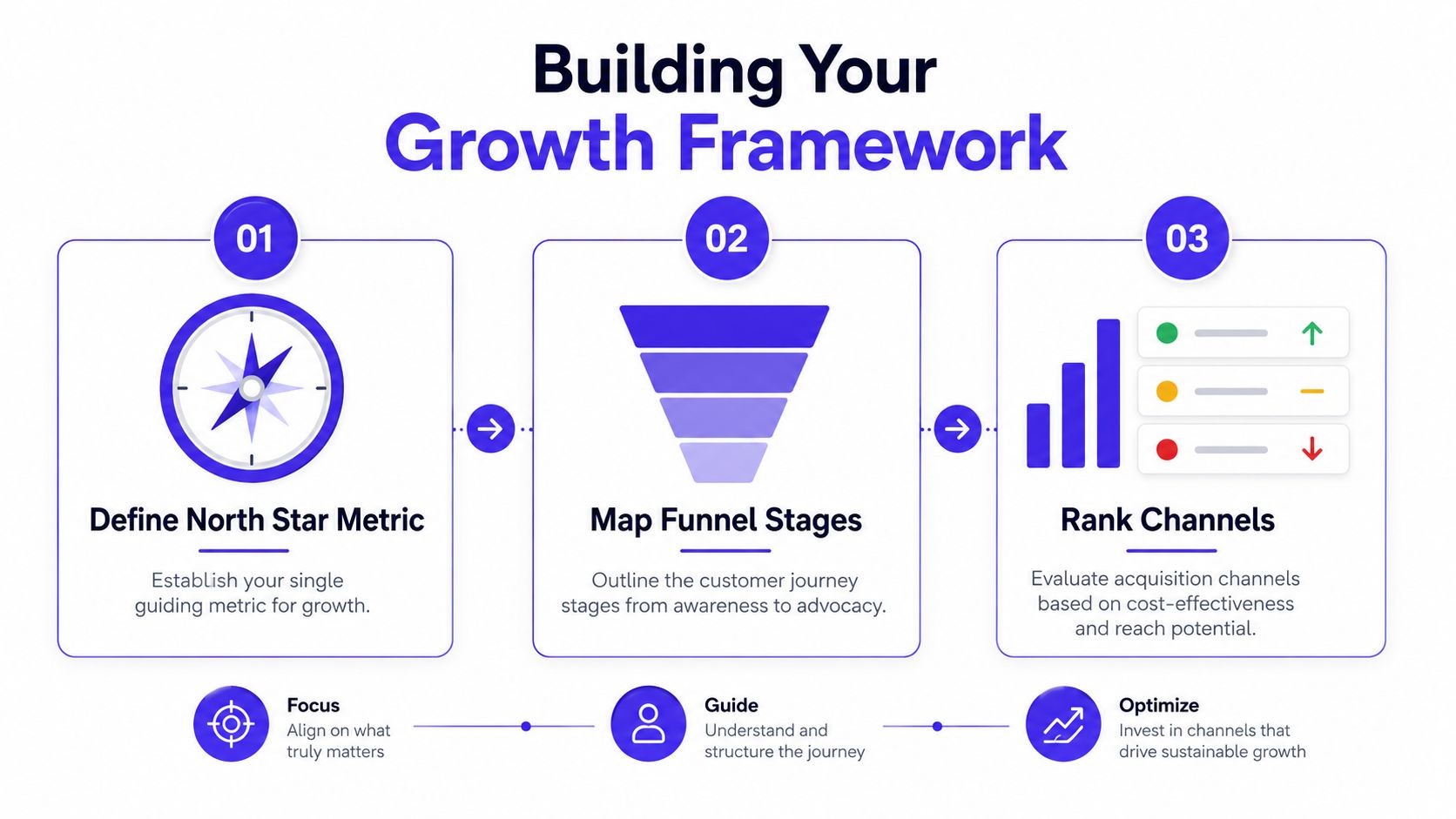
Define the one metric that matters most
Pick the metric that reflects delivered value, not just interest.
That choice forces discipline. If the team says the goal is “growth,” everyone interprets it differently. Engineering might optimize speed, marketing might chase volume, and sales might prioritize any lead with a pulse. A North Star creates one shared target.
For early products, the best metric often sits around activation or repeat usage, because that's where weak fit reveals itself fastest.
Map the journey from visit to value
Teams generally know their funnel in theory. Fewer know where users hesitate, get confused, or drop out.
Write the journey in plain language:
- Discovery through search, communities, referrals, directories, or outbound.
- Evaluation on your site, review profile, product page, or launch listing.
- Conversion into signup, demo, or free trial.
- Activation when the user reaches first value.
- Retention and expansion when usage becomes habitual or team-wide.
Product marketing earns its keep. A lot of startup advice jumps straight to channel tactics, but that skips the harder issue. Most startup growth content focuses on high-band channel tactics but underserves the critical gap of integrating marketing as a strategic function early, especially positioning and product marketing before launch, according to BrightIron's analysis of early-stage marketing gaps.
If your homepage says “AI-powered workflow intelligence” and buyers are searching for “faster compliance reporting,” your channels won't save you. Positioning comes first.
Field note: The best-performing campaigns I've seen usually looked obvious in hindsight. The message matched the buyer's problem so closely that the channel almost felt secondary.
Rank channels by fit, not noise
A lot of channel selection is ego disguised as strategy. Founders pick the channels they personally enjoy, the channels investors mention, or the channels competitors appear to be winning.
A better ranking process uses three filters:
| Channel filter | What to ask |
|---|---|
| Audience fit | Do your buyers actually spend time here or search this way? |
| Execution fit | Can your team produce enough quality to compete? |
| Compounding fit | Does the work keep paying off after the first push? |
That last filter is why startup directories deserve a place in the framework. Good listings can support backlinks, entity validation, branded search coverage, and LLM SEO. Bad listings just create clutter.
Use a lightweight experiment sheet
Every channel test should live on one page.
Include:
- The bottleneck you're trying to solve
- The channel or tactic you're testing
- Why you believe it might work
- The asset required such as a landing page, category page, demo flow, or directory profile
- The metric to watch
- The decision date
For teams trying to tighten attribution across channels, this guide on optimizing marketing performance is a useful reference because it helps connect campaign activity to actual business outcomes rather than surface metrics.
Channel Specific Growth Tactics
No single channel carries an early-stage company for long. What works is a mix of channels that support each other.
Long-tail content can surface intent. Directory profiles can strengthen trust and citations. Paid ads can test positioning faster than SEO. Product-led loops can reduce dependence on constant paid acquisition. AI onboarding can improve what happens after the click.
The mistake is treating these channels as separate silos.
SEO that doubles as market research
For SaaS SEO and startup SEO, early content should answer narrow buyer questions, not chase broad vanity keywords.
A founder building an AI sales assistant doesn't need to rank first for “AI tools.” That phrase is too broad, too competitive, and often too mixed in intent. A stronger move is publishing pages around comparisons, use cases, alternatives, pain-specific workflows, and category modifiers buyers use during evaluation.
This does two things at once. It builds search visibility, and it reveals what language the market uses naturally.
Content also pairs well with startup directories. Search engines and AI systems often want corroborating signals. A strong site plus strong external profiles is better than either one alone.
Paid acquisition works best as a learning loop
Paid ads are useful early when the goal is learning, not ego-driven scale.
Run them to test:
- Message-market fit
- Landing page clarity
- Audience segmentation
- Sales call quality for demo-led products
For early-stage B2B AI SaaS, there is at least one benchmark worth keeping in mind. The target monthly growth rate in paid users should be 15–20%, with activation time and activation rate treated as critical pre-revenue metrics, according to this discussion on measuring early-stage B2B AI SaaS growth.
That doesn't mean every startup should immediately buy growth. It means acquisition has to be judged against activation and margin reality. If users sign up but consume expensive AI resources before they convert or retain, paid growth can hide a structural problem.
Product-led growth needs activation discipline
Product-led growth sounds clean on paper. In reality, it only works when users reach value fast and understand what to do next.
That's where AI can help the product itself. Companies embedding AI directly into activation and retention flows achieve 20–40% improvements in net revenue retention by using behavioral churn prediction and AI-powered onboarding personalization, based on GroovyWeb's SaaS growth analysis.
For founders, the takeaway isn't “add AI everywhere.” It's more specific:
- Use AI to reduce confusion during onboarding
- Personalize guidance based on user behavior
- Spot accounts that look likely to stall or churn
- Trigger sales or support intervention at the right moment
That's much more valuable than adding a flashy chatbot nobody needs.
Partnerships and communities still matter
Founders often underrate small partnerships because they don't look like scalable channels at first.
But niche podcasts, ecosystem integrations, co-marketing with adjacent tools, and community participation can produce high-intent users. This is especially true in B2B software where trust and relevance matter more than raw reach.
The key is fit. A modest partnership with a workflow tool your users already love often beats broad sponsorships that create weak traffic.
Directory submissions now support more than classic SEO
Startup directories used to be treated as launch-day accessories. That view is outdated.
Directory presence now supports several layers at once:
- Backlinks from recognized domains
- Entity consistency across the web
- Branded search coverage
- Citations that AI systems may rely on
- Trust validation for buyers, journalists, and investors
A complete profile matters more than a stub. Teams working on AI search optimization can also use a tool like Nuwtonic's Generative Engine Optimization Audit to inspect how their brand and content show up across AI-driven discovery surfaces.
And if you want a practical benchmark for what curated manual listing work looks like in the market, StartupSubmit is one example of a service built around startup directories rather than mass automation.
Comparison of Growth Channels
| Channel | Strengths | Weaknesses |
|---|---|---|
| Long-tail SEO content | Compounds over time, reveals buyer language, supports topical authority | Slow feedback if positioning is weak |
| Paid ads | Fast learning, useful for testing offers and audiences | Can get expensive before activation is strong |
| Product-led loops | Strong leverage when activation is smooth | Breaks if onboarding is confusing |
| Partnerships | High trust, strong audience overlap when chosen well | Harder to systematize |
| Startup directories | Builds backlinks, trust signals, startup SEO support, AI search visibility | Low value if submitted to weak or spammy sites |
| Community participation | Helpful for niche credibility and early feedback | Time-intensive, difficult to scale carelessly |
Good channel selection isn't about finding the “best” tactic. It's about choosing the next tactic that matches your bottleneck.
Maximizing Directory Submissions
Directory submissions still work. The problem is that most founders execute them badly.
They either submit to everything they can find, including junk sites, or they submit to a few major platforms with thin profiles and never follow up. Both approaches waste the opportunity.
Here's what a real workflow looks like:

Start with a curated list, not a giant spreadsheet
For new SaaS companies, manual submission to a curated set of 30–50 high-Domain Authority startup directories is the fastest method for building foundational trust signals, quality referring domains, and rapid indexation by Googlebot and emerging AI search engines, according to ListMySite's analysis of startup directories and SEO.
That word curated matters.
A useful shortlist includes major discovery and review properties, relevant indie launch sites, and category-specific directories that fit the product. The goal isn't volume for its own sake. It's external validation from sites people and machines already trust.
Fill profiles like they matter, because they do
Founders often paste the same lazy sentence into every listing. That leaves value on the table.
Strong directory profiles usually include:
- A clear description written for humans, not keyword stuffing
- Accurate categories so the product appears in the right discovery paths
- Screenshots and logos that make the listing look real and maintained
- A consistent URL and brand name across platforms
- Notes and tracking for submitted, approved, and live statuses
This process gets tedious fast, which is why many teams either assign it and forget it or outsource it. If you want to see the kind of operational benefits manual submission services emphasize, directory submission benefits give a useful picture of the workflow expectations.
What to avoid
The biggest mistakes are predictable:
- Mass low-quality submissions that create weak links and clutter
- Duplicate listings that confuse brand signals
- Inconsistent descriptions that weaken positioning
- No acceptance tracking so teams don't know what went live
Directory work should support sustainable backlink strategy, startup marketing, and AI search visibility. It shouldn't become a spam operation.
A directory profile is often a buyer's second impression of your company. Treat it with the same care as your homepage.
Measuring Success and Scaling
Growth work becomes expensive when teams keep running channels that feel promising but don't change the business.
Measurement fixes that. Not by adding endless dashboards, but by tying each channel to the metric it is supposed to move.
Watch activation before you celebrate acquisition
A lot of startups celebrate signups too early. For software products, acquisition without activation is mostly a list-building exercise.
For early-stage B2B AI SaaS startups, the target monthly growth rate in paid users should be 15–20%, and critical pre-revenue metrics include activation time and activation rate according to the early-stage B2B AI SaaS measurement benchmark.
That benchmark matters because AI products can scale usage faster than revenue if the onboarding path is loose or the pricing model is weak. You need to know:
- How long it takes a new user to hit first value
- How many users hit that moment
- Which channels bring users who activate fastest
- Whether usage patterns threaten margin before monetization catches up
Build a reporting rhythm that forces decisions
The best startup dashboards are boring. They answer a few recurring questions clearly.
A practical reporting cadence looks like this:
Weekly review
Use the weekly view for movement and anomalies.
Look at:
- New users by channel
- Activation progress
- Sales conversations or demo quality
- Directory approvals and live listings
- Content pages or campaigns producing qualified traffic
Weekly reviews are for noticing change. They're not for rewriting strategy every Friday.
Monthly review
The monthly view is where scaling decisions happen.
Ask:
| Question | Why it matters |
|---|---|
| Which channels brought the best-fit users? | Volume without fit creates noise |
| Which experiments changed activation or retention? | That's where compounding starts |
| Which costs rose faster than revenue quality? | Early warning for weak unit economics |
| Which assets are still producing after launch week? | Helps identify durable channels |
Know when to double down and when to stop
Scaling should follow evidence, not enthusiasm.
Double down when a channel does three things at once:
- Brings relevant users
- Supports activation or retention
- Still looks healthy after the first bump
Pause or reduce when a channel attracts curiosity clicks, bloats support load, or creates expensive usage with low conversion.
This applies to backlinks and directory strategies too. A few trusted listings that improve visibility, referral quality, and branded search confidence are worth more than a messy footprint of weak placements.
Use a simple growth memo
One thing I've found useful in startup teams is replacing long reports with a short decision memo.
Include:
- What changed
- Why it probably changed
- What the team should keep doing
- What gets cut
- What gets tested next
That format keeps growth tied to judgment, not just dashboards.
Implementing Your Growth Plan
Most founders don't need more ideas. They need a sequence.
The practical sequence is: validate demand, tighten positioning, install measurement, choose a small set of channels, build trust signals, then scale only what proves itself.
Two real-world patterns founders can copy
A bootstrapped indie hacker usually wins by narrowing. The product targets a sharp problem, the website uses plain language, content focuses on high-intent long-tail topics, and directory listings strengthen visibility in search and AI discovery surfaces. That founder doesn't have budget to spray across channels, so every asset has to do multiple jobs.
A Series A AI startup usually has the opposite problem. More resources, more internal stakeholders, and more ways to waste effort. In those teams, the most impactful improvement is often alignment. Product marketing, onboarding, sales, content, and AI retention workflows have to point at the same value story or the funnel leaks everywhere.
Neither case needs “more marketing” in the abstract. Both need coherence.
Implementation checklist
Use this as an operating checklist, not a one-time launch doc.
First layer
- Validate the pain through demos, interviews, review mining, and actual buyer language
- Refine positioning so the homepage, sales narrative, and listings say the same thing
- Choose the North Star Metric that reflects delivered value
- Map the funnel from discovery to retention
Channel layer
- Publish long-tail content around use cases, alternatives, and pain-specific queries
- Run small paid tests to validate message-market fit before aggressive spending
- Improve onboarding so activation happens faster
- Set up partner conversations with adjacent tools and niche communities
- Prepare a directory list focused on trusted startup and software platforms
Trust and discovery layer
- Complete every profile fully with descriptions, screenshots, tags, and correct URLs
- Track accepted listings so the team knows what is live
- Monitor brand search results to see whether external trust signals are improving
- Review AI search presence to understand how your startup appears in LLM-driven answers
Operating layer
- Review weekly for movement and blockers
- Review monthly for scale or cut decisions
- Document lessons so the team doesn't repeat weak experiments
- Keep scope tight until one or two channels clearly outperform the rest
A practical 30, 60, and 90 day cadence
In the first month, focus on validation, messaging, analytics hygiene, and the first batch of content and listings.
By the second month, tighten onboarding, expand the channels showing signal, and clean up profile consistency across the web.
By the third month, scale only what improves qualified acquisition and downstream product outcomes. Everything else goes back into the backlog.
If you want help offloading the repetitive work involved in manual directory submissions, StartupSubmit pricing is worth reviewing to see whether a done-for-you option fits your stage and bandwidth.
FAQ
What is a startup growth strategy?
It's a repeatable plan for increasing users, revenue, and retention by aligning product value, positioning, channels, and measurement. It's broader than growth hacks and more useful than a list of disconnected tactics.
Which channels should SaaS founders prioritize first?
Usually the channels that match buyer intent and create compounding value. For many early-stage products that means a mix of positioning work, long-tail SEO, a small number of paid tests, product activation improvements, and selective startup directories.
Do startup directories still help SEO?
Yes, when they're curated, relevant, and filled out properly. They can support backlinks, trust signals, indexation, branded search coverage, and AI search visibility. Low-quality mass submissions are a different story and usually aren't worth it.
How does directory work affect ChatGPT visibility and LLM SEO?
AI systems increasingly rely on recognized external sources and structured brand presence across the web. A solid footprint on reputable startup and software directories can strengthen the signals those systems use for discovery and citation.
When should founders scale a growth channel?
Scale after the channel consistently brings relevant users who activate, retain, or convert well enough to justify more investment. Don't scale because a top-line number briefly looks exciting.
If directory submissions keep falling to the bottom of your list, StartupSubmit can handle the manual work for you. It's built for SaaS and AI startups that want stronger startup directory coverage, cleaner backlinks, and better search visibility without turning the process into another internal project.