Startup SEO Services: What Founders Actually Need
Most startup founders don't need a full-service SEO retainer on day one. They need enough trust, crawlable relevance, and credible backlinks to make the company discoverable after the launch announcement disappears. A technical audit can be useful, but it won't compensate for an empty brand footprint, a vague product page, or a domain with no meaningful references.
That's the hidden gap in startup SEO services. Established companies can spread SEO across content teams, digital PR, technical specialists, and analytics. A young SaaS or AI company usually needs a narrower system that turns limited time and budget into durable discovery signals, then expands once the evidence supports more investment.
Why Most Startup SEO Advice Misses the Mark
The popular advice says to start with a massive audit, publish continuously, and wait for authority to compound. That playbook assumes you already have content capacity, a clear search history, and enough domain strength to compete for meaningful queries. Most early-stage founders have none of those advantages.
In the first year, SEO has a different job. It should clarify what the product does, give search engines crawlable pages to understand, create credible third-party references, and protect the brand's search results from looking empty. A founder launching an AI workflow tool may need a focused product page, use-case pages, software profiles, and relevant directory listings before they need a large editorial calendar.
Backlinks remain a durable foundation because link authority still correlates strongly with rankings. In an analysis of 11.8 million Google search results, the first result had an average of 3.8 times more backlinks than pages ranking in positions two through ten, according to Backlinko's search ranking analysis. That doesn't mean founders should buy every link offered to them. It means authority is a constraint that content alone may not solve quickly.
Practical rule: Early startup SEO should reduce uncertainty first. Build the pages, profiles, and links that help search engines and buyers understand the company before adding volume.
A focused directory strategy can help fill that early gap, but selection matters. The curated startup directory guide is more useful than a random spreadsheet because founders need to distinguish indexed, relevant platforms from sites that exist mainly to collect submissions.
Generic retainers often waste money through activity that's easy to report but hard to connect to growth. A monthly content quota, recurring audit slides, and broad keyword lists may look complete while leaving the startup's core trust problem untouched. The better question is simple: which deliverables will create a stronger branded footprint and a more credible path to non-branded discovery?
Core Deliverables of Startup SEO Services
A useful startup SEO engagement produces assets you can inspect, verify, and keep using. It shouldn't be defined by meetings or hours. The core work normally combines technical readiness, focused pages, third-party profiles, link acquisition, and measurement.
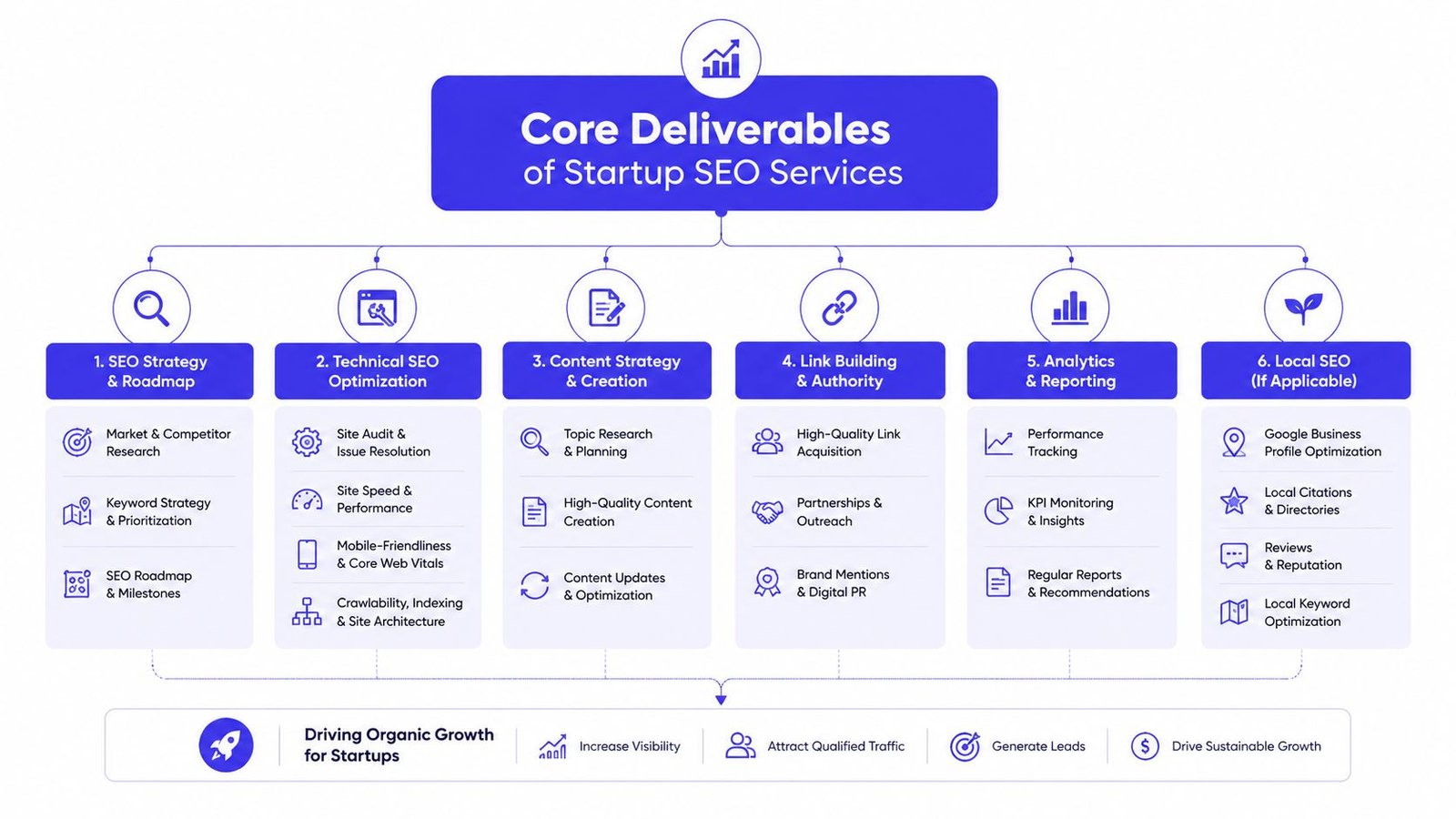
A focused set of outputs
Launch and product pages come first. Your homepage should explain the category, audience, problem, and product clearly enough for a buyer and a crawler. Supporting pages should target real use cases, integrations, industries, or alternatives, rather than forcing every keyword onto one page.
Technical accessibility is the next layer. Google Search Central says AI features need crawlable text, structured data that matches visible content, and crawling allowed by robots.txt and any CDN or hosting layer. Google also says AI features and AI Mode are included in overall Search traffic in Search Console, so technical work supports both traditional measurement and newer search surfaces. The Google guidance for AI features in Search provides the implementation baseline.
Directory submissions should be manual, categorized, and checked for duplicates. A proper profile includes a consistent company description, accurate category selection, a destination URL, product details, and any available social or review references. The vendor should record whether the listing was accepted, indexed, or rejected. For SaaS companies, a specialized SaaS directory submission service is one model for outsourcing that repetitive execution.
What a backlink campaign should prove
Benchmarks from startup backlink guidance suggest that a structured run across roughly 50 to 100 directories can produce about 30 to 60 live backlinks from domains with DR 40 to 90, as described in startup backlink acquisition guidance. Those figures are benchmarks, not guarantees. Approval, indexability, link attributes, topical fit, and the quality of each domain determine whether the placements have practical value.
The report should show URLs, acceptance notes, screenshots, and link attributes where available. It should also separate dofollow links from nofollow links instead of treating every profile as equivalent. Founders who are building the surrounding content system can also use these actionable SaaS content strategy tips to make directory descriptions, landing pages, and supporting content reinforce the same positioning.
The deliverable is not “submitted to hundreds of sites.” It's a clean, verifiable set of relevant brand references that supports search visibility, referral discovery, and future outreach.
Pricing Models and What Each Tier Actually Delivers
Startup SEO pricing becomes confusing when vendors compare unlike services. A one-time directory project, a link-building project, and an ongoing SEO retainer solve different problems. Comparing their headline prices without comparing outputs is how founders end up paying for broad activity instead of useful assets.
The ranges below are practical market bands, not fixed rates. Scope, niche difficulty, editorial requirements, geography, and the startup's existing website all affect the final quote.
Startup SEO Service Pricing Comparison
| Service Type | Typical Price Range | Key Deliverables | Timeline |
|---|---|---|---|
| One-time directory submission service | Low to mid three figures | Manual submissions, duplicate checks, categorized profiles, acceptance report | Often several days to a few weeks |
| Project-based link building | Mid three figures to several thousand | Prospecting, outreach, content support, approved placements, reporting | Several weeks to a few months |
| Lean monthly SEO engagement | Low thousands per month | Technical priorities, landing pages, content direction, link acquisition, reporting | Ongoing, with early signals before durable growth |
| Full-service agency retainer | Several thousand to five figures per month | Strategy, content production, technical work, digital PR, analytics, account management | Ongoing, generally suited to larger growth programs |
A one-time submission package often makes sense before product-market fit is fully established. It creates a defined project, limits financial exposure, and gives the team a report it can use in future audits. It won't replace editorial links, useful content, or product-led distribution.
Project-based link building offers more control over relevance. It can target publications, partner sites, integration pages, or niche resources, but quality outreach takes time and approval is uncertain. A vendor that charges per “link delivered” may create the wrong incentive if it accepts placements from weak or irrelevant domains.
Retainers can work once the startup has a validated audience, a content backlog, and enough conversion data to prioritize opportunities. Before that point, the fixed monthly commitment can outlast the strategy's usefulness. Ask vendors to separate labor from deliverables and calculate the effective cost per approved, live, relevant placement rather than the cost per pitch or submission.
A retainer should buy compounding work, not recurring explanations of why work is still needed.
How to Evaluate an SEO Vendor for Your Startup
The first vendor conversation should feel more like a due-diligence call than a sales presentation. Ask what will be delivered, how quality will be checked, and what the vendor won't do. If the answers stay at the level of “authority,” “visibility,” and “growth,” you haven't received a plan.
Questions that expose the operating model
Ask for a written deliverable list. It should specify the target pages, directory or publication types, reporting fields, approval process, and ownership of accounts and content. “We'll build high-quality links” isn't a deliverable. “We'll prospect relevant software platforms, submit approved profiles manually, and provide live URLs with acceptance notes” is.
Check whether the vendor distinguishes referring domains, backlinks, dofollow links, nofollow links, indexed pages, and referral visits. Those terms describe different outcomes. A report that combines them into one rising number can make a weak campaign look productive.
Verify domain claims in Ahrefs or another third-party tool. Look at the actual referring domains, the relevance of the linking pages, anchor text patterns, estimated organic visibility, and whether the links remain live. Domain Rating is a comparative metric, not proof that a placement sends traffic or improves rankings.
Red flags and green flags
| Red Flag | Why It Matters | Green Flag |
|---|---|---|
| Guaranteed rankings | Rankings depend on competition, query intent, and many external signals | Clear milestones without ranking promises |
| Opaque link lists | You can't assess relevance or risk | Live URLs, link attributes, and screenshots |
| Automated mass submissions | Repetitive footprints can create poor-quality placements | Manual review and duplicate checking |
| No access to accounts or assets | The startup may lose its profiles later | Ownership and transfer terms in writing |
| Reporting only activity | Submission counts don't equal SEO value | Reporting tied to indexability, authority, and discovery |
If your company operates in a specialist field, compare generalist vendors with niche expertise. Founders evaluating a fintech SEO agency should look for evidence that the provider understands regulated language, buyer research, and trust requirements rather than just promising more content.
Before signing, request sample reports, ask how rejected listings are handled, and confirm whether the vendor removes spam networks from its process. The StartupSubmit versus Outrank comparison can help frame the difference between a directory-focused service and a broader SEO agency model.
Directory Submissions as a Tactical SEO Lever
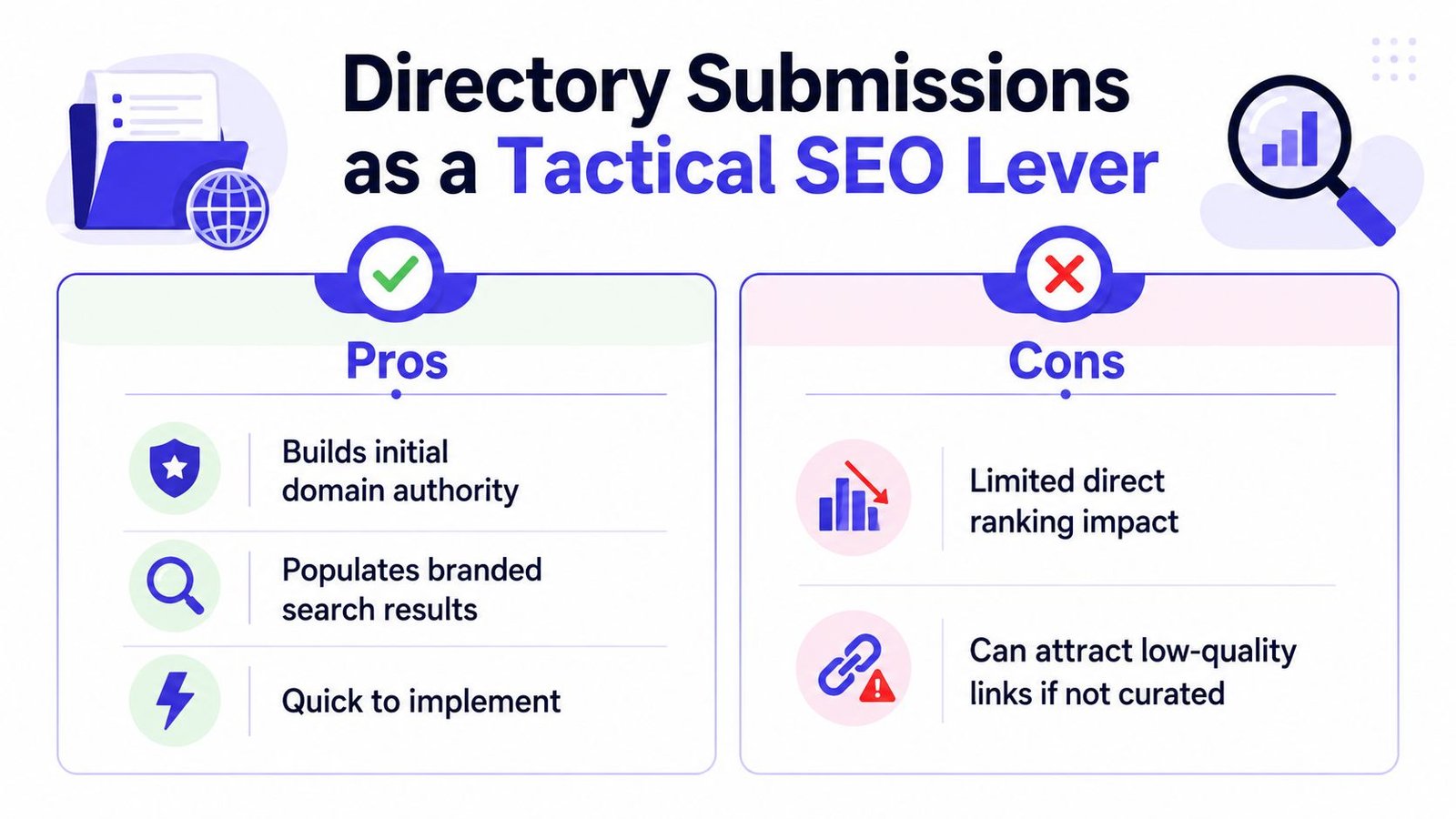
Directory submissions do not replace technical SEO, useful content, or customer proof. They can still give a young startup fast trust signals. A relevant profile creates another discovery path for buyers, supports branded search results, and gives search engines a crawlable reference while the company website builds history. The same profile may also help AI search systems confirm the product category, company name, and audience.
The quality gap is substantial. In a 2026 statistical survey of 1,077 startup launch and directory destinations, the median Domain Rating was 35, 400 listings, or 37%, offered a dofollow link, and 974 sites, or 90%, accepted free submissions. Only 18 sites combined free submission, a dofollow link, and DR 70-plus authority, according to directory ecosystem statistics from IdeaProof.
Those figures make indiscriminate volume a poor use of a startup's time. Free access does not establish authority, while a dofollow link does not guarantee relevance, indexation, or referral traffic. A focused submission package, such as a manual directory submission service, should prioritize fit and ownership over a long spreadsheet of placements.
Manual work versus automated volume
Automation appears efficient until directories apply different categories, required fields, editorial standards, and duplicate rules. A bot can publish inconsistent descriptions, create duplicate profiles, or place a startup in irrelevant categories. Manual review takes longer, but it protects brand accuracy and filters out sites unlikely to help buyers or search engines.
A practical workflow includes:
- Map the brand data: Prepare the canonical name, product description, founder details, categories, URLs, logo files, and social profiles.
- Check existing listings: Search the company name and domain before creating a new profile.
- Prioritize relevance: Select software, startup, launch, review, and industry platforms that match the product.
- Review link quality: Check authority, indexability, editorial context, and dead-link risk.
- Record outcomes: Save the live URL, approval status, link attribute, login ownership, and screenshot.
The survey also found 46 listings, or 4%, carried a high dead-link risk. Directory records need periodic review because an old placement can disappear, change categories, or stop passing useful referral value.
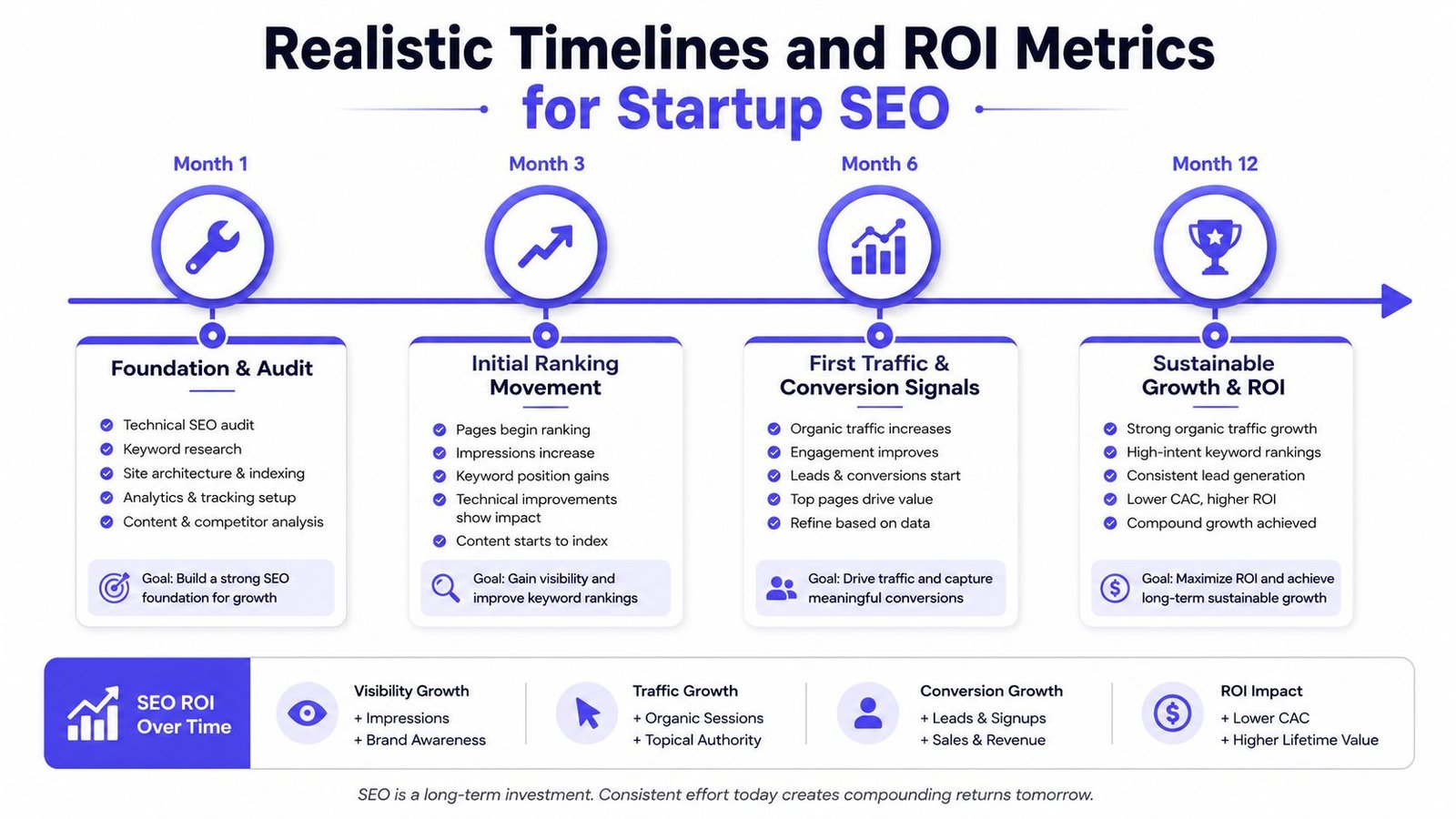
Directories become more useful when they support a wider trust system. Pair them with original product education, integration pages, customer proof, review profiles, and editorial outreach. Consistent descriptions across those assets give buyers and AI systems clearer evidence of what the startup offers and who it serves.
Realistic Timelines and ROI Metrics for Startup SEO
A launch can create attention without creating lasting search demand. Traffic often spikes, then falls as the platform feed moves on. The practical response is to convert that short-lived exposure into assets that keep working, including optimized pages, third-party profiles, directory backlinks, useful references, and a measurement baseline. Generic SEO retainers often miss this gap by reporting activity before trust signals have had time to accumulate.
A practical sequence for the first year
Month 1 should establish the foundation. Confirm that important pages are crawlable, visible copy matches structured data, analytics and Search Console are configured, and the site explains the product clearly. Build a list of relevant directories and prepare consistent submission materials. These early placements may not produce immediate traffic, but they can strengthen brand consistency for buyers and AI search systems.
By month 3, look for movement rather than a finished result. New pages may begin appearing for branded and low-competition queries. Directory placements may be live, pending, rejected, or not yet indexed. Review whether the startup is accumulating qualified references, durable directory backlinks, and clearer associations with the right product category. A retainer that produces generic blog posts while ignoring those signals is usually misaligned with an early-stage company's needs.
By month 6, evaluate discovery and conversion signals together. Review impressions, clicks, branded queries, landing-page engagement, sign-ups, demo requests, and referral traffic from profiles. A ranking change matters more when it reaches a page that explains the product and offers a clear next action. Compare organic performance with referral visits from directories and profiles, since a link can support discovery even before it produces measurable search growth.
The link rationale is supported by the 11.8-million-result Backlinko analysis, which found that pages with backlinks generated 14.4 times more organic clicks than pages without backlinks. That relationship does not guarantee a result for an individual startup. It does support treating relevant link acquisition as both a traffic lever and an authority activity.
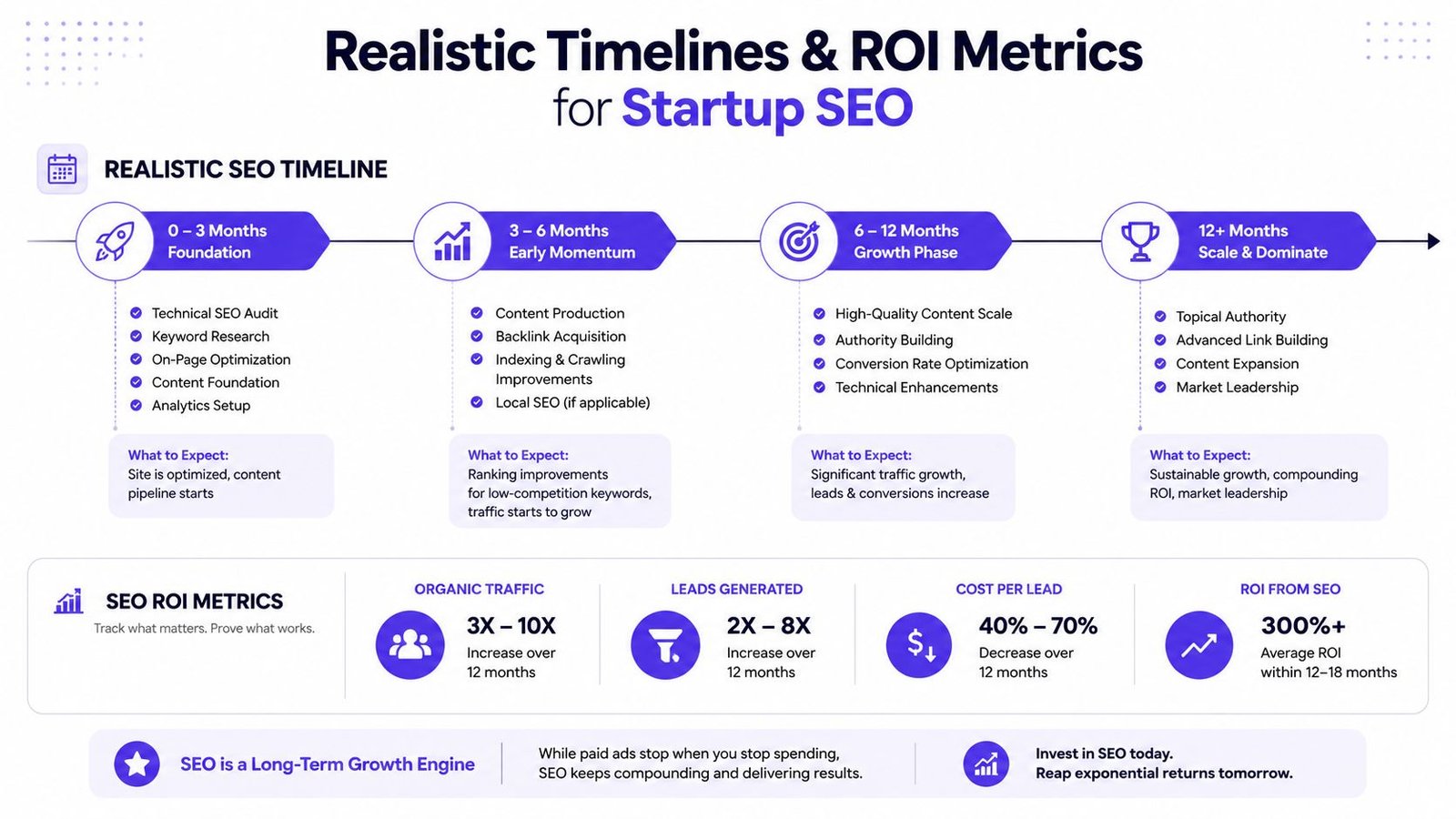
What to measure weekly and monthly
Track technical errors, indexing changes, newly live links, rejected submissions, and branded impressions often enough to catch problems early. Review rankings, referring domains, organic landing pages, assisted conversions, and AI visibility monthly, so short-term noise does not dictate strategy.
AI search needs its own observation layer. Test realistic prompts across Google AI Overviews, Perplexity, and ChatGPT. Record whether the brand appears, how it is described, which pages or profiles are cited, and which competitors are mentioned. Google says AI feature traffic is included in overall Search Console traffic, but citation and mention monitoring still requires deliberate testing outside standard rank tracking.
A startup should demand evidence that each month's work builds trust, improves discoverability, and makes the next month more productive. Dramatic traffic growth is a later outcome, not a sensible early benchmark.
Practical Next Steps and Common Questions
Founders can make meaningful progress without committing to a broad retainer immediately. Start with a short operating plan:
- Audit the essentials: Confirm crawlable text, visible product information, structured data alignment, Search Console access, and clear conversion paths.
- Build the trust layer: Prepare consistent company information and identify relevant startup, software, review, launch, and industry directories.
- Choose quality over volume: Reject low-relevance sites, check duplicates, and insist on a report containing live URLs and acceptance details.
- Create search-ready assets: Publish pages for core use cases, integrations, alternatives, and customer questions.
- Add AI visibility checks: Test how Google AI Overviews, Perplexity, and ChatGPT represent the brand, then improve the pages and profiles those systems can access.
- Review after the first execution cycle: Decide whether the evidence supports more submissions, editorial outreach, content production, or a broader engagement.
The AI search environment is changing, but it isn't moving in a straight line. Semrush reported that Google AI Overviews appeared for 6.49% of keywords in January 2025, rose to nearly 25% in July, and fell to 15.69% in November. Navigational queries triggering AI Overviews rose from 0.74% in January to 10.33% in October, as reported in the Semrush AI Overviews study. Track visibility as a changing discovery channel, not as a replacement for traditional SEO.
Frequently asked questions
Do directory links still matter in 2026?
They can, when the directory is relevant, crawlable, maintained, and trusted by its audience. They shouldn't be treated as a substitute for editorial links, useful content, or a technically sound website.
What should an AI-first startup optimize first?
Make the product category, use cases, terminology, and evidence easy to understand in crawlable text. Keep structured data aligned with visible content, and build credible third-party references that confirm the company's identity and expertise.
What can a solo founder do with almost no budget?
Handle the foundational pages, Search Console setup, and a small set of carefully selected profiles personally. Use a spreadsheet to track submissions, ownership, live URLs, indexation, and renewal or update requirements. The free startup directories list can help create an initial prospecting set.
What if the launch spike has already faded?
Treat the launch as raw material. Improve the landing page, turn recurring questions into useful pages, claim relevant profiles, and pursue references from partners, communities, integrations, and publications. The goal is to convert temporary attention into durable discovery paths.
What if previous link building created a bad profile?
Stop the low-quality campaign, export and review the referring domains in Ahrefs or a comparable tool, document clearly harmful patterns, and avoid trying to conceal the history with more random links. A qualified SEO practitioner can help separate risky placements from links that are low impact.
StartupSubmit offers manual submission and profile management for SaaS and AI startups that need a defined directory-focused SEO project rather than an open-ended retainer. Visit StartupSubmit to review the submission approach, reporting details, and available coverage options before choosing your next trust-building step.