Customer Research Online: A Founder’s Playbook
You launch a SaaS product with a polished landing page, a clear value proposition, and a small burst of attention from Product Hunt or social media. Then a prospective customer asks a question you weren't prepared for: “What do people say about you outside your own website?” They search your brand, compare alternatives, read reviews, ask an AI tool for recommendations, and look for evidence that your product works for companies like theirs. By the time they reach your homepage, much of the decision may already be made.
That's the uncomfortable reality of customer research online. Founders aren't only researching users through surveys, interviews, and analytics. Customers are researching the company, product, reputation, and alternatives across search engines, review platforms, communities, startup directories, and AI-generated answers.
Why Online Customer Research Now Drives Every Purchase
A founder can spend weeks validating a problem and still miss the research buyers conduct after launch. The team asks users what they need, but buyers ask a different set of questions: Is this product credible? Has anyone like me used it? What are the alternatives? Does the company appear consistently across trusted websites?
That buyer-side investigation has become routine. A 2026 industry synthesis of online review behavior reports that more than 99% of American consumers read online reviews before purchasing, while 93% say reviews influence their decisions. The same source reports that 77% consider reviews important, and about one in three won't buy without reading them first. Independent survey coverage in that synthesis also finds that 96% regularly look at reviews for an unfamiliar product or service, while 47% always check reviews before proceeding.
For an early-stage SaaS or AI company, this changes the definition of discovery. Your landing page is one research document among many. A directory profile, review page, comparison article, community discussion, and product listing can each answer a different part of the buyer's question.
Customers investigate the evidence around your claim
Suppose your homepage says your AI meeting assistant saves teams time. A buyer may search for:
- Independent validation: Reviews, ratings, and user discussions.
- Category context: Startup directories and software marketplaces that explain where the product fits.
- Competitive alternatives: Comparison pages and “best tools” lists.
- Operational proof: Integrations, security information, documentation, and customer experiences.
- Reputation signals: Consistent company descriptions across recognized platforms.
The volume of feedback matters as well as its wording. Research summarized by the Northwestern University Spiegel Research Center reports that a product with five reviews is 270% more likely to be purchased than a product with no reviews. The same source cites research linking review volume with purchase decisions and reports that 63% of consumers say reviews influence whether they buy from a new online store, while 70% are more likely to purchase a product with positive reviews.
Practical rule: Treat every public profile as part of your product experience. Customers may encounter it before they ever encounter your onboarding flow.
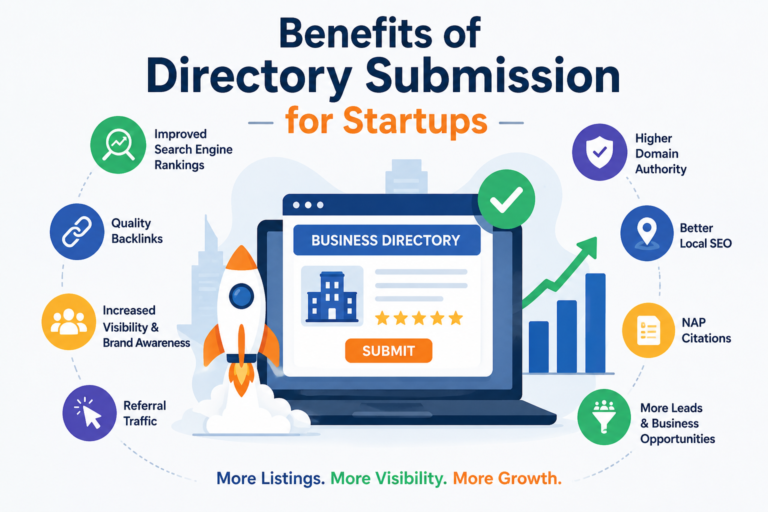
This is why customer research has become a two-way practice. You study interviews, behavior, and feedback. Buyers study your external footprint. A carefully managed directory submission service can support that footprint, but only when listings are accurate, relevant, and useful to the people researching the category.
Research tools should fit the question
You don't need an elaborate research stack. You need a clear question and a channel that can answer it. Founders comparing survey platforms can use a curated guide to best SurveyMonkey alternative tools when the default survey workflow doesn't fit their audience or budget.
Start by separating two questions:
- What are customers trying to accomplish? Interviews, usability sessions, and support conversations usually reveal this.
- What convinces customers to choose us? Reviews, search results, directories, comparison pages, and sales-call objections reveal this.
Confusing those questions creates weak research. A survey may tell you that users like a feature, but a review search may reveal that the feature isn't trusted because buyers can't find independent evidence about it.
Choosing the Right Research Methods for Your Stage
Early-stage teams often collect too much low-quality data because they use methods that don't match their current product reality. A pre-launch founder with no active users can't learn much from a satisfaction survey. A mature SaaS product with abundant behavioral data shouldn't rely only on a handful of interviews.
The right mix depends on the decision in front of you. Are you validating a painful problem, testing whether a prototype makes sense, finding friction in an existing workflow, or understanding why customers leave?
Match the method to the decision
| Method | Best For | Time Required | Cost Range | Insight Type |
|---|---|---|---|---|
| Interviews | Problem discovery, buying context, churn reasons | Medium to high | Low to moderate | Motivations, language, unmet needs |
| Surveys | Measuring preferences and validating patterns | Low to medium | Low to moderate | Quantitative direction and segmentation |
| Moderated usability testing | Finding confusion in a workflow or prototype | Medium | Low to moderate | Observed friction and comprehension |
| Unmoderated usability testing | Comparing task completion across concepts | Low to medium | Moderate | Behavioral patterns at scale |
| Analytics review | Identifying drop-offs and high-use paths | Low | Low | What users do |
| Social listening | Finding recurring language and objections | Medium | Low to moderate | Market vocabulary, sentiment, alternatives |
The table is a planning tool, not a ranking. Interviews usually produce the richest explanation, but they can overrepresent unusually motivated users. Analytics shows what people do, but rarely explains why. Surveys create comparable responses, but poorly written questions turn uncertainty into misleading precision.
For a problem-validation stage, combine interviews with social listening. Look at conversations in relevant communities, then ask interviewees to reconstruct a real recent event rather than describe an imagined future. For a prototype, pair moderated usability testing with a short follow-up survey. You need direct observation first, then a structured read on perceived usefulness.
Keep the research stack deliberately small
Most founders can sustain two or three methods. A practical early mix might include:
- Interview conversations for buying triggers and failed workarounds.
- Analytics review for the behavior that contradicts what users say.
- A focused survey for prioritizing questions that already have clear response options.
Don't run all three because they sound rigorous. Run them because each answers a different part of the same decision.
For competitive context, use best startup directories as research surfaces rather than treating them only as link-building destinations. Directory categories, descriptions, reviews, and competitor positioning can show how the market describes itself, which terms buyers may recognize, and where your product's explanation is still vague.
A common failure is asking a survey to discover a problem, validate a solution, measure satisfaction, and prioritize features at once. That produces a long questionnaire with conflicting objectives. Separate exploratory work from measurement, and write one primary decision at the top of the research brief.
Recruiting Participants and Writing Questions That Work
The hardest research problem is often recruitment. A beautifully designed interview script won't help if the only participants are friends, highly engaged beta users, or people who already agree with your thesis.
Start with the people who recently experienced the problem, not everyone who might theoretically benefit from your product. For a B2B tool, that may mean users who completed a particular workflow, prospects who chose a competitor, former customers, or people who abandoned onboarding. For an AI product, include users who tried a manual alternative, because their workaround often reveals the underlying job.
Recruit from behavior, not demographics alone
Use a simple recruitment sequence:
- Start with first-party contacts. Pull candidates from recent signups, support tickets, trial cancellations, sales conversations, and activation events.
- Add independent voices. Recruit through relevant communities, beta lists, founder networks, and social channels. Community participation should come before promotion, especially when using Reddit marketing support or any discussion-based channel.
- Screen for the event. Ask when they last encountered the problem, what they used instead, and whether they personally made or influenced the purchase.
- Separate users from buyers. A daily user may explain workflow friction, while an economic buyer may explain trust, risk, and approval barriers.
- Track recruiting bias. Record who declined, who completed, and which segments are missing. Silence from a segment isn't evidence that the segment has no problem.
The invitation should explain the topic, time commitment, recording policy, and how feedback will be used. Don't oversell the product in the invitation. A participant who thinks you're looking for praise will edit their answers accordingly.
Ask for recent behavior
Weak question: “Would you use an automated reporting tool?”
Better question: “Tell me about the last time you prepared that report. What did you do first, and what took the most effort?”
The first asks for a prediction. The second asks for a sequence of observable actions. Predictions are useful later, but recent behavior is the stronger foundation for problem discovery.
Useful templates include:
- Problem validation: “When did you last realize your current process wasn't working?”
- Workaround discovery: “What did you try before using a dedicated tool?”
- Feature prioritization: “Which part of this workflow would you remove if you had to simplify it?”
- Churn investigation: “What changed between your last successful use and the decision to stop?”
- Positioning research: “What words did you use when searching for a solution?”
- Trust research: “What did you need to verify before you felt comfortable trying it?”
Avoid questions that contain the desired answer, bundle multiple ideas, or ask users to rank features they haven't seen. If you need prioritization, show a small set of concrete options and ask about trade-offs. Then follow up with “Why?” until the answer reaches a real consequence, such as lost time, approval risk, missed revenue, or a workaround that someone maintains manually.
Recruitment quality beats analytical sophistication. A precise analysis of the wrong audience is still wrong.
Response Rates and Sample Sizes You Can Realistically Hit
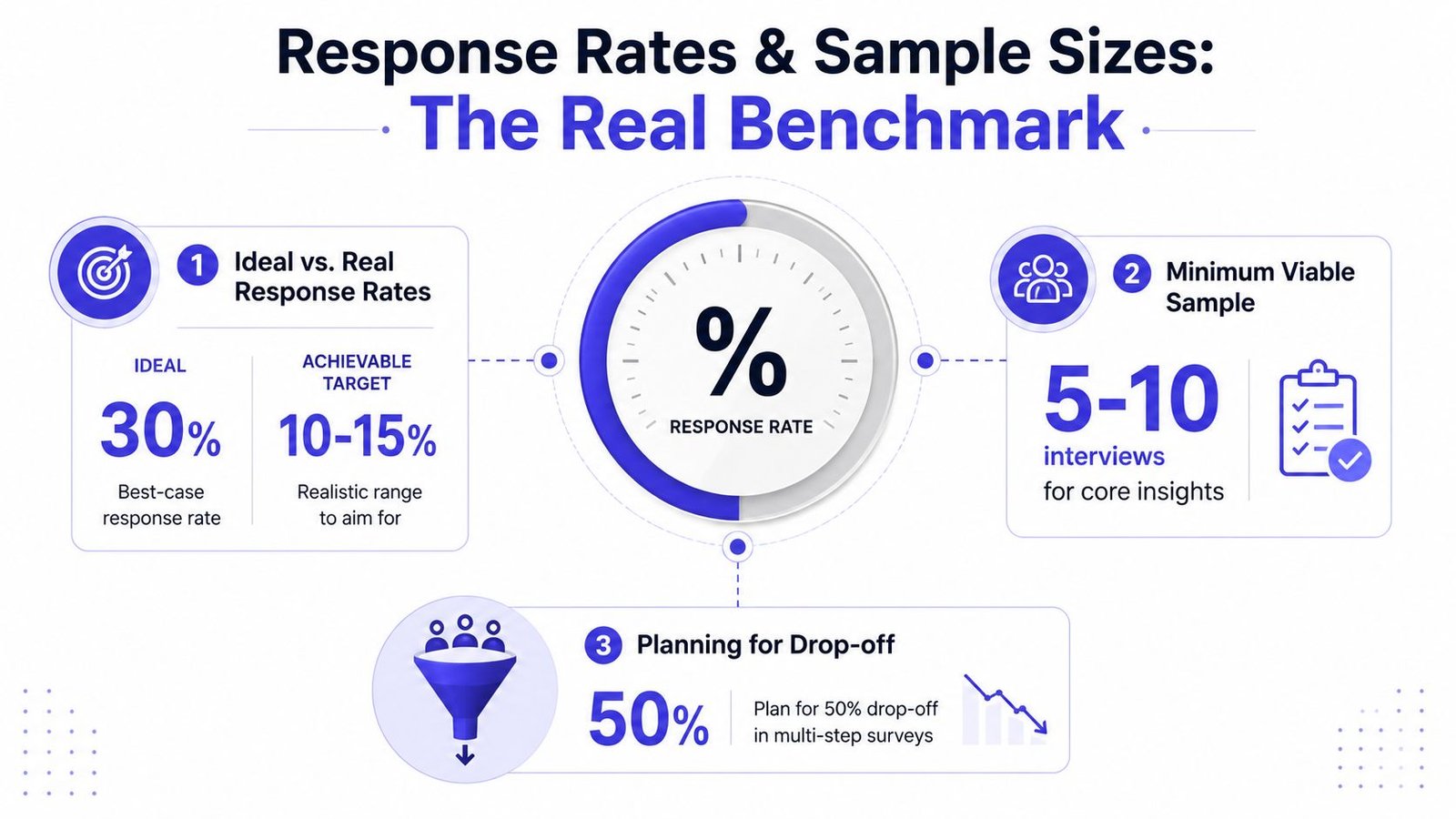
Survey planning fails when founders treat an ideal response rate as a forecast. Channel, audience fit, timing, and perceived relevance usually matter more than removing one more question from the form.
A benchmark covering 4,332 surveys reports a median response rate of 9.98%, while results above 22% placed programs in the top quartile, according to SpaceForm's survey response rate benchmarks. The same source gives typical email ranges of 10% to 15%, with B2B email surveys often reaching 20% to 30%. It recommends treating 0% to 4% as a redesign signal, especially for broad, unsegmented audiences.
Context changes completion
A CX survey response guide from Clootrack reports average response rates of 3.65% for popup surveys, 29.95% for web-link surveys, and 34.37% for in-app surveys. These figures are benchmarks, not promises. They show why a survey displayed after a relevant action can outperform a generic intercept that interrupts visitors without context.
Use the lowest-friction channel for the audience you understand best. Segment by recent activity, role, plan, use case, or lifecycle stage. A cancellation survey should focus on the cancellation event, rather than asking a customer to evaluate every product area. If your reach is limited, explore free startup directories for low-cost audience reach while you refine the survey and recruiting approach.
Plan sample size before sending invitations
For statistically usable research, many CX teams plan around 95% confidence and a ±5% margin of error. The Clootrack guide notes that a population of 1,000 customers requires about 285 completed responses under that planning approach, implying a 28.5% completion rate.
That calculation helps only when the sample represents the audience you want to understand. A large response count from power users cannot explain why casual users never activate. With a small audience, combine directional survey results with interviews and behavioral evidence. Present the findings as evidence about the sampled group, not as universal market truth.
If response is weak, diagnose the failure before sending more reminders:
- Audience mismatch: Remove people who have not experienced the relevant workflow.
- Poor timing: Trigger the survey after a meaningful action, not during an unrelated session.
- High friction: Reduce required fields and cut questions that do not affect a decision.
- Wrong channel: Move from a popup to an in-app prompt, web link, or targeted email.
- Low trust: Explain why you are collecting feedback and what may change as a result.
A low response rate usually points to a research design problem, not a motivation problem.
How AI Search Is Reshaping Customer Discovery
The old discovery path was straightforward. A buyer searched Google, opened several websites, compared pages, and formed an opinion. The newer path may begin with an AI search tool that summarizes a category, recommends products, describes trade-offs, and answers follow-up questions before the buyer visits a company site.
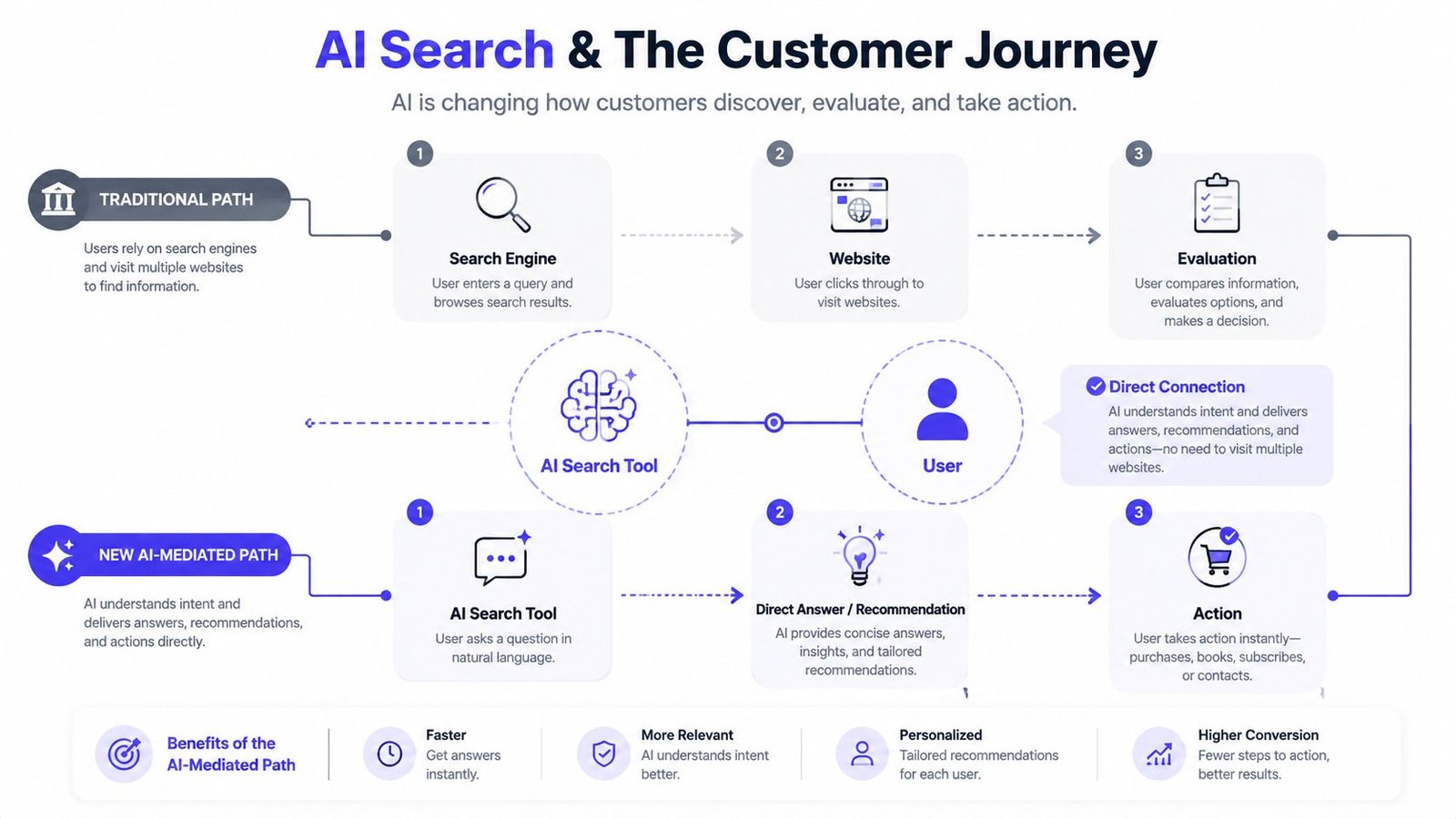
Research in the Yext AI archetypes study reports that 62% of consumers trust AI to guide brand decisions, 43% use AI search tools daily or more, and 75% say they use new search tools more than they did a year earlier. The same source reports that 60% of searches end without a click-through, while 80% of consumers rely on AI-written results for at least 40% of searches.
For founders, this creates a new research surface. You need to understand not only what ranks, but what an AI system can find, combine, and repeat about your company.
Brand mentions now carry broader discovery value
Backlinks still have a role in authority and referral discovery, but they aren't the only signal associated with visibility in AI-generated results. An Ahrefs analysis of 75,000 brands found a stronger correlation between Google AI Overview visibility and brand web mentions, which scored 0.664, than with backlinks, which scored 0.218.
A separate analysis of AI Overview citations reported that citations from Google's top ten organic results fell from 76% to 38%, indicating that AI answers aren't just copying the traditional blue-link order, as described by Link Building Journal's analysis.
That makes trusted directories, review sites, product databases, and community pages strategically useful. Product Hunt, G2, SaaSHub, Capterra, AlternativeTo, and relevant startup listings can provide more than a link. They can give AI systems additional consistent descriptions, category associations, use cases, and external references to reconcile.
Build an AI discovery monitoring loop
Run the same prompts a buyer might use in ChatGPT, Perplexity, Google AI Overviews, and other answer engines:
- “What are the best tools for [specific job]?”
- “What alternatives exist to [competitor]?”
- “Which products suit [audience or workflow]?”
- “What are the drawbacks of [category]?”
- “Is [your product] suitable for [use case]?”
Record whether your brand appears, how it is described, which competitors appear, and what evidence the answer cites. Don't treat one response as a ranking report. Repeat the test with different wording and compare the external pages those systems rely on.
Founders who want a more structured approach can use this AI agents for customer research playbook to think through research automation without handing judgment over to a model.
An AI directory submission service can support this broader presence, but directory volume alone isn't the strategy. Relevance, consistency, accurate categories, and genuine third-party usefulness matter more than filling every available form.
Turning Research Data into Product and Marketing Decisions
Raw feedback becomes valuable only when it changes a decision. A folder full of interview recordings and survey exports isn't a research program. It's storage.
Start each study with a decision statement: “We need to decide whether to simplify onboarding for technical teams,” or “We need to choose which use case leads the homepage.” This prevents the team from collecting interesting observations that nobody can act on.
Use a repeatable analysis workflow
First, preserve the source language. Export exact phrases from interviews, support tickets, reviews, and community posts. Customer wording often reveals the search terms and category labels your team has been missing.
Next, code for behavior and consequence. Tag statements such as “manual workaround,” “approval delay,” “missing integration,” “trust concern,” or “unclear setup.” Avoid coding every opinion as equally important. A feature request without a business or workflow consequence shouldn't automatically outrank a less frequent problem that blocks activation.
Then, compare segments. Separate buyers from users, new accounts from established accounts, retained customers from churned accounts, and high-intent prospects from casual visitors. A pattern that appears across independent sources deserves more attention than a loud request from one highly engaged customer.
Finally, translate evidence into an owner and action. Each finding should identify the affected segment, supporting evidence, decision, owner, and next validation step.
A compact report can use this format:
| Finding | Evidence | Decision | Owner | Next Check |
|---|---|---|---|---|
| Setup language is unclear | Interview phrases and onboarding exits | Rewrite setup guidance | Product and content | Test revised flow |
| Buyers lack category context | Search prompts and sales objections | Add comparison content | Marketing | Review qualified conversations |
| Feature request is narrow | Few mentions, limited workflow impact | Defer for now | Product | Revisit after broader demand |
Feed customer language into SEO and LLM visibility
Customer research should shape the words on your landing pages, help documentation, comparison pages, directory listings, and review responses. If customers call a workflow “client reporting,” don't force “automated performance summaries” into every heading because it sounds more polished.
Use the vocabulary carefully. Search engines need clear topical context, while AI systems need consistent external descriptions they can connect. That doesn't mean copying one sentence across every profile. It means describing the same product truthfully from several useful angles: the job it performs, the audience it serves, the workflow it replaces, and the limitations a buyer should understand.
A strong insight has a destination. If a finding doesn't change a product decision, message, workflow, or research question, it probably hasn't been framed sharply enough.
Ethical Research Practices and Practical Next Steps
Ethical research produces better data because participants are more likely to be candid when they understand the process. Ask permission before recording interviews, explain how responses will be stored, limit access to identifiable information, and remove personal details from reports when they aren't necessary.
Avoid leading questions that reward agreement. Don't ask, “How much would you love an AI feature that automates this?” Ask what the participant does today, what they've already tried, and what happens when the process fails. Be transparent about whether feedback may influence product development, marketing, or public case material.
Use this week's schedule to create momentum:
- Choose one decision: Write the product or marketing choice the research must inform.
- Recruit a focused group: Invite people who recently experienced the relevant workflow.
- Run five conversations: Keep the script short and ask for concrete recent examples.
- Review public discovery: Search your brand, category, and alternatives across Google and AI tools.
- Publish the learning internally: Share customer language, evidence, decision, and owner in one concise document.
Customer research online compounds when the team revisits it. Each interview improves the next question, each search observation sharpens positioning, and each honest public profile gives buyers better evidence to evaluate.
StartupSubmit helps SaaS and AI founders build a consistent external presence through manual submissions to startup and software directories, with categorized listings, backlink details, acceptance notes, and screenshots in the final report. Visit StartupSubmit to turn your customer discovery insights into accurate directory profiles that support search visibility and AI-mediated discovery.