What Is Domain Authority in SEO? a Founder’s Guide
Domain Authority is Moz's 1 to 100 comparative score for estimating how likely a site is to outrank competitors, and it's built from backlink data rather than on-page content. It's a benchmark, not a Google ranking factor.
If you just launched a SaaS site, that answer can feel rude. You ship the product, post on Product Hunt, watch a little traffic come in, then open Moz and see a number that looks embarrassingly small next to a competitor sitting calmly at a much higher score. That reaction is normal, and it's exactly why founders keep asking what is domain authority in SEO.
The score feels personal because it sits right beside your broader marketing effort. You've got a product, a homepage, maybe a few blog posts, and now a single number seems to sum up whether the internet respects you. Moz built DA to make ranking potential easier to compare, and it became popular because SEO teams needed a shorthand while link-based signals became central to organic search. The metric's value comes from being useful in competitive benchmarking, outreach, and link-building workflows, not from any claim that Google uses it directly. Moz's explanation of Domain Authority makes that distinction clear.
For founders, the emotional trap is obvious. A new site can feel invisible, and DA looks like a scorecard for that invisibility. The better way to read it is as a relative measure of your backlink strength against the field you're playing in, not as a verdict on your company.
The Week After Your Launch When the Score Feels Personal
The founder moment nobody posts on LinkedIn
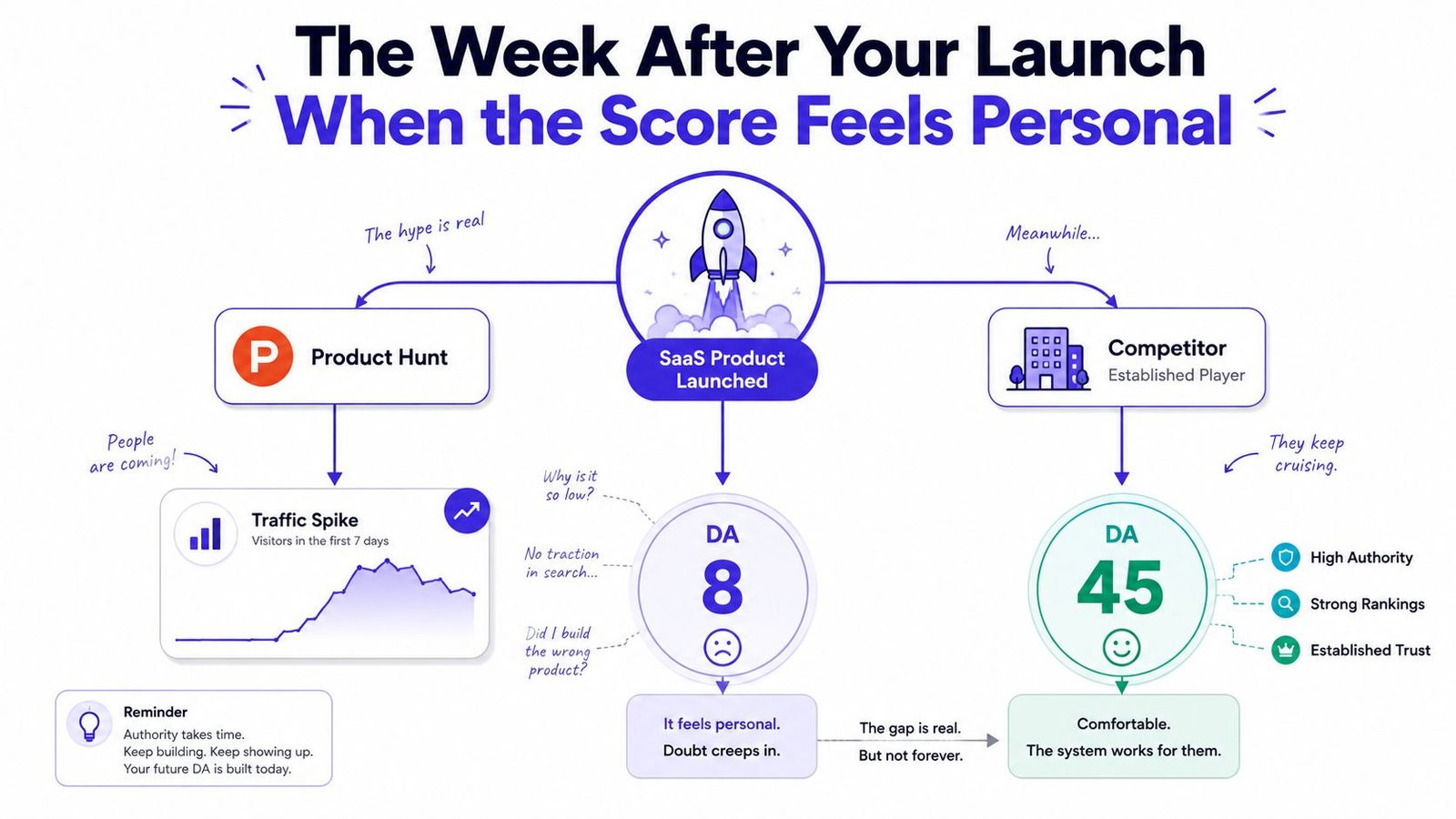
The week after launch is weird. Your inbox has a few nice replies, your Product Hunt spike already feels like last week's weather, and the SEO tab is the one tab you keep reopening because it looks objective. Then you see DA 8 and a competitor sitting at 45, and it feels like your site has been judged before it's had a chance to speak.
That feeling is common because DA was built to compare sites across a crowded web, not to flatter early-stage companies. Moz describes it as a 1 to 100 ranking-prediction metric, and the important word there is comparative. It estimates ranking potential against competitors, so a young site can be doing the right things and still look weak on paper. Moz's Domain Authority guide explains that the score is meant to estimate ranking potential rather than act as a direct Google ranking factor.
Practical rule: if your site is new, treat the score like a map, not a report card.
That's why founders use DA in business development and link-building workflows. It compresses a messy reality, backlink strength, referring-domain quality, competitiveness, and trust signals, into one number that's easy to compare. StartupSubmit's SaaS directory submission service fits that workflow because it's the kind of work founders use when they need a structured way to build a starting backlink footprint without doing every submission manually.
Why the metric exists at all
DA got traction because SEO teams needed a shorthand once links became a major part of organic strategy. Instead of reviewing every referring domain by hand, teams could sort prospects, monitor growth, and compare themselves to competitors. That made the score useful even to people who knew it wasn't a perfect measure.
So yes, the number can sting. It's still useful because it tells you where your site stands in a competitive field, which is exactly the question a first-time founder is trying to answer after launch.
How Moz Calculates the Score
Think in votes of trust, not magic
Moz says DA is calculated from a site's backlink profile and related off-page signals, with links acting like votes of trust from other websites. A site with more high-quality inbound links usually earns a higher DA, while a new domain or a site with only a few links tends to stay low on the scale. Moz's explanation of how to explain Domain Authority frames the metric around link-based trust rather than content scoring or traffic.
That is the part founders usually miss. DA is not a CMS score, and it is not a design score. It mostly reflects who links to you, how credible those linking domains look, and how your backlink profile compares with everyone else's. If you want the number to move, other sites need to point at yours for real reasons.
Why the scale feels harder at the top
The scale is not linear. Moving from a low score to a mid-range score is usually easier than climbing into the upper tiers, because the score compresses a lot of authority into the top end. A site can add links and still barely move, while a stronger competitor may appear to rise in smaller but more meaningful steps.
Moz's own explanation also makes clear that DA is designed to estimate ranking potential, not to measure content quality, traffic, or conversions. That matters because a site can publish excellent content and still have limited authority if nobody trustworthy links to it yet. A founder should read DA as a signal about referral strength, not as a summary of the whole marketing stack.
A good backlink changes the score because another site is vouching for you. A prettier homepage doesn't.
For a startup team, the practical implication is blunt. If your link profile is thin, the fastest path up the curve is earning relevant links, not tweaking titles for the fifth time. A new SaaS site can also gain early structure by using an AI directory submission service to build a starting backlink footprint without handling every submission by hand. The score follows the off-page footprint.
Where Your Site Sits on the Curve
Benchmarks that make the anxiety less personal
A brand-new SaaS site can feel far behind when the number is low, but that reaction usually comes from comparing your launch to companies that have spent years collecting links. One industry compilation reports an average DA of 21, a median of 15, and says 52.4% of websites have DA under 20. The same source reports that only 8.3% of websites reach DA 40+, while just 2.5% reach DA 80+. Another 2025 review says the median website sits around DA 30 to 35, that only 5% of websites reach DA 60 or higher, and that new domains often start at DA 1. It also says new sites typically need 12 to 18 months to reach about DA 20 to 30 with consistent effort. BacklinkGrid's domain authority statistics collects those benchmarks.
That spread matters because it separates normal from alarming. Most of the web lives in the lower and middle ranges, while the upper end is crowded by sites that have had time to accumulate trust, mentions, and referrals. A fresh domain is not broken because it starts low, it is starting where most new domains start.
A simple way to read the curve
| DA range | Share of websites | Founder read |
|---|---|---|
| DA under 20 | 52.4% | Very common for new or lightly linked sites |
| DA 20 to 39 | Most of the rest, clustered low to mid | A realistic early target for a young startup |
| DA 40+ | 8.3% | Stronger authority, usually built over time |
| DA 60+ | 5% | Harder territory, usually not a week-three goal |
| DA 80+ | 2.5% | Rare, concentrated among established brands |
Use that curve as context, not as a grade on your company. A site in the first band is not failing, it just has not built enough referring-domain support yet. A site that climbs into the next band has usually done the unglamorous work of earning links from credible places, and that is what changes how search engines and prospects read the domain.
For a new SaaS team, the practical question is simpler than the scoreboard suggests. Where does the site sit today, and what is the next realistic band to reach with the team and budget you have?
If you are mapping directories, communities, and review platforms for a new launch, the AI directory submission service is one way teams build that starting footprint without handling every listing from scratch.
DA Versus DR, Trust Flow and Page Authority
The alphabet soup, translated
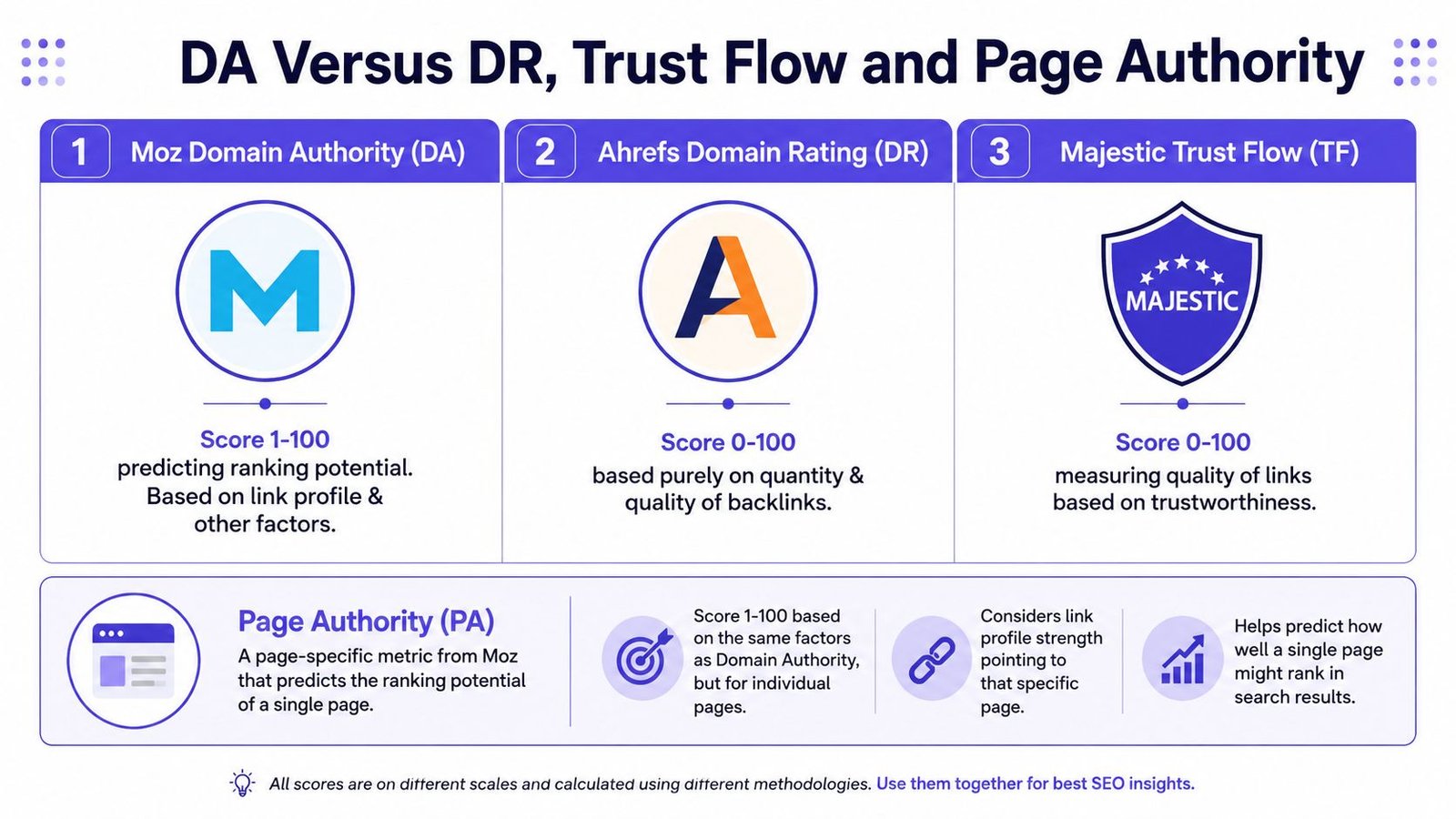
Founders bounce between tools because each platform gives them a different shortcut. Moz uses Domain Authority, Ahrefs uses Domain Rating, Majestic uses Trust Flow, and Moz also has Page Authority for a single page instead of the whole domain. Those numbers often move together, but they're not the same thing, and mixing them mid-campaign can make a site look like it jumped or fell when the tool itself changed.
| Metric | Tool | What it's for | Practical founder use |
|---|---|---|---|
| Domain Authority | Moz | 1 to 100 predictive score for a whole domain | Competitive benchmarking and outreach sorting |
| Domain Rating | Ahrefs | A backlink-based domain metric | Link growth tracking if your team already lives in Ahrefs |
| Trust Flow | Majestic | Link quality and trustworthiness | Checking whether backlinks look credible |
| Page Authority | Moz | Page-level authority rather than domain-wide | Evaluating a specific listing, article, or landing page |
The safest move is boring but effective. Pick one primary tool, use it consistently, and treat the number as a trendline instead of a verdict. Switching tools every month creates fake drama.
Why the comparison matters for startups
Moz's DA is domain-level. That means a strong page on a weak domain can still matter, while a weak page on a strong domain can still underperform. Ahrefs and Majestic frame authority differently, but all three are trying to simplify backlink quality into something a founder can scan quickly.
That's useful, as long as you don't confuse simplification with truth. If your team is trying to decide whether the site is getting healthier, consistency matters more than which score looks prettier this week. Track one metric, compare it against competitors in the same tool, and avoid turning tool changes into business conclusions.
The Directory Placement Question Most Explainers Skip
A low-DA listing can still pull its weight
This is the question founders ask after the basics: if a directory page has modest authority, is it still worth the effort? The short answer is yes, if the page is indexed, trusted, and part of a broader entity footprint that helps people and search systems understand who you are. Moz treats DA as a domain-level measure, not a page-level one, which is why a listing page's value can't be judged by the host domain's score alone. Network Solutions' explanation of domain authority also notes that Moz's explanation reflects both the ranking potential of pages on that domain and the value of another site linking back to you.
That matters for startups because a listing on a recognized platform can do more than pass link equity. It can create a branded mention, a referral path, and a consistent footprint across the web. The score on the host site is only one variable.
Three questions to ask before you submit
- Is the domain trusted and indexed? If the platform is recognizable and search engines crawl it, the listing can support discoverability.
- Will the page be surfaced and cached? A listing that exists but never gets seen is weak fuel.
- Does the profile create a consistent footprint? A clean listing with your brand name, website, and category helps reinforce entity signals even before the authority math looks impressive.
That lens is more useful than chasing a high score badge. A profile on G2, Capterra, Product Hunt, or a curated startup directory can matter because it puts your company into places users and search engines already trust. StartupSubmit's directory submission service sits in that category of work, where the point is broader visibility rather than only chasing one number.
The founder mistake is rejecting useful placements because the host page doesn't look glamorous enough.
Treat directory pages like infrastructure. Some are weak, some are strong, and many still have strategic value because they help other people confirm that your company exists, belongs in a category, and has a real web presence. That's especially relevant when you're early and your own domain still needs time to build recognition.
Practical Ways to Move the Score as a Small Team
Start with links you can earn, not links you can spray
A brand-new SaaS site often feels behind because it has little history, few mentions, and almost no external proof yet. That gap is normal. The fastest way to narrow it is to publish things other people want to reference, such as original research, benchmark reports, and simple free tools that save writers time or give them a data point they cannot easily invent themselves. Founders who create useful assets usually build authority faster than teams that only publish more blog posts.
Digital PR sits next. Founder stories, contrarian takes, and product angles that are interesting can earn coverage if you pitch them cleanly. The pitch still has to earn attention. Nobody owes a startup a mention because the launch went live.
Work the boring outreach that still wins
Broken-link outreach and unlinked-mention outreach still make sense because they are specific. You are not asking for a favor in the abstract, you are pointing to a concrete page problem or an existing mention that can become a link. That makes the ask easier to say yes to.
Guest posting can work too, but only when the publication fits your niche. A SaaS founder chasing a random high-authority site in an unrelated category is usually buying vanity, not compounding value.
Practical rule: relevance beats raw authority when the link is supposed to help your startup grow.
For curated directory coverage, manual submission can make sense if the directories are reputable and the work is done carefully. StartupSubmit is one option for founders who want that process handled rather than building the list, checking duplicates, and filling every profile by hand. If you are deciding where to submit, the best startup directories are a better place to start than any random list with a bigger score. If you want a view of the broader ecosystem around startup visibility and investor discovery, Gritt.io funding connections can help frame how these placements fit into the wider mix.
A short founder checklist for this quarter
- Create one linkable asset: a benchmark, calculator, or data-backed guide that gives other sites something useful to cite.
- Pitch three relevant outlets: not ten random blogs, just a few places your buyers already read.
- Claim or clean up key listings: make sure the brand name, website, and category are consistent.
- Review every backlink request manually: skip PBNs, link farms, and automated submissions.
- Track referring domains, not just score movement: links are the input, DA is the side effect.
What DA Will Not Tell You and How to Read It
The score is useful, just not complete
A brand-new SaaS site can have DA in the basement and still be moving in the right direction. That number does not measure content quality, conversion rate, topical relevance, user experience, or actual Google rankings. It is a diagnostic for authority shape, not a business KPI, and founders get into trouble when they start treating it like the goal.
The most common mistake is rejecting a good link because the host site's number looks lower than expected or the niche feels imperfect. A relevant placement on a smaller site can still be the right call if it reaches the audience you want and adds a credible backlink. The reverse is true too. A polished high-DA placement in the wrong context can do very little for your startup.
Don't let tiny swings steer big decisions
Moz's score is comparative, so a small dip does not automatically mean your site got weaker. It can reflect the web changing around you, or a shift in how the metric reads your backlink profile. For a founder staring at a fresh domain, that distinction matters. Early authority scores often move before the business has enough traffic for the number to feel meaningful.
Use DA to compare prospects, follow authority trends, and check whether your backlink profile is becoming more competitive. Ignore it when the question is pipeline, retention, or whether users care. If traffic is steady, conversions are healthy, and brand searches are rising, a two-point wobble in DA should not take over the week.
A new site also needs a broader frame. A directory that sends a few relevant visitors and a clean backlink can be more useful than a higher-score placement that sits in front of the wrong audience. If you are sorting through placements by hand, the free startup directories list is a practical place to compare options without turning the score into the only filter.
DA is a useful flashlight. It is a bad CEO.
That is the cleanest way to treat it. Use the number to make better link and outreach choices, then return to revenue metrics when the decision is about the business, not the backlink profile.
A 30-Day Founder Action Plan and FAQ
A plan a two-person team can finish
A brand-new SaaS site can feel behind before it has a chance to move. The score may still be low, the backlink profile may still be thin, and every update can feel louder than it should. A month of focused work does not fix everything, but it does give a small team a clean path.
Week 1: Set your baseline DA and DR, audit technical issues, and fix anything that blocks crawling or indexing.
Week 2: Publish one linkable asset that gives people a reason to cite you.
Week 3: Run targeted outreach and pitch one digital PR angle that fits your founder story.
Week 4: Submit to curated directories, review new backlinks, and decide what to repeat next month. If you are mapping that work by hand, the free startup directories list is a practical place to compare options.
A founder should read this plan as sequence, not magic. First make sure search engines can find the site. Then give other people something worth linking to. After that, earn a few relevant placements and check whether the pattern is starting to change.
The point is not to chase every possible link. The point is to build a site that looks real from the outside and behaves cleanly on the inside.
FAQ
Is Domain Authority a Google ranking factor?
No. It is Moz's comparative score for ranking potential, not a direct Google signal.
How fast can a new domain grow?
Growth is slow. The benchmark data above says new sites often need 12 to 18 months to reach about DA 20 to 30 with consistent effort.
Is buying links worth it?
If you are buying them only for the score, no. Relevant, earned links placed where real people might click are the safer choice.
How does DA relate to LLM visibility and ChatGPT answers?
DA does not measure that directly. For AI search and ChatGPT visibility, brand mentions, trusted listings, and clear entity signals matter alongside backlinks, which is why directory and profile coverage still shows up in growth plans.
If you want a faster way to build a clean backlink base and credible startup listings, StartupSubmit handles manual directory submissions for SaaS and AI startups across a wide network of directories. It is a practical fit when you want the footprint built without spending your week inside submission forms. Visit it if you want directory coverage that supports the authority work you are already doing.