Submission to Directory: The SaaS Founder’s Launch Playbook
Most founders treat submission to directory sites like launch confetti. You post on Product Hunt, maybe push to BetaList, collect a spike, then move on to “real” growth channels.
That's backward.
Directories matter most after the launch buzz fades. They're one of the few early-stage tactics that keep working when your social posts stop getting replies, your launch thread drops off the homepage, and nobody remembers your Tuesday release.
For a new SaaS or AI product, directory profiles do three jobs at once. They create referring domains, they put your brand on sites buyers already trust, and they give AI systems more places to verify your company's legitimate status. That last part matters more now than most founders realize.
The mistake isn't using directories. The mistake is treating them like a one-day promotion instead of long-term infrastructure.
Why Your Launch Traffic Fades and How Directories Fix It
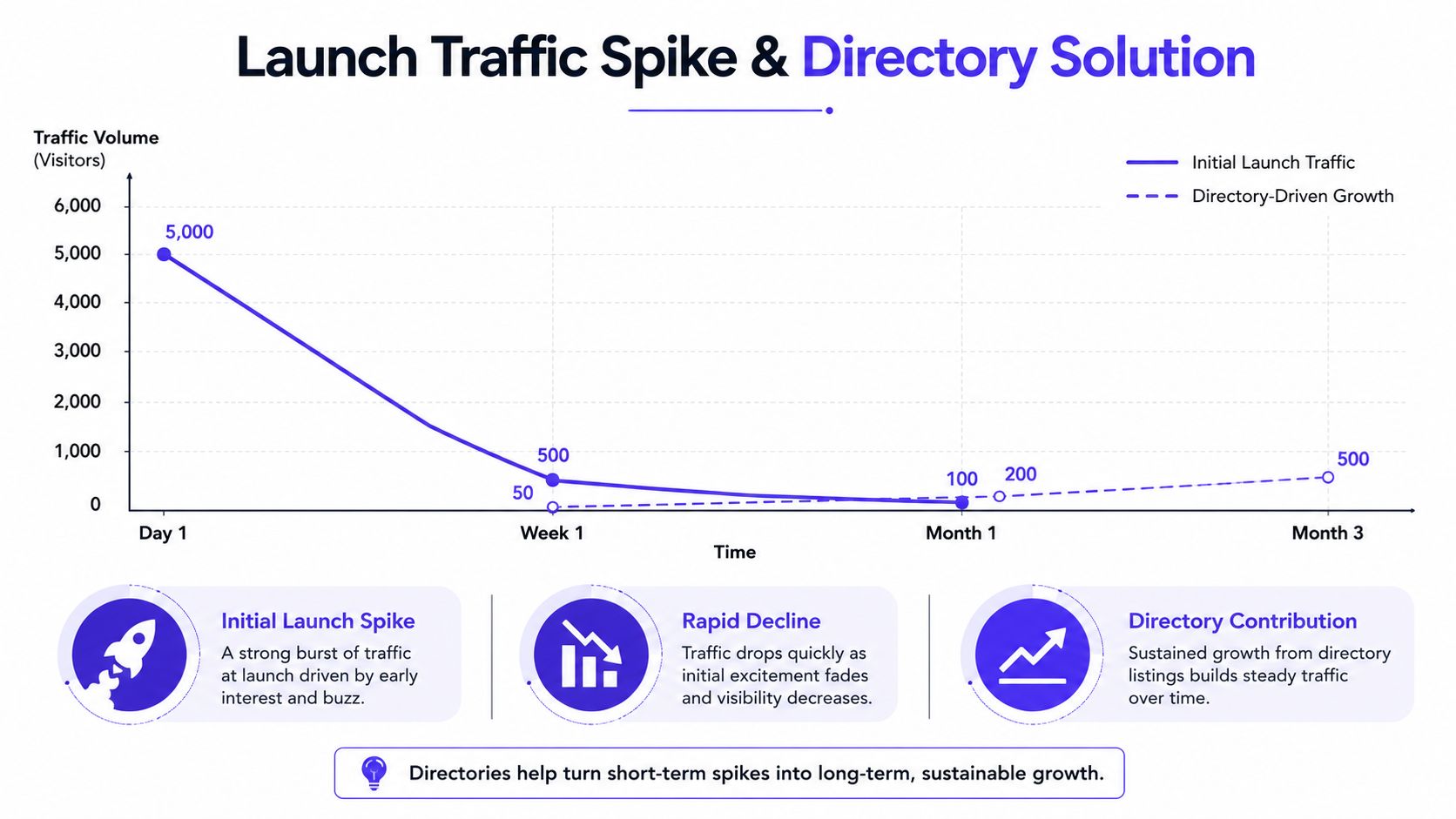
Launch traffic usually looks impressive for a few days and then gets ugly fast. That isn't a sign your product failed. It's the normal pattern.
Data shows 60-80% of launch traffic decays within 30 days, while startups with 20+ high-DR directory profiles maintain 3x more consistent organic traffic 6 months post-launch compared to teams that rely only on launch platforms (reference). This data underscores why directory work deserves more respect than it gets.
Launch platforms are events, not assets
Product Hunt can still be useful. So can BetaList, Indie Hackers, and niche launch communities.
But they behave like events. You get attention in a narrow window, from a specific audience, under a ranking mechanic you don't control. Once the listing cools off, so does the traffic.
Directories work differently. A live Crunchbase profile, G2 listing, AlternativeTo page, or category-specific SaaS profile keeps existing. It can rank for your brand. It can appear when investors search your company. It can show up when a buyer compares options.
That's why I treat submission to directory sites as brand surface area, not a launch checklist item.
What directories actually fix
Founders usually think directories are about backlinks alone. That's too narrow.
They also help with:
- Brand validation: Your company looks more real when search results include recognizable profiles instead of only your homepage.
- Referral diversity: A handful of trusted directory pages is healthier than betting everything on one launch thread.
- Post-launch decay management: You need durable visibility after the initial spike disappears.
- AI search verification: Large language models often look for signals across known aggregator sites, not just your website.
Practical rule: If people can only find your startup on your own domain, your trust footprint is still thin.
A lot of teams now use services that package this process, including StartupSubmit benefits, but the underlying principle matters more than the vendor. The win comes from building a durable layer of profiles across reputable platforms.
The long-term asset mindset
A founder who treats directories as launch garnish ends up with a few scattered profiles and no system.
A founder who treats them as infrastructure builds something more useful. They create a network of listings that supports SEO, fills page-one brand results, and keeps sending trust signals long after launch week is forgotten.
That's the right frame. Not “where can I submit today?” but “which listings will still help this company six months from now?”
Building Your Directory Submission Asset Kit
Most directory campaigns fail before the first form gets filled.
The problem usually isn't the directory. It's the prep. Founders scramble for logos, guess at category tags, paste the same description everywhere, and wonder why half the submissions never go live.
The most common rejection trigger is simple. Copy-pasting identical descriptions creates duplicate content patterns. Preparing 3 to 5 unique description variants designed for different audience angles is required to pass editorial review, and completing every available field can increase referral traffic by up to 40% (Backlynk directory submission guide).
Build the kit before you submit anywhere
A clean asset kit turns submission to directory sites from annoying admin into repeatable work.
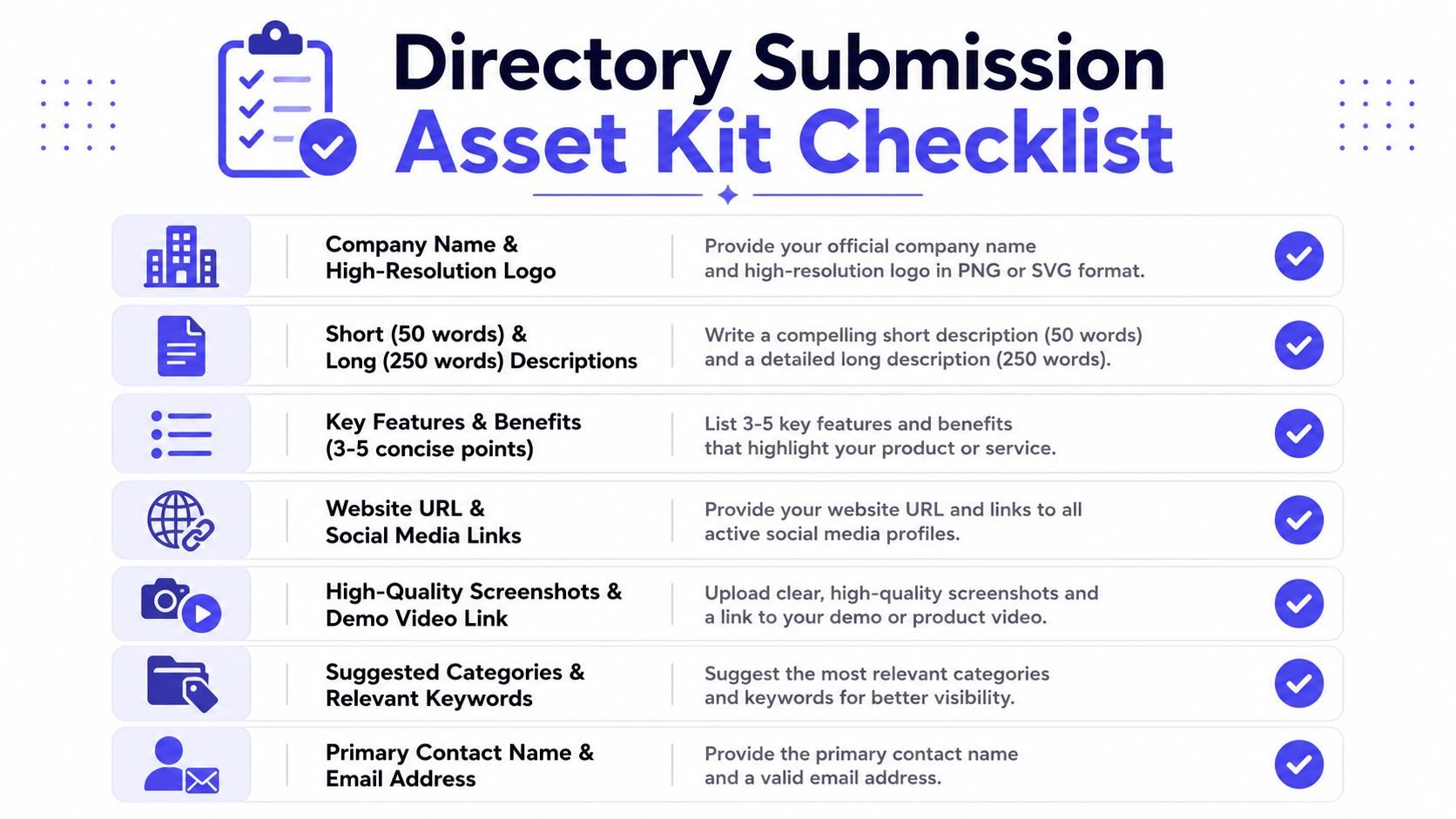
Mine usually includes:
- Core brand assets: company name, short tagline, homepage URL, logo files, favicon, and product screenshots
- Social proof inputs: founder profile links, company social handles, and support email
- Category mapping: primary category, secondary category, and backup tags for directories with odd taxonomies
- Link targets: homepage, pricing page, demo page, or a category landing page if the directory allows deep links
A lot of directories ask for the same information in slightly different formats. If you don't standardize it first, you'll waste time rewriting basics on every form.
Write description variants that serve different audiences
Here, most founders cut corners and pay for it later.
I like to prepare a small stack of reusable descriptions with different angles:
| Asset | What it does | Best use |
|---|---|---|
| Short pitch | Fast summary of the product | Tight forms and teaser fields |
| Feature-led version | Focuses on workflow and capabilities | SaaS directories and product databases |
| Benefit-led version | Focuses on outcomes and pain points | Buyer-focused and review-style listings |
| Founder-story version | Adds narrative and mission | Startup communities and maker platforms |
| Technical version | Uses product depth and terminology | AI, dev, or specialist directories |
The point isn't to sound clever. The point is to avoid a detectable footprint and fit the context of the platform.
Don't submit the same paragraph to a startup directory, an AI tools database, and a review site. Those audiences don't read the same way, and moderators don't either.
Fill every field you can justify
Half-complete listings look abandoned. They also tend to perform like abandoned pages.
Before submission, collect:
- Screenshots that show the actual product
- A demo or explainer link if available
- Relevant tags and categories
- Pricing status
- Founding year if the platform asks
- Support or contact email
- Short founder or company bio
- Social links that are active
If a field is optional but relevant, fill it. The strongest directory profiles feel complete enough that a stranger could understand what the product is without visiting your site.
Keep one master sheet
Use Airtable, Notion, Google Sheets, whatever you already trust.
Track every asset in one place: description variants, categories, profile links, login emails, and notes about which wording works best for which platforms. Once you've done this once, future submissions get much easier. It also makes updates far less painful when your product positioning shifts.
Where to Submit A Founder's Strategy for Choosing Directories
The value of submission to directory sites isn't in the raw count. It's in the quality and relevance of the sites you pick.
That's where founders waste the most time. They chase giant lists, submit to every directory with a form, and end up with a pile of weak placements on sites nobody visits.
The better strategy is narrower. Go after authoritative platforms first, then layer in niche directories that match your product category.
Start with the sites that move authority
For early-stage startups, the top tier matters disproportionately. Product Hunt (DR 92), Crunchbase (DR 91), and AngelList (DR 90) should be high on the list because those platforms carry real authority, and 50 submissions to high-DR directories (DR 50+) are far more impactful than 500 submissions to random low-quality sites (ListMySite analysis).
That's the quality-over-quantity case in one line.
A new domain does not need more junk backlinks. It needs credible mentions from places search engines and buyers already recognize.
A practical directory stack
I usually sort targets into four groups.
Tier one platforms
These are the obvious names. Product Hunt, Crunchbase, AngelList, G2, Capterra, AlternativeTo, SaaSHub.
If you skip these, you're leaving the highest-trust surfaces untouched.
Niche industry directories
An AI startup should care about AI-specific databases. A developer tool should care about dev-focused listings. A vertical SaaS product should care about industry hubs buyers browse.
Relevance matters because these profiles can send qualified referral traffic, not just link equity.
Reputation and review surfaces
These aren't always “directories” in the classic sense, but they matter for branded search. Buyers often trust these pages more than your homepage because they feel third-party.
Low-value long tail
This bucket is full of directories with weak moderation, vague categories, and little evidence of real users. I skip most of them.
Traffic beats vanity metrics
One subtle mistake founders make is chasing Domain Rating in isolation. That can backfire.
According to an Ahrefs 2024 correlation study cited here, links from pages with actual organic traffic pass more SEO equity than high DR alone. In practice, that means a smaller directory with real visitors can beat a flashy-looking site that exists mostly as a metrics shell.
If you're building on a lean budget, the same logic applies to your own stack. Teams comparing design options for landing pages often review tools like AI-powered website builders to get pages live faster, but the same principle holds after launch. Real usage signals matter more than polished appearances.
Use a selection filter before you submit
I'd only prioritize a directory if it passes most of these checks:
- Recognizable brand: buyers or investors might trust seeing it
- Clear moderation: the site isn't accepting every spam listing instantly
- Relevant category fit: your product belongs there without stretching the label
- Search presence: branded pages from the directory can show up in Google
- Useful profile structure: enough fields to explain what the product does
A listing on the right site can help your brand for a long time. A listing on the wrong site just creates cleanup work later.
For founders, the primary task isn't finding more directories. It's choosing the ones worth being associated with.
The Manual Submission Grind Tips for Efficient Form-Filling
Manual submission work is repetitive, but it doesn't have to be chaotic.
Most founders burn out because they do it in the wrong order. They open thirty tabs, rewrite the same answers over and over, lose track of passwords, and submit half-finished profiles just to get through the list.
A cleaner workflow makes a huge difference.
Work in small batches
Don't try to clear your entire target list in one sitting.
A better rhythm is to group directories by similarity. Do startup platforms together. Do software databases together. Do review and reputation sites in another batch. The forms usually ask for similar fields, so your context switching stays low.
I also keep one working document open with the exact assets I need that day. Not the whole master sheet. Just the description variants, categories, screenshot links, and target URL for that batch.
Tailor on the fly, but only lightly
Manual doesn't mean rewriting from scratch every time.
What works is a controlled edit. Start from one of your prepared descriptions and make small changes based on the directory's angle. If it's a founder community, lead with the problem you built the product to solve. If it's an AI tools site, emphasize the AI workflow. If it's a buyer-oriented listing, use clearer business language.
That's faster than custom writing every profile, and safer than spraying the same paragraph everywhere.
Field note: The biggest time saver is not automation. It's having pre-approved language blocks that you can adapt in seconds.
Watch the details that trigger weak submissions
Most bad directory profiles come from small errors, not giant strategic mistakes.
Common ones:
- Wrong category choice: A good product in a bad category gets buried.
- Missing confirmation email: Some listings never publish because nobody clicks the approval link.
- Tracking-heavy URLs: Extra parameters can look messy or suspicious.
- Placeholder screenshots: Real product images beat polished mockups that don't reflect the actual interface.
- Thin profiles: If the directory gives you room for tags, social links, or company details, use it.
A managed option can help if you're short on time. Some founders use StartupSubmit because it handles manual form-filling across a large set of directories, but the same standards still apply whether you do it yourself or outsource it.
Keep your submission log brutally simple
You do not need a fancy CRM for this.
Track five things:
- Directory name
- Submission date
- Profile URL or draft URL
- Status
- Notes
That note field matters more than people think. Use it for “needs email confirmation,” “asked for alternate category,” “duplicate existing profile,” or “rejected because description too generic.”
Protect your own time
The emotional cost of this work is real. It's not hard in a technical sense. It's hard because it's repetitive and easy to postpone.
So make the session easy to finish.
Use browser autofill where appropriate. Keep assets in one folder. Save logos in the file formats directories usually ask for. Use a dedicated email address for directory accounts so your primary inbox doesn't become a junk drawer.
Manual submission to directory sites works best when the process is boring in a controlled way. That's what you want. Less creativity, fewer errors, more live profiles.
Tracking Your Impact SEO Timelines and Expected ROI
Directory work feels slow if you expect instant traffic.
It feels sensible if you track the right milestones.
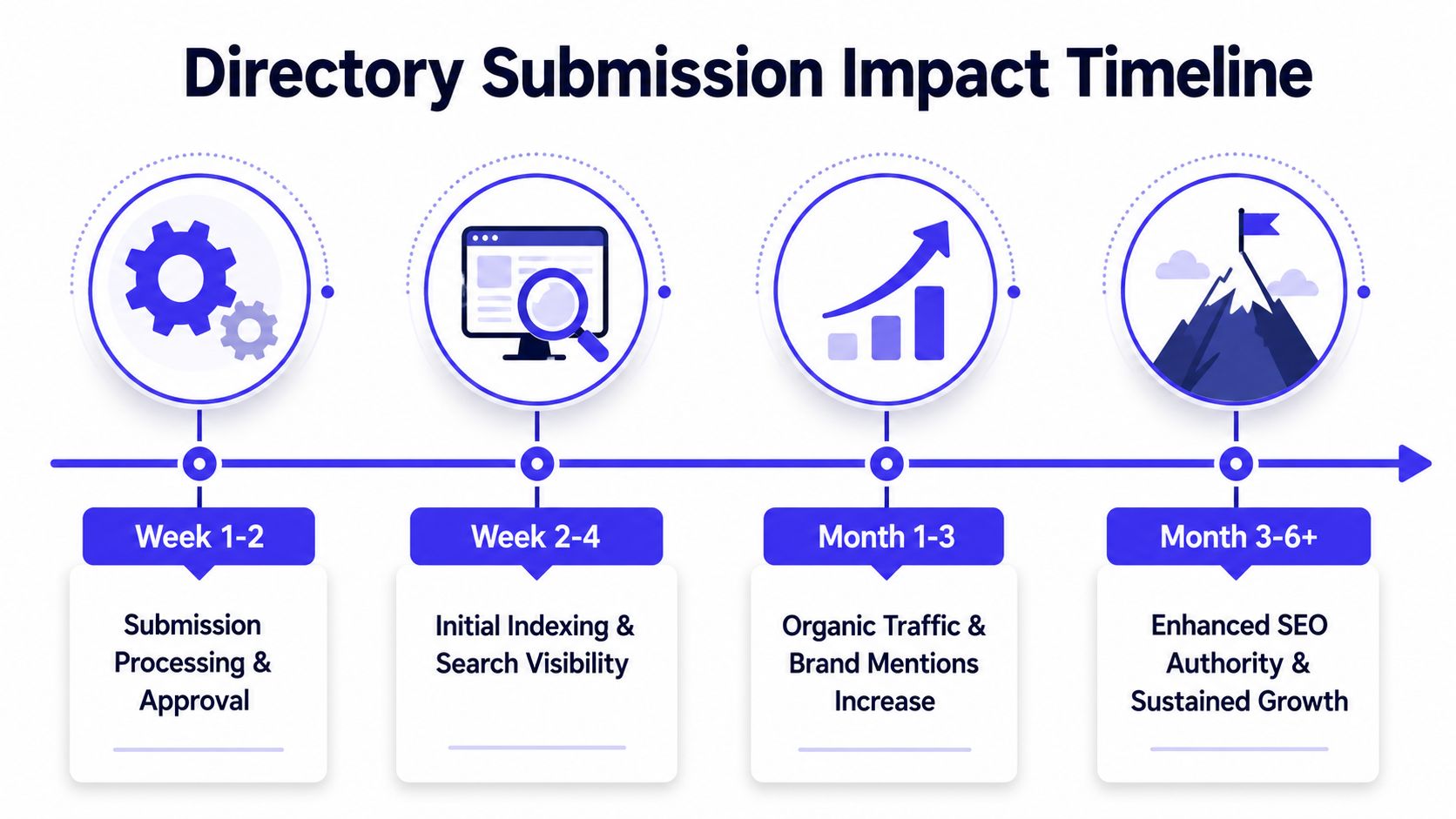
The sequence is usually predictable. Backlinks from directory submissions are typically indexed within 2 to 4 weeks, measurable Domain Rating changes tend to appear in 2 to 3 months, and organic traffic gains usually take 3 to 6 months. The same source recommends limiting activity to 7 to 10 directories per day to keep link velocity natural (LaunchRocket on directory submission timing).
What to watch first
The first useful signal isn't traffic. It's indexation.
If a directory profile goes live but never gets indexed, it won't contribute much. Early on, I watch for:
- Live profile URLs
- Whether the profile page appears in search
- Whether the backlink resolves correctly
- Whether the brand information is accurate
In this scenario, tools like Ahrefs, Semrush, and Google Search can help. You're not trying to prove direct last-click conversions from each listing. You're checking whether your new citations are entering the ecosystem.
Distinguish direct ROI from infrastructure ROI
Most founders ask the wrong question: “How many customers did this directory send me?”
That's too narrow.
A directory profile may send direct referral traffic, but it can also support outcomes that are harder to isolate. It can help branded search, improve your backlink profile, make your company easier to verify, and strengthen page-one search results for your name.
That's why I report directory results in layers.
| Metric type | What to measure | Why it matters |
|---|---|---|
| Visibility | Live profiles and indexed pages | Confirms placement exists and can be found |
| Authority | Referring domains and DR movement | Shows SEO foundation getting stronger |
| Discovery | Referral visits and branded searches | Indicates market recognition is improving |
| Trust | Presence on known third-party sites | Helps buyers and investors validate the brand |
Free listings versus paid listings
Nuance matters here.
A lot of directories are free to submit to, which makes them easy wins. But some niche paid listings can still be worth it if they’re editorially reviewed and highly relevant. What matters is not the price tag. It’s whether the listing adds trust, visibility, or a useful backlink from a page with real presence.
I’d avoid paying just to appear on a generic site with no audience and no brand recognition. I would consider paying when the directory is respected in the category and the profile quality is high.
Treat directory ROI like infrastructure ROI. You’re building a foundation that other channels can stand on.
Set expectations before you start
The founders who get frustrated with submission to directory campaigns are usually measuring too early or expecting the wrong outcome.
If you set the timeline up front, the work feels much easier to defend. You’re not buying a traffic spike. You’re building durable discovery, stronger backlink diversity, and a more credible search footprint over time.
The Founder’s Dilemma DIY vs Professional Submission Services
This is usually where the theory meets calendar reality.
You can absolutely do directory submissions yourself. In fact, I think every founder should do at least a handful manually once. It teaches you how platforms categorize products, which descriptions get accepted, and where your positioning still sounds fuzzy.
But DIY gets expensive in a different way. It burns founder time.
For new SaaS sites starting at DR 0, 100 manual submissions to high-DR directories (DR 50+) typically yield a DR increase of 15–25 points within 30–60 days (ListMySite on manual submissions). That upside is real. The question is who should do the work.
When DIY makes sense
DIY is a good fit when:
- Cash is tight: You can invest time instead of budget.
- Your positioning is still changing: It’s easier to adjust messaging manually.
- You want to understand the directory environment: Doing the first wave yourself teaches you which directories are most relevant.
- Your target list is small: A curated list is manageable without outside help.
There’s also a branding upside. Founders who handle the early submissions themselves usually get sharper about how they describe the product publicly. That carries over into landing pages, sales calls, and review sites.
If you’re also building your public founder presence during this phase, a strong personal branding tool workflow can help keep LinkedIn and company positioning aligned with how you appear across directories.
When a service is the smarter move
Outsourcing starts to make sense when the opportunity cost gets silly.
If your team already has traction, product deadlines, sales calls, customer support, and content work, spending days in forms may be the wrong use of founder attention. A manual service can handle the repetitive work, maintain consistency, and produce reporting you can review.
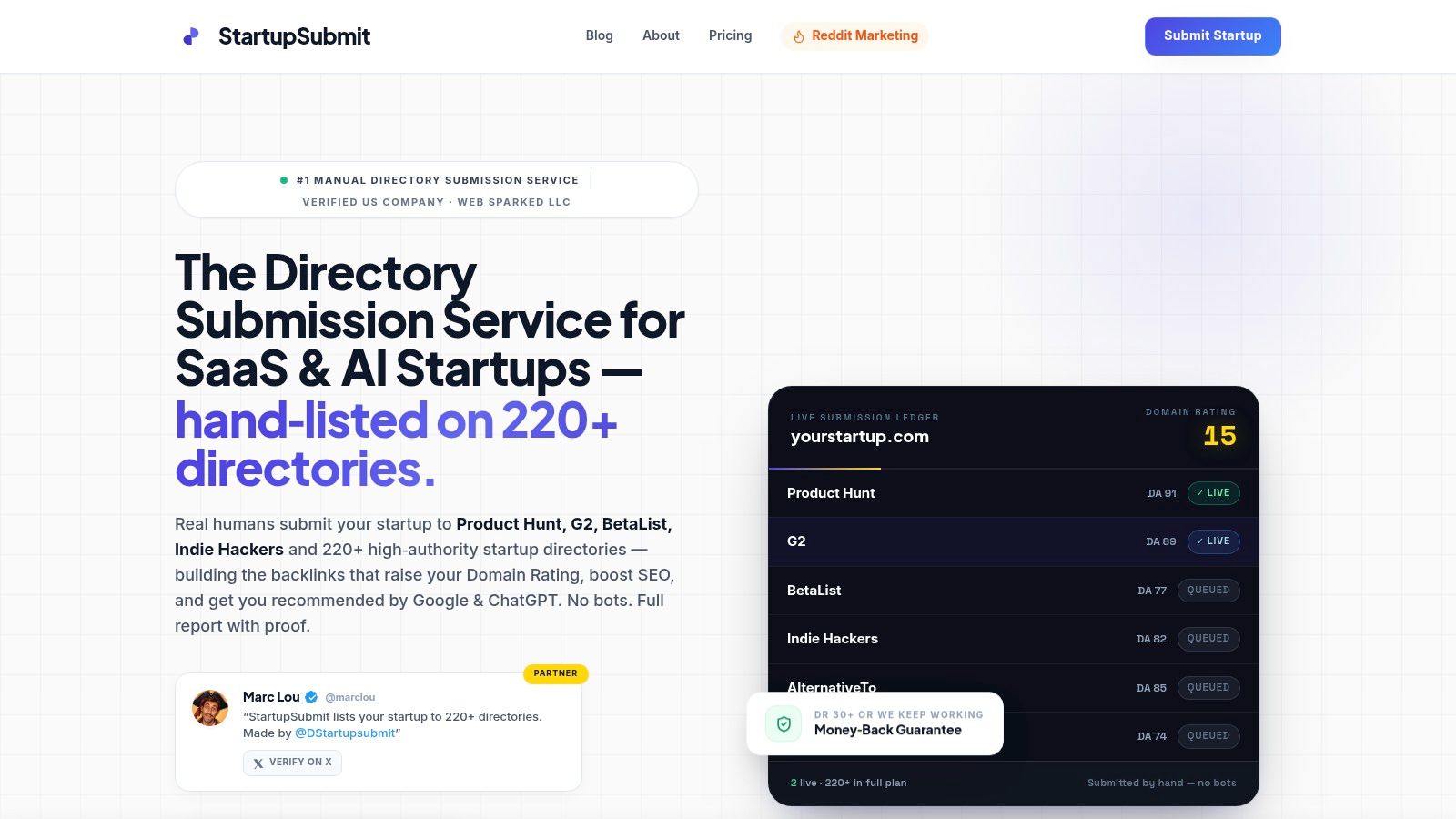
One example is StartupSubmit pricing, which positions the work as manual directory placement for SaaS and AI startups rather than bulk automation. That distinction matters. The more reputable services focus on curation, duplicate checks, and reporting, not just raw submission counts.
DIY versus service comparison
| Factor | DIY Submission | Professional Service (e.g., StartupSubmit) |
|---|---|---|
| Time cost | High founder or team time | Lower internal time requirement |
| Cash cost | Lower direct spend | Paid upfront |
| Learning value | High | Lower hands-on learning |
| Consistency | Depends on your process | Usually more standardized |
| Scale | Hard to maintain at volume | Easier to execute across many directories |
| Error risk | Higher if rushed | Lower if the provider is careful and manual |
| Reporting | You build it yourself | Often included as part of delivery |
Outsource when the work is clear but repetitive. Keep it in-house when the positioning is still unstable.
The wrong way to think about this is “free versus paid.” The right way is “whose time should carry the administrative load?”
Frequently Asked Questions About Directory Submission
Do directory listings help with ChatGPT visibility
Yes, but only on the right platforms.
AI search engines like ChatGPT, Claude, and Perplexity cross-reference trusted aggregator hubs including Product Hunt, G2, and Crunchbase to verify and recommend digital products. Startups that aren't listed on those platforms won't appear in AI-generated recommendations, regardless of website SEO (ListMySite resource on startup directories).
That's why submission to directory sites now overlaps with AI search optimization. If your startup is invisible on known aggregator hubs, your website alone may not be enough for AI-driven discovery.
What should I do if my product pivots or rebrands
Update the highest-trust profiles first.
Start with Crunchbase, Product Hunt, G2, major software directories, and any profile that ranks for your brand name. Keep your company description, category, logo, and URL consistent across those core surfaces before you worry about the long tail.
If the pivot is major, keep a record of old profile URLs and note where redirects or manual edits are needed.
Are paid featured listings worth it
Sometimes, but only when the site has actual category relevance and a profile format that helps buyers evaluate the product.
I wouldn't pay for placement on a generic directory just because it promises visibility. I would consider paying for an editorially reviewed listing on a respected niche platform where the audience overlaps with the product's buyers.
How do I avoid duplicate content issues at scale
Use description variants and match them to directory type.
A simple way to manage this is to maintain a short core value proposition, a longer feature-focused version, and a more benefit-driven version. Then adapt intros, category language, and callouts based on the platform. That keeps the content distinct enough for moderation and more useful for readers.
How do I verify which submissions actually count
Check three things:
- The profile is live
- The profile page is indexable
- The backlink points to the right destination
A live listing that nobody can find is still weak. A live, indexed listing on a trusted platform is the asset you're after.
What should I do next
Start with a shortlist, not a giant spreadsheet. Claim the highest-trust profiles first. Prepare real assets before you submit. Fill every field that helps a buyer understand the product. Then track live listings and update the ones that matter most.
If you want to offload the repetitive part, StartupSubmit is one option for handling manual directory submissions across startup and software platforms while keeping the process structured. It fits teams that want the visibility benefits without turning founders into full-time form-fillers.