
Your SaaS Growth Strategy Playbook for 2026
The SaaS market isn't just growing. It's getting crowded fast. The global Software as a Service market reached $466 billion in 2026 and is projected to grow at 19.38% annually through 2029, while companies now deploy 106 SaaS applications on average and compete across more than 33,200 vendors, according to SaaS market data compiled by SellersCommerce. That changes the job of a founder.
Your aim isn't solely to get attention. You're trying to build a system that turns attention into activation, retention, and expansion before stronger, louder, better-funded competitors do.
Most advice on SaaS growth strategy falls into two bad camps. One camp gives you abstract frameworks with no execution detail. The other gives you channel tactics with no regard for stage, pricing, or unit economics. Neither helps when you're deciding whether to hire, ship a free trial, cut a paid campaign, or spend a week fixing onboarding friction.
A workable SaaS growth strategy is narrower than people think. It starts with the economic engine. Then it forces prioritization. Then it applies the right growth motion for your stage, team, and cash position. If you want a practical companion resource on founder-focused, data-backed SaaS growth tactics, that angle is especially useful when you're trying to grow without a bloated marketing budget.
What works for a founder at the earliest stage won't look like what works for a company with a full growth team. That's why the right playbook is never universal. It's conditional.
Table of Contents
- Introduction The Unignorable Rise of SaaS
- Your Financial GPS Core SaaS Economic Frameworks
- How to Prioritize Your Growth Initiatives
- The Acquisition Engine Channel Playbooks
- Plugging the Leaks Activation and Retention Strategies
- The Founder-Led Playbook Early-Stage Growth Tactics
- Measure and Iterate Growth Experiments and OKRs
- Frequently Asked SaaS Growth Strategy Questions
Introduction The Unignorable Rise of SaaS
A good SaaS growth strategy starts with accepting one uncomfortable truth. Product quality alone won't carry you.
There's too much software in the market, too many adjacent competitors, and too many products that look similar from the outside. Buyers compare alternatives quickly. Teams trial several tools at once. If your distribution, onboarding, and retention systems are weak, even a strong product gets buried.
That's why growth can't sit in one function. It isn't just marketing, and it isn't just sales. It's the combined performance of pricing, acquisition, onboarding, customer success, and expansion. Weakness in one part shows up everywhere else. You'll see it as low conversion rates, short retention, messy pipelines, and pressure to keep buying growth.
What serious founders get right
Founders who build durable growth systems do a few things differently:
- They track business health before chasing channels. They know whether retention can support acquisition.
- They choose fewer bets. A focused strategy beats a wide one almost every time.
- They treat activation as a growth problem. If users don't reach value fast, top-of-funnel effort gets wasted.
- They pick a motion that fits the team they have. Solo founders shouldn't copy a scale-up's GTM stack.
The best growth plan is usually the one your team can execute consistently for the next two quarters, not the one that looks smartest in a board deck.
What this playbook optimizes for
This playbook is built for practical decision-making. It starts with the numbers that tell you whether your business can support growth. Then it moves into prioritization, acquisition channels, retention systems, founder-led tactics, and experiment design.
If you're early, bootstrapped, or running lean, that matters even more. A lot of generic SaaS advice implicitly assumes you have specialists, paid spend, and time to absorb mistakes. Most founders don't.
Your Financial GPS Core SaaS Economic Frameworks
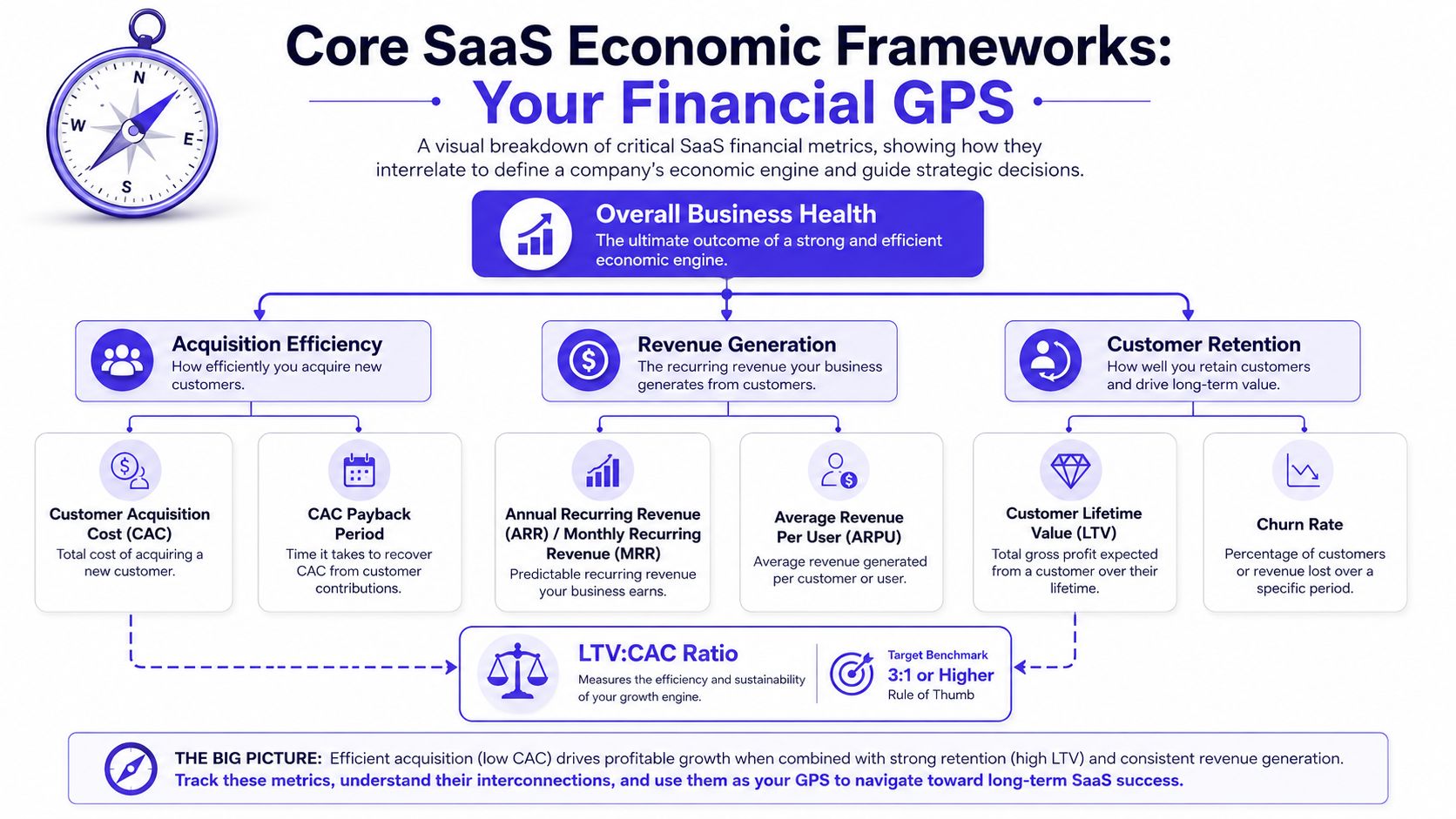
Before you pick a channel, decide a pricing model, or hire anyone, you need a working view of your economics. Think of it as a financial GPS. Without it, you might move fast, but you won't know if you're getting closer to a healthy business or just burning runway more efficiently.
Start with the questions that matter
You don't need a complex finance model on day one. You do need clear answers to these questions:
- What does it cost to acquire a customer? That's the practical use of CAC. Include ad spend, contractor costs, sales effort, software, and founder time if acquisition is founder-led.
- How much revenue does a customer represent? Use MRR or ARR depending on your contract model. If your deals vary a lot, track ACV as well.
- How long do customers stay, and do they expand? That's where LTV, churn, and expansion revenue become strategic rather than academic.
- How long does it take to earn acquisition cost back? Payback determines how aggressively you can reinvest.
Most founders skip this step because they think they need precision first. You don't. You need directional truth. A rough, honest model beats a polished fantasy.
For founders working through packaging or offer structure, it helps to review how buyers experience your price page and buying path. Looking at a live reference point like StartupSubmit pricing can be useful, not because you should copy the numbers, but because simple packaging usually converts better than clever packaging.
The metrics to watch together
Don't evaluate metrics in isolation. A healthy-looking acquisition number can hide a retention problem. Strong trial volume can hide weak activation.
Here's the practical stack:
| Metric | What it tells you | Common mistake |
|---|---|---|
| CAC | How expensive growth is | Leaving out labor and software costs |
| MRR or ARR | Revenue base and trend | Treating booked revenue as retained revenue |
| ARPU | Account value over time | Averaging together very different customer types |
| Churn | How much value leaks out | Only tracking logo churn and ignoring revenue churn |
| LTV | Customer value over the relationship | Using unrealistic retention assumptions |
| Payback period | How quickly you recover CAC | Scaling spend before payback is understood |
Practical rule: If you can't explain why a customer is profitable, you're not ready to scale acquisition.
A lot of bad SaaS growth strategy decisions come from treating growth as a volume problem. It's usually an efficiency problem first. You don't need more leads if the wrong users sign up, fail to activate, and leave before expansion is possible.
When founders master these basics, the rest of the strategy gets easier. Pricing becomes clearer. Channel choice becomes narrower. Hiring becomes less emotional.
How to Prioritize Your Growth Initiatives
Most early-stage teams don't fail because they lack ideas. They fail because they keep too many ideas alive at once.
A founder has a backlog that includes SEO, cold email, onboarding fixes, pricing changes, product integrations, referral loops, and AI features. Every item sounds important. The result is predictable. Work gets spread thin, nothing gets enough depth, and the company confuses motion with progress.
Why most growth backlogs fail
Not every initiative deserves a test this quarter. Some are too early. Some are too expensive. Some depend on capabilities you don't yet have.
A useful SaaS growth strategy does three things at this stage:
- Rejects channel envy. Just because another SaaS company grows through webinars, outbound, or PLG doesn't mean that motion fits your product.
- Protects the current bottleneck. If activation is weak, top-of-funnel work should not dominate the roadmap.
- Matches effort to team reality. A solo founder should prefer initiatives with low coordination cost.
The easiest mistake to make is prioritizing what feels visible. Blog posts, paid campaigns, and feature launches look productive. Fixing onboarding copy or cancellation flows looks small. In practice, the quiet fixes often produce better downstream economics.
Use a simple scoring model
You don't need a committee-grade framework. Use a lightweight version of RICE or ICE and score each initiative on four dimensions:
Impact
If this works, does it affect acquisition, activation, retention, or expansion in a meaningful way?Confidence
Do you have real evidence from customer calls, behavior, or repeated objections?Effort
Can your current team ship and measure it without derailing core work?Stage fit
Is this right for your current maturity, or are you copying a later-stage move?
A simple decision table helps:
| Initiative | High impact | High confidence | Low effort | Stage fit | Verdict |
|---|---|---|---|---|---|
| Onboarding fix | Yes | Yes | Yes | Yes | Do now |
| New feature for one prospect | Unclear | Low | Medium | Maybe not | Delay |
| Paid ads | Maybe | Low | Medium | Depends on funnel | Test carefully |
| Partner integration | High | Medium | High | Depends on buyer need | Sequence later |
Teams usually overbuild and under-instrument. A smaller test with clear success criteria beats a bigger launch with fuzzy goals.
If you're deciding between acquisition and retention work, favor the initiative that removes a known bottleneck. Growth comes from sequencing. You fix the leak that limits the next stage of compounding.
The Acquisition Engine Channel Playbooks
Acquisition isn't one engine. It's a set of engines with different fuel costs, setup times, and maintenance burdens. Founders get in trouble when they mix them without understanding the trade-offs.
Use this section like a menu, not a checklist.
Content and SEO for compounding demand
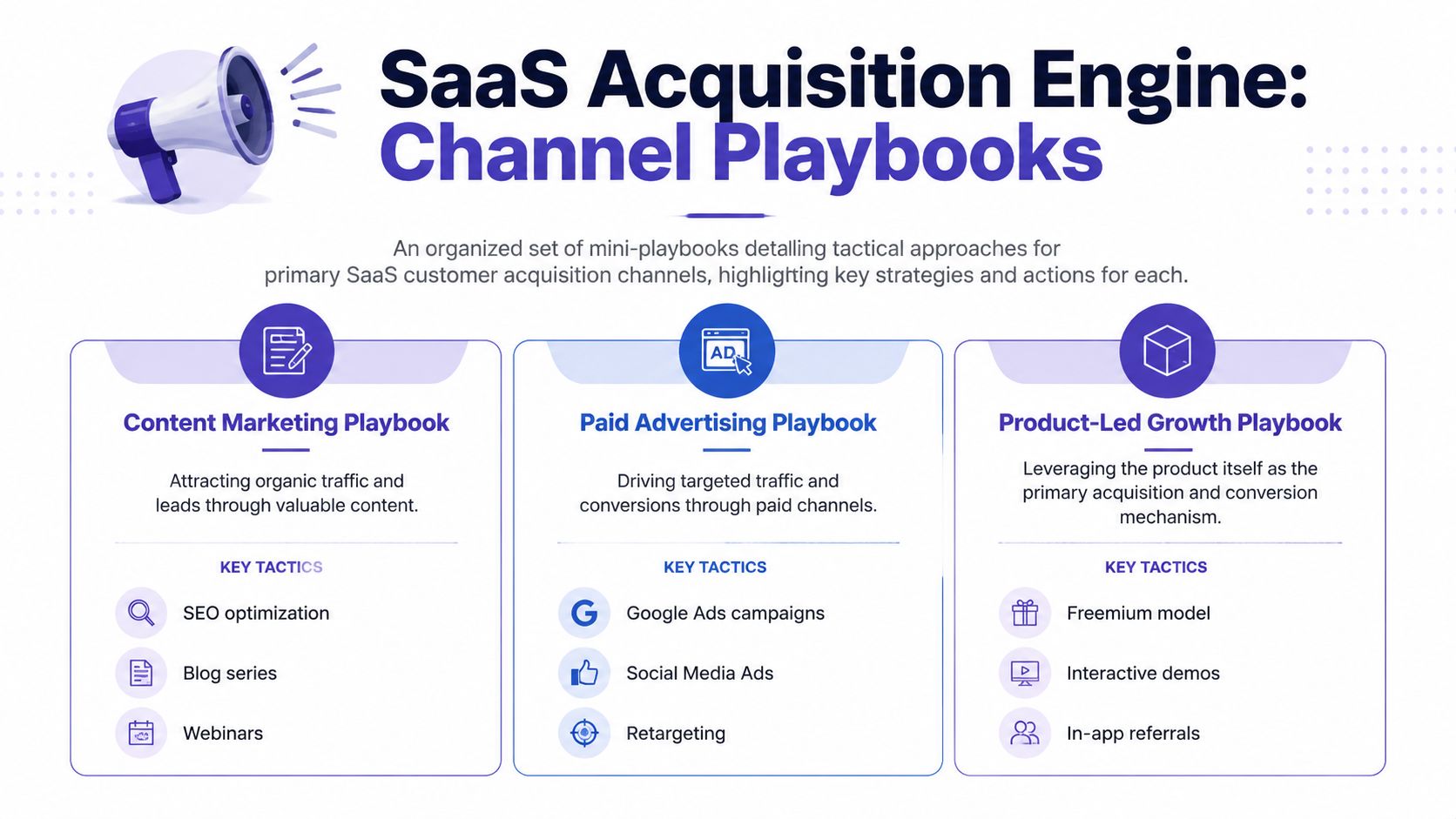
Content is slow to start and powerful once it compounds. It works best when your buyers search with clear intent, your category has educational demand, and you can publish consistently enough to build authority.
Good SaaS content does not read like a brochure. It solves buying-stage questions. It compares alternatives. It answers objections. It helps the reader make a decision.
Starter plays:
- Build around pain-point queries. Write for problems buyers already feel, not your internal feature taxonomy.
- Create comparison pages carefully. “Alternative to” and “best tools for” terms often map to active evaluation.
- Turn customer calls into content briefs. Repeated objections often become high-converting content themes.
What doesn't work is generic thought leadership with no search intent, no point of view, and no conversion path.
Paid acquisition for controlled learning
Paid acquisition buys speed. It also punishes weak fundamentals. If your messaging is unclear or your funnel leaks, paid traffic helps you discover that faster.
Use paid when you need fast feedback on positioning, audiences, or offers. Don't use paid to avoid fixing the product journey.
It's useful to consider:
- Search ads are usually better for capturing existing intent.
- Paid social often works better for narrative, awareness, or remarketing.
- Retargeting is valuable when you already have meaningful traffic.
The common founder mistake is scaling spend before landing page quality, signup friction, and activation are under control.
Here's a useful walkthrough on channel thinking and growth execution:
Product-led growth for low-friction conversion
PLG is powerful when users can experience meaningful value without a long sales process. It's not just “offer a free trial.” It's a system where the product demonstrates value, qualifies fit, and creates natural upgrade moments.
For bootstrapped teams, this often means simplifying the first-run experience, reducing setup friction, and designing the product so one user can succeed before involving a larger team.
For companies using AI in the product or GTM motion, the opportunity is getting bigger. AI-native SaaS applications saw a 108% year-over-year increase in spending in 2025, and AI-native businesses under $1M ARR posted a 93% revenue growth increase compared with traditional peers, according to Zylo's SaaS statistics roundup. The implication is practical. AI can sharpen onboarding, support, and personalization, but only if it shortens time-to-value rather than adding noise.
Partnerships for credibility and leverage
Partnerships are underrated because they're harder to standardize. They can work extremely well when your product sits near an existing workflow, platform, or service provider.
Examples include:
- Integration partners that make your product more useful inside an existing stack
- Agency partners who can recommend your tool during implementation work
- Community partners who already aggregate your ideal buyers
What usually fails is loose “partner programs” with no owner, no incentive, and no shared buyer problem.
A practical comparison helps:
| Channel | Best use case | Main strength | Main risk |
|---|---|---|---|
| Content and SEO | Clear search demand | Compounds over time | Slow feedback |
| Paid acquisition | Fast learning | Speed and control | Expensive if funnel is weak |
| PLG | Fast product value | Scales with lower friction | Hard if setup is complex |
| Partnerships | Adjacent audiences | Borrowed trust | Operationally messy |
Plugging the Leaks Activation and Retention Strategies
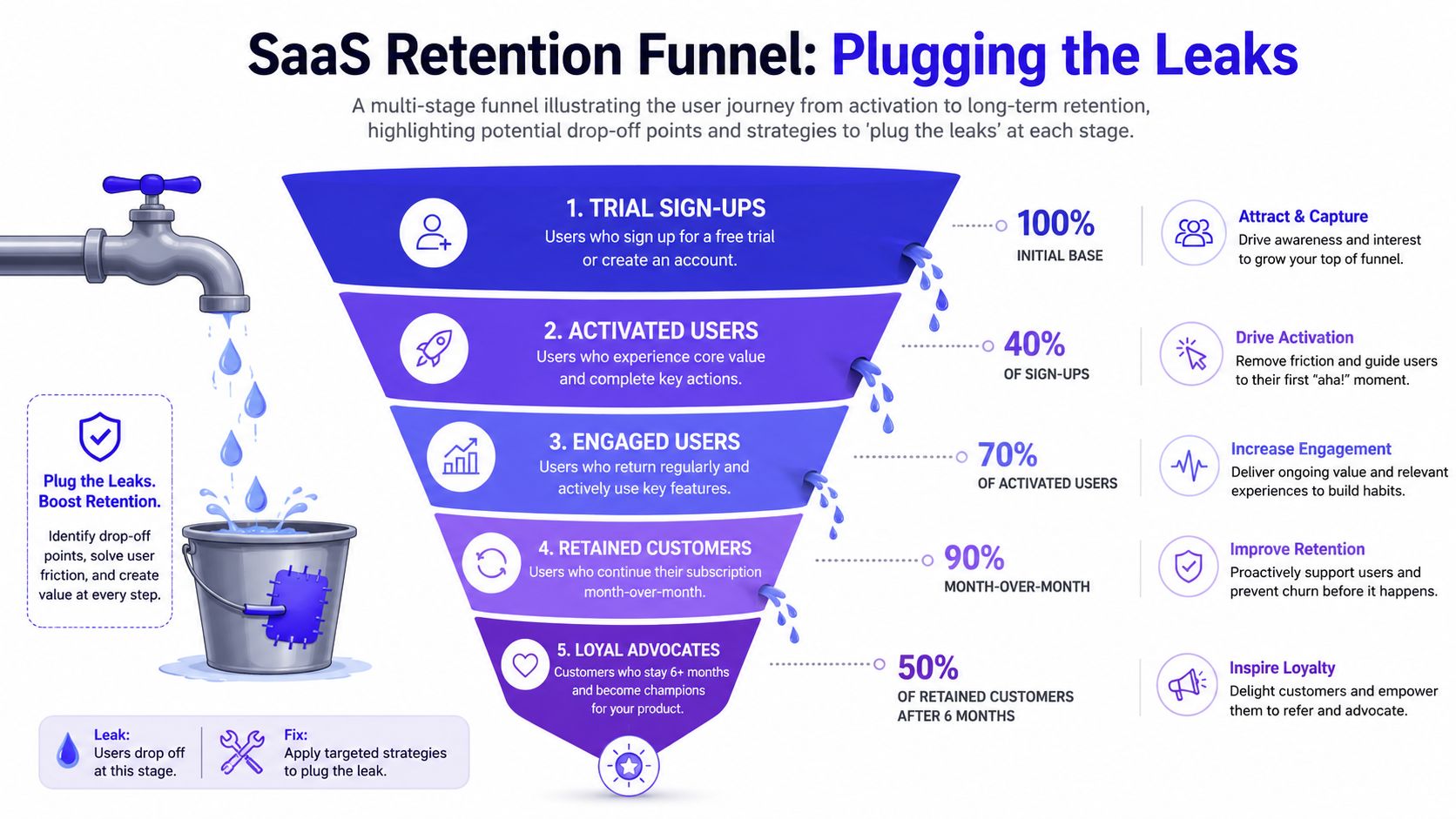
A lot of SaaS companies talk about growth when they really mean acquisition. That's only half the system. If users sign up, stall, and disappear, your funnel is a bucket with holes in it.
The fastest-growing companies aren't just adding new revenue. They're protecting and expanding the revenue they already have.
Activation is the first retention event
Retention doesn't begin on day thirty. It begins the moment a user enters the product.
Your onboarding should answer four things quickly:
- What should I do first
- Why does that step matter
- How soon will I see value
- What comes next if I succeed
That sounds obvious, but many SaaS products still greet users with empty dashboards, broad menus, and too many setup decisions. The result is hesitation. Hesitation turns into non-usage. Non-usage turns into churn.
A better activation system usually includes:
- A narrow first-run path tied to one job-to-be-done
- Contextual prompts inside the product, not just in email
- A visible success milestone that confirms progress
- Lifecycle messaging that reacts to user behavior, not a fixed drip schedule
If you want a useful gut check on whether your product experience builds enough external trust to support retention and expansion, reviewing examples like StartupSubmit benefits can help you think about perceived credibility alongside onboarding.
Negative churn is the goal
The benchmark that matters most isn't vanity growth. It's whether existing customer revenue expands faster than churn removes it. Top-decile early-stage SaaS startups achieve 10 to 17 percent monthly revenue growth primarily because Expansion MRR exceeds Gross MRR Churn Rate, creating negative churn, based on the RevPartners SaaS metric cheat sheet.
That's the core compounding loop.
If expansion revenue doesn't outpace what you lose, growth stays dependent on constant acquisition pressure.
There are two broad leak types:
| Leak type | What causes it | Practical fix |
|---|---|---|
| Voluntary churn | Product mismatch, weak value, poor onboarding | Improve ICP fit, onboarding, and feature adoption |
| Involuntary churn | Billing failures, expired cards, admin issues | Tighten payment recovery and account alerts |
Expansion comes from solving a deeper problem over time. That can mean seat growth, usage growth, premium workflows, or adjacent modules. But upsell only works if the base experience is already strong.
What teams should focus on first
The order matters.
- Fix activation before scaling traffic
- Reduce involuntary churn because it's operationally recoverable
- Segment users by behavior, not just plan
- Build expansion moments into the product journey
A mature SaaS growth strategy doesn't separate retention from growth. Retention is growth with better economics.
The Founder-Led Playbook Early-Stage Growth Tactics
Early-stage SaaS growth usually starts with one person, limited cash, and weak domain authority. That changes the playbook.
A founder without a team cannot run five acquisition channels at once. The job is to pick a few actions that create visibility, credibility, and customer conversations without adding fixed cost. At this stage, manual work is often the highest-return work because it teaches positioning while improving distribution.
Manual distribution is a real growth channel
Directory submissions are easy to dismiss because they look small and repetitive. For an early product with little branded search and few backlinks, they do three useful jobs at once. They create discovery paths, strengthen trust when prospects research your company, and give your site more ways to earn relevant referral traffic.
The mistake is treating all directories as interchangeable. They are not.
Use three buckets:
General startup directories
Sites that feature new products and startup launches. These help with initial discovery and can send short bursts of relevant traffic.Software directories and review platforms
Listings on software marketplaces and review sites help buyers validate that your product exists, fits a category, and has enough detail to compare.Niche and industry-specific directories
These are often the best opportunities for small SaaS companies because the audience is narrower and intent is higher. A finance SaaS on a finance tool list is worth more than a random mention on a broad startup site.
A practical system is simple. Create one accurate company profile with your short description, full description, categories, screenshots, pricing, founder details, and product URL. Submit to the highest-fit directories first. Track status in a spreadsheet. Revisit listings that matter and improve the copy once you learn which positioning gets clicks and demos.
If you want a reference point for how a product explains its positioning and background publicly, review the company background and positioning example. The useful takeaway is not the tool. It is the discipline of making your offer easy to understand in every external profile.
Founder time should go where feedback is fastest
Paid acquisition can work early, but it often hides weak messaging because traffic arrives before the story is clear. Manual distribution, founder outreach, and community participation expose that weakness fast. If people do not click, reply, or sign up from simple profiles and direct messages, the issue usually is not channel complexity. It is positioning.
That is why bootstrapped and solo founders should bias toward channels that create learning as well as reach:
- Directory listings that force category clarity
- Founder-led outbound to a narrow ICP
- Community participation in places where buyers already ask for recommendations
- Integration or template pages tied to real use cases
- Review collection from early happy customers
None of this looks complex. It works because it compounds into proof.
Build public trust before you need to raise or sell harder
Buyers check your footprint. Potential hires do too. Investors do it even faster.
A thin online presence creates friction. A clear footprint across your site, listings, founder profiles, and review pages lowers that friction. That matters whether you are closing the first ten customers or preparing a fundraise. If raising capital is part of the plan, this list can help you find SaaS early stage investors in Australia.
The broader point is strategic. Early-stage founders should treat trust assets as operating assets. Good listings, accurate profiles, founder credibility, customer quotes, and clean category positioning all make later acquisition easier.
Keep the stack light. Keep the feedback loop short. Use the channels that teach you something while they bring in demand. That is usually the right founder-led SaaS growth strategy before scale changes the constraints.
Measure and Iterate Growth Experiments and OKRs
Growth strategy isn't a static document. It's an operating loop.
The best teams don't ask, “What should we launch next?” They ask, “What hypothesis are we testing, and what result would change our next decision?” That shift sounds small, but it changes how work gets scoped, measured, and improved.
Turn projects into experiments
A clean growth experiment has four parts:
Hypothesis
Example: users who reach a key setup step in their first session are more likely to retain.Intervention
Add an in-app checklist, simplify setup, or change the signup sequence.Measurement
Track whether users complete the step and whether downstream usage improves.Decision
Keep, expand, revise, or kill the change.
This mindset protects you from building permanent systems around weak assumptions. It also forces tighter instrumentation. If nobody can define success before launch, the experiment probably isn't ready.
Keep OKRs tied to operating reality
OKRs only help when they connect to the actual engine of the business. If your objective is “grow revenue,” but your real constraint is weak activation or churn, the objective is too vague to be useful.
For bootstrapped SaaS businesses in the $3M to $20M ARR range, the median gross revenue retention is 91 percent, while the top 10 percent achieve 100 percent, and those stronger performers tend to use PLG tactics like self-serve onboarding. They also operate at $500k to $1M ARR per employee versus a traditional $200k to $400k benchmark, according to SaaS Capital's benchmarking analysis.
That tells you where to focus. Better onboarding and lower-friction product experiences aren't cosmetic. They affect retention and operational efficiency at the same time.
A simple operating cadence works well:
| Cadence | What to review |
|---|---|
| Weekly | Active experiments, funnel changes, user feedback |
| Monthly | Retention patterns, expansion signals, channel efficiency |
| Quarterly | Core OKRs, strategic bets, team capacity |
Use lightweight tools if that's what your stage supports. Product analytics, session recording, a CRM, billing data, and a simple experiment log are enough to start. You don't need an enterprise stack to behave like a disciplined operator.
Frequently Asked SaaS Growth Strategy Questions
Founders rarely get stuck on whether growth matters. They get stuck on judgment calls. Which motion fits the product right now? What should pricing do in the first year? When is it time to stop carrying marketing alone?
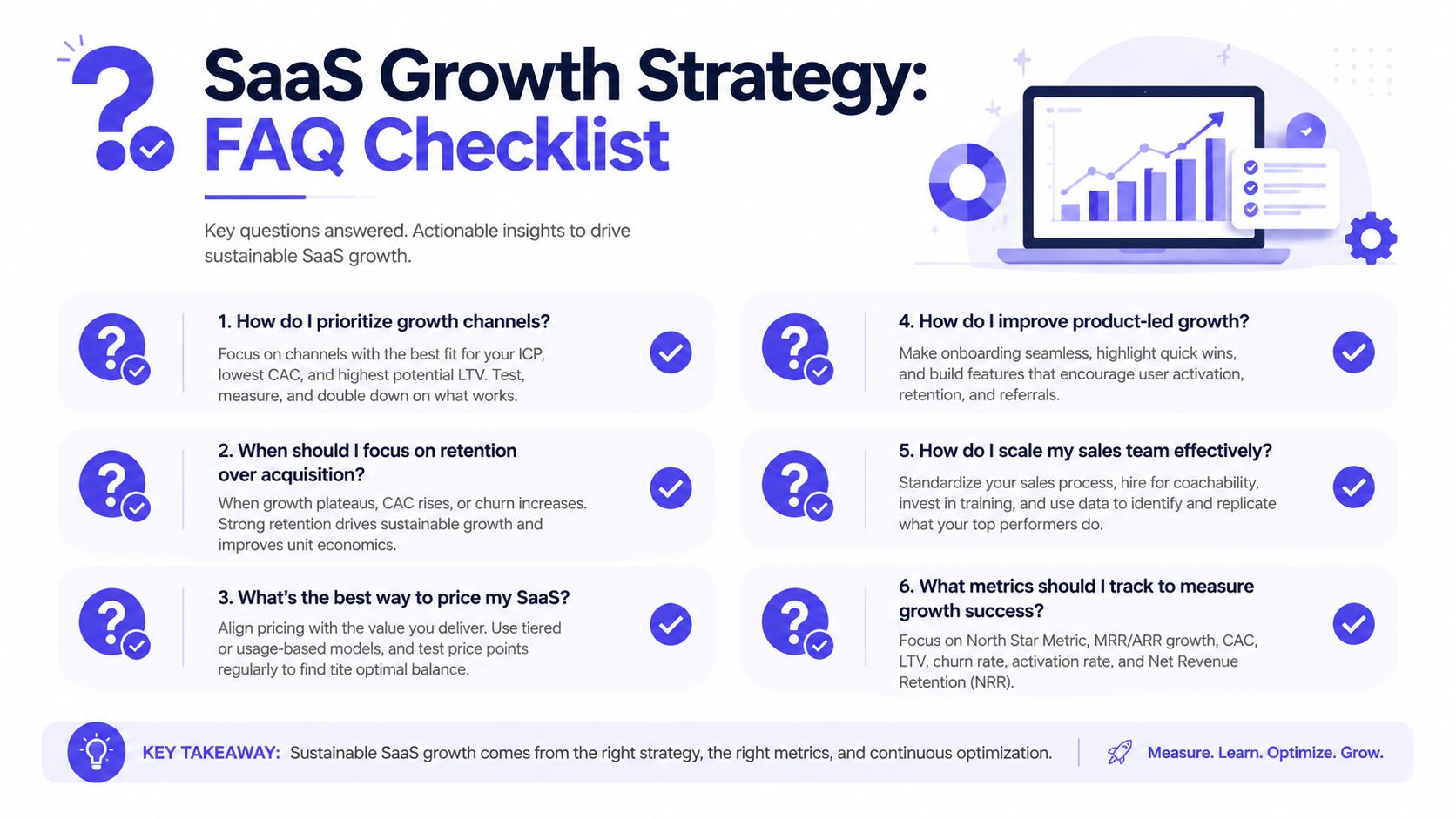
How do I align GTM with unit economics if I have no sales team
Start with payback, retention, and the amount of human help a customer needs before they see value. Those three variables usually tell you more than any channel trend report.
A company without a sales team still has a go-to-market motion. The question is whether that motion fits the deal size and buying behavior. If users can sign up, understand the product quickly, and reach value on their own, self-serve is usually the right starting point. If prospects need education and reassurance, but not a long procurement cycle, content paired with founder-led demos is often a better fit. If the buyer needs security reviews, stakeholder buy-in, or workflow changes before purchase, the founder may need to run a sales-led process for a while.
The mistake is forcing a motion because it sounds efficient. A low-touch funnel looks attractive until churn exposes weak fit.
For bootstrapped and solo founders, this is where low-cost distribution matters. Manual directory submissions, niche communities, integration marketplaces, and founder outreach can work well because they keep acquisition spend low while you learn which segments activate and stay.
How should I price if I barely have historical data
Early pricing should help you learn fast and protect margin. It does not need to be perfect.
Set pricing around clear value boundaries such as usage volume, seats, workflow complexity, or support level. Then watch real behavior. Where do trials stall? Which accounts upgrade without negotiation? Which customers get value but resist the price because the package is wrong, not because the product is weak?
Keep the structure simple at first. In practice, three tiers are enough for many early products.
Avoid two common mistakes:
- pricing so low that you attract customers with weak intent and high support needs
- adding too many plans before you understand willingness to pay
If I were advising a solo founder with limited traffic, I would rather see a simple pricing page and ten pricing calls than a polished five-tier model built on guesswork.
When should I hire a growth lead or marketer
Make the hire when there is a working loop to improve, not just a pile of unfinished ideas.
A growth lead can improve channel performance, tighten activation paths, and add operating discipline. They cannot fix unclear positioning, inconsistent onboarding, and missing instrumentation all at once. If those pieces are still unstable, the founder should stay close to the work a little longer.
The timing is usually better when a few conditions are already true:
- one or two acquisition channels show repeatable signs of demand
- the main bottleneck is visible, such as activation, conversion, or retention
- ownership is clear enough that the hire can make decisions without waiting on the founder every day
- reporting is good enough to judge progress fairly
For an early-stage or bootstrapped SaaS, the first growth hire is not always a full-time senior marketer. Sometimes the better move is a contractor for lifecycle work, a content operator, or help with manual distribution tasks that keep showing returns. StartupSubmit can help. It handles manual directory placements across relevant startup and software platforms so your team can build backlinks, strengthen trust signals, and improve discoverability while staying focused on product and customers.
Good SaaS growth strategy is stage-aware, constraint-aware, and honest about trade-offs. That is what makes it useful.