
Business Category Listing: A Founder’s SEO Guide for 2026
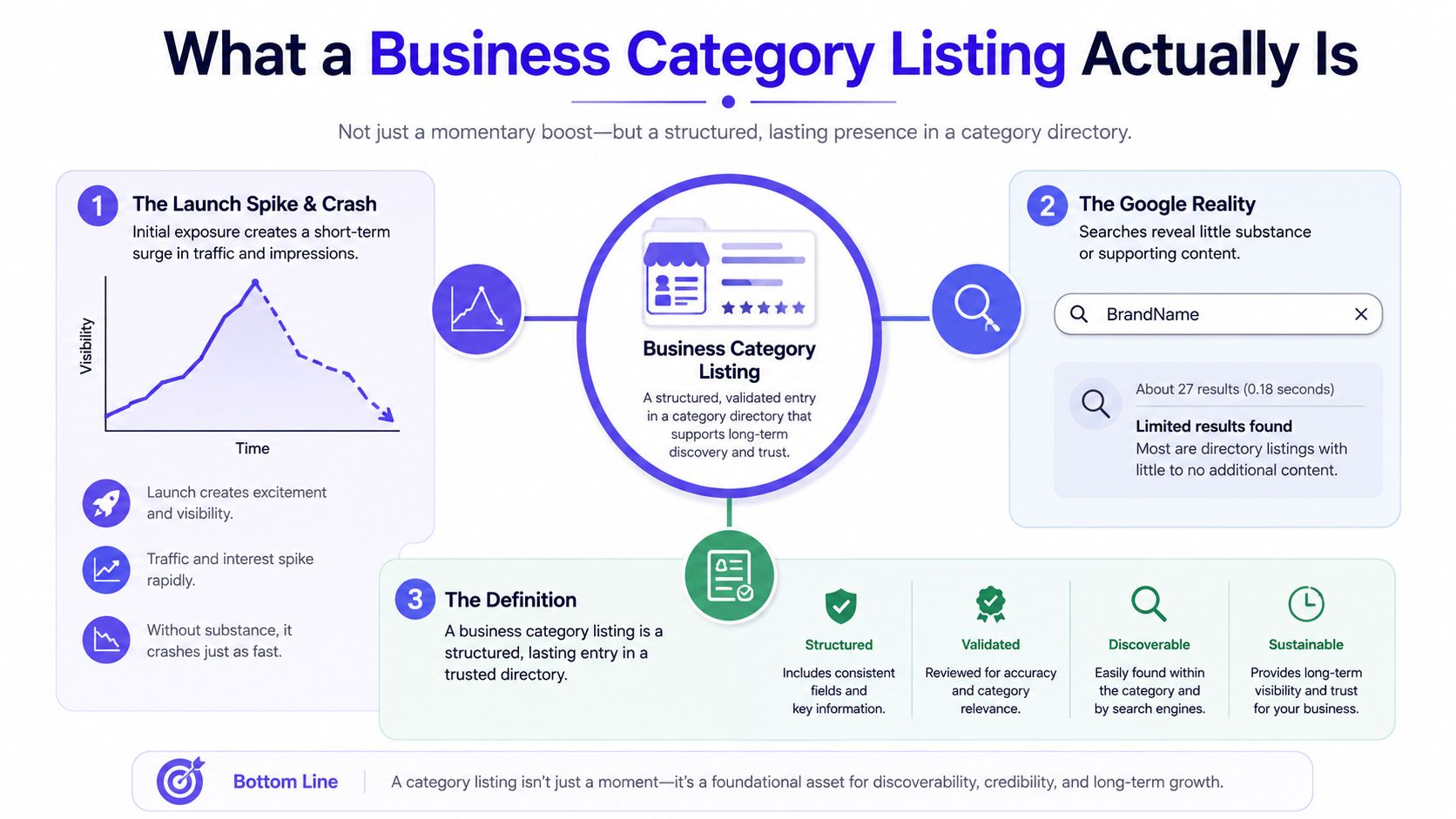
You've probably had this happen. Launch day looks loud, the spike feels real, and then the traffic drops off fast while your brand still looks thin on Google, thin in directories, and invisible in AI answers. That's usually the moment founders realize a business category listing isn't a throwaway profile field, it's the label that decides whether platforms can place your company in the right search, comparison, and discovery paths.
A category sounds boring until it starts controlling visibility. In practice, it's the smallest structured identity most directories will store, and for SaaS and AI products it can shape whether you show up as a fit for a buyer's intent or disappear into a generic bucket. Treating category work like structured-data engineering, not a one-time submission chore, is where the compounding starts.
Defining a Business Category Listing
The first week after launch usually tells the truth. A founder gets a burst from Product Hunt, a few curious clicks from friends, maybe some early signups, then the spike fades and search results still show larger brands with barely anything on page one. That is the point where category data starts to matter more than the logo, the tagline, or the clever homepage copy.
A business category listing is the standardized label a platform uses to classify a company. On Google Business Profile, that means 1 primary category and up to 9 secondary categories. Google's support guidance also makes clear that the primary category is the strongest signal for when and where a listing appears in search results, which is why it is not just a descriptive field, it is a visibility decision (Google Business Profile category guidance).
The practical definition founders miss
Founders often treat a category like a slogan with dropdown behavior. It is a structured tag that directories, search engines, and LLM-driven discovery systems use to decide what your company is, what it belongs next to, and which comparisons it can qualify for.
That matters because the same company can be indexed differently depending on the platform. A SaaS product may be a “Project Management Software” listing in one place, a “Workflow Automation” entry in another, and a “Productivity” result somewhere else. If the underlying data is messy, the entity signal gets muddy, and the system has less confidence about where to surface you.
In a directory workflow, that is the difference between a clean category map and a pile of mismatched entries. StartupSubmit's about page describes a process built around consistency, because manual submissions only hold up when the category and profile data can travel across platforms without drifting.
The category field is not copywriting. It is the smallest unit of structured identity that a third-party platform can store and reuse.
That mindset matters. Once you treat category selection as data modeling, directory submissions stop looking like admin and start looking like search infrastructure.
Orchory's approach to SEO agents shows the same pattern in a different context, structured inputs produce cleaner outputs, while vague inputs create noisy results.
How Search Engines and LLMs Read Category Signals
A founder can pick a category that feels broad and still end up harder to find. Search engines and LLMs read categories as classification signals, so the label helps them decide what a business is, which set of results it belongs in, and which comparisons it can reasonably support. For Google Business Profile, the primary category carries the most weight in how a listing is understood and surfaced (Google's Business Profile category guidance).
Primary category versus secondary categories
| Slot | Limit | Signal Strength | Best Use |
|---|---|---|---|
| Primary category | 1 | Strongest | Match the highest-revenue, highest-intent service |
| Secondary categories | Up to 9 | Supporting | Add only materially relevant adjacent services |
That structure matters because platforms do not treat category fields as decoration. They store them as structured data, and large systems can query and compare them at scale. DataForSEO's category data documentation shows that businesses can be filtered by category and location through structured parameters, which is a good reminder that category taxonomy is machine-readable input, not branding copy (DataForSEO category data documentation).
For AI discovery, the practical effect is straightforward. If an LLM is asked for tools in a category, it performs better when the underlying listings use consistent category labels, clean metadata, and the same entity name across sources. Conflicting category signals do not always break discovery, but they lower confidence and make it easier for the system to place your product in the wrong answer set.
Directory operators who automate submissions already treat this as a data problem. Orchory's approach to SEO agents is a useful example, because it frames SEO work as structured workflows that depend on clean inputs instead of one-off manual tasks.
Practical rule: choose the category a search system would assign, not the one that makes the profile look broader on a spreadsheet.
Why this matters for AI Overview and chat discovery
Google AI Overview, ChatGPT-style discovery, and SaaS comparison engines all depend on structured inputs. They can summarize language, but they still lean on the shape of the entity record behind the summary. If your category, reviews, directory listings, and website copy point in different directions, the system has to reconcile that conflict before it decides where to show you.
That usually means less confidence and weaker placement. A clean category map gives these systems a better chance of understanding what the business does, while inconsistent tags make the listing harder to classify across a large directory network.
Choosing the Right Category for Your Startup
The cleanest way to pick a category is to start with the problem the customer is trying to solve. That's the rule MerchantCentric pushes, and it's the right one because category choice should reflect intent, not keyword stuffing or nearby competitors (MerchantCentric on business listing categories).
Start with the highest-value job
For a SaaS or AI product, I'd map the primary category to the service that drives the most revenue or the strongest buyer intent. If the product does note-taking, transcription, and summary generation, the main question is which promise gets the conversion. The answer usually isn't the flashiest keyword, it's the one that matches how buyers think about the pain.
A simple way to pressure-test the category:
- Name the core problem. What's the user trying to remove, speed up, or replace?
- Map that problem to the category language. Use the label that best fits the intent, not the trendiest term.
- Add adjacent categories only if they're material. If the secondary service can drive serious demand on its own, it belongs. If it's just “nice to mention,” leave it out.
- Check the inquiry quality later. If leads are off-target, the category probably is too.
For example, an AI note-taking app might be tempted to choose Productivity AI, Writing Assistant, or Meeting Transcription. If the product wins because it records meetings and turns them into usable notes, Meeting Transcription is usually the cleaner primary choice. If the product's real conversion hook is drafting polished follow-ups, then Writing Assistant might fit better. Productivity AI sounds broad, but broad often means weaker relevance.
The best category is the one that matches the customer's search intent before they know your brand name.
Validate with outcomes, not ego
The category should keep earning its place over time. If the inquiries get worse after a category change, or conversion quality drops, the category is probably too wide or too clever. The label has to help the right people find you, not just help you feel expansive.
Keeping Categories Consistent Across 200 Plus Directories
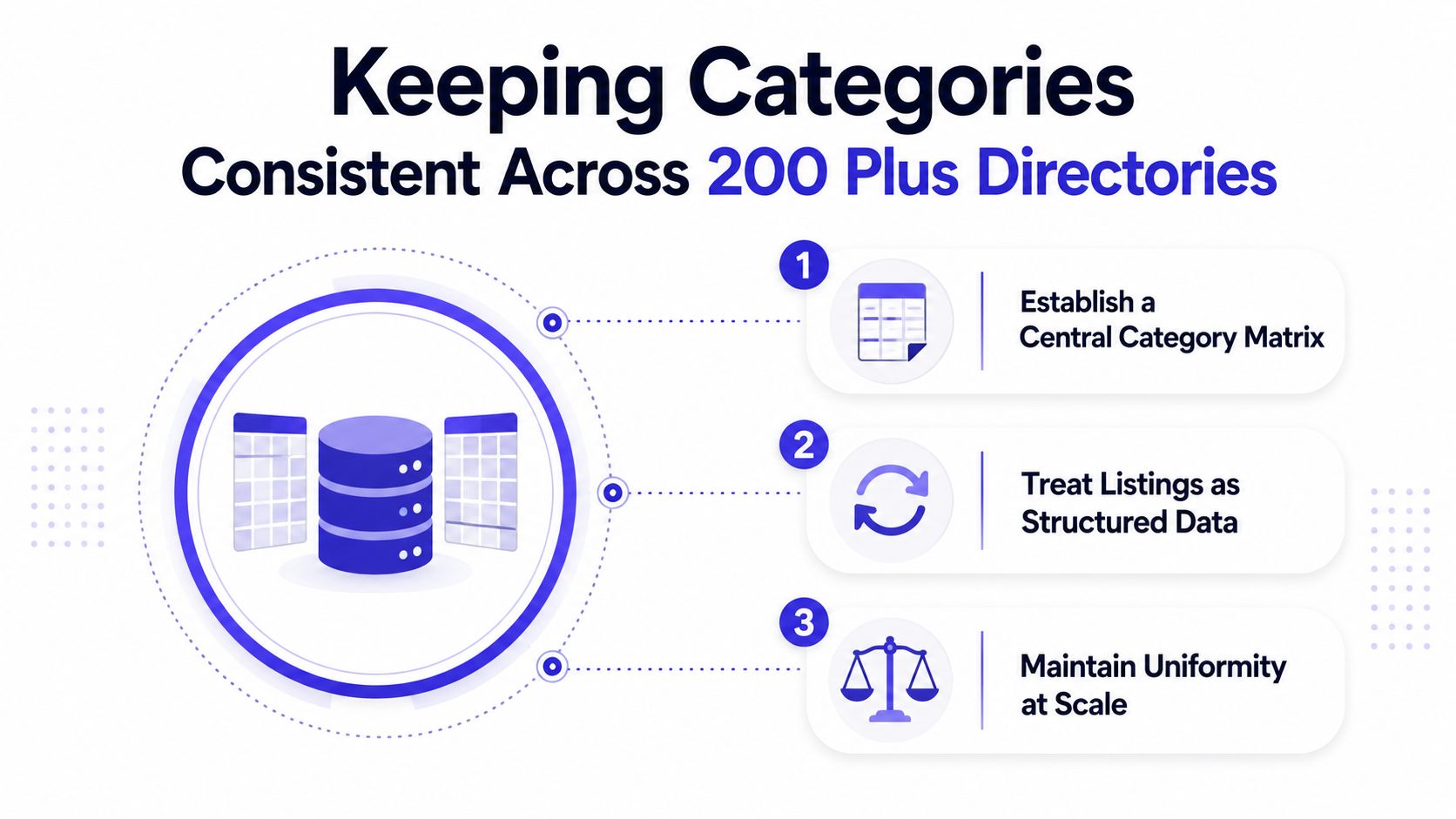
Once you submit beyond a handful of platforms, category work turns into operations. At that point, the asset is a centralized category matrix, because every directory has its own taxonomy, naming conventions, and field behavior. If your team treats each submission like a one-off, category drift shows up fast.
The best-practice approach is to keep a master file with legally consistent NAP data, full address granularity, category taxonomy, and platform-specific structured attributes like registration numbers, certifications, service-area boundaries, and product or service details. Jasmine Directory's guidance on directory schema management also recommends a centralized category matrix and quarterly audits to prevent drift (directory listing schema guidance).
What the master file should actually contain
A useful master file isn't just a spreadsheet of URLs. It should keep the category choice locked to the business model, the submission copy aligned across platforms, and the asset set ready to reuse without rework. That's what removes friction when you're sending the same company data across a large directory network.
At a minimum, the file should track:
- Official name and NAP. Keep the company identity identical across listings.
- Primary and secondary categories. Document the chosen logic for each platform.
- Descriptions by length. Use the correct copy depth for the site.
- Hours, logo formats, photos, and social URLs. These are the fields that usually break if they aren't prepared in advance.
- Platform-specific attributes. Add licenses, service areas, or product details where they matter.
A service like StartupSubmit fits naturally, because the whole point of a manual submission workflow is to keep those fields aligned while the listings are being placed across the network. The pricing page is worth reviewing if you want to see how a category-aware submission process gets organized at scale: StartupSubmit pricing.
Why consistency compounds
One mismatched tag doesn't look like much in a report. Across dozens of directories, it starts weakening trust, duplicate suppression, and search discovery. The compounding asset isn't volume by itself, it's uniformity.
How Real Startup Directories Use Categories Differently
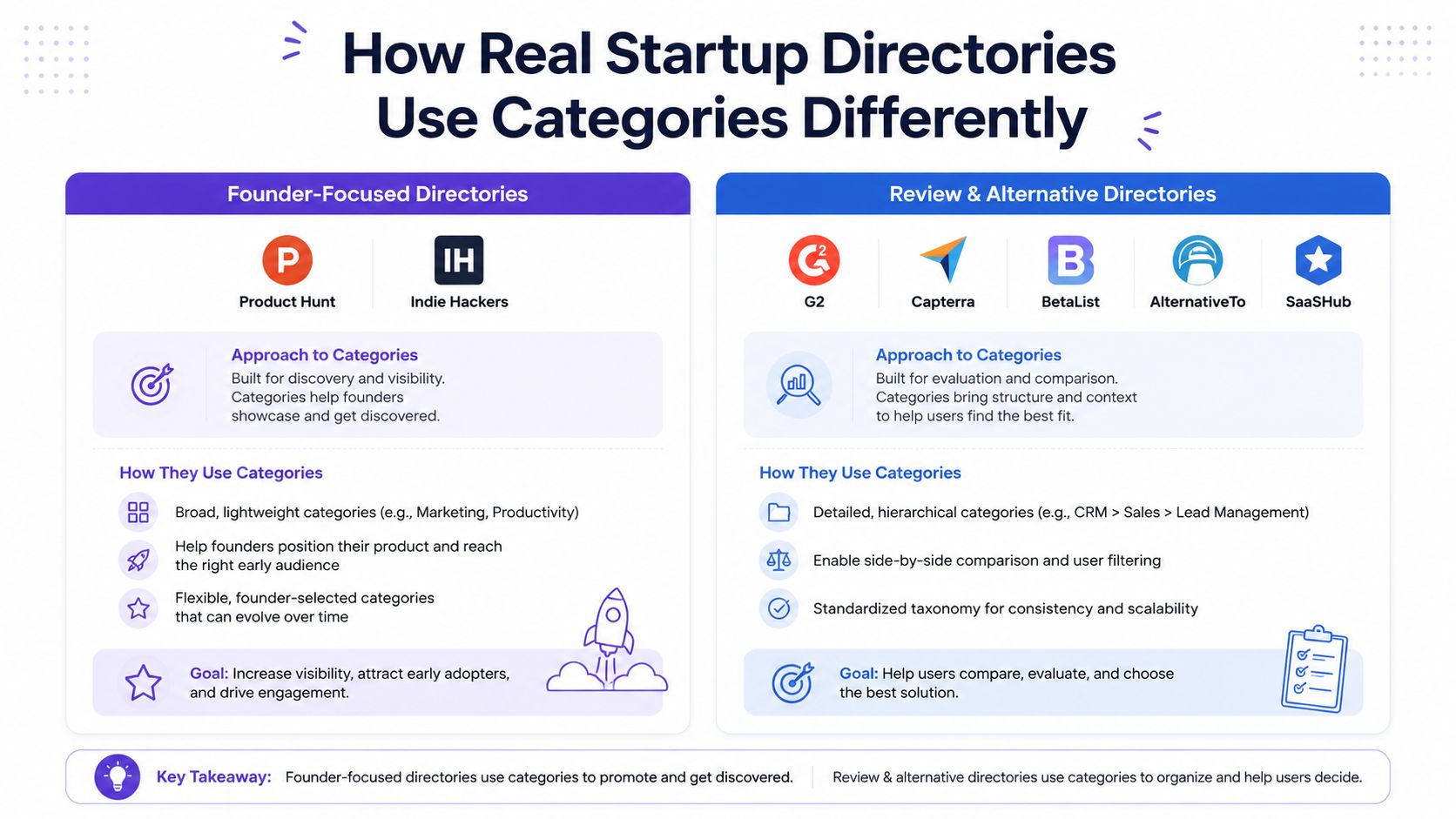
Founders often assume a category is a category. That's not how startup directories work. Product discovery platforms, review sites, and alternative directories each use categories for a different job, so the same product usually needs a slightly different positioning strategy on each one.
The platform decides the job
| Directory | Category role | What it mainly affects |
|---|---|---|
| Product Hunt | Topic tags and launch context | Ranking, discovery, and audience fit |
| G2 | Category and sub-category | Comparison grids and review grouping |
| Capterra | Category and sub-category | Filtered software discovery |
| BetaList | Launch category | Newsletter segmentation and audience targeting |
| Indie Hackers | Topic framing | Community visibility and discussion relevance |
| AlternativeTo | Alternatives graph | Category relationships and replacement intent |
| SaaSHub | Software grouping | Comparison and discovery intent |
Product Hunt is more launch-oriented. If your topic tags are vague, you're making it harder for the right audience to find the launch. G2 and Capterra are closer to buying intent, so category accuracy matters because it controls where you land in comparison logic. BetaList is about launch reach, so the label needs to match the audience a newsletter segment expects. AlternativeTo treats the category like a literal map of replacement options, which makes the relationship between products part of the discovery layer.
That's why mapping the same SaaS product differently per platform isn't inconsistent, it's strategic. A note-taking app can lead with productivity language on one directory, transcription language on another, and workflow automation language somewhere else if each platform rewards a different intent.
The mistake isn't using different category language. The mistake is pretending every directory behaves the same.
What this means for founders
If you're submitting across a network, the category matrix should store platform-specific logic, not one universal label. The goal is alignment, not sameness. The more closely the category matches how that directory surfaces products, the more useful the listing becomes.
Why More Listings Do Not Always Mean More Visibility
There's a reflex I see a lot, if 200 listings are available, founders assume 200 placements must beat 40. In practice, that's often backwards. The best niche opportunities usually come from competitor-gap analysis, keyword demand, and direct user complaints, not from chasing the biggest directory count, which is exactly why some gaps are worth pursuing and others aren't (niche discovery guidance).
Quality beats volume when the data is clean
A tightly mapped set of aligned listings can outperform a scattered footprint because the profile data stays consistent, the leads are better matched, and the AI signals aren't fighting each other. Random categories create noisy entity data. Duplicate profiles create maintenance drag. Weak directories create reporting noise.
That's also where the hidden cost sits. Bad listings take time to maintain, misaligned categories attract the wrong inquiries, and inconsistent metadata makes it harder for search systems to trust the entity. The more copies of your brand you create, the more expensive every mistake becomes.
Here's the practical trade-off:
- Aligned listings usually bring cleaner intent and less cleanup work.
- Scattered listings usually look productive in a spreadsheet but create more operational debt.
- Wrong categories can make your traffic look active while lead quality drops.
For startups that care about durable SEO, the portfolio approach wins. Think of each directory as an asset class. The job is to place the company where the category and audience fit, not to collect the largest stack of logos.
StartupSubmit as a workflow, not a trophy
One reason founders use manual services is to avoid bad coverage patterns. StartupSubmit is built around manual directory submission across a larger network, but the value only shows up when the category choices are controlled and the profiles stay consistent. If you're treating submissions like a checkbox, you'll get checkbox results.
Pre-Submission Checklist for Every Directory
Before any submission goes out, the company should have a master file ready. That file removes most of the friction because the same answers don't need to be rebuilt for every platform. It also keeps the category decision grounded in a stable source of truth instead of whatever the teammate filling the form happened to remember.
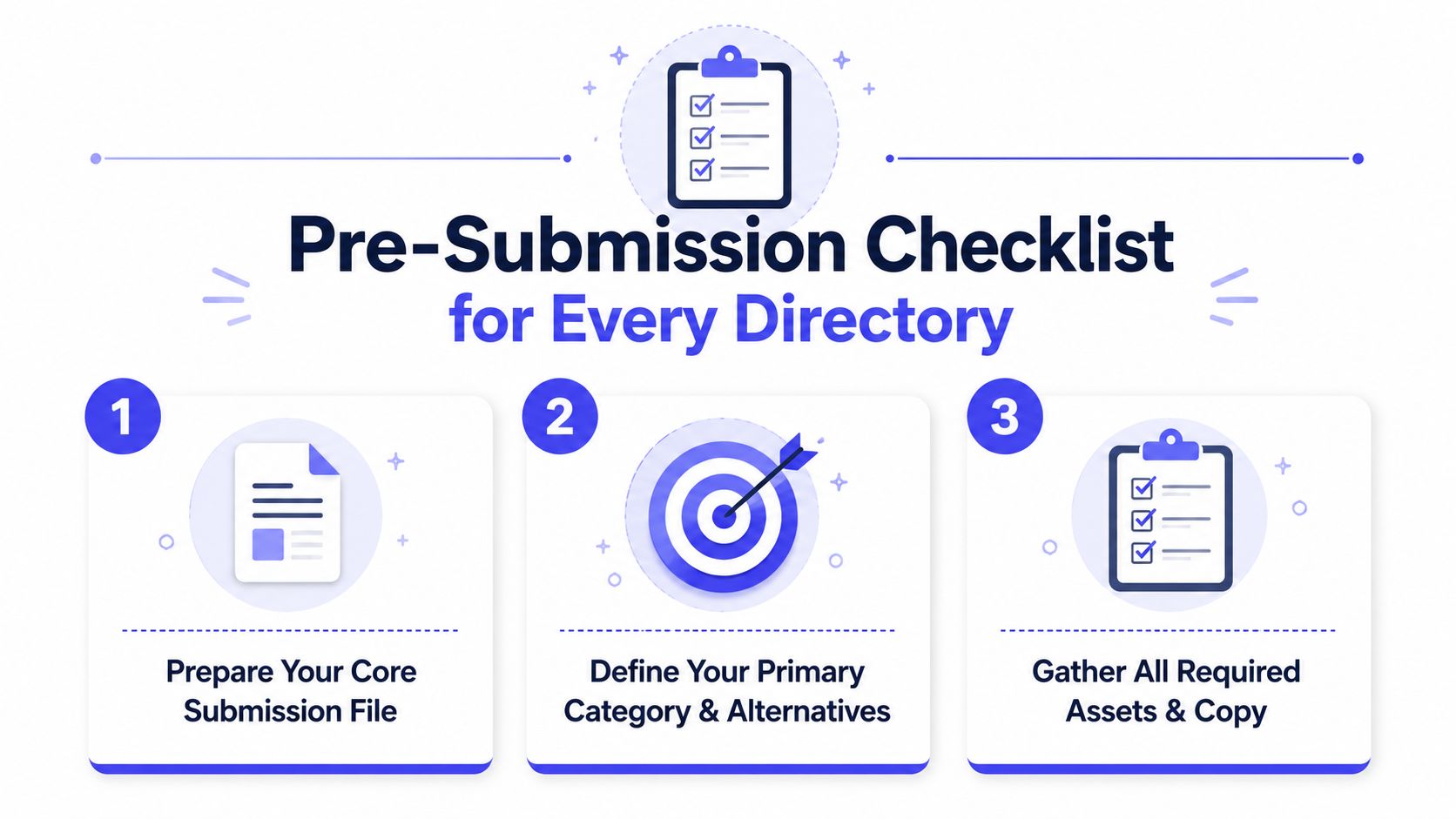
Build the master file once
The submission file should include the core identity data, the category logic, and the copy in the right lengths. A practical business-listing master file typically includes a short description of 50 to 80 words, a medium description of 100 to 250 words, and a long description of 300 to 750 words (submission requirements guide). For WordPress-style category pages, the useful sweet spot is usually 150 to 250 words, and content beyond 400 words may lose attention, so tight writing matters more than filler (WordPress directory category best practices).
Use this checklist:
- Official company name. Match the legal and public version exactly.
- Primary website. Keep the same canonical destination everywhere.
- Public email. Use the contact address you want surfaced.
- Category choices. Document the primary label and any approved alternates.
- Hours and availability. Keep these current if the platform asks for them.
- Logo formats and photos. Prepare files before submission starts.
- Social URLs. Include the accounts you maintain.
Remove old listings before new ones go live
Duplicate suppression is easier than cleanup. If an old listing is still floating around, the new one can fight for the same entity signal and muddy the profile footprint. A quick duplicate check before submission usually saves much more time than trying to fix the problem after it's live.
The best teams don't wait for the next campaign to gather this information. They keep it ready, updated, and searchable so every future submission starts from a clean base.
Validating Categories and FAQ for Founders
The hardest question isn't how to submit, it's when a category is ready. The strongest validation methods still look old-school, because they come from real user behavior: review mining, job-board signals, Reddit and Quora discussions, and small landing-page or waitlist tests. The most useful pattern is to look for repeated pain language, not applause.
A simple validation threshold
A category is ready when three things line up. First, real users describe the problem in language close to the category. Second, the product solves that problem in a way the buyer recognizes. Third, the category produces better inquiry quality when you test it in live listings or on a landing page.
If those three don't line up, the category is probably too broad, too narrow, or too clever. You don't need perfect certainty before submission, but you do need enough evidence that the label will convert traffic into useful interest rather than random clicks.
FAQ for founders
How long until directory backlinks move rankings?
There's no universal clock. Directory links tend to help most when they're part of a broader entity and trust buildout, not when they're treated like a magic switch. The bigger effect is usually on discoverability and brand validation first.
Does LLM discovery really read directory categories?
It can, because category data helps systems classify businesses and compare them to user intent. Clean, consistent categories make that job easier.
What if a directory rejects my submission?
Check the category fit first. Rejections often mean the listing was too broad, too thin, or mismatched to the directory's taxonomy.
Should I pay for premium tiers?
Only when the platform's audience, authority, or placement options justify the cost. Premium is a business decision, not a badge.
What's the next move if I'm starting from scratch?
Build the master file, choose one primary category that matches the main customer problem, and submit where the category can help a buyer find you. If you want a manual workflow for that, StartupSubmit is set up around the same category-aware logic, so the next step is to get the profile data cleaned up and ready for placement.
A CTA for StartupSubmit.