
SaaS Go to Market Strategy: A Founder’s Launch Blueprint
Most founders still treat a saas go to market strategy like a launch checklist. Pick a few channels, write a positioning page, ship a few posts, and hope the market notices. That's why so many launches create a burst of attention and then collapse into silence.
The better framing is harsher and more useful. A launch works when two things happen together, buyers reach value fast and they trust you enough to believe that value is real. If either side is weak, the funnel leaks.
That's not theory. ChartMogul reports that top-performing B2B SaaS companies reach 1,000 subscribers in 11 months, while the median B2B company takes 2 years, and trial-to-paid conversions peak around day 7 before falling off quickly in week 1 (ChartMogul SaaS go-to-market report). In plain English, buyers don't wait around. If your onboarding drags, or your proof is thin, the window closes.
The other mistake is assuming your own site does all the trust work. It doesn't. Buyers now shortlist through review sites, directories, and AI-assisted discovery surfaces, which means your launch needs a validation layer, not just traffic. That's where most “great” launches fail.
Why Most SaaS Launch Plans Fail Before They Start
The worst launch plans are full of motion and light on conviction. Founders spend weeks polishing headlines, then discover they never defined how fast a buyer should reach first value, or what outside proof would make a stranger take the product seriously. That's how you end up with traffic that looks healthy and revenue that stays flat.
Activation speed beats launch noise
SaaS buyers don't convert on your schedule. ChartMogul's data shows trial conversions cluster in the first week, then decay quickly, which means your onboarding, product education, and first-run experience are part of GTM, not post-launch housekeeping (ChartMogul). If the user doesn't hit an “aha” moment fast, the trial intent drains away.
Practical rule: if a prospect can't feel value in the first session, don't scale the channel yet. Fix the activation path first.
That's why the old model of “generate leads, then figure out conversion later” breaks in SaaS. Modern GTM is a compressed chain, acquisition, onboarding, activation, and conversion all happen close together. If one link is slow, the whole motion slows.
Trust signals now influence the shortlist
Buyers rarely rely on a single landing page anymore. They compare your presence across review sites, directories, social proof, and AI-synthesized answers before they commit. A recent B2B SaaS GTM perspective points out that AI search, review sites, and structured listings are now part of vendor shortlisting, not an afterthought (Stratabeat on B2B SaaS GTM strategy).
That changes the game for founders. A launch can look successful on social and still fail in the buyer's head if third-party validation is missing. This is especially true for AI founders and indie hackers, where unfamiliar categories need more proof, not more adjectives.
A strong saas go to market strategy therefore has two jobs. It has to create speed to value, and it has to build external credibility that survives outside your own domain. If either job is ignored, the launch becomes a one-day spike instead of a system.
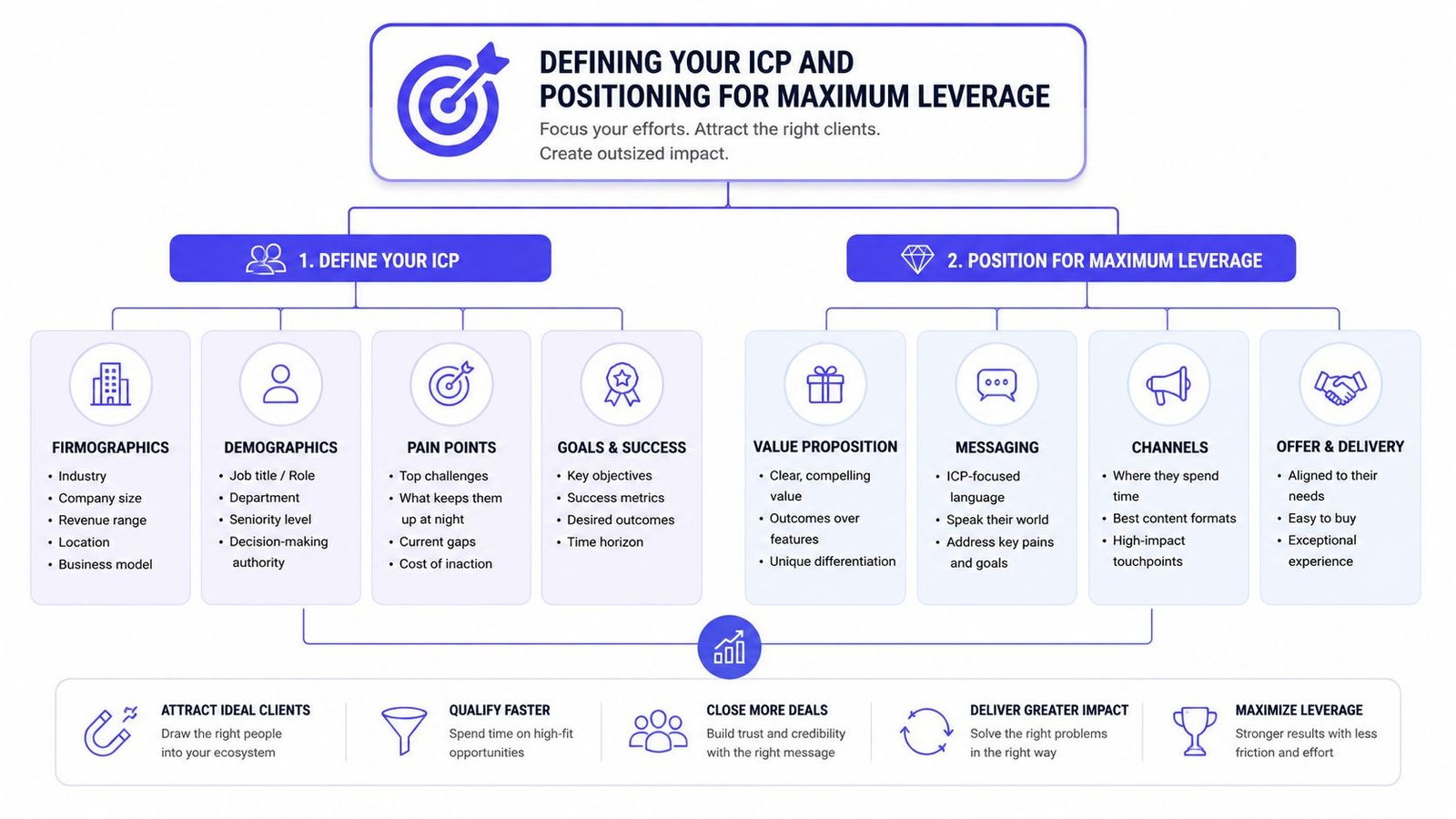
Defining Your ICP and Positioning for Maximum Leverage
Broad targeting feels safe because it seems to preserve optionality. In practice, it blurs the signal. You can't learn which message is working when you're speaking to five markets at once, and you can't build a repeatable launch system if the first users all want different outcomes.
Start with one segment you can actually win
The cleanest early-stage move is to pick one ICP with a clear pain, a clear workflow, and a clear buying trigger. Microsoft's SaaS GTM guidance emphasizes defining the market, building an ICP, and choosing a channel with the shortest path to first value before expanding (Microsoft SaaS go-to-market strategy). That sequencing matters because it keeps the first loop measurable.
A simple ICP filter works better than a vague persona slide.
- Firmographic fit: industry, company size, and pricing tolerance.
- Behavioral fit: the buyer already uses adjacent tools, or shows the problem in public.
- Urgency fit: the pain is visible now, not someday.
- Access fit: you can reach them through one channel without burning weeks on manual outreach.
That's the level of focus that gives you signal fast. If your first users are all over the map, the issue usually isn't marketing. It's a fuzzy market definition.
Position to a pain, not a category
Most weak positioning says what the product is. Strong positioning says why this buyer should care now. The work is to connect the pain to the outcome in language the ICP already uses. For a fintech SaaS product, that might mean lead with risk reduction and audit speed. For an AI writing tool, it might mean reducing the time from idea to usable draft for one specific team.
The goal isn't to sound broad enough for everyone. It's to sound exact enough that the right buyer feels seen.
That's also where instrumentation matters. Before launch, define the events that prove activation, then connect those events back to your ICP segments. If one audience activates and another doesn't, you'll know where to double down instead of arguing in a meeting.
For founders doing launch prep, a directory and distribution checklist can keep the market-facing assets clean. One useful starting point is the free startup directories resource, especially if you're trying to map where your earliest listings and proof points should live.
Choosing the Right GTM Motion for Your Deal Size
Deal size should decide your motion, not founder preference. Too many teams start with self-serve because it feels efficient, then bolt on sales too late when the product is already too complex to convert itself. Others hire sales too early and create expensive human workflows around a product that should stay self-serve.
Compare the motions by ACV, not ideology
The clearest rule of thumb from the research is simple. Under $5K ACV usually fits product-led growth, $5K to $50K ACV often needs sales-assist layered on PLG, and $50K+ ACV typically requires enterprise sales fueled by product signals (Prospeo SaaS go-to-market strategy). That split reflects how buyers evaluate risk, not just how much they will pay.
| ACV Range | GTM Motion | Key Characteristics | Success Metrics |
|---|---|---|---|
| Under $5K | Product-led growth | Self-serve, low-friction onboarding, fast activation | Free-to-paid conversion, activation speed |
| $5K to $50K | Sales-assist plus PLG | Product drives interest, sales helps with conversion | CAC payback, qualified demos, conversion timing |
| $50K+ | Enterprise sales with product signals | Multi-stakeholder buying, high-touch evaluation, usage-based handoff | Sales cycle efficiency, pipeline quality, payback |
Use the economics as a guardrail
A playbook cited in the research says 9% average free-to-paid conversion, $536 average CAC, and a 3:1 minimum LTV:CAC are useful thresholds for comparing your motion (Prospeo). Treat those as a sanity check, not a fantasy target. If your self-serve funnel cannot clear the economics, adding more traffic will not fix the problem.
The more expensive mistake is choosing a motion that fights your buyer. Enterprise buyers want proof, control, and a process. Small teams want speed and clarity. If your ACV and buying complexity point in opposite directions, fix the pricing or the motion before you scale spend.
For distribution-heavy founders, startup directory work can support the chosen motion instead of pretending to replace it. The directory submission service is relevant here because it helps seed the external footprint that self-serve and hybrid motions rely on. For early distribution around communities and niche channels, a focused reddit marketing guide can also help you decide where awareness can turn into qualified traffic instead of noise.
Building Trust Infrastructure Through Directories and Reviews
A launch page alone doesn't create trust. It just gives people one place to find out you exist. Buyers, and now AI-assisted discovery systems, cross-check your presence across review sites, directories, and recognizable listings before they feel comfortable taking the next step.
Why directories matter more than vanity traffic
This isn't about chasing random backlinks. It's about making your brand easy to verify. Product Hunt, G2, Capterra, Indie Hackers, BetaList, AlternativeTo, and SaaSHub all play different roles in that trust layer because they put your startup in places buyers already associate with legitimacy.
That matters most when a buyer doesn't know your name yet. They'll search your company, skim review profiles, and look for a footprint that feels real. If they find nothing, or find only your own website, the burden of proof stays too high.
The same logic applies to AI search visibility and large language model discovery. A strong third-party presence makes your brand easier to surface, summarize, and compare. A weak presence makes you harder to validate, even if the product is solid.
Practical rule: if a buyer has to trust your landing page before they trust your product, you've made the funnel too fragile.
Manual submission beats sloppy automation
Directory submissions are boring, repetitive work, which is exactly why founders skip them or automate them badly. That usually leaves obvious footprints, duplicate profiles, and weak categorization. A manual workflow is slower, but it's also how you avoid rejected listings and mismatched metadata.
One option in this space is StartupSubmit, a manual directory submission service that manages listings across startup and software directories. It's useful to think of that kind of service as infrastructure for visibility, not a growth hack.
The bigger point is timing. Directory placements work best when they're live before or alongside launch, so the first wave of interest finds a credible footprint instead of a blank page. If you wait until after the spike, you're trying to retrofit trust into a story that already felt incomplete.
Your 90-Day Launch Timeline and Execution Plan
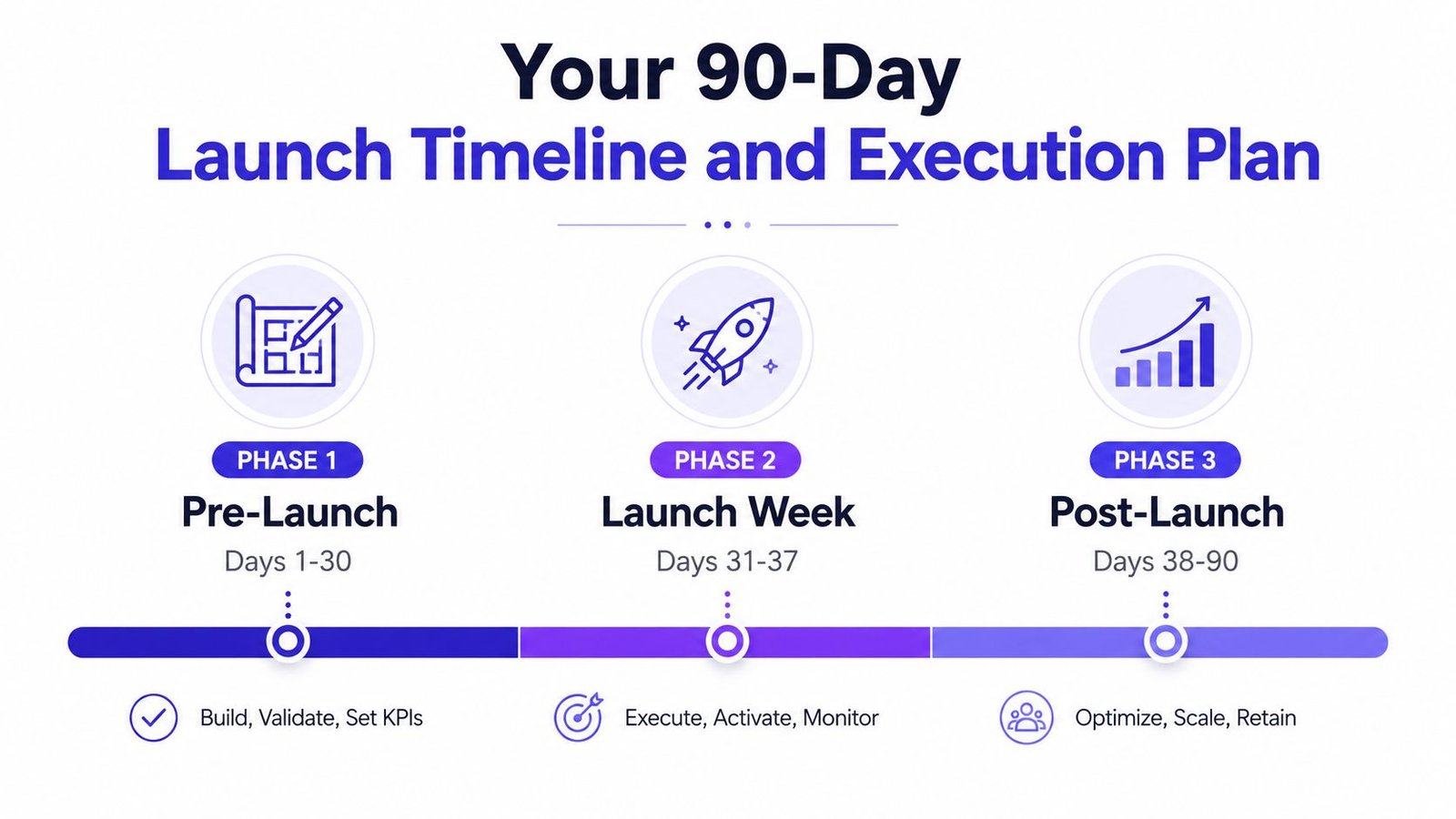
A launch only looks like a moment from the outside. Inside the business, it's a sequence of decisions, fixes, and signals that either stack up or fall apart. The founders who do this well treat launch as a controlled rollout, then a measurement phase, then a trust-building phase.
Pre launch days 1 to 30
This phase is for narrowing, not scaling. Lock the ICP, choose one primary channel, define activation events, and make sure the first-run experience gets users to value. If you're launching into a market where proof matters, prepare your listings, reviews, and profile pages before traffic arrives.
A practical pre-launch checklist looks like this.
- Validate the segment: talk to the exact buyer you plan to serve, then sharpen positioning around their language.
- Instrument the product: track the events that show activation, not just signups.
- Assemble proof assets: reviews, directory listings, and recognizable profile pages.
- Set launch guardrails: decide what success and failure look like before the first visitor lands.
If you want a structured way to pressure-test messaging before launch, the framework from The Business Model Analyst is a useful reference point for disciplined pre-launch validation.
Launch week days 31 to 37
Launch week is about exposure and observation. Push the main channel, monitor activation closely, and resist the urge to add three more acquisition experiments because the first one got attention. Attention without conversion just creates more noise for the team to sort through.
The job in launch week is to watch where people hesitate. Are they dropping before sign-up, before onboarding completion, or before the first meaningful action? That tells you whether the issue is message, trust, or product flow.
Post launch days 38 to 90
Double down on the segment and channel that showed real activation, then tighten the handoff from usage to sales if your motion needs it. If one directory or review profile is getting discovered more often, keep feeding that surface with updates and proof.
For launch management and distribution planning, the best startup directories resource can help founders prioritize where their presence should remain active after launch.
KPIs and Dashboards That Predict Revenue Outcomes
Most dashboards make founders feel busy. They do not help them decide whether the launch is working. The metrics that matter connect product behavior, sales timing, and payback, and they make weak economics visible fast.
Track the numbers that change behavior
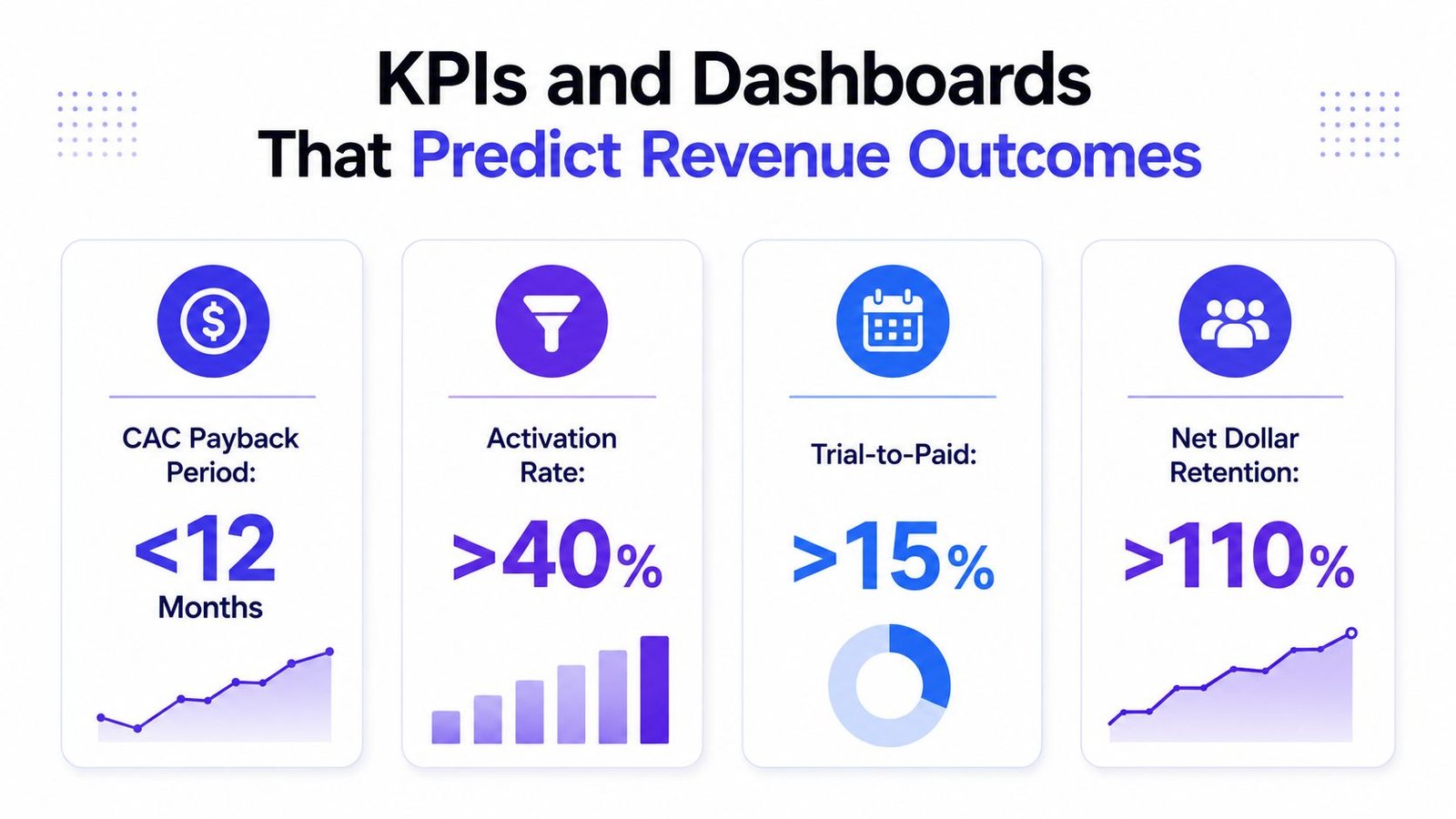
The strongest benchmark in the set is CAC payback. Revenue-stage SaaS guidance frames sub-12-month CAC payback as a healthy growth benchmark, and that is a useful quality gate because it forces discipline on acquisition and activation together (SaaSHero SaaS go-to-market strategy). If payback keeps slipping, the problem is usually not just traffic.
You also need event-level analytics, not just top-of-funnel counts. Track the product actions that show readiness, then route those accounts differently based on fit and intent. That lets sales start with context instead of random outreach.
A useful dashboard usually connects these pieces.
| Metric | What It Tells You | Why It Matters |
|---|---|---|
| CAC payback | How long it takes to recover acquisition cost | Reveals whether growth is efficient |
| Activation rate | Whether users reach first value | Predicts whether trials will convert |
| Trial to paid timing | When interest peaks and decays | Shows where onboarding must improve |
| Net dollar retention | Whether accounts expand after purchase | Indicates product depth and customer fit |
Avoid vanity metrics that hide weak economics
Signups, clicks, and impressions can all rise while revenue stalls. Founders need a dashboard that shows which accounts are worth human attention and which ones should stay in product-led flow. Segmenting by intent and fit keeps the team from wasting sales time on accounts that were never likely to close.
If onboarding is weak, acquisition only makes the problem more expensive.
That is the trap I have seen most often in early SaaS teams. They celebrate traffic, then discover the first-run experience is killing conversion. Fixing the dashboard will not fix that. Fixing the product flow will.
The GTM metrics that deserve attention are the ones that map to revenue, not applause. If a metric does not change a decision, cut it from the core dashboard.
Common GTM Pitfalls and How to Avoid Them
The expensive mistakes in SaaS GTM are usually quiet. Teams keep spending because something is moving, even when that motion is hurting the economics.
The launch that can't support its own sales cycle
A launch falls apart fast when the sales cycle asks for more proof than the team has built. Reps then spend their time educating accounts that were never qualified, which makes the pipeline look busy while conversion stays thin. I've watched founders respond by adding headcount before they tightened qualification. The result was usually more activity, not more revenue.
The Starr Conspiracy cites Salesforce's State of Sales Report showing only 27% of B2B sellers hit quota in 2023, down from 53% in 2018 across 27 countries and 5,500 respondents, plus a median enterprise sales cycle of 84 days for deals over $100K ACV (The Starr Conspiracy benchmarks). That combination explains why brute-force selling gets harder, not easier, in complex SaaS markets.
A better fix is stricter ICP definition, tighter routing, and stronger proof assets so sales only touches accounts with real intent. If a segment cannot be named clearly, priced cleanly, and backed with proof, it usually does not deserve a full sales motion yet.
Launching across too many channels at once creates a different kind of failure. The message gets blurred, attribution gets messy, and nobody can tell which segment works. Pick one path, prove it, then expand.
The product that looks good but can't retain
The market-strategy roundup notes the median B2B SaaS sales cycle is 84 days, up 22% since 2022, and only 13% of SaaS companies ever reach $10M ARR after 10 years. It also says companies with self-serve revenue are nearly 2x more likely to be profitable, 68% versus 36.4% (GTM 80/20 market strategy statistics).
That is why weak first-run experiences are so dangerous. A product can attract attention, but if users do not activate and stick, the economics turn ugly later. In those cases, the fix is better onboarding, cleaner positioning, and a motion that matches the deal size.
A useful pivot test is simple. If buyers need handholding, add sales assist. If buyers want to self-serve but cannot see the value quickly, simplify the onboarding. If pricing and product complexity are mismatched, change the motion before you change the channel mix.
One tool category that can reduce the trust gap is directory and listing management, especially when the brand is still new. The point is not vanity presence. It is making the market see coherent proof wherever it checks, including review platforms and AI search results. The difference between a launch that looks active and one that converts often comes down to whether that proof layer is managed well, which is why teams should compare options like StartupSubmit vs SubmitSaaS before they start scattering submissions.
If you are building a SaaS launch and want the trust layer handled without stuffing the team with manual submission work, visit StartupSubmit and review how its directory placement process fits into a real go-to-market system. It is a practical way to build search visibility, third-party proof, and a cleaner launch footprint before traffic starts moving.