
10 Free Business Listing Websites for New Startups 2026
Citation building is the process of creating consistent, structured business mentions across authoritative directories and platforms, and 99.2% of pages ranking in Google's top results had at least one external link. For startups, it strengthens search visibility and helps search systems identify what your company is, where it operates, and which category it belongs to.
The popular advice says citation building is mainly for plumbers, dentists, restaurants, and other businesses with storefronts. That advice is incomplete. A startup may not need foot traffic, but it still needs search engines, buyers, investors, and AI systems to find a consistent version of its business across the web.
A citation usually includes a business name, address, phone number, website, and category. It might appear on a map platform, software marketplace, startup directory, review site, social profile, industry publication, or company database. The link matters, but the structured identity matters too.
The practical shift is to treat citations as canonical data management, not a checkbox in local SEO. One accurate company record should guide every profile, submission, mention, and update. That record gives Google and AI-powered search systems fewer conflicting signals to reconcile.
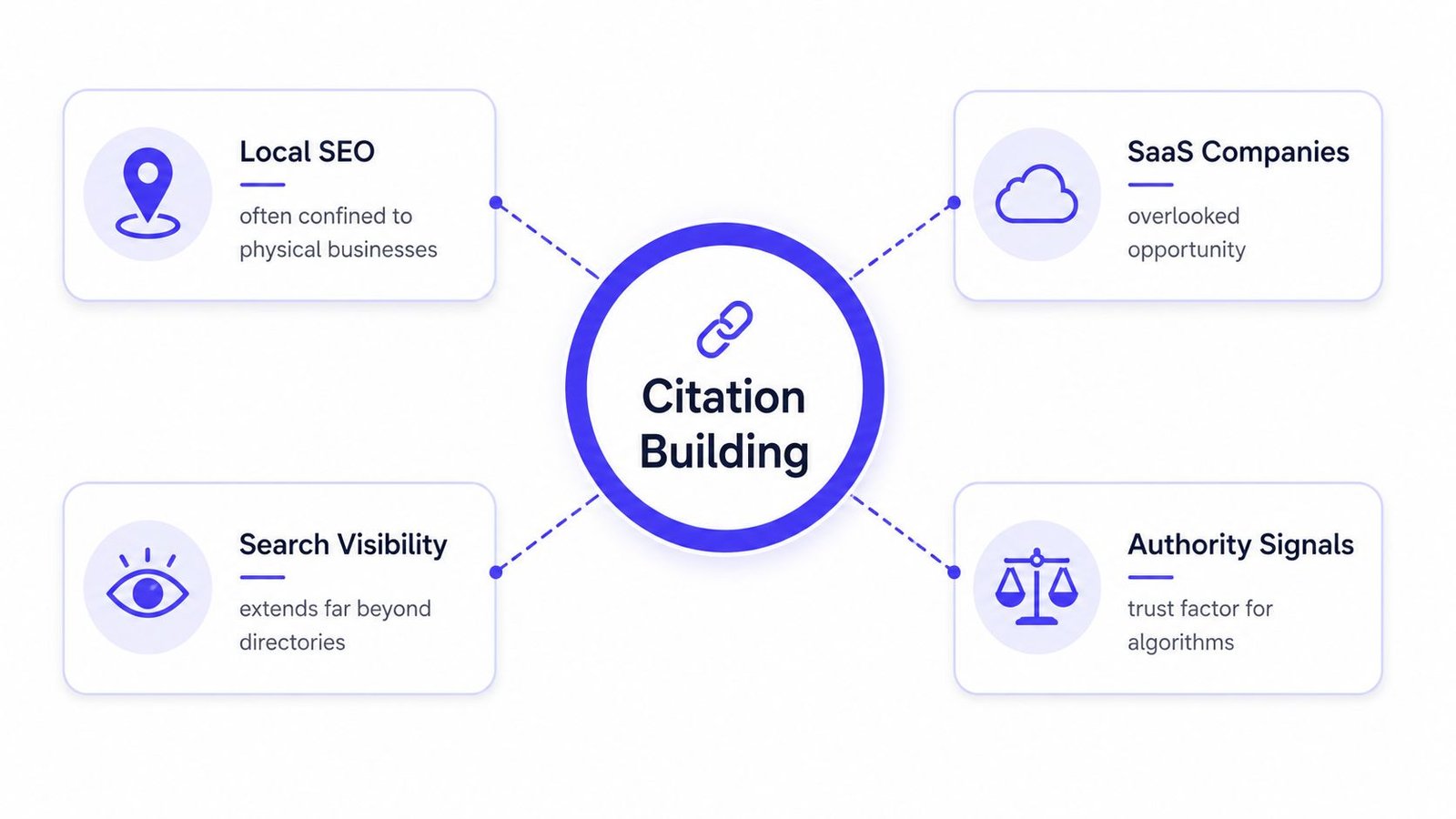
Citation Building Goes Far Beyond Local SEO
A SaaS company can have customers across the world and still benefit from consistent business references. Its profiles on Product Hunt, G2, Capterra, Crunchbase, LinkedIn, and relevant startup directories help search systems connect the brand with its product category, audience, founders, and website.
A citation doesn't always include a clickable backlink. A business mention can still function as an entity reference when the name and other identifying details are present. If the listing also links to the website, it can support both entity discovery and the site's link graph.
That distinction matters for startup SEO. Founders often measure directory work only by referring domains, then dismiss a listing that doesn't pass obvious link equity. In practice, a well-maintained profile can support branded search, category association, customer discovery, reputation management, and machine-readable business information at the same time.
Why entity consistency matters
Search engines aggregate business information from many sources. Large language models and AI Overviews also need corroborating references to understand whether a company is real, what it offers, and how it differs from similarly named businesses.
That doesn't mean every directory carries equal weight. A relevant software marketplace usually tells a stronger topical story for a SaaS startup than an unrelated general directory. A profile with a clear category, accurate description, website, logo, and social links gives crawlers and AI systems more context than a bare company name.
Practical rule: Build one canonical company record first. Every directory submission should reproduce that record, not create a new interpretation of the business.
For a young company, this is also a reputation asset. Buyers who search the brand may encounter several trusted profiles before reaching the website. Founders preparing a launch can use StartupSubmit as one route for organizing startup and software directory placements, but the underlying standard remains the same, accurate and relevant information.
The Anatomy of a High-Quality Citation
A useful citation carries enough consistent information for a person or system to identify the business without guesswork. Start with the exact public-facing business name. Decide whether the official record uses a legal suffix such as “Inc.” or “LLC”, then apply that choice consistently where platforms allow it.
The core fields are straightforward:
- Business name: Use the canonical brand or legal name, not a rotating mix of abbreviations.
- Address: Keep the format stable, including unit details and street styling.
- Phone number: Use the primary business number rather than temporary campaign numbers.
- Website URL: Point to the canonical domain and the most relevant homepage or profile destination.
- Primary category: Select the category that best describes the product, not the category with the broadest audience.
Add supporting information when a platform permits it. A concise product description, founding year, logo, social profiles, founder information, pricing model, and secondary categories can help establish topical relationships. Don't stuff descriptions with keywords. Explain what the product does, who uses it, and which problem it solves.
A practical comparison
A complete G2 or Crunchbase profile might identify the brand as a workflow automation platform for finance teams, link to the official website, use the correct logo, connect the company's social accounts, and provide a consistent description. A thin directory entry might list only a shortened name, an outdated domain, and a generic “software” category.
| Citation Field | High-Quality Example | Low-Quality Example |
|---|---|---|
| Business name | Exact approved brand name | Abbreviation or inconsistent suffix |
| Address | One standardized company address | Different formatting or missing unit |
| Phone | Primary published business line | Tracking number or old number |
| Website | Canonical company domain | Redirect, campaign URL, or dead page |
| Category | Specific software or industry category | Generic or unrelated category |
| Description | Clear explanation of product and audience | Keyword-stuffed or empty field |
| Profiles | Verified logo and social links | Missing or mismatched brand assets |
Structured data on your own website can reinforce the same identity, but schema can't repair contradictory external listings. Your directory profile, homepage, social accounts, and company databases should all describe the same organization.
Founders building a target list can start with startup directory opportunities for software companies, then remove platforms that lack relevance, editorial standards, or a legitimate audience. The goal isn't to appear everywhere. It's to appear accurately where your customers and search systems already look.
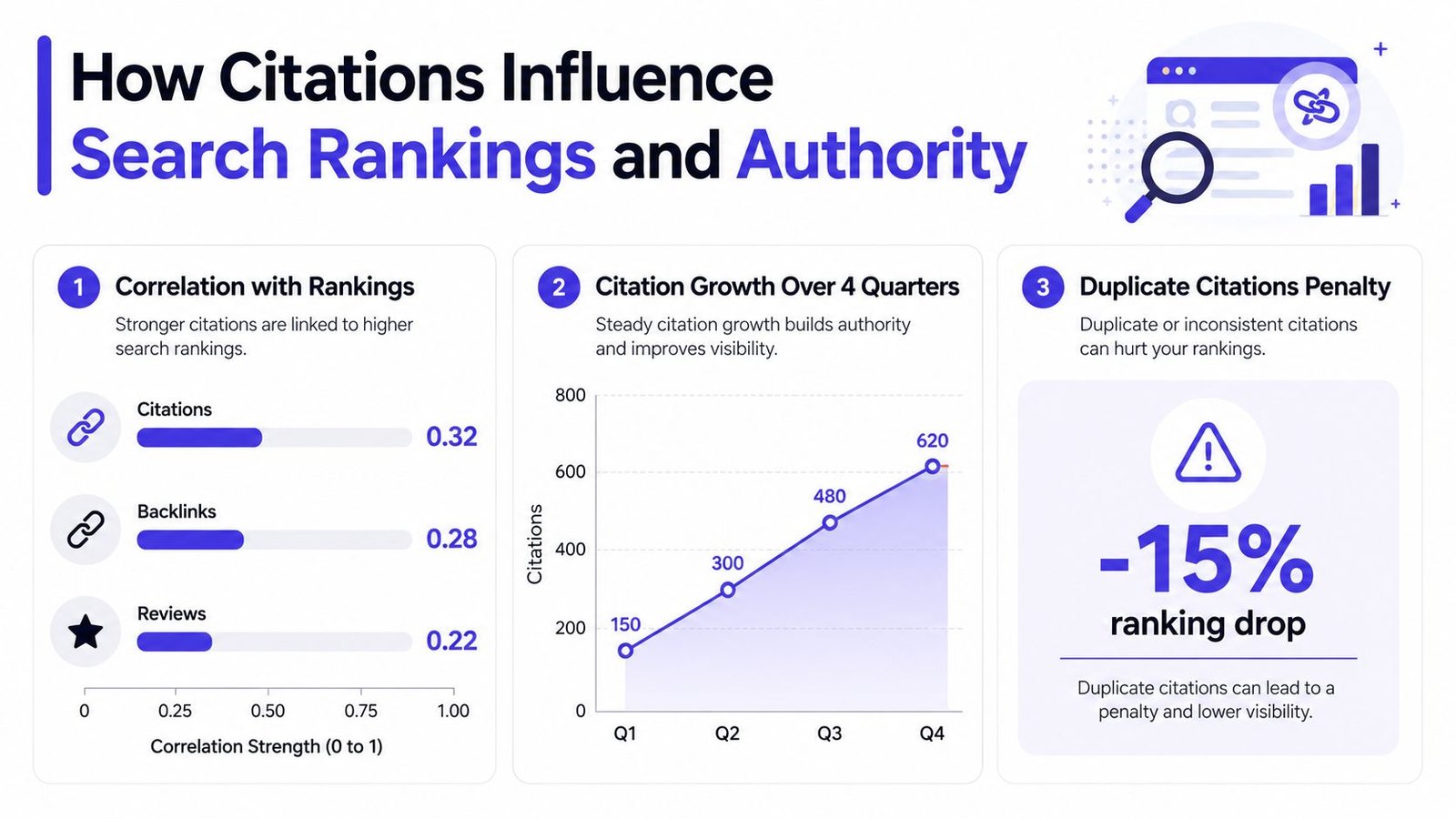
How Citations Influence Search Rankings and Authority
Citations influence visibility through three related signals, quantity, quality, and consistency. Quantity creates broader coverage, but a large collection of weak or duplicated profiles won't compensate for missing information on important platforms. Quality depends on the credibility and relevance of the source. Consistency helps systems decide that multiple references describe the same entity.
Backlinks remain a foundational SEO signal. A Moz analysis summarized by Internet Marketing Team found that 99.2% of pages ranking in Google's top results had at least one external link, while 77.8% of individual ranking pages had at least one link pointing to them. The same source reports that the number one Google result averages 3.8 times more backlinks than positions two through ten, and that the average top-ranking page gains 5% to 14% more followed links each month.
Those figures don't prove that submitting to directories alone will produce rankings. They show why a startup shouldn't ignore the off-site footprint around its website. Citation work is one component of that footprint, especially when listings create clean referring domains and reinforce the brand's category.
Local relevance is meaningful, not dominant
Moz's 2017 Local Search Ranking Factors survey, summarized by BrightLocal, attributed about 13% of local ranking influence to citation consistency and volume. That makes citations meaningful, but not decisive. Relevance, reviews, website quality, proximity, and links still shape the outcome.
A separate survey summary places Google Business Profile signals at roughly 32% of Local Pack influence, link signals at around 15%, and citation signals at approximately 7%, as reported by Link Building Journal. The exact methodologies differ, so treat these figures as directional rather than a universal ranking formula.
For a software startup, topical relevance often matters more than raw listing volume. G2, Capterra, Product Hunt, AngelList, SaaSHub, and AlternativeTo can associate a product with software categories and buyer use cases in ways a generic directory can't. That context can support organic discovery and give AI systems more evidence when they assemble answers about tools in a specific market.
Manual Submissions Versus Automated Directory Tools
Automated directory tools solve a real problem, founders don't want to retype the same company information across dozens of forms. The problem starts when speed becomes the main quality criterion.
Bulk systems may distribute a profile quickly, but they can also create duplicate records, select poor categories, truncate descriptions, or propagate outdated NAP details. Once inaccurate data reaches aggregators, cleanup becomes more time-consuming than the original submission. A founder may spend an afternoon fixing a phone number that took a few minutes to distribute.
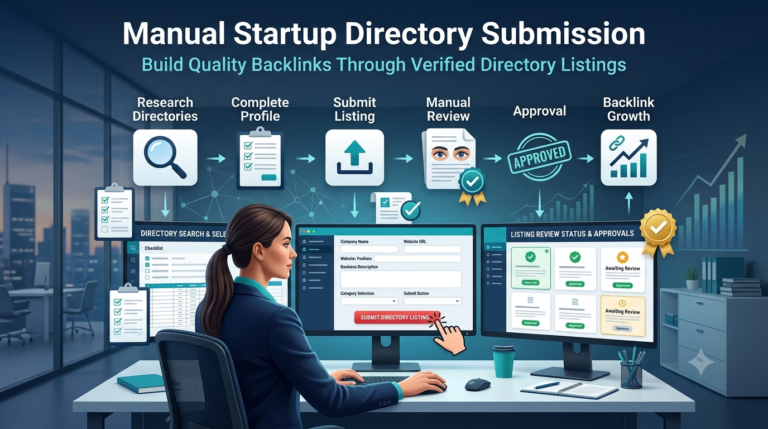
Manual work has the opposite trade-off. It takes longer, but the operator can inspect each platform, choose the right category, tailor the description, confirm ownership, and save the live listing URL. That makes manual submission particularly useful for early-stage SaaS and AI startups, where every profile should explain the product accurately.
| Factor | Automated Tools | Manual Submissions | Curated Service |
|---|---|---|---|
| Speed | Fast distribution | Slower, platform by platform | Faster execution with human review |
| Data control | Depends on templates and integrations | High control over every field | High control with documented inputs |
| Category selection | May be broad or incorrect | Chosen for platform relevance | Reviewed for fit and accuracy |
| Duplicate handling | Often limited | Checked during submission | Checked before and during placement |
| Verification | May leave follow-up to the founder | Managed directly | Specialists can track follow-ups |
| Best fit | Simple, stable records | Small priority list | Founders needing scale without bulk spam |
The middle ground is a manual directory submission service. A specialist can handle repetitive forms while preserving the judgment required for category selection, duplicate checking, and verification. That differs from a cheap bulk package whose main deliverable is a large spreadsheet of unverified URLs.
If you evaluate a service, inspect its process rather than its headline directory count. StartupSubmit's directory submission service describes a manual workflow for startup and software directories, with reporting intended to let clients review submitted URLs and acceptance details. That type of transparency matters more than a promise to place a company on every available directory.
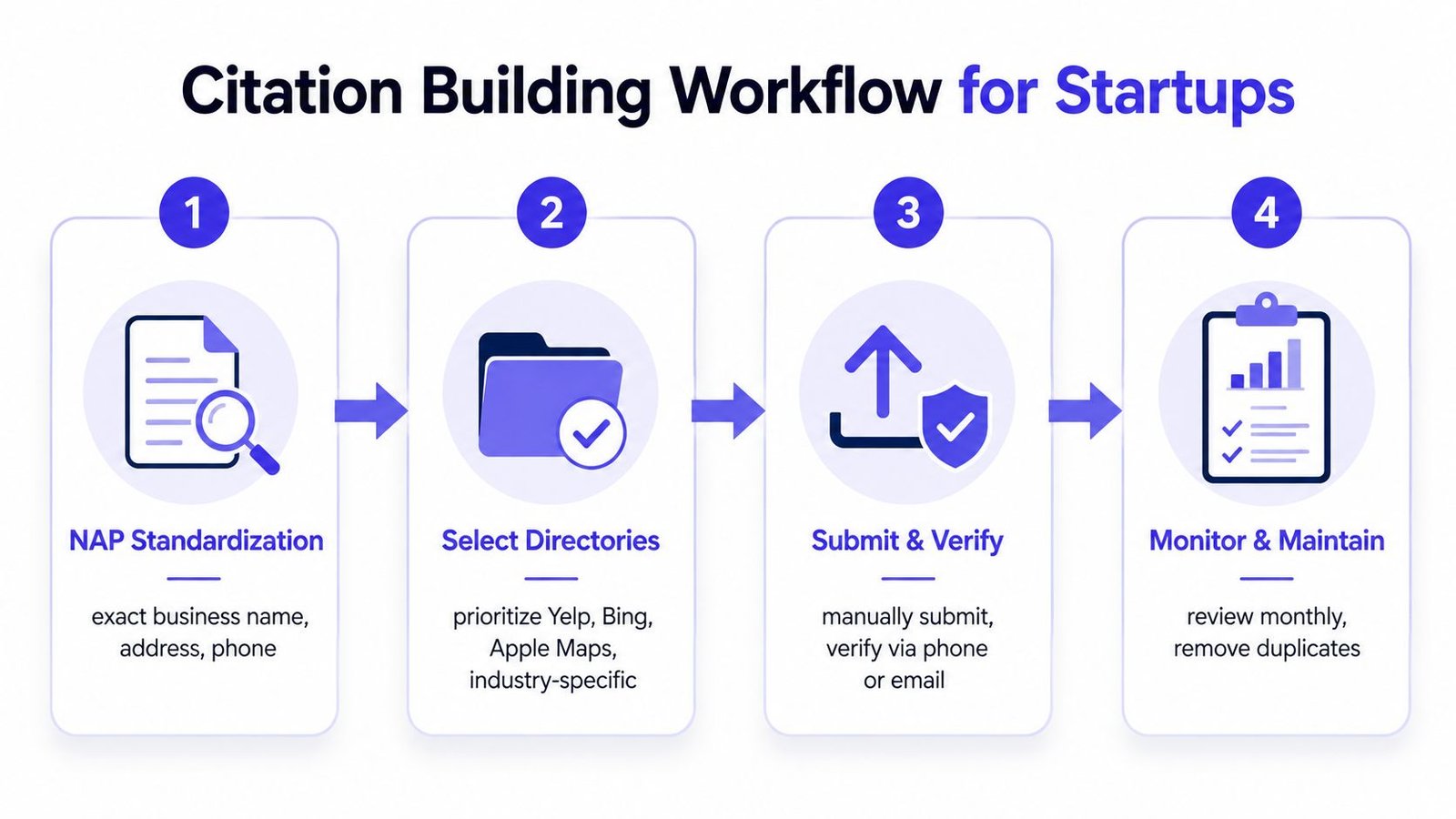
A Practical Citation Building Workflow for Startups
A founder can build a reliable citation system without treating the work as an endless SEO project. The first requirement is a source-of-truth document. Record the approved business name, address format, phone number, website, primary category, short description, long description, logo files, social profiles, and account credentials.
Start with the canonical record
Audit existing listings before creating new ones. Search the brand name, domain, phone number, former business names, and founder profiles. Record each result, then mark it as accurate, duplicate, outdated, unclaimed, or irrelevant.
Fix major aggregators and core platforms first. Correcting a high-distribution source can influence downstream directories, although local citation guidance from DirJournal notes that propagation can take 8 to 12 weeks. That delay is why founders shouldn't judge the workflow only by what appears immediately after submission.
Prioritize by relevance
Use three practical tiers:
- Foundational platforms: Google Business Profile, Bing Places, Apple Maps, LinkedIn, and any major company database relevant to your business model.
- Industry platforms: G2, Capterra, Product Hunt, SaaSHub, AlternativeTo, AngelList, and directories where software buyers or startup audiences research products.
- Geographic and specialist sources: Regional listings or vertical communities that match your customers, service area, or market.
A platform earns priority through a combination of audience relevance, source credibility, indexing potential, and verification standards. Do not submit to a directory just because a competitor appears there.
Submit, verify, and maintain
Complete every field that improves identification. Upload the same logo, use the approved description, select the narrowest accurate category, and save the profile URL. Verification may require email, phone, ownership evidence, or moderator approval, so create a tracking sheet with status, login email, verification date, and next action.
After submission, monitor the record rather than assuming the job is finished. A relocation, rebrand, new phone number, or category change should trigger a citation audit. Guidance from BrightLocal on citation building frames this as a lifecycle process, with a master NAP record, duplicate cleanup, and ongoing monitoring.
For execution at software-directory scale, a SaaS directory submission service can be considered alongside internal work. The decision depends on whether your team has the time to manage forms, verifications, corrections, and reporting without neglecting product marketing.
Common Citation Mistakes That Undermine Your SEO
The most damaging errors usually look minor in isolation. One profile says “Example Inc.”, another says “Example, LLC”, and a third uses a shortened brand name. An address changes from “Street” to “St.”, the phone number becomes a tracking line, or an old domain remains attached to a profile.
Search engines may reconcile some variations, but founders shouldn't rely on that. A fragmented record makes it harder to connect mentions to one entity and gives aggregators more opportunities to distribute incorrect data.
The errors worth fixing first
- Inconsistent identity: Choose one approved business name, address format, phone number, and website.
- Duplicate listings: Claim, merge, or remove multiple profiles that describe the same company.
- Incomplete profiles: Add categories, descriptions, logos, website links, and social accounts where available.
- Unverified records: Follow every verification email and document ownership of the listing.
- Irrelevant directories: Avoid platforms that have no audience, editorial oversight, or connection to your industry.
- Stale information: Update listings after a rebrand, relocation, product repositioning, or phone change.
Wrong categories create a separate problem. A startup that labels an AI analytics product as a generic marketing agency may gain a broader label but lose precision. Search systems and buyers need the category that best describes the actual offer.
The cheapest listing is expensive if your team has to repair the data it spreads.
Reviews deserve attention too, but don't manufacture them or treat them as a substitute for accurate company information. For founders researching how specialized directories can serve narrow audiences, a resource such as this pirate game stores list illustrates why topical relevance can be more useful than indiscriminate directory coverage.
Treat changes as data migrations
A business change should produce a checklist, not a one-off edit. Update the website, social profiles, company databases, map listings, software marketplaces, and any aggregator records. Then revisit duplicates and search results after the updates have had time to propagate.
Citation maintenance isn't glamorous, but it prevents a clean profile from decaying into conflicting records. That matters for both conventional rankings and the confidence with which AI systems interpret your company.
Why Citations Matter for LLM Discovery and AI Overviews
AI search systems need to identify entities before they can recommend them. A startup with one polished homepage but contradictory profiles across the web gives those systems an incomplete record. Consistent citations provide corroborating references for the company name, category, website, audience, and business context.
This is especially relevant to ChatGPT visibility, Google AI Overview inclusion, and other generative search experiences. These systems don't evaluate a brand only through its homepage. They may draw from company databases, software review platforms, industry pages, community discussions, and other indexed sources when forming an answer.
Make the company easy to describe
An AI system is more likely to understand a company when its descriptions use stable terminology. If one listing calls the product “AI sales intelligence”, another calls it “CRM automation”, and the website uses “revenue operations platform”, the labels may be related, but the relationship isn't guaranteed to be clear.
Use a consistent positioning statement across important profiles. State the product category, target customer, core use case, and distinguishing capability in plain language. Keep the same canonical product name and connect profiles to the official website and social accounts.
The AI directory submission service from StartupSubmit is one example of a service positioned around manual placements for AI and software startups. Whether you do this internally or delegate it, the strategic requirement is unchanged: publish accurate, structured information on sources that AI systems can index and interpret.
Don't promise guaranteed inclusion in an AI answer. Citation building increases the evidence available to search systems, but recommendation decisions depend on query intent, source selection, content quality, competition, and ongoing indexing. Measure visibility through branded searches, referral traffic, indexed profile pages, mentions, and observed appearances for relevant prompts.
Your First 30 Days of Citation Building
A focused first month is enough to establish the operating system. It won't solve every discovery problem, and it shouldn't try to. The aim is to create a clean canonical record, secure priority profiles, and leave behind a process your team can repeat.
Week one
Audit the brand, domain, phone number, founders, and existing profiles. Claim listings that already exist, identify duplicates, and finalize the company description and category language. Create a spreadsheet with the platform, profile URL, status, login owner, NAP accuracy, verification requirement, and next action.
Week two
Work through foundational platforms manually. Google Business Profile, Bing Places, Apple Maps, LinkedIn, Crunchbase, and relevant software or startup databases deserve attention before obscure directories. Complete each profile, connect the official website, upload matching brand assets, and save evidence of the published listing.
Week three
Move into category-specific sources. A B2B SaaS company might prioritize G2, Capterra, Product Hunt, AlternativeTo, and industry communities. An AI developer tool may need technical ecosystems and founder-oriented platforms instead. Choose sources based on where potential users research products, not on a generic list.
Week four
Review every submitted profile for indexing, duplicate creation, incorrect categories, broken links, and inconsistent copy. Set a quarterly review cadence, with an extra audit whenever the company changes its name, domain, address, phone number, or positioning.
Use Search Console to watch branded queries and indexed pages, and review analytics for referral visits from directory profiles. Citation signals may take time to settle, particularly when aggregators distribute changes over several weeks. Treat early movement as directional evidence, not a guaranteed ranking result.
The best next step is simple: create the canonical record today, audit what already exists, and submit only to platforms that strengthen your startup's identity. If the manual workload is larger than your team can absorb, StartupSubmit offers manual directory submissions for SaaS and AI startups, with duplicate checking, categorized listings, and a final report containing submitted URLs and placement details. Evaluate it alongside an in-house workflow, then choose the option that lets you maintain accurate data after launch.