AI Search Engine Optimization: The Startup Founder’s
AI search engine optimization has a counterintuitive center of gravity: your own website may not be the strongest proof that your startup exists. Generative systems increasingly assemble answers from indexed pages, recognized entities, citations, reviews, directories, videos, and other third-party references. A polished landing page helps, but it can't compensate for a brand that appears nowhere else.
That shift matters because Google AI Overviews reached 2 billion monthly users in 2026, while AI-generated content in Google Search reportedly rose from 2.27% of search content in 2019 to 17.31% in 2025 (Semrush). Industry analysis also suggests that roughly 60% of searches now end without a click (Semrush). Founders now have to optimize for being included in an answer, not only for earning a visit.
Why Traditional SEO Is No Longer Enough
Traditional SEO still matters. Crawlability, internal links, useful content, technical accessibility, and backlinks remain the foundation for discovery. The problem is that a blue-link ranking is no longer the complete definition of visibility.
When a buyer asks an AI search tool for the best project management software for a small engineering team, the system may summarize several sources, compare features, mention alternatives, and provide citations. The user might never inspect the original search results. Your startup can therefore lose the opportunity before a conventional click-through metric records anything.
AI search engine optimization changes the target from ranking a page to making the brand usable in an answer. That requires clear product facts, consistent entity information, evidence from independent websites, current documentation, and content that can be extracted without losing meaning.
Practical rule: Treat every important page as both a destination for humans and a source document for an answer engine.
The difference becomes especially visible for early-stage SaaS companies. A new product might rank for its own brand name but remain absent when prospects ask broader questions such as which tools support a particular workflow, integrate with a specific platform, or serve a narrow industry. Classic startup SEO often focuses on publishing more articles. AI visibility demands a stronger connection between the product, the category, the problem, and the sources that corroborate those relationships.
A useful startup directories resource can help founders identify places where that external footprint should exist, but listings aren't a substitute for product clarity. They work when the same accurate facts appear across credible profiles and reinforce what the main website says.
Google remains a dominant search gateway in major markets, so this isn't a niche concern for AI companies or software brands. AI-mediated discovery now affects organic visibility, brand trust, and downstream conversion paths across SaaS, software, and consumer categories (Semrush). Traditional SEO gets your evidence into the index. AI search optimization helps that evidence become part of the answer.
How AI Answer Engines Select Sources
AI answer engines rely on retrieval and relevance signals rather than a single optimization score. Retrieval systems first locate candidate material, then answer-generation systems judge which sources are useful enough to cite or incorporate. For founders, the practical question is not how to decorate a page with markup. It is whether the product is clearly described and supported by credible evidence across the web.
A 2026 controlled RAG benchmark covering 252,000 trials identified four gatekeeper factors in citation selection: topical relevance, list position, explicit price information, and recency (the RAG benchmark). Completeness and trust cues produced smaller gains in the same benchmark, while formatting-only edits had little impact.
Relevance comes before polish
A page about “customer data platforms” is a weak source for a question about passwordless authentication, even though both subjects belong to software. The page must match the query's subject and intent closely. A focused integration page can therefore outperform a broad company blog post when the question concerns that integration.
List position also affects selection. Retrieval systems encounter some candidates earlier because those pages are discoverable, internally linked, indexed, and aligned with the query. Basic technical SEO still supports LLM SEO by helping relevant evidence enter the candidate set.
Current facts beat stale claims
The benchmark highlights recency and explicit price information. For a SaaS buyer comparing plans, current pricing, plan names, update dates, and clear eligibility conditions give an answer engine usable evidence. A vague overview published years ago gives it less material to work with.
A new date on an unchanged article will not create meaningful visibility. The timestamp should reflect a substantive review of the facts. Cosmetic freshness is easy for users to distrust and leaves the underlying retrieval problem unresolved.
Substance beats markup theater
Schema can clarify that a page describes a product, review, event, or FAQ. It can support interpretation, yet it cannot compensate for thin or mismatched content. Founders evaluating AI SEO services should ask whether a provider improves evidence, relevance, and source coverage instead of promising that markup alone will place a brand in every answer.
The same principle applies to a directory submission service for AI startups. A listing helps when it places accurate, query-relevant information on a crawlable third-party page. Repeated profiles with conflicting descriptions create noise. Consistent mentions across credible directories, review sites, and industry pages give answer engines more corroborating context.
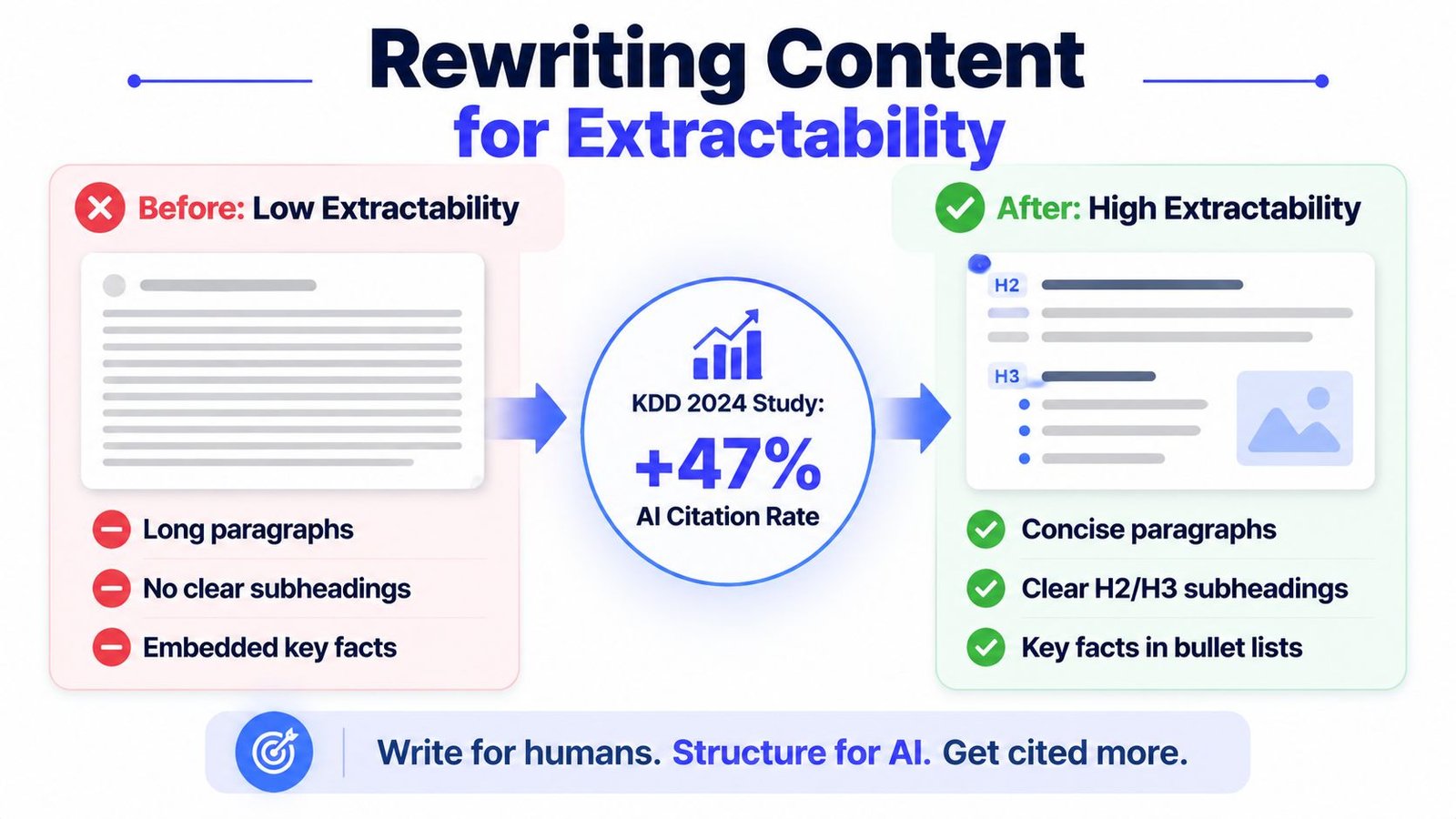
Rewriting Content for Extractability
The best AI search optimization edits usually make a page clearer for people too. The objective isn't to turn prose into disconnected fragments. It's to ensure that a definition, claim, qualification, or comparison still makes sense when an answer engine retrieves only part of the page.
A 2024 KDD study on Generative Engine Optimization found that targeted content edits raised AI-search visibility by 30–40% on a Position-Adjusted Word Count metric and 15–30% on a Subjective Impression metric (the KDD study). Those findings support editing for extractability, but they don't justify flattening every article into robotic bullet points.
Start with a direct definition
A product page should answer “What is this?” near the top, using the language a buyer would use. Compare these two openings:
- Weak: “Modern teams need a smarter way to manage operational complexity.”
- Stronger: “AcmeFlow is a workflow automation platform for finance teams that need approval routing, audit trails, and Slack notifications.”
The second version identifies the product category, audience, use case, and core capabilities. An answer engine can reuse it with less interpretation, and a human visitor understands the offer faster.
Turn claims into evidence-bearing statements
Avoid stacking adjectives such as "powerful" and "next-generation." State what the product does, who it serves, and where the information comes from. If a feature has a limitation, document it. Honest constraints often make a page more useful than broad positioning language.
For each priority page, check whether it includes:
- A self-contained answer: Write a sentence that can stand alone if extracted.
- An identifiable entity: Use the company name, product name, category, and relevant integration consistently.
- A clear qualification: Explain who the feature is for and when it doesn't apply.
- Supporting evidence: Link to documentation, an original report, a product page, or a credible external reference.
Use structure as navigation, not decoration
Descriptive H2 and H3 headings help readers locate information and help retrieval systems distinguish one subject from another. Tables work well for plan comparisons, integrations, and “best for” decisions. FAQ blocks can answer real objections, provided the answers add information rather than repeating the page introduction.
Schema markup belongs in the supporting layer. Use relevant structured data when it accurately describes the visible page, but don't spend a week adding markup while your pricing page remains unclear or your product category changes from page to page.
The editing test: If a reader copied one paragraph into a Slack message, would the claim still be accurate without the rest of the article?
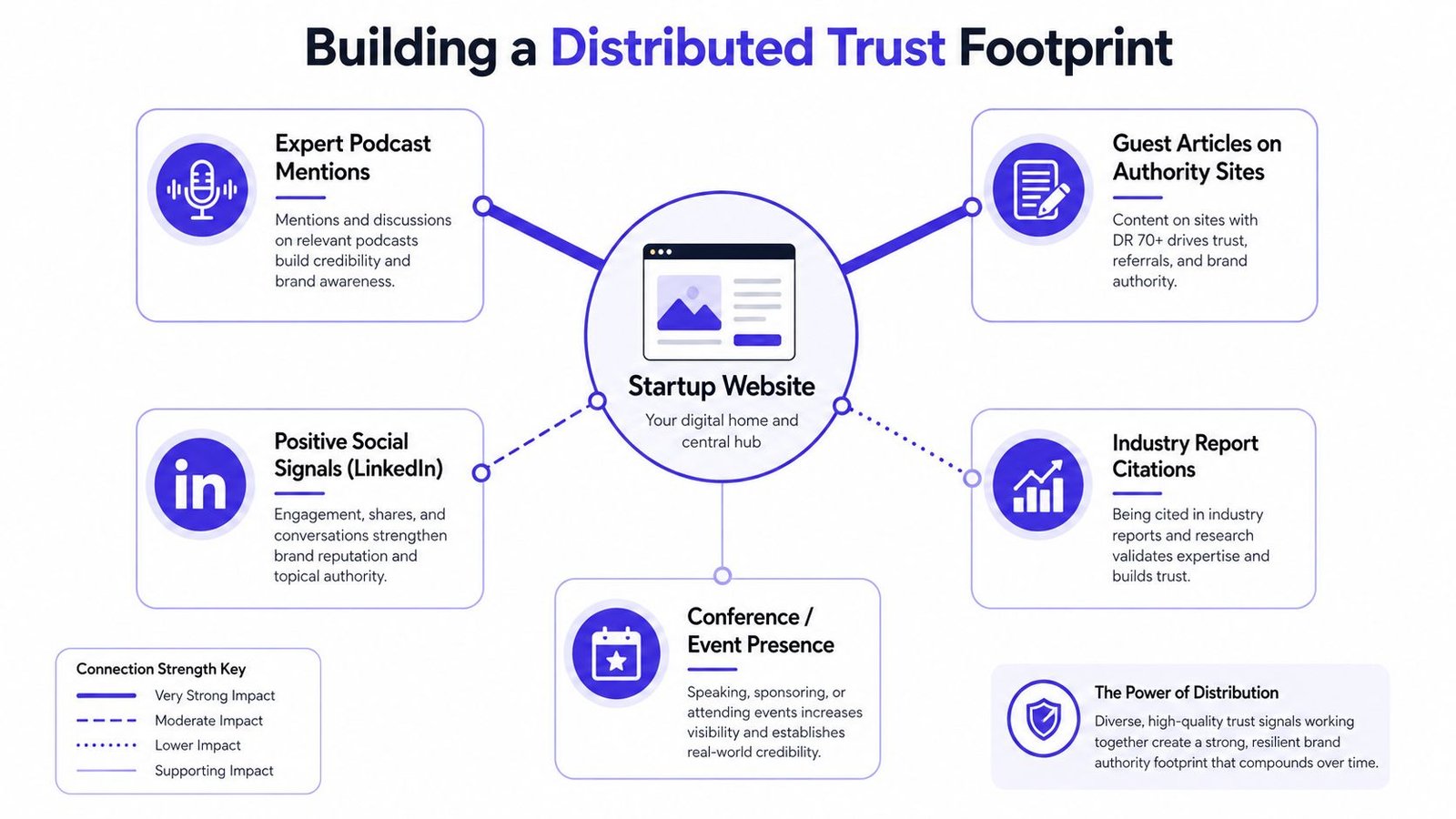
Building a Distributed Trust Footprint Off-Site
AI search engine optimization depends on evidence beyond your own website. For startups with limited domain authority, answer engines may look for recognized entities, third-party mentions, reviews, and independent sources that confirm the company's identity and category. A second blog post cannot create that corroboration by itself.
Research on smaller brands argues that generative systems can favor trusted third-party sources, recognized entities, and brand mentions across the open web (research on brand authority in generative systems). The practical takeaway is clear: build external evidence before expecting an answer engine to rely heavily on your own claims. Off-site trust is not a public-relations add-on. It is part of the retrieval infrastructure around the brand.
Build profiles where buyers validate software
For a SaaS product, relevant platforms may include Product Hunt, G2, Capterra, Crunchbase, AlternativeTo, and SaaSHub. Keep the company name, product category, URL, founding description, integrations, audience, and pricing position consistent across profiles.
Consistency does not require pasting the same paragraph everywhere. Adapt the emphasis to the platform. A review profile should describe customer experience. A directory should clarify the category and use case. A Product Hunt page can explain the launch story and meaningful product changes.
Prefer quality and accuracy over volume
Automated submissions can produce duplicate listings, wrong categories, abandoned profiles, and conflicting brand details. Manual review takes longer, but it lets a team confirm relevance, claim existing profiles, and check whether platform moderators are likely to accept the listing. Teams that want outside help can evaluate a manual directory submission service alongside internal execution or a specialist agency.
StartupSubmit is one example of that manual approach. Its published service describes submission and management across 200+ startup and software directories, including Product Hunt, G2, Capterra, BetaList, Indie Hackers, AlternativeTo, and SaaSHub. It also describes duplicate checking, categorization, backlink reporting, acceptance notes, and screenshots. Those details make the service easier to compare with an internal process, though founders should still verify each directory's relevance and current standards.
Third-party profiles do not compensate for weak product quality, documentation, or customer experience. They create a distributed trust footprint that gives retrieval systems more opportunities to associate the startup with a category. They also give prospects independent places to verify the company before starting a conversation.
Measuring AI Search Visibility Beyond Rankings
Rank tracking answers a narrow question: where does a page appear in a conventional result set for a chosen query? That remains useful, but it doesn't tell you whether ChatGPT, Google AI Overviews, or another answer engine cites your company when a buyer asks a related question.
AI referral traffic has become large enough to measure seriously. AI platforms generated more than 1.1 billion referral visits in June 2025, representing a 357% year-over-year increase, according to the cited industry analysis (AI search statistics). Referral traffic is only one signal, though. A user may see your brand in an answer and later go directly to your site, search your name, or talk to sales without creating an obvious AI referral session.
Use a combined measurement model
Track three categories together:
- Citation frequency: How often does an engine cite your domain, product, or branded profile for a defined set of questions?
- Answer share of voice: Which brands appear alongside you, and how often do you appear when the question covers your category?
- AI-referred behavior: Which visits arrive from identifiable AI tools, and what do those visitors do after landing?
Server logs and analytics can reveal referral patterns that standard rank tools miss. For citations, maintain a prompt set that reflects real buying questions, then record the engine, query, cited source, answer context, and date. Don't treat a synthetic visibility score as revenue.
| Dimension | Traditional SEO | AI Search Optimization |
|---|---|---|
| Primary visibility unit | Page position for a keyword | Brand or source inclusion in an answer |
| Main success signal | Impressions, clicks, rankings | Citations, answer share, assisted discovery |
| Useful instrumentation | Search Console, rank trackers, analytics | Citation logs, prompt monitoring, server referrals, analytics |
| Main advantage | Mature and repeatable reporting | Captures answer-level visibility |
| Main limitation | Misses zero-click and unlinked exposure | Results vary by engine, prompt, location, and time |
A practical free startup directories guide can help expand the set of external sources you monitor, but directory count isn't a KPI by itself. Measure whether the profiles are indexed, accurate, relevant, and contributing to discovery or brand verification.
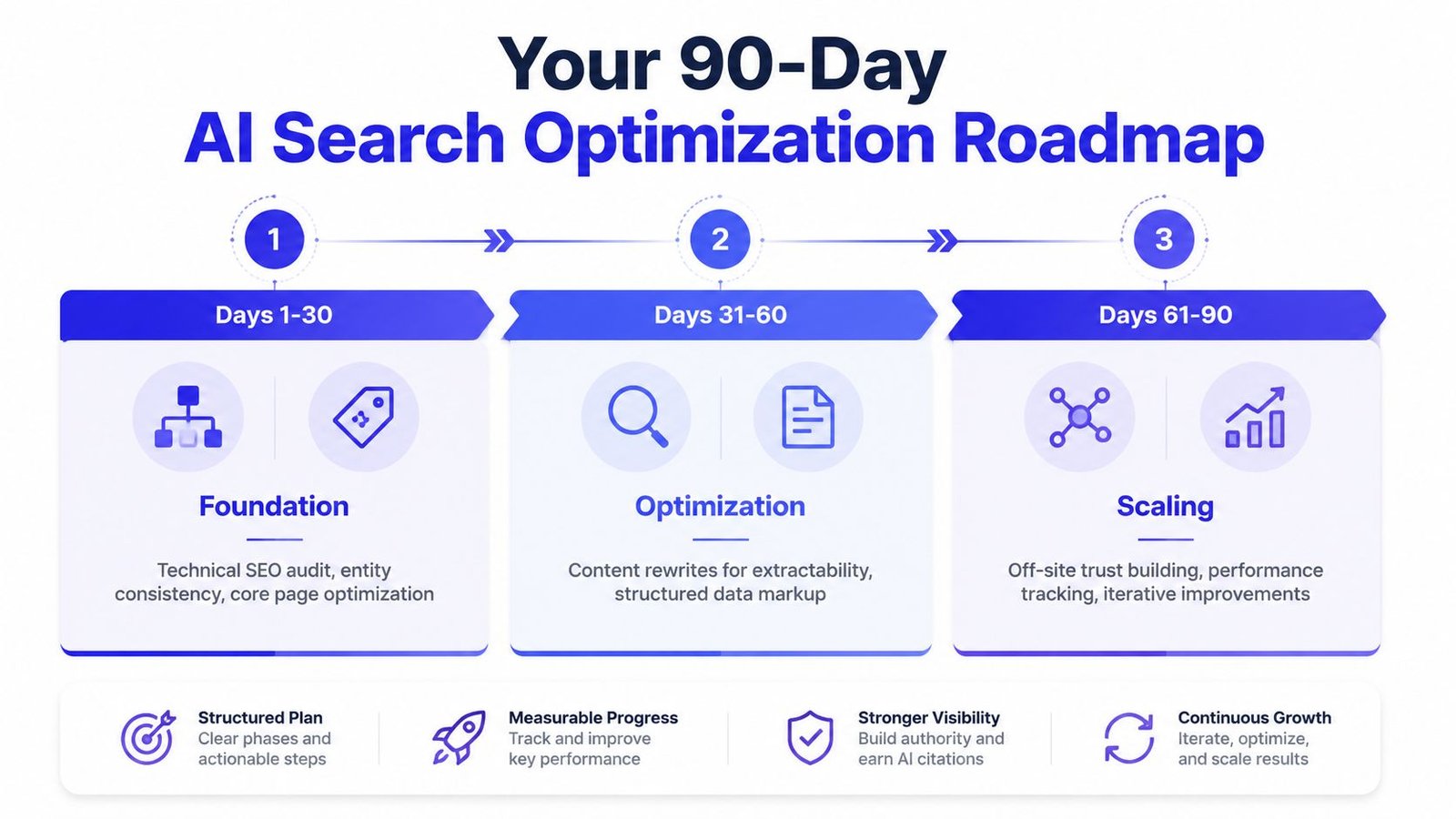
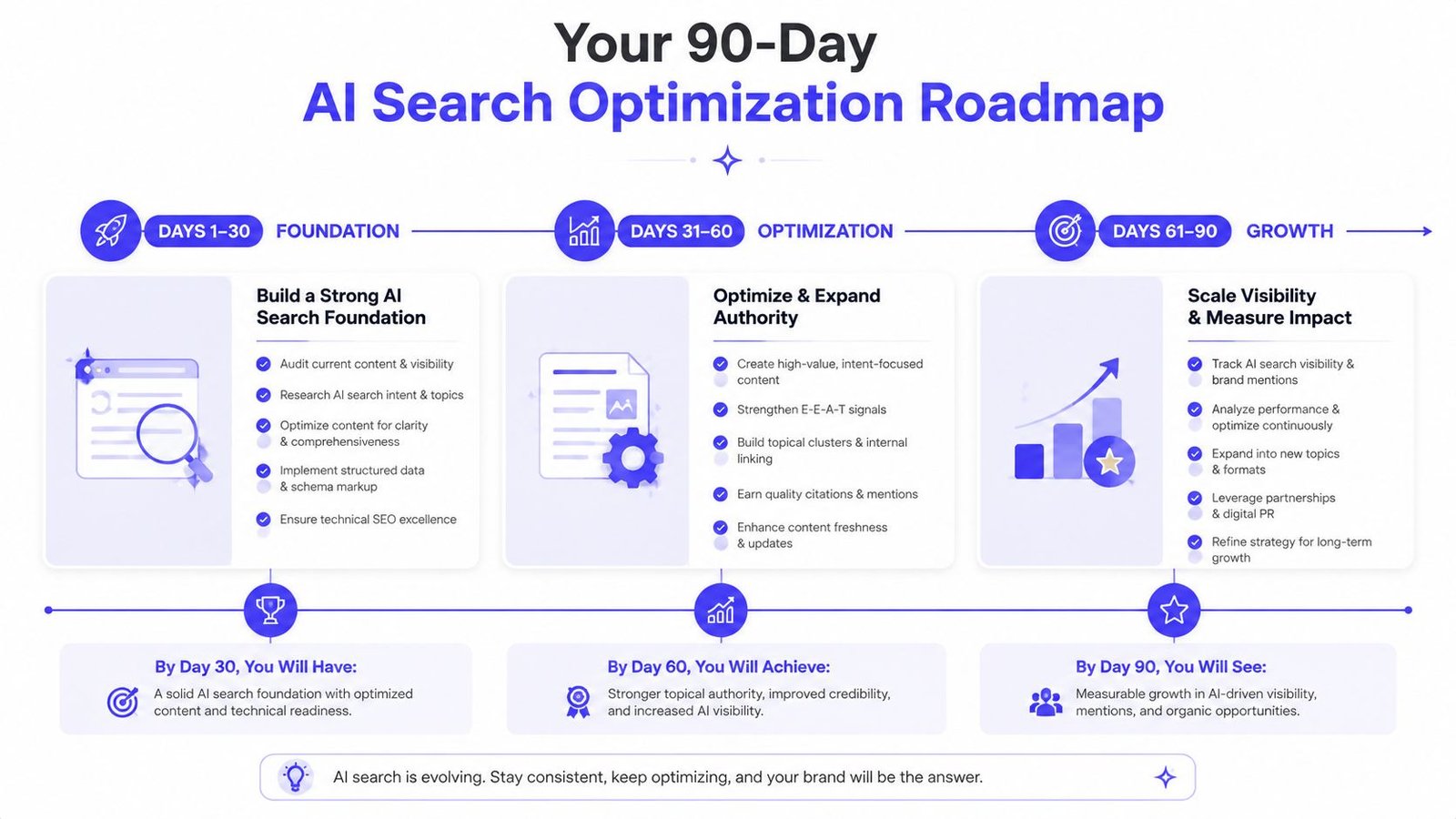
Your 90-Day AI Search Optimization Roadmap
The sequence matters. Founders often start with directory submissions or schema because those tasks feel tangible, then discover that the website still has unclear positioning and outdated product facts. Fix the source material first, then expand the number of places where that material appears.
Days 1 to 30 build the foundation
Audit the pages that matter most to revenue: homepage, product pages, use-case pages, pricing, integrations, comparison pages, and documentation. For each page, record the target audience, category, primary problem, product capability, evidence, last meaningful update, and related internal links.
Then check the technical basics:
- Crawl access: Make sure important HTML content can be discovered and rendered.
- Entity consistency: Compare the company name, product name, category, description, and social profiles.
- Answer clarity: Add direct definitions and concise responses to genuine buyer questions.
- Internal connections: Link related product, use-case, integration, and documentation pages.
The deliverable is a clean source of truth. Don't scale publishing until the core facts are stable.
Days 31 to 60 expand the evidence
Rewrite the priority pages using the extractability framework. Add relevant structured data where it accurately describes visible content. Create or claim profiles on the directories and review platforms that match your market, then standardize the essential business details.
Request reviews from real customers without scripting their words. A review that explains the problem, workflow, and outcome gives future buyers and answer engines more context than a generic five-star rating.
Days 61 to 90 amplify and measure
Build content with citation potential, such as original comparisons, integration documentation, opinionated category guides, and data your team can legitimately publish. Include video where the topic benefits from demonstration. A 2026 Search Engine Journal report summarizing Ahrefs data found that YouTube accounted for 5.6% of Google AI Overview citations, while 18.2% of citations from URLs outside Google's top 100 were YouTube URLs (Search Engine Journal's report). The report also said YouTube citations had grown 34% over the prior six months (Search Engine Journal's report).
Set up citation monitoring and AI referral reporting before you publish the next batch. Review which pages, profiles, formats, and claims appear in answers, then improve the weakest evidence instead of adding content indiscriminately.
Risks and Ethical Considerations in AI SEO
AI search optimization can produce bad outcomes when founders treat extraction as the only objective. Over-compressed writing may be easy for a machine to reuse but unpleasant for a person to read. A page made from disconnected answer fragments can lose nuance, context, and the distinctive experience that makes a startup credible.
The safer approach is structured human writing, not machine-shaped prose. Use headings, lists, tables, and direct answers where they improve comprehension. Keep examples, qualifications, and original insight where removing them would make the claim misleading.
AI-generated content creates another risk. Publishing large quantities of generic pages may create short-lived coverage while weakening the site's reputation and wasting the team's editorial capacity. Founders should use automation for research assistance, briefs, and quality checks, then apply human review to facts, product claims, customer language, and point of view.
Treat external platforms as rented land
Directories, review sites, social networks, and video platforms can strengthen your trust footprint, but you don't control their algorithms or policies. A profile can change format, lose visibility, or become outdated. Keep the canonical facts on your website and treat third-party profiles as corroborating references, not the only record.
Google's interface is also making source authority more visible. Google announced in May 2026 that it was adding a Highly Cited badge to more web article links, with the label also appearing in AI Overviews and AI Mode (Google's cited update coverage). The update indicates when an article explicitly references a highly cited source. That favors material other publishers find useful, not manufactured mention patterns.
MLA guidance reinforces the distinction between an answer surface and a durable source. The MLA Style Center guidance on Google AI Overviews says search results aren't a work and recommends citing the underlying source page for claims drawn from an overview. For founders, the lesson is straightforward: appearing in an answer is useful, but the independently verifiable page remains the asset worth improving.
Practical Next Steps for Startup Founders
Use a short execution list rather than another broad strategy document.
This week
- Audit ten priority pages: Rewrite unclear introductions, add direct definitions, verify product facts, and identify claims that need evidence.
- Standardize the entity: Create one approved version of your company name, product category, URL, audience description, integrations, and pricing language.
- Start an answer log: Test real buyer questions across the AI search engines your customers use, and record citations, competitors, and missing information.
This month
Claim and improve profiles on the most relevant directories and review platforms. Don't chase every listing. Choose sources that buyers recognize and that can accurately describe your product.
Publish at least three pieces designed for reference, such as an integration guide, a transparent comparison, or a category explainer based on genuine product experience. Add AI referral tracking and a basic citation-monitoring process before judging the results.
This quarter
Review citation frequency, answer share of voice, referral behavior, branded searches, qualified leads, and sales conversations together. Ask prospects where they first heard about you, because direct visits can hide earlier exposure in an AI answer or third-party profile.
Common founder questions have practical answers:
- How long does AI SEO take? There isn't a reliable universal timetable. Results depend on crawlability, source quality, query relevance, recency, competition, and how quickly external references accumulate.
- Does AI optimization replace traditional SEO? No. It builds on technical SEO, indexed content, internal links, and backlinks while adding answer-level measurement and source selection.
- What if the startup has no domain authority? Start with clear product pages and a distributed trust footprint. Earn legitimate mentions, complete relevant profiles, collect honest reviews, and publish evidence other sites can cite.
For SaaS teams that need help organizing software-directory profiles, a SaaS directory submission service can handle repetitive manual work while your team focuses on positioning, customer evidence, and content worth citing.
StartupSubmit provides manual directory submissions for SaaS and AI startups, with profile creation, duplicate checking, categorization, backlink URLs, acceptance notes, and placement screenshots across its directory network. If your startup needs a more consistent off-site trust footprint for AI search engine optimization, visit StartupSubmit and review the submission options before choosing your first set of platforms.