How to Improve Directory Approval Rates: A Complete 2026 Guide
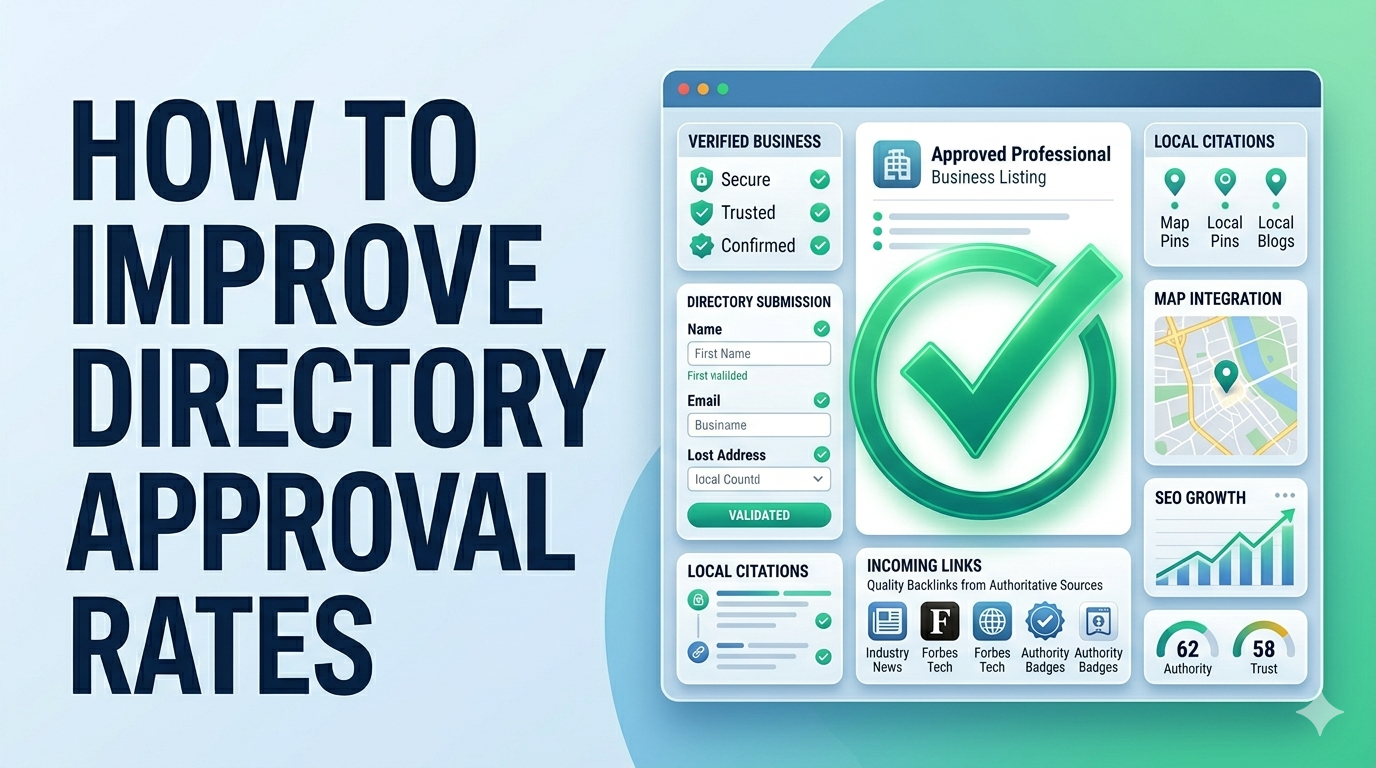
How do you improve directory approval rates? Improve directory approval rates by submitting accurate, complete business information, choosing the correct category, writing unique non-promotional descriptions, maintaining strict NAP consistency, ensuring your website is fully functional, and targeting directories with genuine manual review processes rather than instant-approval spam sites.
Directory approval is the gatekeeping step that determines whether your business listing actually goes live — and a surprising number of submissions get rejected for entirely avoidable reasons. Understanding exactly why Manual Review teams reject listings, and what Quality Control standards they apply, is the fastest way to raise your approval rate across every trusted business directories campaign.
This guide breaks down the specific directory rejection reasons seen across modern editorial directories in 2026, and gives you a practical, step-by-step process to get approved more often, faster.
1. Why Directory Approval Rates Matter for SEO
Every rejected submission is wasted time — and worse, a missed opportunity for a quality backlink and citation building signal. As Search Engine Optimization has matured, directories have tightened their Quality Control standards specifically to filter out exactly the kind of low-effort submissions that used to flood the web in the 2000s.
The Cost of Low Approval Rates
A low approval rate doesn’t just mean fewer backlinks — it often signals deeper issues with your submission process: inconsistent NAP Consistency, incomplete information, or a website that doesn’t meet basic quality thresholds. Directories with editorial review teams reject submissions with blurry assets, generic descriptions, or placeholder information, and the same standards apply whether you’re submitting a business listing or a product launch.
What Higher Approval Rates Signal to Google
When your listings are consistently approved by directories with genuine Manual Review processes, it builds Trust Signals that compound over time — both with the individual directories and, indirectly, with search engines evaluating your overall Website Authority.
2. Top Reasons Directory Submissions Get Rejected
Understanding the most common Directory Rejection Reasons is the first step toward avoiding them entirely.
Reason 1: Incomplete or Inaccurate Business Information
Most high-authority directory submission sites require your website name, URL, description, category, and sometimes contact details or ownership verification. Providing incomplete or inconsistent information is one of the leading causes of rejection.
Fix: Build a single source-of-truth document containing your exact business name, address, phone number, website URL, primary category, and both short (50-80 word) and long (150-300 word) descriptions before you submit anywhere.
Reason 2: Keyword Stuffing in Titles and Descriptions
Stuffing unnecessary keywords into your directory submission title or description is a common mistake that reads as Spam Prevention bait to editorial reviewers, increasing rejection risk significantly.
Fix: Keep your title meaningful rather than a list of keywords — generally between 20 and 50 characters — and avoid any promotional language in the title field itself.
Reason 3: Incorrect or Mismatched Category Selection
Business Categorization errors are a frequent and entirely preventable rejection cause. Choosing a category that doesn’t accurately represent your website’s niche or industry both hurts approval chances and reduces the SEO value even if approved.
Fix: Always select the most specific, accurate subcategory available — not just the closest general match.
Reason 4: Low-Quality or Non-Functional Websites
Directories prefer websites that are professionally designed, easy to navigate, and offer meaningful content to users. Submitting an incomplete, broken, or under-construction site reduces approval chances dramatically.
Fix: Confirm your site is fully functional, mobile-friendly, and free of broken links before beginning any submission campaign.
Reason 5: Generic or Duplicate Descriptions
Editorial directories increasingly reject submissions using the exact same description copy-pasted across dozens of platforms, since it signals a low-effort, automated approach rather than genuine Manual Directory Submission effort.
Fix: Write a unique description tailored to each directory’s audience — a developer-focused directory needs different messaging than a local consumer directory.
Reason 6: Poor-Quality Visual Assets
For directories requiring logos or screenshots, blurry images, placeholder logos, or low-resolution assets are common rejection triggers, particularly on directories with active editorial teams.
Fix: Prepare a logo at minimum 256×256 and ideally 512×512 PNG resolution, plus clean screenshots at 1280×800 or higher before submitting.
3. The Business Verification Process: What to Expect
Many high-authority directories — particularly Google Business Profile, Yelp, and Bing Places for Business — require a formal Business Verification step before your listing goes fully live.
Common Verification Methods
| Method | Used By | Typical Timeframe |
| Postcard/Mail Verification | Google Business Profile | 5-14 days |
| Phone Verification | Google Business Profile, Bing Places | Minutes to hours |
| Email Verification | Most general directories | Minutes |
| Document/Ownership Verification | BBB, premium directories | Days to weeks |
| Manual Editorial Review | Curated niche directories | Days to weeks |
How to Pass Verification Faster
- Ensure your business address matches exactly across your website, utility bills, and any official registration documents
- Use a business phone number that’s actively monitored — verification calls often come unannounced
- Respond to verification emails or postcards immediately; delays can reset the review queue
- Avoid using a P.O. Box address where physical verification is required
4. NAP Consistency: The Foundation of Approval and Local SEO
NAP Consistency — keeping your Name, Address, and Phone number identical across every platform — is one of the single biggest factors influencing both Directory Approval and overall Local SEO performance.
Why Inconsistency Causes Rejections
Editorial reviewers and automated verification systems alike cross-reference your submitted NAP details against existing public records. Even a small inconsistency — “St.” versus “Street,” or an outdated phone number — can trigger a rejection or a request for resubmission.
Building a NAP Consistency Checklist
- ✅ Use one exact business name format everywhere (no variations, abbreviations, or punctuation differences)
- ✅ Use the identical address format across your website footer, Google Business Profile, Yelp, and all other listings
- ✅ Keep a master spreadsheet documenting the exact approved format for reference
- ✅ Update every platform simultaneously if your business relocates or changes phone numbers
- ✅ Audit existing listings quarterly to catch and correct drift
5. Optimizing Business Profile Completeness
Business Profile Completeness directly correlates with approval rates across nearly every directory type. Incomplete profiles signal low effort and frequently sit in Manual Review queues far longer than fully completed ones.
The Complete Profile Checklist
- Business/website name (consistent format)
- Full website URL (matching the destination exactly)
- Short description (50-80 words, unique per directory)
- Long description (150-300 words, unique per directory)
- Primary and secondary category selection
- Logo (minimum 256×256 PNG)
- 3-5 supporting images or screenshots
- Contact information (phone, email, physical address)
- Founder/owner name and relevant social profiles (where applicable)
- Operating hours (for local business directories)
Completing every available field — even optional ones — consistently improves approval speed, since it signals to editorial reviewers that the submission was prepared with genuine care.
6. Choosing High-Quality Directory Sites Over Spam Listings
Not every directory deserves your submission effort. Distinguishing High-Quality Directory Sites from spam platforms protects both your approval rate and your broader Off-Page SEO profile.
Signals of a High-Quality Directory
- Has visible Manual Review or editorial moderation (not instant auto-approval for every submission)
- Maintains a clear, detailed Directory Submission Guidelines page
- Shows consistent, real user traffic rather than appearing abandoned
- Has reasonable Website Authority (high Domain Authority, low spam score)
- Categorizes listings logically and maintains them over time
Signals of a Low-Quality Directory to Avoid
- Approves every submission instantly with zero review
- Requires a reciprocal link back to the directory
- Has an outdated, neglected design with broken navigation
- Shows no evidence of active moderation or Quality Control
Directories with editorial control, consistent traffic, and human verification consistently outperform high-volume, auto-approve directories — both for approval reliability and genuine SEO value.
7. Following Directory Submission Guidelines to the Letter
Every directory publishes its own Directory Submission Guidelines, and skipping this step is one of the most preventable causes of rejection.
Before You Submit, Always Check
- Title format requirements — character limits, allowed/forbidden language
- Category structure — does the directory require a specific subcategory level?
- Required vs. optional fields — missing a required field guarantees rejection
- Content restrictions — some directories prohibit promotional language entirely
- Resubmission policy — can you fix and resubmit, or does rejection mean permanent exclusion?
Reviewing each directory’s specific submission guidelines before submitting ensures your site isn’t rejected or removed after initial approval due to a missed requirement.
8. Manual Directory Submission vs. Automated Tools: Approval Rate Impact
The method you use to submit dramatically affects your approval rate.
Manual Directory Submission
Manual submission allows you to tailor each listing’s category, description, and assets specifically to that directory’s audience and guidelines — directly improving approval likelihood. Writing unique descriptions takes more time upfront but dramatically increases both approval rates and the SEO value of each listing.
Automated Mass-Submission Tools
Tools that blast identical submissions to hundreds of directories simultaneously almost always produce lower approval rates, since they typically use generic, duplicate descriptions and ignore category-specific requirements — exactly the pattern editorial reviewers are trained to reject.
The 2026 Recommendation
Focus on 10 to 20 quality directories first and submit gradually over time rather than blasting hundreds in a single week. Slow, selective submission looks more natural, gives you time to track what gets approved, and allows follow-up on anything stuck in review.
9. Tracking Your Submissions for Better Results
Without a tracking system, you lose visibility into which submissions are stuck in review, which directories actually went live, and which ones still need follow-up.
What to Track
Keep a simple spreadsheet recording: directory name, login email used, submission date, current status (pending, approved, rejected), the live URL once approved, link type (dofollow/nofollow), and any reviewer notes or rejection reasons received.
Why Tracking Improves Future Approval Rates
Tracking confirms whether your operational process is actually working — if rejection rates climb for a specific reason (category mismatch, incomplete profile, image quality), you can correct that pattern before it repeats across dozens of future submissions.
10. Special Considerations for Local Business Citations
For Local Business Citations specifically — listings on Google Business Profile, Yelp, Bing Places for Business, and similar platforms — approval standards differ slightly from general web directories.
Local Listing Management Best Practices
- Claim your business profile across multiple directories, but always keep NAP details identical across every platform
- Select the most accurate primary business category available — local directories often weight this heavily for both approval and search ranking
- Add real operating hours and keep them updated, especially around holidays
- Upload genuine photos of your actual location, products, or team — stock images frequently trigger manual review flags on local platforms
- Respond promptly to any verification calls, postcards, or emails from the platform
AI-Driven Directory Trends in 2026
Some modern directories now use AI to validate submissions and categorize businesses more accurately, which means inconsistent or vague business descriptions are increasingly flagged automatically before a human reviewer even sees them.
11. A Step-by-Step Pre-Submission Checklist
Use this checklist before submitting to any directory to maximize your approval odds:
Before Submitting:
- [ ] Website is fully functional, mobile-friendly, and free of broken links
- [ ] NAP details match your master source-of-truth document exactly
- [ ] Logo and images meet minimum resolution requirements
- [ ] Short and long descriptions are written uniquely for this specific directory
- [ ] Correct category and subcategory identified and confirmed
- [ ] Directory’s specific submission guidelines reviewed in full
- [ ] No promotional language or keyword stuffing in title/description fields
- [ ] Contact information is current and actively monitored
After Submitting:
- [ ] Logged in tracking spreadsheet with date and status
- [ ] Verification emails/calls/postcards monitored and responded to promptly
- [ ] Follow-up scheduled if no response within the directory’s typical timeframe
- [ ] Live listing checked for accuracy once approved
Frequently Asked Questions (FAQ)
Why do directory submissions get rejected most often? The most common rejection reasons are incomplete or inconsistent business information, incorrect category selection, keyword-stuffed titles or descriptions, non-functional websites, and duplicate content copied across multiple directories.
How long does directory approval typically take? Approval timelines vary widely by directory type — instant for low-quality auto-approve sites, hours for phone-verified platforms, and days to weeks for editorial directories with genuine manual review processes.
Does NAP consistency really affect approval rates? Yes. Many directories and verification systems cross-reference your submitted Name, Address, and Phone Number against existing public records, and inconsistencies are a frequent, avoidable cause of rejection or delayed approval.
Should I use the same description for every directory? No. Using identical, duplicate descriptions across multiple directories reduces approval chances and signals a low-effort, automated submission pattern that editorial reviewers are specifically trained to flag.
Is manual directory submission worth the extra time compared to automated tools? Yes. Manual submission allows you to tailor descriptions, categories, and assets to each directory’s specific guidelines, which directly and measurably improves both approval rates and the resulting SEO value.
What’s the ideal number of directories to submit to at once? Most current guidance recommends starting with 10-20 high-quality, relevant directories and submitting gradually, rather than mass-submitting to hundreds of directories in a short period.
Conclusion
Improving your Directory Approval rate comes down to treating each submission as a genuine business listing rather than a bulk SEO task. Quality Control standards across trusted business directories in 2026 specifically reward accurate, complete Business Profile Completeness, strict NAP Consistency, correct Business Categorization, and respect for each platform’s individual Directory Submission Guidelines.
Combine careful preparation with Manual Directory Submission to high-quality, relevant directories platforms like Google Business Profile, Yelp, and Bing Places for Business that maintain real Manual Review processes — and your approval rate, your Citation Building results, and your overall Website Authority will all improve together as a natural byproduct of doing the work correctly the first time.