10 Best Product Hunt Alternatives for SaaS & AI Startups
The best startup marketing channel isn't the one everyone recommends. It's the one that matches your current constraint.
Product Hunt can create launch momentum. Paid search can put you in front of existing intent. Startup directories and backlinks can build durable discovery. Content can establish topical authority. Communities can create trusted feedback loops. Email can turn borrowed attention into an audience you own.
The mistake is trying to run all of these at once. A founder with limited time may need one channel that creates fast learning. A funded SaaS team may need a measurable acquisition engine. An AI startup may need third-party mentions and structured content that improve visibility in Google AI Overviews and ChatGPT.
Use five filters before choosing:
- Audience intent: Are people actively searching, comparing, asking peers, or discovering?
- Time to impact: Do you need pipeline now, or can you build an asset over time?
- Founder bandwidth: Can you execute consistently, or should you outsource repetitive work?
- Measurement: Can you connect activity to qualified traffic, signups, demos, or retention?
- Compounding value: Will the work keep producing discovery after the campaign ends?
A practical channel portfolio might look like this:
The ten channels below are prioritized by the job they perform, not by hype. StartupSubmit is one relevant option for founders who want to offload repetitive directory work through a manual submission process, but no directory placement can compensate for weak positioning or a product people don't want.
1. Startup Directory Submissions
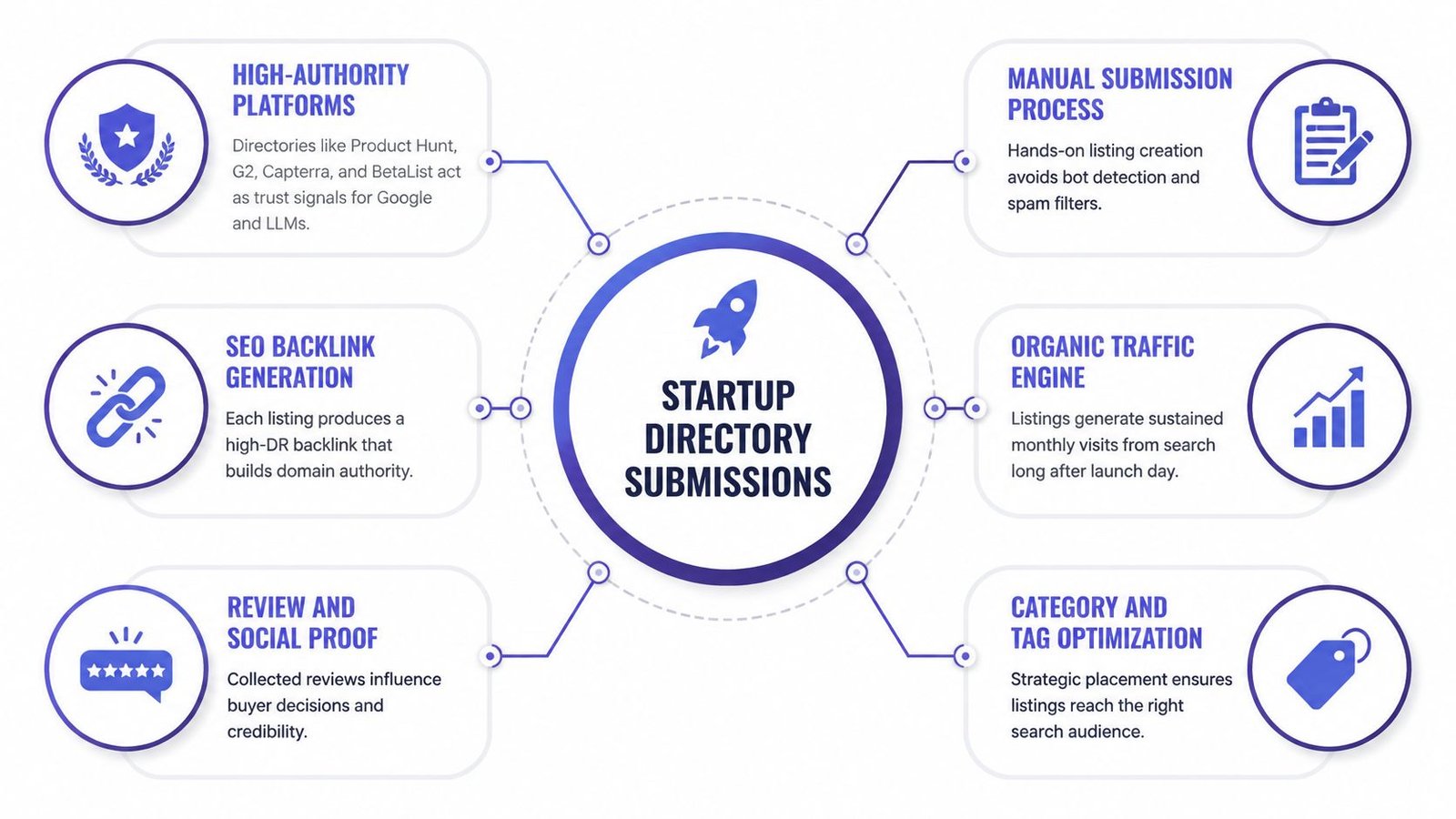
Startup directories are often treated as launch-day paperwork. That undersells them. A well-built profile gives buyers, search engines, journalists, and AI systems another structured place to understand what your company does.
For an early-stage SaaS or AI startup, submit manually to relevant platforms such as Product Hunt, G2, Capterra, BetaList, Indie Hackers, AlternativeTo, and SaaSHub. Each platform serves a different job. Product Hunt supports discovery and launch conversation. G2 and Capterra support software comparison and reviews. Indie Hackers can generate founder-to-founder feedback.
A sparse listing rarely helps. Write a complete description, choose the category where your ideal customer searches, include clear use cases, and link back to the right website page. Use relevant phrases naturally in the tagline and description, but don't turn the profile into a keyword dump.
Treat listings as a distribution system
Directories also support your broader startup directory strategy. The useful question isn't “How many profiles can we create?” It's “Which profiles attract qualified visitors, reviews, referrals, or credible brand mentions?”
Track referral traffic with tagged links. Watch which directories produce product-page visits, trial starts, demo requests, or review activity. Then improve those profiles first. A directory that sends fewer visitors but better-fit buyers may matter more than a large platform with weak intent.
Practical rule: Complete the profile before chasing the next profile. Accurate categories, consistent positioning, useful screenshots, and a working destination URL matter more than a long list of half-finished listings.
Manual work also reduces the risk of duplicate profiles, inconsistent descriptions, and submission errors. For founders without the time to repeat the same research and form filling across many platforms, a manual service can be a reasonable operational choice. The value is execution quality and reporting, not a promise that every directory will produce immediate customers.
2. Startup SEO and Site Structure Optimization
SEO starts before the first blog post. If Google can't crawl, understand, or index your site, directory profiles and content assets have nowhere reliable to send their authority.
Start with Google Search Console. Inspect important URLs, review indexing issues, submit your sitemap, and check whether your product pages are discoverable. Your site should have a logical path from homepage to category pages, feature pages, use-case pages, and supporting resources. A visitor should understand the product quickly, while a crawler should understand how the pages relate.
Technical basics have practical consequences:
- Use descriptive page titles: Explain the page's purpose instead of repeating the company name.
- Build clear internal links: Connect feature pages to use cases, comparisons, documentation, and signup paths.
- Add structured data carefully: Use relevant organization, software application, product, and FAQ markup where the content supports it.
- Improve sharing previews: OpenGraph tags help directory listings and social shares display the correct title, image, and description.
- Protect conversion paths: Every important organic landing page should offer a relevant next step, not just a generic homepage link.
An About page should explain who founded the company, where it operates, what it does, and how users can verify the business. Where accurate and appropriate, company schema can reinforce those details. Don't add invented founding dates, locations, or people just to fill fields.
Fix architecture before publishing at scale
Many startup sites publish articles while their core product pages remain thin, disconnected, or difficult to index. That reverses the order of operations. Build a small set of strong commercial and use-case pages first, then publish supporting content that answers the questions those pages can't cover.
The same principle applies to AI search. Clear page structure, direct explanations, visible authorship, descriptive headings, and useful references make content easier for both humans and machine systems to interpret. Schema can help clarify entities, but it won't rescue vague copy or a confusing information architecture.
3. Backlink Acquisition Through High-Authority Sources
A backlink is useful when it helps a real reader discover your company and gives search engines context about your relevance. A random link from a low-quality network usually does neither.
New domains face a credibility problem. They may have excellent product pages, but few independent sites have referenced them. That makes it harder to compete for valuable searches, especially where established vendors already have strong editorial coverage. The solution isn't buying every link available. It's earning relevant mentions from directories, industry publications, partners, customers, and communities.
A practical acquisition sequence starts with assets you can control. Build accurate directory profiles, claim product listings, create partner pages, and publish resources worth referencing. Then identify websites that already mention competing products or publish “best tools” pages. Ahrefs and Semrush can help reveal those patterns, but the tool only creates a prospect list. Someone still needs to assess relevance and write a credible outreach message.
Prefer relevance over volume
Your anchor text should describe the destination naturally. A partner linking to your integration page might use the integration name. An industry publication might link to a research report. Forcing an exact-match commercial phrase into every request looks unnatural and makes the relationship worse.
Founder-led outreach works best when you offer a reason to link:
- Original evidence: Share a useful dataset, benchmark, or analysis.
- Expert contribution: Offer a focused answer to a journalist's or editor's question.
- Partnership value: Create an integration, co-marketing resource, or customer education piece.
- Useful replacement: Suggest your page when an existing reference is outdated or broken.
A manual directory submission service can handle repetitive profile creation, duplicate checking, categorization, and reporting. That's different from promising that a large number of submissions will automatically create rankings. For broader outreach, use a focused digital PR outreach playbook and personalize every pitch.
Links should be a by-product of being useful in the places your buyers already trust.
Review your referring domains periodically. Look for relevant opportunities, broken links, unlinked brand mentions, and pages that attract referral visitors. Don't make disavowal your default response to every unfamiliar link. Investigate first, document the issue, and use Google's guidance when a serious manual-action concern exists.
4. Product Hunt Launch Strategy and Community Engagement
Product Hunt concentrates attention effectively, but sustained acquisition requires additional channels beyond a single launch day. Treat the platform as a discovery and validation channel, then connect its traffic to programs that capture demand, build authority, and retain users.
A launch page needs a clear product explanation, consistent visual identity, credible maker profile, and conversion path that works under pressure. Before launching, participate in the community and study which conversations attract thoughtful engagement. A founder who appears only on launch day asks strangers to care without first establishing relevance.
The launch message should explain the problem, intended user, and moment the product becomes useful. Avoid a feature inventory. Product Hunt visitors scan quickly, so show the product in action and make the first action obvious.
Design the follow-up before the launch
Launch activity can create a useful spike without creating sustained demand. Capture email subscribers, demo requests, waitlist members, or product feedback while interest is fresh. Reply to comments, address objections, and record recurring questions. Those questions can become website copy, onboarding messages, comparison pages, and future content.
A coordinated launch can include:
- Community preparation: Build familiarity before asking for support.
- Message discipline: Give supporters a simple explanation they can repeat accurately.
- Fast responses: Stay available during the first part of launch day.
- Distribution after launch: Share the launch in relevant communities and founder networks without spamming them.
- Durable follow-up: Publish directory profiles, customer education, and search-focused pages after the launch spike.
Product Hunt fits products with a visual demo, a clear audience, and an active maker community. Enterprise software may gain more from customer references, partner distribution, review platforms, or a targeted event. Match the channel to buyer behavior, available budget, and execution capacity rather than the founder's preferred launch ritual.
Pairing a launch with StartupSubmit and LaunchDirectories helps founders separate channel roles. Product Hunt creates concentrated discovery and feedback. Directory distribution can support broader indexed profiles and referral paths, giving the launch a longer tail while SEO and lifecycle programs develop.
5. Google AI Overview Optimization and LLM Visibility
AI search adds a second visibility job for startups. Ranking in blue links still matters, but companies also need pages that AI systems can select, summarize, and cite. Treat this channel as an authority program, not a replacement for SEO: create clear source material, then support it with independent references and recognizable profiles.
Google AI Overview citations do not follow the traditional organic top ten. One analysis found that 38% of cited pages also appeared in the top ten, 31.2% came from positions 11 to 100, and 31.0% came from beyond position 100, according to Search Engine Journal's analysis of Google AI Overview citations. Page-one rankings remain useful, but they are only one route to visibility. For a closer examination of the AI Overviews SEO impact on citation patterns, review the analysis available at busylike.com.
Google changed citation presentation in August 2024, placing sources in a more prominent right-hand panel and making them easier to open on mobile through site icons, as The Verge reported. Clear branding and credible source pages therefore affect whether users can recognize and visit the cited company.
Make the answer easy to extract
Use direct question-and-answer sections, comparison tables, definitions, concise process steps, and clear entity descriptions. Answer “What does this product do?” in plain language. Explain who it serves, what it replaces, what it integrates with, and where it is not a fit. These formats help both readers and retrieval systems understand the page without guessing.
ChatGPT visibility requires a broader brand program. A repeated-runs study found that ChatGPT mentioned an average of 44 brands across 100 responses. Another study found YouTube mentions correlated with AI visibility at about 0.737, while branded web mentions correlated at 0.66 to 0.71. Search Engine Land's coverage of the brand visibility research supports building brand mentions across third-party pages and video ecosystems, rather than relying on your own website alone.
Create accurate profiles on G2, Capterra, Product Hunt, and relevant software directories. Publish comparison and category pages without unsupported competitor claims. A focused AI directory submission service can assist with profile execution, while your site and independent references should provide the underlying explanation.
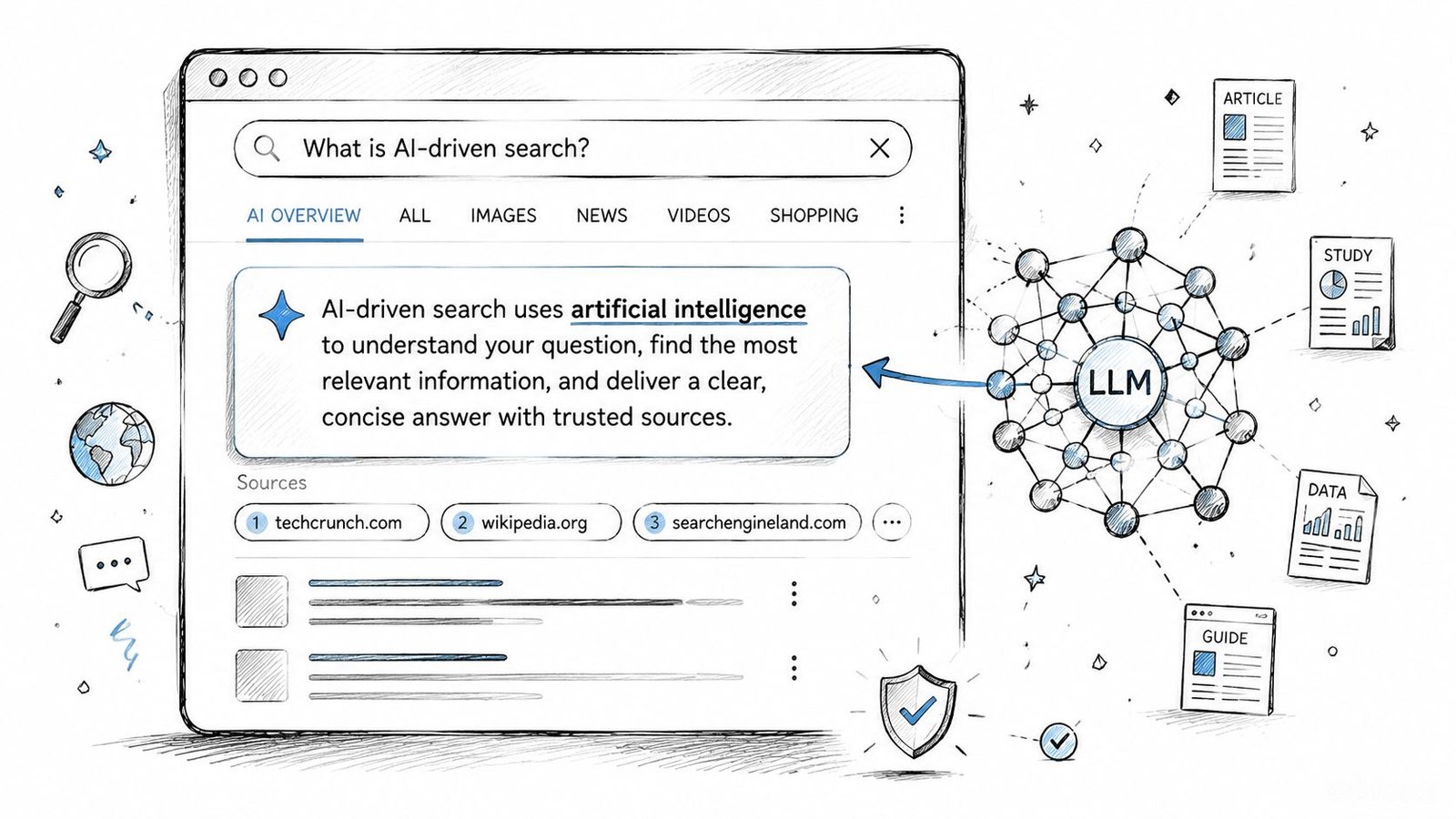
For informational content, clarity usually beats promotional language. A citation study found that the top 1% of cited domains captured 47% of citations, with an average of 4.2 citations per overview and a median of 4. Commercial queries averaged 3.1 citations, compared with 5.6 for definitional and how-to queries, according to Digital Applied's citation pattern study. Start with useful explanations, then connect them to product pages, directory profiles, and lifecycle follow-up so authority can support pipeline and retention.
6. Content Marketing and Topical Authority Building
Content should earn its place in a startup's growth system. Its job is to create discovery, answer buying questions, build authority, and support conversion after a visitor arrives from search, a directory, a community, or a launch.
Choose one commercial topic tied to current demand. A project management product might focus on workflow software for distributed teams. An AI recruiting tool might focus on structured candidate screening. Build a useful pillar page, then connect it to use cases, implementation guides, alternatives, comparisons, troubleshooting, and product documentation.
The strongest topics come from real friction. Review sales calls, support tickets, onboarding conversations, and community questions. Repeated concerns about integrations, security, migration, compliance, or setup effort should shape the editorial plan. This approach also keeps SEO connected to product marketing instead of producing articles that attract visits without helping evaluation.
Organize each cluster around the buyer's next decision:
- Category education: Define the problem and explain the available approaches.
- Use-case content: Show how specific teams or roles apply the solution.
- Comparison content: Explain differences between tools, methods, and workflows without unsupported competitor claims.
- Product documentation: Help new users reach value after signup.
- Evidence and references: Cite reputable research and separate facts from opinion.
Distribution requires its own plan. In 2024, marketers reported using email at 93%, social media at 92%, and blog posts at 79% for content distribution. In-person events were used by 56%, and webinars by 55%, according to the 2024 B2B content marketing statistics benchmark. These figures show reported channel usage, not guaranteed results. A startup with limited budget may begin with search and email, then add social, webinars, or events when the team can support them consistently.
Connect broad educational pages to relevant product and use-case pages with internal links. Refresh content when the product, search intent, or supporting evidence changes. A smaller cluster that answers buyer questions well can create more durable value than a large archive of interchangeable posts. Track assisted conversions and qualified pipeline, not traffic alone, so the program stays tied to growth rather than publishing volume.
7. Reddit Community Engagement and Organic Audience Building
Reddit rewards relevance before reach. Users quickly challenge weak positioning, vague claims, and forced promotion, so the platform can provide candid product feedback while exposing poor messaging.
Begin by observing communities where buyers already discuss the problem. Read each subreddit's rules, recurring questions, accepted formats, and tone. Entering with a product pitch before understanding that culture usually creates resistance.
Useful participation can take several forms: explain how you solved a problem, compare approaches, share building lessons, or publish original research. Mention the product only when it directly answers the question, and disclose your connection. If the product has a limitation, state it plainly. A transparent answer earns more trust than a staged neutral recommendation.
Use Reddit as a research channel
Reddit can support discovery and product intelligence at the same time. Conversations reveal the language users choose, objections they repeat, and alternatives they already consider. Feed those findings into landing pages, onboarding emails, documentation, and SEO briefs.
A workable routine is simple:
- Observe first: Learn community expectations before posting.
- Answer directly: Give the useful response before mentioning the product.
- Use a consistent identity: A real founder or clearly branded account is easier to evaluate.
- Record objections: Treat criticism as research for positioning and product decisions.
- Measure quality: Track engaged visits, activated users, replies, and feedback rather than raw clicks.
Community monitoring should include recurring topics and discovery language. The guide to TikTok hashtag trends offers a useful way to study hashtag-based discovery principles that can also inform how teams identify recurring themes across platforms, including Reddit.
Reddit fits early-stage SaaS and AI products when problem-aware buyers ask peers for recommendations before trying an unfamiliar tool. It can create discovery and trust, but it requires consistent participation, careful disclosure, and time from someone who understands the product. The 2025 small-business advertising trends report from Intuit also indicates that several channels remain less heavily used than mainstream digital options, supporting a broader channel mix rather than dependence on one source.
Founders can study Reddit marketing for startups as an operating discipline. Outside help may cover research, formatting, or execution, while the product team remains responsible for community understanding and every claim.
Reddit links are not automatically strong SEO assets, and attention alone does not prove success. The durable value comes from better product decisions, clearer positioning, and qualified people entering a follow-up path the startup controls.
8. Press Coverage and Media Relations Strategy
Press coverage can create discovery and authority, but only when the startup has a story that matters beyond its own launch. A new product by itself rarely gives a journalist enough reason to write.
Stronger angles include original research, a meaningful partnership, a clear industry shift, a founder with unusual expertise, or a customer problem that exposes a wider pattern. The startup should contribute evidence, access, or insight. It should not be the entire story.
Build reporter relationships before requesting coverage. Read recent articles, confirm each reporter's beat, and send useful context without immediately asking for an article. A focused pitch then names the angle in the subject line and opening, supplies evidence, identifies available sources, and explains why the publication's audience would care.
Prepare material that reduces reporting effort
A compact media kit should include:
- Founder background: A concise bio focused on relevant experience.
- Company context: What the product does and who uses it.
- Visual assets: High-resolution logos, product images, and founder photos.
- Evidence: Research findings, substantiated customer examples, and relevant documentation.
- Contact details: One responsive person who can answer follow-up questions.
Timing affects response rates. Avoid pitching immediately after a major industry announcement unless the startup adds a distinct angle. State what is confirmed, what is planned, and what remains confidential. Never manufacture urgency or suggest that coverage is guaranteed.
Press works best as an authority and pipeline-support channel, not as a predictable acquisition engine. A strong article can build credibility with buyers, partners, candidates, and investors. It can also provide a third-party reference for sales pages and later pitches. Attribution to revenue may remain difficult, so connect coverage to a measurable next action, such as a tracked visit, demo request, partnership conversation, or email signup.
Republishing coverage on the company site can help visitors find it. Preserve the original publication's attribution and follow its terms. Earned media strengthens the public footprint, while customer proof still needs to come from verifiable product experience.
9. Paid Search for Short-Term Visibility While Organic Grows
Paid search is useful when the buyer already knows what problem they need to solve. It puts a startup in front of intent before organic rankings have matured, and it gives the team a fast way to test language, offers, and landing pages.
Start with high-intent queries such as “best,” “alternative,” category-plus-use-case phrases, or competitor names. Don't send every click to the homepage. A visitor searching for an alternative to a specific tool should land on a page that explains the comparison, migration path, and reason to switch.
Paid search also functions as market research. Search terms reveal the language people use. Ad performance can expose which positioning earns attention. Conversion quality can show whether the audience you assumed existed is willing to start a trial, request a demo, or speak with sales.
Keep acquisition economics visible
Build campaigns around a specific conversion event. Track trial starts, completed demos, qualified form submissions, or revenue rather than treating every click as progress. Add negative keywords to remove irrelevant searches, separate brand and non-brand campaigns, and review actual search terms regularly.
The organic search case is strong in SaaS benchmarks. One 2025 report described organic search as generating 44.6% of B2B revenue and about 53% of SaaS website visits in its dataset. It also reported an average return of $36 to $42 for every $1 spent on organic search, while 43% of B2B marketers called organic search their highest-ROI channel. These figures are dataset-specific, so they shouldn't become a forecast for your company. They do explain why paid search should often support, rather than replace, a durable SEO program. See the SaaS marketing statistics and benchmarks for the underlying figures.
Use paid data to prioritize organic pages, but don't assume a keyword will perform identically in both channels. Paid ads offer controlled messaging and immediate placement. Organic content earns visibility through relevance, authority, and continued usefulness.
Set a test budget you can afford to lose, define the success threshold before launch, and scale only after qualified acquisition is sustainable. If the landing page, activation flow, or product promise is weak, more clicks will only expose the problem faster.
10. Email Marketing and Community Building for Retention
Email gives startup teams an owned way to turn short-lived attention into an ongoing relationship. Directory visitors, Product Hunt supporters, Reddit readers, and search visitors may leave after one session. A permission-based subscriber can receive education, activation help, product updates, and retention messages later.
Start collecting addresses early, but make the exchange specific. A useful template, implementation guide, checklist, product update, or category newsletter usually gives people a clearer reason to subscribe than a generic “join our newsletter” request.
The first emails should reflect signup intent. A trial user needs guidance toward the first meaningful product outcome. A content subscriber may respond better to a useful explanation, a related guide, and a relevant product invitation. A founder-led newsletter can build trust by sharing real lessons instead of repeating sales copy.
Measure lifecycle value, not vanity
Apple Mail Privacy Protection makes open rates less dependable for B2B measurement. Track clicks, replies, activated users, product usage, pipeline, and retention instead. Email ROI benchmarks commonly cite $36 to $42 in revenue for every $1 spent, or roughly 3,600% to 4,200% ROI, in 2026 reporting. That figure comes from Verified.Email's email marketing ROI statistics, and it should not become a forecast for every list or automation program.
Build the lifecycle around user intent:
- Welcome emails: Set expectations and deliver the promised resource.
- Activation messages: Help users complete the action connected to product value.
- Behavioral segments: Separate trial users, paying customers, inactive users, and high-intent leads.
- Educational updates: Teach a workflow, use case, or implementation method.
- Re-engagement paths: Give inactive subscribers a relevant reason to return or change preferences.
Email should also feed the rest of the marketing system. Replies reveal questions that can become content. Product objections can sharpen landing-page copy. Customer language can make paid ads more specific. Testimonials from lifecycle conversations can strengthen directory profiles and sales materials.
The right role depends on the channel mix. Discovery channels create attention, while email captures permission and extends the relationship. One B2B survey reported that 85% of marketers said multichannel marketing was becoming more effective, with 65% seeing a moderate increase and 20% seeing a significant increase. It also reported that 15% saw effectiveness decline. These figures come from the multichannel email marketing benchmark. For an early startup, a simple welcome and activation flow may be more useful than a large automation system. As acquisition grows, behavioral segments and retention campaigns can justify the extra setup effort.
Top 10 Startup Marketing Channels Comparison
| Strategy | Implementation complexity | Resource requirements | Expected outcomes | Ideal use cases | Key advantages |
|---|---|---|---|---|---|
| Startup Directory Submissions | Low–Medium, manual listing work | Low budget; moderate time per listing; basic copywriting | Sustainable high-DR backlinks and referral traffic; indexing in weeks | Early-stage startups needing quick authority and backlinks | High-authority backlinks; passive discovery; low cost |
| Startup SEO & Site Structure Optimization | Medium–High, technical setup and audits | Technical expertise or agency; tooling (GSC, crawlers) | Improved crawlability, indexing and organic rankings over months | Sites with crawl/index issues or scaling content | Foundation for all organic channels; improves UX |
| Backlink Acquisition from High-Authority Sources | High, outreach and relationship building | Significant outreach time or PR budget; content for placements | Domain authority growth and ranking improvements (months) | Startups needing DR to compete for keywords | Strong ranking signal; referral traffic; credibility |
| Product Hunt Launch & Community Engagement | Medium–High, timing and coordination | Founder time; launch assets; community prep | Large immediate traffic spike; potential short-term signups | B2C and indie-tool launches seeking viral exposure | Rapid visibility; social proof; press attention |
| Google AI Overview & LLM Visibility | Medium, content structuring and citations | High-quality, structured content; schema; monitoring | Emerging channel: LLM citations and qualified traffic over time | Startups targeting Q&A discovery and AI-driven search | Early-mover advantage; high-intent, answer-driven traffic |
| Content Marketing & Topical Authority | Medium–High, sustained content program | Content team or freelancers; research and distribution | Compound organic traffic and topical authority (3–6+ months) | SaaS and category-leaders building long-term SEO | Long-term traffic; thought leadership; internal linking |
| Reddit Community Engagement & Organic Audience Building | Medium, cultural sensitivity and consistency | Ongoing time investment; community monitoring | Referral traffic, early adopters, authentic feedback (variable ROI) | Niche consumer products and developer tools | Highly engaged users; honest product feedback; free channel |
| Press Coverage & Media Relations Strategy | High, story development and outreach | PR expertise or agency; newsworthy assets | High-authority mentions, backlinks and credibility; unpredictable timing | Startups with news (funding, research, partnerships) | Prestige backlinks; investor and user credibility |
| Paid Search (SEM) for Short-Term Visibility | Medium, campaign setup and optimization | Ad budget; analytics and landing page resources | Immediate targeted traffic and conversion data; stops when paid | Customer acquisition and messaging validation | Fast, measurable results; scalable when profitable |
| Email Marketing & Community Building for Retention | Medium, automation and segmentation | Email platform; content creation; list-building effort | Higher retention, increased LTV and repeat engagement over time | Products needing retention and repeat usage (SaaS) | Owned channel with high ROI; direct user relationships |
Build a Channel Portfolio, Not a Collection of Tactics
Start with the constraint, not the channel list.
A pre-launch founder may need feedback, positioning clarity, and a small group of early adopters. A newly launched SaaS product may need indexed pages, credible profiles, and a way to capture visitors after launch activity fades. A growing B2B company may need predictable pipeline and stronger proof for buyers who compare vendors carefully.
The first thirty days should fix the foundation. Make sure the website explains the product in plain language, the primary conversion path works, important pages are crawlable, and analytics record one meaningful conversion event. Create or improve the key product, use-case, and About pages. Claim the social and directory profiles that buyers are likely to inspect.
In days thirty to sixty, choose one durable discovery channel and one direct audience channel. Durable options include directory submissions, content, and backlink acquisition. Direct channels include email, Reddit, founder-led LinkedIn activity, or warm partnerships. Don't choose two channels that both require heavy production if you can't sustain either. A founder may pair directory execution with email. A technical team may pair content with Reddit feedback. A B2B founder with strong relationships may pair partner outreach with SEO.
From days sixty to ninety, add a controlled acquisition experiment. Paid search makes sense when the landing page, activation experience, and conversion tracking are ready. If the product still needs customer validation, spend the budget on interviews, onboarding improvements, or small community experiments instead.
Reserve a major Product Hunt launch or PR push for a moment that has a follow-up path. Before launch day, decide where new visitors go, what you'll capture, which emails they receive, and how you'll measure qualified outcomes. Attention without a next action is a spike, not a system.
Match channels to operating conditions
The channel portfolio should also reflect intent. Search and comparison pages capture existing demand. Reddit and Product Hunt create discovery. Backlinks and PR build authority. Email retains attention. No single channel performs all four jobs equally well.
StartupSubmit is one option for founders who want manual submission, duplicate checking, categorization, and report-backed directory execution through https://startupsubmit.app. Its published service materials describe manual submissions across startup and software directories, profile quality control, and final reporting that can include backlink URLs, acceptance notes, and screenshots. Whether you use a service or handle submissions internally, review the resulting traffic and lead quality instead of judging the work by profile count alone.
Track every channel with tagged links and a consistent naming system. Define one primary conversion event, then add secondary events such as qualified visits, activated accounts, replies, demo requests, or review activity. Review qualified traffic monthly. Reinvest in channels that create revenue, improve retention, or leave behind a compounding visibility asset.
The practical decision is rarely “SEO or Product Hunt” or “Reddit or paid search.” It's usually sequence and role. Use a launch channel to create attention, an authority channel to make the brand easier to trust, a demand-capture channel to meet active searches, and an owned channel to continue the conversation.
If repetitive directory work is slowing your launch, StartupSubmit offers manual submissions, duplicate checking, categorization, and report-backed execution across startup and software directories. Visit StartupSubmit to review the service and decide whether offloading directory distribution fits your 30-, 60-, and 90-day startup marketing plan.