Understanding Value Proposition for SaaS and AI Startups
A clever homepage headline isn't a value proposition. It's only the most visible expression of one.
For SaaS and AI startups, the harder problem is keeping the promise believable after the visitor clicks. Your landing page may promise a faster workflow, while onboarding demands technical setup. Your pricing page may imply simplicity, while documentation assumes expertise. Support may describe the product in completely different language. The copy can be polished and still lose the sale because the experience contradicts it.
Understanding value proposition means understanding the whole buyer journey, not just writing a memorable sentence. The strongest propositions connect a real customer job to a meaningful outcome, explain why the product can deliver it, and provide enough proof for the buyer to trust the claim. They also survive contact with onboarding, product usage, billing, support, and external search profiles.
Why Most Startup Value Propositions Fail Before the First Click
Founders often treat the value proposition as a homepage exercise. They workshop headlines, debate adjectives, and ask whether the copy sounds differentiated. Those questions matter, but they're downstream questions. The first question is whether the company has identified a customer problem worth solving and can express it in language buyers use.
A strong proposition starts with evidence. Research guidance on value proposition design grounded in customer evidence recommends combining interviews, observation, surveys, and support-ticket analysis before drafting messaging. That process prevents a common failure mode: building a confident statement around what the team assumes customers value.
The second failure happens after the headline. A prospect clicks “Start free,” reaches an onboarding form, sees unfamiliar terminology, and begins configuring a product that feels more complicated than the promise suggested. The homepage said “simple.” The product says “bring your own workflow, data model, and integration strategy.” That gap is a value proposition failure, even if the software itself is powerful.
Practical rule: Every major touchpoint should answer the same question, in context: “Why is this the right next step for me?”
Your value proposition should remain recognizable across:
- Acquisition pages: The visitor should understand who the product serves and what outcome it supports.
- Pricing: Plans, limits, usage rules, and billing language should reinforce the promised buying experience.
- Onboarding: The first task should move the user toward the outcome, not toward internal product configuration.
- Documentation: Technical explanations should connect features to the jobs customers hired the product to perform.
- Post-sale support: Customer-facing teams should describe value consistently, especially when users encounter friction.
For founders building an outbound motion, the same principle applies to prospecting messages. A practical resource on Yalc on outbound lead generation is useful because outbound value depends on matching the problem, audience, and reason to act now. A generic email can't repair unclear positioning.
Your external presence matters, too. A startup that appears in startup directories with inconsistent descriptions creates doubt before a buyer reaches the website. Search results, review profiles, launch pages, and social posts all become part of the proposition.
The Core Components of a Strong Value Proposition
A strong value proposition connects a customer's current situation to a better future state. The customer has a job to complete, a pain to reduce, or progress to make. Your product needs a clear route between that need and the promised result, plus evidence that the route works.
Start with the customer job
Name the situation before naming the feature. “AI-powered workspace” describes a category. “Turn scattered customer interviews into a searchable research brief” describes a job a buyer can recognize.
The job may be functional, such as reducing manual reporting, or tied to confidence, risk, and professional reputation. If you skip this context, the reader must translate your product into personal relevance.
Define the outcome
The outcome is the change the customer wants; the feature list is only the means to that change. A project-management product may include tasks, views, automations, and integrations. The buyer may want one reliable place to see what the team needs to finish next.
Describe measured results precisely, but avoid unsupported performance claims. Customer-perceived value reflects benefits against monetary and non-monetary costs, including time, effort, and switching friction, as explained in this guide to customer perceived value and trade-off testing.
Explain the mechanism
A mechanism answers one practical question: why should this product deliver that result? It may be a workflow, data advantage, integration model, specialist process, or product architecture. “Save time” states an outcome. “Automatically turns support conversations into tagged product feedback” gives the buyer a reason to believe.
Add proof
Proof can include product evidence, customer language, transparent limitations, demonstrations, integrations, reviews, and credible third-party profiles. It reduces perceived risk when buyers compare alternatives or research a brand before contacting sales. A managed directory listing service can support that research process by keeping a company's external profile clear and consistent.
The B2B value prop explained clearly reference helps separate the promise from its supporting explanation. Use this audit:
- What job does the buyer need completed?
- What outcome matters after the job is done?
- What mechanism makes your approach credible?
- What evidence reduces the buyer's risk?
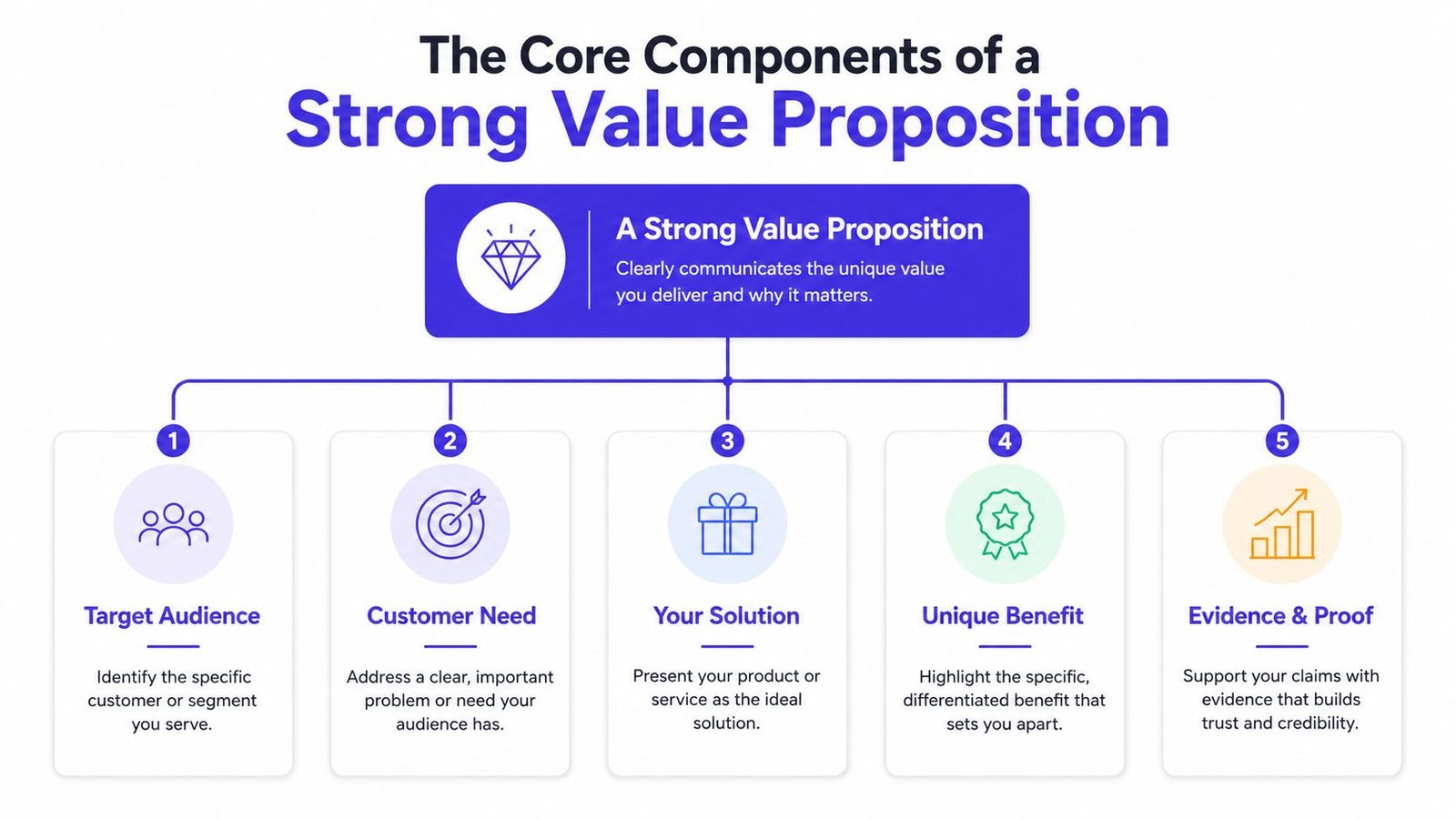
A proposition can sound appealing while still leaving these questions unanswered. Each missing answer adds interpretation work for the buyer, creating friction before evaluation or purchase.
Choosing Between the Value Proposition Canvas and Jobs to Be Done
The Value Proposition Canvas and Jobs to Be Done are useful for different kinds of uncertainty. Trying to force both into one workshop often produces a large document and little clarity. Choose the framework based on what you don't yet understand.
The Value Proposition Canvas is strongest when you already have a defined customer segment and need to connect its pains and gains to your product. It helps a SaaS team examine whether a feature relieves a stated frustration or creates a desired benefit. It's practical for auditing a landing page, restructuring a product narrative, or deciding which capabilities deserve emphasis.
Jobs to Be Done goes deeper into the buying situation. Customers don't purchase software just because a feature exists. They hire it to make progress in a particular circumstance. An AI tool may be hired to prepare for an executive review, reassure a team that no important issue was missed, or replace an improvised spreadsheet before it becomes operational risk.
A decision matrix for founders
| Criteria | Value Proposition Canvas | Jobs to Be Done |
|---|---|---|
| Best starting point | You have a defined audience and product | You're still investigating why people switch or buy |
| Main question | Which pains and gains does the product address? | What progress is the customer trying to make? |
| Useful evidence | Interviews, surveys, support tickets, feature feedback | Switching stories, purchase timelines, rejected alternatives |
| SaaS application | Map workflows to features and outcomes | Understand the trigger behind adoption or replacement |
| AI application | Connect model capabilities to user benefits | Discover the trust, control, and confidence customers need |
| Main risk | Turning the canvas into an internal feature checklist | Collecting interesting stories without a clear positioning decision |
| Best deliverable | A sharper message and prioritized benefits | A clearer segment, trigger, and competitive alternative |
Use the canvas when the product is real but the message feels unfocused. Use Jobs to Be Done when the team keeps asking, “Why would anyone replace their current workaround?”
A useful interview starts with a real decision, not an opinion. Ask what happened when the buyer first looked for a solution, what they used before, which alternatives they considered, and what made the decision feel safe. Avoid asking, “Would you use an AI tool for this?” Hypothetical answers flatter ideas. Past behavior reveals the job.
For an early-stage team, Jobs to Be Done can expose a positioning opportunity that feature mapping misses. For a growing product with multiple segments, the Value Proposition Canvas can turn that insight into usable messaging for each audience.
Don't build a framework for its own sake. The output should change a headline, onboarding task, sales qualification question, or product priority.
Real Examples of Value Propositions That Convert
The best public examples are useful less for their exact wording than for their structure. Notion has long benefited from making a broad product feel adaptable to distinct work habits. Linear positions around a focused product experience for software teams. The lesson isn't to imitate either brand. It's to identify how each connects a recognizable user context with a specific kind of progress.
A weak SaaS headline often sounds like this: “The intelligent platform for modern business operations.” It contains a category signal, but not a job, audience, or reason to care. The visitor still has to ask what the product does and whether it belongs in their workflow.
A stronger version would be: “Turn weekly operating updates into a shared decision brief for your leadership team.” It identifies the task, the audience, and the outcome. The supporting copy can then explain the mechanism, such as connected data sources, structured summaries, and review controls.
What Notion and Linear teach
Notion's broad flexibility works because the product experience gives users recognizable starting points, templates, and familiar work objects. Flexibility without orientation can feel like a blank page. The value proposition needs to promise possibility while the product provides a concrete first move.
Linear's positioning is narrower. Its appeal comes from focus, speed of collaboration, and a workflow designed around software development. Narrow positioning can exclude some prospects, but it gives the right prospects a stronger reason to believe the product understands their environment.
For AI products, the same pattern applies. “Build with generative AI” is a technology statement. “Review every customer conversation and surface recurring objections before the next product meeting” describes a job and a moment of use.

Deconstruct the claim before publishing
Use this test on any proposed message:
- Audience: Can a specific buyer tell that the product is for them?
- Situation: Does the message describe a problem or trigger they recognize?
- Outcome: Is the benefit visible without decoding product jargon?
- Mechanism: Does the product have a believable way to create that benefit?
- Proof: Can the buyer verify the claim through the page, product, or third-party evidence?
The strongest proposition often isn't the most original sentence. It's the sentence that makes the buyer's current problem feel accurately understood, then gives them a credible next step.
The Cross-Channel Consistency Problem That Kills Conversion
A value proposition can fail operationally even when customers understand the homepage. The buyer may believe the initial promise, then encounter contradictory information in the pricing table, product tour, documentation, or sales process.
This problem has measurable commercial consequences. Independent 2025 consumer research found that 54% of shoppers abandoned a sale because product content was inconsistent across channels, while 71% returned a product because it didn't match the online listing. Those findings concern shopping experiences, but the underlying lesson applies directly to SaaS and AI: buyers judge the promise through what happens after the first impression.
SaaS doesn't usually involve a physical return, but it has equivalent failure points. Users abandon setup, downgrade, stop attending implementation calls, or decide that the product isn't worth the effort. An AI product can suffer an even sharper mismatch when marketing implies autonomy but the actual workflow requires constant review and correction.
Build a message control system
A founder shouldn't rely on memory to keep messaging aligned. Create a short source-of-truth document containing the primary customer, job, outcome, mechanism, proof, approved terminology, and claims the company won't make.
Then audit the customer journey against it:
| Touchpoint | Audit question | Typical failure |
|---|---|---|
| Homepage | Is the audience and outcome obvious? | Category language replaces customer value |
| Pricing page | Does the buying model match the promise? | “Simple” product with confusing limits |
| Onboarding | Does the first action move toward value? | Setup tasks precede useful progress |
| Documentation | Does technical detail explain the customer job? | Features documented without outcomes |
| Sales and support | Do people use the same customer language? | Each team invents its own positioning |
Assign ownership. Marketing can maintain the message source, product can own onboarding language, and customer success can collect recurring objections. Review changes before a new feature changes what the company promises.
The first click creates expectation. The product experience either earns trust or spends it.
Cross-channel consistency also includes external profiles. A startup's listing on Reddit marketing resources, review platforms, and launch communities should use accurate descriptions and point to the same core positioning. Consistency doesn't mean copying identical text everywhere. It means preserving the same customer, problem, and outcome while adapting to each platform.
How to Test Your Value Proposition in Two Weeks
A two-week test should answer one question: do the right buyers understand, want, and believe the promise well enough to take the next step?
Don't start by testing ten headlines. Start with one customer segment and one job. The test becomes noisy when the audience, offer, page, and call to action all change at once.
Days one through five
On the first two days, write a hypothesis in plain language:
“For [specific buyer] facing [recognizable situation], this product helps them achieve [desired outcome] through [credible mechanism].”
Interview current users, recent prospects, and people who rejected the product. Ask about the last time the problem occurred, what they tried, what made the situation urgent, and what they feared might go wrong. Capture exact phrases. Don't ask respondents to write your headline.
On days three through five, create one focused landing page. Keep the headline outcome-led, use a short explanation for the audience and mechanism, add proof you can verify, and make the call to action match the promise. An AI writing tool can generate variants from interview notes, but a human should remove generic claims and unsupported certainty.
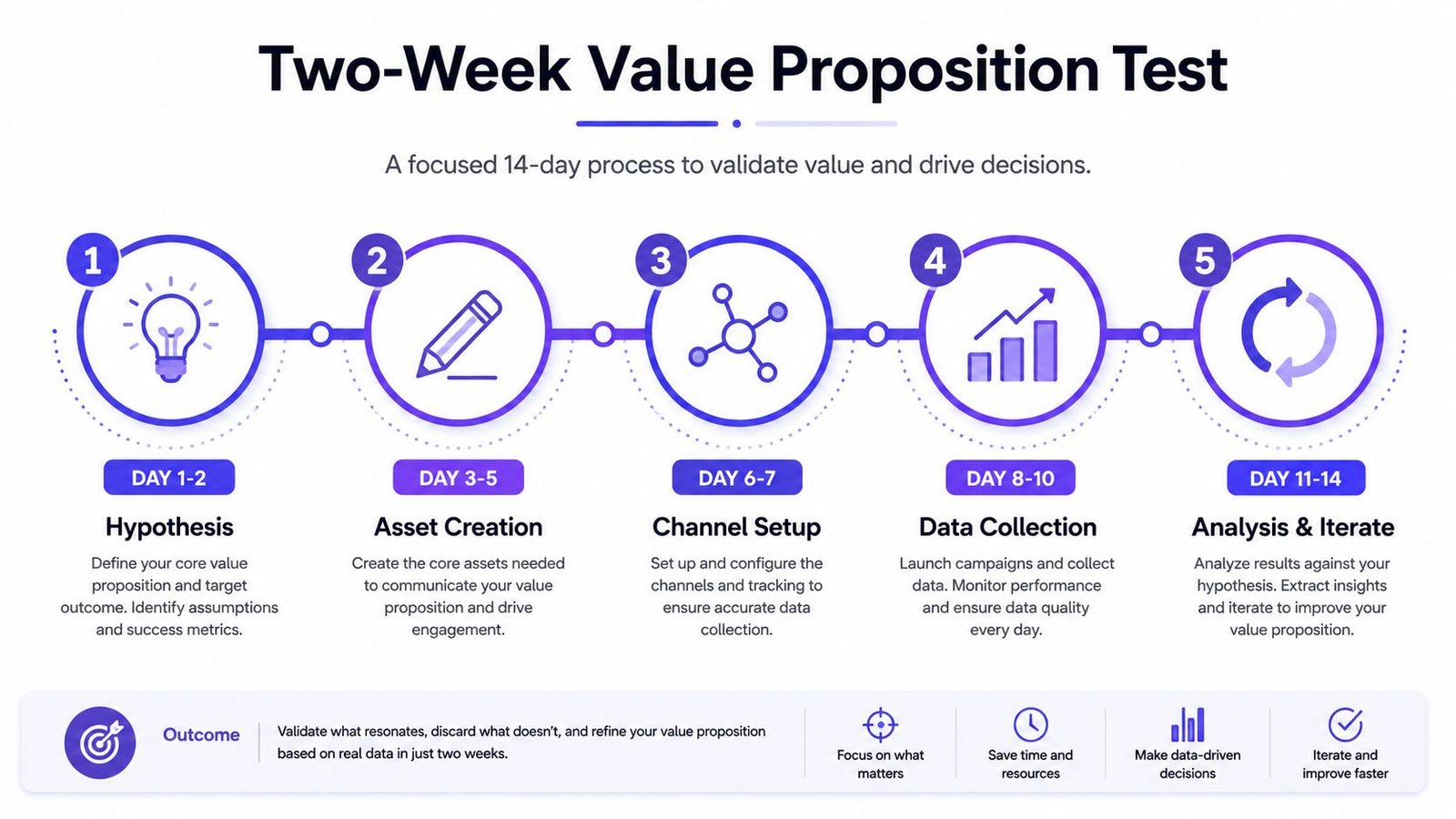
Days six through fourteen
Use days six and seven to publish the page and connect one acquisition channel. Keep the audience consistent. You can use targeted outreach, an existing email list, relevant communities, or paid traffic, but don't treat clicks as proof of value. A click shows attention. Activation, qualified replies, demo quality, trial progression, and purchase conversations reveal whether the promise survives.
During days eight through ten, collect both behavior and language. Ask new users what they thought the product would do before signing up, what they expected to happen next, and where the experience differed. A short survey can expose whether the audience understood the proposition, while interviews explain why.
Use days eleven through fourteen to classify the feedback:
- Clear and wanted: Keep the core promise and improve proof or distribution.
- Clear but unwanted: The copy works, but the job may not be urgent enough.
- Wanted but unclear: Rewrite around the customer's language and situation.
- Believable but difficult: Fix onboarding, pricing, or product friction.
- Interesting but undifferentiated: Clarify the alternative you replace and why now.
For quantitative testing, use metrics you already track rather than inventing a benchmark. Compare qualified actions against the previous message, and document audience, channel, page version, and time window. The result should be a decision, not a vanity report.
You can also use free startup directories as one distribution layer for a tested description, provided each listing accurately reflects the same proposition.
Connecting Value Proposition to Search Visibility and AI Discovery
Search visibility is partly a messaging problem. If your company description changes from “automated customer research” to “AI knowledge infrastructure” to “insight platform” across different profiles, search engines and language models receive an unstable picture of what you do.
A clear proposition gives every external mention a common semantic center. Your website, Product Hunt page, G2 profile, Capterra listing, founder interviews, documentation, and directory submissions can use different formats while consistently naming the audience, job, outcome, and category.
Backlinks strengthen that system when they come from relevant, credible pages. They don't replace product-market fit or customer proof, but they can help search engines discover and contextualize a new domain. A practical SaaS SEO guide from Quarter Digital is useful background for connecting technical optimization, content, and authority building.
Why AI search changes the distribution equation
Google AI Overviews alter how users interact with traditional results. Semrush cites Pew Research Center findings showing that users clicked traditional organic results 8% of the time when an AI Overview appeared, compared with 15% when no overview appeared, and clicked links inside the overview 1% of the time. The figures come from startup SEO guidance on AI search behavior.
That makes brand inclusion important even when a click doesn't follow. A startup may need to be mentioned in authoritative pages, directories, reviews, and expert comparisons so its positioning is available to the systems summarizing a category.
A separate analysis cited by SurferSEO reviewed 405,576 Google AI Overviews. It found an average overview length of 157 words, an average of 5 cited sources per query, and overlap with top-ten organic results in 52% of cases, as reported in this analysis of AI Overview tracking tools. The practical implication is not that founders should write for a machine. It's that indexable, authoritative, consistent pages remain valuable inputs.
For AI startups, maintain a fact sheet with the product category, target users, core job, integrations, security information, pricing model, and approved description. Use it to update profiles and directory entries. A carefully managed AI directory submission service can support that foundational distribution work, but only when the listings are accurate and relevant.
Common Mistakes and Your Next Steps
Most startup messaging problems fall into a short checklist:
- Vague category language: Replace “next-generation platform” with the job and outcome.
- Feature-first framing: Explain what changes for the customer, not only what the product contains.
- Unproved differentiation: Name the mechanism and provide evidence instead of claiming superiority.
- Homepage tunnel vision: Audit pricing, onboarding, documentation, support, and external profiles.
- One universal message: Adapt the proposition to buyer stage, urgency, role, and risk tolerance.
- Framework obsession: Choose the Value Proposition Canvas or Jobs to Be Done based on the uncertainty you need to resolve.
- No testing loop: Interview buyers, publish a focused message, observe behavior, and revise.
- AI without verification: Use AI for drafting speed, but ground every claim in customer evidence and product reality.
Start with the touchpoint that creates the most friction. If visitors understand the homepage but fail during setup, fix onboarding before rewriting the headline. If prospects ask what the product does, return to customer interviews and sharpen the job. If the message is clear but buyers choose alternatives, investigate proof, switching costs, trust, and timing.
Treat your value proposition as an operating system for the company's customer-facing work. Review it when the product, audience, competitive alternatives, or buying context changes. The winning statement is the one your buyer recognizes, your product delivers, and your external presence reinforces.
StartupSubmit offers manual submissions to 200+ startup and software directories, including platforms such as Product Hunt, G2, Capterra, BetaList, Indie Hackers, AlternativeTo, and SaaSHub, with duplicate checking, accurate categorization, and a final report of submitted and accepted listings. If you've validated your value proposition and need consistent third-party profiles and backlinks to support it, visit StartupSubmit and choose the coverage that fits your launch stage.