
SEO for SaaS Company: Boost Growth & MRR
Most SaaS SEO advice is still stuck in 2018. It tells founders to publish more blog posts, wait patiently, and hope traffic turns into pipeline. That's not how the best teams approach SEO for a SaaS company now.
The faster path is narrower and more practical. Build pages around buyer intent, make the site technically easy to crawl, and earn the kind of off-page trust signals that both Google and AI-driven discovery systems can understand. Done well, SEO isn't just a brand channel. B2B SaaS companies achieve an average ROI of 702% from SEO and typically break even within 7 months, according to SaaS SEO statistics compiled by LinkQuest.
I've seen the same pattern repeatedly. The teams that win don't treat SEO as a blog calendar. They treat it as an acquisition system tied to demos, trials, and revenue. If you want a good reference point for that broader operating model, SEO for SaaS platforms is a useful example of how technical, content, and growth priorities fit together. And if you're evaluating how your company appears beyond your own website, it's also worth reviewing your external footprint through your startup profile and directory presence.
Table of Contents
- Beyond the Blog A Modern SaaS SEO Framework
- The Technical Foundation That Enables Growth
- Mapping Content to the SaaS Buyer Journey
- Building Your Acquisition-Focused Content Engine
- Winning with Off-Page SEO and AI Discovery
- Measuring What Matters and Creating Growth Loops
Beyond the Blog A Modern SaaS SEO Framework
Blog-first SEO sounds sensible because it feels productive. You can publish quickly, target broad topics, and watch impressions rise. The problem is that most of that activity sits too far from purchase.
A better framework for SEO for a SaaS company has three parts. First, technical foundations make the site crawlable, indexable, and trustworthy. Second, funnel-mapped content targets the searches that line up with the buying process. Third, off-page authority validates your company through mentions, links, and credible profiles outside your domain.
That combination moves faster than isolated tactics. In practice, the fastest gains usually come when strong on-page execution is paired with high-quality off-page signals. Landing pages need clear search intent, useful copy, internal links, and fast load times. Then those pages need reinforcement from trusted startup directories, niche publications, and relevant backlinks.
Practical rule: If a page can't plausibly lead to a demo request, trial signup, or sales conversation, it probably shouldn't sit at the center of your SEO roadmap.
The old debate between on-page and off-page misses the point. You rarely get durable wins from choosing one. A technically weak site wastes content effort. A content-light site gives search engines nothing meaningful to rank. A site with no external validation struggles to earn trust, especially in competitive software categories.
Here's the framework I'd use for an early-stage SaaS team:
| Focus area | What good looks like | Common mistake |
|---|---|---|
| Technical base | Fast pages, clean indexation, clear site structure | Chasing advanced fixes before core pages are stable |
| Intent-led content | Pages built around real buying questions | Publishing broad educational posts with no conversion path |
| Off-page trust | Relevant mentions on credible platforms | Buying junk links or treating directories as a shortcut |
Most founders don't need more SEO activity. They need less wasted motion. The right system is lean, commercial, and hard to confuse with content marketing theater.
The Technical Foundation That Enables Growth
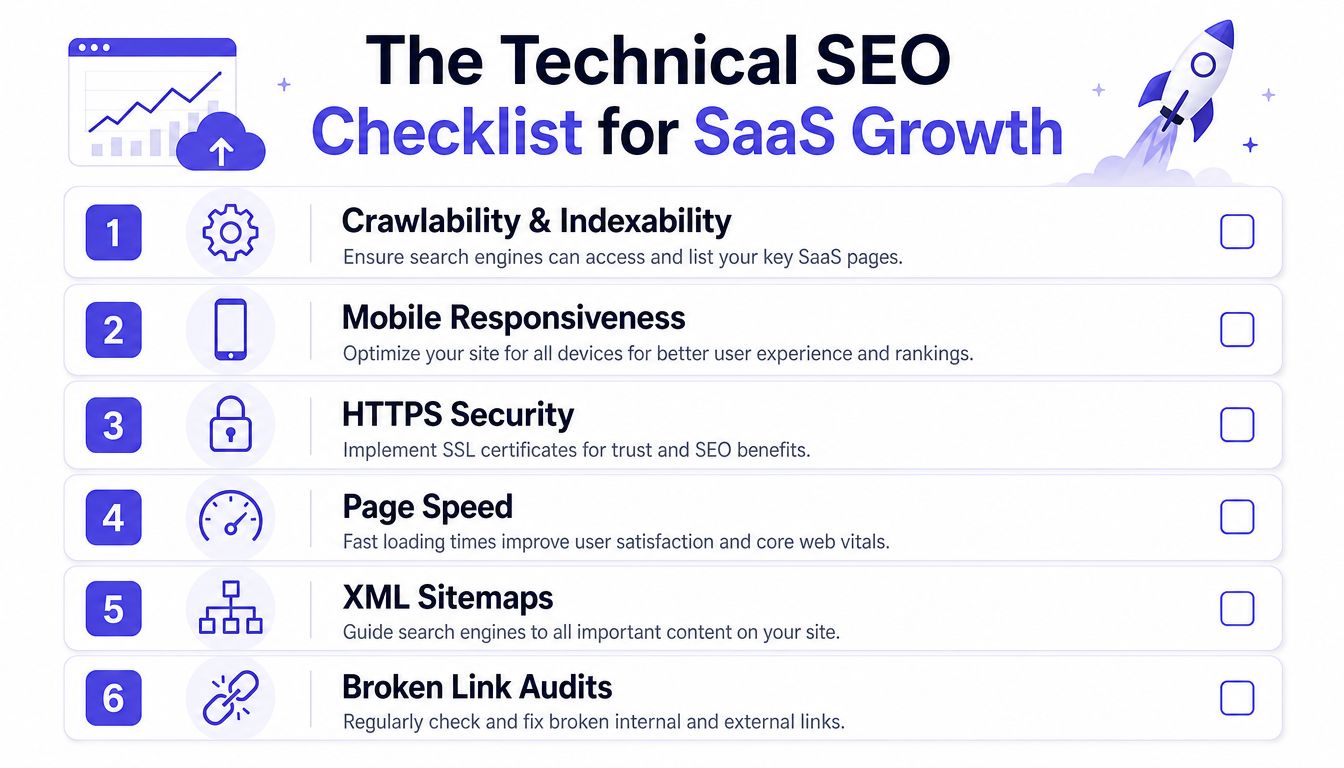
Technical SEO isn't the glamorous part of the work, but it decides whether the rest of your effort compounds or stalls. For SaaS, this is the foundational 20% of effort, and the benchmarks are clear: Largest Contentful Paint under 2.5 seconds, mandatory HTTPS, and the use of XML Sitemaps and Schema Markup. Ignoring duplicate content and broken links weakens ranking signals, as outlined in SEOptimer's SaaS technical SEO guidance.
Fix the pages that matter first
Don't start with a giant audit spreadsheet. Start with the pages that carry revenue intent. Your homepage, product pages, integrations, solution pages, pricing, comparison pages, and key blog posts should be technically sound before anything else.
Use this checklist:
- Check crawlability: Search engines need to reach your key pages without friction. If important commercial pages are blocked, orphaned, or buried, they won't perform.
- Improve speed: Fast sites convert better and waste less crawl budget. If your main landing pages feel heavy, trim scripts, compress media, and simplify templates.
- Enforce HTTPS: Trust matters in SaaS. Buyers notice security signals, and search engines do too.
- Publish XML sitemaps: They help search engines find your important content, especially when the site is growing.
- Add schema where it clarifies meaning: Product, organization, FAQ, and review-related markup can help search engines and AI systems understand what your software does.
- Fix broken links and duplicate URLs: These are quiet killers. They split authority, confuse crawlers, and create a worse user journey.
One area founders often miss is canonicalization. SaaS sites create duplicate paths constantly through campaign pages, faceted navigation, reused templates, and outdated docs. If you don't set canonical tags carefully, you end up making several pages compete for the same query.
Treat technical SEO like revenue insurance
I don't think of technical SEO as a growth hack. I treat it as insurance against wasted acquisition spend.
When a team invests in content, paid acquisition, partnerships, or launch activity, every visitor lands on an experience that either supports conversion or leaks it. Broken internal links, slow templates, mixed versions of the same page, and careless redirects all make that experience worse.
A clean technical setup won't rank an empty site. But a messy setup can absolutely drag down a strong one.
For SaaS companies adapting to AI-driven search, the standard also shifts upward. Clear headings, consistent entity naming, and structured data matter more because machines need to parse your company, product category, and use cases correctly. If you want a useful external read on that overlap, AI-first search optimization for SaaS is a solid reference.
A few implementation details are worth being strict about:
- Use contextual internal links. Link related pages naturally from product, feature, and educational content.
- Preserve authority during URL changes. If you rename pages, redirect them properly instead of letting them die.
- Keep templates simple. Fancy interactions often hurt performance more than they help conversion.
- Audit docs and help centers. These sections often create duplicate or thin pages without anyone noticing.
Founders don't need to become technical SEOs. They do need to know when the site is blocking growth. This is one of those moments.
Mapping Content to the SaaS Buyer Journey
Most SaaS teams overvalue traffic and undervalue intent. That's why they end up with a blog full of educational posts and a pipeline that still depends on outbound or paid spend.
The better move is to map content to the buyer journey and prioritize the pages closest to revenue. The underlying logic is simple. A search for “what is workflow automation” and a search for “best workflow automation software for accounting firms” do not deserve the same priority.
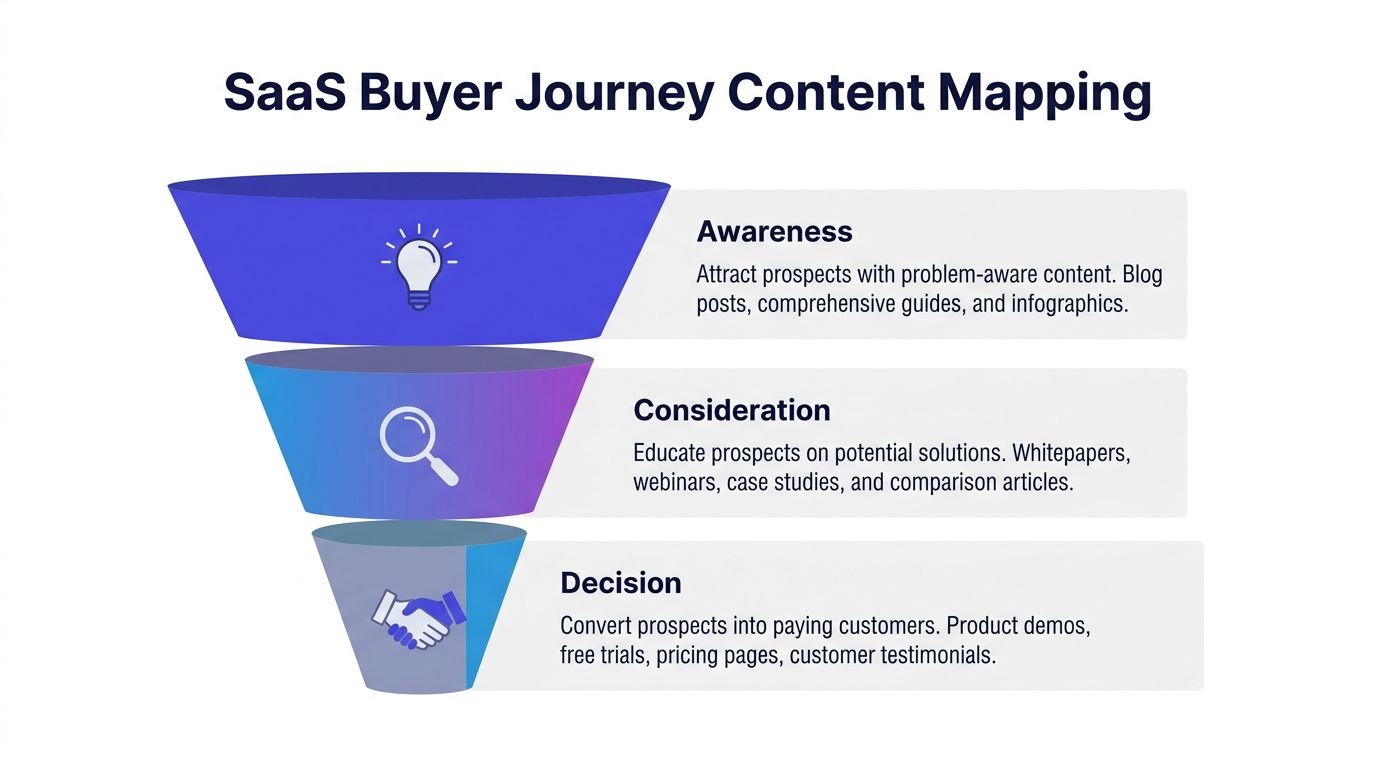
To make that distinction visible across the team, use the funnel as an editorial filter.
Why bottom-of-funnel pages deserve the first sprint
The common advice is to publish top-of-funnel content first because it's easier to rank. That's sometimes true. It's also how teams spend months generating visitors who were never close to buying.
Bottom-of-funnel searches generate 3.2x more conversions than informational blogs, and companies optimizing for these high-intent keywords see 47% higher lead quality and 31% faster sales cycles, according to this SaaS SEO analysis shared by Eric Carrell.
That's why I'd start with pages like:
- Alternative pages: “Competitor X alternative”
- Comparison pages: “Tool A vs Tool B”
- Use-case pages: “Project management software for agencies”
- Industry pages: “CRM for private equity”
- Solution pages: “Client onboarding software”
- Template-led commercial pages: “SaaS proposal template with software workflow”
These terms don't always produce the biggest traffic charts. They produce better conversations.
If a founder asks whether to publish another broad thought-leadership post or a sharp use-case page tied to a buying query, I'd choose the use-case page first almost every time.
Here's a practical way to think about priority:
| Funnel stage | Search pattern | Best page type | Primary goal |
|---|---|---|---|
| Awareness | Problem-focused questions | Guides, explainers, frameworks | Capture interest |
| Consideration | Comparison and evaluation queries | Vs pages, alternatives, category pages | Shape shortlist |
| Decision | Vendor and use-case intent | Product, pricing, demo, industry pages | Convert |
What to publish at each stage
For Awareness, publish only the topics that connect cleanly to your product. Skip broad industry essays unless they lead naturally into a solution angle. A post should answer a real question, then move the reader toward the next step.
For Consideration, create pages that help buyers compare options impartially. “Versus” pages work when they're specific, fair, and written by someone who understands the trade-offs. A weak comparison page reads like a sales page in disguise. A strong one helps the buyer choose, even if they don't choose you.
This video is useful if you're refining how those content stages connect to SaaS conversion paths:
For Decision, tighten everything. Product pages need to explain what the software does, who it's for, what problem it solves, and what the next step is. Pricing pages should reduce uncertainty. Demo pages should answer objections before sales does.
A simple content map for SEO for a SaaS company often looks like this:
- One core category page for the main commercial term
- Several use-case pages by role or industry
- Competitor comparison pages for active evaluations
- A small support layer of educational content tied to the same topic cluster
That order matters. Build outward from buyer intent, not inward from whatever keywords are easiest to rank.
Building Your Acquisition-Focused Content Engine
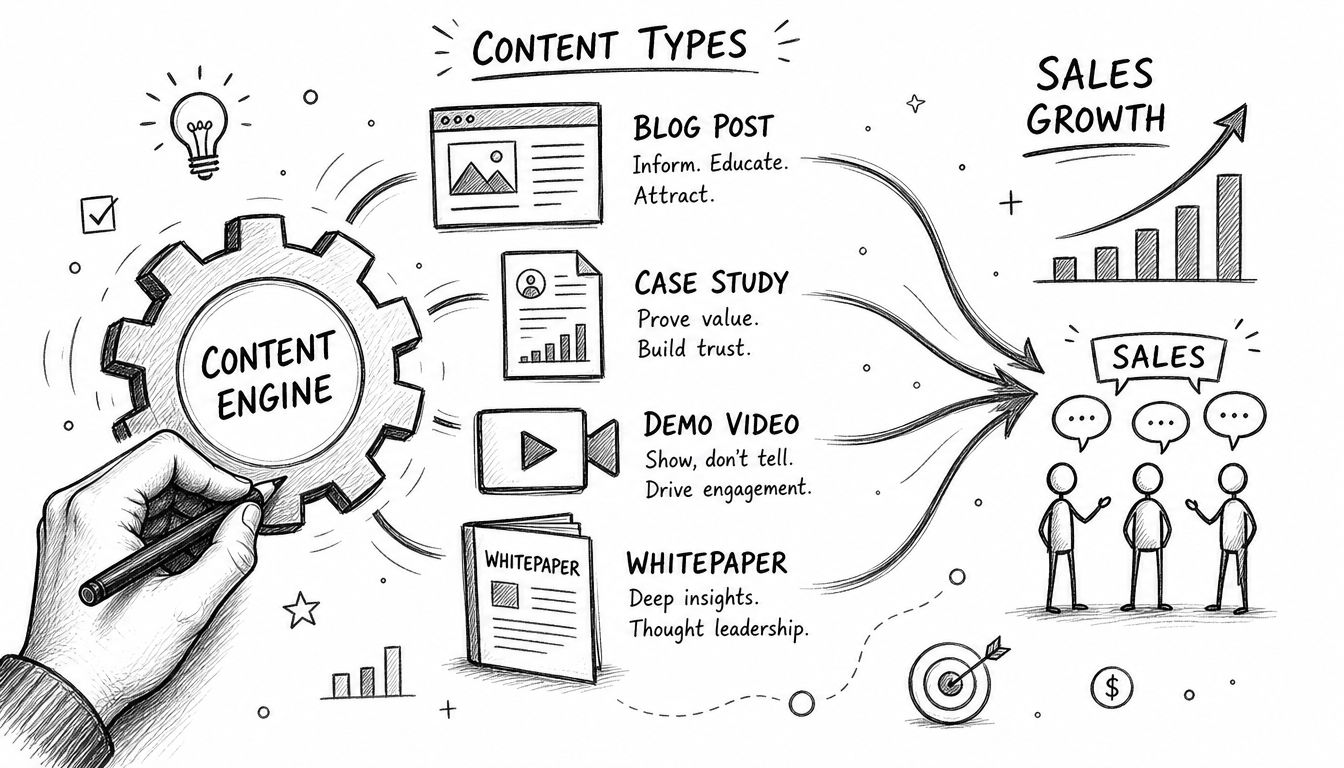
A real SaaS content engine isn't a publishing machine. It's a set of pages that help buyers discover, evaluate, and trust the product. According to the 70/20/10 rule for SaaS, 70% of SEO results stem from an on-page content strategy mapped to the buyer funnel, and prioritizing keyword clusters by Buyer Intent Strength over raw search volume is critical for terms that can drive demo signups within 6 to 12 months, based on Kalungi's SaaS SEO framework.
Four page types that pull their weight
Start with commercial landing pages. These are your “software for,” “best tool for,” “alternative to,” and “vs” pages. They align tightly with buyer intent, and they give sales-qualified traffic a clean path to book a demo or start a trial.
Then build educational support content around the same cluster. If you publish a page targeting startup directories or submission services, support it with articles on how directories work, how to judge quality, and how founders improve discoverability. That structure makes the commercial page stronger because the surrounding content reinforces topical relevance.
A third category is product-led content. In this approach, your software helps the reader do the thing they searched for. If your app automates reporting, show the exact workflow. If your product manages onboarding, publish a detailed page that walks through the onboarding process and demonstrates the software naturally.
The fourth category is underused: help docs and practical assets. Documentation, setup guides, templates, calculators, checklists, and lightweight tools often attract some of the most qualified visitors because they sit close to real product use.
Here's a simple content build order:
- Core money pages first: Main category page, use-case pages, and pricing-adjacent content.
- Comparison layer next: Alternative pages and versus pages for active evaluators.
- Supportive educational cluster: Articles that answer adjacent questions and feed internal links back to commercial pages.
- Docs and assets: Templates, checklists, onboarding guides, and feature explainers.
How to cluster without bloating your site
Teams often err by publishing too much disconnected content. They chase every adjacent keyword, create overlapping articles, and end up with keyword cannibalization.
A better cluster starts with one commercial center. Everything else supports that page.
For example, if your target cluster is a directory-related commercial term, the supporting content might include:
- A tactical explainer on how submission workflows work
- A quality filter guide for choosing reputable directories
- A visibility article on how external profiles influence discovery
- A buyer-facing landing page for the service itself
That's enough to establish relevance without creating a maze. You can also use your directory strategy planning and visibility benefits as a model for thinking about how external profiles support internal content clusters.
Key takeaway: Don't build content around topics. Build it around decisions buyers are already trying to make.
A few execution details matter more than people think:
- Lead with the query: Put the primary topic near the start of the title and make the first section answer the search directly.
- Use internal links with intent: Link from educational pages into commercial pages where the transition feels natural.
- Keep conversion paths obvious: Every page should make the next action clear. Demo, trial, signup, template download, or contact.
- Refresh instead of multiplying: If two articles target the same idea, merge them before creating a third.
This is what separates content that looks busy from content that sells. The engine works when each page has a job.
Winning with Off-Page SEO and AI Discovery
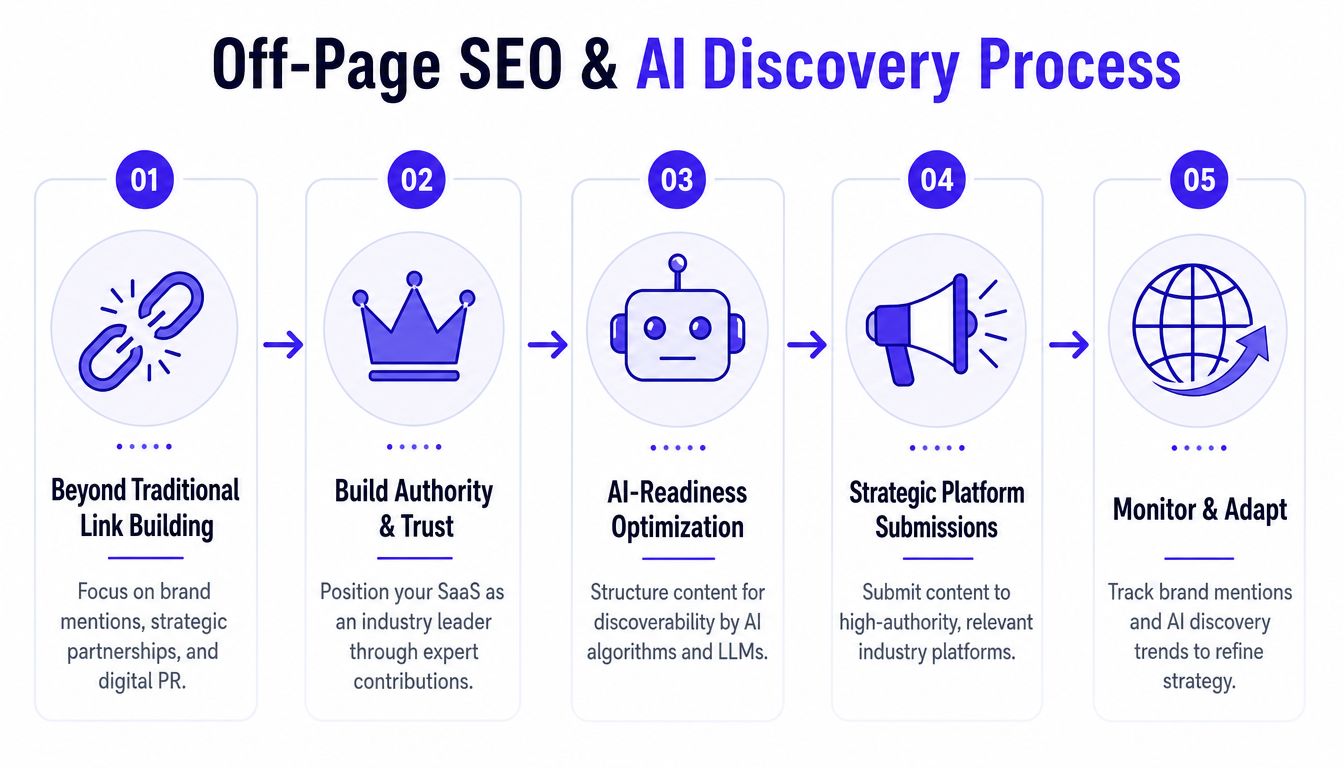
Off-page SEO used to mean one thing to most SaaS teams: get backlinks. That's still part of the story, but it's no longer the full strategy.
The more useful frame is authority distribution. Your brand needs to appear consistently across the web, on pages that buyers trust and machines can parse. That includes links, but it also includes profiles, reviews, founder mentions, software directories, and category listings that reinforce what your company is and where it belongs.
Emerging data shows that 73% of early-stage SaaS buyers now discover tools via AI overviews and directory mentions, not just organic search, and high-authority directories such as Product Hunt and G2 are explicitly crawled by LLMs for brand validation in AI-first discovery, based on this discussion of AI-driven SaaS discovery.
Directories are no longer a side tactic
A lot of founders still dismiss directory SEO because they remember spammy submission networks. That criticism is fair when the placements are low quality and irrelevant. It misses what's happening with high-authority platforms.
For a new SaaS company, strong directory profiles do several jobs at once:
- They validate the brand externally: Buyers can cross-check your company on recognized platforms.
- They support link equity: Quality directories still function as legitimate citations and backlinks.
- They improve discoverability: New websites often get found and indexed faster when they appear on trusted listings.
- They strengthen AI visibility: LLMs need corroborating sources. Directories help provide them.
Quality directory placements also tend to show measurable SEO results within 30 to 90 days, according to Active Marketing's review of directory submissions. And for new websites, directory submissions can accelerate indexation because Googlebot often discovers listed URLs faster than unlisted ones, as explained in this directory SEO walkthrough.
What good off-page execution looks like
The best off-page work isn't random outreach. It's coordinated narrative control.
Start with consistency. Your company description, category labels, product positioning, and core use cases should match across your site, directory profiles, and third-party mentions. If one listing calls you an AI workflow assistant, another says project management platform, and your homepage says operations OS, you make both buyers and machines work harder than necessary.
Then prioritize placements that a buyer would trust:
- Core software directories: Product Hunt, G2, Capterra, AlternativeTo, SaaSHub
- Founder and company profiles: Crunchbase, Indie Hackers, relevant community profiles
- Niche industry listings: Vertical-specific directories and publications
- Earned mentions: Guest contributions, podcasts, partner pages, interviews
Strong off-page SEO doesn't look like "more links." It looks like a cleaner, more believable public record of what your SaaS does.
Finally, adapt your writing for AI retrieval. Use clear headings, descriptive subheads, structured answers, and consistent entity language. If you want a practical companion on that front, how to show up in ChatGPT results is worth reading.
The old off-page playbook asked, “How do we get a backlink?” The current one asks, “Where does the web confirm that we're a real, trusted solution in this category?” That question leads to better decisions.
Measuring What Matters and Creating Growth Loops
If you're serious about SEO for a SaaS company, measure outcomes that sales and finance care about. Rankings matter, but only for terms tied to real buying intent. Traffic matters, but only when it produces signups, demos, or qualified conversations.
Track money terms, not vanity traffic
A lean dashboard is enough. I'd track:
- Organic demo requests: Which landing pages generate them
- Trial or signup volume from organic: Especially from commercial pages
- Rankings for money terms: Use-case, category, comparison, and alternative queries
- Assisted conversions: Educational content that contributes before the close
- External profile health: Branded search results, reviews, and key third-party listings
Ignore dashboards built to impress. If traffic rises while sales-qualified leads stay flat, the strategy needs adjustment.
Turn acquisition into a compounding loop
The best SaaS SEO systems become self-reinforcing. A buyer finds a high-intent page, signs up, has a good experience, leaves a review, mentions the brand publicly, and strengthens your off-page trust signals. Those signals support future rankings and discovery.
That's the growth loop to aim for. SEO brings in the right users. The product and customer experience create proof. That proof improves future SEO.
When you review budget, include the cost of maintaining that loop. Content refreshes, review generation, branded SERP cleanup, and trustworthy third-party presence all deserve attention. If you're comparing outside execution options, it helps to review directory submission pricing and rollout scope in the same way you'd evaluate any acquisition channel: speed, coverage, quality control, and reporting.
If your SaaS has strong product-market fit but weak external visibility, StartupSubmit is a practical way to fix the part most founders never have time for. It handles manual submissions to reputable startup and software directories, helps build a cleaner off-page footprint, and gives you documented placements you can track alongside rankings, branded search results, and lead flow.