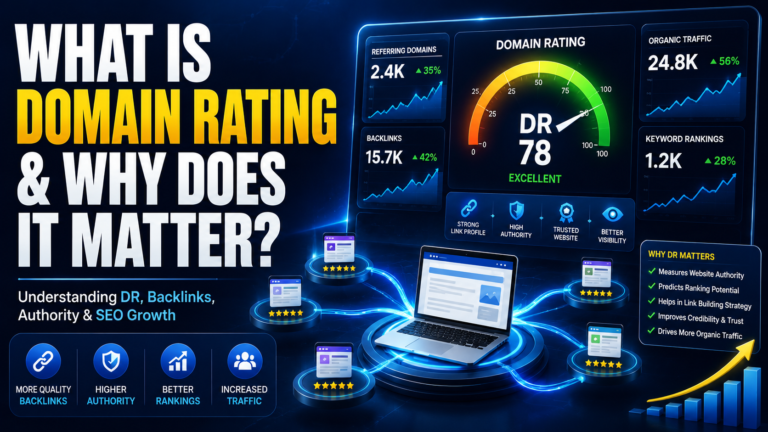
Claim 4 US Startup Directories First and Lock Them in Under Two Hours
Claim four listings first: Google Business Profile, Apple Business Connect, Bing Places, and LinkedIn. Add Crunchbase or Product Hunt if you want investor or launch-day eyeballs. Before any of that, standardize your name, address, and phone details, pick one canonical URL, and load a logo and a tight description everywhere. Quality-first beats mass submission every time. That one afternoon of prep determines whether the next fifty listings help you or just sit there ignored.
TL;DR:
- Claim only the top five to ten high-authority directories, such as Google Business Profile, Apple Business Connect, Bing Places, and LinkedIn, to maximize visibility and relevance.
- Standardize your business name, address, phone number, and descriptions across all platforms to prevent duplicate listings and improve local search rankings.
- Focus on accurate, complete profiles with consistent NAP details, quality visuals, and carefully chosen categories to reduce rejection and increase acceptance rates.
- Use a shared document to prepare and copy listings assets to ensure consistency and save time during multiple submissions, minimizing review issues.
- Measure the impact of directory listings over at least eight weeks through referral traffic, indexed backlinks, and branded search growth before expanding to additional platforms.
Which US Startup Directories Should You Claim First?
Not every directory earns your time. A handful of platforms carry enough authority and search traffic that skipping them costs you real visibility, while the other few hundred are optional polish. Industry guidance consistently points founders toward a quality-first approach: claim the tier-one platforms, then branch out only if it makes sense for your industry.
Here’s what each one actually does for a startup:
- Google Business Profile — Powers the local pack, Google Maps, and voice search results. If anyone searches your company name or “startups near me,” this is often the first thing they see.
- Apple Business Connect — Controls how you show up in Apple Maps and Siri search on iPhone. Roughly half the US smartphone market runs iOS, so skipping this cuts your reach in half on mobile.
- Bing Places — Smaller search share than Google, but it feeds Microsoft’s ecosystem, including Outlook and Windows search. Enterprise buyers and older demographics still lean on Bing more than you’d think.
- LinkedIn — Your company page is where investors, recruiters, and B2B buyers verify you’re real before they take a meeting. A thin or missing page reads as a red flag to anyone doing due diligence.
- Crunchbase and Product Hunt — Not traditional citation directories, but credibility engines. Crunchbase gets pulled by investors and journalists researching funding history; Product Hunt can drive a real traffic spike on launch day.
- BBB and niche industry directories — Lower search volume individually, but they signal legitimacy to buyers who cross-check before purchasing, especially in regulated or B2B categories.
BrightLocal’s list of top US citation sites notes that a single listing typically takes a quarter of an hour or more to complete properly. Multiply that by the tier-one platforms above. You’re looking at under two hours to lock down the listings that matter most.
What to Prepare Before You Submit a Single Listing
Directories reject or bury listings for one reason more than any other: incomplete or inconsistent information. Build your asset pack once, then reuse it everywhere.
- Lock your canonical name and NAP. Your business name, address, and phone number need to match, character for character, across every platform. A “Inc.” on one listing and nothing on another creates duplicate entity confusion that hurts your local SEO.
- Write two description lengths. A short version (20 to 60 words) for platforms with tight character limits, and a long version (150 to 300 words) that leads with what your product actually does, not your mission statement.
- Pick categories carefully. Most directories let you choose a primary and one or two secondary categories. Resist the urge to check every box that seems relevant; tightly matched categories rank and convert better than broad ones.
- Prepare your visuals. A square logo (usually 500x500px minimum), a few product screenshots, and a demo video link if you have one. Some directories reject submissions outright without a logo.
- Standardize contact details. Use a business email and phone number you control long-term, not a founder’s personal cell that changes when they leave.
- Know your verification method. Phone, email, or postcard verification varies by platform. Phone verification is usually fastest; postcard verification (common for Google Business Profile) can take a week or more, so start it early.
Pro Tip: Keep a single shared document with your canonical NAP, both description lengths, and image links. Every time you submit to a new directory, copy from that document instead of retyping from memory. This alone eliminates most of the inconsistency errors that get listings flagged for review.
Should You Submit Manually or Use an Automated Tool?
This comes down to a trade-off between speed and quality, and the two options produce different results.
- Manual submission means someone reads each directory’s guidelines and writes a listing that fits its specific format. It takes longer per listing but produces higher acceptance rates and backlinks that read as genuine, not templated.
- Automated or batch tools blast the same profile to dozens of directories at once. Faster, but rejection rates climb because editors and automated filters both catch generic, copy-pasted content.
Before choosing, run through this checklist:
- How much founder or team time can you realistically spend this month?
- Is your goal early traffic, investor visibility, or long-term SEO authority?
- Do you have budget to outsource, or is this a scrappy DIY phase?
If you’ve already tried a batch tool and you’re seeing low indexing rates, repeated rejections, or NAP inconsistencies creeping back in after multiple attempts, that’s your signal to bring in a manual submission service instead of burning more hours fighting the same problem.
How Do You Know If Directory Listings Are Working?
Set a baseline before you submit anywhere. Pull your current organic impressions, referral traffic, and branded search volume from the past four weeks so you have something to compare against.
Track these four metrics weekly:
- Referral traffic from directory listings, using UTM-tagged links so you know exactly which platform sent the click.
- Organic impressions in Google Search Console, watching for movement tied to newly indexed pages.
- Branded search growth, meaning more people typing your company name directly into Google.
- Backlinks indexed, checked through Ahrefs or Moz to confirm the directory actually published a live, crawlable link.
Run this as an eight-week test. Week one is your baseline. Weeks two through four, submit to five to ten platforms and log which ones get indexed fastest. Weeks five through eight, watch for referral traffic and branded search movement. Most directory links carry a NoFollow tag, but they still contribute citation authority and real referral clicks, so don’t judge success by dofollow status alone.
A positive signal looks like steady upticks in branded search or a new source showing up in your referral traffic report. If eight weeks pass with no measurable movement across any metric, that’s noise, not a scaling opportunity. Stop and reassess before adding twenty more directories to the pile.
The Mistakes That Get Listings Rejected or Waste Your Time
Most directory problems trace back to the same handful of avoidable errors.
- Mass-submitting to low-quality directories. A directory with no editorial standard and no real traffic isn’t a citation, it’s digital litter. Directories only help SEO when they’re relevant, curated, and actually drive visitors.
- Letting NAP drift across platforms. Even small mismatches, like “St.” versus “Street,” create duplicate entity confusion that search engines have to untangle.
- Stuffing exact-match anchor text. Directories that let you customize a backlink’s anchor text are not an invitation to jam your target keyword into every field.
- Using a personal email or phone for verification. When that founder leaves or that number changes, you lose access to update or reclaim the listing.
- Skipping mandatory fields or picking vague categories. Incomplete profiles get bounced by editorial review far more often than founders expect.
Fix these before you submit, not after a rejection email forces you to.
Managing Reviews on Startup Directories
Reviews on directories like Google Business Profile, Yelp, or industry-specific platforms carry more weight than most founders assume, especially early on when you have little else to prove credibility. A handful of thoughtful responses can do more for conversion than a dozen more listings.
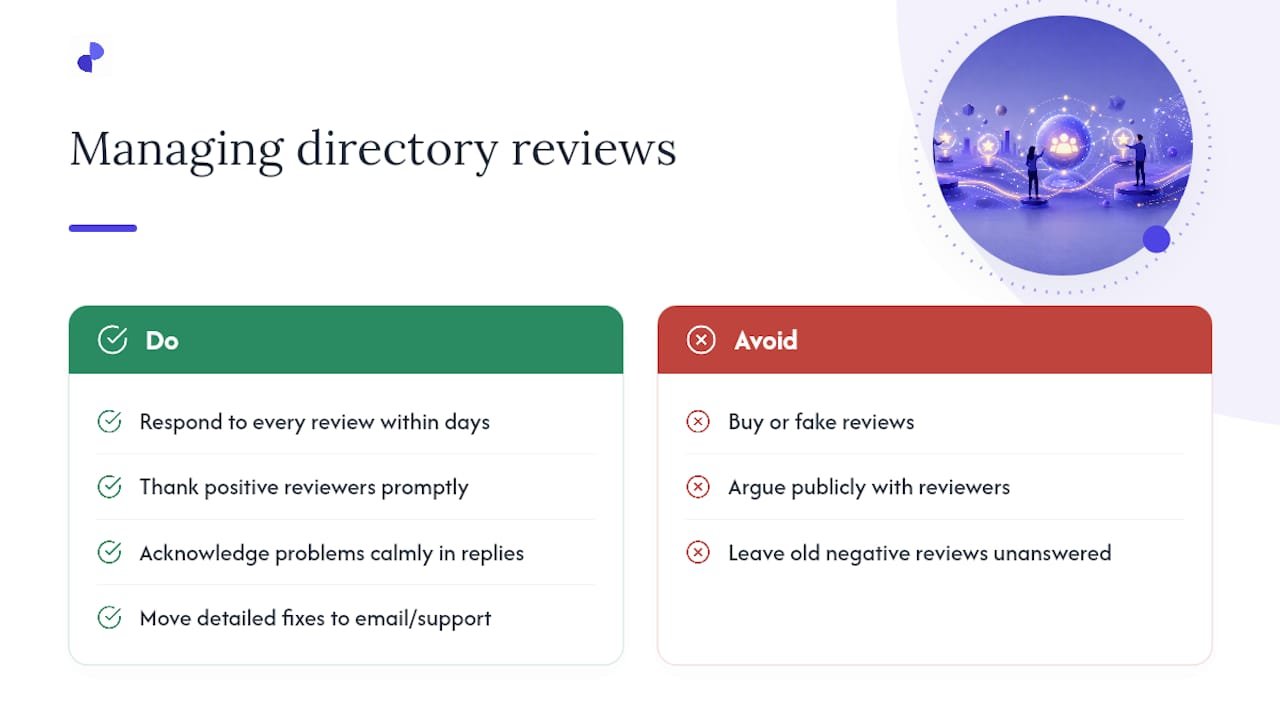
Respond to every review, positive or negative, within a few days. A quick thank-you on a good review costs nothing and signals that a real team is behind the brand. A critical review deserves a calm, specific response: acknowledge the issue, state what you’re doing about it, and move detailed back-and-forth to email or a support channel rather than arguing in public.
Never buy reviews or ask employees to post from personal accounts pretending to be customers. Google and Yelp both have detection systems for this, and getting caught can get your listing suspended entirely, which erases the SEO benefit you were chasing in the first place.
Set a simple cadence: check your top three to five directory listings weekly during your first few months, then move to a biweekly check once volume stabilizes. A stale profile with unanswered one-star reviews from eight months ago tells visitors nobody’s home.
What to Know Before You Submit Startup Data Publicly
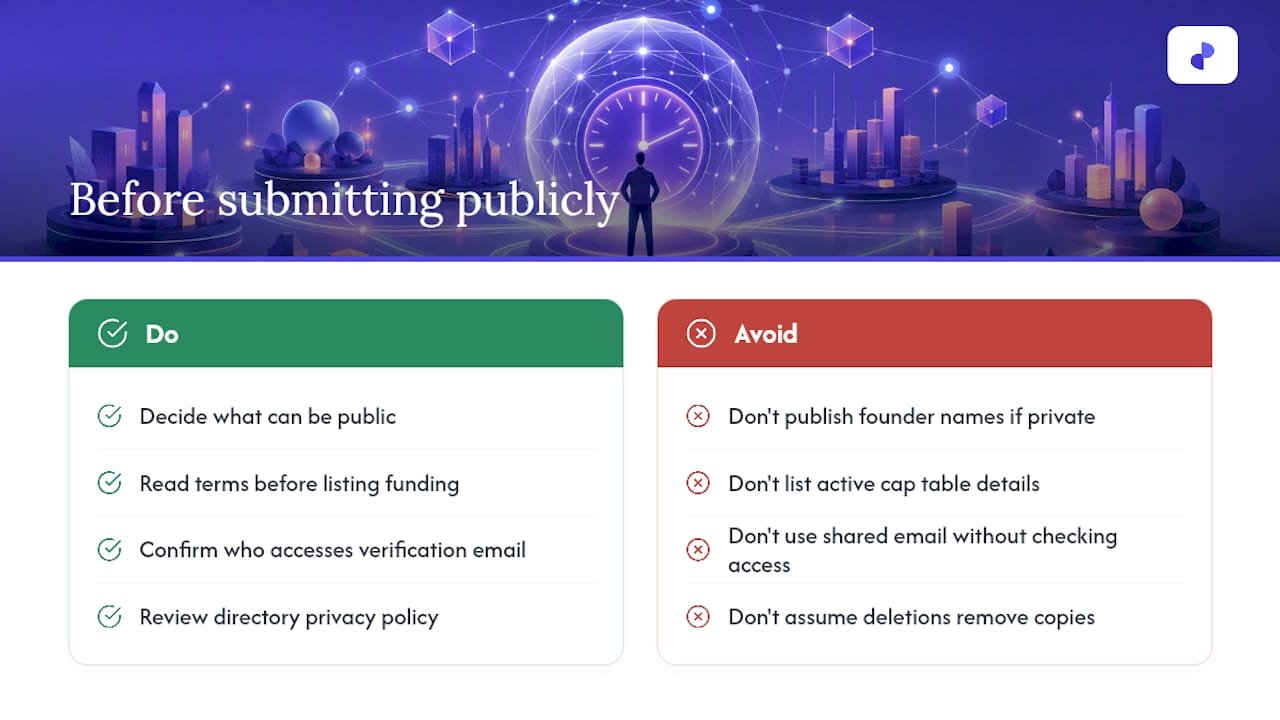
Directory submissions ask for information that feels harmless, until you realize some of it is sensitive by nature. Founder names, funding amounts, office addresses, and contact emails all become public and searchable the moment a directory approves your listing.
Before you submit anything, decide what you’re comfortable making permanent. Some directories scrape and republish data to other sites, meaning even if you later ask the original directory to remove your listing, copies can persist elsewhere. Read a platform’s terms before submitting if you’re listing funding figures, cap table details, or any information tied to an active fundraise, since some investors and legal counsel prefer that data stay off public directories until a round closes.
If you use a shared business email or phone number for verification, confirm who else on your team has access and how long that access lasts, especially if a co-founder or early employee might leave. Losing control of a verification email means losing the ability to update or remove a listing later.
Review each directory’s own privacy policy before submitting personal contact details, and only list a home address if the platform requires it for verification purposes, not because a field is marked optional but tempting to fill in for completeness.
Why Most Founders Get Directory Strategy Backwards
Founders tend to treat directory submissions as a numbers game: more listings, more backlinks, more visibility. That thinking is backwards. A hundred low-authority listings with inconsistent NAP data can actively confuse search engines about which version of your business information is accurate, which drags down the local SEO benefit you were trying to build in the first place.
The founders who get real results treat directory submission the way they’d treat a product launch: prepare the assets once, submit to a short list of platforms that carry real authority, and measure before scaling. Startupsubmit’s own work backs this up. The team specializes in manual submissions to more than 220 high-authority directories, and manual, contextual listings tend to see higher acceptance rates than batch-submitted ones, sometimes producing traffic increases as high as 338% within days of going live.
The lesson isn’t “submit everywhere.” It’s “submit correctly to the places that matter, then expand once you’ve confirmed it’s working.”
— Danish
Let Startupsubmit Handle the Directory Grind for You
If you’ve read this far and the idea of manually researching, formatting, and submitting to dozens of directories sounds like a week you don’t have, there are services that handle this work. Instead of a founder burning evenings on category selection and verification emails, a dedicated team writes and places your listing across high-authority directories, checking for duplicates and tailoring each profile so it actually gets approved.
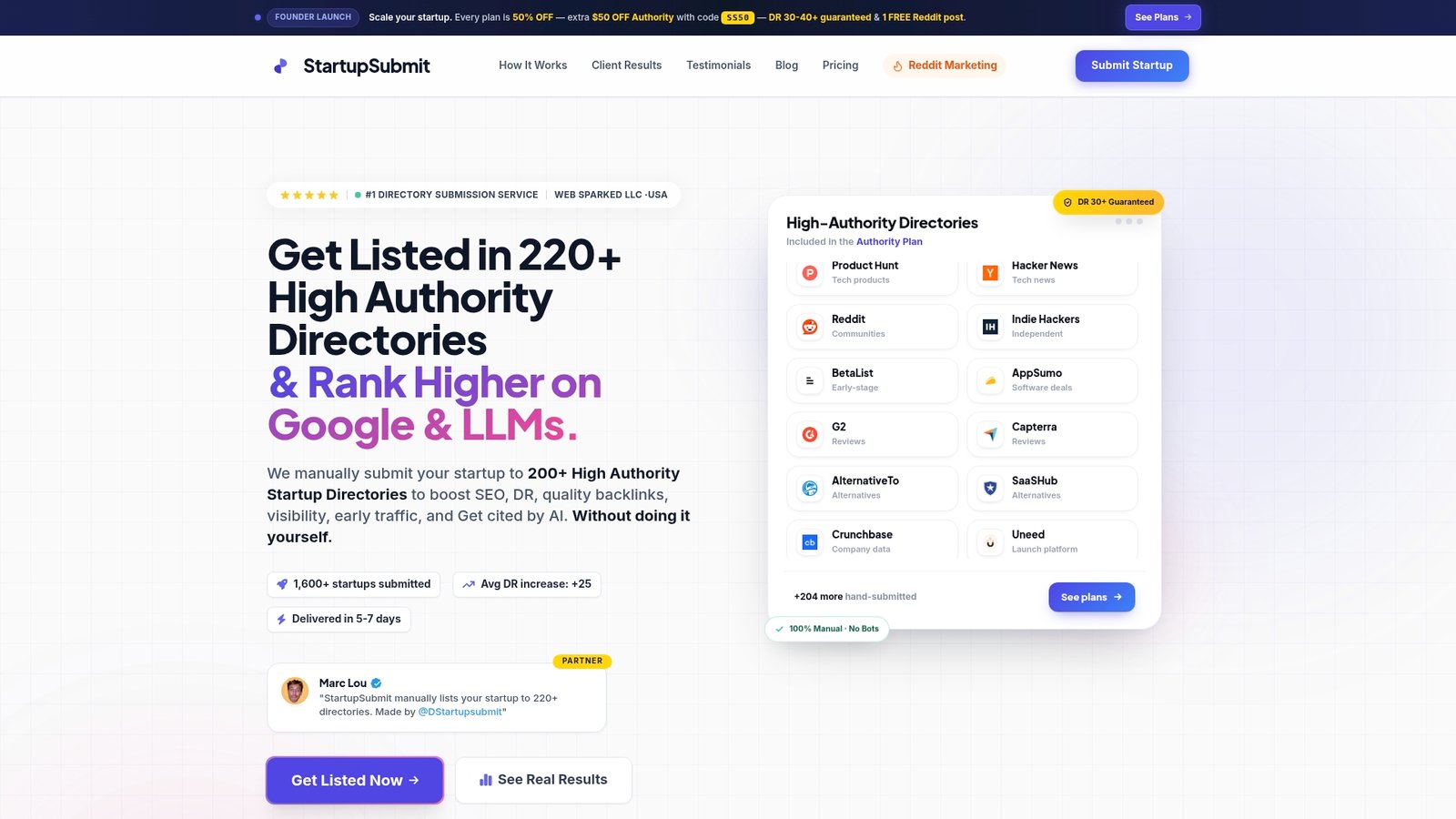
This makes sense if you’re short on time, want manual-quality listings instead of automated blasts, and you’re trying to build early traction fast, whether that’s for investor visibility, launch-week traffic, or long-term SEO groundwork. Founders in SaaS or AI can also check the directory submission service built for those categories if they want listings tailored to that space specifically.
Start by visiting the Startupsubmit submission page to see how the process works and get your listing pipeline moving this week.
Sources
FAQ
How many directories should a startup start with?
Start with five to ten high-authority platforms rather than dozens at once, then measure indexing and referral traffic before expanding further.
How long does it take to see results from directory listings?
Most founders can judge early signal within an eight-week window, tracking indexing speed, referral clicks, and branded search growth weekly against a baseline.
Are directory backlinks dofollow or nofollow?
Most directory links use a NoFollow tag, but they still contribute citation authority and referral traffic, so they remain worth pursuing even without direct link equity.
How much does a manual directory submission service cost?
Pricing for Startupsubmit’s manual submission service is listed directly on the Startupsubmit website, where current packages and coverage details are kept up to date.
What’s the biggest reason directory listings get rejected?
Incomplete fields and inconsistent NAP details across platforms cause most rejections, which is why standardizing your business information before submitting matters more than submission volume.
Recommended
- Best Startup Directories 2026 — 15 Top Platforms + Full 220+ List
- StartupSubmit vs AIDirectories (2026): Honest Directory Submission Service Comparison
- StartupSubmit vs LaunchDirectories (2026): Honest Directory Submission Service Comparison
- StartupSubmit vs Outrank (2026): Honest Directory Submission Service Comparison