

Virtual Assistants for Startups: The Founder’s Playbook
49% of remote teams now include at least one virtual assistant, and that makes this an operating decision, not a novelty, for startups that need more output without adding headcount. The history matters too, because the shift from early conversational software to today's distributed assistant work explains why virtual assistants for startups can cover scheduling, customer communication, lead qualification, transcription, and knowledge retrieval without forcing founders to build every function in-house (historical evolution of virtual assistants).
Most founders get stuck on the wrong question. They ask whether to hire a human VA or use AI, when the actual question is which work should stay founder-owned, which should go to a human, and which should be automated.
The Reality of Virtual Assistants for Startups
A virtual assistant buys back time from work that does not need your judgment every time it happens. For founders, that is a capacity decision, not a status move. The test is whether the work has clear rules, or whether it still depends on your context.
The assistant market has grown alongside remote work, with industry estimates placing the global virtual-assistant services market at about $4.12 billion in 2021 and more than $19.6 billion in 2025, with projections of roughly $25.6 billion by 2027 (market estimates and projections). That does not mean every startup should hire one. It does mean the model has become part of normal operating practice.
The jobs that fit are usually repeatable and process-heavy. Inbox triage, calendar coordination, CRM hygiene, research prep, listing maintenance, customer routing, and transcription all belong in that bucket. Founders lose money when they hand off judgment-heavy work too early, then blame the assistant when the actual problem is unclear task design.
Keep judgment close if the task depends on your context. Give away the work that needs consistency more than creativity.
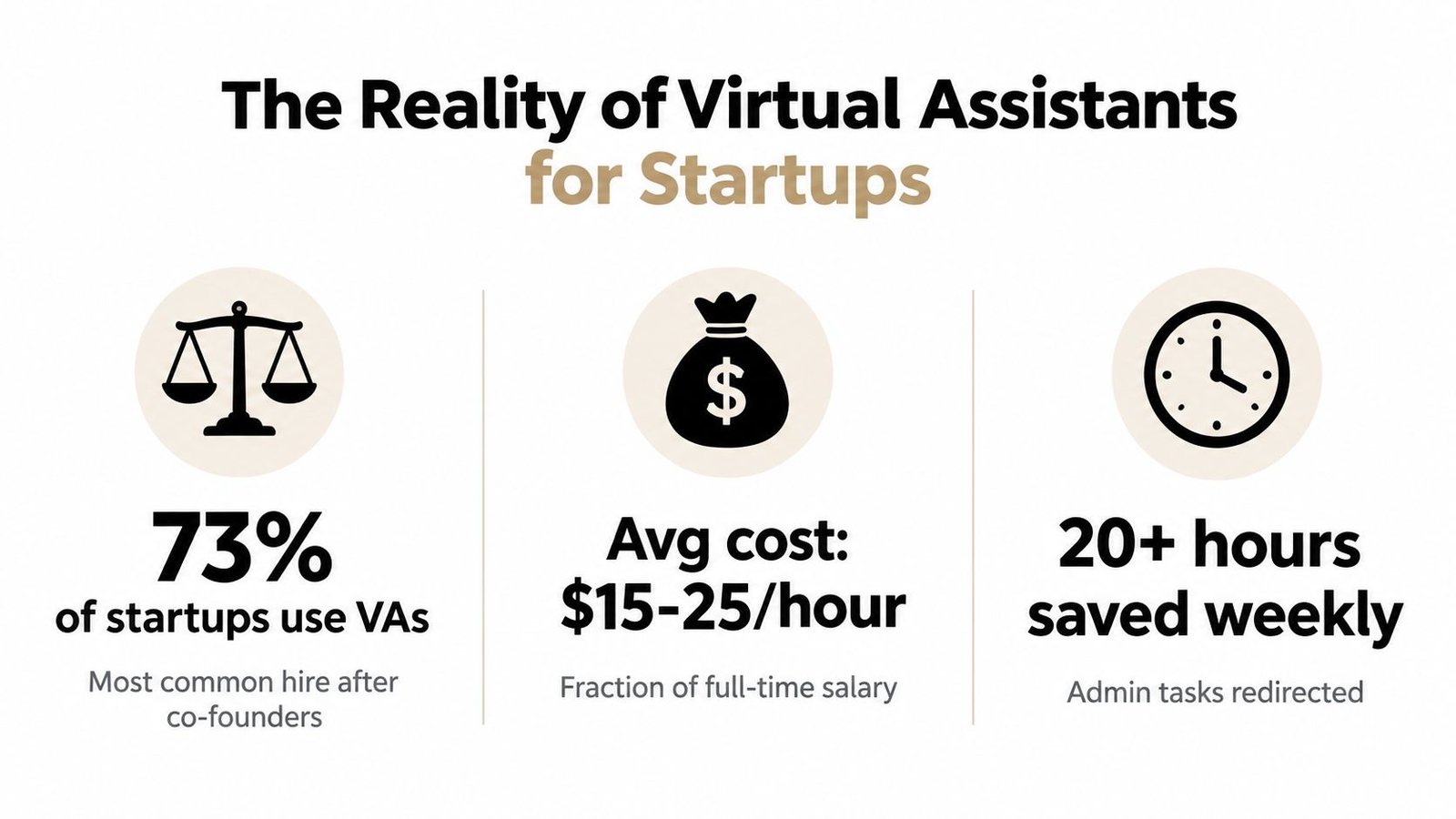
Deciding What to Delegate – The Founder Delegation Matrix
The cleanest way to start is to audit your own week. Not the week you wish you had, the one you lived. Look for tasks that are repeated, easy to define, and expensive only because they keep interrupting you.
A simple three-part filter
Use value, volume, and variety. High value means your judgment changes the outcome. High volume means the task comes up often enough to justify process work. High variety means the task changes every time, which usually makes it a poor fit for automation.
Founder-owned work tends to be high value and high context. Investor updates, customer discovery calls, product positioning, and sensitive hiring conversations belong there. Human VAs can take over structured admin, while software handles narrow repeat tasks that follow clear rules.
The most common mistake is outsourcing discovery. A founder who stops talking to customers in order to use outside help usually gets faster at the wrong things. By contrast, listing updates, lead cleanup, and scheduling are classic support tasks because they drain time without adding strategic insight.
| Task Type | Recommended Resource | Example Activities |
|---|---|---|
| Strategic and sensitive | Founder | Investor updates, pricing decisions, product feedback synthesis |
| Repetitive and structured | Human VA | Calendar management, inbox triage, CRM updates, travel coordination |
| Rule-based and low-risk | Software automation | Routing form submissions, tagging tickets, sending standard reminders |
A startup directory workflow also fits this lens. If you're evaluating how your startup appears in listings, StartupSubmit's directory submission service is the kind of manual, process-driven support that belongs in the “delegate to a human” bucket, not the “leave it to chance” bucket.
Keep founder energy for work where judgment changes revenue, retention, or reputation. Everything else should earn its place on your calendar.
Sourcing Your First Virtual Assistant
Where you hire matters as much as who you hire. I've seen founders save money on day one and lose it later through weak screening, bad handoffs, or endless rework. The right channel depends on how much management bandwidth you have.

The three sourcing models
Freelance platforms give you the broadest pool and the most price flexibility. They work when you already know how to test for competence and can write a tight task brief. The downside is obvious, quality control sits on you.
Agencies reduce screening risk. They're useful when speed matters and you want someone pre-vetted, but you'll usually pay for that convenience. This works best for founders who need consistency more than customization.
Specialized networks sit in the middle. They're often the strongest choice for SaaS founders because you can find people who already understand marketing, operations, customer support, or technical workflows. That saves onboarding time and lowers the odds of teaching a generalist how your stack works from scratch.
| Channel | Strengths | Trade-offs | Best fit |
|---|---|---|---|
| Freelance platforms | Low friction, wide selection | Heavy vetting burden | Founders with strong hiring discipline |
| Agencies | Pre-screened talent, faster placement | Higher cost, less flexibility | Teams that need reliable coverage fast |
| Specialized networks | Role-fit and better context | Fewer casual options | SaaS, AI, and growth teams with defined workflows |
The right test is not “who's cheapest.” It's “who can produce clean output with the least founder oversight.”
How LatHire Can Help
When the work needs cross-border hiring support, LatHire is worth looking at because it combines talent search, vetting, and operational support in one place. It connects U.S. and Canadian companies with pre-vetted Latin American professionals across technology, marketing, sales, and operations through its platform at LatHire.
That matters for startups that want one source for sourcing, onboarding, and compliance instead of stitching together freelancers and ad hoc contractors. LatHire says it uses AI assessments, skills evaluations, and human-led background checks, and it also supports HR, international payroll, benefits, and legal compliance. For founders who need to move fast without building a recruiting function, that combination removes a lot of coordination overhead.
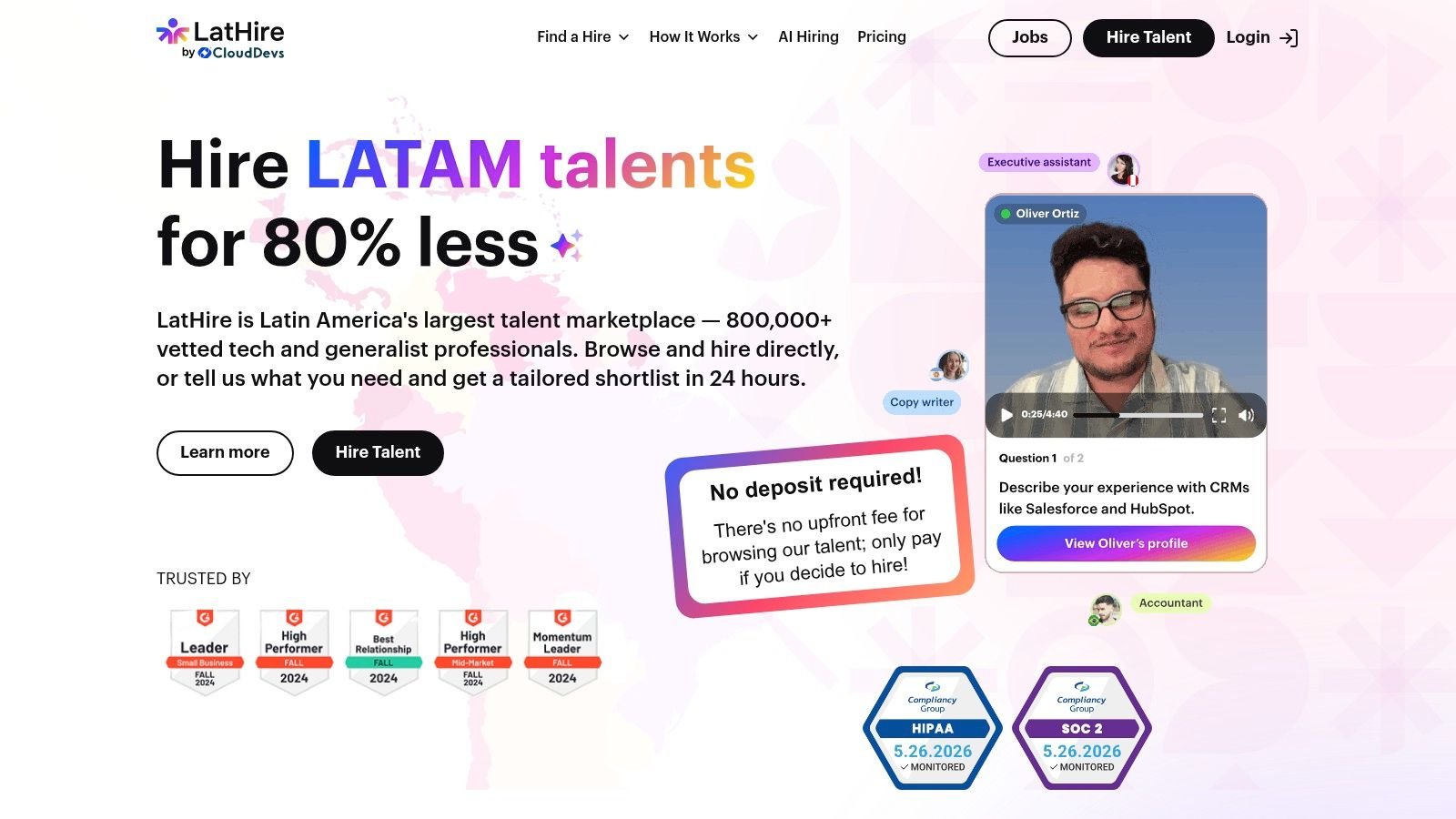
The right use case is when you need a capable generalist or specialist, but you also need the hiring process to be managed. That makes it a reasonable option for founders who don't want to spend a week reviewing profiles, negotiating contracts, and sorting out payroll details across borders.
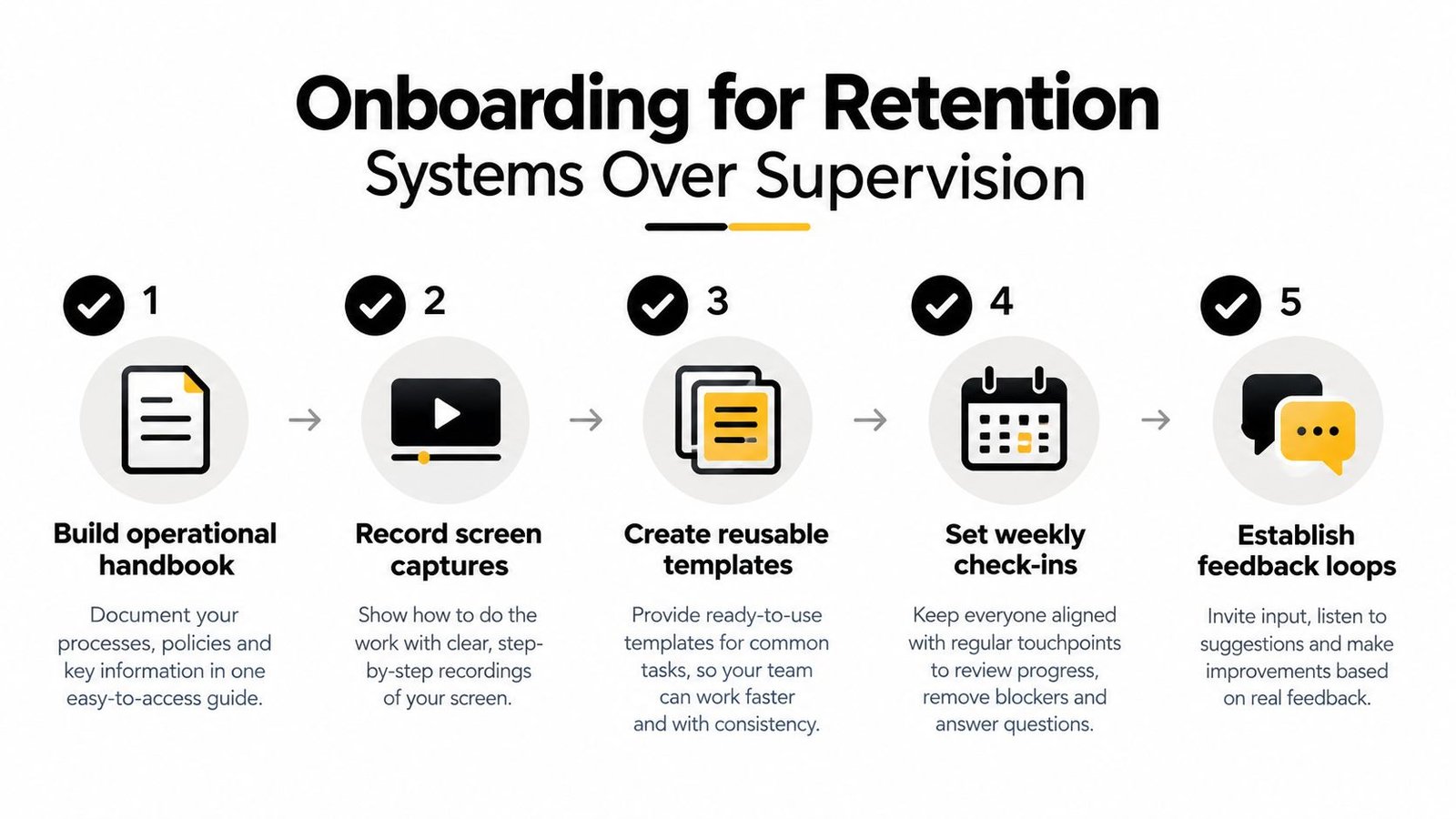
Onboarding for Retention – Systems Over Supervision
A VA relationship fails fast when the founder keeps the process in their head. The assistant starts guessing, small errors pile up, and the founder ends up paying for confusion instead of output. A written onboarding system fixes more than extra check-ins ever will.
Build the operating handbook first
Start with a handbook that covers tools, permissions, recurring tasks, edge cases, and escalation rules. If a task repeats, record it once in a document or a short screen capture. That keeps the assistant from needing your judgment for every small decision, and it gives you something to correct instead of re-explaining the same work.
Use check-ins to reduce, not create, noise
Weekly check-ins should surface blockers, not recreate supervision. Keep them focused on outcomes, open questions, and changes in priorities. Daily review from the founder usually adds drag, not control.
The best remote systems make the next handoff easier than the last one.
Contract structure matters here too. Hourly work fits uncertain scope, while retainers make more sense once the job is stable and repeatable. The hidden cost is turnover, because every replacement resets documentation, trust, and context.
For startup teams formalizing repeatable workflows, StartupSubmit's directory submission service is a practical example of process over improvisation. The same rule applies to assistants, document the work once, then let the person execute.
Pricing Models and Contract Structures
Hourly pricing is useful when the scope is still fuzzy. You're buying flexibility, and that matters early. Retainers work better when the assistant owns a stable slice of recurring work, because you stop renegotiating the same tasks every week.
The bigger question is whether your contract protects the business. Clarify confidentiality, IP ownership, access rights, and what happens when the relationship ends. If the assistant touches customer data, internal docs, or account credentials, sloppy paperwork can cost more than the work itself.
A founder should also budget for management overhead. Even a strong assistant needs review time, context updates, and occasional correction. That's why the cost worth planning around is not the invoice total, it's the full cost of making the work dependable.
For marketing and SEO support, this becomes especially important. A VA can help maintain directory profiles, update listings, and organize backlink outreach, but the workflow should still sit inside your broader growth system. If you need that kind of support for SaaS positioning, StartupSubmit's SaaS directory submission service is the sort of outsourced process that fits a repeatable operating model rather than a one-off campaign.
Contract for flexibility, not fantasy. If the work changes every week, don't lock yourself into a structure that assumes it won't.
Integrating VAs into Your SEO and Growth Stack
A virtual assistant can do real damage here if you hand over the wrong work. They can also become one of the most useful parts of your growth stack when the process stays human-led and quality-controlled. The difference comes down to whether SEO work is treated like reputation management or like a link dump.
Use assistants for quality work, not spam
Google classifies low-quality directory and bookmark-site links as link spam when they are created mainly to manipulate rankings. It also flags buying or selling links for ranking purposes, excessive exchanges, and keyword-rich or hidden links, while noting that properly qualified links can use rel="nofollow" or rel="sponsored" (Google spam policies). A VA should focus on relevant, editorially credible placements, not mass submission.
A good assistant can handle the repetitive parts of directory work, like profile completion, duplicate checks, description consistency, and screenshot capture. They should not spray identical copy across junk sites or invent anchor patterns that look manufactured. The goal is trust, not volume.
Keep search and entity consistency tight
Google also says structured data helps systems understand page content, and its guidance for AI features makes clear that pages do not need special AI-only files or special schema to appear in AI Overviews (Google AI features guidance). The practical takeaway is simple, your site needs to be crawlable, clear, and consistent before you spend time on fancy submission tactics.
A VA can help a startup maintain product identity across directories, review sites, and external profiles. Consistent company name, category, description, and URLs reduce confusion for users and search systems. They can also support a curated list of the best startup directories by keeping submissions aligned with the same naming and profile standards.
AI search rewards pages and profiles that make verification easy. The assistant becomes a quality control layer that protects your SEO from shortcut-driven mistakes.
Managing Performance and Avoiding Common Pitfalls
The fastest way to waste a VA is to manage them like a nervous founder, then act surprised when they stop taking initiative. Remote assistants do best when the scorecard is clear and the feedback loop is short. If they have to guess what matters, you lose time and money.
Watch for the failure modes early
Micromanagement kills momentum. Scope creep does too, especially when one “small extra task” becomes a daily expectation. If the work keeps expanding without a reset, the assistant starts optimizing for survival instead of ownership.
Use a simple review rhythm. Track task completion, turnaround, escalations, and repeat errors. When something fails twice, the problem is usually the process, not the person.
Unclear handoff ownership is another common mistake. Someone has to own the final answer for customer issues, billing questions, legal topics, and sensitive account recovery. If that person is not named, the assistant becomes the default risk sink.
If you also maintain local visibility, a service like StartupSubmit's local citation service shows the same principle. Clear ownership and structured delivery beat random effort every time. VAs need that same discipline to stay effective.
Bottom line: manage outcomes, not presence.
A healthy VA relationship should feel calm after the first few weeks. If it feels like constant correction, the system is broken. Fix the process, tighten the scope, and stop asking one person to compensate for missing structure.
If you're ready to put this into practice, start by mapping one week of founder work, then separate it into founder-owned, human-delegated, and automation-ready tasks. If you want a faster path on the SEO side, use StartupSubmit to offload the manual directory work and keep your VA focused on operations that move the business forward.