SEO for Directories: The SaaS Playbook
The popular advice is simple: submit your startup to as many directories as possible, collect backlinks, and watch Domain Rating rise. That approach turns SEO for directories into a spreadsheet exercise. It also sends founders toward irrelevant platforms, copied descriptions, and links created mainly to manipulate rankings.
A better approach treats each listing as part of your company's public identity. A strong profile helps people understand what you sell, gives search engines another crawlable reference to your website, and supports the consistency that modern search systems need to interpret a startup. The link may matter, but the surrounding context matters too.
For SaaS and AI companies, directory work belongs inside a wider startup SEO and reputation program. You're building discoverability across software platforms, review sites, founder communities, and branded search results. The practical question isn't “How many links can we get?” It's “Which profiles make our company easier to find, understand, verify, and trust?”
Rethinking Directory Submissions for Modern Search
Google says it primarily discovers pages through links from pages it has already crawled, while its technical guidance recommends making links crawlable so additional pages can be found. That makes a well-maintained directory profile useful discovery infrastructure, particularly for a new SaaS or AI domain with few external references. It doesn't make every directory link a ranking shortcut. Google's SEO Starter Guide also makes clear that PageRank is only one part of Search and that there's “much more to Google Search than just links.”
The distinction matters because founders often measure the wrong output. A directory campaign can produce a higher backlink count while doing little for qualified discovery. A smaller group of relevant profiles can create stronger branded coverage, referral paths, and independent descriptions of the same organization.
Practical rule: Treat a directory listing as a citation and distribution asset first, and a potential link signal second.
The history of DMOZ illustrates why directory quality has always mattered. The Open Directory Project began on June 5, 1998, as GnuHoo, later became DMOZ after Netscape's acquisition, and reached 1 million URLs in October 1999. It recorded 5,169,995 sites across more than 1,017,500 categories by April 2013, then declined to 3,996,412 sites by October 31, 2015, before closing in March 2017. This history is documented in the directory-era overview.
The lesson isn't that directories stopped mattering. It's that their value depends on editorial standards, organization, maintenance, and audience relevance. Modern startup directories, software marketplaces, review platforms, and founder communities are more useful when users browse them and when the profile provides information beyond a naked URL.
That's the operating principle behind a thoughtful Directory Submission Service. Research the platform, confirm the category, prepare a differentiated profile, verify the live page, and record the outcome. Don't confuse a large submission count with a strong search footprint.
Crafting Titles and Descriptions That Convert
A directory profile has two jobs. It must explain the product quickly to a human visitor, and it must give search systems clear language about the organization, audience, problem, and capabilities.
Copying one keyword-heavy paragraph across dozens of platforms fails both tests. Users see repetition, while search engines receive a cluster of near-identical pages with limited independent value. Write from a consistent positioning framework, then adapt the wording to each directory's audience and limits.
Start with a precise title
Use this structure as a starting point:
Brand or Product Name + Primary Function + Distinctive Benefit
For example:
Acme AI Meeting Assistant for Searchable Meeting Notes
The title identifies the entity, states the product's main function, and adds a benefit without making an unsupported superlative. Don't force every keyword into the title. If the directory already displays a category beside the listing, use the title for clarity rather than duplication.
Build the description around user intent
A useful description answers five questions in a natural order:
- What is it? Identify the product type.
- Who does it help? Name the audience or team.
- What problem does it solve? Describe the practical friction.
- What makes it useful? Mention real capabilities or differentiators.
- Where is it used? Add a specific use case if it improves understanding.
An accurate example for an AI meeting assistant might say that the product records or transcribes meetings, identifies key discussion points, and helps teams review decisions. Those details should appear only if the product genuinely offers them. Clear factual language is more useful for LLM SEO than exaggerated claims such as “the ultimate AI solution.”
The three fields I prioritize are the business description, primary category, and website URL. The description carries the product narrative. The category places it in the directory's own browsing and search system. The URL connects the listing to the correct canonical destination, which may be a product page rather than the homepage.
Complete relevant secondary fields too. Product tags, pricing, location, social profiles, logos, screenshots, and founder information can improve the profile's usefulness, although no individual field guarantees higher Google rankings.
For more platform ideas, use startup directories selectively. The right directory is one where your audience can understand and validate the product, not just one offering an open submission form.
Technical Requirements for Indexable Profiles
A published listing isn't automatically an indexable listing. I've seen profiles that look live in a browser but are blocked from crawling, hidden behind an account, canonicalized elsewhere, or marked with link attributes that founders never recorded.
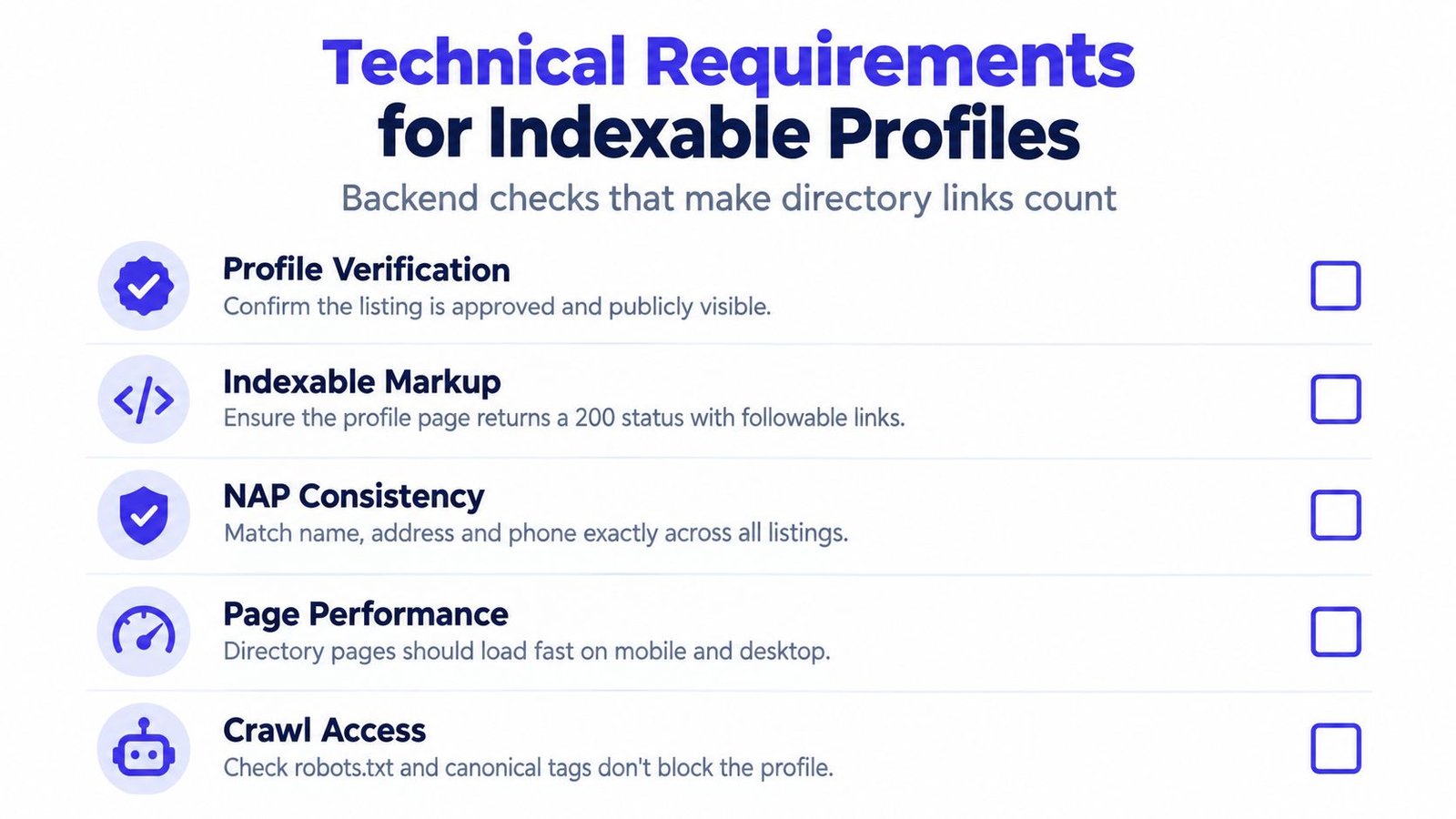
Start with the page itself. An approved profile should return an HTTP 200 status, load without authentication, and be accessible to search crawlers. Check the canonical tag to confirm it points to the intended profile URL rather than a category page, homepage, or duplicate version. Review robots.txt and page-level directives for accidental blocking, and confirm that the page isn't marked noindex.
Evaluate the link in context
A nofollow, ugc, or sponsored attribute changes how you should interpret a placement, but it doesn't automatically make the profile useless. Google recommends rel=nofollow for paid, login-restricted, or untrusted links, and its guidance makes clear that not every directory link should transfer ranking signals.
A nofollow profile on a respected software or product platform may still send referral visitors, support branded search coverage, and provide an independently hosted description of the company. That can be more valuable than a dofollow link from a neglected directory with no editorial control or real audience.
Record these fields for every placement:
- Directory domain and profile URL: Preserve the exact live location.
- Indexability status: Note whether the page is crawlable and indexable.
- Canonical target: Confirm the profile has a sensible canonical relationship.
- Anchor text and destination: Check whether the link points to the right page.
- Link attributes: Record
nofollow,ugc,sponsored, or no declared attribute. - Approval evidence: Save the acceptance note or a screenshot where appropriate.
Google's ProfilePage structured data documentation explains that this markup is intended for pages focused on one person or organization, with that organization represented as the page's mainEntity. The documentation also recommends validation through the Rich Results Test and URL Inspection. A profile blocked by robots.txt, noindex, or login requirements can't be properly processed.
You don't control the directory's markup, but you can choose platforms that present one identifiable organization clearly. Keep your name, website, logo, product identity, and core category consistent. Don't paste an identical keyword-stuffed paragraph into every profile, because differentiation helps users and reduces the appearance of templated distribution.
For broader profile quality guidance, elite profile tips for 2026 is a useful complementary resource. Apply the same discipline to directory records, especially around completeness, accuracy, and public visibility.
A submission workflow such as submitting to directories should end with verification, not the moment a form is sent. The live page is the asset. Until you've checked it, you don't know what was published.
Avoiding Spam Filters and Categorization Traps
Directory SEO crosses the line into spam when the primary purpose of the links is ranking manipulation. Google's spam policies specifically identify links from low-quality directories or bookmark sites as link spam when they're created mainly to manipulate rankings. Paid links, excessive exchanges, and automated link creation create similar risk.
The old DMOZ-era instinct was to submit everywhere and hope a few placements survived. Modern SaaS SEO works better with qualification. A curated profile on a relevant software platform can support discovery and trust. A batch of near-identical listings across irrelevant networks can create an obvious manipulation pattern without helping users.
| Evaluation Factor | Green Flag, Proceed | Red Flag, Avoid |
|---|---|---|
| Editorial control | Human review, clear guidelines, visible moderation | Instant publication with no quality checks |
| Audience fit | Software buyers, founders, developers, or a defined niche | Unrelated categories and generic link pages |
| Page quality | Unique profile pages with useful product information | Thin pages built mainly to sell links |
| Technical access | Public, crawlable pages with stable URLs | Login walls, noindex, blocked crawling, or unstable URLs |
| Link purpose | Genuine discovery, reputation, or referral value | Placement exists only to inflate backlink metrics |
| Profile differentiation | Tailored description and accurate attributes | Identical copy repeated across the network |
The most common categorization mistake is choosing a broad or popular category instead of the product's actual function. An AI meeting transcription tool should generally use a category such as AI meeting assistants, transcription software, or productivity tools when those options exist. A generic business category may look larger, but it tells directory visitors less and can reduce discovery through relevant filters.
Correct the mistake by reviewing the available taxonomy before submitting. Pick the closest primary category, then use secondary categories or tags only when they genuinely apply. Don't add every adjacent keyword in the hope of appearing more often.
A category is a promise about what the product does. If the category is wrong, the listing starts by disappointing the person who finds it.
Keep a placement log so you can identify patterns early. Include the domain, category, profile URL, status, canonical target, anchor text, link attributes, description version, and date checked. This also makes cleanup possible if a directory becomes compromised, fills with spam, or changes its link policies.
Quality beats volume because relevance gives the listing a reason to exist. That reason is what makes the placement useful to users, defensible from a search-policy perspective, and more likely to contribute to a coherent brand footprint.
Building Entity Trust for AI and Local Search
A company is easier for search systems to interpret when independent pages agree on what it is. The name, website, product category, audience, founder identity, and core capabilities shouldn't change randomly from one platform to another.
That consistency doesn't mean every listing should be identical. It means the underlying facts should align while the explanation adapts to the platform. G2 may emphasize customer outcomes and software capabilities. Crunchbase may emphasize the organization and company history. A founder community may focus on the maker, product origin, and use case.
Reviews add evidence that links can't provide
Directory profiles become more useful when they contain credible customer evidence, current product information, and category-specific details. Local-search data offers a useful, qualified analogy. An analysis of 3,269 businesses reported that proximity drove 55.2% of ranking influence across positions 1–21, while review count contributed 19.2%. Among the top 10, review count rose to 26%, and review-keyword relevance reached 22.8%. These figures concern local businesses, not SaaS directories, so they shouldn't be copied into a software-ranking forecast. They do show why completeness and review relevance can matter alongside links. The analysis from Impression Digital provides the underlying context.
For SaaS and AI teams, the practical translation is straightforward:
- Ask customers for honest feedback on relevant platforms.
- Never invent reviews or offer incentives that compromise authenticity.
- Encourage reviewers to describe the actual workflow, use case, and product capability.
- Keep product names, categories, and core descriptions aligned across profiles.
- Refresh outdated screenshots, pricing references, and feature claims.
Google says AI Overviews and AI Mode use existing Search ranking and quality systems. Its AI features guidance describes retrieval-augmented generation as retrieving relevant current pages from the Search index and using them to ground responses, with prominent clickable links that can support the answer.
That means AI search optimization doesn't require a separate collection of speculative “AI keywords.” It requires crawlable pages that explain the product clearly and evidence that exists beyond the company's own website. Directory profiles can support that foundation, but they won't replace useful first-party content, technical accessibility, or genuine reputation.
Branded SERP ownership is a better objective than a raw Domain Rating target. When someone searches your startup, they should encounter a consistent set of credible profiles, product pages, reviews, founder references, and relevant third-party descriptions. Founder-led companies can also learn from resources such as Founder Connects on smarter founder decisions, particularly when building a broader public identity around the people behind the product.
For citation consistency across business profiles, a local citation service can be considered alongside direct work on software and startup platforms. The service category matters less than the discipline: accurate records, relevant sources, honest reviews, and regular checks.
Operational Workflows and Measuring Real Impact
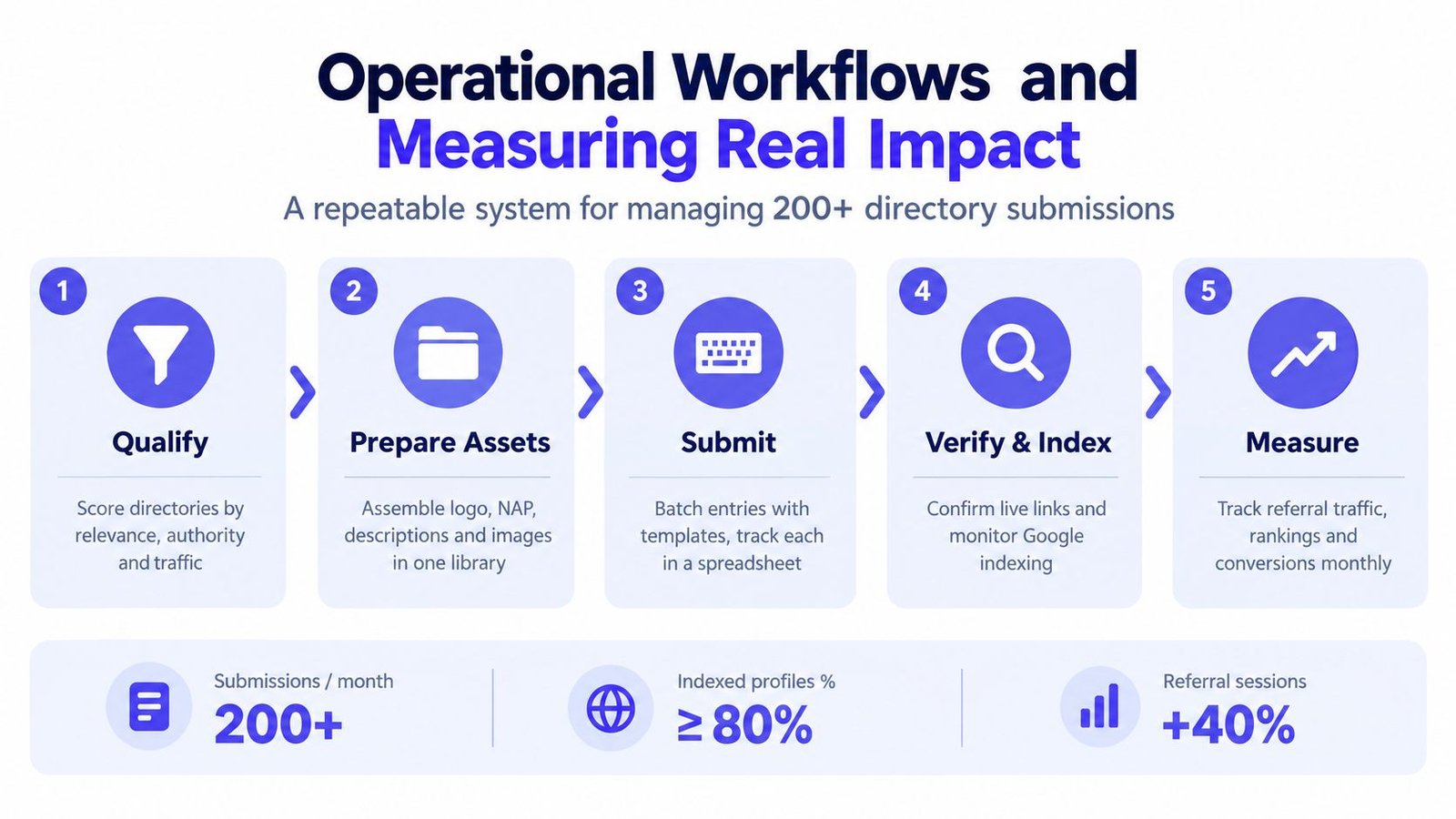
Manual submission becomes wasteful when every listing starts from a blank page. It becomes manageable when the team separates research, asset preparation, submission, verification, and measurement.
The first step is qualification. Score each directory by audience relevance, editorial quality, crawlability, profile usefulness, and referral potential. Remove duplicates before creating a new record. A platform that already has your product may offer a claim or update process, which is usually more useful than creating a second profile.
Use one source of truth
Create a shared asset library containing the approved logo, product name, canonical URLs, short and long descriptions, category options, screenshots, founder details, social profiles, and review destinations. Store variations rather than one universal paragraph. A software marketplace and a founder directory need different emphasis even when the facts remain consistent.
Then submit in controlled batches. Track the date, account used, category selected, copy version, approval status, live URL, link attribute, and follow-up date. Verify each listing after publication and check it again later for changes.
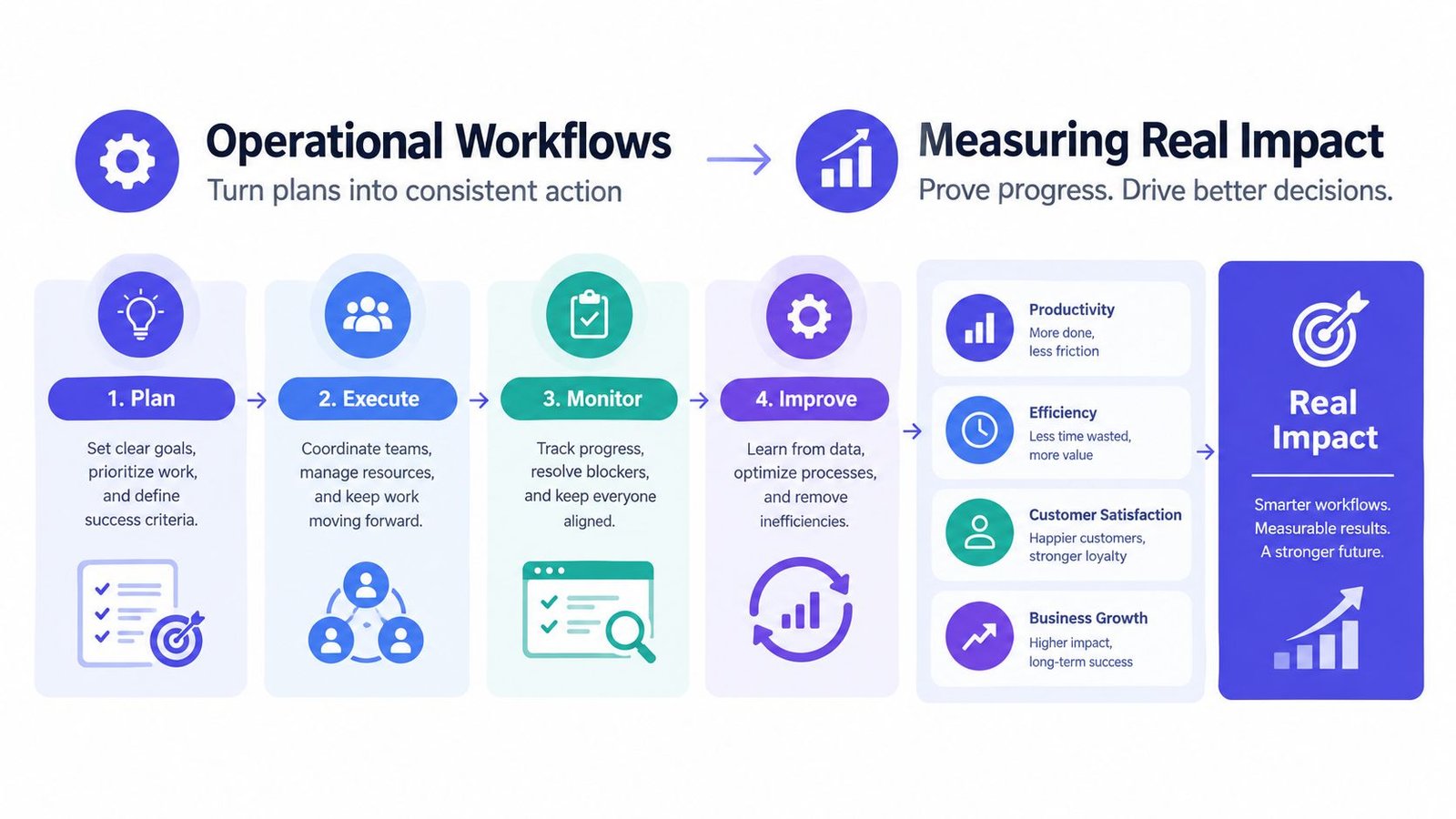
Google Search Console can show whether profile pages receive impressions and clicks, while analytics can separate directory referrals from other channels. Track:
- Indexed profile pages: Which approved listings are discoverable?
- Qualified referral actions: Do visitors click through, start a trial, request a demo, or contact the team?
- Branded search coverage: Do credible profiles occupy more of the results around the company name?
- Review recency and relevance: Are recent customers describing the use cases you want to be known for?
- New referring domains: Are you earning a diversified profile rather than repeating the same network?
- AI visibility: Do relevant prompts in Google AI features or other answer engines surface the company or its supporting profiles?
An Ahrefs analysis of approximately one billion web pages found that 66.31% had no external links from referring domains, while 26.29% had links from only one to three referring domains. The same study reported a positive relationship between referring-domain counts and organic search traffic, while warning that correlation doesn't prove causation. See the Ahrefs link-building statistics analysis.
Consistency also matters. Ahrefs' study of top-ranking pages observed that many number-one pages acquired backlinks from new referring domains at roughly 5% to 14.5% monthly, a relationship rather than a ranking formula. The backlink growth study supports a measured cadence instead of a one-time blast.
Founders can manage a focused campaign internally. When research, categorization, bespoke copy, verification, and reporting start consuming launch time, a manual SaaS directory submission service may be a practical operational choice. The standard remains the same either way: relevant placements, accurate data, and measurable outcomes.
Common Directory SEO Questions Answered
Can directory submissions improve Domain Rating?
They can contribute referring domains, but Domain Rating is a third-party metric, not a Google ranking factor. Don't publish a before-and-after DR claim unless you have the starting score, ending score, measurement dates, referring-domain data, and a way to separate directory activity from other SEO work.
Measure live profile URLs, indexed pages, relevant referral traffic, branded search coverage, organic performance, and conversions alongside any third-party authority metric. A DR increase alone doesn't prove that directory optimization caused better rankings or revenue.
Which profile fields matter most?
Prioritize the business description, primary category, and website URL.
The description explains what the product does, who it helps, and which problem it solves. The primary category determines how the directory organizes and presents the listing. The website URL must resolve correctly and should point to the most relevant canonical destination when the directory allows it.
Complete other fields when they're relevant, but don't assume that filling every box guarantees visibility.
How should an AI startup choose its category?
Choose the closest accurate category based on the product's primary function. An AI meeting assistant belongs in a meeting, transcription, productivity, or AI assistant category when those options fit. Don't choose a broad business category just because it has more visitors.
Should every listing use the same description?
No. Keep factual entities and core positioning consistent, but adapt the title, description, feature emphasis, and use case to the directory's audience and limits. Repeated keyword-heavy copy creates weak profiles and gives users little reason to trust the listing.
What should founders do first?
Audit existing profiles, remove duplicates, define the canonical website URL, prepare accurate category options, and build a placement log. Start with directories your customers, partners, founders, and investors might actually use. Then review indexing, referrals, branded results, and conversions before expanding.
StartupSubmit offers manual directory submissions for SaaS and AI startups, including research, duplicate checking, category matching, customized profile copy, live URL reporting, and placement verification across startup and software platforms. If you want to turn directory work into a controlled entity and discovery program rather than a backlink-counting exercise, visit StartupSubmit and review the available submission options.