LLM Visibility Tracking: What It Is and How to Measure It
The most popular advice about LLM visibility tracking is to ask an AI assistant about your category, check whether your startup appears, and save the screenshot. That's a useful spot check. It's a poor measurement system.
For a founder deciding where to spend limited marketing time, the key questions are whether buyers repeatedly encounter the brand, which sources support those appearances, and whether the description is correct. A single visibility score won't answer all three.
Table of Contents
- What LLM Visibility Tracking Measures
- Why One Prompt Check Tells You Almost Nothing
- How to Run a Repeatable Tracking Protocol
- Dedicated Platforms Versus a Spreadsheet
- Auditing Citations Claim by Claim
- Third-Party Sources That Shape AI Answers
- Frequently Asked Questions About LLM Visibility Tracking
- Your First Seven Days of Tracking
What LLM Visibility Tracking Measures
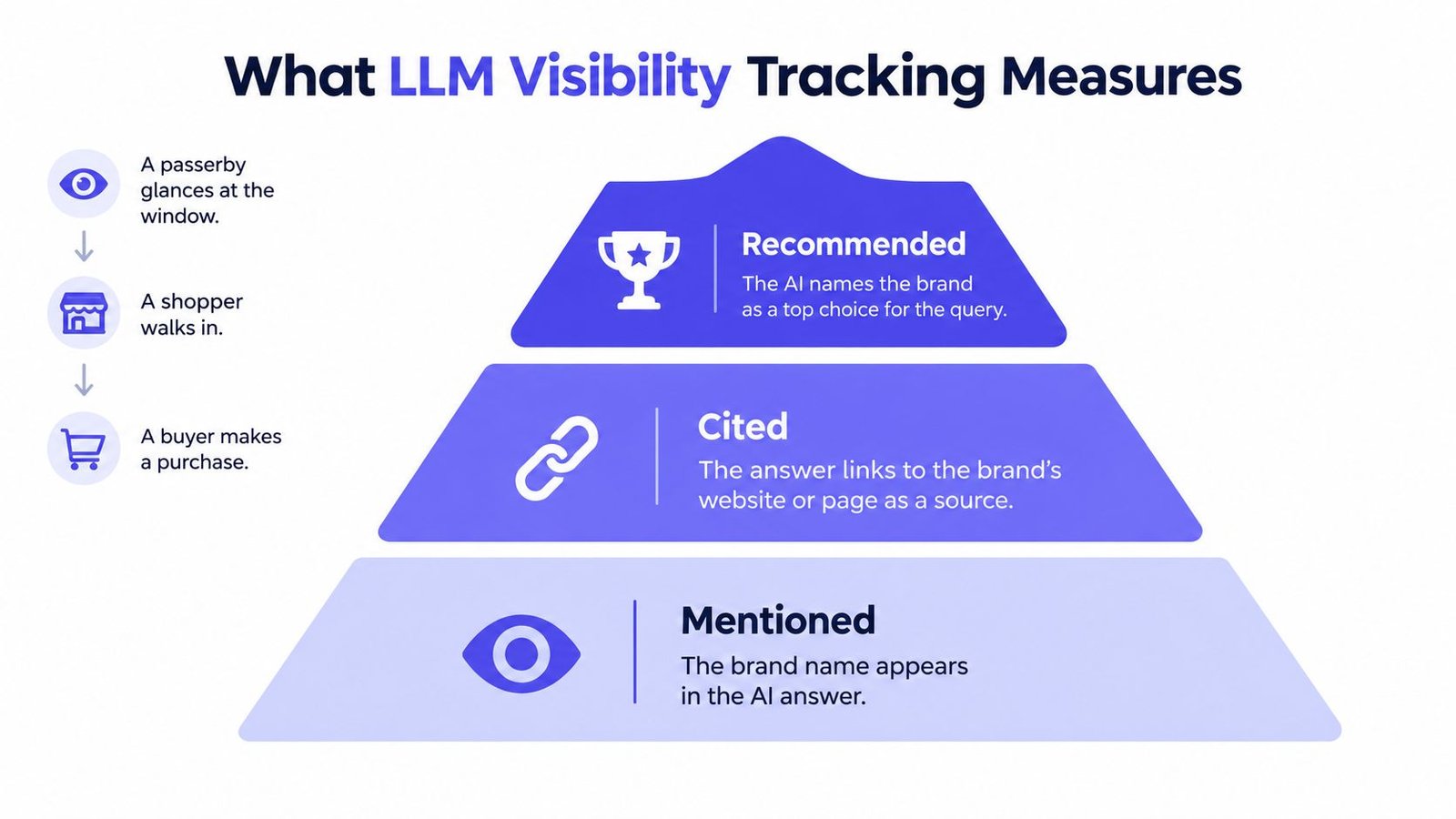
A shop owner counts foot traffic, but a passerby who glances at the window isn't the same as a shopper who walks in and buys. AI discovery needs the same separation: exposure, recommendation, and purchase intent aren't interchangeable.
LLM visibility tracking measures whether and how your brand appears in AI-generated answers across a defined set of prompts, engines, and dates. Useful tracking also records the evidence attached to those answers and the visits they generate.
The six layers of LLM visibility
These are hypothetical observations for Ledgerly, a fictional invoicing tool, not performance benchmarks.
| Layer | Question It Answers | Example for Ledgerly |
|---|---|---|
| Retrieval | Did the engine pull my pages or listings for this query? | Ledgerly's G2 page appears in retrieved sources for best invoicing software for freelancers |
| Mention | Did the answer name my startup? | Ledgerly appears in 5 of 8 runs |
| Citation | Which URL backed the answer? | The cited link is a Capterra listing, not Ledgerly's own site |
| Position | Where did the brand land in the list? | Third of six recommendations |
| Referral click | Did anyone visit from the answer? | 14 sessions tagged with the chatgpt.com referrer in a month |
| Accuracy | Is the description right? | Described as a payroll tool, which it is not |
Retrieval happens before the visible answer. Record it only when the engine or collection method exposes retrieved sources. Don't infer that a page wasn't retrieved just because it wasn't cited.
Mention measures brand inclusion, while citation identifies the supporting URL. A directory page can support an answer about Ledgerly without sending the reader to Ledgerly's website.
Position is meaningful when the answer contains an ordered recommendation list. Don't manufacture a rank for a passing reference in prose.
Referral clicks belong in your analytics system. Accuracy requires checking the answer against current product facts, because a prominent but incorrect recommendation isn't a clean win.
Why conventional rank checks miss the answer
Google's guidance on AI search features explains that its systems identify supporting pages during response generation, review retrieved information, and display prominent clickable links that can span a wider, more diverse set of sources than traditional results. Your tracker therefore needs the prompt, cited URL, and surrounding answer, not just an organic position.
That changes how you evaluate startup directories. A profile found through a list of free startup directories is a candidate discovery source, not evidence that an answer engine uses it.
Working rule: A tracker that reports only rank measures the wrong layer.
Why One Prompt Check Tells You Almost Nothing
Say a founder asks ChatGPT for software recommendations, sees their startup named, and posts a screenshot. The next morning, the brand is missing, although nobody changed the website.
Neither response proves that the startup's authority rose or fell. They're observations from a variable system, not fixed positions on a leaderboard.
A 2026 multi-engine study found consecutive-day Jaccard similarity of 0.34–0.42 for cited-source sets and 0.45–0.59 for brand presence; its bootstrap analysis required at least seven repeated runs to bring the standard error of estimated brand detection below 0.10, and eight runs to bring it below 0.08. Those thresholds describe that study's results, not a universal guarantee for every tracking setup.
Why answers change without website changes
Answer engines don't share one retrieval pipeline. Differences in retrieval indexes, ranking systems, prompt interpretation, model versions, and freshness policies can change the evidence selected for an answer.
The practical consequences are straightforward:
- A missing URL isn't automatically a loss. Another source may support the same brand recommendation.
- A new citation isn't automatically progress. The engine may have swapped sources without changing its recommendation.
- A model update is a measurement event. Record it before attributing a change to your latest campaign.
An AirOps analysis of more than 45,000 AI-search citations found that only about 30% of brands stayed visible in back-to-back responses, roughly 57% of brands that disappeared resurfaced later, and brands receiving both a mention and citation were 40% more likely to reappear than those receiving citations alone.
Read changes as estimates
Consider a hypothetical result: Ledgerly appears in 3 of 8 runs during one week and 5 of 8 the next. That's an encouraging observation, but it's not enough to announce a trend without checking uncertainty.
Use a confidence interval for each rate, and preferably an interval for the difference between periods. With sparse observations, uncertainty can remain substantial even when the percentages look dramatically different.
For repeated observations, bootstrap by date or another appropriate collection block rather than assuming every answer is independent. Runs collected close together can share retrieval conditions.
Don't rewrite your homepage because an answer changed overnight. Investigate persistent changes across matched prompts and comparable conditions.
Use brand mention rate as the steadier headline metric. Treat individual source changes as clues about retrieval, not a daily verdict on your startup marketing.
How to Run a Repeatable Tracking Protocol
Build a small experiment you can maintain before buying a large dashboard. Consistent inputs matter more than an impressive prompt count that your team stops checking.
In Ahrefs' analysis of 55.8 million AI Overviews across 590 million searches, AI Overviews appeared for 16% of US keywords and appeared more frequently for informational, longer, and higher-volume queries. Your prompt set should include buyer questions, not just your brand name.
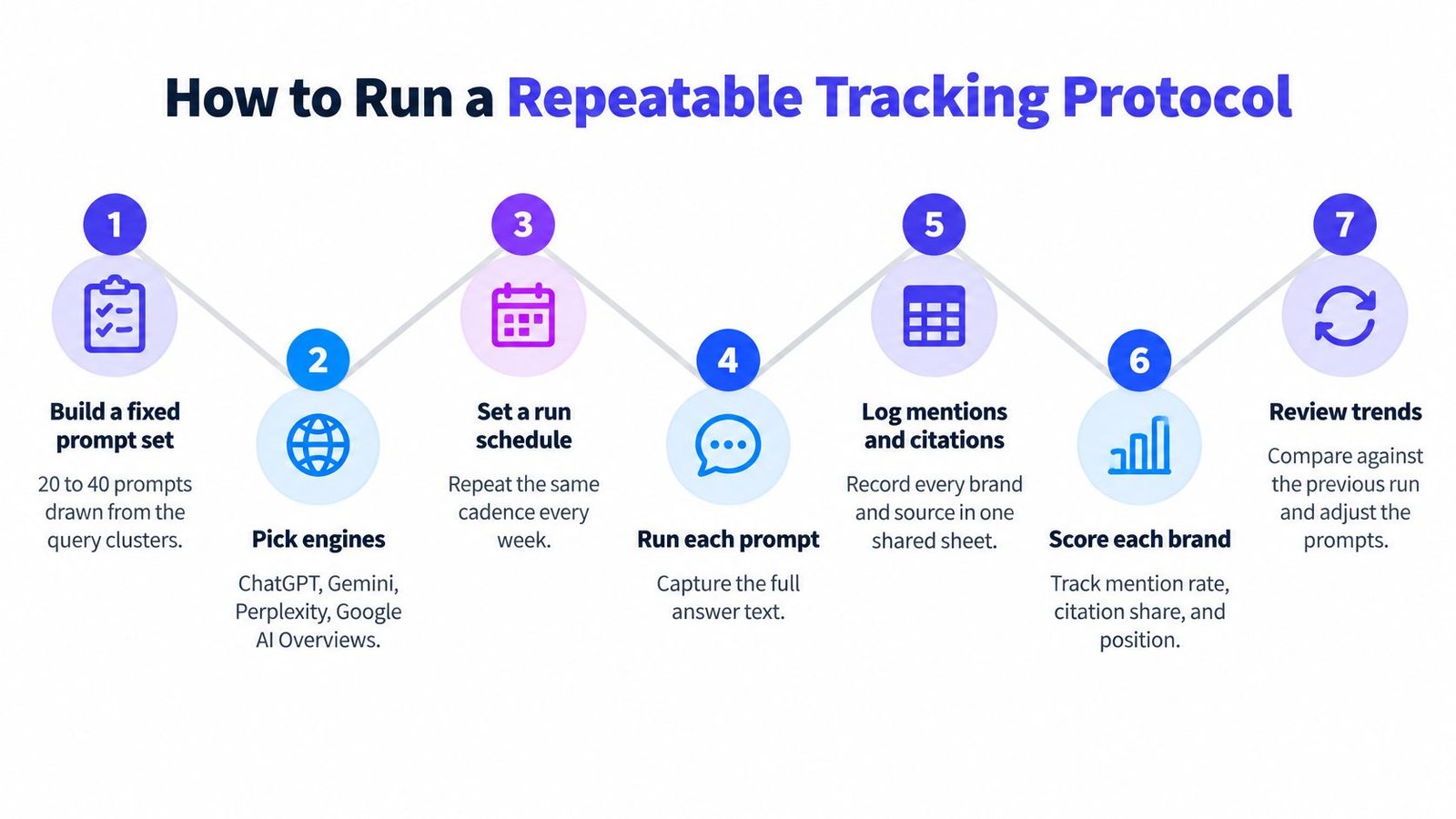
A practical collection sequence
Build a fixed prompt set. I'd start with 20 to 40 prompts as an operating choice, drawn from customer conversations, sales objections, and the clusters below. Separate branded questions from unbranded discovery questions so prompted brand recognition doesn't inflate discovery performance.
Choose the engines and conditions. Consider ChatGPT, Gemini, Perplexity, Google AI Overviews, and Claude, then fix locale and device for each. Record whether you're testing the consumer interface or an API, because those aren't automatically equivalent experiences.
Schedule repeated observations. Use at least eight runs per prompt across different days as your initial protocol, then expand if uncertainty remains wide. For workload planning, 20 prompts × 8 runs × 5 engines = 800 observations in a hypothetical cycle.
Save the answer before scoring it. Log the full response, run date, mention, recommendation position, cited URL, citation type, accuracy flag, engine, and model version where exposed. Record unknown model versions as unknown rather than guessing.
Calculate separate rates. Mention rate is the share of eligible answers naming your brand; citation rate is the share containing a qualifying citation. Define whether that means your own domain, a third-party page about your brand, or either, and keep the definition unchanged.
Report rolling aggregates. Use a two-to-four-week reporting window as your working cadence, with confidence intervals and engine-level breakdowns. Keep failed runs separate from successful answers that omit the brand.
Assign corrections to an owner. Send wrong descriptions to whoever controls the underlying page and track the correction date. Preserve the original observation so the audit trail survives the fix.
Query clusters for a SaaS prompt set
| Query Cluster | Example Prompt | Why Track It |
|---|---|---|
| Category definition | What is LLM visibility tracking? | Shows whether the category name links to your brand |
| Comparison | Best project management tools for remote agencies | Tests whether you appear in shortlists |
| Alternatives | Alternatives to [competitor name] for small teams | Reveals displacement opportunities and which competitor sources dominate |
| Pricing | How much does invoicing software cost for freelancers? | Checks whether prices in third-party sources are current |
| Integration | Invoicing tool that connects to Stripe and QuickBooks | Tests the technical discovery path |
| Trust | Is [brand name] a legitimate software company? | Exposes how the model describes your reputation |
Add a prompt ID and cluster label to every observation. Otherwise, a strong result for branded trust questions can conceal weak performance on unbranded comparisons.
When reviewing the best startup directories, match candidates to these intents. A broad startup profile and an integration-focused software listing serve different questions.
Don't change poorly performing prompts mid-cycle. Add proposed replacements to a separate test set, or you'll confuse improved visibility with easier questions.
Dedicated Platforms Versus a Spreadsheet
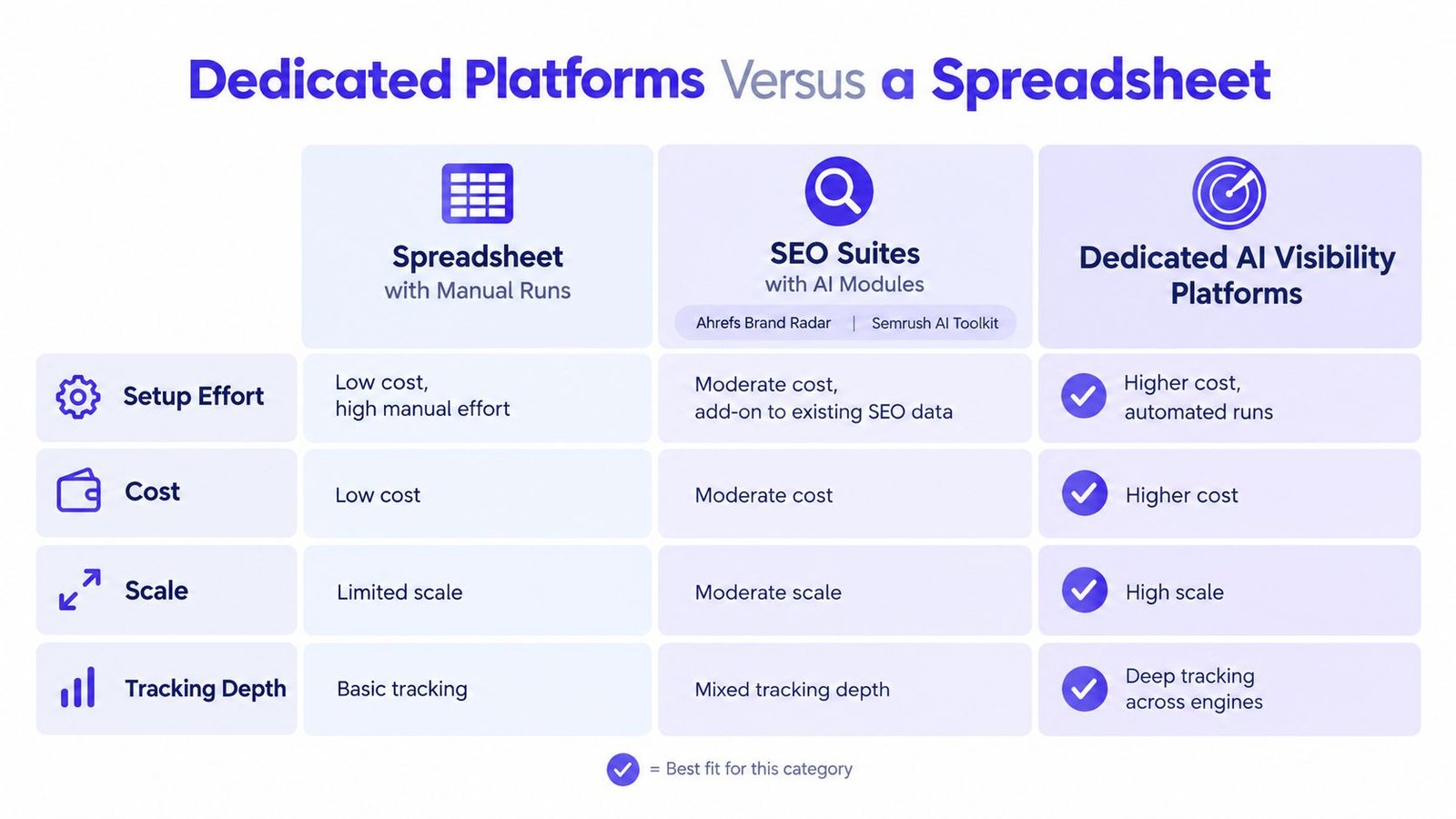
You have three practical options: a spreadsheet with manual runs, an SEO suite's AI module, or a dedicated AI visibility platform. Choose based on collection workload and auditability, not the attractiveness of the summary score.
Tracking options compared on the protocol criteria
| Option | Strongest At | Repeated Runs | Accuracy Audit | Cost Pattern |
|---|---|---|---|---|
| Spreadsheet with manual runs | Pre-launch founders tracking under 20 prompts | Manual, you schedule each run | Manual, you read every answer | Your time only, if using existing tools |
| SEO suite AI module, such as Ahrefs Brand Radar or Semrush AI Toolkit | Teams already paying for SEO data | Verify custom-prompt scheduling and repeat counts | Verify raw-answer access and claim-review workflow | Add-on or bundled fee, check current pricing |
| Dedicated AI visibility platform | Teams tracking many prompts across several engines | Scheduled automated runs, verify plan limits | Verify claim-level review rather than sentiment alone | Subscription, check current pricing |
Use cloro's tracking-tool roundup and Hootsuite's LLM visibility guide to build a shortlist. Up North Media's comparison of AI visibility platforms for 2026 provides another selection resource; confirm current features and pricing directly before committing.
What to test before paying
- Repeated runs: Can you schedule identical custom prompts, rather than query a vendor's existing prompt database?
- Engine coverage: Does the plan cover your buyers' engines and markets?
- Raw answers: Can you export complete responses and citation URLs for audits?
- Uncertainty: Does the platform explain its sampling and confidence intervals?
- Business reporting: Can you compare impressions, cited appearances, referrals, and assisted conversions?
The last criterion matters because visibility and traffic can diverge. In Ahrefs' desktop CTR analysis, position-one CTR for AI-Overview keywords fell from 0.073 in March 2024 to 0.026 in March 2025, against an estimated 0.040 without the feature.
Don't treat lower CTR alone as evidence that content stopped contributing. Equally, don't use mentions to excuse an acquisition program that never produces qualified demand.
My decision rule: under about 20 prompts in one market, a spreadsheet is a reasonable starting point. Several markets, several engines, or shared reporting requirements justify evaluating paid collection.
Auditing Citations Claim by Claim
A 2026 evaluation of LLM source attribution reported link validity above 94% and topical relevance above 80% for the strongest frontier models, yet factual accuracy ranged from 39% to 77%; increasing retrieval depth from 2 to 150 tool calls reduced fact-check accuracy by approximately 42% on average in two frontier models.
A working link proves that a page exists. It doesn't prove that the page supports the sentence beside it.
Trace the wrong claim to its source
Say a startup has raised a Series A, but a directory profile still describes it as seed-stage. An answer engine cites that profile and repeats the old stage.
The link is accessible and relevant. The description is still wrong, and increasing the citation count would only give you more incorrect appearances to report.
Citation audit fields and failure examples
| Audit Field | What to Check | Typical Failure |
|---|---|---|
| URL accessibility | Does the cited link load the intended page? | Link redirects to a homepage or returns an error |
| Topical relevance | Is the page about the question asked? | Cited page covers a different product category |
| Claim-level entailment | Does the page support the exact sentence the model wrote? | Page mentions the feature, but not the claimed price |
| Brand-name accuracy | Is the company name spelled and described correctly? | Name merged with a similarly named company |
| Category accuracy | Is the product placed in the right category? | Listed as a CRM instead of an invoicing tool |
| Pricing or feature accuracy | Are prices and capabilities current? | Free tier described as discontinued |
| Source ownership | Is the citation first-party or third-party? | Outdated third-party review drives the answer |
Attach the engine and model version to each audit entry. Also distinguish source error from unsupported model interpretation: editing a correct page won't necessarily fix a claim the model invented.
Fix the source and the answer-ready page
Start with the stale third-party profile when it's editable, because that's often the quickest correction. Then align the first-party page, keeping the company name, category, canonical URL, product capabilities, and geographic scope consistent across profiles.
For location-sensitive businesses, the same discipline applies to local citation management. Don't copy a broad international description into a listing that should describe a specific service area.
Build an answer-ready page for each valuable prompt cluster: current pricing with a visible update date, honest comparisons naming real alternatives, and category pages using consistent terminology. Add concise FAQ answers for integration and pricing questions that repeatedly surface.
Check that pages load without a login wall and use Google Search Console's URL Inspection tool to inspect indexing status. Special AI markup isn't the fix; clearer facts on accessible pages are the priority.
Audit priority: Correct the claim that could mislead a buyer before chasing another citation.
Third-Party Sources That Shape AI Answers
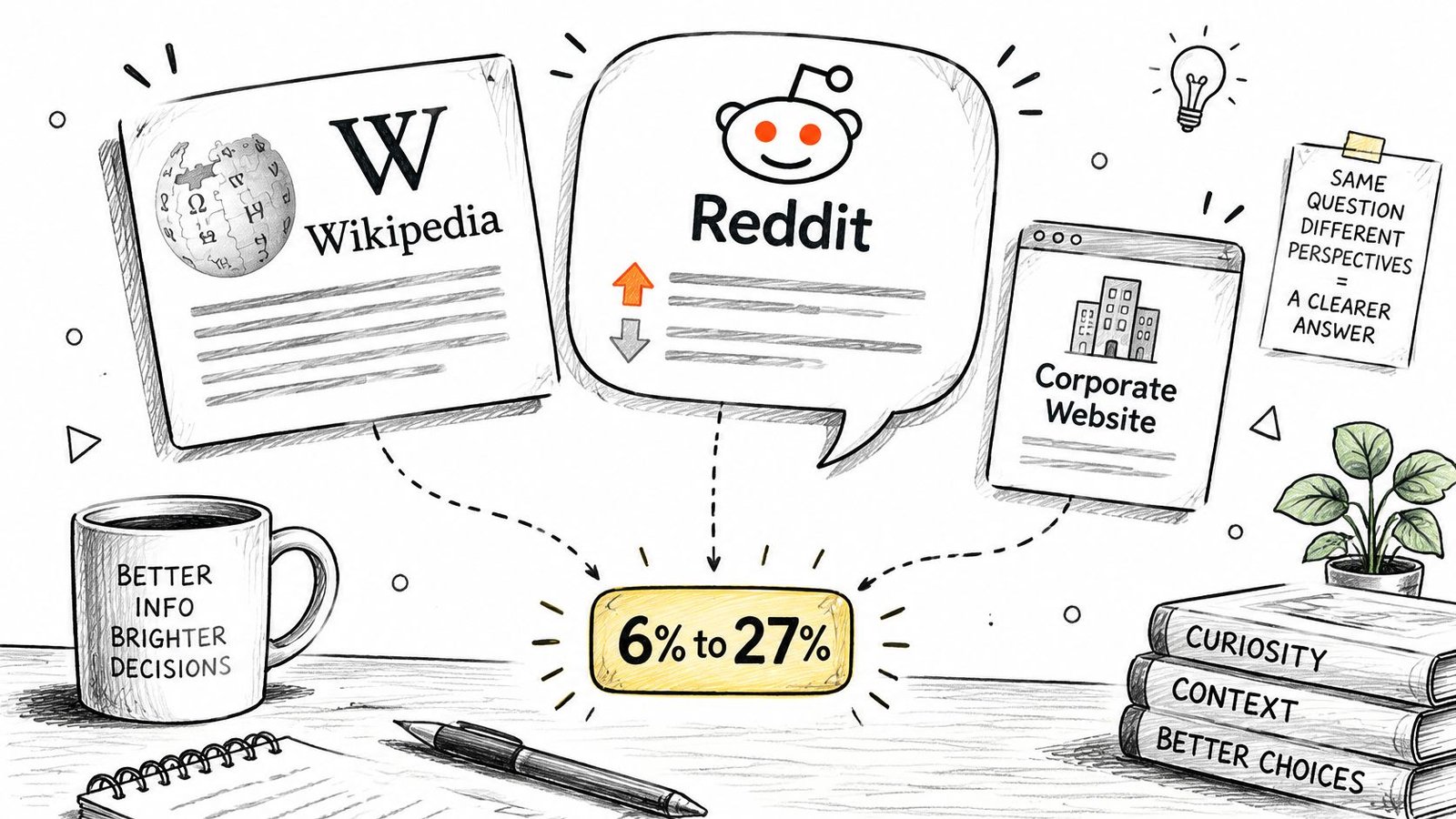
Wikipedia and Reddit consistently outranked corporate websites as cited sources in the cross-industry findings discussed by Semrush's AI search visibility analysis, while only 6%–27% of the most-mentioned brands also ranked among top cited sources, depending on industry and platform. The same article discusses an analysis of 6.8 million citations, of which 86% came from sources marketers can manage or strongly influence.
That doesn't make every editable profile valuable. Brand awareness, source authority, and editorial control are different things.
Match sources to buyer intent
A software directory can establish your product's category and canonical URL. A detailed customer review can explain whether it works for a particular team. Documentation can support an integration claim that a general company profile cannot.
Watch these source types separately:
- Software directories: Check category placement, entity details, and whether the profile appears for relevant comparisons.
- Review platforms: Monitor G2 and Capterra for current descriptions and substantive customer feedback.
- Community discussions: Track the actual use cases and objections people discuss, without planting promotional replies.
- Documentation: Make technical requirements, limitations, and supported integrations explicit.
- Press and analyst references: Check whether independent descriptions match your current product and market.
Don't respond by trying to manufacture a Wikipedia page or flood Reddit. Source relevance and editorial standards still apply.
An Ahrefs summary of an analysis across 75,000 brands reported a 0.664 correlation between branded web mentions and Google AI Overview presence, exceeding the reported correlation for backlinks or domain rating. Correlation isn't causation, and it isn't a forecast of what another mention will do for your startup.
Build a source-level dashboard
Separate linked mentions, unlinked mentions, review pages, and AI citations. Then tag them by query intent, geography, and engine so you can identify which source types repeatedly support useful answers.
A directory listing supports entity consistency; an independent review or relevant discussion may provide the evidence needed for a credible recommendation. Neither substitutes for accurate product information.
A directory submission service such as StartupSubmit covers the directory layer. Reviews, customer references, and genuine industry mentions require their own work.
Judge that combined footprint by the answers buyers receive, not by the number of completed profiles or backlinks in a delivery report.
Frequently Asked Questions About LLM Visibility Tracking
How long until my numbers mean something?
Plan for at least eight observations per prompt across different days, allowing about two weeks to establish an initial baseline. That's a collection plan, not a promise of statistical certainty. Read the uncertainty interval before treating a change as progress.
Does ranking first on Google guarantee AI citations?
No. Organic ranking and selection as supporting evidence are different outcomes. Keep conventional SEO reporting, but don't use a top organic position as a substitute for inspecting generated answers and their sources.
Which engines should I track first?
Start with the two or three your buyers use in practice. Ask prospects how they research software, and inspect referral traffic for supporting clues. Add more engines only when your team can maintain collection and audit quality.
Is LLM SEO different from Google AI Overview optimization?
The practical work overlaps: accurate product pages, accessible documentation, consistent listings, and credible third-party references. The measurement scope differs. Google AI Overviews is one search surface; broader AI search optimization also requires checking other engines, interfaces, and recommendation contexts.
Your First Seven Days of Tracking
Day 1: Choose 20 buyer-style prompts from the query clusters and put them in a fixed sheet. Have another person check that they sound like genuine questions, not prompts written to force a brand mention.
Day 2: Select engines, fix locale and device, and create the observation columns. Save a separate field for source changes and listing dates.
Establish the baseline before changing inputs
Days 3 to 7: Run every prompt daily and record the date. Continue into the following week until each prompt reaches your initial observation target.
Week 2: Calculate mention and citation rates, then identify the third-party sources appearing most often.
Weeks 3 to 4: Audit incorrect descriptions, request corrections, and publish your first rolling report with uncertainty intervals.
For the directory layer, add submission dates and live URLs from your AI directory submission workflow to the same sheet. At StartupSubmit, we track each submission's status in one report, including anything requiring customer action, but that report doesn't confirm every listing is live.
Verify public links yourself. Danish's stated reporting principle is to report what went live, because that's the only number you can spend.
Put the review on your calendar
- Write the prompts and get a second-person wording check.
- Finish the first week without changing the test set.
- Book a two-week review comparing mention rates and cited sources with listing dates.
StartupSubmit manually creates and manages directory listings for SaaS and AI startups, with itemized reporting so you can track the directory layer alongside your AI visibility observations. Visit StartupSubmit if you want to delegate the submission work while keeping verification, citation quality, and measurement in your own reporting.