How to Set Realistic Expectations for Your Startup Launch Today
A web directory is a human-curated index that lists websites under a category. Yahoo launched one of the first major directory-based discovery systems in 1994, and by the end of 2014 its directory had closed, but curated listings matter again because structured sources can influence backlink quality, brand discovery, and AI search visibility.
You’ve probably felt the problem firsthand. Your new SaaS launches, you submit it to several platforms, and then the results look uneven. One profile sends a few qualified visitors and appears when prospects search your brand. Another sits buried in a category nobody visits. A third never gets indexed at all.
That difference is the point. A directory isn’t valuable because it accepts your URL. It’s valuable when people, search engines, and AI systems can discover and trust the listing.
What Is a Web Directory in Plain English
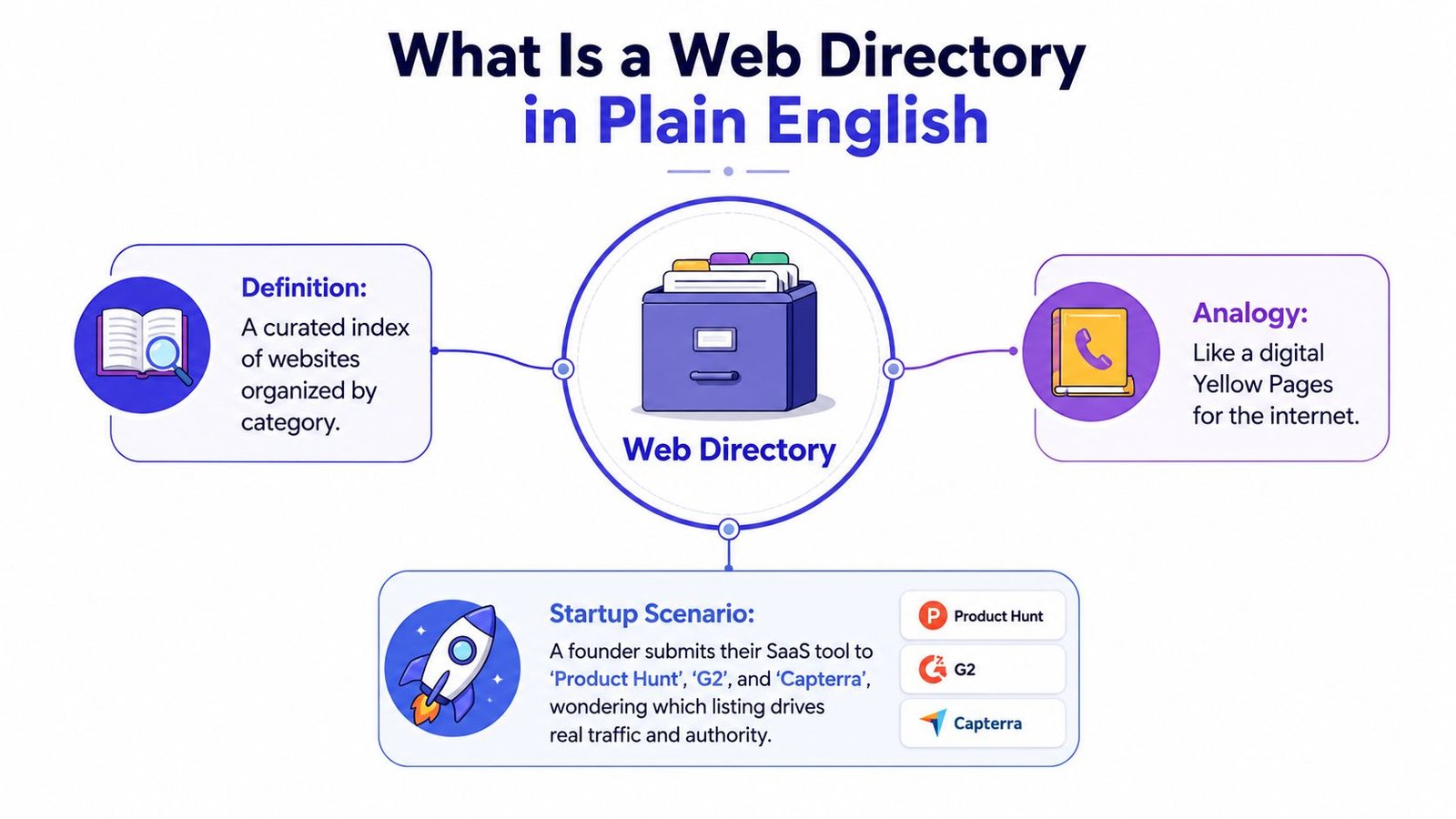
A web directory is a curated index of websites organized into categories, usually through editorial review rather than automated crawling. Think of it as a digital Yellow Pages, except the entries may describe software, companies, publications, communities, or specialist resources instead of local services.
When a founder submits a product to StartupSubmit, the practical question isn’t whether the product gets listed. The better question is whether the directory has a useful taxonomy, a real audience, an indexable page, and enough editorial credibility for the listing to support discovery.
Directory versus search engine
A search engine crawls and retrieves pages in response to a query. A directory classifies websites in advance. Its core function is category assignment, not query-time ranking, as explained in this comparison of web directories and search engines.
That distinction changes how you judge performance:
- Search engines answer questions such as “best accounting software for startups.”
- Directories place products under categories such as accounting, finance, SaaS, or startup tools.
- Bookmarking sites let users save or share links, often with little editorial control.
- Review marketplaces combine product listings with ratings, customer feedback, and comparison features.
For a SaaS launch, the right directory can create several useful assets at once: a branded profile, a category association, a referring domain, and a third-party page that explains what your product does. Those assets may support traditional SEO and help AI systems connect your company with a specific topic.
The wrong directory is just an empty submission form. It may accept your money or URL without giving users a reason to visit, editors a reason to trust the entry, or crawlers a reason to retain it.
How Web Directories Evolved from Yahoo to AI Overviews
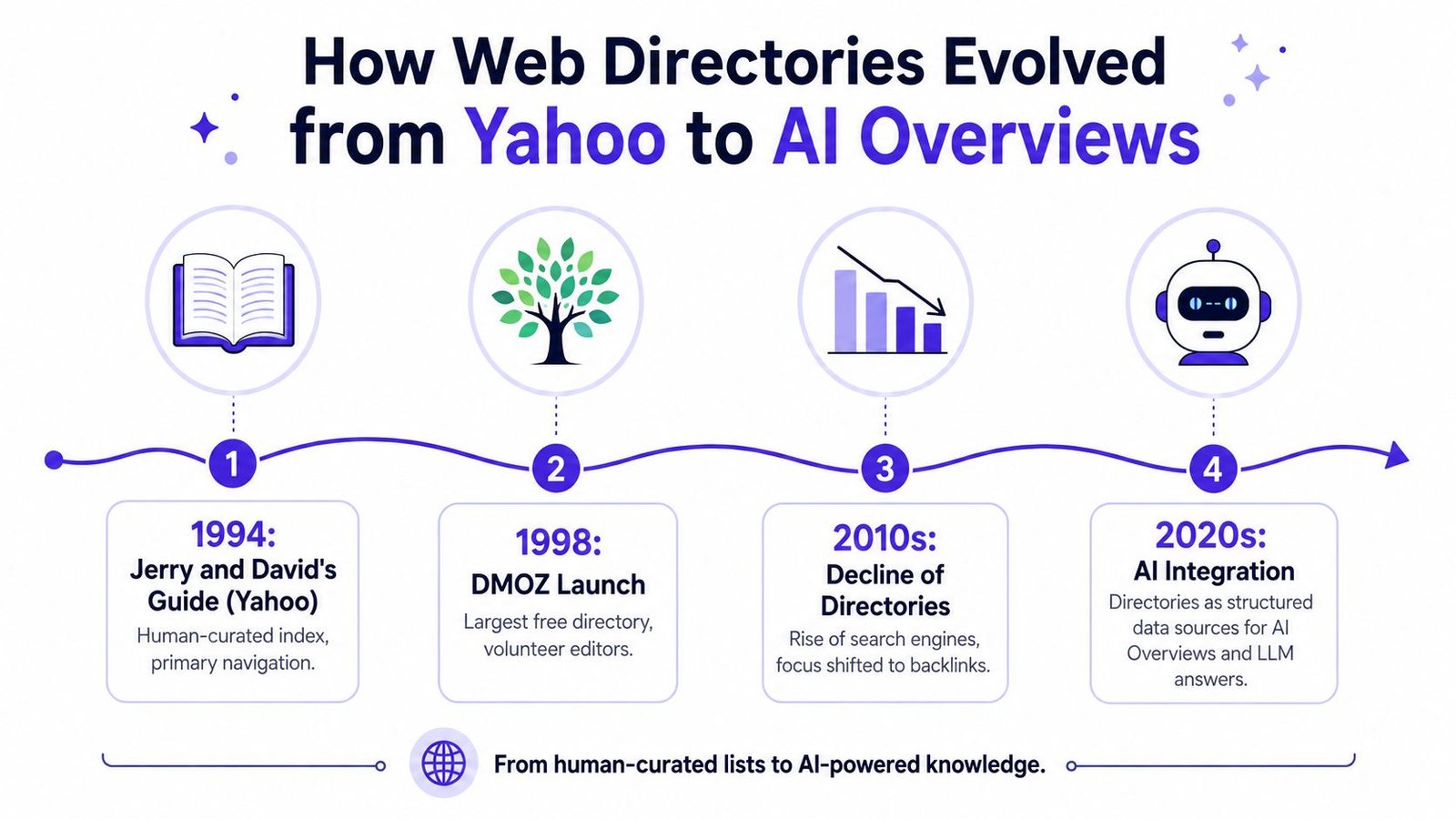
Directories began as a navigation layer for a web that was still difficult to explore. Yahoo launched its directory in 1994 under the name “Jerry and David’s Guide to the World Wide Web,” according to the historical account from ODP. Human editors organized websites into categories because automated crawling and ranking weren’t yet the dominant way to find information.
DMOZ, also called the Open Directory Project, launched in 1998 and became the largest free web directory. Its volunteer-editor model created a level of selectivity that bulk-listing websites never matched. The trade-off was speed. One historical account describes new submissions waiting 6–12 months for review, a reminder that human curation can produce quality while creating operational bottlenecks. DirectoryReady’s history of web directories documents that transition.
Why search engines changed the model
As search engines improved, users stopped browsing category trees for most everyday queries. Search engines could crawl a much larger portion of the web and rank pages dynamically. Inbound links also became strategically important, which pushed many directories away from navigation and toward link building.
That shift created a bad incentive. Directory owners could charge for listings, while marketers could submit to large numbers of sites without considering audience or editorial fit. The result was a crowded market of directories that looked useful on the surface but delivered little discovery value.
Why directories are returning in a different form
Modern software platforms revived the directory model with richer profiles and stronger user intent. Product Hunt focuses on launches and product discovery. G2 and Capterra support software comparison. Indie Hackers connects products with a founder community. These platforms aren’t lists of URLs. They add context, categories, reviews, discussions, or launch activity.
AI search adds another reason to care. A 2026 analysis of about 4,200 commercial-intent queries reported that AI Overviews surfaced at least one third-party directory citation in roughly 73% of cases when a local-services or product-category interpretation was plausible, according to Jasmine Directory’s analysis. Google also says pages appearing in AI features such as AI Overviews are included in overall search traffic.
The modern opportunity isn’t to recreate Yahoo’s directory. It’s to build accurate, trusted profiles where buyers and AI systems can verify what your company does.
The Four Directory Types Founders Should Know
Founders often ask for “directory submissions” as if every listing has the same job. It doesn’t. The category determines the audience, the profile format, the likely referral intent, and the type of trust the listing can create.
| Directory type | Primary job | Useful for SaaS and AI startups | Main trade-off |
|---|---|---|---|
| General directories | Broad web categorization | Basic brand presence and discovery | Weak audience relevance |
| Niche directories | Topic-specific discovery | Qualified traffic from a defined community | Smaller total reach |
| Local directories | Geographic business discovery | Agencies, local SaaS providers, location-based companies | Limited value for purely global products |
| Software and startup directories | Product comparison, launches, and founder discovery | Most early-stage SaaS and AI products | Profiles often need ongoing maintenance |
General directories
General directories can provide a basic citation, but they rarely deserve the largest share of a startup marketing budget. Their categories are broad, and the user intent is often unclear. A listing may help search engines discover a brand reference, but it won't automatically produce qualified demand.
Treat these directories as supporting assets. Check whether the category pages are indexed and whether real websites appear in the listings before investing time.
Niche directories
Niche directories are usually more useful when your product solves a recognizable problem. An AI tool directory, no-code directory, developer resource directory, or cybersecurity catalog can place your startup beside products buyers already consider.
The smaller audience is often an advantage. A visitor browsing a focused category has already supplied context, so your product doesn't need to fight for attention against unrelated companies.
Local directories
Local listings matter when geography affects the purchase. A local consultancy, implementation partner, software provider with regional sales, or service business may benefit from consistent business details across relevant platforms.
For a fully distributed B2B SaaS product with no local service footprint, local directory work is usually a lower priority. Don't force a local strategy onto a global product just because local citations are easy to buy.
Software and startup directories
Most early-stage founders should begin here. Product Hunt, G2, Capterra, BetaList, Indie Hackers, AlternativeTo, and SaaSHub each connect software with a different discovery or comparison behavior.
A focused submission plan can include AI directory submission support when the product needs placement across relevant AI and software categories. The strategic rule is simple: one credible, well-matched profile can be more useful than ten generic listings because relevance gives the page a reason to attract clicks, references, and trust.
How Directories Affect SEO, Backlinks, and AI Visibility
A directory listing can influence three connected outcomes, but none is guaranteed by submission alone.
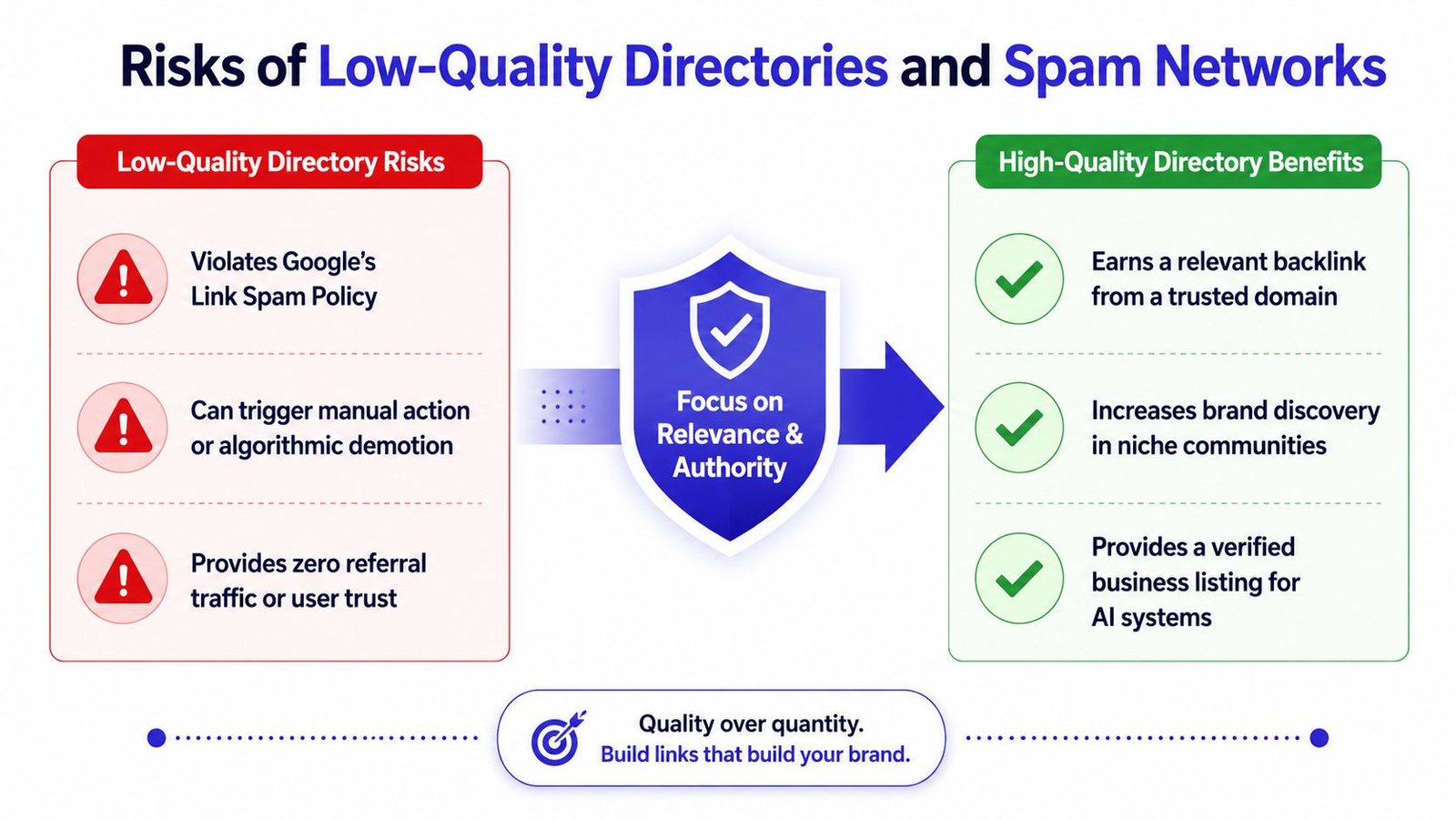
First, it can create a referring domain. If the directory is indexed, authoritative, and editorially maintained, its page may participate in the broader link graph. If the page isn't indexed or the site behaves like a link farm, the backlink may provide little practical value.
Second, it can improve brand discovery. A prospect may encounter your product through a category page, a comparison search, a review profile, or a branded query. That exposure can matter even when the directory link doesn't produce a measurable ranking change.
Third, it can provide structured information for AI search systems. A profile that consistently states the company name, product category, use case, integrations, and website gives third-party systems a clearer entity record than an isolated homepage mention.
Indexing is the gatekeeper
Industry reporting has found that only a minority of submitted directory backlinks are indexed. One dataset reported an overall indexing rate of around 23%, while another multi-domain study reported roughly 24.3%, as described in the analysis of 200 directory submissions across 15 sites.
Those figures don't mean every directory campaign will produce the same result. They show why submission volume is a poor substitute for quality control. Track the live URL, confirm that the page exists, and check whether search engines can discover it.
Citation and backlink aren't the same
A backlink is a clickable link from another website to yours. A citation is a mention of business or entity information, which may include a link but doesn't have to.
For local businesses, NAP consistency means keeping the name, address, and phone number accurate and consistent across listings. For SaaS companies, the equivalent discipline includes consistent brand spelling, product naming, homepage URL, category, founding description, and positioning language.
A clean profile helps humans understand the company. It also gives crawlers and AI systems fewer conflicting signals to reconcile.
AI visibility needs corroboration
AI Overviews and LLM-powered discovery don't depend on one profile alone. They draw from an ecosystem of pages, and directory profiles can serve as structured third-party corroboration. That makes directory work part of AI search optimization and LLM SEO, not a replacement for product pages, documentation, reviews, or useful editorial content.
For SaaS founders, the practical objective is entity consistency. Make sure independent platforms describe the product in compatible terms, use the correct category, and link to a page that confirms the same positioning. A SaaS directory submission service can support the repetitive execution, but the founder still needs to define the message and approve the categories.
Reputable Web Directories Worth Your Time
The right shortlist depends on your product and launch stage. A consumer app may benefit from launch momentum on Product Hunt. An established B2B platform may care more about G2 and Capterra reviews. A developer tool may gain more from AlternativeTo, SaaSHub, and specialist communities than from a broad startup catalog.
| Directory | Focus | Editorial style | Best fit |
|---|---|---|---|
| Product Hunt | Product launches and discovery | Community-driven launch activity | New products, major releases, founder-led launches |
| G2 | Software reviews and comparisons | Review-driven marketplace | B2B SaaS with customers willing to review |
| Capterra | Software categories and buyer comparison | Structured marketplace listings and reviews | Category-led software discovery |
| BetaList | Early-stage startup discovery | Curated startup submissions | New startups seeking early visibility |
| Indie Hackers | Founder community and product stories | Community participation and discussion | Indie hackers and bootstrapped products |
| AlternativeTo | Alternatives to known software | User-oriented categorization | Products with clear competitors or substitutes |
| SaaSHub | SaaS discovery and comparisons | Product catalog and category structure | SaaS products building broader discovery |
| AI and specialist lists | Topic-specific tool discovery | Varies by editor and niche | AI products, no-code tools, developer software |
What makes these platforms useful
Product Hunt and BetaList can support launch discovery, but they're often event-oriented. A launch spike doesn't automatically become durable organic traffic. G2 and Capterra can support evaluation-stage searches, but their value increases when your product has credible customer feedback and a complete profile.
AlternativeTo and SaaSHub are useful when buyers compare products by function. Indie Hackers is different. It's less of a conventional software marketplace and more of a community where the founder story, progress, and participation affect visibility.
Founders who don't have time to check duplicate listings, rewrite descriptions for each platform, and document acceptance status sometimes use a manual service such as StartupSubmit's startup directory submission service. The useful part of that model is the workflow, not the raw submission count. You still need to approve the positioning, categories, and destination URLs before anything goes live.
Selection rule: Choose directories based on buyer intent first, editorial quality second, and backlink potential third.
A good shortlist normally includes a mix of launch, review, comparison, and niche platforms. Avoid treating every site as interchangeable. G2 is not a substitute for Product Hunt, and an AI tool catalog is not a substitute for customer reviews.
Risks of Low-Quality Directories and Spam Networks
More listings can make a startup feel busy without making it more discoverable. Google defines link spam as links created primarily to manipulate rankings and explicitly lists low-quality directory or bookmark site links among examples in its spam policies.
That policy matters because a directory backlink isn't automatically a positive signal. Search engines may ignore links that appear manipulative, and a mass-submission pattern can waste effort while creating inconsistent company information across the web.
Filters to apply before submitting
Use a short review process before you hand over product details or pay a listing fee:
- Inspect the category page: Look for real companies, useful descriptions, and a coherent taxonomy.
- Check indexability: Confirm that public profile pages can be reached by crawlers and aren't hidden behind account walls.
- Review editorial standards: A directory that accepts every submission instantly has little evidence of curation.
- Assess relevance: A product listing should sit beside comparable tools, not unrelated websites.
- Look for user behavior: Search the directory's brand and categories to see whether it has a visible discovery role.
- Watch the sales pitch: Promises of guaranteed rankings, guaranteed authority, or huge backlink counts are warning signs.
Don't obsess over a third-party metric such as Domain Rating in isolation. A high score doesn't rescue an irrelevant category, an unindexed profile, or a page surrounded by obvious paid links.
The cost of bad data
Inconsistent company names, descriptions, URLs, and contact details create more cleanup work later. Local businesses face additional NAP problems, while SaaS companies can confuse buyers and automated systems when one profile calls the product an analytics platform and another calls it a CRM.
A directory should earn its place in your launch stack by improving context, not by increasing the number of URLs in a spreadsheet.
The safest strategy is selective coverage. Submit to fewer relevant platforms, keep the profiles accurate, and record which listings are accepted and discoverable.
A Founder-Friendly Submission Workflow That Works
A directory campaign starts with a controlled source of truth. Prepare one approved sheet with the official product name, short and long descriptions, categories, target audience, pricing language, social profiles, logo files, screenshots, and canonical website URL. This prevents small inconsistencies from spreading across public profiles and confusing buyers or search systems.
Run submissions in this order:
- Find existing profiles. Search for the company, product, founders, and previous names. Claim or update an existing listing instead of creating a duplicate.
- Choose the right category. Select the category that reflects the product's primary job. Extra tags may increase coverage, but they can weaken relevance.
- Adapt the description. Keep the positioning consistent, then revise the opening for each platform's audience and character limits.
- Submit manually where context matters. Moderated directories may request screenshots, founder details, or launch information. Automation can create duplicates and recognizable submission patterns.
- Record the outcome. Save the submitted URL, status, date, category, and editorial notes. Capture a screenshot after acceptance.
- Inspect the published page. Check the link, logo, description, category, and contact details once the listing is live.
A useful report makes every decision reviewable. Include live URLs, acceptance notes, rejected submissions, duplicate findings, and available screenshots. Add the reason for any rejection when the platform provides one, so the next submission is more precise.
A manual workflow such as directory submission service can handle repetitive research, categorization, and form completion while the founder controls positioning. Delegate execution if it saves time, but review the copy and categories yourself. The finished deliverable should be an auditable set of profiles, not a vague assurance that forms were sent.
Checklist and Next Steps for Your First Submission Sprint
Use this checklist before you start:
- Define the goal: Choose discovery, reviews, backlinks, reputation, AI visibility, or a combination.
- Shortlist by type: Start with software, startup, niche, or local directories that match the product.
- Verify quality: Review relevance, editorial standards, indexability, and the surrounding listings.
- Prepare consistent data: Approve the product name, categories, descriptions, URLs, images, and contact details.
- Run the submissions: Work through the shortlist manually or use a documented manual workflow.
- Log every outcome: Record submitted, accepted, rejected, duplicate, and pending profiles.
- Check visibility: Revisit published URLs and monitor referral traffic, branded searches, indexing, and AI-generated mentions where possible.
- Review quarterly: Update profiles after major positioning, pricing, product, or brand changes.
Common questions
How long do directory submissions take
Review time varies by platform. A submission can publish quickly on an active launch site or wait for editorial moderation on a curated directory. Measure outcomes after the listing is live, not immediately after the form is sent.
Do directories still help AI search visibility
They can help when the directory is relevant, structured, publicly accessible, and trusted. The evidence is strongest when directory information agrees with your website, reviews, documentation, and other third-party profiles.
Should every startup submit to hundreds of directories
No. Coverage only helps when the platforms are relevant and the pages are useful. A smaller, carefully reviewed set is safer than bulk submissions to citation farms.
Start with a focused 5–14 day submission sprint. Pick the platforms that match your buyer, prepare one approved profile brief, document every result, and review the live listings before expanding the campaign.
StartupSubmit offers manual submissions across startup and software directories, including duplicate-checking, categorization, and a final report with submitted URLs and acceptance notes. If you want a documented directory workflow for your SaaS or AI launch, visit StartupSubmit and review the available submission options.