Software Submission Sites: 10 Options Compared for 2026
A 200-directory package sounds impressive until you check how many listings are approved, how many fit your product, and what happens when a directory rejects your submission. Directory count measures activity, not distribution. Buying more form submissions isn't automatically better startup marketing.
The usual advice about software submission sites is to maximize coverage and collect backlinks. That skips the questions that affect your budget: Does a badge need to stay on your website? Are paid-launch fees included? Can you get a refund after work starts? Will anyone discover your product?
An independent LaunchList audit of startup directories found that only 596 of 1,276 directories, or 47%, had published a listing within the previous 90 days. A long target list can contain plenty of inactive destinations.
Buy a relevant distribution campaign, not a spreadsheet that happens to contain lots of domains.
Before choosing a provider, separate these outcomes:
- Submitted: Someone completed the application.
- Approved: The directory accepted your product.
- Indexed: A search engine can find the published profile.
- Commercially useful: The listing produces qualified visits, signups, or credible buyer exposure.
Consistency matters, too. The same discipline used to build consistent business directory listings applies to software profiles: accurate names, categories, descriptions, and destination URLs make your business easier to understand.
The options below cover managed services, smaller campaigns, and directory catalogs. The useful comparison isn't who advertises the biggest number. It's who handles the work you need, under conditions you can accept.
Table of Contents
- 1. StartupSubmit
- 2. SubmitStorm
- 3. SubmitSaaS
- 4. AI Directories
- 5. LaunchDirectories
- 6. Listifying
- 7. EasySubmits
- 8. GTM Works
- 9. SaaSListing.co
- 10. Submitator
- How the ten services differ on pricing model, directory scope and best-fit buyer
- Pick One Service, Then Measure What Sticks
1. StartupSubmit
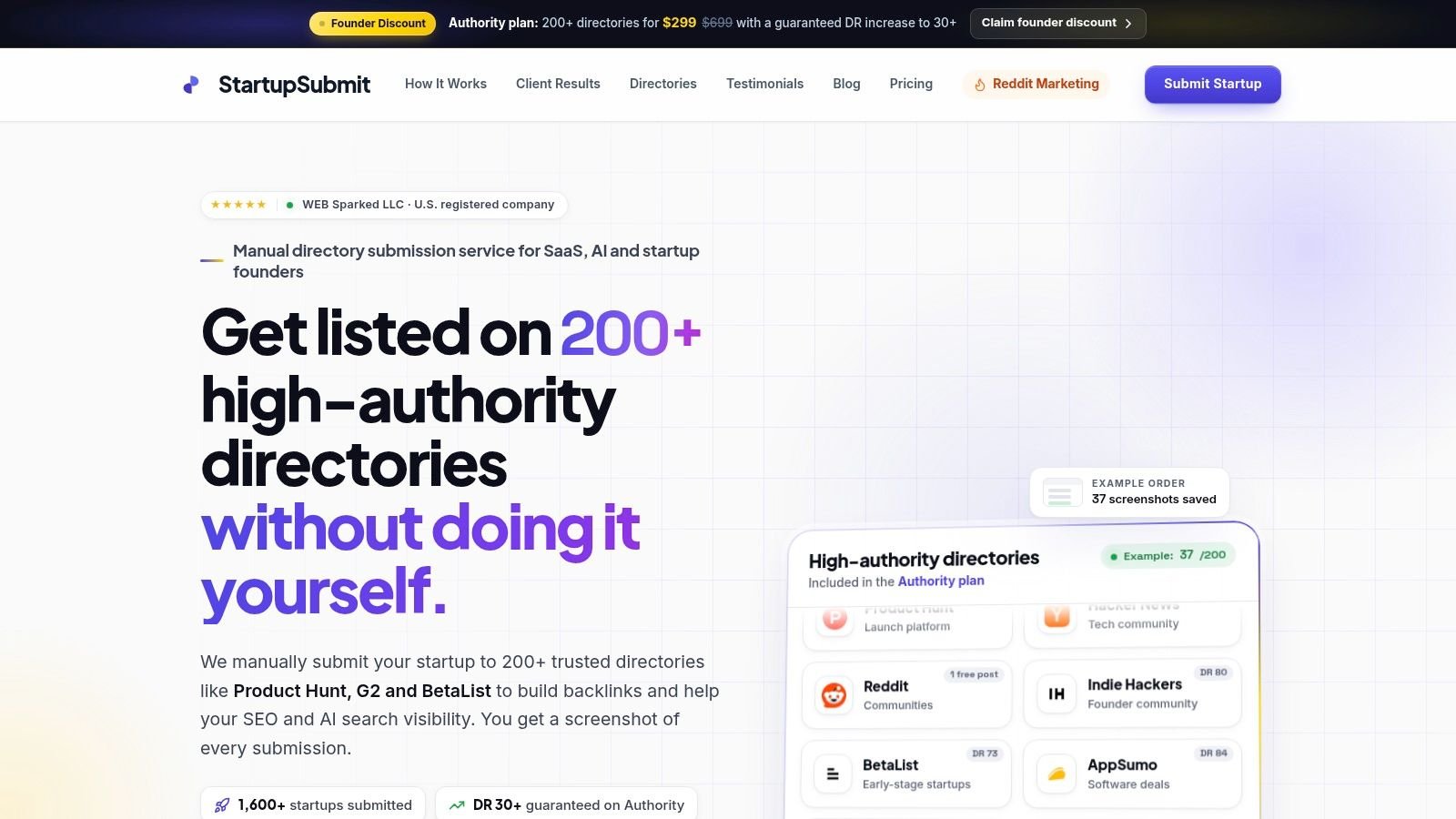
Best for SaaS and AI founders who want manual execution with documented submissions. Our service handles category selection, duplicate checks, platform-specific forms, captchas, and verification emails rather than sending generic copy through automated tools.
We select targets from a database of 300+ platforms, matching each product to relevant software directories, launch communities, and niche listings. Coverage includes G2, Capterra, Product Hunt, BetaList, Indie Hackers, AlternativeTo, and SaaSHub. Separate startup, SaaS, and AI services help keep the directory mix aligned with the product.
The practical benefit is less founder administration. A developer tool needs different categories and communities from an AI meeting assistant, even when both are sold as SaaS.
What You Receive and What Remains Outside Our Control
Our submissions are 100% manual, performed by SEO specialists, with a screenshot of every submission. We complete submissions within 5–7 days, but directory moderation and publication can take longer.
- Coverage: The top plan covers 220+ directories, selected for eligibility and fit.
- Evidence: Reporting includes submission URLs, screenshots, and acceptance notes where available.
- Track record: We've submitted 1,600+ startups.
- Boundaries: Completing an eligible platform's vendor submission process doesn't guarantee acceptance, rankings, referral traffic, or AI citations.
One-time plans suit founders who don't want another recurring marketing subscription. The service also includes custom listing information rather than treating every destination as an interchangeable backlink.
For any advertised Domain Rating guarantee, distinguish the metric's contractual terms from business outcomes. A third-party authority score isn't a promise of customers, and a case study can't isolate directory submissions from other SEO work.
My recommendation: Choose this approach when your bottleneck is execution and consistency. Before purchasing, read the current plan's refund and badge-management terms, then judge delivery by the documented work and the quality of live profiles, not by assumed ranking gains.
2. SubmitStorm
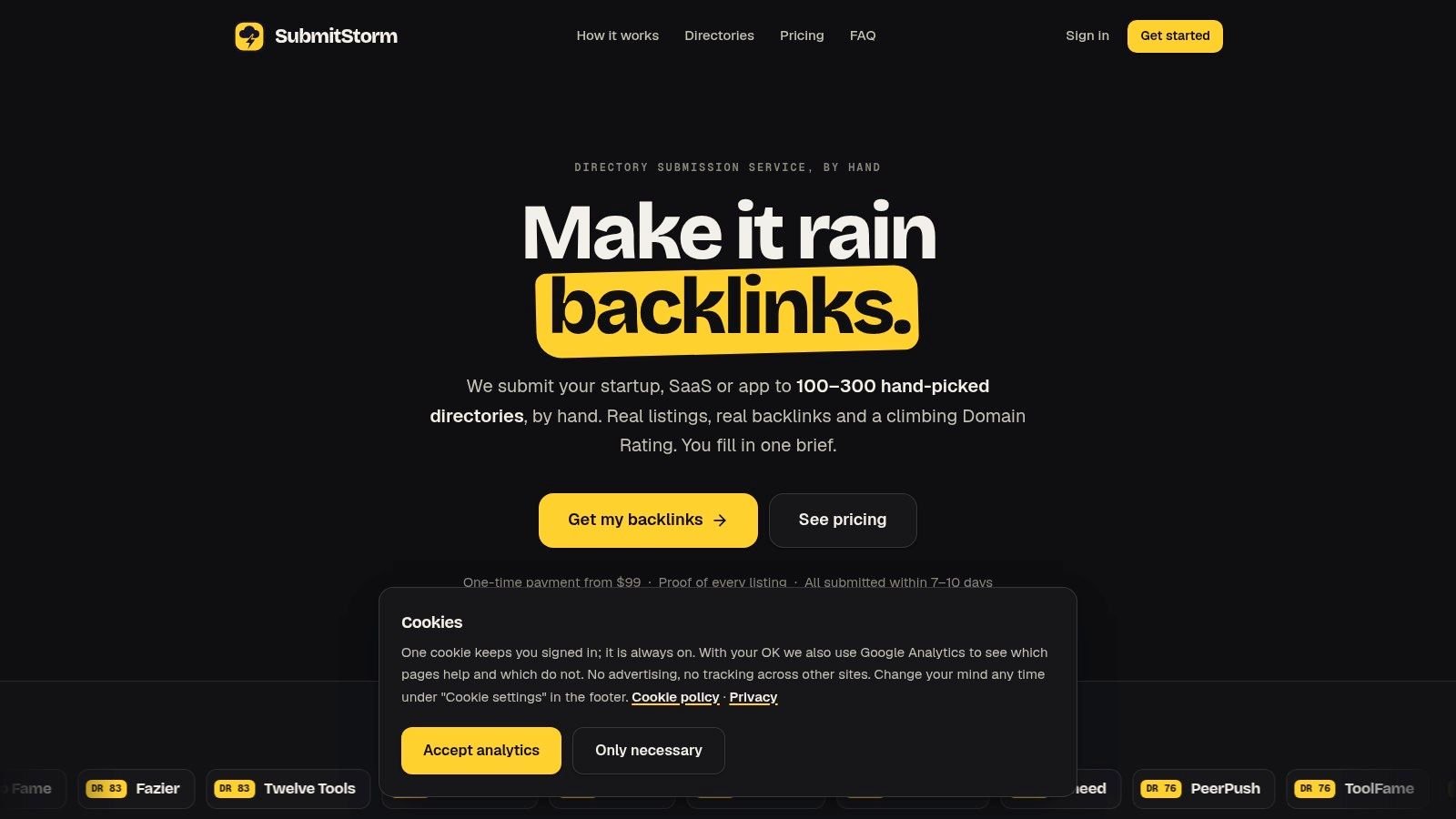
A dashboard is useful when someone on your team will review it. SubmitStorm combines packaged submissions with tracking and a final report, making it a reasonable candidate for founders who want campaign visibility without managing each application.
SubmitStorm advertises one-time packages covering 100 to 300 directories, with manual submissions and product-category matching. Its positioning spans SaaS, startups, AI tools, and apps, so suitability depends on the target list rather than the headline package size.
The main trade-off is the optional badge component. If badge-related placements count toward the purchased submission total, you need to understand what you're authorizing before comparing its package with another provider's.
Treat Badge Placement as a Separate Decision
A directory application and an outbound badge on your homepage aren't equivalent deliverables. The latter changes your own website and may introduce a continuing obligation.
- Strong point: Dashboard tracking and screenshot evidence make the submission work easier to inspect.
- Watch closely: Establish whether optional badges affect the advertised total.
- Don't assume: Promotional Domain Rating estimates aren't guaranteed SEO results.
For a founder running several launch activities simultaneously, centralized tracking can reduce the work of reconciling emails and spreadsheets. It won't solve irrelevant targeting, though.
I'd prioritize this service when reporting convenience matters, provided the proposed directories match the product. Keep refund eligibility, badge consent, and approval status separate in your purchase decision. None should be inferred from a delivery-window claim.
3. SubmitSaaS
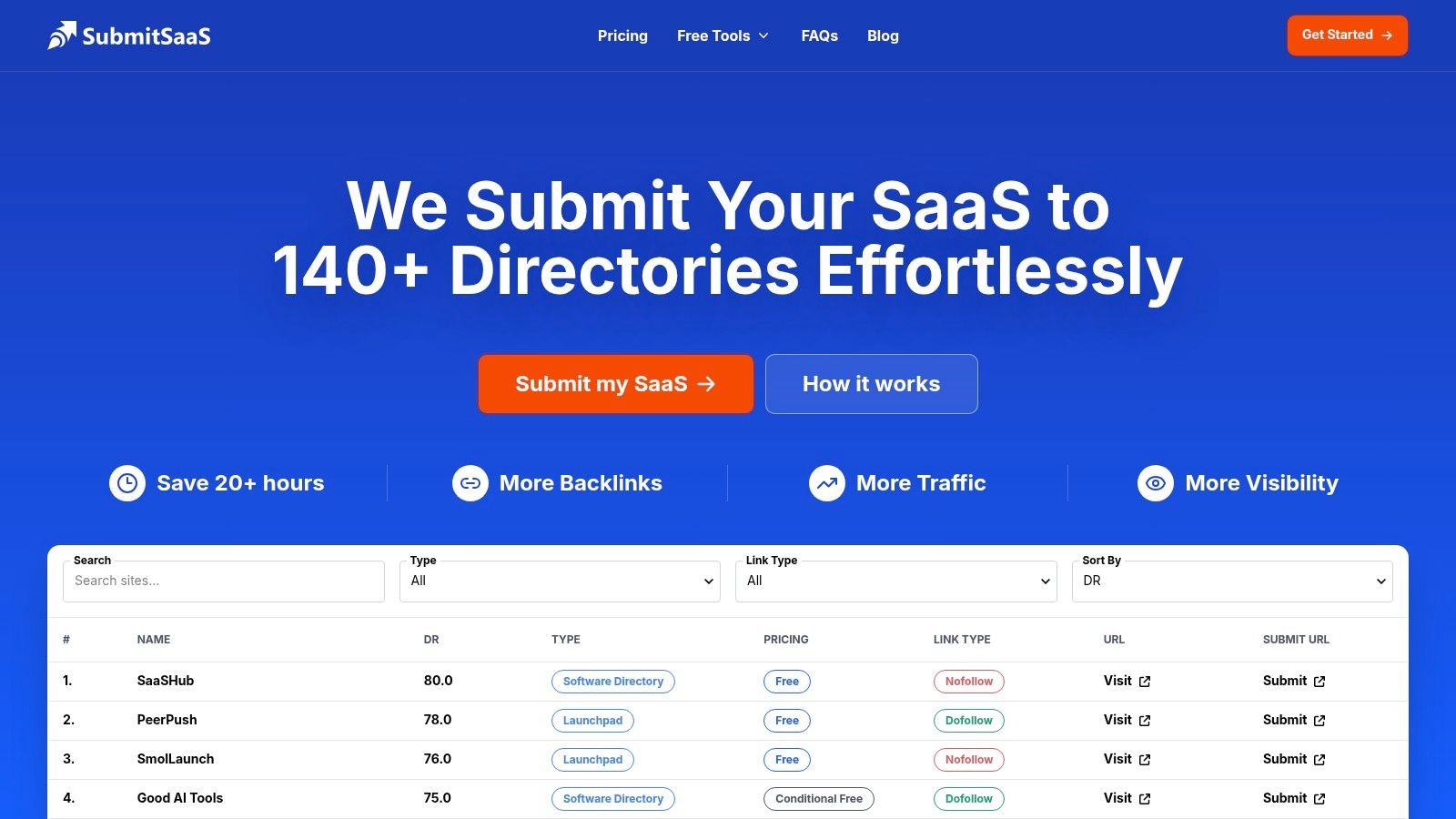
Say you've launched a subscription product and already have clear positioning, screenshots, and pricing. You don't need a launch consultant. You need someone to complete relevant profiles without creating inconsistent versions of your product description.
That's the appeal of SubmitSaaS: fixed submission bundles aimed at SaaS businesses, with listing information handled during the campaign and a report afterward. The straightforward scope can suit a founder who wants a bounded outsourcing task.
The compromise is control over the target list. A preset bundle is easy to purchase, but it may include destinations you've already covered or categories that don't suit your customers.
- Useful inclusion: Listing-copy and consistency work can reduce inaccurate descriptions.
- Budget consideration: Separate directory listing fees may sit outside the service charge.
- Selection risk: A bundle's submission count doesn't establish how many profiles will become public.
Before committing, prepare your existing-profile list. Otherwise, you may pay for work that overlaps with accounts you already own.
The comparison of managed SaaS submission approaches is useful when deciding how much customization and reporting you need. Compare directory selection and handling of existing listings, not just the entry price.
For a tightly defined SaaS product, a fixed bundle can be enough. For software spanning several buyer categories, I'd put more weight on category-level targeting than on a modest difference in package cost.
4. AI Directories
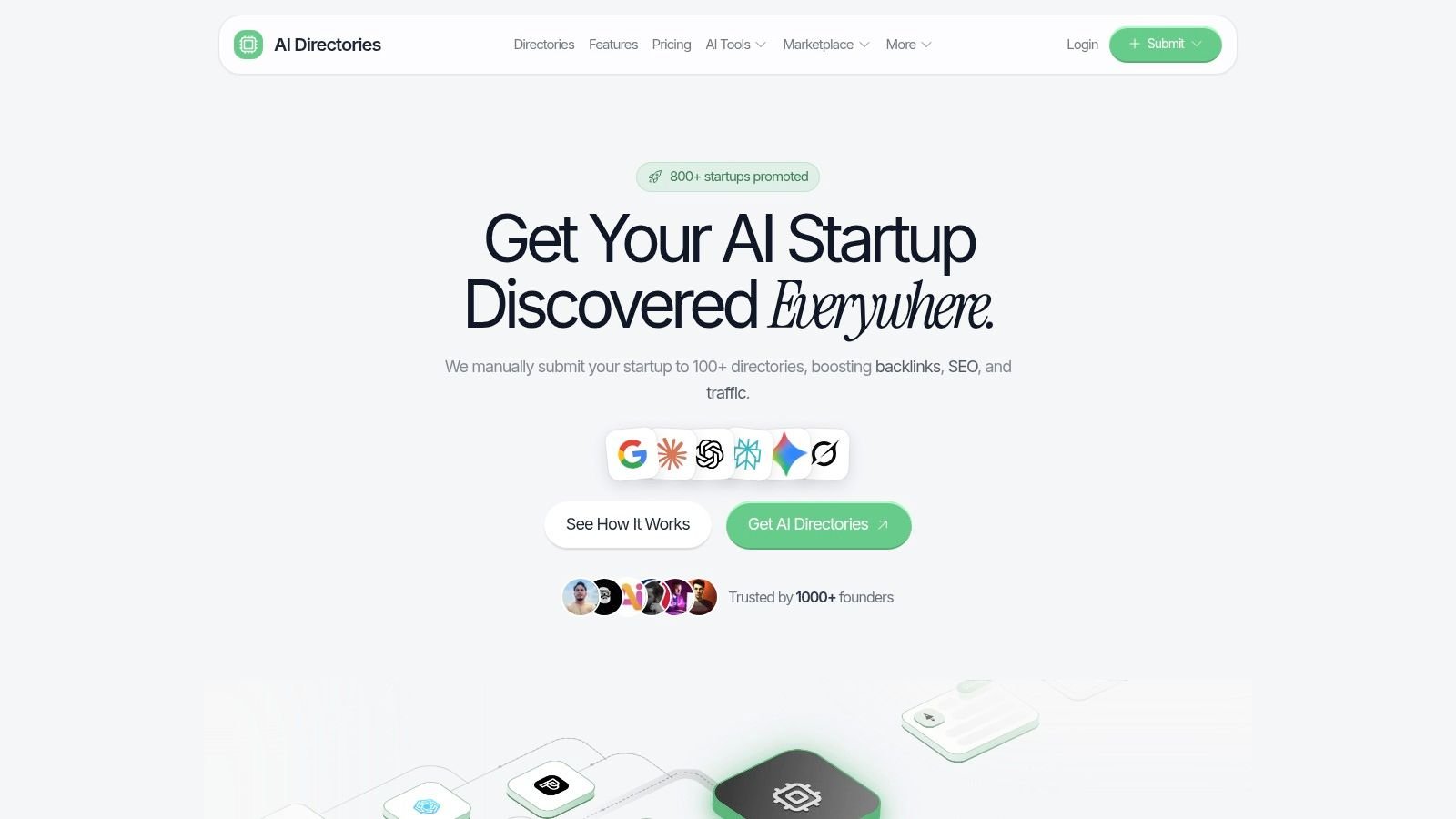
An AI label doesn't automatically make every AI directory relevant. A developer-facing coding agent and a consumer image generator may share the same underlying technology while attracting entirely different audiences.
AI Directories offers manual packages covering 30+, 60+, or 100+ AI directories, and its FAQ says it can also work with non-AI tools. Higher tiers include a stated allowance for paid directory fees, while the pricing page also describes an owned-directory listing and newsletter mention.
That fee allowance is worth examining. It gives buyers something more concrete to evaluate than an unspecified promise of premium exposure.
Separate Submission Work From Purchased Exposure
Paid directory access, newsletter promotion, and a standard product profile should be evaluated separately. Each can have different publication conditions and different potential to generate visits.
- Best fit: AI products with a clear category and an audience that browses tool directories.
- Main uncertainty: The pricing page doesn't state a clear delivery timeline.
- Policy distinction: A satisfaction guarantee isn't necessarily a specific, time-bound refund policy.
The AI directory service comparison can help clarify the trade-off between specialist AI coverage and broader startup distribution.
For an AI founder, I'd write the listing around the task the product completes, not just the model or technology it uses. A buyer searching for transcription software needs to understand supported workflows, output quality, and intended users. Clear use cases beat generic AI positioning, whether the listing is read by a person or summarized by a search system.
5. LaunchDirectories
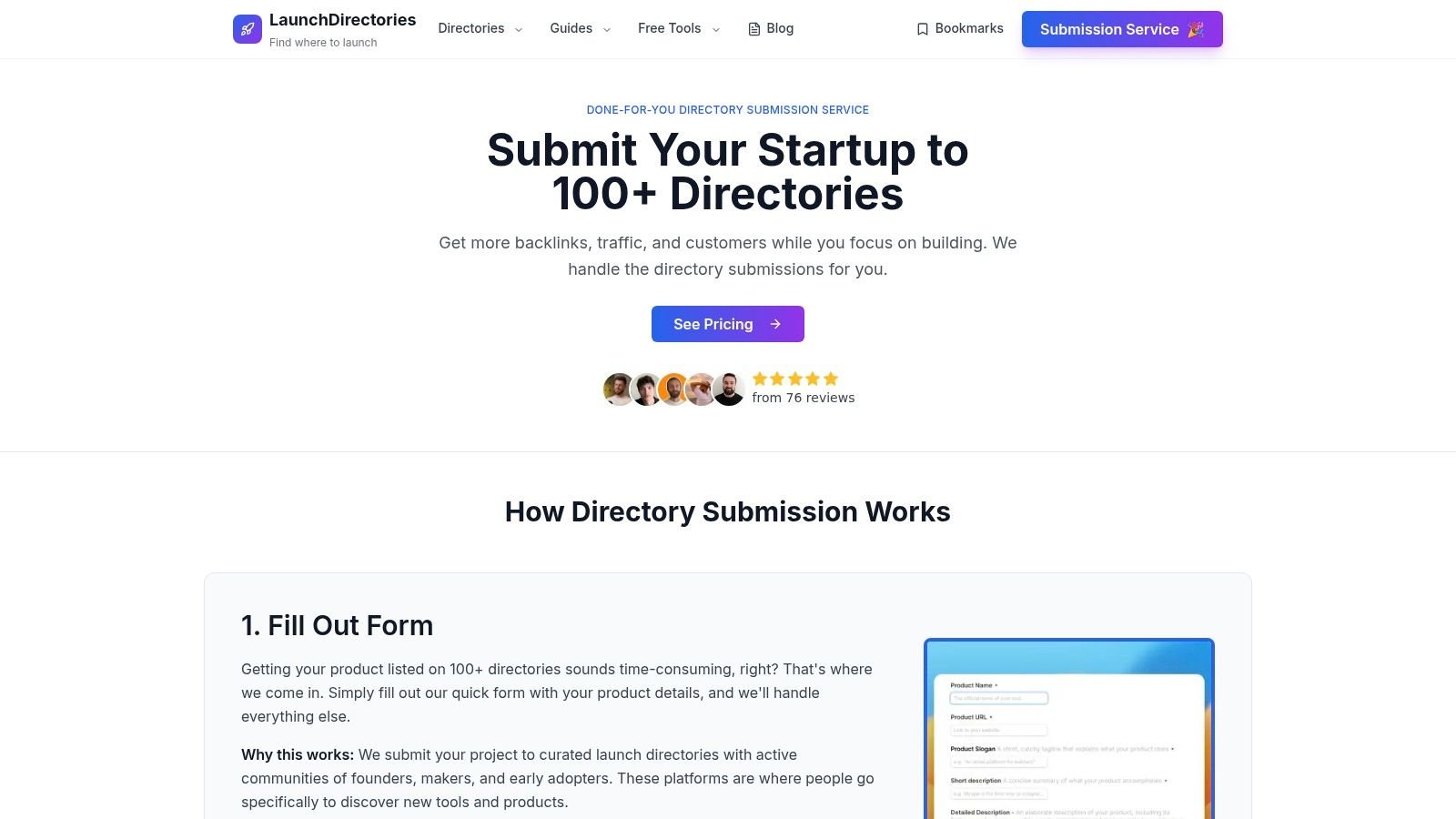
LaunchDirectories is worth considering when you want directory submissions and selected paid launches in the same campaign. Those are related activities, but they shouldn't be treated as identical.
LaunchDirectories states an average delivery time of four to six days for its manual submission service and describes hand-picked packages with detailed reporting. Selected packages include paid launches on partner directories.
The obvious benefit is coordination. A founder can prepare assets once instead of managing separate submission and promotional vendors.
A paid launch deserves its own line in the report. Record where it appeared, what exposure was purchased, and which visits or signups followed.
The limitation is attribution. A temporary featured position may produce a launch spike, while an ordinary profile may remain discoverable later. If both are reported as completed placements, you lose the ability to compare them.
- Confirm inclusion: Identify the partner launches included in your chosen package.
- Check fee boundaries: Establish whether any additional directory charges remain payable.
- Measure separately: Tag promotional destinations where permitted and compare their visitors with ordinary directory referrals.
The LaunchDirectories service comparison provides a starting point for comparing campaign scope.
I'd choose this model when the paid-launch destinations themselves appeal to the target customer. I wouldn't pay extra solely because a package uses the word premium. Publication still depends on each platform's rules, and neither paid exposure nor a backlink establishes lasting search authority.
6. Listifying
Smaller campaigns can be the more sensible starting point. If your positioning is still changing, creating profiles across a huge network also creates a maintenance job you may not be ready to own.
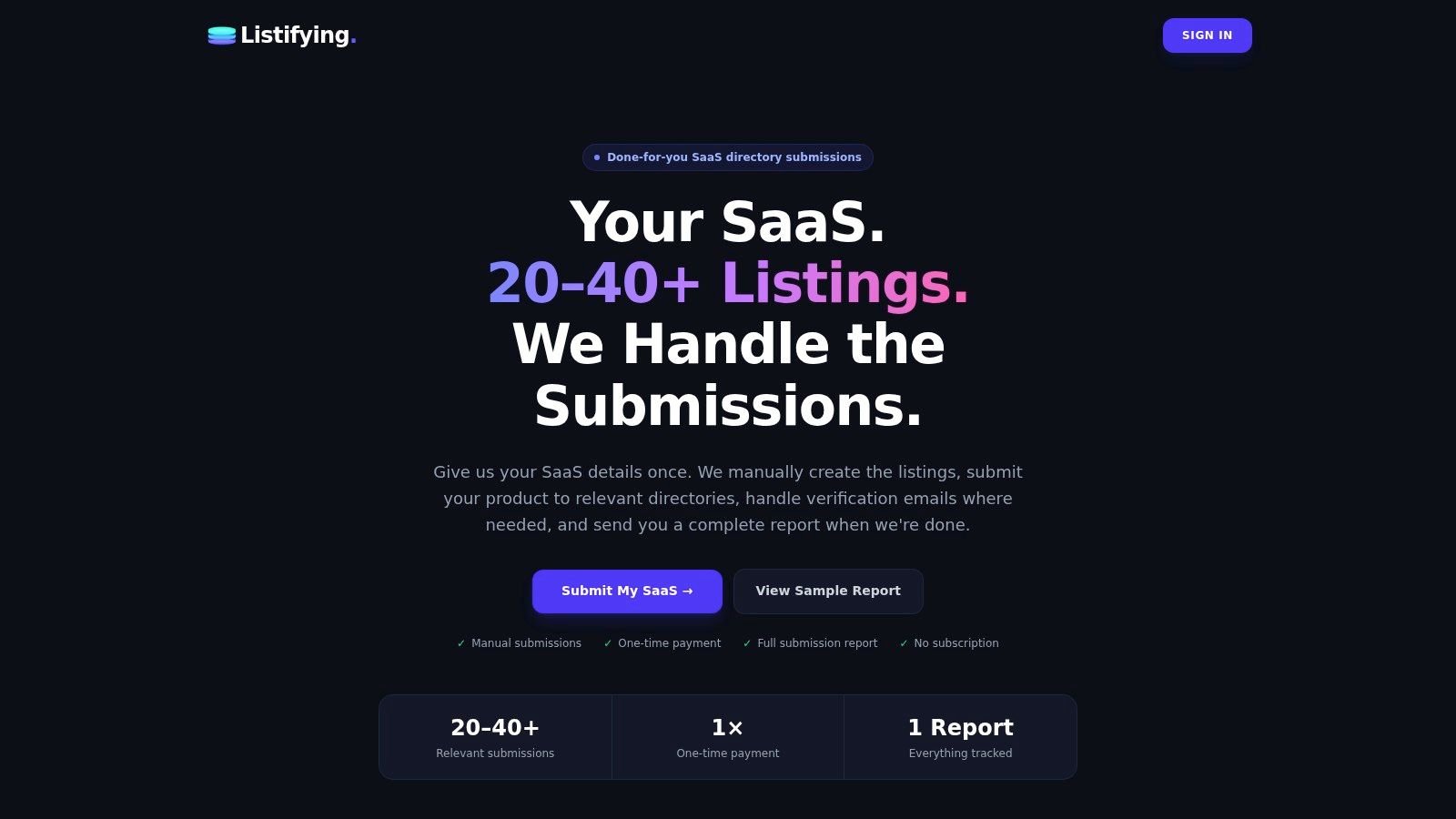
Listifying offers manual submissions with account creation, form completion, and verification-email handling where needed. Its reporting includes submission statuses and listing URLs when available, which is more useful than treating every application as a published profile.
The key purchase condition is explicit: Listifying's terms state that work becomes non-refundable once it has started. That makes onboarding approval consequential, especially if your product name, pricing, or launch date is unsettled.
Finish Your Product Information Before Work Starts
Give the provider a stable company name, canonical website URL, approved description, current screenshots, and a monitored contact email. Don't hand over draft positioning and expect corrections to happen automatically across every destination.
- Good fit: A modest initial campaign with limited administrative complexity.
- Useful boundary: The service distinguishes submission work from guaranteed publication or SEO outcomes.
- Trade-off: Smaller coverage means you may need another campaign later.
Use a curated startup directory selection guide to identify the platforms you'd regret missing before choosing a smaller package.
I'd favor this approach for a solo maker testing a specific product category. The smaller scope makes it easier to inspect the resulting profiles and learn which descriptions attract the right visitors. Just settle the scope before work begins, because the refund condition limits your room to change direction afterward.
7. EasySubmits
EasySubmits gives founders a choice that most packaged services don't emphasize: research directories yourself or outsource a selected batch. That flexibility matters if you enjoy target selection but dislike repetitive account creation.
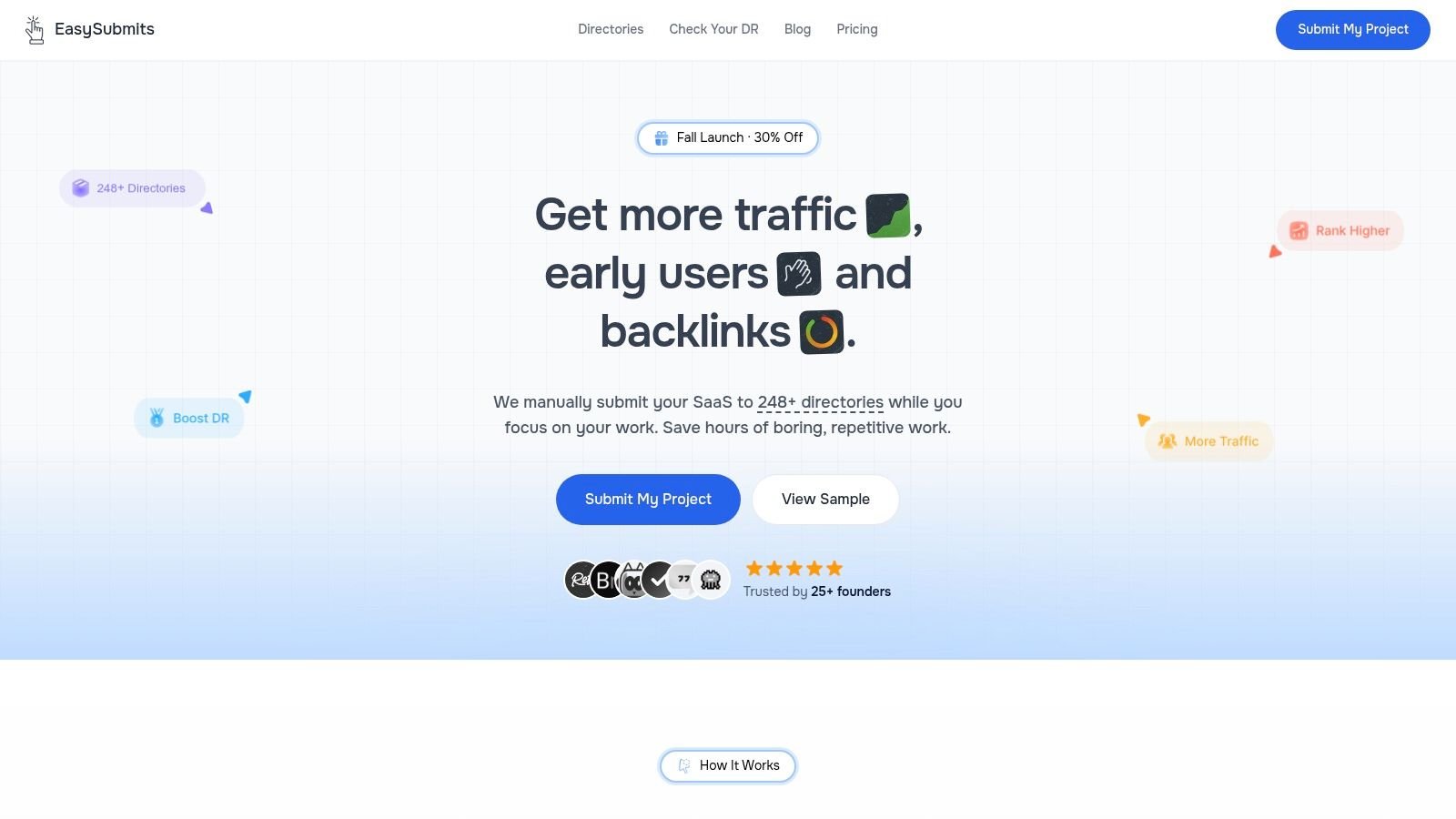
EasySubmits advertises a catalog of 248+ directories, while managed packages cover 20–30 or 40–65 submissions. Catalog size is not campaign size. Treating them as equivalent would distort the comparison.
Its filters cover category, price, and Domain Rating. Those can help narrow a list, but they shouldn't replace inspecting the actual directory pages.
Use Filters to Shortlist, Then Inspect
Open recent profiles in your category. Check whether descriptions are readable, product links work, and visitors can move from a relevant category page to an individual listing.
- DIY advantage: You retain control over research and prioritization.
- Managed advantage: Basic and Premium packages include submission reporting.
- Purchase detail: Premium advertises priority processing, while discounted pricing should be checked at checkout.
A free startup directory resource can also help you decide whether outsourcing is worth the time saved.
This option suits a founder who wants a hybrid workflow: submit personally to strategically important communities and outsource routine profiles. That keeps you involved where launch timing, comments, or community participation matter.
I wouldn't sort purely by Domain Rating. A relevant directory with understandable categories and actual product discovery can be more useful than a high-scoring domain whose listing pages receive no meaningful attention.
8. GTM Works
Some teams don't have a submission problem. They have an asset-preparation and coordination problem.
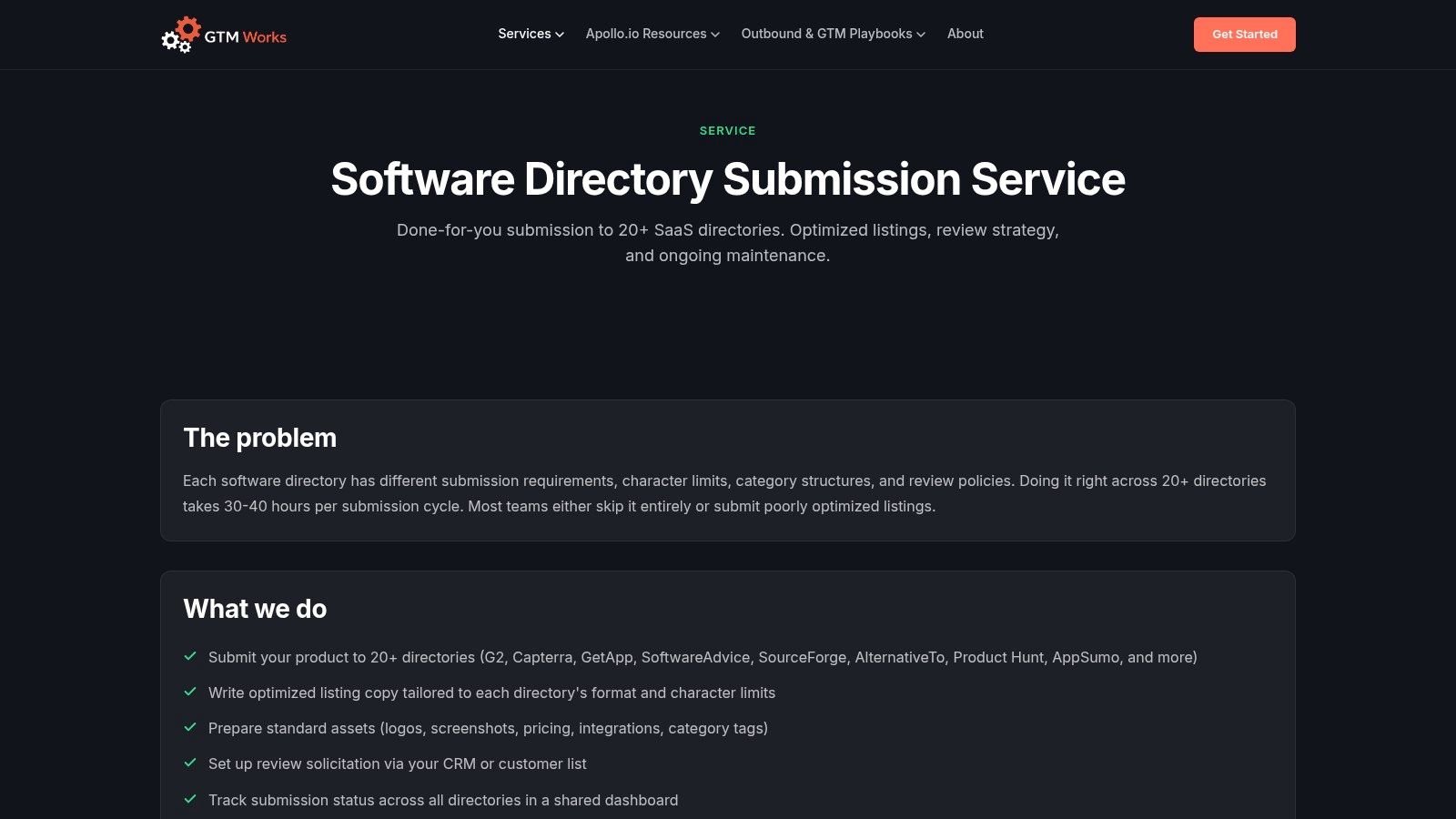
GTM Works offers a more involved service covering platform-adapted copy, logos, screenshots, pricing information, tags, review-solicitation templates, status tracking, and follow-up. Its named destinations include software-review platforms such as G2 and Capterra.
That scope makes more sense for a B2B company preparing buyer-facing profiles than for an indie hacker who already has everything ready to paste into forms. The service costs more than basic submission packages, so the additional coordination needs to be work you require.
Review Profiles Need More Than a Backlink
According to G2's 2024 Buyer Behavior Report, 31% of global buyers surveyed identified public product-review websites as the information source they consult most when planning a business purchase. That supports treating review profiles as sales assets, not merely SEO citations.
- Preparation value: Platform-specific copy can explain your product within each site's taxonomy.
- Coordination value: Follow-up helps address corrections and incomplete applications.
- Compliance requirement: Review requests must follow platform rules and avoid fabricated feedback or non-compliant incentives.
The published scope describes broad platform coverage, but also frames the package as capped directory work. Get the final deliverable list into the agreement rather than assuming every named destination is included.
I'd pay for this model when internal coordination would otherwise delay the campaign. I wouldn't choose it just to maximize referring domains. Its strongest justification is better-prepared buyer information, not submission volume.
9. SaaSListing.co
Already know where you want to appear? SaaSListing.co's bring-your-own-list workflow may be more useful than purchasing a preset bundle.
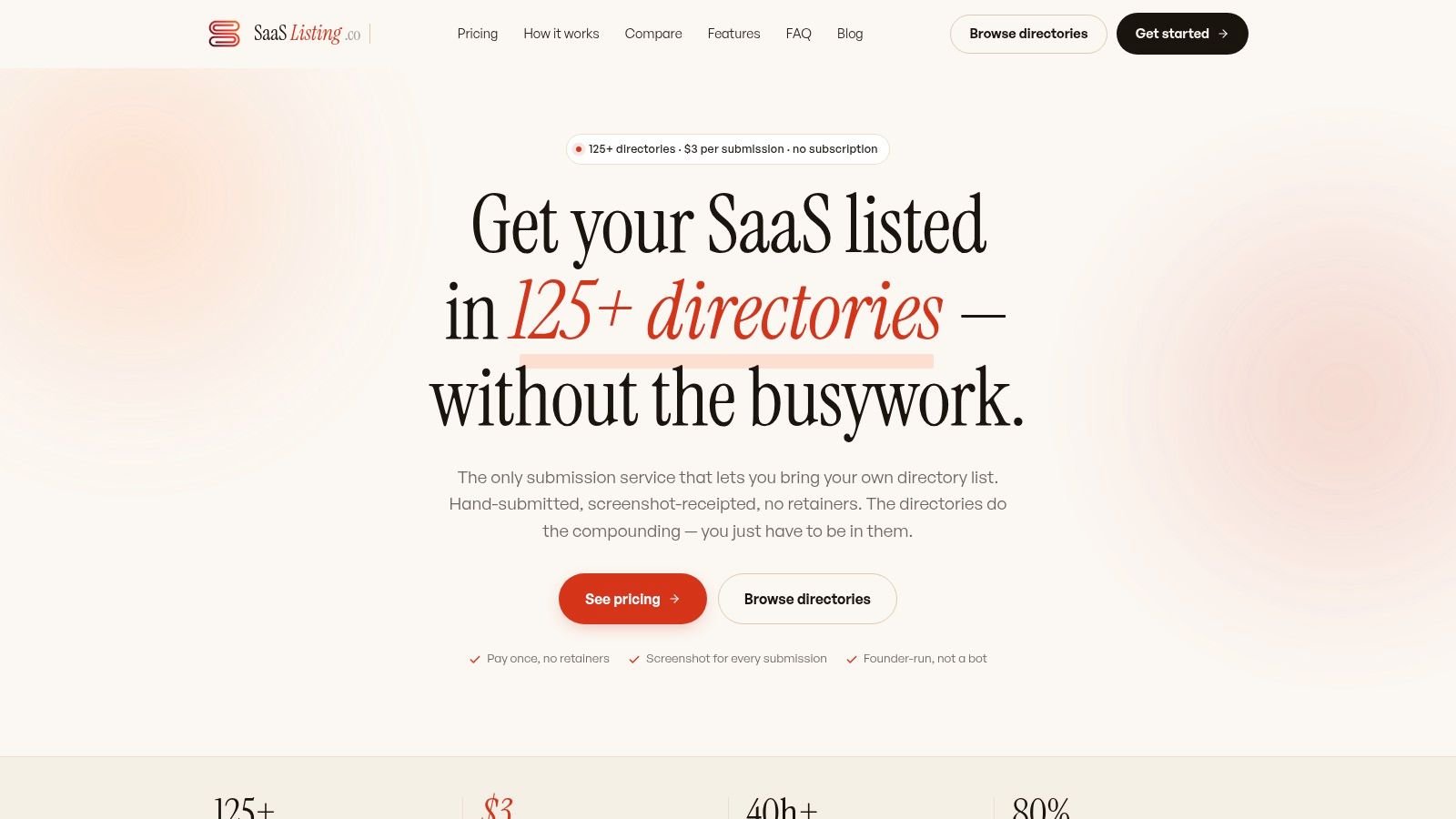
SaaSListing.co advertises hand-submitted listings, per-directory pricing, screenshot receipts, and no subscription. You control the targets, while the provider handles the submission work.
The trade-off is research responsibility. You need to identify appropriate destinations, remove duplicates, inspect submission requirements, and decide which fees are acceptable. Outsourcing form completion doesn't outsource the strategy.
- Best fit: Teams with an existing, qualified directory shortlist.
- Pricing advantage: Per-directory charging makes scope easier to calculate.
- Potential downside: A broad campaign may cost more than a discounted bundle.
- Evidence limit: A screenshot proves an action, not necessarily approval or publication.
For example, a developer-tool founder might select comparison sites, integration directories, and specialist communities rather than a general startup catalog. That targeted list can be sensible even if it's much shorter.
Google's link-spam policy explicitly includes low-quality directory or bookmark site links among its examples. Target control is useful only if you exercise it carefully.
I'd choose per-directory execution when the shortlist is already strong. Remove destinations whose main pitch is selling ranking credit, and distinguish legitimate paid exposure from buying links for rankings. A real audience and an editorial reason for the profile should come before the backlink.
10. Submitator
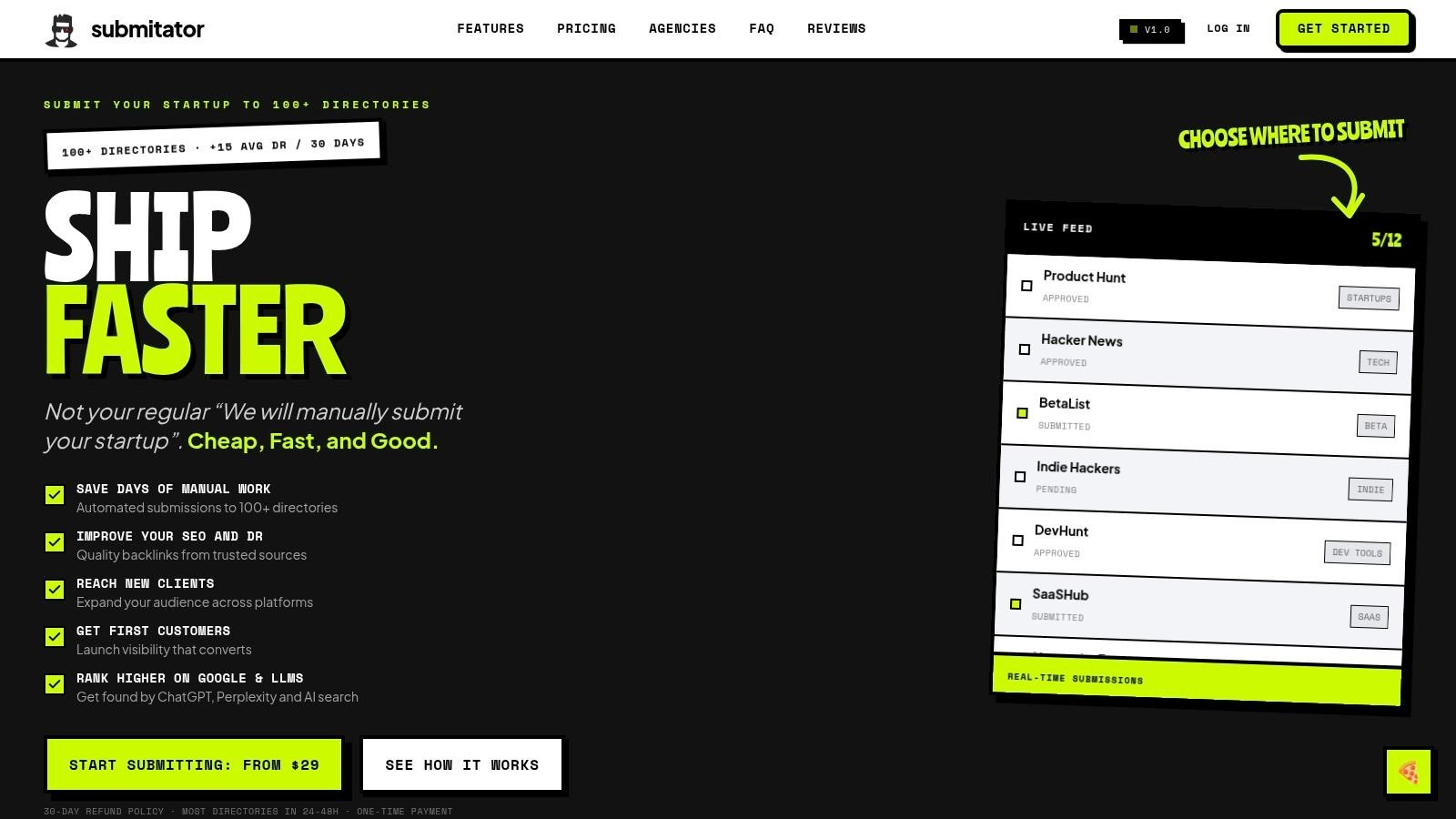
Read the badge condition before connecting your website. Submitator offers catalog-based target selection and dashboard tracking, but its badge policy is a material part of the service.
Submitator says that when a directory requires a badge, it places and keeps that badge on the customer's site. That is different from only asking your permission to submit a product description elsewhere.
Its model otherwise appeals to founders who want more choice than a fixed bundle provides. The provider advertises one-time plans, real-time tracking, reports with listing links, and directory review before catalog inclusion.
Website-control rule: A submission provider shouldn't receive broader publishing access than the agreed work requires.
Before purchasing, inspect which selected directories require reciprocal badges. Decide whether you accept each placement, where it can appear, and what happens if you later remove it.
- Useful feature: Customer-selected targets reduce reliance on an opaque preset list.
- Operational benefit: Dashboard updates make progress easier to monitor.
- Main condition: Badge retention can create an ongoing website obligation.
- Unresolved outcome: Catalog inclusion doesn't guarantee approval, indexing, or qualified referrals.
This service may suit a founder comfortable with reciprocal badge arrangements and hands-on target selection. It's less attractive if you keep a tightly controlled marketing site or don't want third-party promotional elements.
The distinction is practical, not cosmetic. A badge changes your site; a directory profile changes someone else's. Evaluate those permissions separately before comparing package prices.
How the ten services differ on pricing model, directory scope and best-fit buyer
| Item | Pricing model | Directory scope | Best for |
|---|---|---|---|
| StartupSubmit (recommended) | One-time plans from $99 to $299 | 60+ to 200+ curated directories | Teams seeking broad, hands-on submissions with documented placements |
| SubmitStorm | One-time packages; prices not specified | 100 to 300 hand-picked directories | Startups wanting tracked, done-for-you submissions |
| SubmitSaaS | Fixed, one-time bundles; relatively low entry price | Preselected SaaS-focused directories | SaaS teams seeking a straightforward campaign |
| AI Directories | Multiple campaign sizes; prices not specified | 30+ to 100+ AI directories | AI product launches seeking specialized directory coverage |
| LaunchDirectories | Packaged pricing; exact prices not specified | Hand-picked directories, with paid partner launches in select packages | SaaS and AI teams wanting reports and a stated delivery window |
| Listifying | One-time packages; relatively inexpensive | Smaller directory campaigns | Customers starting with a modest submission campaign |
| EasySubmits | Advertised one-time pricing | Managed packages cover 20–65 submissions; DIY catalog has 248+ directories | Founders choosing between researching directories and outsourcing submissions |
| GTM Works | Fixed one-time price; amount not specified | Up to 20 named software and launch platforms | Teams wanting listing preparation and follow-up support |
| SaaSListing.co | Per-directory pricing; no subscription advertised | Customer-selected directories from a catalog of 125+ | Teams with a target list that want control over submissions |
| Submitator | One-time plans; low starting price advertised | Customer-selected directories from its catalog | Teams wanting directory choice and dashboard tracking |
Pick One Service, Then Measure What Sticks
Choose a provider based on the directories you need, the refund terms you accept, and the badge or paid-launch conditions you're willing to authorize. Don't purchase overlapping campaigns before you understand where the initial batch landed.
Start with a small, category-matched campaign and track referral traffic and branded searches for 60 days. That's a practical observation window, not a promised SEO payback period. If your sales cycle is longer, keep tracking opportunities after the initial review.
Establish a Baseline Before Submissions Begin
Record existing directory profiles, branded search queries, referral sources, and conversion events. In Google Analytics, distinguish directory visitors who browse briefly from those who start trials, request demos, or reach activation.
- Track delivery: Record submitted, pending, approved, rejected, and live statuses separately.
- Inspect publication: Verify category accuracy, destination URLs, screenshots, and product descriptions.
- Measure value: Connect referrals to qualified signups or pipeline where possible.
- Record full cost: Include service fees, directory charges, paid launches, and maintenance time.
A live link can be useful without sending immediate traffic, but don't assign it an invented revenue value. Likewise, a referral spike isn't valuable if visitors aren't suitable customers.
Treat AI Visibility as an Observation, Not a Guarantee
AI Search Optimization and LLM SEO introduce another measurement problem: visibility doesn't always produce a click. A Pew Research Center analysis reported by The Decoder found that conventional-result clicks occurred on 8% of searches with an AI Overview, compared with 15% without one, among the searches it studied.
For Google AI Overview and ChatGPT visibility, maintain a repeatable set of category and comparison prompts. Record whether your company appears, how it's described, and which sources are cited. Treat these observations as directional because answers can vary.
Consistent third-party profiles make accurate product information available, but no submission service can guarantee an AI citation. Genuine reviews, clear positioning, and useful product evidence deserve more attention than a promise of instant AI visibility.
Scale the Useful Placements
Once you've reviewed the results, expand into adjacent directories that share the characteristics of productive placements. Update pricing, integrations, screenshots, and positioning on existing profiles before creating more maintenance work.
The decision resembles other outsourcing choices: the app submission approaches with LetsDeployIt offer a useful comparison of doing the work yourself, hiring execution help, or purchasing broader coordination.
Prepare your product assets, choose a provider whose conditions fit, and assign someone to inspect the report. The campaign is finished when you understand what became useful, not when someone marks every form submitted.
StartupSubmit offers manual, category-matched directory submissions for SaaS products, AI tools, and startups, with screenshot evidence and reporting you can review. Visit StartupSubmit to compare coverage options and choose a campaign that fits your product, then measure the resulting profiles against actual discovery and qualified referrals.