Local SEO Citation Building for SaaS Startups
Roughly 77% of the average small or medium-sized business's Google Business Profile searches were discovery searches, rather than direct searches, according to SearchLab's 2026 Google Business Profile statistics. Those are people looking for a category or a solution, not typing a company name they already know.
That's the useful starting point for local SEO citation building at a SaaS startup. You're not trying to collect map pins for a remote product. You're making sure buyers, Google, and AI answer systems can find public pages that agree about what your company is and whom it serves.
Table of Contents
- Why SaaS Startups Still Need Local Citations
- Which Directories to Claim and in What Order
- How to Build Citations from One Canonical Record
- How to Clean Duplicates and Bad Listing Data
- How to Measure Citations and AI Visibility
- Frequently Asked Questions About Citation Building
- Choose a Manual Build or a One-Time Handoff
Why SaaS Startups Still Need Local Citations
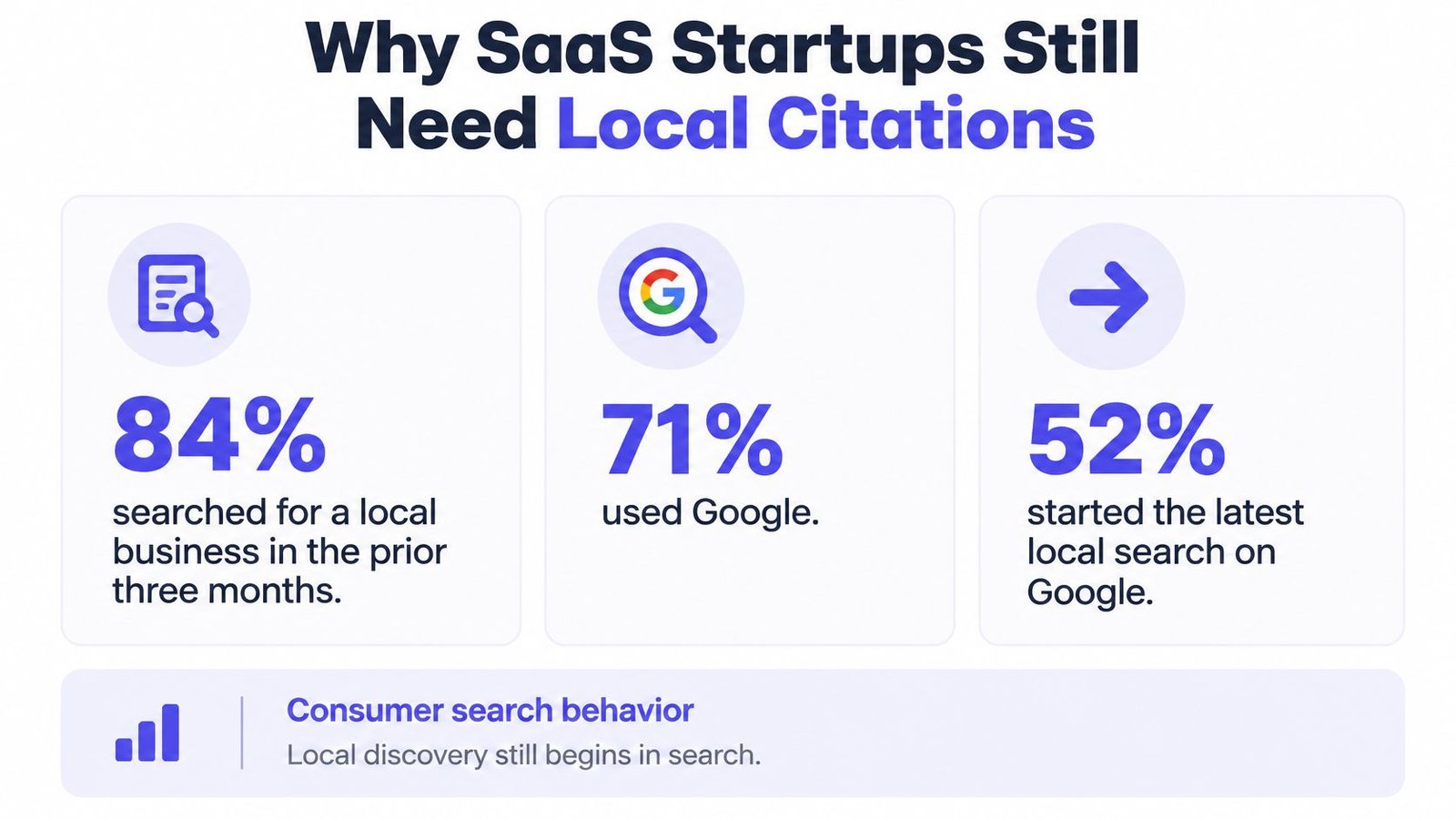
BrightLocal's 2026 consumer search research reports that 84% of consumers had searched for a local business during the previous three months, 71% used Google during that process, 52% began their latest local search on Google Search, and 9% began on Google Maps. These figures describe local-business searches, not SaaS conversion rates. They underline why a company's public identity needs to be consistent beyond its homepage.
The same BrightLocal research reports that customers are 2.7 times more likely to consider a business reputable when they encounter a complete Google Business Profile. For a remote software company, the goal is not to chase map visibility where it has no eligible physical presence. It is to establish a consistent, machine-readable record that buyers, search engines, and AI answer systems can recognize.
What counts as a citation for software
A traditional citation lists a business's name, address, and phone number, often shortened to NAP. For a software company, a useful public record also connects:
- Identity: Product name, public company name, and canonical website.
- Place: Headquarters city and country, or a genuine service area.
- Purpose: Product category, target buyer, and a clear description.
- Verification: Contact details and recognizable company profiles.
Most SaaS founders do not serve customers at a counter. A location should reflect a place the company can document, not every city where someone could buy a subscription.
Google names relevance, distance, and prominence as its primary local-ranking factors in its local ranking guidance. Distance limits what local rankings can do for a remote product, and directory submissions cannot change that. Accurate categories and consistent company details are within a founder's control.
Build for a buyer's question
A meeting-notes tool for recruitment teams should have profiles that clarify its purpose: does it support candidate interviews, integrate with recruiting software, or serve a particular market? A name-only listing leaves buyers guessing.
A useful profile answers those questions without requiring a visitor to return to the homepage. The entry becomes a discovery asset when its description, category, and company details agree across public platforms.
Practical rule: If a profile can't explain what you sell to someone who's never heard your name, it isn't finished.
A manual SaaS directory submission service can handle repetitive listing work, but citation count alone is no ranking promise. Prioritize accurate, relevant profiles over low-value directories that add little context for buyers.
Which Directories to Claim and in What Order
Citation tiers for a SaaS or AI startup
| Tier | Examples | Job it does | Submit when |
|---|---|---|---|
| Map and primary profiles | Google Business Profile, Bing Places, Apple Business Connect | Corroborate name, place, and category for local pack and knowledge results | You can verify a real office or service area and meet platform eligibility rules |
| Startup launch directories | Product Hunt, BetaList, Indie Hackers | Show the product is a real, launched company | Canonical name, URL, and one-line description are locked |
| Software comparison and review sites | G2, Capterra, AlternativeTo, SaaSHub, Trustpilot | Help buyers compare vendors and read firsthand feedback | Category is stable and at least a few real users exist |
| Company data graphs | Crunchbase, LinkedIn Company | Fill branded search with recognizable third-party profiles | You want investors, hires, or champions to verify you |
| Niche and regional lists | Industry roundups, country software lists, a local chamber if you operate there | Match a specific buyer community or home market | The audience overlaps your buyers |
Start with eligibility, not brand recognition
Map platforms come first only when your business qualifies. A verifiable address alone isn't permission to create every kind of business profile, and an online-only SaaS company shouldn't invent customer-facing operations.
A virtual mailbox isn't a shortcut around eligibility or verification. Failed verification, account recovery, and duplicate cleanup can consume more founder time than the original submission.
For a remote software company, startup launch platforms may be the first appropriate tier. Product Hunt and BetaList give visitors product context; Indie Hackers can support a maker's public product presence where its current publishing options fit. Don't assume every community works like a conventional business directory.
Give comparison sites a stable category
Review platforms deserve more preparation than a launch listing. If your homepage calls the product an AI assistant while your review profile calls it project management software, buyers won't know which competitors to compare.
BrightLocal's 2025 Local Consumer Review Survey, based on 1,026 U.S. adults, found that 83% used Google to read reviews and 74% checked at least two review sites before making a purchase decision. This consumer behavior supports maintaining relevant review profiles, not assuming every review platform belongs in a SaaS campaign.
Company graphs serve another audience. An investor, potential hire, or internal buying champion should find recognizable third-party information about the company, rather than only promotional landing pages.
Niche lists come last because they require judgment. A country-specific software roundup may fit your market; a chamber listing makes sense only where you operate.
Apply a rejection test before opening forms
Business directories accounted for 31% of local-intent organic search results in 2024, according to BrightLocal's Business Listings Visibility Study. That doesn't establish the same share for software searches. Check the actual results your buyers encounter.
Use a curated startup directory shortlist as a starting point, then reject sites that fail these tests:
- Audience fit: The country, category, and visitor intent match your buyers.
- Useful facts: The page can expose pricing model, integrations, geography, or a meaningful product description.
- Technical access: Visitors can open the profile and reach your website without a broken or concealed destination.
- Editorial credibility: The site isn't a coupon farm, article-spin network, or unrelated listing warehouse.
I would cap the first working list at 15 to 40 targets. That's a workload recommendation, not a ranking threshold, and it's enough to discover whether your positioning survives real category menus before considering a larger submission batch.
How to Build Citations from One Canonical Record
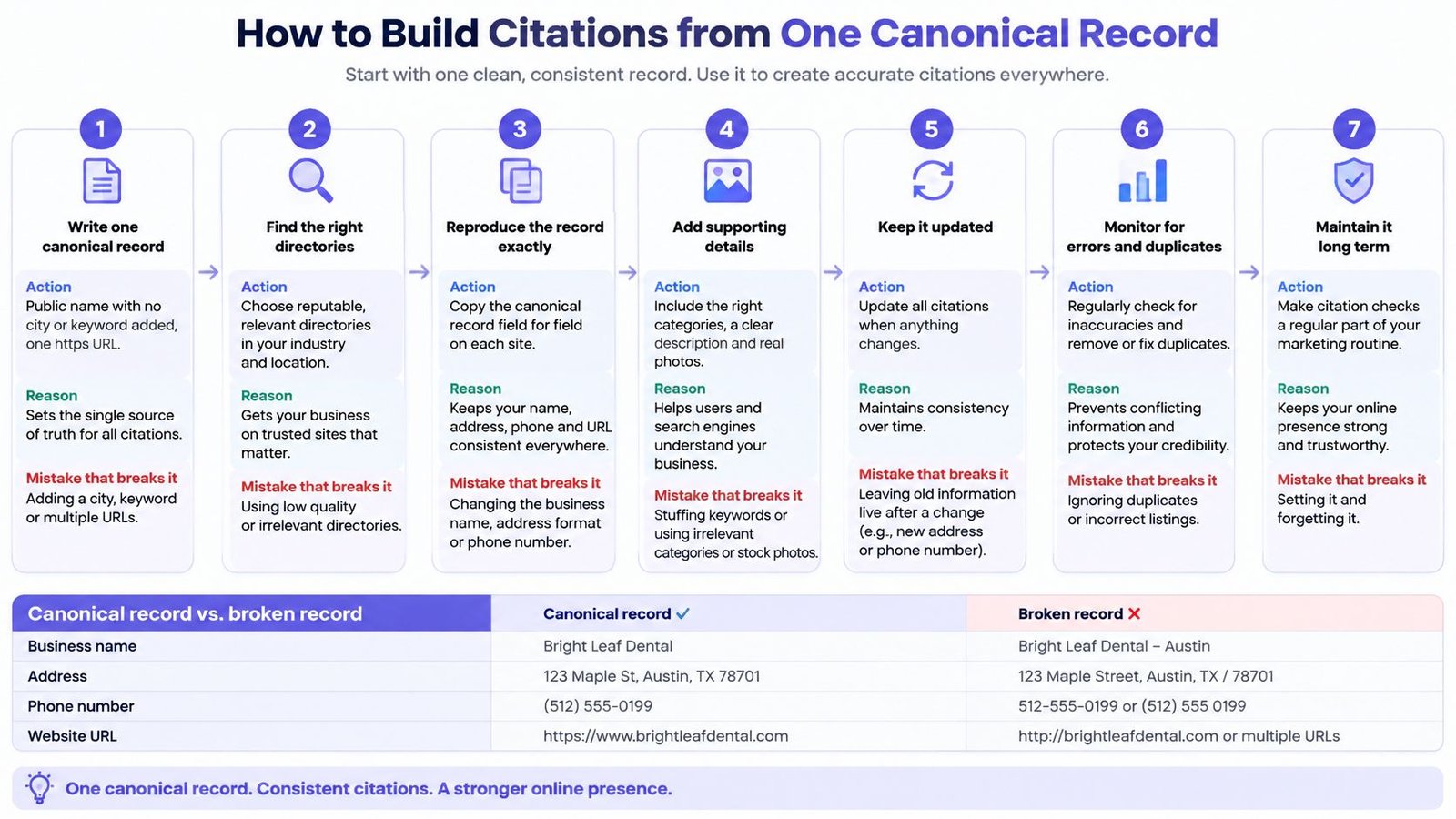
A canonical record gives every directory the same core facts about your business. For a SaaS startup, that means clear, consistent information buyers, search engines, and AI answers can connect to one entity, not a collection of mismatched profiles.
Prepare the record before submitting
Write one canonical business record.
Use the public business name, one website URL, one main phone number, and the company's actual location or service area. Add the primary category, relevant secondary categories, and social profile URLs. A logo and opening hours are optional; publish hours only if they apply and are accurate.Create adaptable descriptions.
Prepare a short summary and a longer version, then adapt each to the platform's limits. State who the product serves, what it does, and a proof point you can support. Keep the facts consistent while adjusting the emphasis for launch communities, review sites, and industry directories.Search before creating.
Search the brand, domain, founder name, and phone number. Record existing profile URLs and mismatched details, including listings no one on the current team recognizes. A new signup can create a duplicate instead of fixing an existing record.
Publish with ownership and evidence
Claim or correct valuable existing profiles.
Prioritize eligible Google, Bing, and Apple records, along with review profiles that already appear for your brand. Restore access before expanding. Use a company-controlled email address so the profile remains accessible if a contractor leaves.Submit manually against each site's taxonomy.
Select the closest accurate category from the platform's menu. If the exact category is unavailable, choose an honest parent category and explain the use case in the description. Don't claim capabilities just to fit a more attractive label.Log evidence, not just form completion.
Record the profile URL, destination URL, account email, submission date, and status: pending, live, or rejected. Check whether the website reference is a crawlable HTML link with anhrefattribute, as described in Google's link documentation. A logo mention alone does not guarantee a backlink.Recheck publication and indexing at regular operational intervals, such as every 30 days.
Note whether each page is public, crawlable, and apparently indexed. Search operators are not a definitive indexing audit. Keep rejected and unresolved records in the report so the outcome of each submission remains clear.
A shared spreadsheet can manage a small build. Use separate columns for approved copy, submitted copy, and live copy to see whether an error came from your submission or a publisher's edit.
A documented website directory submission process is easier to track than browser history and confirmation emails. Citation count does not guarantee local rankings, and a submission list cannot support a fixed Domain Rating forecast.
How to Clean Duplicates and Bad Listing Data
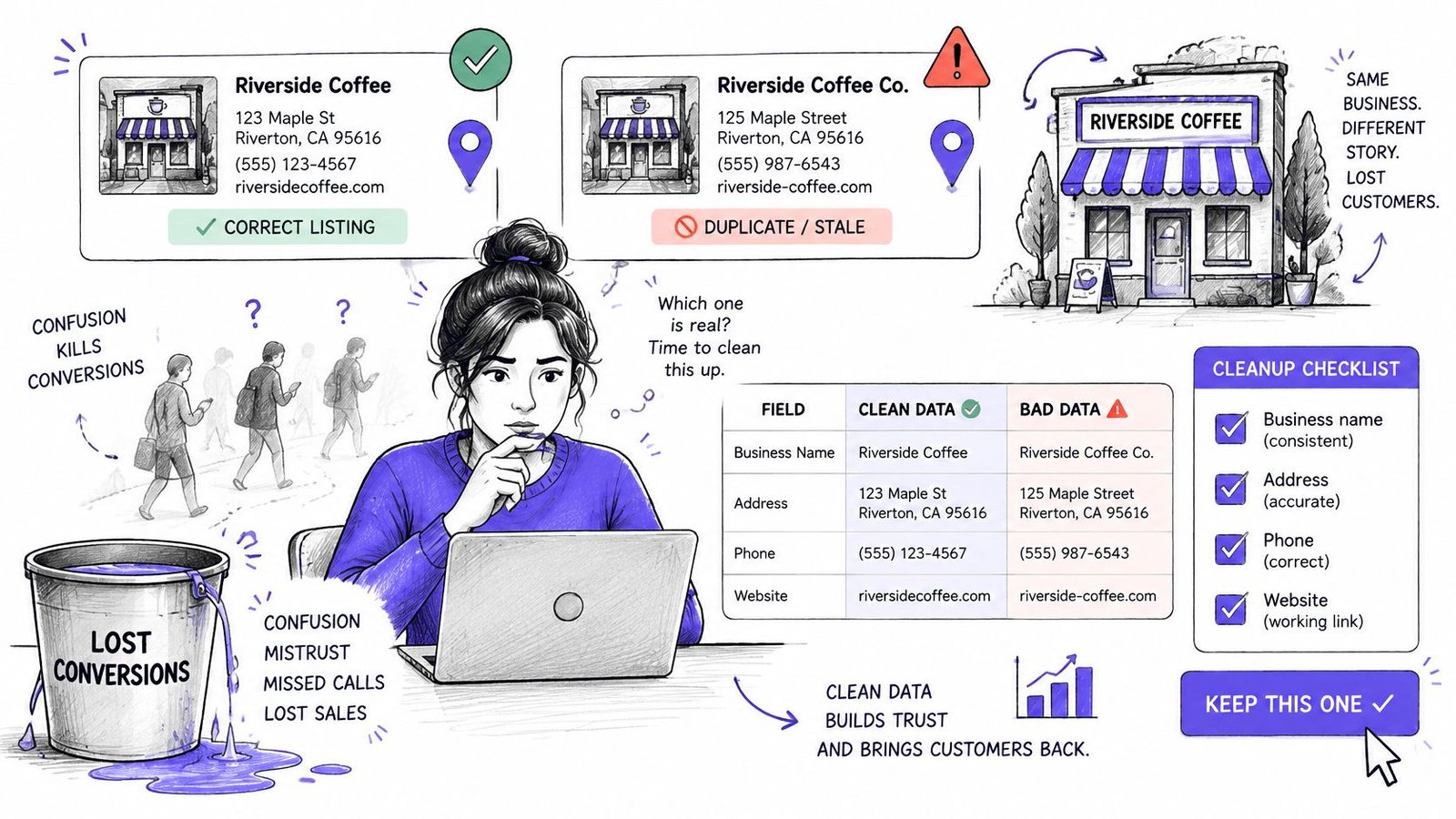
62% of consumers would avoid a business after finding incorrect information online, according to BrightLocal's local SEO statistics. Treat a wrong URL or outdated product description as a buyer-trust problem, not merely an SEO formatting issue.
Export every submitted record and compare the live page against the canonical sheet. Check name, address or service area, phone, URL, category, and published hours; confirm that the profile is public, isn't flagged as a duplicate, and links to a working destination with a 200-level success response.
Citation failures and the fix
| What you see | Usual cause | Fix |
|---|---|---|
| Two profiles for one brand | Old name, old address, or a second signup | Request a merge into the profile with reviews or age; suppress the empty twin where supported |
| City or keyword inside the name | Someone chased a local pack query | Revert to the public or legal name on every owned profile |
| Same 40-word blurb everywhere | Copy-paste submission | Rewrite the long description per tier; keep only the short summary identical |
| Category says Software | Taxonomy was ignored | Choose the closest supported category to the query a buyer types |
| Brand shows but no crawlable link | Button, script, or logo only | Confirm an HTML anchor with href or don't count it as a link |
| Old domain still on live profiles | Rebrand or site move | Redirect the old domain and edit each listing to the new URL |
Don't delete a duplicate carrying legitimate reviews without checking the platform's merge process. Preserve useful history where the publisher allows it, and document any reviews or fields that won't transfer.
A generic category also needs interpretation. AI meeting notes or B2B billing may describe buyer intent, but if the platform doesn't offer that exact label, choose the nearest accurate category and use the description to supply the missing detail.
Make product changes trigger listing updates
A renamed product, new domain, merged brand, headquarters move, discontinued feature, or changed pricing model should open a citation-update task. Redirecting the old website doesn't update the facts shown on third-party pages.
Each listing needs an owner, last-verified date, canonical URL, category rationale, and a status such as live, pending, rejected, duplicate, or needs merge. Keep screenshots as evidence, then sample-check them against the spreadsheet rather than assuming they prove the current page.
An old capability claim can be more damaging than an old logo. A buyer may expect a feature you removed, and an answer system may repeat the outdated description.
Recheck after publisher edits, including corrections made by platform support. Close the task only when the public page reflects the approved facts, not when someone acknowledges the ticket.
How to Measure Citations and AI Visibility
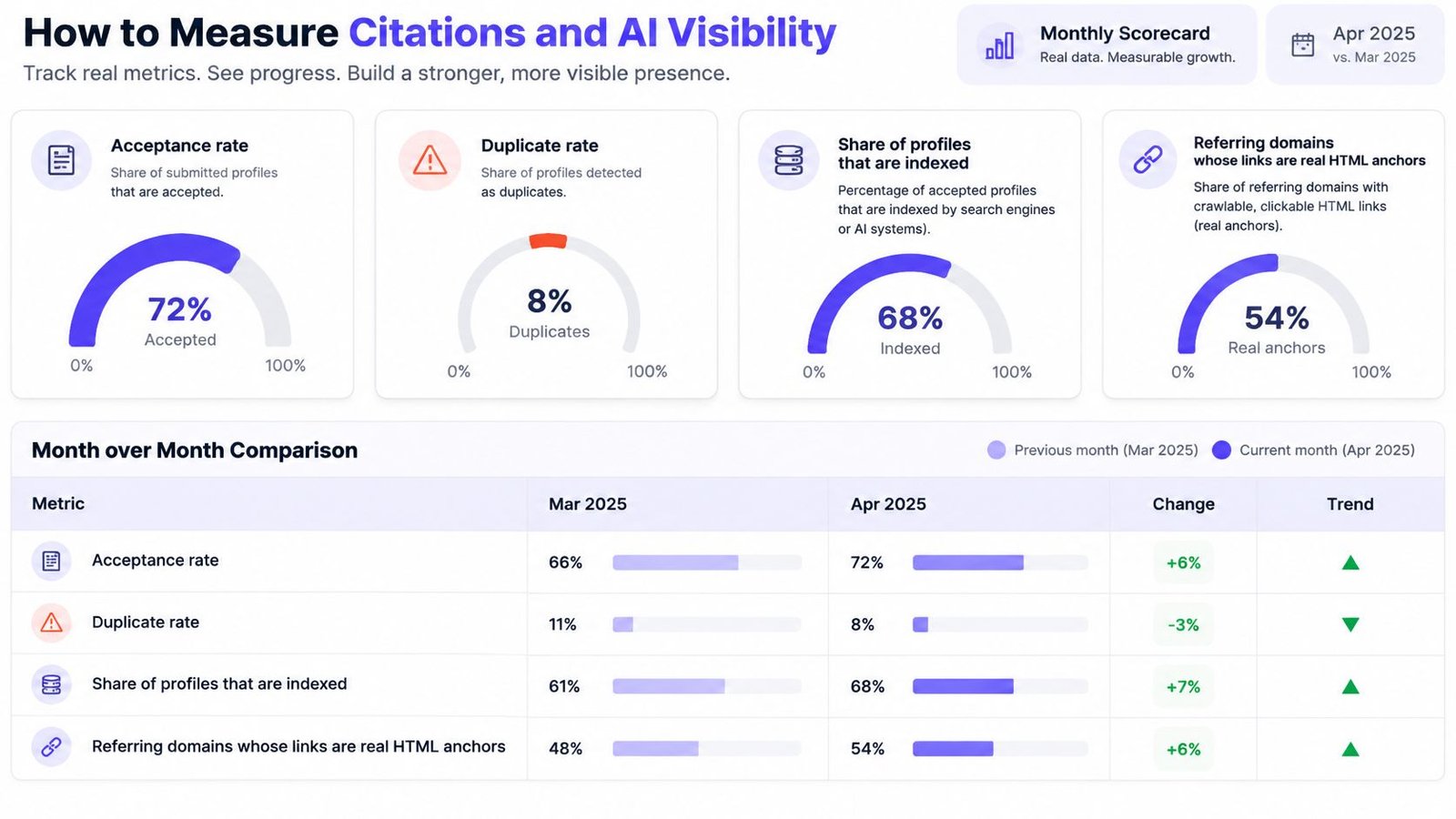
Start with a monthly scorecard, not a ranking promise. Separate what your team delivered from what search platforms chose to index, display, or recommend.
Citation scorecard for search and AI visibility
| Metric | What it tells you | Check cadence |
|---|---|---|
| Acceptance rate | Share of submissions that went live | Monthly |
| Duplicate rate | Profiles doubled or flagged for one brand | Monthly |
| Indexed-profile rate | Share of live profiles Google has indexed | After each 30-day recrawl |
| Referring domains with HTML anchors | Real crawlable links, not logo or script mentions | Monthly |
| Branded-search impressions | Whether searches for the brand grow over time | Monthly |
| Qualified sessions from listing URLs | Visits from listings that match buyer intent | Monthly |
| Correction lag | Days between a wrong fact appearing and its fix going live | Each recheck |
Define denominators before reporting. Acceptance rate should use submitted targets; indexed-profile rate should use live profiles, with uncertain indexing checks labeled accordingly.
Use Google Search Console for branded-query impressions and your analytics platform for referral sessions and meaningful actions, such as demo requests or activated trials. Don't attribute all branded-search growth to citations when launches, outbound campaigns, or press coverage ran during the same period.
Measure answer usefulness separately from rank
A 2025 SE Ranking analysis of 10,000 U.S. queries found an average of 12.6 sources cited per Google AI Mode answer, while a separate study summarized in Steady Demand's AI-search research index found that only 25% of top-10 organic results also appeared in the AI Overview for the same query. Traditional rankings and AI inclusion aren't interchangeable measurements.
For AI search optimization and LLM SEO, audit the facts exposed on each profile:
- Product identity: Is the product clearly distinguished from the parent company?
- Buying context: Are category, pricing model, and intended customer explicit?
- Compatibility: Are current integrations and geographic constraints documented?
- Comparison context: Is any alternative-to positioning accurate and supportable?
An indexed page missing these attributes gives an answer system less useful evidence. Adding them improves documentation, but doesn't guarantee Google AI Overview inclusion or ChatGPT visibility.
For a broader measurement framework, Sprints & Sneakers explains how to track citation KPIs for AI visibility. Pair that framework with a repeatable set of buyer questions, recording the date, answer, and cited pages rather than treating a single favorable response as durable visibility.
Keep deliverables honest
An AI directory submission checklist should distinguish published mentions, crawlable links, and observed AI citations. They're different outcomes.
At StartupSubmit, we don't promise a backlink from every listing, because citation building isn't a link-building service. Report unresolved discrepancies and correction lag alongside submitted URLs, and request honest, specific reviews from real users rather than manufacturing ratings.
Frequently Asked Questions About Citation Building
Should citations go live before launch?
Prepare the canonical record and target list before launch, then submit launch-oriented startup directories during launch week when the product is publicly accessible. Follow each platform's rules for beta products and launch timing.
Don't publish placeholder pricing or speculative capabilities just to finish a profile. Those claims may remain public after your homepage changes.
Are paid directory listings worth it?
Pay when the directory reaches your buyer and exposes useful product facts, with a crawlable website link if that's part of the value you're buying. Inspect comparable live listings before paying.
A logo-and-name placement doesn't justify a fee on SEO grounds alone. Sponsored audience access can still have value, but measure it as advertising rather than assuming it purchases ranking authority.
What if someone publishes a wrong listing for my brand?
Claim the page if the platform supports ownership verification. Otherwise, submit a suggested edit or support request with evidence, such as your official pricing page, company registration, or product documentation.
Mark an ordinary correction as needs correction and a duplicate requiring consolidation as needs merge. Keep either open until the public page changes; a support acknowledgment isn't a completed repair.
Can citations guarantee visibility in ChatGPT or Google AI Overviews?
No. Citations supply public facts that search and answer systems may discover and corroborate, but they don't guarantee a recommendation.
Track observed mentions and cited sources against relevant buyer questions. Keep those observations separate from submission completion, organic rankings, and referral conversions so you don't promise a result your team can't control.
Choose a Manual Build or a One-Time Handoff
Keep the work in-house when you have a single location, a short target list, and stable positioning. I'd generally handle fewer than about 15 listings internally if the name, URL, and category aren't about to change.
Hand off the forms when the list reaches dozens, another location adds a separate record, or an agency needs client-ready reporting without assigning staff to repetitive submissions. The handoff still needs an approved canonical sheet and someone responsible for future changes.
StartupSubmit plans compared
Our directory submission service provides a manual handoff handled by SEO specialists, with no bots. Local plans are a one-time payment per business location, matched to country and category across the US, UK, Canada, Australia, and New Zealand.
| Plan | Citations | One-time price | Cost per citation | Best fit |
|---|---|---|---|---|
| Starter | 50 | $79 | $1.58 | Core listings at a single location |
| Authority | 300 | $259 | $0.86 | Competitive markets needing industry, niche, regional, and review sites in one build |
The Authority plan is our recommended best-value option, but a larger package isn't automatically the right choice for a remote software product. Choose coverage based on relevant eligible platforms, not the lowest unit price.
Decide who owns the work afterward
Our local citation process has four steps:
- Choose a plan and pay once.
- Send business details through one short form.
- Our team researches and submits the records by hand.
- Receive a report of every submission and its status, with delivery within 5–7 days.
The build is one-time; later changes require a new update. Agencies can request an unbranded report for their clients.
Map citations and startup or AI directory submissions are different jobs. Product Hunt-style profiles don't replace a legitimate local record, and map listings don't explain a software product's integrations or competitive category.
This week, lock the canonical sheet, check map-platform eligibility, approve the target list, and resolve existing duplicates. Block an afternoon for that preparation whether you submit personally or delegate, and don't buy another batch until the first recrawl shows what became public.
StartupSubmit offers manual local citation building and startup directory submissions for founders who want to hand off the form-filling without losing sight of the records. Visit StartupSubmit to choose the right submission route, then prepare your canonical business details before the build begins.