SaaS Directories: 10 Submission Services Compared for 2026
The cheapest directory package is rarely the best deal, because a sales page full of URLs doesn't tell you whether a buyer will ever open those sites. Founders still get told to buy the biggest list at the lowest price and call it SaaS SEO. That advice treats every profile like a backlink. It isn't.
Before you pay, you need three answers. Which directories will a software buyer really browse? Does the listing go live, or does it sit in a queue? What does the provider do when a directory says no?
SaaS directories split into jobs that a single "200 submissions" line hides.
- Buyer review sites such as G2, Capterra, GetApp, Software Advice, TrustRadius, and SaaSworthy are where teams compare tools, pricing, and reviews.
- Launch platforms such as Product Hunt, BetaList, and Indie Hackers can spike for a day among early adopters, then go quiet.
- Alternative engines such as SaaSHub and AlternativeTo rank for "alternatives to" searches.
- Company profiles such as Crunchbase document the business, not the product shortlist.
Crowding is why category fit beats volume. G2's technology review platforms category contained 122 products in search results, while broader marketplace data put Capterra above 45,000 software products across more than 1,200 categories. A separate analysis of GetApp's 994 categories found a median of 136 products. 610 categories, 61.4%, held at least 100 products, and 8 held more than 1,000. A vague category in that taxonomy doesn't get you compared. It gets you buried.
I wouldn't buy on price per URL. I'd buy on whether the mix includes those buyer sites, whether you get proof, and whether declines get replaced or counted as "submitted." Paid editorial work, including category roundup placements with Verbatim Digital, is a different channel from directory forms. Don't let a low sticker price stand in for either one.
Table of Contents
- 1. StartupSubmit
- 2. SubmitWell
- 3. SubmitSaaS
- 4. Submitator
- 5. EasySubmits
- 6. ListingSaaS
- 7. FoundrList
- 8. SwipeToLaunch directory submission
- 9. LaunchDirectories
- 10. Submit by Hand
- How the 10 submission services compare on price, coverage, delivery and guarantees
- Match the Service to Your Launch Stage Before You Pay
1. StartupSubmit
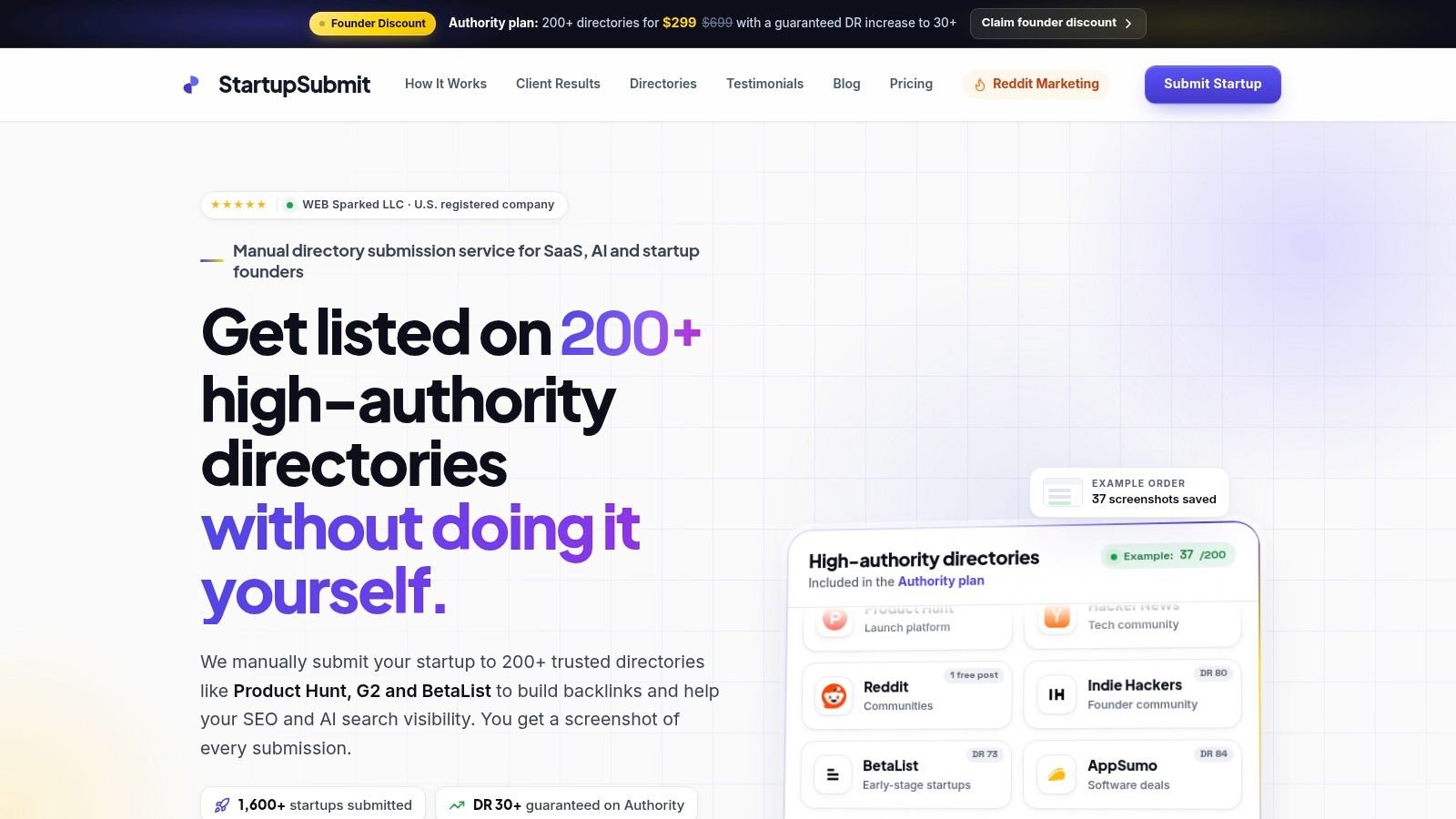
StartupSubmit handles manual submissions for SaaS and AI products across startup and software directories. The directory mix can include Product Hunt, G2, Capterra, BetaList, Indie Hackers, AlternativeTo, and SaaSHub. For a SaaS product, the useful distinction is whether a campaign reaches both launch audiences and buyer-facing software or review sites. Submission volume alone does not answer that.
What you can verify, and what you can't
The plans are one-time payments: Starter costs $99 for 60+ directories, Growth costs $199 for 150+, and Authority costs $299 for 220+. Authority includes a DR 30+ guarantee. StartupSubmit writes a unique description for each directory and checks for duplicate listings before submitting. Execution typically takes about 5–14 days, with work targeted to begin within 24 hours after onboarding is complete.
Directory fit matters more than a uniform list. StartupSubmit matches platforms to a product's category and each site's rules, combining AI-specific directories with general software platforms where appropriate. A CRM filed under a broad business category may be harder for buyers to distinguish from unrelated tools; the more specific category a platform offers can put it alongside closer alternatives.
Practical rule: Check that your product name, URL, and category are consistent across profiles. Then judge the campaign by which directories accept the listing, not just how many forms were submitted.
The completion report includes submitted URLs, acceptance notes, and screenshots. Some directories still decide whether to publish a listing, and some may ask the business owner to confirm it by email, phone, or post. The report can document submissions and placements, but it cannot make third-party sites approve a listing or guarantee traffic, rankings, or AI citations.
2. SubmitWell
SubmitWell is the low entry price in this set, and that is both the appeal and the limit. Published packages are $35 for 50 submissions, $59 for 100, and $99 for 200+, with delivery in about 6–7 working days. You get screenshot proof, live links, and a stated swap if a site is down or declines the listing.
The work is manual and aimed at startups and SaaS products, which already puts it ahead of a scraped bookmark blast. Google's spam policies name low-quality directory links, automated link programs, and paid links meant to manipulate rankings as link spam. A human clicking submit doesn't erase that risk if the underlying sites are thin.
- What you can verify: Package size, a turnaround window, screenshots, and a replacement when a directory won't publish.
- What you can't: You don't pick the full list. The provider curates it.
- What it can't guarantee: Approval. A declined URL replaced with "an equivalent" may not be a buyer site your customers use.
I'd use the $35 tier only as a test of reporting quality, not as the whole SaaS directory plan. If the live links skip G2, Capterra, SaaSHub, and AlternativeTo, the cheap count didn't buy the comparison shelf.
3. SubmitSaaS
SubmitSaaS is built for software products, with packages from 60+ to 140+ submissions priced about $60 to $140. The stated turnaround is 48 hours. Directory review times still vary, so "submitted in two days" is not "live in two days."
The process is more careful than a bulk paste. They review product details, open a dedicated inbox for profile mail, submit the listings, and send a report with screenshots. That inbox is useful. Confirmation mail from review sites won't bury your main founder address, and you can hand the box to whoever owns the listings later.
Buyers are already narrowing the set before they ever see your homepage. In G2's 2024 Buyer Behavior Report, which surveyed more than 1,900 B2B software decision-makers, the share considering four to seven products fell from 45% in 2023 to 31% in 2024, while buyers considering only one to three products rose to 49%. A profile that names pricing model, deployment, integrations, and a real use case has a chance to enter that short list. A generic "all-in-one platform" line does not.
Paid directory fees are excluded, and any published Domain Rating figures are marketing targets, not a ranking or traffic promise. If you want directory submission help for SaaS startups on the review sites that feed those shortlists, check that those sites are in the range of 60 to 140, not assumed.
4. Submitator
Submitator sells the dashboard as much as the submissions. There is a directory catalogue, progress tracking, and a final report with links. The All Directories plan is listed at $149 once, and the provider says that plan includes later additions to the catalogue. Most submissions are described as happening within 24–48 hours, with a longer wait when the queue is busy.
Speed is the trade-off I watch. A wide catalogue submitted in two days can mean thin, repeated copy. The process is not presented as exclusively manual, so I wouldn't assume every form gets a custom description and a category check.
A large catalogue proves coverage. It doesn't prove that a buyer, or a search system, will treat the page as a real product profile.
For an AI tool, general startup lists and AI-specific directories are different shelves. Manual AI directory submissions belong on sites buyers and models already use for tool discovery, not on every URL in a growing database. Google's guidance on AI features treats AI Overviews and AI Mode as experiences that still surface links, and it points site owners back to crawlable, indexable, useful pages. A directory profile helps only when it is accurate and on-topic. Submitator's monitoring is handy. It still can't force a directory to approve you, and a future catalogue add-on isn't the same as a relevant listing today.
5. EasySubmits
EasySubmits is the only provider here that leads with a do-it-yourself list. The DIY file covers 248+ directories for $19, sortable by price, category, and Domain Rating. Done-for-you packages are smaller and cheaper than the bulk shops. Basic is $59 for 20–30 submissions. Premium is $109 for 40–65. Reports come with the paid work. SaaS and AI SaaS are the stated fit, and the provider says other business types aren't ideal for Premium.
That honesty is useful. A local service or a marketplace store doesn't belong in a software-review queue. The limit is volume. Forty to sixty-five handoffs won't cover review sites, launch communities, and AI lists unless the list is ruthlessly picked. The $19 file can, if you do the work.
An Ahrefs study of about 920 million pages, covered in its backlink growth study, found that pages ranking first often gained followed links from new referring domains at roughly 5% to 14.5% per month. That is a long climb, not a launch-week spike, and it is not a promise that directory forms cause rankings. I'd buy the DIY list if you have the hours and a tight inclusion rule. I'd skip Premium if you need G2-level coverage and the package can't show those names.
6. ListingSaaS
ListingSaaS argues from proof, not from catalogue size. Submissions are made by hand, listing copy is customized, and a live dashboard stores timestamped screenshots. Packages are $99 for 100 directories and $149 for 200. The larger plan adds AI directories, a named account contact, and free resubmission of rejections for 30 days.
That rejection window is the detail most order forms skip. A "submitted" status is not a live URL. Thirty days of retries won't override a directory's rules, but it does mean a decline isn't dropped on delivery day.
Review sites only help when the evidence is real. Capterra's software buyers guide context sits next to a hard constraint from Google. Review markup has to describe a specific item, ratings have to come from users, and misleading review content can make a page ineligible for rich results. Your directory profile can collect genuine reviews. It should not be scraped into fake stars on your own site.
- Strength: Tracking and a written follow-up on declines, which is what you need when approvals slip.
- Limit: Paid directory fees are extra, and this is a newer provider, so outside reputation is still thin.
- Not guaranteed: Delivery dates or approval. Third parties own the publish button.
I'd consider the $149 plan when you want 200 shots plus a person to ask, and you accept that AI-directory add-ons still need category fit.
Boost Your Startup's Traffic & SEO with up to 200+ Directory Listings
Skip the grind. Our team manually submits your product to relevant, high-authority directories, with screenshot proof for every submission, so you get real users, feedback and lasting backlinks without lifting a finger.
Get Listed Today7. FoundrList
FoundrList sits at a higher price for a smaller count. Packages cover 30, 50, or 100 directories, from $130 to $279, with reports that usually arrive within seven days. You can try a free single submission before you commit. The report includes status and listing links, which is the minimum I'd accept from any paid submitter.
The workflow is mixed. They use their own form tooling where they can and submit manually where a site requires it. That is fine if the tooling doesn't smear the same paragraph across every profile. It is a weaker story if "tooling" means speed over fit. Not every submission is described as fully manual.
Enterprise buyers still lean on review sites, which a 30-listing startup bundle can miss entirely. In G2's 2025 buyer behavior research, 56% of enterprise buyers at companies with 1,000–5,000 employees named software review sites as a top source for researching products. If your pipeline is mid-market, a curated startup list without G2, Capterra, GetApp, or TrustRadius is the wrong shelf, even at a careful price.
Founder-reported Domain Rating changes on a sales page are not a customer promise. Directories still decide what goes live. I'd use the free single submission to judge category choice and copy, then buy 50 or 100 only if those samples land on sites your buyers open.
8. SwipeToLaunch directory submission
SwipeToLaunch runs a product-discovery platform and a done-for-you submission offer beside it. Plans cover 30+, 60+, or 100+ hand-picked submissions, from $99 to $199. They match by category, check for an existing listing, and include a free listing on SwipeToLaunch itself. Stated report times are seven business days for Starter and Pro and ten for Premium.
The free listing is a bonus, not a substitute. Their own launch platform is not G2, Capterra, or TrustRadius. A new discovery site can put you in front of people hunting launches. It does not carry the review history a procurement lead expects.
AI search has changed the research path without making directory spam useful. A CloudRatings summary of G2's April 2025 survey found that 79% of B2B software buyers said AI search had changed how they research, and 29% started with AI search more often than Google. The same discussion of Pew data found users clicked a traditional result in 8% of visits when an AI summary appeared, versus 15% without one. More referral URLs won't restore those clicks. Consistent category, pricing, and use-case facts might show up as sources.
Their DR guarantee applies only at certain starting DR levels and plan conditions. Read that clause before you treat "DR" as an outcome you purchased.
Some directories may also require a badge. If you want directory listing services for AI startups aimed at established software and AI platforms, don't count a badge-gated blog network as the same thing.
9. LaunchDirectories
LaunchDirectories targets SaaS and AI products, describes its directory list as hand-picked, and offers Pro and Premium packages. The provider does not publish a delivery window, so the service is difficult to schedule around a fixed launch date. Its packages may include selected paid launches, and the service provides a submission report.
Check which partner placements are included before paying. “Selected paid launches” does not mean every directory fee is covered, and a partner launch page is not the same as a profile on a buyer-facing review site. G2, Capterra, and GetApp have their own vendor processes.
Capterra, GetApp, and Software Advice are owned by the same parent company. They serve a different purpose from launch platforms that can create a short-lived burst of attention: review sites help buyers assess software, while launch directories focus on discovery. Use StartupSubmit's guide to compare startup listing sites and check whether the proposed placements reach the buyers you need. Approvals remain at each directory's discretion.
10. Submit by Hand
Submit by Hand is the slow, documented option. Packages are 50, 100, or 200 directories at $149, $249, or $399, delivered over about 2–3 weeks. Reports can include submission dates, screenshots, listing links once published, and account logins where an account was created. There is a public directory list, a live report, and a CSV export. If a site is unavailable or paid-only, they replace it. They do not pay directory fees for you.
The price is the objection, and it is a fair one next to a $35 bulk pack. What you are buying is handover. Logins and a public list mean you can see the footprint and keep it updated after the invoice is paid. Excluding paid-only directories keeps the bill honest. It also means premium review placements, if they require a vendor fee, remain your problem.
OpenAI's introduction of ChatGPT search says responses can include links to web sources and that a site can choose to appear. That is not a formula that cites your directory profile. It does mean a crawlable, consistent public record is the only lever you control. Same product name, same category, same canonical URL, unique supporting copy.
Two to three weeks will miss a hard launch date. I'd still rather wait for logins and live links than accept a same-week spreadsheet of unindexed profiles. If you need to get listed in software directories that buyers already trust, ask whether those names are on the public list before you pay the premium for documentation alone.
How the 10 submission services compare on price, coverage, delivery and guarantees
Directory count and turnaround time are useful filters, but they do not show whether a service reaches the sites your buyers use. Review sites such as G2 and Capterra serve a different purpose from launch platforms such as Product Hunt, where attention can be brief. Check the directory mix and what the provider promises about outcomes before comparing prices.
| Item | Starting Price | Directory Coverage | Stated Delivery Time | Guarantee or Replacement Policy |
|---|---|---|---|---|
| StartupSubmit | $99 | 60+ directories | Typically about 5–14 days after onboarding | The $299 Authority plan covers 220+ directories and includes a DR 30+ guarantee |
| SubmitWell | $35 | 50 directories | About 6–7 working days | Replaces unavailable or declined directories with equivalent ones |
| SubmitSaaS | $60 | 60+ directories | Advertised 48-hour turnaround | No guarantee or replacement policy stated |
| Submitator | $149 | All-directories plan; catalogue size not specified | Usually 24–48 hours; may take longer when busy | No guarantee or replacement policy stated |
| EasySubmits | $19 | DIY list of 248+; done-for-you packages cover 20–65 submissions | Not stated | No guarantee or replacement policy stated |
| ListingSaaS | $99 | 100 directories | Not stated | Free rejection resubmissions for 30 days on the 200-directory plan |
| FoundrList | $130 | 30 directories | Usually within 7 days | No guarantee or replacement policy stated |
| SwipeToLaunch directory submission | $99 | 30+ hand-picked submissions | 7 business days for Starter and Pro; 10 for Premium | Conditional DR guarantee on eligible plans |
| LaunchDirectories | $149 | 60+ directories | Not specified | No guarantee or replacement policy stated |
| Submit by Hand | $149 | 50 directories | Approximately 2–3 weeks | Replaces unavailable or paid-only sites |
The table separates stated terms from outcomes a provider cannot control. Directory operators decide whether to publish a listing, so a submission count is not the same as a count of live placements. For StartupSubmit, the $99 entry plan covers 60+ directories; the Authority plan's DR 30+ guarantee applies to that plan, not to every tier.
Match the Service to Your Launch Stage Before You Pay
Price per directory is a sorting trick. A $35 pack and a $399 pack can both fail if neither submits to the three sites your buyers already use, and both can look successful if the report counts "pending" as done.
Start with the shelf, not the package grid.
- Pre-launch, no reviews yet: Product Hunt, BetaList, and Indie Hackers for the spike, plus SaaSHub and AlternativeTo so the "alternatives" pages exist after launch day. Don't expect that spike to become pipeline.
- First paying customers: Claim G2, Capterra, GetApp, Software Advice, and TrustRadius, and ask real users for reviews. A profile with no user evidence is a brochure.
- AI product: Add AI-specific directories only where the category exists. A general startup list does not explain an agent, a model workflow, or an integration.
- You will manage listings yourself: Prefer the provider that hands over logins, a status, and a decline policy. Submit by Hand and ListingSaaS are built around that paper trail. EasySubmits fits if you want the list and the labor stays with you.
- You want one manual pass across a wide curated set: Judge coverage of the names above, unique copy, and what happens on a no. A low price that hides the list is the expensive option.
G2's 2025 year in review put the company's reach at more than 100 million global software buyers, with a marketplace of more than 200,000 products and services, 175,000 vendors, and 2,000 categories. You will not out-list that catalog. You can show up in the right row with a stable name, a specific category, and a URL that matches your site.
Check three things on the order form. Are G2, Capterra, SaaSHub, and AlternativeTo included, or only "similar" sites? Are paid fees included or excluded? Do you receive the login, the live URL, and a note when a directory refuses? Keep that report. You will need it the next time a buyer, an investor, or a support email asks who owns the profile.
Then stop buying listings for a quarter. Fix the profiles that went live, request reviews from customers who will write them, and measure branded queries, qualified referrals, and shortlist mentions. Raw listing count is the metric the sales page wants. It isn't the one that tells you the directory did its job.
StartupSubmit handles the manual part of this work for SaaS and AI products, with category-matched listings, duplicate checks, and a report you can audit instead of a raw URL dump. If you want that buyer-site footprint without spending a week inside submission forms, start with the plan that names the directories your customers browse. Visit StartupSubmit and match the coverage to your launch stage before you pay for another list.
Ready to build high-quality backlinks?
We'll manually submit your product to 60 to 200+ directories in 5 to 7 days, with screenshot proof for every submission. No bots, no boring forms, just more time for selling and building.
See pricing & get started →