10 Best Directory Submission Sites for SaaS Startups 2026
Nearly every list of the best directory submission sites is sorted by Domain Rating, and that single column explains why so many founders spend a weekend submitting and then watch nothing move. A DR 90 domain in a category your buyers never open hands you a confirmation email and a link nobody clicks.
The large launch and review platforms all sit near the top of common Domain Rating scales, but those scores drift over time and say nothing about whether a listing page gets indexed. Three things separate a useful directory from a big one: your buyers already use it, a human reviews what you send, and the listing stays online long enough for a crawler to find it. High authority is the easy part.
Google's own guidance is blunter than most listicles. Links help it discover pages and judge relevance, links from untrusted sites can work against you, and paid placements are expected to carry a sponsored or nofollow tag (Google's guidance on outbound links).
Every platform below is ranked on buyer relevance, editorial review and real traffic, and the limit of each option gets named, including the submission service run by the team behind this site. If you cannot name the audience a directory serves, skip it regardless of its score. Before you submit anywhere, the backlink tools featured on NZ Apps let you inspect a directory's outbound links and see what its live listings do.
Table of Contents
- 1. StartupSubmit
- 2. Product Hunt
- 3. G2
- 4. Capterra
- 5. BetaList
- 6. AlternativeTo
- 7. SaaSHub
- 8. Indie Hackers
- 9. Crunchbase
- 10. Trustpilot
- How the ten directories compare on best use, cost, review process and audience
- Your Directory Plan for the Next 30 Days
1. StartupSubmit
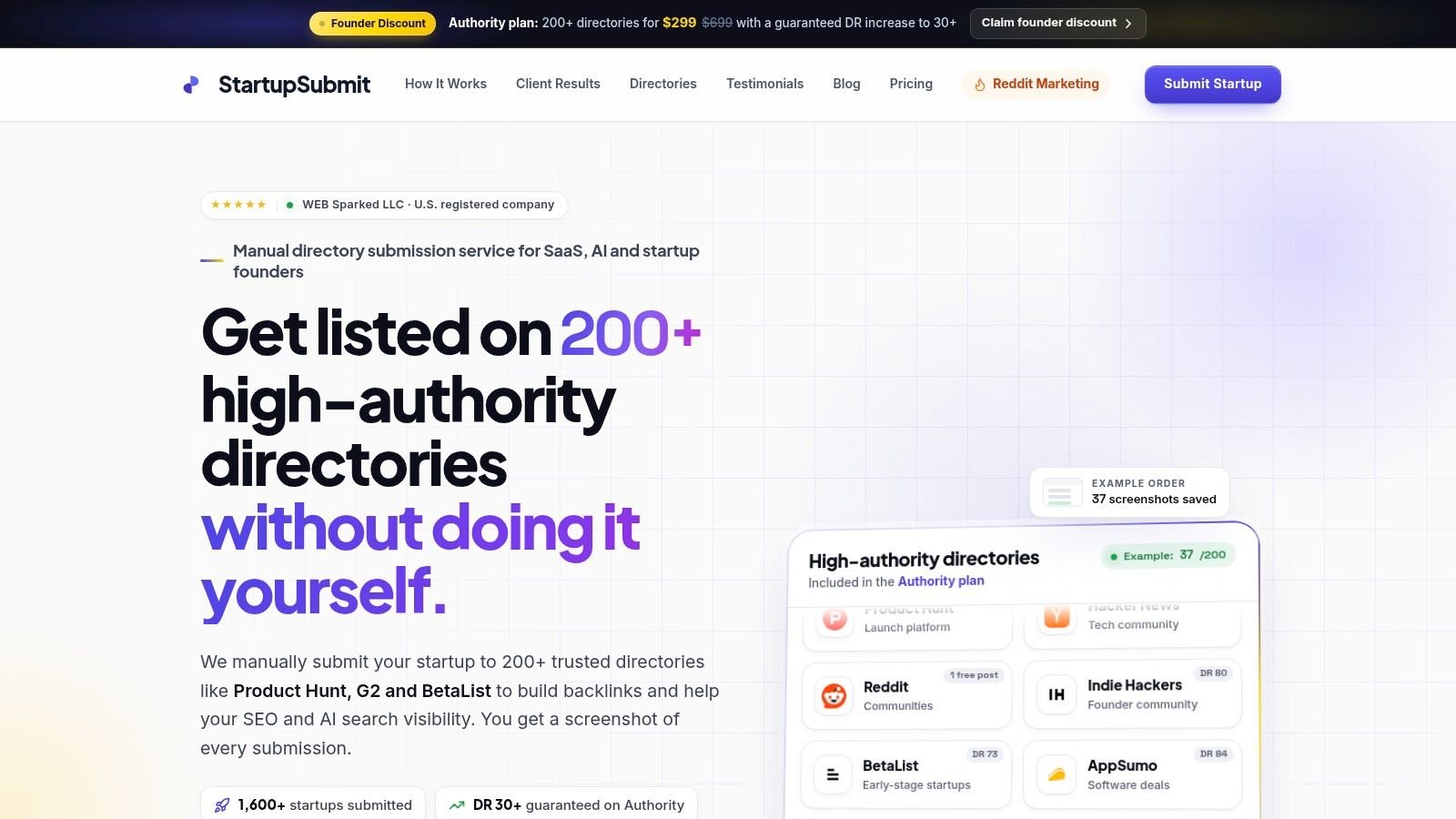
The fastest route to a broad, clean footprint is paying someone else to fill in the forms. StartupSubmit is the manual directory submission service published by the team behind this list, so its limits get the same treatment as everyone else's.
The handover is deliberately dull. You supply product details once, and a team of 20 SEO specialists picks each directory by hand from a database of 500+ curated, editorially reviewed platforms. Link farms and spam networks are excluded, and any directory where you already appear gets skipped in favour of a relevant replacement.
What the plans actually cover
Three one-time plans. Starter is $99 for 60+ directories, Growth is $199 for 150+, and Authority is $299 for 200+ with a DR 30+ guarantee. At the Growth tier that works out to roughly $1.33 per backlink, the figure to hold against an agency retainer. Skip Starter unless you only want a footprint check; the gap between 60 and 150 listings is where the referring-domain count starts to matter.
Descriptions are written per directory rather than pasted, which matters more than founders expect. Identical copy across 150 profiles is the easiest duplicate pattern for a moderator to catch. Campaigns typically run about 5 to 14 days, and the final report lists every submitted backlink URL with a screenshot for each placement. Most listings are permanent because submissions follow each platform's guidelines and pass editorial review. One user on X reported reaching DR 30 in just over a month; treat that as an individual result, not a typical one.
Where it stops
A submitted listing is not an approved listing. Directories control acceptance and timing, and no service can promise a live page. The DR guarantee applies to Authority only, and visibility in AI answers is an outcome listings aim for rather than something anyone can guarantee. If you have more time than money, build the asset kit and do the first twenty yourself.
Website: https://startupsubmit.app
2. Product Hunt
Product Hunt launched in 2013 as a side project and has spent more than a decade in technology discovery since, which is why the platform now reads as an archive as much as a launch board (Product Hunt's own product page). A launch leaves behind a permanent product page with visuals, tags, maker details and a comment thread.
What launch day is actually for
It's for collecting the questions your homepage doesn't answer. The comments are the deliverable, and the page is a durable reference you can link to from pitch decks and cold email for years. Featuring and rankings depend on community engagement and aren't guaranteed to anyone.
Skip it if you can't be in the comments for six hours on launch day. A launch with an absent maker collects a handful of upvotes and a page nobody revisits.
The honest trade: you'll get a traffic spike, a permanent page and a public record of how the launch went. You won't get much from the link itself, so don't count it in your backlink budget.
Before you pay for any submission, you can find no-cost startup listing sites and test whether the basics work for your category.
Website: https://www.producthunt.com/
3. G2
G2 is where B2B software gets shortlisted, and the scale is hard to argue with. Founded in 2012, the marketplace carried more than 150,000 products and services across over 2,100 categories, backed by more than 2 million authenticated B2B user reviews and roughly 80 million annual visitors, per G2's State of Software report.
Why the review count is the asset
The profile is free. The reviews are what convert. A buyer comparing three tools treats a verified review page as third-party evidence in a way no landing page can match, and each review adds a page that ranks for your category terms.
New startups start at zero reviews, and that's the true cost. Budget time for asking your first twenty customers properly rather than blasting an email. Enhanced seller features sit behind paid packages, and the spend only makes sense once you have review volume worth amplifying.
Skip G2 if you sell a consumer app with no software category. You'll end up in a bracket where nobody is shopping.
If you sell AI tooling, it also pays to build backlinks through AI directories where buyers browse by use case rather than by software category.
Website: https://www.g2.com/
4. Capterra
Capterra is a catalogue for people already comparing business software. Vendor accounts let you manage product details, watch the listing and respond as reviews land. Paid lead-generation and promotion programmes exist, and they're optional.
That word optional is doing real work. Google's spam policies treat buying or selling links for ranking purposes as link spam and list low-quality directory or bookmark site links as an example, while saying paid advertising or sponsorship is fine when it carries rel="nofollow" or rel="sponsored" (Google's spam policies).
The line worth drawing
Capterra selling placement is advertising. A directory selling followed links is not, and that distinction is the clearest filter on this whole list.
Skip anything that sells you a followed link for a flat fee. Skip instant-approval directories where the pages around yours are casino and essay-writing listings. Skip any directory that wants a reciprocal link on your site. Those three signals cover most of the harm a submission campaign can do to a young domain.
Capterra itself is worth an hour if your product has a clear category and public pricing information. It's worth nothing if your pricing is "contact us" and your category is invented.
Website: https://www.capterra.com/
5. BetaList
BetaList is built for early adopters hunting new internet startups, and it accepts products that are pre-launch, in beta or live. Visitors land on a short listing and click through to your site, which is exactly the audience a pre-revenue build wants.
Submission is paid and selection-based. BetaList says unselected submissions get an automatic refund, which makes the downside a week of waiting rather than lost money.

The listing itself is a showcase, so treat the visuals as part of the submission. A clean wide screenshot and a one-line tagline do more than three paragraphs of feature copy.
Who should skip it
Skip BetaList if you're past product-market fit and selling to procurement teams. The traffic is curiosity-driven, and curiosity converts at a different rate than a buyer with a budget line. If you're pre-launch with a landing page and a demo, it's one of the better places to list your software startup before you have reviews to show.
Website: https://betalist.com/
6. AlternativeTo
AlternativeTo exists for one search pattern, and it's a valuable one. People arrive looking for alternatives to software they already know, which means intent is specific and the comparison is already in their head. Standard submission is free, though the review queue can take a long time.
Paid priority review moves a submission up the queue. It doesn't buy acceptance.
The queue nobody warns you about
Free submission to a well-moderated directory means waiting behind everyone else who submitted free. That's not a reason to skip it. It's a reason to submit on day one and forget about it for a month instead of refreshing the dashboard.
Don't pick directories on estimated traffic either. A large Ahrefs study of links and referring pages found organic traffic reaching a referring page didn't show a meaningfully stronger relationship with rankings than the raw number of referring domains, and summing traffic to referring domains barely differed from counting them (Ahrefs on links with traffic).
If the listing page ranks for your category, traffic follows. If it doesn't, the DR figure was never doing anything for you.
Skip AlternativeTo if your product isn't a genuine alternative to something people already pay for. "The only tool of its kind" has nothing to sit next to.
Website: https://alternativeto.net/
Boost Your Startup's Traffic & SEO with up to 200+ Directory Listings
Skip the grind. Our team manually submits your product to relevant, high-authority directories, with screenshot proof for every submission, so you get real users, feedback and lasting backlinks without lifting a finger.
Get Listed Today7. SaaSHub
Treat SaaSHub as a comparison engine with a listing attached. It accepts SaaS, IaaS, PaaS, apps and other software, and it lets you connect a listing to categories and competitors, so the payoff comes from showing up next to tools buyers already know. No submission fee is stated on the submission page.
Read the current acceptance rules before you apply. A waitlist-only page is a weak candidate anywhere that asks for a usable product, and a domain email looks more legitimate than free webmail when a reviewer checks whether the company is real.
Small tactics that change the outcome
Name real competitors. Competitor associations put you on the comparison pages, which are the closest thing SaaSHub has to high-intent shelf space. Three genuine alternatives beat a polished listing that sits next to nothing.
Write the category like a buyer would search it. If the product could fit two labels, choose the one your best-fit customers type into Google, not the one that sounds broader.
Approval should be treated as editorial review. If you delegate the work, use it to expand your SaaS startup's online footprint through manual, category-matched submissions rather than a bulk dashboard blast.
Skip SaaSHub if nobody can name the tools you replace. A listing with no credible competitors has little to rank for.
Website: https://www.saashub.com/
8. Indie Hackers
Indie Hackers is a founder community with a product database attached. Listings can show categories, platforms, business model and revenue, which makes the directory read like a build-in-public archive rather than a review site.
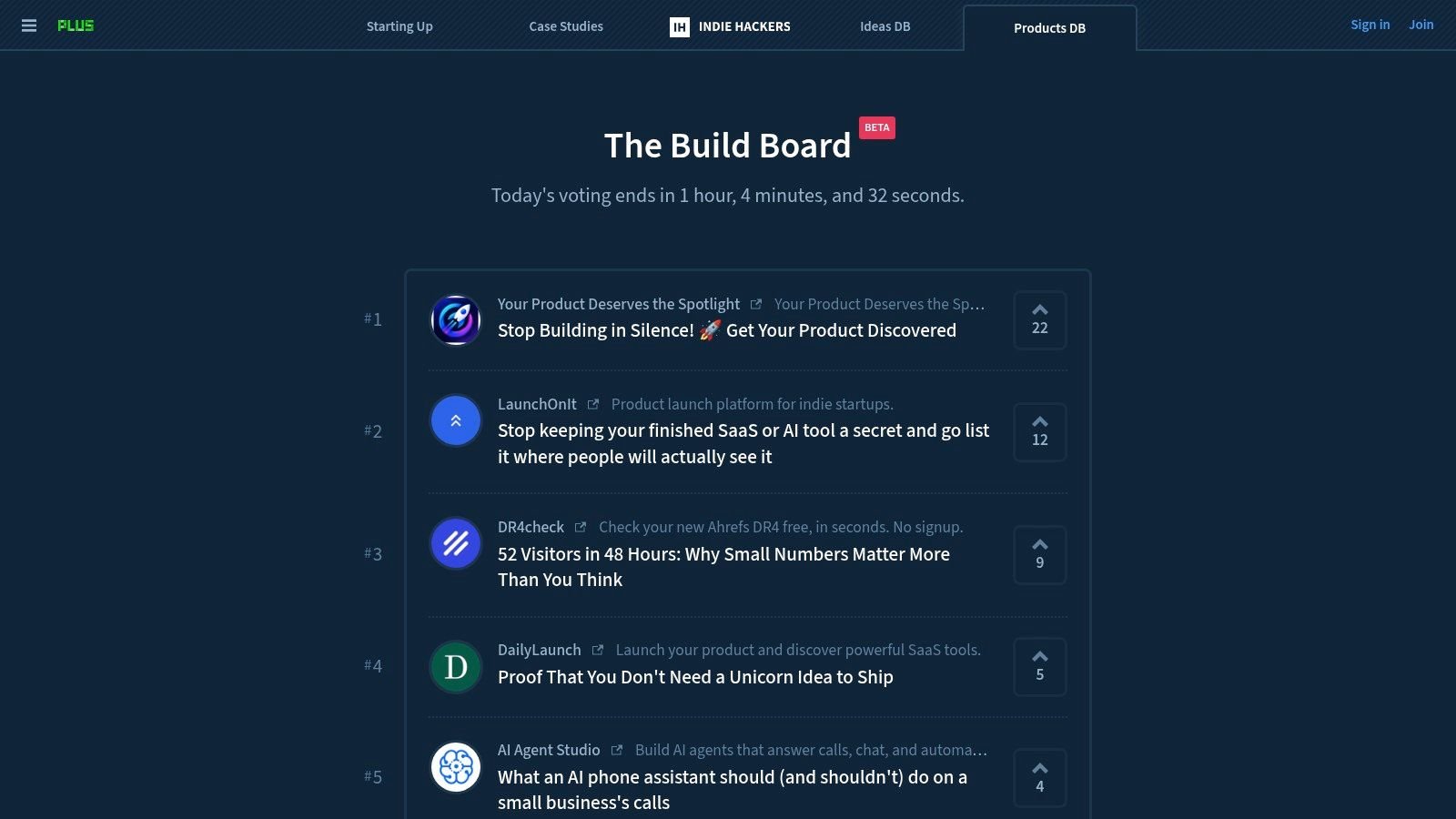
That's the point and the limit. The audience is bootstrapped startups and independent makers, so it rewards the founder who shows up in threads with real numbers.
Add the product, then answer three questions in a relevant thread in the same week. A listing with no participation behind it is a dead page.
What to share and what to hold back
Revenue figures are optional and worth considering carefully. Sharing an MRR number invites useful benchmarks and blunt criticism in equal measure. Decide before you submit, not after.
Skip Indie Hackers if nobody on the team will post. Reach there comes from engagement, not from the entry itself, and it isn't a buyer-review marketplace where procurement teams go shopping.
Website: https://www.indiehackers.com/products
9. Crunchbase
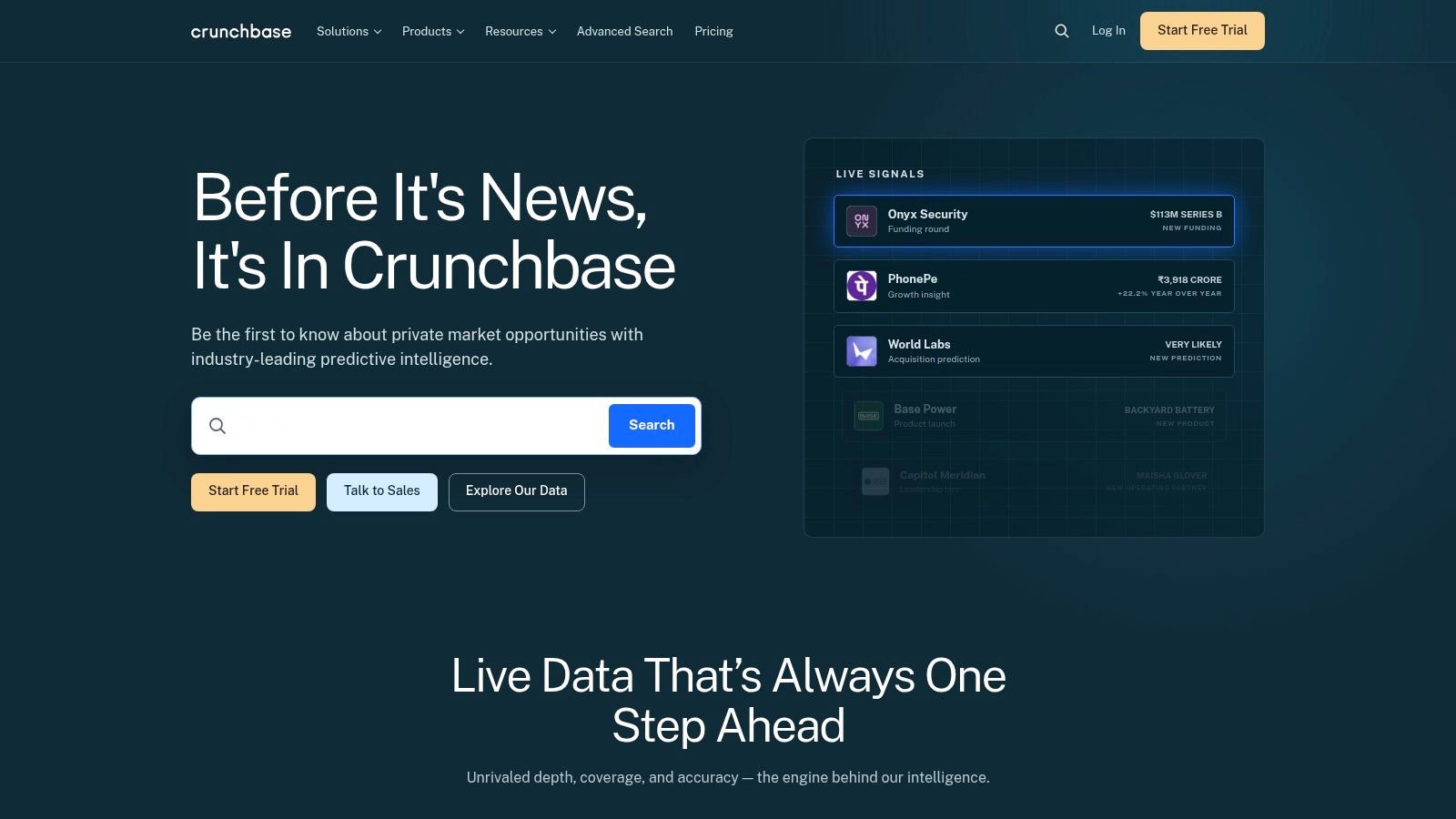
Crunchbase is a company database, not a directory of products. A profile holds your website, description, industry, location, founders and funding rounds, and free registered users can create and edit one. Some fields, including ranking-related ones, sit under Crunchbase's control.
Treat it as the entity layer. When a journalist, an investor or a buyer searches your company name, a populated Crunchbase profile is one of the two or three pages that determines whether you look real.
Why the profile matters for AI search
Google's documentation on AI features sets a concrete bar. A page must be indexed and eligible to appear in ordinary Search with a snippet before it can show up as a supporting link, and those appearances are tracked in Search Console's Performance report under the Web search type (Google's AI features documentation).
That's the whole LLM SEO argument in one sentence. A half-filled profile on a database nobody can crawl contributes nothing to ChatGPT visibility or a Google AI Overview citation.
Skip Crunchbase if you're not raising and not selling to anyone who checks. Otherwise, spend the twenty minutes.
Website: https://www.crunchbase.com/
10. Trustpilot
A Trustpilot profile ranks for the search every prospect eventually runs: your company name plus "reviews." That makes it reputation infrastructure. Claim the profile, fill in the business details, collect genuine feedback and answer every review, positive or not. Start on the free plan, which caps how many review invitations you can send each month, and pay only when volume demands it.
The platform's reach is wider than early-stage founders tend to assume. In BrightLocal's 2025 survey of 1,026 U.S. adults, Trustpilot was used as a review source by 13% of consumers, behind Google at 85%, Yelp at 44% and Facebook at 32%, and 96% of consumers said they're open to writing a business review (BrightLocal's local consumer review survey).
The trap with review profiles
An empty profile looks worse than no profile. If you can't get five real reviews in the first month, delay claiming until you can.
You also can't control what lands there. Have a response plan before the first one-star review, not after. A calm, specific reply does more for a prospect reading the page than the complaint did against you.
Skip Trustpilot if you have no customers yet. And if collecting reviews and managing profiles across platforms is more manual work than your team has time for, StartupSubmit's directory submission service submits by hand to curated, editorially reviewed directories only.
Website: https://www.trustpilot.com/
How the ten directories compare on best use, cost, review process and audience
| Item | Best For | Cost Model | Review Process | Main Audience |
|---|---|---|---|---|
| StartupSubmit | Done-for-you directory submissions for SaaS and AI startups | One-time plans from $99 to $299 | Manual submissions; reports typically in 5–7 days; directory approval not guaranteed | SaaS and AI startup founders |
| Product Hunt | Launching a new technology product and gathering early feedback | Free to launch | Community engagement influences visibility; featuring is not guaranteed | Product makers and people discovering new tools |
| G2 | Building a B2B software profile and collecting reviews | Free entry-level presence; paid seller features available | Product profiles and customer reviews | B2B software buyers and vendors |
| Capterra | Reaching buyers comparing business software | Profile available without paid promotion; optional paid marketing | Product listing with optional customer reviews | Business software buyers and vendors |
| BetaList | Promoting pre-launch, beta, or live startups to early adopters | Paid submission; automatic refund if not selected | Subject to platform selection | Early adopters and new startups |
| AlternativeTo | Reaching users comparing software alternatives | Free submission; optional paid priority review | Community-submitted; priority review does not guarantee approval | People searching for software alternatives |
| SaaSHub | Listing publicly available SaaS and software products | No submission fee stated | Submission requires approval; unreleased products are not accepted | Software users comparing products |
| Indie Hackers | Sharing a product with a founder-focused community | Cost not specified | Product can be added to the database; reach depends on engagement | Indie makers, bootstrappers, and founders |
| Crunchbase | Creating a public company profile in a startup database | Free profile creation for registered users | Profiles can be edited subject to platform controls | People researching companies, teams, and funding |
| Trustpilot | Collecting customer feedback and managing a business reputation | Free account available; paid tools offered | Customers submit reviews; businesses can respond | Consumers researching businesses and reviewed companies |
Your Directory Plan for the Next 30 Days
Most of your competitors aren't doing this work. BrightLocal's 2025 SMB marketing report found that only 17% of small and medium-sized businesses use business directories and just 15% use review platforms, while 42% of consumers trust online reviews as much as personal recommendations, down from 79% in 2020 (BrightLocal's SMB marketing report). Thin competition and stubborn consumer trust is a rare combination.
Week one
Pick three directories that match your actual buyers and submit there before anything else. For most B2B SaaS products that means one review platform, one launch platform and one community. Build the asset kit once: a square logo, a wide logo, a one-line tagline, a 50-word and a 150-word description, three screenshots and a founder bio. Then reuse it everywhere.
Write the description for each platform rather than pasting the same text. Rotate two versions so your listings don't read as duplicates. Choose the category by hand. The wrong category is worse than no listing, because it puts your product in front of buyers who will never convert.
Skip any directory that approves every submission instantly. Editorial review is what makes a listing worth having, and a link from a site with no standards adds risk instead of authority.
Week two to four
Work outward in batches of ten and log everything: directory, date submitted, status, live URL. A spreadsheet works. Forty unlogged submissions do not, because you can't reclaim a link you never tracked.
Submit the slow queues first. Review sites and databases take longest to publish, so get them in line early and fill in the faster directories while you wait.
Day 60 check
Look at three numbers: referring domains, branded search impressions, and referral sessions by directory using UTM tags. Referring domains move first. Rankings and most of the referral value show up in the second and third month, not launch week.
Be honest about what directories can't do. Google states that meeting its best practices doesn't guarantee crawling, indexing or search visibility (Google Search Essentials), and AI-search referrals still account for a small share of referral traffic for most sites. Directories build the entity footprint that AI answers draw on. They don't buy you a citation.
That is why the structured data around your profiles matters as much as the profiles themselves. The AI SEO work that pays off is consistent data across every page a buyer or a model can find.
StartupSubmit submits SaaS and AI products by hand to 200+ curated directories, including Product Hunt, G2, Capterra, BetaList, Indie Hackers, AlternativeTo and SaaSHub, with hand-picked categories, duplicate checks and a screenshot for every placement. One-time plans run from $99 for 60+ directories to $299 for 200+ directories with a DR 30+ guarantee, and delivery typically takes about 5 to 14 days. Treat it as the foundation layer: it builds the listings, and you add guest posts and press placements on top for contextual authority. If you'd rather spend the next month shipping than filling in forms, start a StartupSubmit order and get a report with a submitted URL and a screenshot for every placement.
Ready to build high-quality backlinks?
We'll manually submit your product to 60 to 200+ directories in 5 to 7 days, with screenshot proof for every submission. No bots, no boring forms, just more time for selling and building.
See pricing & get started →