How to Increase Domain Authority: A Startup’s Roadmap
If your startup is not showing up in search, the problem usually is not your product. It is trust.
Founders feel this early. You launch on Product Hunt, post on LinkedIn, maybe get mentioned in a niche community, and traffic jumps for a few days. Sign-ups come in. Then the spike fades. Pipeline slows, branded search stays thin, and the leads you hoped SEO would bring never really arrive.
That is the reality for most new domains. You are not just competing on product quality. You are competing on credibility. Thin backlink profiles, a limited brand footprint, and weak third-party validation make it hard to rank, even when your product is stronger than the companies above you.
This is where Domain Authority becomes useful. Not as a vanity metric, but as a founder-friendly benchmark. It helps you see how much trust your site has earned compared with the startups already winning the search terms tied to pipeline, demos, and revenue.
Founders do not need another bloated SEO checklist. They need to know where to spend limited time and budget. What should you fix first? Which links actually move the needle? What can wait until next quarter? Most of all, you need to avoid a common SaaS mistake: chasing flashy but irrelevant backlinks that look good in a report and do almost nothing for search performance.
The right approach is simpler than it seems. Build foundational trust signals first. Create content people genuinely want to cite. Support it with technical SEO that helps authority flow through the site. If your backlink profile is still light, start with the basics and make sure your company presence is consistent across the web. That is the groundwork behind why startup visibility compounds over time.
Table of Contents
- Your Startup's Authority Problem Isn't What You Think
- Audit Your Starting Point and Set Realistic Goals
- Secure Foundational Trust with High-Impact Link Building
- Amplify Authority with Content and Digital PR
- Solidify Your Gains with Technical and On-Page SEO
- Monitor Measure and Maintain Your Domain Authority
What foundational links look like for SaaS
Your Startup's Authority Problem Isn't What You Think
Many founders assume they have a traffic problem. In practice, they usually have an authority gap.
Your homepage may be polished. Your product may solve a meaningful problem. Your documentation may be stronger than that of competing vendors. None of that guarantees search visibility if credible third-party sites are not referencing your business. Domain Authority matters here because it reflects whether your startup has built enough off-site trust to compete.
Traffic spikes don't create authority
Launch traffic is volatile. It signals awareness, not sustained credibility.
Search performance works differently. Search engines rely heavily on external signals, especially backlinks from credible websites. The verified guidance is consistent on this point: increasing Domain Authority depends primarily on off-page SEO, especially link building and digital PR. Internal site improvements alone rarely move that metric in a meaningful way.
Practical rule: If reputable sites in your market are not linking to your startup, search engines have limited reason to view your domain as established.
That does not make technical SEO optional. It means technical refinements without link acquisition will not solve the core issue. Many early-stage teams spend weeks revising title tags while competitors continue adding relevant referring domains.
DA is useful when you treat it as a benchmark
DA becomes misleading when founders treat it as a vanity KPI. It becomes useful when they use it to answer a more practical question: Are we credible enough, relative to the sites ranking for the terms we want to win?
That perspective turns "how to increase domain authority" into a business decision. You are not pursuing a score for its own sake. You are closing the trust gap between your startup and the sites already performing well in search.
Audit Your Starting Point and Set Realistic Goals
Before building authority, establish a realistic baseline. This does not require an enterprise SEO stack. It requires a few reliable checks and the discipline to compare your domain against the right competitors.

Check the number, then check the context
Use a DA or DR checker from a well-known SEO platform. Do not overreact to small differences between Moz, Ahrefs, or similar tools. What matters is consistency.
Then compare your startup with 2 to 3 direct competitors, not large publishers. If you sell finance workflow software to mid-market teams, benchmark against other finance workflow vendors, not Forbes or HubSpot.
A useful benchmark comes directly from the verified guidance: if competitors hold DA scores between 40 and 50, your target should be to reach or exceed that range to materially improve search visibility.
| Situation | What it means |
|---|---|
| Your score is close to competitors | Content quality and technical execution may drive results faster |
| Your score is far below competitors | Off-page SEO should become a clear priority |
| Your score is higher than weaker competitors | You may already have an opportunity to win on long-tail intent |
Run a quick backlink sanity check
Open Google Search Console and the backlink checker you trust most. You are not conducting a forensic review. You are looking for clear patterns.
Check these first:
- Referring domains: Are links coming from multiple websites, or only a few?
- Top linked pages: Are most links pointing only to the homepage?
- Relevance: Are the linking domains actually connected to your market?
- Risk: Do you see obvious junk, scraper sites, or misaligned directories?
If you want a structured shortlist of tools for this stage, The SEO Agent's AI SEO recommendations are useful because they group research and workflow options in one place.
If your backlink profile is inconsistent, your SEO outcomes will usually be inconsistent as well.
Set a target that matches your market
Do not set a DA goal in isolation. Tie it to the search opportunities that matter to the business. If your authority is still low, avoid building your content strategy around terms dominated by much stronger domains. Prioritize topics where your site can compete, then use earned links to expand your reach.
A practical audit output looks like this:
- Current authority level
- Three real competitors
- Gap in referring domains and relevance
- Pages most worth building links to
- A near-term target tied to your market
If you are allocating founder time or deciding whether to outsource repetitive SEO work, map that against your current stage and pricing options for manual submission support.
Secure Foundational Trust with High-Impact Link Building
New startups often make link building harder than it needs to be. They pursue high-profile placements before establishing the trust signals that help search engines recognize them as legitimate businesses.
Start with trust signals, not ego links
For a new domain, the first objective is not a homepage link from a major publication. The first objective is to build a clean, credible, and consistent footprint across platforms search engines already trust.
The verified data is clear on this point. For small businesses, getting listed across online directories can cost under $100 and significantly improve DA by establishing presence in trusted databases. Few early-stage tactics offer the same mix of speed, affordability, and simplicity.
This approach is especially effective for SaaS startups that have not yet built enough content or brand awareness to earn links naturally. Directory and profile listings do not replace editorial links, but they create a foundation.
What foundational links look like for SaaS
For a startup, foundational trust links usually come from software directories, startup listing sites, review platforms, founder communities, and company profile pages. The objective is not volume. It is consistency.
Think in layers:
- Company identity platforms: Product Hunt, Crunchbase, Indie Hackers
- Software discovery sites: G2, Capterra, AlternativeTo, SaaSHub
- Relevant directories: Industry or niche-specific listing sites
- Reputation pages: Profiles that validate your brand for branded searches
The strongest version of this work is curated, manual, and selective. The verified guidance also warns against links from sites with strong spam signals.
A new SaaS site does not need hundreds of random backlinks. It needs a credible footprint on sites that people and search engines already trust.
Many teams are also thinking beyond traditional SEO. If that matters for your roadmap, link building for LLM ranking is worth reviewing because it reflects the same broader shift.
When to use a submission service
Manual submissions take time. Every listing requests slightly different information, categories, description lengths, screenshots, logos, or social links. Teams often start this work and then stop before establishing meaningful coverage.
If you are managing it in-house, create a single source-of-truth document that includes:
- Brand description: Short and long versions
- Primary category: Plus acceptable secondary categories
- Core links: Homepage, product page, pricing, docs, contact
- Visual assets: Logo, screenshots, favicon
- Social proof: Reviews, launch links, founder profile links
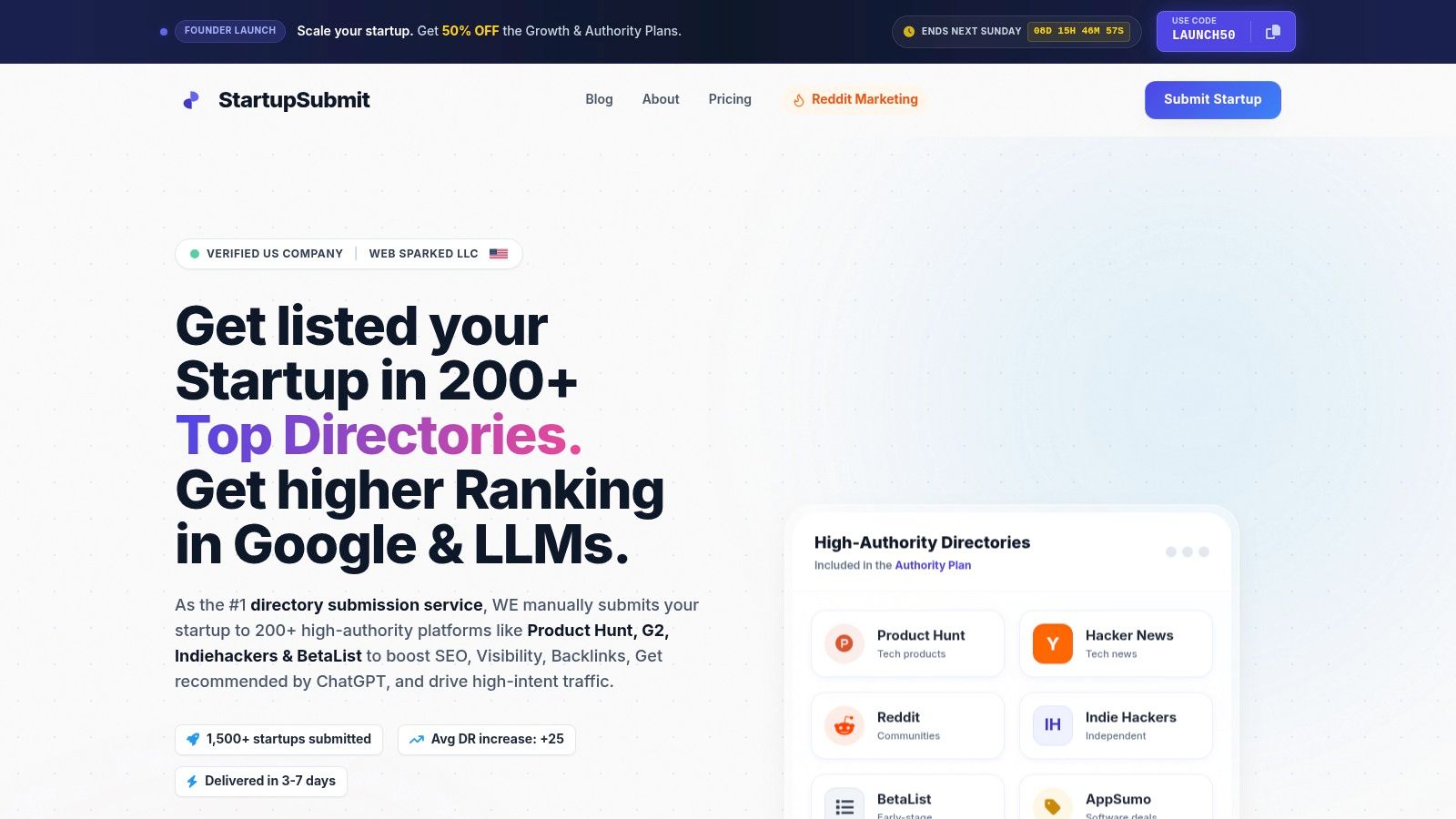
Want to accelerate this step without pulling your team off growth work? StartupSubmit helps SaaS and AI companies build foundational visibility faster through manual directory and startup profile submissions, with reporting that shows exactly where your product has been placed.
Later in the process, video can help your team understand what a cleaner submission workflow looks like in practice.
If you do not want your team spending time on repetitive forms, one option is StartupSubmit, which manually submits SaaS and AI startups to a broad set of startup and software directories and returns a report of placements.
What doesn't work well at this stage
Founders often lose time when they jump into advanced outreach before the fundamentals are in place.
| Tactic | Problem for a very new startup |
|---|---|
| Broad guest post pitching | Difficult to win without brand credibility or proof assets |
| Buying cheap backlink packages | High spam risk and weak relevance |
| Chasing only high-DA media sites | Slow, expensive, and often inefficient |
| Ignoring local and niche listings | Misses the easiest trust-building opportunities |
The fastest path is not always the best long-term strategy, but foundational links often make everything that follows more effective.
Amplify Authority with Content and Digital PR
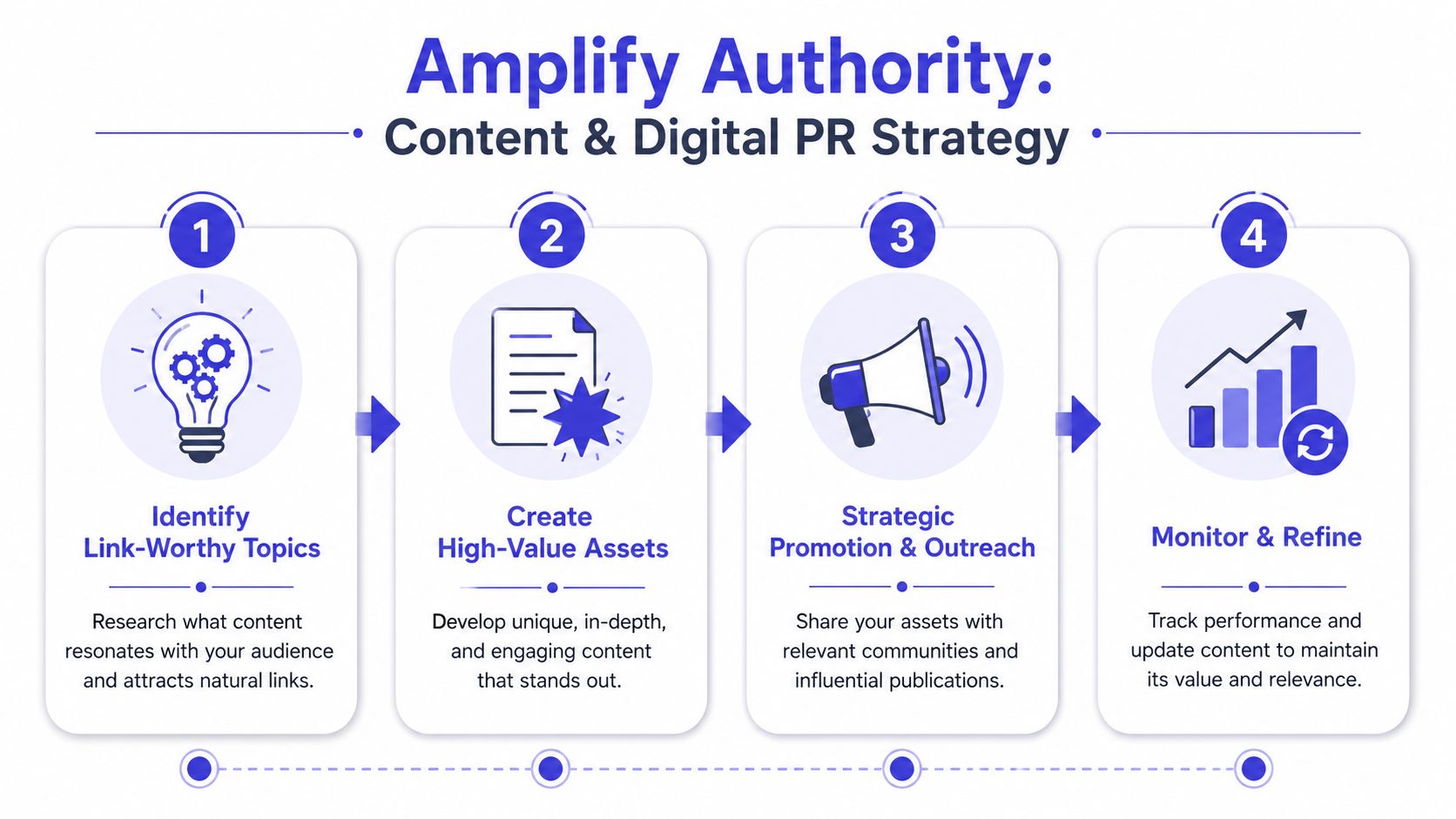
Once your initial trust layer is in place, backlinks need to be earned. This is where content and digital PR begin to drive stronger authority growth.
A generic blog post is unlikely to attract strong links. Startups earn better backlinks when they publish something another writer, operator, or analyst can cite with confidence.
Build assets people can actually cite
The verified guidance on how to increase Domain Authority points to link-worthy content such as original research, expert guides, and shareable resources. For SaaS, that usually means one of four formats.
- Original data from your product
If your software surfaces workflow patterns, anonymized benchmarks, trend snapshots, or usage behavior, package that information into a report.
- Definitive problem-solving guides
A strong guide should answer the operational question fully, include practical examples, and be credible enough that a niche publisher would cite it.
- Free tools
Calculators, generators, templates, and checklists can attract links when they solve recurring tasks.
- Expert-backed resources
The verified data notes that content with expert contributions is more likely to be cited.
Relevance beats raw authority for new SaaS sites
This is one of the most important nuances for startup teams.
A large site linking to you is not automatically valuable if the context is weak. The verified dataset includes a notable claim from a 2024 to 2025 Ahrefs analysis of 10K new SaaS domains, where 68% of DR growth stalls when new backlinks come from domains with DA above 50 but zero topical overlap. The example given is a travel blog linking to an AI tool, which signals a relevance mismatch rather than meaningful authority transfer, as described in this Ahrefs-focused discussion on SaaS link relevance.
That aligns with what many SaaS operators observe in practice. A link from a smaller but highly relevant RevOps blog, developer tools newsletter, or vertical SaaS publication often contributes more than an isolated mention on a broad lifestyle site.
Key distinction: For a new SaaS domain, the best backlink is usually the one that makes editorial sense, not the one with the highest authority score.
When evaluating opportunities, ask:
- Would this site realistically cover our product category?
- Would a real reader click this link and find it useful?
- Does the topic align with our expertise?
- Are we building a backlink profile that looks coherent over time?
You can also strengthen your profile by ensuring your external visibility reinforces your category positioning and trust signals across the web. That is one reason teams care about the discovery benefits of consistent startup profiles alongside content campaigns.
Digital PR that fits an early-stage team
You do not need a full PR department to earn meaningful links. You need a small number of assets worth pitching and a disciplined approach to outreach.
For an early-stage SaaS company, the practical sequence usually looks like this:
- Create one standout asset: A benchmark report, founder-led guide, or simple free tool
- Build a shortlist of relevant targets: Niche blogs, newsletters, resource pages, analyst-style sites
- Personalize outreach: Explain why the asset is useful for their audience
- Repurpose the same core insight: Turn one asset into guest commentary, LinkedIn threads, and community posts
Guest posting still works when the publication is relevant and selective. Broken link building also works when you can replace a dead resource with something stronger. Generic outreach does not.
Solidify Your Gains with Technical and On-Page SEO
Authority earned through backlinks only delivers full value if your site can absorb and distribute it effectively. If pages are difficult to crawl, internal links are weak, or low-quality backlinks are pulling the domain down, your off-page work will underperform.
Technical SEO does not create authority on its own. It protects and channels the authority you earn.
Make your site easy to crawl and understand
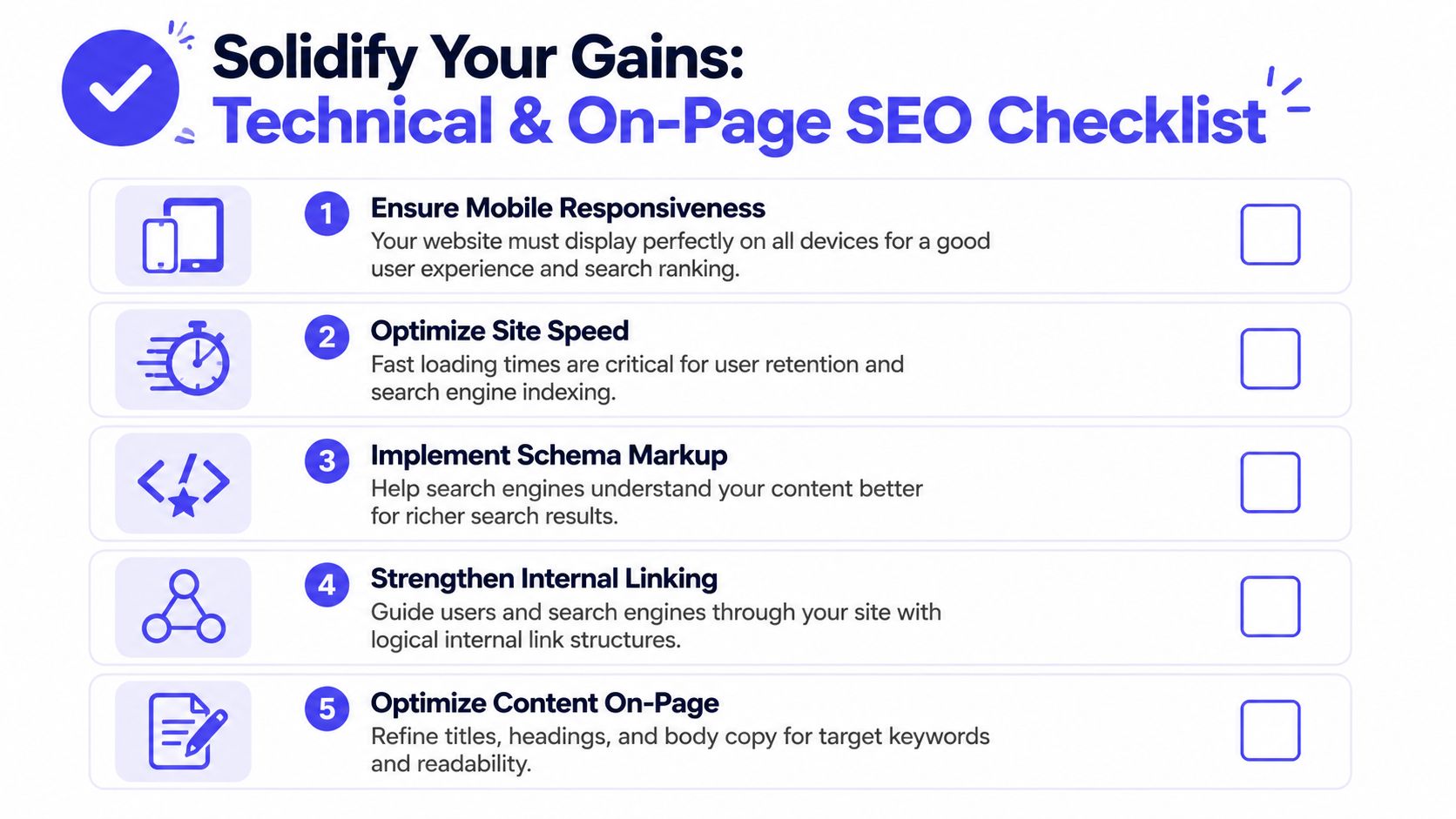
The verified data points to a straightforward technical foundation: SEO-friendly URLs, a sitemap, robots.txt optimization, and stronger site navigation. For a startup, that means keeping the site structure simple and predictable.
Use this as your baseline:
- URLs: Keep them readable and stable
- Sitemap: Submit it in Google Search Console
- Robots rules: Block only what should not be crawled
- Navigation: Make core pages reachable within a few clicks
- Mobile experience: Ensure important pages work cleanly on phones
This work is not glamorous. It matters because search engines need to discover, crawl, and understand the pages you want to rank.
Use internal links to move authority where it matters
A common mistake is allowing most backlinks to point to the homepage while important commercial pages remain isolated.
Internal linking helps solve that. The verified guidance specifically notes that internal links should support key money pages, avoid orphan pages, and feel natural. For SaaS, money pages often include pricing, product category pages, integration pages, and comparison pages.
| Page type | Internal linking role |
|---|---|
| Homepage | Links to product, pricing, and core use cases |
| Blog posts | Link to relevant product and comparison pages |
| Use case pages | Link to demos, features, and proof assets |
| High-authority resources | Pass relevance to commercial pages without over-optimizing anchors |
When a blog post earns a backlink, do not leave that value stranded on the blog page.
Clean up harmful links before they become a drag
If your audit revealed suspicious backlinks, address them. The verified data warns that failing to disavow toxic or spammy backlinks is a common pitfall, and that using Google Search Console to ignore harmful links helps prevent them from influencing authority calculations, as discussed in this Forbes Technology Council piece on increasing domain authority.
That does not mean disavowing every unfamiliar domain. Apply judgment. The real risk is a pattern of clearly spammy, manipulative, or irrelevant domains.
A simple process works well:
- Export suspect links from your backlink tool.
- Review them manually for obvious junk.
- Request removal if practical.
- Use Google's disavow workflow for links you cannot remove and do not want associated with the domain.
On-page SEO matters here as well. Refine titles, headings, and body copy around the terms you can realistically compete for. On-page improvements help you capitalize on authority. They do not replace the need to earn it.
Monitor Measure and Maintain Your Domain Authority
Many startup SEO plans underperform because authority building is treated as a short-term campaign rather than an operating discipline.
Domain Authority moves slowly because trust moves slowly. The activities that improve it are cumulative. Profiles get indexed. Content gets discovered. Links accrue over time. Search engines reassess your site as those signals build.
Track the signals that lead the score
The score itself matters less than the inputs behind it.
Monitor these regularly:
- Referring domains growth: Are new relevant sites linking to you?
- Link quality: Are those links credible and aligned with your niche?
- Top linked pages: Are your strongest pages earning links, or only the homepage?
- Brand search footprint: Does your startup's search presence show recognized profiles and assets?
- Keyword traction: Are pages gaining visibility for realistic target terms?
The verified data repeatedly points to the importance of the quality and quantity of external links and the growth of referring domains.
Use a simple operating rhythm
Keep the cadence light enough that it remains consistent.
A strong startup rhythm is:
- Weekly: Check new links, mentions, and outreach opportunities
- Monthly: Review referring domains, key pages, and competitor movement
- Quarterly: Audit technical issues, spam risks, and content assets worth refreshing
For newer companies, patience matters. One of the few relatively fast trust-building actions is directory coverage. The verified data states that obtaining directory listings across online platforms can cost under $100 and significantly increase domain authority by establishing trust signals and local relevance, as noted in this WordStream guide to increasing domain authority.
The broader point is simple. Domain authority is not a vanity metric when it is tied to visibility, trust, and pipeline growth. Startups that consistently earn relevant links, publish assets worth citing, and maintain a strong technical foundation put themselves in a far better position to rank, convert, and compete.
The companies that win organic search over time are rarely the ones chasing shortcuts. They are the ones that build credible signals systematically and turn authority into a durable acquisition channel.
If your team wants to strengthen that foundation without losing hours to repetitive submissions, StartupSubmit can help. It handles manual submissions for SaaS and AI startups across startup and software directories, then provides reporting so you can see where your product is listed and keep your authority-building process moving.
If increasing search visibility is a priority this quarter, this is one of the simplest ways to establish trust signals faster and free up your team to focus on content, product marketing, and revenue-generating work.