
Local Citation Service: How It Works and What It Costs
A local citation service creates, fixes and maintains one consistent set of name, address and phone number listings for a business across maps, local directories, industry platforms and review sites. For most single-location businesses, the useful range is 11 to 20 accurate listings, not 300. What follows is the workflow, who it fits, how volume behaves and what a one-time plan costs per location.
Local intent runs daily. Rio SEO's 2025 consumer behavior study, a survey of more than 1,000 consumers, found that 84% of U.S. consumers reported searching online for local businesses every day. A citation set exists to answer that habit with one clean, verifiable record.
Table of Contents
- What a Local Citation Service Actually Does
- Local Citations vs Startup Directory Submissions
- Who Needs Local Citations and Who Should Skip Them
- How Many Citations You Actually Need
- What Local Citation Services Cost in 2026
- How a Citation Service Manages Your Listings
- Local Citation Service FAQs
- Choosing a Citation Service Without Wasting Budget
What a Local Citation Service Actually Does
BrightLocal's 2025 consumer study measures the behavior behind the purchase. 39% of respondents estimated that at least 41% of their searches were dedicated to finding information about local businesses, Google was the default platform for 45% of consumers, and Google Maps alone was the first-choice starting point for 15% (BrightLocal). Combine Google Search with Safari and 53% of respondents' default starting points are covered.
A citation is the record that answers those searches. It carries the name, address and phone number (NAP) plus the website, primary and secondary categories, hours and service areas. It lives on Google Business Profile, Bing Places, Apple Maps, Yelp, regional directories, and industry or review platforms.
A citation still counts when there's no link. Search engines and AI assistants use repetition across independent sources to confirm that one real business exists at one address and does one thing. A matching phone number on eight trusted sites is corroboration. Four different phone numbers across twelve sites is an open question.
The day-to-day work, in order:
- Audit every listing already carrying the business name, including ones the owner forgot about.
- Lock a master NAP record with the owner, formatted one way, including suite numbers and tracking lines.
- Fix contradictions in name, address and phone before adding anything new.
- Submit to platforms that match the location and category, by hand, with categories mapped to each site's own taxonomy.
- Verify acceptance and report live URLs, statuses and anything needing the owner's action.
The cleanup side is unglamorous, and fixing inconsistent business listings is usually where the first round of work goes. If you're still working out which platforms matter at all, the founder's guide to directory submissions maps the options before you spend anything.
One honest caveat. These surveys show the scale of local-intent behavior. They don't measure a ranking effect from any directory count, and no citation package can promise a Maps position.
Local Citations vs Startup Directory Submissions
Founders get sold the wrong product constantly, because both services are called "listings." They solve different problems.
| Dimension | Local citations | Startup directory submissions |
|---|---|---|
| Primary goal | Get found by nearby customers searching maps and local queries | Get discovered by users, investors and journalists researching products |
| Core listing data | Name, address, phone, hours, website, categories, service areas | Product name, tagline, description, category, pricing, launch details |
| Typical platforms | Google Business Profile, Bing Places, Yelp, Apple Maps, industry and review sites | Product Hunt, G2, Capterra, BetaList, AlternativeTo, Indie Hackers, SaaSHub |
| Best fit | Local, service-area, multi-location and brick-and-mortar businesses | SaaS, AI and indie startups selling software online |
| Discovery trigger | Near-me, category and service searches in Maps and local packs | Category, alternative and best-of searches in software directories |
| Main SEO payoff | Entity consistency and prominence for local rankings | Backlinks, referring domains and authority profiles for organic and AI visibility |
The mental model is simple. Citations confirm that one real business operates at one place. Startup directories confirm that one product exists in one software category. A plumber needs the first record. A bootstrapped SaaS needs the second.
That distinction also changes how you judge results. An Ahrefs links study found that the total number of referring domains had roughly the same relationship to ranking as the number of referring domains receiving organic traffic, which argues for counting unique, relevant domains over raw submission totals (Ahrefs). Some citation work produces genuine referring domains; a lot of it is an unlinked mention that still helps entity clarity.
Free listings and social pages are where most small businesses start before paying anyone, and free local listings and social pages covers that base without a budget. StartupSubmit runs both service lines, local citations and the startup listing service for AI tools, so the directory mix matches the business type rather than the sales page.
Who Needs Local Citations and Who Should Skip Them
Buy them if customers can arrive in person or the business serves a defined geography. That covers restaurants and retail, clinics and dental practices, plumbers, cleaners, contractors, law firms, agencies, franchises with multiple branches, and any service-area business that hides its address and lists coverage areas instead.
Skip them if there's no location and no local customer. A SaaS selling to distributed teams, an AI product with a self-serve trial, an indie tool with a global user base: the coverage budget does better in software directories, product-led SEO and AI visibility work. Paying for 300 map listings is how founders burn a launch budget on nothing.
Coverage should match where the business operates. We build citations for local and small businesses, service-area businesses, multi-location businesses, home services, professional services, healthcare practices, restaurants and retail, franchises, and agencies, and plans use directories that serve the business's own country and area across the US, UK, Canada, Australia and New Zealand.
The AI-search wrinkle
Generic directories do less for AI answers than commonly assumed. A 2025 Localogy analysis found that AI-powered search draws on Google Business Profile, Yelp, Tripadvisor, OpenTable, Justia, Healthgrades and other vertical-specific sources, with niche relevance counting for more than generic directory presence (Localogy).
A restaurant benefits from OpenTable or Resy. A law firm needs Justia or Avvo. A project-management SaaS needs G2 and AlternativeTo, which is a different kind of authority entirely.
| Business type | Platforms to prioritize |
|---|---|
| Restaurant | Google Business Profile, Yelp, Tripadvisor, OpenTable, Resy |
| Law firm | Google Business Profile, Justia, Avvo |
| Dental clinic | Google Business Profile, Healthgrades, Bing Places |
| Plumber or contractor | Google Business Profile, Bing Places, Yelp, industry platforms |
| Project-management SaaS | G2, Capterra, AlternativeTo, Product Hunt |
| AI tool startup | G2, Product Hunt, AlternativeTo, Indie Hackers |
The edge cases founders ask about
- SaaS with a real office and walk-in demos: run both service lines. Local citations for the address, software directories for the product.
- Agency serving local clients: citations for the agency's own city presence, directories for its service positioning. The two reports never merge into one vanity number.
- AI tool startup: software and AI directories first. Map listings only if there's a physical studio or a local sales presence.
The test: if a customer could search "near me" and reasonably expect your business to appear, you need citations. If not, you need product directories.
Boost Your Startup's Traffic & SEO with up to 200+ Directory Listings
Skip the grind. Our team manually submits your product to relevant, high-authority directories, with screenshot proof for every submission, so you get real users, feedback and lasting backlinks without lifting a finger.
Get Listed TodayHow Many Citations You Actually Need
Volume plateaus, and the data shows it clearly. A 2025 analysis of 16,098 Google Business Profiles found top-three local visibility in 45.0% of cases for businesses with 1 to 5 citations, 53.2% with 6 to 10, and 60.0% with 11 to 20, with results largely flattening after that and reaching 69.1% even for profiles with more than 200 citations (Localo).
| Citations per profile | Profiles ranking in top 3 | How to read it |
|---|---|---|
| 1-5 | 45.0% | Bare-minimum presence, but visibility is left on the table |
| 6-10 | 53.2% | Core local coverage starts to compound |
| 11-20 | 60.0% | Practical sweet spot for most single-location businesses |
| More than 200 | 69.1% | Plateau; extra volume alone stops paying off |
Read that closely. The analysis didn't measure listing consistency, and correlation isn't causation, so the shape is the message rather than the exact percentages. Doubling from 20 to 200 listings moves the needle less than moving from 5 to 15 does.
Google's own framing points the same way. Local prominence is evaluated partly through information found across the web, including links, articles and directories, alongside review count and rating, which means the effect is mediated by relevance, distance and reputation rather than submission volume (Google Business Profile help).
Turning the curve into a budget
- Single location, normal market: target 11 to 20 accurate listings on the platforms your category uses. Leave headroom for duplicates and cleanup.
- Competitive metro: go bigger, but only on relevant platforms and vertical directories. Volume on filler sites buys nothing.
- One-suburb salon or a single-location dentist: 300 listings is a number on an invoice, not a strategy.
Practical rule: correcting five wrong listings usually beats adding fifty correct ones, because inaccurate records can hurt rather than help.
Before you buy more coverage, check whether the listings you already have say the right thing. For founders still weighing directory programs, the StartupSubmit guide to launch directories explains where the startup-side spend belongs.
What Local Citation Services Cost in 2026
Pricing is where the model gets clear. Citation work is a one-time project per business location, not an ad retainer.
| Plan | Citations | One-time price | Price per citation | Best for |
|---|---|---|---|---|
| 50-citation plan | 50 | $79 | $1.58 | Core listings for a single-location business |
| 100-citation plan | 100 | $109 | $1.09 | Wider local and industry coverage in competitive markets |
| 300-citation plan | 300 | $259 | $0.86 | Recommended best value; costs $68 less than three 100-citation plans |
The 300-citation tier is marked as the recommended best-value option at $0.86 per citation, and it costs $68 less than buying three 100-citation plans. Buying in bulk only makes sense if those extra placements are relevant, which is the discipline the visibility curve demands.
One-time pricing exists because the work has a defined end: an audit, a batch of submissions, verification and a report. Monthly retainers in this category are usually paying for syncing software or ongoing management, not for building anything new. If a provider quotes a monthly fee, ask what work happens in month four.
How to pick a tier
- A single-location business in a normal market: the 50-citation plan covers core listings at $1.58 each.
- A competitive metro or a category with heavy local competition: the 100-citation plan adds wider local and industry coverage at $1.09 each.
- Multi-location or agency work: run the per-location math. Three separate 50-citation orders cost $237; one 300-citation tier at $259 covers a wider footprint for one location, so decide by how many locations you operate.
Plans are priced per business location, and each location gets its own set of citations, so a four-branch franchise multiplies the cost rather than sharing it. Coverage spans the US, UK, Canada, Australia and New Zealand, priced within each country's directory set. If you want to sanity-check a directory list before paying anyone, StartupSubmit's free directory list is a reasonable starting point.
How a Citation Service Manages Your Listings
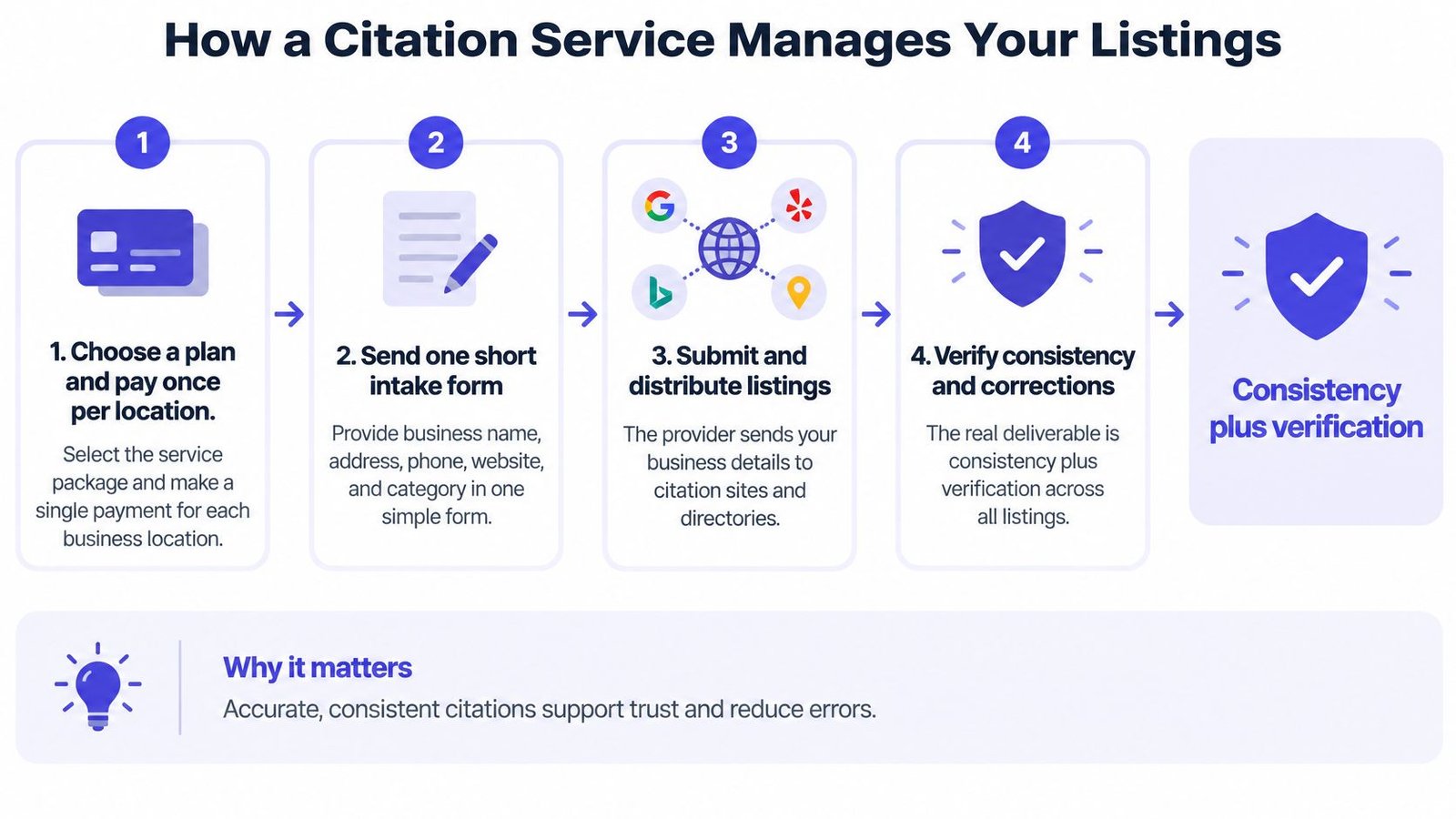
Citation volume plateaus fast. After the core general, local and map-style listings are live, the useful work is consistency: one master NAP record, duplicate cleanup and platforms chosen for your country, city and category. That is what a managed order is really buying.
- Choose a plan and pay once per location. One payment covers one location and its own set of citations.
- Send one short intake form. Business name, address or service area, main phone number, website URL, primary category, services and a short description. Logo, opening hours, social profiles and existing listings help, but they are not blockers.
- The team confirms a master NAP record and submits by hand. Every platform is checked for existing profiles, categories are mapped to each directory's own taxonomy, and submissions go in manually with no bots.
- You receive a report within 5 to 7 days. Live URLs, statuses, a screenshot of every submission and flags on anything that needs your action.
Why manual submission is the whole product
A submitted record is not automatically a live citation. Moderated platforms reject bot-like patterns, and automated footprints can leave profiles pending, merged or removed before they ever help a customer find you. Manual submission keeps the data uniform and gives each site the exact fields it asks for.
In an independent survey of local-search experts, 90% considered accurate citations critical or very important to local rankings, and 86% judged citation quality more important than quantity, with industry relevance as the leading selection criterion (BrightLocal trust report).
Conflicting names, addresses, phone numbers, categories or URLs create entity-resolution ambiguity. Crawlers and customers cannot tell whether several profiles belong to one organization, confidence in the record drops, and the correction work multiplies.
Where most cleanup starts: name, address and phone variations. Check those three fields on every existing listing before touching anything else.
If rankings sag or calls dry up, use why Google calls suddenly slow down as the audit companion. Keep the submission report as your baseline so you can later track which directory listings stay live; it lists live URLs, statuses and screenshots, and flags anything that needs your action.
Local Citation Service FAQs
Is a local citation the same as a backlink?
No. A citation confirms your name, address and phone number and can exist with no link at all, while a backlink passes authority from one page to another. One well-built directory profile can do both jobs at once, which is why the two get confused.
Can I build citations myself?
Yes, and for a single-location business it's a reasonable few weekends of work. The boring parts are what you're paying a provider for: duplicate discovery before submission, category mapping to each site's taxonomy, and a verified report showing what went live.
Does a citation guarantee a place in Google AI Overviews?
No. Google's documentation states that AI Overviews draw from multiple web sources and the Knowledge Graph, and Google decides automatically which links appear, so no listing or tactic guarantees inclusion (Google Search Central). The practical aim is a consistent, accurate record that clearly explains what the business does and who it serves.
What if an old listing has wrong details and I can't log in?
Use the platform's claim or suggest-an-edit process, then back it with proof such as a business registration document, a utility bill or an invoice showing the address. Track the fix in your audit sheet until the record is live and correct, rather than assuming the request worked.
Choosing a Citation Service Without Wasting Budget
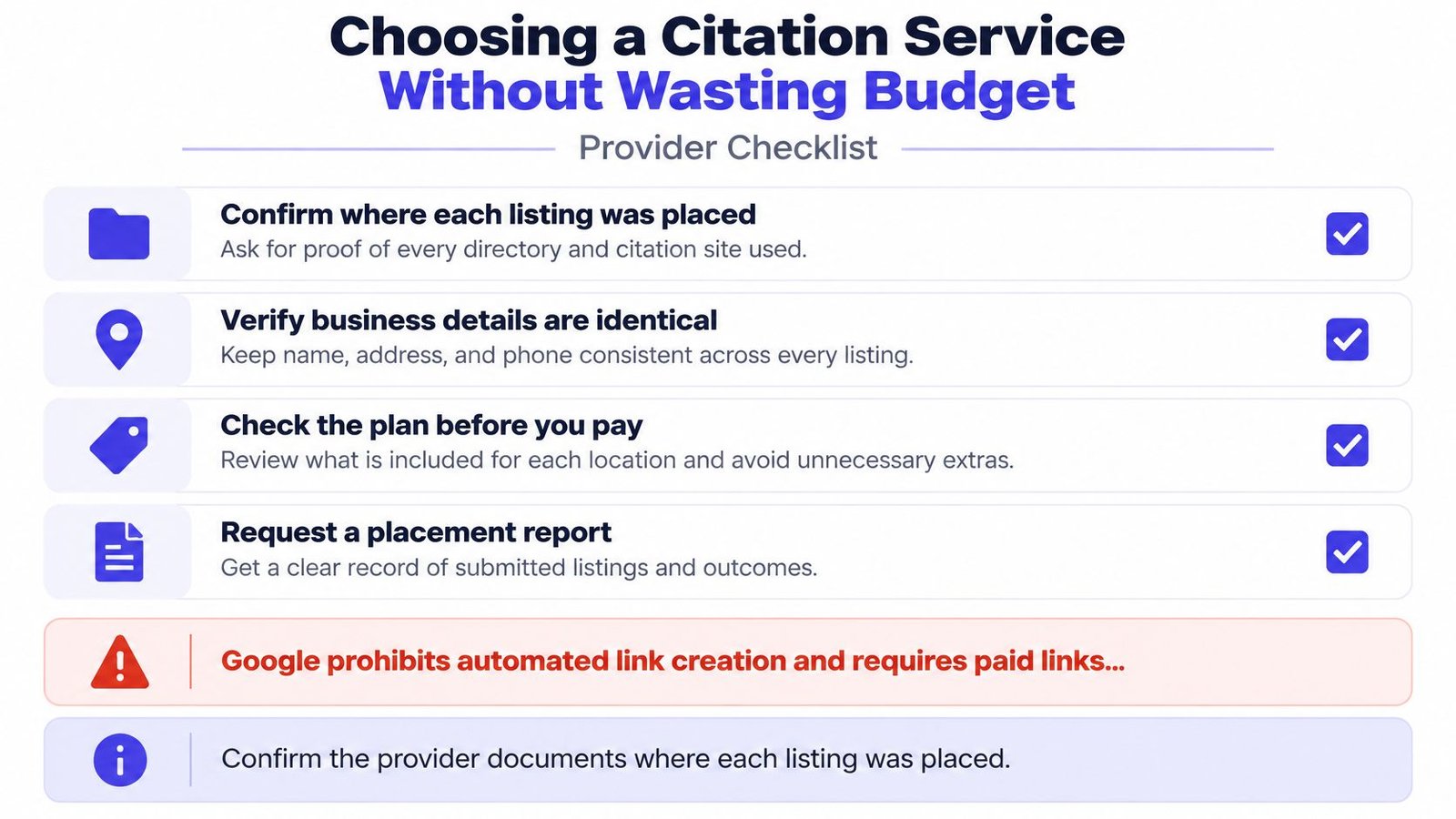
Google's link spam policies prohibit automated programs or services that create links, paid links intended to manipulate rankings, and contracts that force links without letting the publisher qualify them. Paid placements are acceptable when they carry rel="nofollow" or rel="sponsored" (Google Search Central link schemes). That alone tells you which providers carry risk.
Ask these before paying:
- Where did each listing go? You want a report with live URLs and statuses, not a count.
- Are paid placements separated from genuine profiles? A sponsored badge and a real company profile are different products.
- Will anyone promise ranking credit from every link? Walk away. Nobody can.
- Can agencies get an unbranded report? Yes, ours can be rebranded for client delivery.
- Is there a sample report? Ask for one before money moves.
Red flags: guaranteed rankings, thousands of links at implausible prices, identical spun descriptions across listings, and no proof of placement. Google's structured-data policies also require marked-up information to be visible, current and relevant to the page, so a profile whose schema contradicts its visible copy is a liability rather than an asset (Google Search Central structured data).
Your first week of work
- Search your brand name plus phone number. Note every top result showing a different address or number.
- Fix the master record on your own site first, including LocalBusiness schema with identical details to your Google Business Profile.
- Size the plan against the visibility table, starting from the 11 to 20 baseline rather than a vendor quota.
- Check the report within a week, then watch searches in Google Business Profile for the following month. Google reports direct searches (your name or address), discovery searches (a category or service), and branded searches separately, plus the total across all three, with search-term metrics updated monthly and taking up to five days to appear (Google Business Profile performance).
If discovery searches climb while direct searches hold steady, the listing work is doing its job. If nothing moves in two months, audit accuracy before buying more coverage.
StartupSubmit builds local citation sets by hand for local, service-area and multi-location businesses across the US, UK, Canada, Australia and New Zealand, with one-time plans from $79 for 50 citations up to $259 for 300, each including a duplicate check and a screenshot of every submission. If your business lives on maps and near-me searches, that's the visibility problem worth fixing first. If you run a SaaS with no local customers, the startup and AI directory work is the better spend, and either way you can start at StartupSubmit.
Ready to build high-quality backlinks?
We'll manually submit your product to 60 to 200+ directories in 5 to 7 days, with screenshot proof for every submission. No bots, no boring forms, just more time for selling and building.
See pricing & get started →