
How to Start US Company Remotely in 2026
You're at the kitchen table with a laptop open, Stripe asking for a U.S. entity, and three tabs arguing with each other. One tab says form a cheap Delaware LLC. Another says investors want a Delaware C-Corp. A third is a founder thread full of half-answers, bad shortcuts, and zero mention of the part that slows people down, EINs, bank KYC, and mismatched documents.
That's the trap. The paperwork is the easy part. The job is sequencing the formation so the IRS, the bank, and your payment stack all agree with each other. If you get that order wrong, you don't just waste a week. You burn time on rework, delays, and avoidable legal cleanup.
The good news is that you can start a U.S. company remotely without flying in, and you can do it in a way that's actually usable for SaaS, AI, and indie hacker operations. The bad news is that cheap formation offers love to sell the filing and ignore the stuff that blocks launch. This playbook is for founders who want the whole system, not just a filing receipt.
The Remote US Company Decision Most Founders Get Wrong
The first mistake is treating entity choice like a formality. It isn't. If you're bootstrapping and plan to pull profits out directly, an LLC is often the cleanest path. If you're aiming for venture capital, SAFEs, or an eventual acquisition, a Delaware C-Corp is usually the serious default because that's the structure investors already know and expect.
The second mistake is treating a registered agent and a mailing address as the same thing. They're not. A registered agent is there to receive legal notices in the state of formation. A mailing address is where your founder mail, bank letters, and compliance documents go. Mixing those up creates stupid delays later, especially when banks or state agencies ask for consistency.
The third mistake is picking the cheapest formation offer before you know what comes after it. The historical context matters here. The U.S. Census Bureau data cited by IRMI shows that 51.6% of U.S. businesses were home-based in the 2007 Survey of Business Owners, and most of those home-based firms were tiny in revenue terms, with 57.1% below $25,000 in sales and receipts and only 6.9% at $250,000 or more (IRMI summary of Census data)). Remote formation isn't a hack. It's been structurally normal for a long time.
Practical rule: choose the entity based on how you expect to raise money and get paid, not on the lowest sticker price.
If you're a solo founder selling software from day one, that means you should decide on fundraising path first, taxation second, and state third. If those three don't line up, you'll pay for it later in re-platforming, tax cleanup, or a cap table that's awkward to fix. The cheapest filing is often the most expensive mistake.
For a quick shortlist of the kinds of directories and visibility assets that matter after formation, the most useful starting point is the curated list at StartupSubmit's best startup directories. That matters because formation is only the start. Discovery comes next.
LLC vs C-Corp and Where to File
A remote founder should start with a simple decision tree.
If you're a bootstrapped founder planning to keep profits and move fast, an LLC usually wins on simplicity. Income generally passes through to the owner, which means the tax treatment is built around the owner's return rather than a separate corporate layer. If you're a foreign founder filing remotely, the mechanics still need to be handled carefully, but the basic reason to use an LLC is simple, fewer moving parts.
If you're planning to raise institutional capital, issue SAFEs, or keep the door open for acquisition, a Delaware C-Corp is usually the better fit. Investors like familiarity. Acquirers like familiarity. Your legal counsel will like familiarity. That matters more than hobbyist tax optimization chatter on X.
State choice is a separate decision
Delaware is popular for a reason. It has the Court of Chancery, deep investor familiarity, and a formation ecosystem that's optimized for startups. It also comes with recurring costs, including the $400 minimum franchise tax and the commonly cited $80 registered agent benchmark from the plan notes you gave me. That's not cheap, but it's the default for a reason.
Wyoming and New Mexico can look cheaper on paper, especially for LLCs. Wyoming is attractive for privacy and low maintenance, and New Mexico is known for low-cost upkeep and no annual report in the way many founders expect from other states. The catch is banking and fundraising. Cheap maintenance doesn't help if you later need investors to understand the entity or if a bank reviewer wants a setup they see every day.
| Factor | Delaware C-Corp | Wyoming LLC | New Mexico LLC |
|---|---|---|---|
| Best for | Venture-backed SaaS and AI startups | Bootstrapped founders wanting lower upkeep | Cost-sensitive solo founders |
| Investor familiarity | Very high | Lower | Lower |
| Tax posture | Corporate layer, later complexity | Pass-through is usually simpler | Pass-through is usually simpler |
| Ongoing upkeep | Franchise tax and agent costs | Lower annual maintenance | Low maintenance profile |
| Banking acceptance | Strong | Can be fine, but less standard | Can be more uneven |
| Privacy | Normal startup disclosure | Stronger privacy reputation | Moderate |
| Long-term fundraising fit | Strongest | Weaker | Weaker |
That table is the blunt version. Here's the less glamorous one. If you think you might raise venture money, file Delaware first. If you know you're staying bootstrapped and want to distribute profits, an LLC can be cleaner. If you pick Wyoming or New Mexico today and then decide on VC next year, you may end up paying to convert or reincorporate, which is exactly the kind of work founders hate and lawyers bill for happily.
My rule of thumb: venture path, Delaware C-Corp. Bootstrap path, LLC. Anything in between, get the founder's tax plan in writing before filing.
One more tax point matters. LLC taxation can be pass-through, which is often easier for small operators. C-Corps can face double taxation at the corporate and shareholder levels, but they also provide a structure investors expect and can support QSBS eligibility in the right circumstances. That trade-off is why “cheapest state” is the wrong lens.
The Remote Formation Workflow That Actually Works
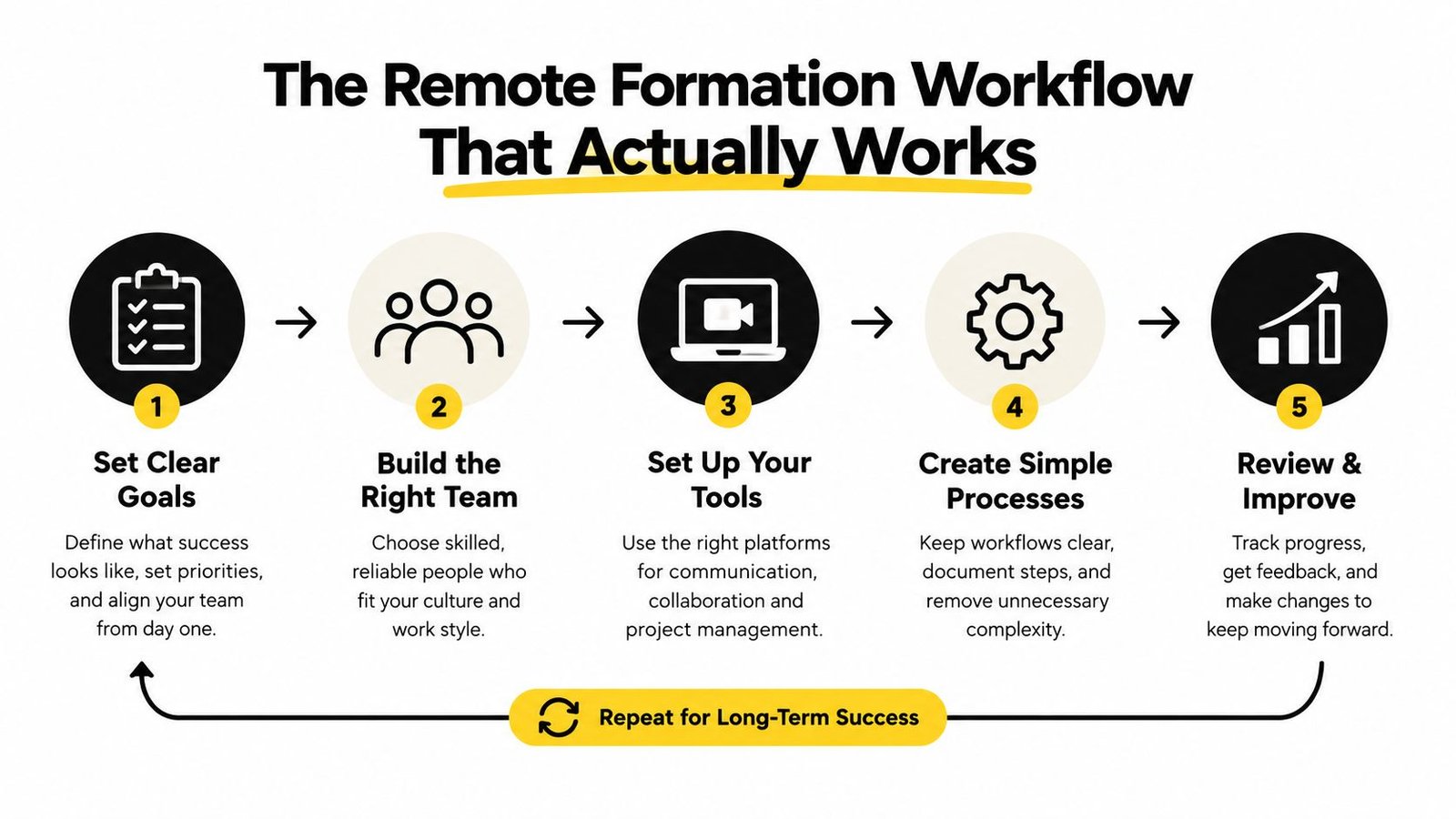
The sequence matters more than the provider. Founders waste time when they jump straight to banking or Stripe before the entity data is clean. That's backwards. You want the legal entity, tax number, banking, and compliance documents to read like they were assembled by one person, not four vendors on different days.
Step 1 choose the entity and state
Start with the business model, not the formation promo. If you're going C-Corp, reserve the name if the state process requires it. If you're forming an LLC, confirm the state naming rules before you file. This is the point where founders often overthink branding and underthink the legal shape of the company.
Step 2 appoint a registered agent
Use a real registered agent in the formation state. Don't use your own address if you're abroad. Don't use a mailbox service and hope nobody notices. Companies such as Northwest, Firstbase, and Doola are common picks because they handle state notices and legal mail properly. If a notice gets missed, everything downstream gets messier.
Step 3 file the formation documents
File the Certificate of Formation or Articles of Incorporation through the state portal or a formation provider, and pay the state fee. This is the part that looks boring and is still essential. If your founder names, addresses, or entity details are inconsistent here, the rest of the stack gets harder.
Step 4 get the EIN from the IRS
This is the #1 timeline killer for non-U.S. founders. The IRS online EIN tool isn't available to international applicants without the right identifiers, so you're usually dealing with phone, fax, or mail instead. That means your entity can exist on paper while your bank and payments stack sit in limbo. If the responsible party is wrong or the company name doesn't match the filing, you get delays or rejection.
Step 5 finalize operating docs and open banking
You still need an Operating Agreement or Bylaws, plus founder stock purchase documents if you're a corporation. Then open the bank account remotely with a provider that accepts passport and EIN combinations without a Social Security Number, such as Mercury or Relay, depending on your profile and region. That is where banks ask for consistent KYC, not vibes.
The first real pain point is not incorporation. It's document alignment. If your state filing says one thing, your EIN application says another, and your banking profile says a third, you'll get stuck in review.
Keep every document boringly consistent. The IRS, the bank, and Stripe don't reward creativity.
For a practical submission workflow that fits neatly after formation, use StartupSubmit's startup directory submission service. That kind of visibility work only helps when the entity stack is already clean.
How StartGlobal Can Help
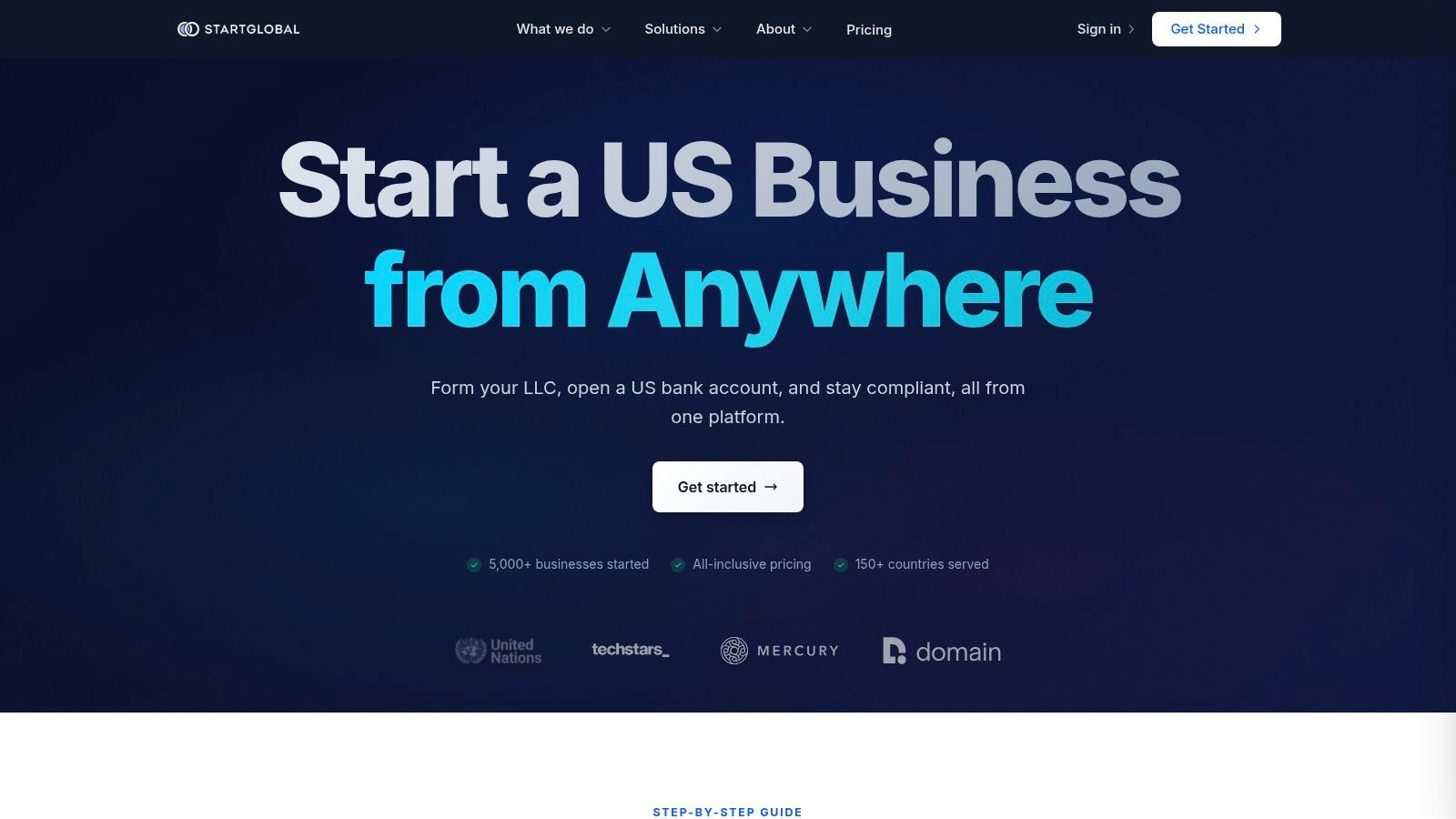
StartGlobal is worth looking at if you want one place to handle the messy middle between formation and a usable operating setup. It focuses on forming and managing U.S. LLCs for founders worldwide, and the useful part is that it's built around remote execution, not a U.S. visit. The platform combines formation, EIN support, banking setup assistance, and ongoing compliance in a single workflow, which is exactly where most founders lose time.
The standout feature is not just the filing. It's the operational layer around it. That includes registered agent coverage, state report filing, bookkeeping, and tools like a U.S. mailing address, phone number, invoicing, and customer support software. For founders who want the company to feel live after incorporation, that bundle is practical.
It also handles the stuff that kills momentum for non-resident founders, especially when the EIN and bank onboarding step gets tangled. If you want a resource that maps the process cleanly, the page on start a US company remotely is a useful reference point. It's especially relevant when you're deciding whether to stitch together five vendors or use one system that keeps the documents aligned.
The strongest fit is a founder who wants speed, consistency, and a managed compliance path. It's less compelling if you already have U.S. legal and accounting support in-house and only need a filing vendor. For everyone else, especially solo founders and small SaaS teams, the value is in reducing the number of places where a mismatch can happen.
Real Timelines, Real Costs, and Where the Cheap Headlines Break
The headline price on a formation page usually tells you almost nothing. A $0 or $39 filing offer can still leave you paying for a registered agent, EIN workaround, certified copies, banking review time, and a pile of small corrections. By the time a non-U.S. founder has a working setup, the actual spend is rarely just the filing fee.
Here's the budget logic I use with founders. If you need a real launch, not a paper entity, plan for the state filing, the registered agent, document prep, tax setup, bank onboarding friction, and cleanup risk. That's why a realistic first-year budget often lands well above the glossy landing-page number.
| Cost Item | Headline Price | Realistic Non-U.S. Cost |
|---|---|---|
| State filing | Low or promotional | Varies by state fee and entity type |
| Registered agent | “Included” or cheap intro price | Ongoing paid service |
| EIN support | “Free” in the bundle | Time cost or paid filing support |
| Operating docs | Often omitted | Add-on or attorney review |
| Bank onboarding | “Instant” in the sales copy | Review time and follow-up |
| Certified copies | Not mentioned | Extra administrative cost |
| Apostille or foreign-use docs | Not mentioned | Often needed for cross-border use |
| Compliance follow-up | Not included | Annual upkeep and filings |
The cheap packages break in predictable ways. They skip the EIN handoff. They don't include a real operating agreement template. They forget that a registered agent is a real compliance function, not a branding extra. They also leave you alone when the bank asks for more proof than the sales page prepared you for.
A better mental model is timeline, not price. Week one should get you the entity filing and registered agent. Week two should focus on EIN follow-up and operating docs. Week three should be banking and compliance cleanup. If the EIN is delayed, everything else slides.
A realistic remote launch can still happen fast if the documents are aligned. The working rule from the brief is clear, the formation step can often be done in 1 to 3 business days, EIN issuance by phone can happen the same week, and bank setup often takes 1 to 4 weeks depending on KYC depth. In the best case, a fully operational launch can happen in roughly 2 to 3 weeks when the founder submits matching incorporation, tax, and banking documents without inconsistencies (Global Law Experts).
The thing that kills momentum is not state filing speed. It's the gaps between filing, EIN, and banking.
Turning Your New Entity Into Discoverable SaaS
A newly formed company stays invisible until you give it trust signals. A solo dev in Lisbon with a fresh Delaware C-Corp and a live Stripe account still looks unproven if the web has no consistent references to the company. Directory submissions are part of launch operations, not a marketing afterthought.
Start with the basics. Your name, address, and phone need to match across the website, Crunchbase, Product Hunt, and the key niche directories. Your domain email should be tied to the EIN-backed company identity, not a random personal mailbox. If a reviewer, customer, or investor searches the brand and sees five different versions of the company, trust drops fast.
The value of startup directories compounds because each listing adds another citation, another crawlable reference, and another signal that the entity exists and is active. That matters for search visibility. It also helps the less glamorous job of making the company look real enough for partners, customers, and AI systems that summarize brands.
The first month profile stack
Claim these quickly:
- Crunchbase profile so the company has a canonical business listing.
- Product Hunt page if you're launching a product and can use launch-day attention.
- G2 or Capterra if the product fits reviews and B2B comparison shopping.
- AlternativeTo if the product has an obvious replacement angle.
- SaaSHub for SaaS discovery.
- Indie Hackers for founder-facing visibility.
- BetaList if the product is still early but public.
- LinkedIn company page for corporate identity.
- Website trust pages with legal name, address, support, and billing info.
- Domain email tied to the company.
- Payment and billing pages that match the entity.
- One curated directory submission path, such as StartupSubmit's directory submission service (https://startupsubmit.app/directory-submission-service/), to keep the footprint coherent.
That's the part many founders ignore. They assume the product will market itself once it is live. It won't. If you do not seed the company across the web on purpose, the entity stays hard to verify and easy to overlook.
Ongoing US Compliance Without Burning Out
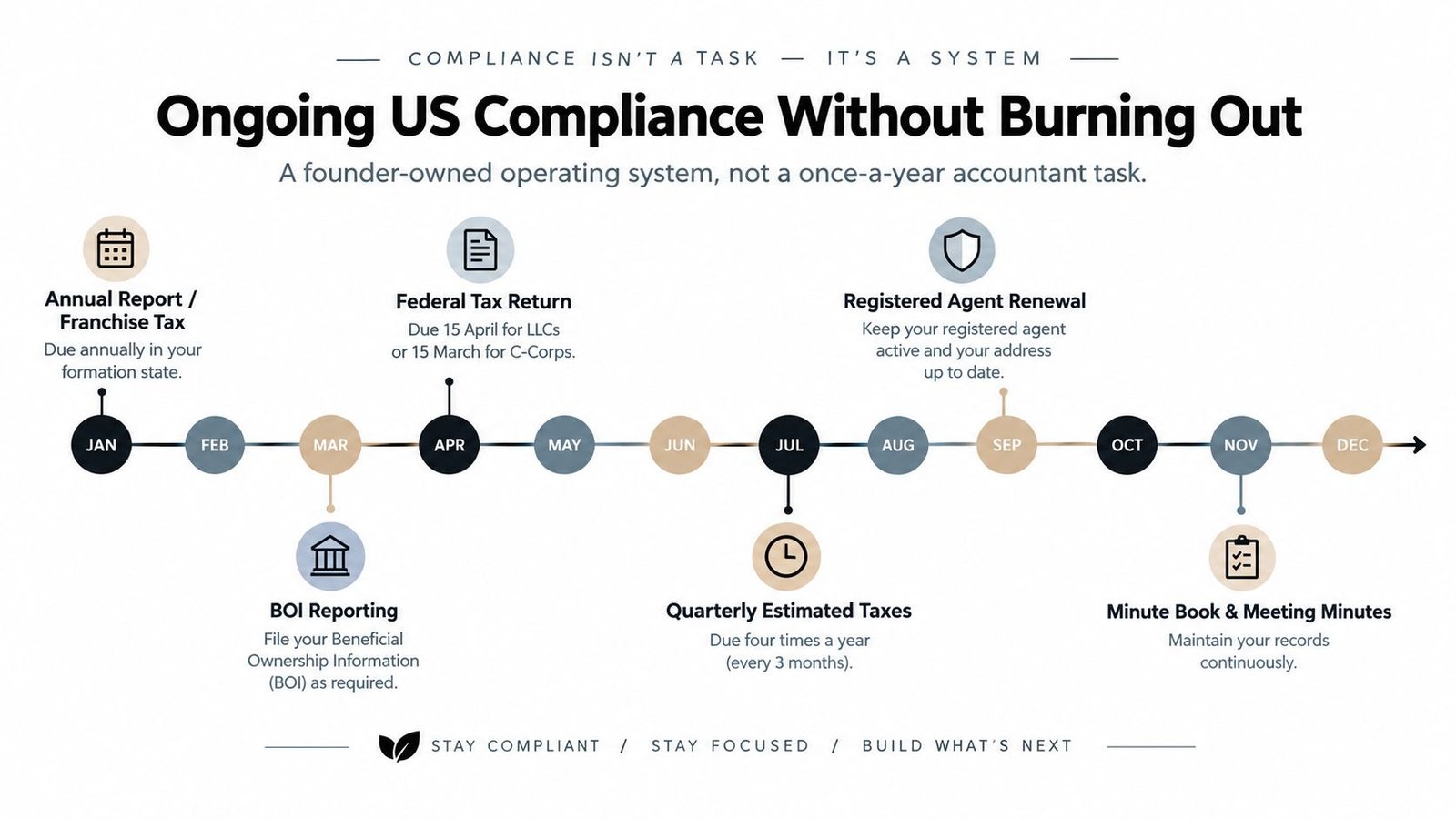
Compliance belongs on a calendar, not in someone's memory. Remote founders get into trouble when they treat filings as a once-a-year chore instead of recurring operating work. Set a monthly compliance block, keep one dashboard for due dates, and work with a CPA who understands non-U.S. founders.
The obligations change by entity and state, but the operating rhythm stays the same. Delaware C-Corps owe franchise tax. Wyoming and New Mexico have their own reporting patterns. Federal returns still need filing. If you have beneficial owners, BOI reporting sits in the same stack. Miss one item and the rest gets harder to keep clean.
Ignore it long enough and the business starts to wobble. A lapsed registered agent can lead to administrative dissolution. Banks notice missing state filings. A frozen account is a painful way to learn that compliance was part of operations from day one.
Build compliance like product ops. If it only exists in one person's head, it will fail.
Startup visibility work and compliance work overlap. A well-run company keeps its public profiles, legal entity, and billing details aligned, and a local citation service (https://startupsubmit.app/local-citation-service/) keeps the NAP data consistent. That makes bank review easier, keeps directories from conflicting with the entity record, and reduces confusion for customers. It also matters when you are tracking referral traffic from directory submissions and trying to see which profiles carry weight.
The right 30-60-90 day pattern is boring, and that is the point. Form the company cleanly, activate banking and payments, then keep distribution and compliance moving in parallel. That is the operator's version of starting a U.S. company remotely.
Your 30-60-90 Day Remote Launch Plan
Days 1 to 30 are for the boring work that keeps you from redoing everything later. Pick the entity, file through a registered agent, get the EIN, open a Mercury or Relay account if they fit your setup, and fund the company cleanly. If Stripe is part of the launch, line up the entity and banking details before you touch the payments flow.
Days 31 to 60 are for activation. Finalize founder agreements, issue shares where applicable, connect onboarding, and publish the trust pages that make the company look real. This is also the right time to submit to the top directories via a SaaS directory submission service (https://startupsubmit.app/saas-directory-submission-service/) and clean up the brand footprint. Wait too long and you miss the window when the entity is fresh, searchable, and easiest to verify.
Days 61 to 90 are for stabilization. Put BOI and annual report reminders on the calendar, engage a cross-border accountant, check sales tax nexus, and track referral traffic from directories. Keep one dashboard that shows what is due, what is paid, and what is still waiting on a human.
FAQ
Can a U.S. company have non-resident directors? Yes, in many cases it can. The key issue is consistency across the bank, tax setup, and compliance documents, because that is what gets reviewed.
Do I need to put in minimum capital? Usually not as a headline rule for remote formation, but you should still fund the account enough to make the company look real and operational.
Is Stripe Atlas the only route? No. It is one path. The better question is whether the formation stack gives you banking, tax, and document consistency.
How should I handle multi-currency payouts? Keep the operating account clean, track conversions carefully, and make sure your accounting matches the actual settlement currency.
Can I do all of this without traveling to the U.S.? Yes, in many cases you can. The bottlenecks are usually EIN processing, bank review, and document consistency, not the formation itself.
For founders who want the cleanest path from zero to a live entity, the next move is simple. Decide on the fundraising path, file the right entity, and build the visibility stack immediately after. Use StartupSubmit alongside the formation plan if you want help filling the directory and backlink layer without wasting founder time, then keep the compliance calendar tight so the company stays usable after launch.