SEO for Startup Business: A 90-Day Founder Playbook
Most startup SEO advice starts with the wrong question: “How do we rank for more keywords?” A new SaaS or AI company usually has a more urgent problem. Search engines, buyers, review platforms, and AI systems need to understand what the company is, who it serves, what it replaces, and why it deserves attention.
That makes SEO for startup business less about collecting backlinks and more about building a reliable entity and discovery system. Organic search remains a foundational acquisition channel. A 2024 compilation of search-industry research reported that organic search accounted for 53.3% of website traffic, compared with 27% for paid search (HigherVisibility's organic versus paid search statistics). But publishing pages alone won't create demand. The same compilation reported that 96.55% of content received no organic Google traffic and that more than 66.31% of pages had no backlinks.
The playbook below is built for founders with limited time. It prioritizes crawlable product pages, credible profiles, evidence-led content, useful mentions, and measurement that still works when Google AI Overviews answer a query before the searcher clicks.
Why Most Startup SEO Advice Burns Your Time
The popular startup SEO playbook is usually a pile of disconnected tasks: publish blog posts, increase Domain Rating, acquire backlinks, and chase page-one rankings. That sequence sounds productive, but it creates activity before it creates understanding.
A new company rarely needs dozens of generic articles. It needs a clear homepage, focused product and use-case pages, documentation that explains the product, comparison pages that help buyers decide, and third-party profiles that confirm the company exists. Those assets serve customers, traditional search, and AI systems at the same time.
The ranking-first mindset also hides a measurement problem. Google's first organic result historically received a much higher click-through rate than the second position, with the compilation cited above reporting 37.15% for position one and 14.91% for position two. That gap explains why rankings matter, but rankings aren't the business outcome. A position-one result for an irrelevant query is still wasted effort.
AI search changes what visibility means
Google users don't always click after seeing an answer summary. Pew Research found that users clicked a traditional result in 8% of searches with an AI Overview, compared with 15% when no summary appeared. Only 1% clicked a cited link inside the summary, while 26% ended the browsing session without visiting a result (Pew Research's analysis of Google AI Overviews).
That doesn't make SEO less useful. It changes the success model. A page can influence discovery, branded searches, buyer confidence, and assisted conversions without generating a proportional increase in sessions. For a startup, qualified demand matters more than raw organic traffic.
Google says AI Overviews and AI Mode use relevant links to help people verify information and explore related material. There isn't a special registration form for AI visibility. The practical requirements remain familiar: make important pages crawlable, explain the product clearly, demonstrate expertise, and build supporting references (Google's documentation on AI features in Search).
Treat directories as entity assets
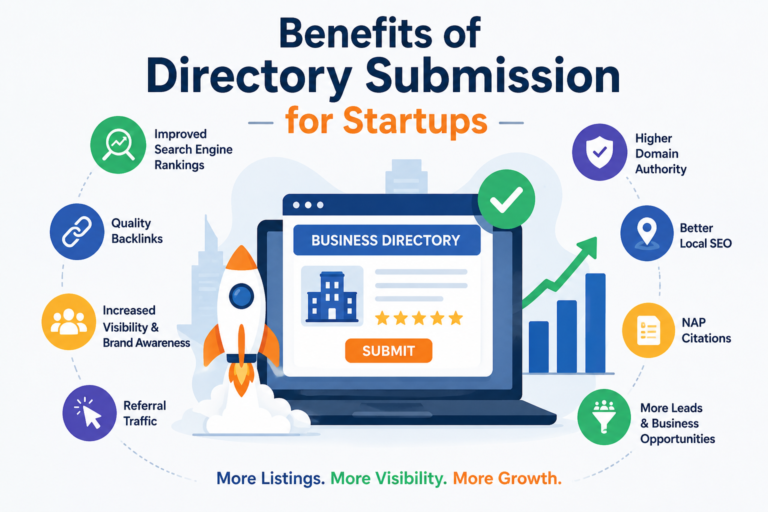
A startup directory profile can provide more than a link. A well-maintained listing creates another place where buyers can find the brand, confirms the category, reinforces the product description, and gives search systems consistent information.
A weak listing does the opposite. Duplicated copy, inaccurate categories, keyword-stuffed anchors, and thin profiles create noise. Google's ranking systems evaluate many signals, and its history with PageRank shows why links remain part of how systems understand relationships between pages. Google also makes clear that no individual backlink guarantees a ranking (Google's ranking systems guide).
Your starting definition of success should be simple:
- Entity clarity: Does every important page describe the same company, product, category, and audience?
- Qualified discovery: Are relevant prospects finding the brand through search, profiles, reviews, and references?
- Evidence: Can a buyer or AI system verify the product through documentation, comparisons, customer proof, and independent mentions?
- Pipeline impact: Do branded searches, demos, sign-ups, referrals, or assisted conversions improve?
If a tactic doesn't support one of those outcomes, it probably doesn't deserve founder bandwidth.
Technical Foundations You Can Verify in a Day
Technical SEO doesn't need to become a six-week project. A founder can establish a defensible baseline in one focused day, then hand specific defects to a developer.
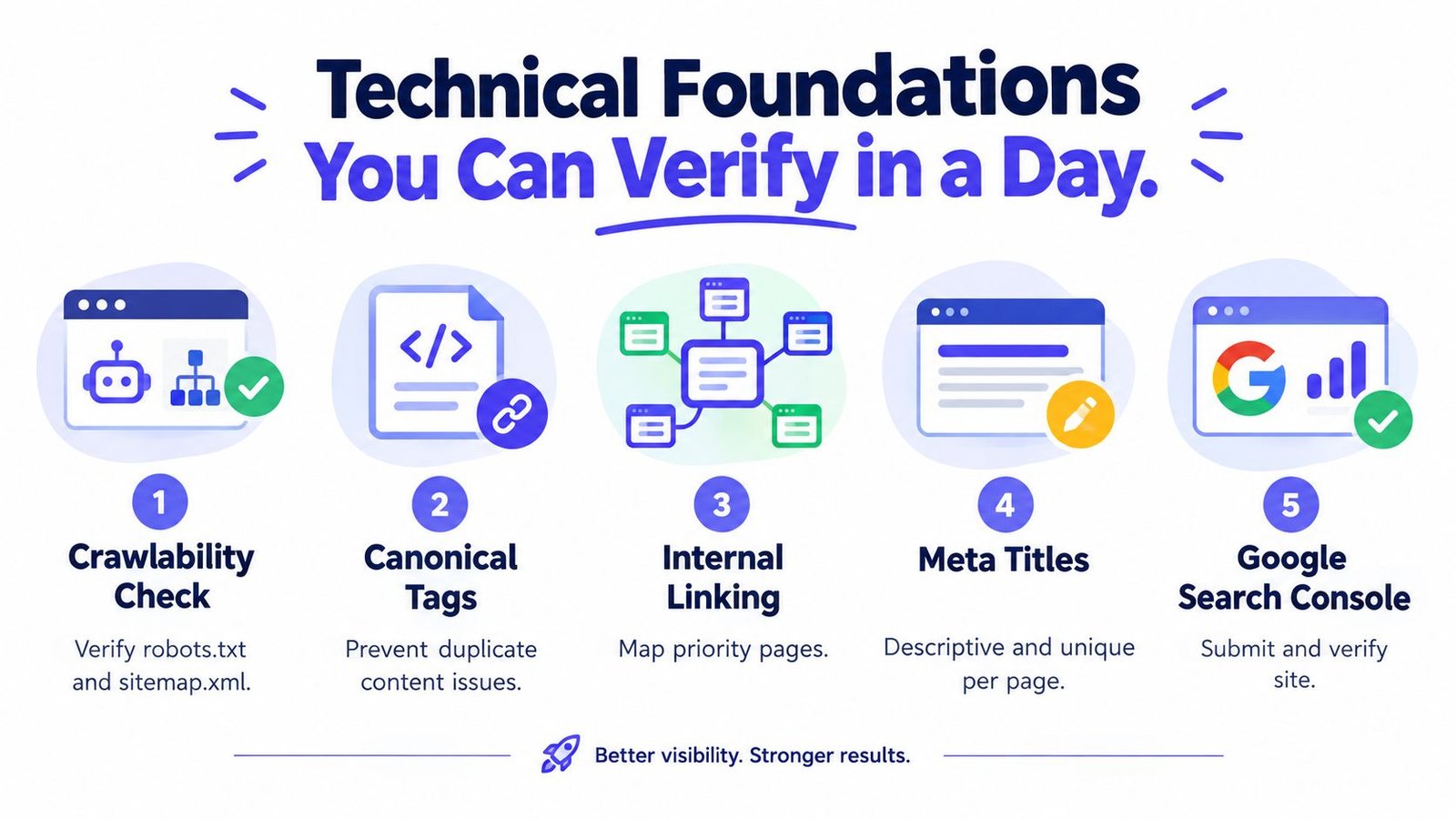
Start with crawlability and page access
Open the key commercial pages in a browser and confirm that they load normally. Then inspect the source or use Google Search Console to check whether the homepage, product pages, pricing page, documentation, integration pages, and important comparison pages are indexable.
Check these items in order:
- Robots.txt and sitemap.xml: Confirm that the site isn't blocking important paths and that the XML sitemap contains canonical, live URLs.
- Status codes: Commercially important pages should return a successful response, not a redirect chain or a missing-page response.
- Canonical tags: Each primary page should identify its preferred URL where appropriate. Canonicals won't repair poor information architecture, but they help clarify duplicate or near-duplicate versions.
- Internal links: Link from navigation and relevant copy to the pages that matter commercially. Google describes links as a way to connect users and search engines with relevant pages.
- Titles and headings: Give every important page a descriptive, unique title and a clear main heading. Write for the buyer's intent, not a list of variations.
A founder who wants help with location-based business visibility can also review this local citation service as a separate citation workflow. Keep that work distinct from core SaaS product-page optimization.
Establish the measurement baseline
Verify the domain in Google Search Console and record the starting values for indexed pages, impressions, clicks, average position, branded queries, and non-branded queries. Export the data or place the baseline in a shared sheet with the date and any active launch campaigns.
Use a crawler such as Screaming Frog, Sitebulb, or a comparable audit tool to identify broken internal links, duplicate titles, missing headings, and pages that aren't linked from the site. Don't chase every warning. Fix anything that blocks discovery or makes a commercial page difficult to understand.
Add structured data only when it matches the page
Use applicable Organization, SoftwareApplication, Product, and BreadcrumbList structured data when the visible page content supports it. Google says structured data can help systems understand page content and may make a page eligible for enhanced search results, but it doesn't guarantee a rich result.
Practical rule: Structured data should describe what the visitor can see. It shouldn't be used to invent reviews, prices, features, or claims that the page doesn't support.
Record the technical changes, the URLs affected, and the date. That simple log prevents later confusion about whether a traffic change followed an indexing fix, a content release, a launch spike, or a directory campaign.
The Directory Submission Operating Model
Directory submission works when you treat it as controlled entity building, not as a race to collect links. The first deliverable isn't a list of websites. It's a canonical company record that every profile can use without creating contradictions.
Create one source-of-truth document containing:
- Identity: Exact brand name, legal name, domain, founders, and social profiles.
- Positioning: Product category, target customer, one-sentence value proposition, and the problem solved.
- Commercial details: Pricing model, primary use cases, integrations, and current availability.
- Creative assets: Logo variants, product screenshots, founder headshots, and approved images.
- Copy blocks: Short, medium, and long descriptions written for different audiences.
- Tracking fields: Destination URL, category, anchor or branded URL, publication status, indexation status, and date.
Don't paste the same paragraph into every listing. Map each destination to a distinct intent first. A software review site should explain evaluation criteria and use cases. An alternative-product page should clarify what the product replaces or complements. A launch platform should emphasize the release and the audience. A community profile should sound like a real participant, not a press release.
Use a manual workflow with quality controls
A manual directory submission service can handle repetitive research and form completion when the founder has better uses for the same hours. StartupSubmit describes a 100% manual process, duplicate checking, categorization, and a final report containing submitted URLs, acceptance notes, and screenshots.
The manual part matters because Google's spam policies warn against automated link-building services, paid links intended to manipulate rankings, excessive exchanges, and other link schemes. Sponsored or paid placements should use suitable qualifying attributes such as nofollow or sponsored where applicable (Google's spam policies).
This isn't a reason to avoid every directory. It's a reason to reject directories with no audience, no editorial standards, thin pages, or obvious manipulation patterns. Prefer branded anchors and naked URLs over forced exact-match anchor text. Make the profile useful even if the link were removed.

Read the delivery report like an operator
A normal execution window may be 5–14 days, with work often beginning after onboarding and data verification. The report should let you distinguish submitted, accepted, pending, rejected, and existing listings.
For every placement, record:
| Field | Why it matters |
|---|---|
| Profile URL | Confirms the asset exists |
| Page title and category | Shows whether the listing matches the intended entity |
| Link attribute | Separates ordinary, nofollow, and sponsored treatment |
| Indexation status | Indicates whether search engines can discover the page |
| Publication date | Starts the measurement cohort |
| Referral and branded activity | Connects visibility with user behavior |
Don't celebrate a large submission count by itself. The useful output is a clean, relevant footprint that improves discovery without creating duplicate noise.
Content That Wins in AI Search and Google
Generic keyword content has a weak chance of becoming a trusted reference. A founder-led SEO program should produce a small library of pages containing facts, comparisons, limitations, implementation detail, and evidence that another page doesn't have.
Start by dividing demand into five intent groups:
- Problem education: The buyer understands the pain but not the category.
- Category comparison: The buyer is evaluating types of solutions.
- Alternatives: The buyer knows a competitor or incumbent and wants options.
- Integration: The buyer needs the product to work with an existing workflow.
- Brand: The buyer is checking the company, product, founders, reviews, or pricing.
Build assets with a reason to cite them
A one-person marketing team can build a useful portfolio in a quarter without publishing daily. Prioritize assets such as:
- A clear category page explaining who the product is for and who it isn't for.
- A transparent comparison against common alternatives.
- An implementation guide with real setup decisions and limitations.
- Integration documentation written for the actual workflow.
- A product changelog that shows ongoing development.
- A customer evidence page with approved outcomes and context.
- An original benchmark, survey, or product dataset where the startup genuinely owns the methodology.
- A glossary or reference page that defines category language precisely.
The strongest pages answer the question directly, show how the answer was reached, and link to supporting documentation. They don't hide the limitations. An AI system can summarize a generic opinion from anywhere. It has more reason to reference a page containing distinctive evidence and a clearly stated methodology.
Segment content by business signal
Use the query type to choose the metric. A comparison page may generate fewer visits than an educational article but produce more qualified conversations. A documentation page may assist conversion without appearing as a last-click source.
| Query intent | Example asset | Primary signal to track |
|---|---|---|
| Problem education | Diagnostic guide or workflow explainer | Branded follow-up searches and qualified visits |
| Category comparison | “How to choose” or category comparison page | Demo requests and assisted conversions |
| Alternatives | Alternative page with transparent trade-offs | Non-brand clicks and product-page visits |
| Integration | Setup guide, API documentation, or workflow tutorial | Activation, referral traffic, and sign-ups |
| Brand | Product, founder, review, and pricing pages | Branded impressions and direct demand |
A practical AI directory submission service may support the external entity layer, but it can't replace evidence on your own site. Directory profiles help confirm the company. Product pages and documentation explain why the company matters.
Backlinks Beyond Directories
Directories are one layer of a startup's external footprint. They shouldn't be the entire strategy. A healthy profile develops from places where the company contributes something useful, such as an integration, a customer review, technical expertise, or a concrete story.
The fastest route to a meaningful reference is usually proximity. Ask an integration partner to list the product on its integrations page. Ask a customer whether a workflow story would help its audience. Give a community a useful teardown or answer instead of dropping a product link.
Choose sources by signal quality
| Tier | Example source | Best signal it sends |
|---|---|---|
| Reputation profile | Software marketplace or trusted startup platform | The company is a real, categorized entity |
| Customer review | Verified review or customer story | Buyers have evaluated the product |
| Integration page | Partner documentation or marketplace | The product works in a relevant ecosystem |
| Editorial mention | Independent publication or founder interview | The company has a story worth covering |
| Founder expertise | Technical article, podcast, or conference resource | The team understands the problem |
| Community contribution | Useful discussion, tutorial, or open-source work | The team participates without forcing promotion |
Use the next ten hours based on the asset you already have. If you have active customers, pursue reviews and evidence. If you have strong integrations, create partner pages. If your founders have specialized knowledge, publish technical material. If the company is brand new and lacks proof, accurate reputation profiles and selected startup directories can establish basic discoverability.
Sequence outreach without creating spam
Start with people who already know the product. Then contact partners whose users face the same problem. Only after that should you pitch a broader editorial angle. Each message should offer a specific resource, data point, comparison, or customer story.
Community participation follows the same rule. A founder who wants to test founder-led distribution can study Reddit marketing for startups, but the operating principle is broader than Reddit. Contribute before asking for attention, respect each community's norms, and don't turn every answer into a disguised landing page.
Measurement That Survives an AI-First Search
The dashboard should answer one question: Is the startup becoming easier for the right people and systems to discover, understand, and trust?
Search Console remains the starting point. Separate branded and non-branded queries, then record impressions, clicks, average position, and indexed pages. Add the external footprint: indexed profile URLs, referring domains, referral visits, branded search movement, assisted conversions, and observed appearances in AI-generated answers.
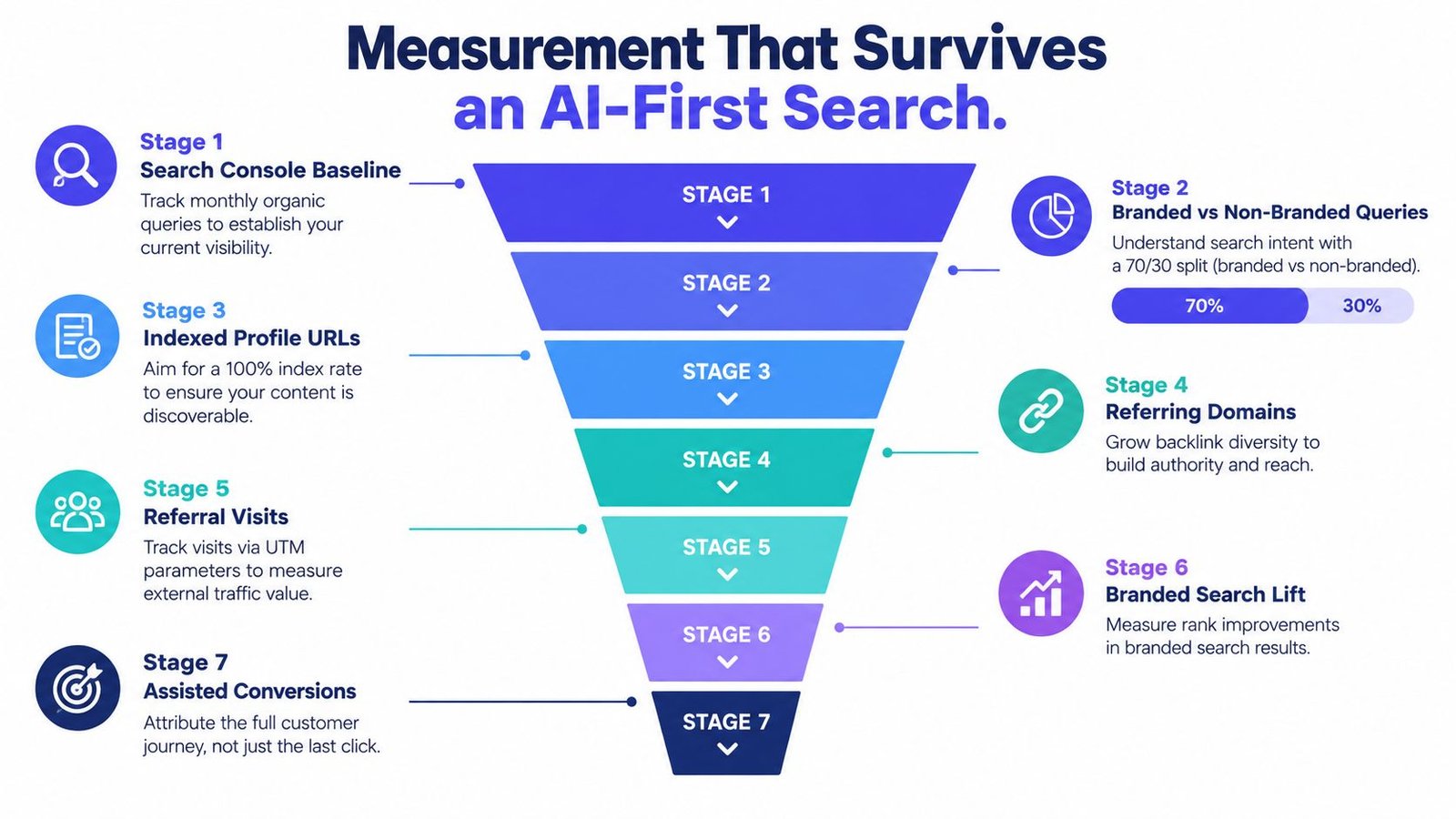
Separate indicators from outcomes
Domain Rating is a third-party authority metric, not a Google ranking factor. Referring-domain totals are useful inventory, but they don't show whether the domains are relevant, indexed, trusted by users, or capable of sending qualified prospects.
Ahrefs studied whether links from pages and domains receiving organic traffic correlated more strongly with rankings. Its analysis reported that the total organic traffic of referring pages had a higher correlation than merely counting referring pages with traffic, while referring domains with traffic didn't correlate more strongly than the total number of referring domains (Ahrefs' study of links from pages with organic traffic). The practical lesson is straightforward: don't impose an arbitrary traffic threshold on every potential reference. Evaluate context, relevance, indexability, and user value together.
Use UTMs where a platform permits them. For directory and partner cohorts, record the publication date and compare behavior against the pre-submission baseline. A reasonable evaluation window is 8–12 weeks, long enough to observe indexation, branded discovery, referral activity, and assisted pipeline rather than only launch-day noise.
Track the following in one dashboard:
- Discovery: Indexed pages, indexed profiles, impressions, and query coverage.
- Demand: Branded impressions, non-branded clicks, direct visits, and referral visits.
- Engagement: Product-page visits, documentation paths, demo starts, and sign-up behavior.
- Influence: Assisted conversions, partner referrals, review activity, and AI answer appearances.
- Quality: Relevant referring domains, duplicate listings, rejected submissions, and incorrect brand information.
Avoid the two common attribution errors
The first error is celebrating an early spike. A launch platform, founder announcement, or social post can create short-lived attention that doesn't become durable search demand. Label launch events in analytics so you can separate them from the organic baseline.
The second error is blaming one channel for every later change. Rankings and traffic respond to many signals, including content updates, technical fixes, seasonality, competitors, and search presentation. Treat a directory campaign as a cohort with a start date, not as proof that every ranking movement came from a submitted profile.
AI search makes this discipline more important. Data from Semrush reported that AI Overviews appeared for more than 13% of tracked queries in March 2025, up from 6.49% in January, while an Ahrefs analysis of 300,000 keywords found a 34.5% lower average click-through rate for the top-ranking page when an AI Overview was present (Digiday's summary of AI search data). Measure what happens after visibility, not just whether visibility exists.
Your 90-Day SEO Roadmap
A founder-friendly SEO program needs sequence. Start with pages and data you control, build the external footprint once the information is accurate, then judge performance through qualified outcomes.
Weeks 1 through 3 build the foundation
Audit crawlability, sitemap coverage, canonical tags, internal links, titles, headings, and structured data. Verify Search Console and create the baseline sheet. Rewrite the homepage, product page, pricing page, and key use-case pages if a new visitor can't understand the product quickly.
Your checkpoint is comprehension and access. If Google can't reach a page, or a prospect can't identify the audience and use case, don't scale content or directory work yet.
Weeks 4 through 8 build the footprint
Create the canonical company data sheet. Select destinations by intent rather than by volume, remove existing duplicates, and submit accurate profiles with distinct descriptions. At the same time, publish the first evidence assets, such as a category comparison, an integration guide, a transparent alternatives page, and a documentation improvement.
Use internal links to connect those assets to the relevant commercial pages. For broader market context, founders can also review this curated resource on top seed investors in digital marketing, particularly when shaping an investor-facing narrative around distribution and category positioning.
The checkpoint is quality. If the team can't maintain accurate descriptions, approve profile copy, or respond to customer evidence requests, reduce the submission scope or bring in help. A manual directory workflow is sensible when repetitive execution is consuming founder time. A fractional SEO lead makes more sense when technical prioritization, content strategy, and attribution are all stalled.
Weeks 9 through 13 measure and iterate
Review the dashboard across the full cohort. Check which profiles were indexed, which pages earned impressions, whether branded discovery changed, and whether referrals assisted demos or sign-ups. Improve pages that attract the wrong intent before publishing more pages.
Use startup directories for discovery selectively. The list is less important than whether each destination gives buyers a useful way to verify the company.
A realistic one-person operating rhythm is one technical review, one evidence asset, one external relationship, and one measurement review at a time. Don't sacrifice product work to manufacture SEO activity.
SEO can't fix weak product-market fit, unclear positioning, or a product nobody wants. If customer conversations aren't producing a repeatable problem and a credible reason to buy, redirect energy to the product and distribution motion before expanding the content program.
Start this week by running the technical checks, verifying Search Console, creating the canonical data sheet, and choosing the first three evidence assets. Then set an 8–12 week review date and judge the program by qualified demand, branded discovery, assisted conversions, and useful references, not by DR or a raw backlink total.
StartupSubmit handles manual submissions across startup and software directories, including profile preparation, duplicate checking, categorization, and reporting, so founders can build an accurate external footprint without turning SEO into form-filling. Visit StartupSubmit to review the directory submission workflow and decide whether it fits your 90-day startup SEO plan.