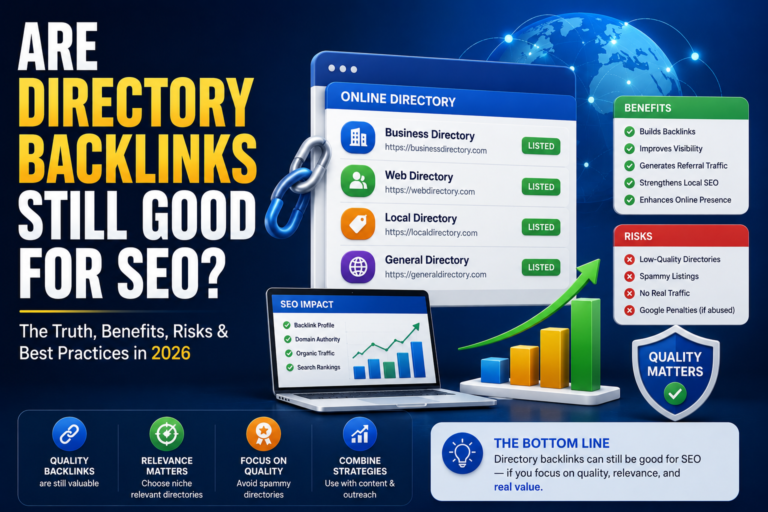
6 Fast Win SaaS Directories Founders Should Submit First
Submit to Product Hunt, SourceForge, AlternativeTo, BetaList, SaaSHub, and ProductSifter this week. Those six combine fast approval, real traffic, and genuine backlink value. After that, open profiles on G2, Capterra, GetApp, and GoodFirms for the longer, review-driven push. Do the fast wins first; the strategic listings pay off over months, not days.
TL;DR:
- Prioritize fast-approval directories like Product Hunt, SourceForge, and BetaList during launch to gain immediate traffic and feedback, saving slower reviews for later stages.
- Focus on directories with clear, upfront pricing and short approval timelines, as these provide more reliable planning and higher-quality backlinks.
- Match directories to your product stage and target audience: early-stage tools target BetaList and Product Hunt, while established SaaS products should aim for G2 and GoodFirms.
- Prepare comprehensive, tailored submissions with a concise pitch, high-quality screenshots, logos, and relevant category tags to increase acceptance chances.
- Use manual or curated submission services to improve acceptance rates and backlink quality, especially when manual effort is limited.
Table of Contents
- What Are the Best SaaS Directories for Founders Right Now?
- How Do You Decide Which Directories to Prioritize?
- What Should Your Directory Submission Actually Include?
- Does Manual Submission Actually Outperform Automated Tools?
- The High-ROI-First Approach Nobody Talks About
- StartupSubmit Handles the Directory Grind for You
- Sources
- FAQ
What Are the Best SaaS Directories for Founders Right Now?
Not every directory deserves the same slice of your launch week. Some approve listings in 48 hours and hand you real traffic immediately. Others take six weeks and only pay off once you’ve accumulated reviews. An investigative roundup of 42 major directories found that 26 offer genuinely free listings, but approval times swing wildly, from 24 to 48 hours on the fast end to six weeks or longer on the slow end. That gap is the whole game. Prioritize wrongly and you risk wasting time waiting on a directory that will not significantly improve your SEO.
Here’s the shortlist worth your time, roughly ordered by how fast they pay off:
- Product Hunt rewards a well-timed launch with a burst of early-adopter traffic and direct feedback, though the payoff depends heavily on launch-day execution.
- SourceForge carries high domain authority and heavy monthly traffic, and its free tier makes it a low-effort, high-reach listing.
- AlternativeTo normally has a queue running months long for free listings, but a small fee jumps you to the front in days, per AlternativeTo’s own listing process.
- BetaList puts you in front of an audience that specifically hunts for early-stage tools, which matters if you need beta users more than backlinks.
- SaaSHub organizes listings by category, so buyers comparing tools in your niche find you through search rather than a random scroll.
- ProductSifter ranks by verified reviewer outcomes rather than who paid for placement, which its transparency charter makes explicit.
- G2 now runs G2 Digital Markets, a consolidated submission path that also covers Capterra, GetApp, and Software Advice through one form.
- GoodFirms feeds into vendor shortlists that procurement teams actually build from, useful if your buyer is enterprise.
- TrustRadius leans into long-form, analyst-style reviews that B2B buyers read before a purchase decision.
- directree labels each listing Observed, AI-inferred, or Founder-edited, and issues do-follow backlinks once you claim your profile.
| Directory | Primary purpose | Cost | Approval time | Backlink value | What you get |
|---|---|---|---|---|---|
| Product Hunt | Launch discovery | Free | 1-3 days | Moderate | Community upvotes, profile page |
| SourceForge | Broad reach | Free | 1-3 days | High (high DR) | Listing page, download stats |
| AlternativeTo | Comparison discovery | Free (or small fee to skip queue) | Days (paid) to months (free) | Moderate | Comparison listing, do-follow link |
| BetaList | Early adopter discovery | Free/paid tiers | Days to weeks | Low to moderate | Early-user exposure |
| SaaSHub | Category discovery | Free | Days | Moderate | Category page listing |
| ProductSifter | Verified-outcome discovery | Free | Days | Moderate | Ranked comparison entry |
| G2 (Digital Markets) | Review-driven buyer intent | Free profile, paid promotion | 1-2 weeks | High | Review pages, buyer-intent leads |
| GoodFirms | Vendor shortlisting | Free/paid | 2-4 weeks | Moderate to high | Researcher-curated profile |
| TrustRadius | In-depth B2B reviews | Free/paid | 2-4 weeks | High | Long-form reviews, analyst visibility |
| directree | Living directory listing | Free (claim) | Days | High (do-follow, re-crawled) | Claimed profile, do-follow link |
Pro Tip: Skip the queue on AlternativeTo if you’re launching within 30 days. A small fee versus a months-long free wait is one of the cheapest SEO decisions you’ll make this quarter.
How Do You Decide Which Directories to Prioritize?
Match the directory to your actual stage, not to a list someone else ranked. A prelaunch product needs beta testers more than backlinks; a two-year-old SaaS with paying customers needs review volume more than discovery traffic. Run this three-step filter before you submit anywhere:
- Evaluate your stage. Prelaunch and early-beta products belong on BetaList, Product Hunt, and AlternativeTo first. Products with existing customers should prioritize G2, Capterra, and GoodFirms, where reviews carry weight.
- Filter by audience fit. A dev-tools product belongs on StackShare and SourceForge; a vertical SaaS for agencies fits better on niche category pages inside SaaSHub or Crozdesk than on a general marketplace.
- Score by SEO value against effort. A directory that gives a do-follow link and re-crawls regularly, as directree does, outperforms a static listing that never updates again after approval.
Before submitting, check whether a directory publishes its pricing and typical approval window up front. Directories that state this clearly reduce planning friction and tend to run tighter editorial operations overall. Red flags worth walking away from: no visible pricing, approval queues advertised as “coming soon” with no timeline, and zero editorial standards, meaning anyone gets listed regardless of quality. That last one dilutes the SEO value of the backlink you’re chasing.
What Should Your Directory Submission Actually Include?
Sloppy submissions get rejected or buried. Before you touch a single form, prepare these assets:
- A tight 140 to 220 character pitch that states what your product does and who it’s for, with no jargon.
- Two to three real product screenshots, not stock mockups.
- A logo sized for both square and wide placements (most directories want both).
- A one-line pricing summary and a short integrations list, if relevant.
- An optional 30 to 60 second explainer video for platforms like Product Hunt where video boosts engagement.
Pick your category carefully. “Productivity” is so broad it buries you; “Project Management for Remote Teams” gets you found by the right searcher. Overbroad categories are the single most common reason a good product gets no traffic from a directory listing.
Pro Tip: Claim your listing wherever possible instead of leaving it as a passive submission. Claimed profiles on living directories like directree get priority re-crawling, which keeps your backlink active and indexed.
Track every submission in a spreadsheet: date submitted, expected approval window, and a follow-up date. Directories with vague timelines deserve a follow-up email at the two-week mark, not radio silence.
Does Manual Submission Actually Outperform Automated Tools?
Automated “submit to 100 directories” tools promise speed but often produce thin, templated listings that editors reject or bury. A manual, tailored listing tends to earn higher acceptance rates and a better-quality backlink, which moves domain authority more reliably over time, according to StartupSubmit’s own submission methodology.
The difference isn’t the number of directories you hit. It’s whether each listing reads like a real editor wrote it, or like a bot filled in a form. Editors and algorithms both notice which one it is.
For founders weighing DIY versus a bot-driven tool versus a manual service: DIY works if you have the hours and the patience to write 20 unique profiles. Automated tools work for volume but sacrifice acceptance rates and listing quality. A manual service sits in between, trading a fixed cost for higher acceptance and cleaner backlinks across 220+ directories.
The High-ROI-First Approach Nobody Talks About
Most directory advice treats submission as a checklist: get listed everywhere, wait for backlinks to compound. That’s backwards for a founder with limited runway. The research backs a sequencing approach instead: three to five fast-win listings first, then the consolidated review platforms, then the slow strategic ones that require accumulated reviews.
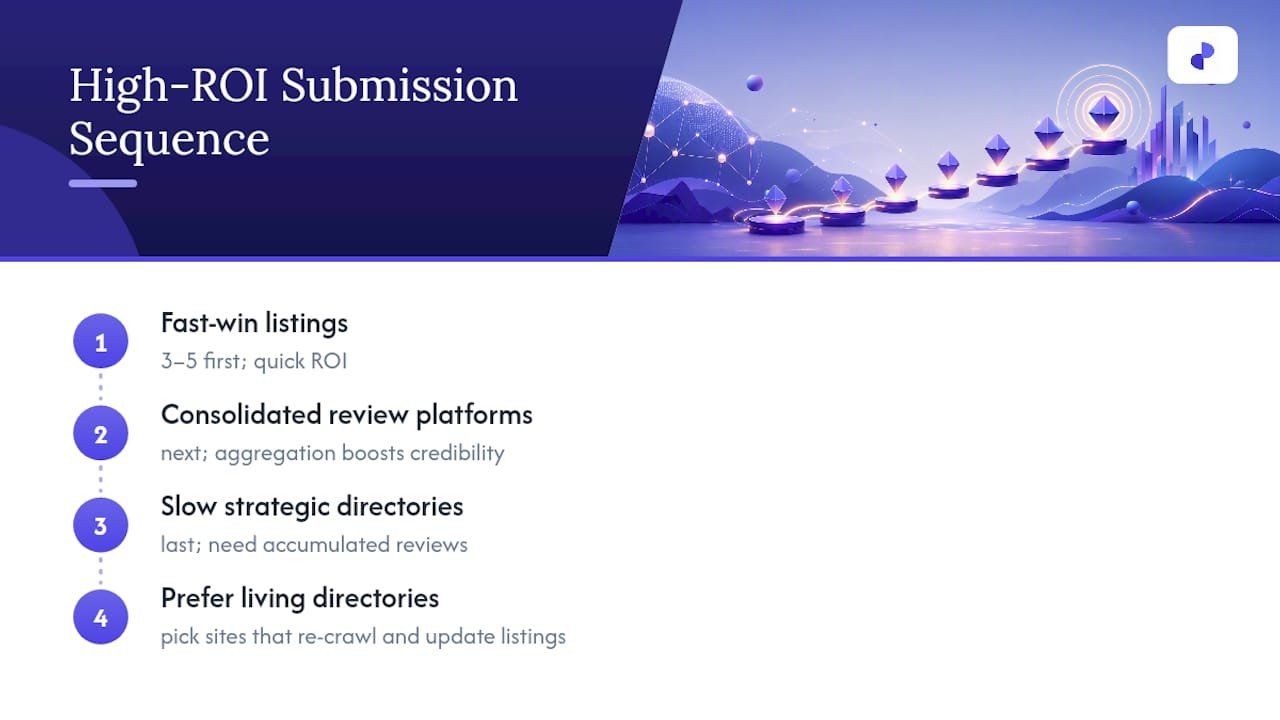
The overrated move is chasing every directory on a 200-item “awesome list.” Those lists are useful for later, not for launch week. The underrated move is checking whether a directory is a living directory that re-crawls and updates listings, versus a static roundup that goes stale the day it publishes. A do-follow link on a dead page loses value fast.
If I had to pick one thing readers get wrong: they treat backlink count as the goal. Backlink quality and re-crawl frequency matter more than raw volume, and that’s exactly where manual, curated submissions earn their cost over bot-driven mass submission.
— Danish
StartupSubmit Handles the Directory Grind for You
Running down 220+ directory submission forms one by one eats a week you probably don’t have during launch. StartupSubmit’s directory submission service does the manual work instead: duplicate checking, category selection, and unique profile writing across more than 220 high-authority directories, handled by a team rather than a bot.
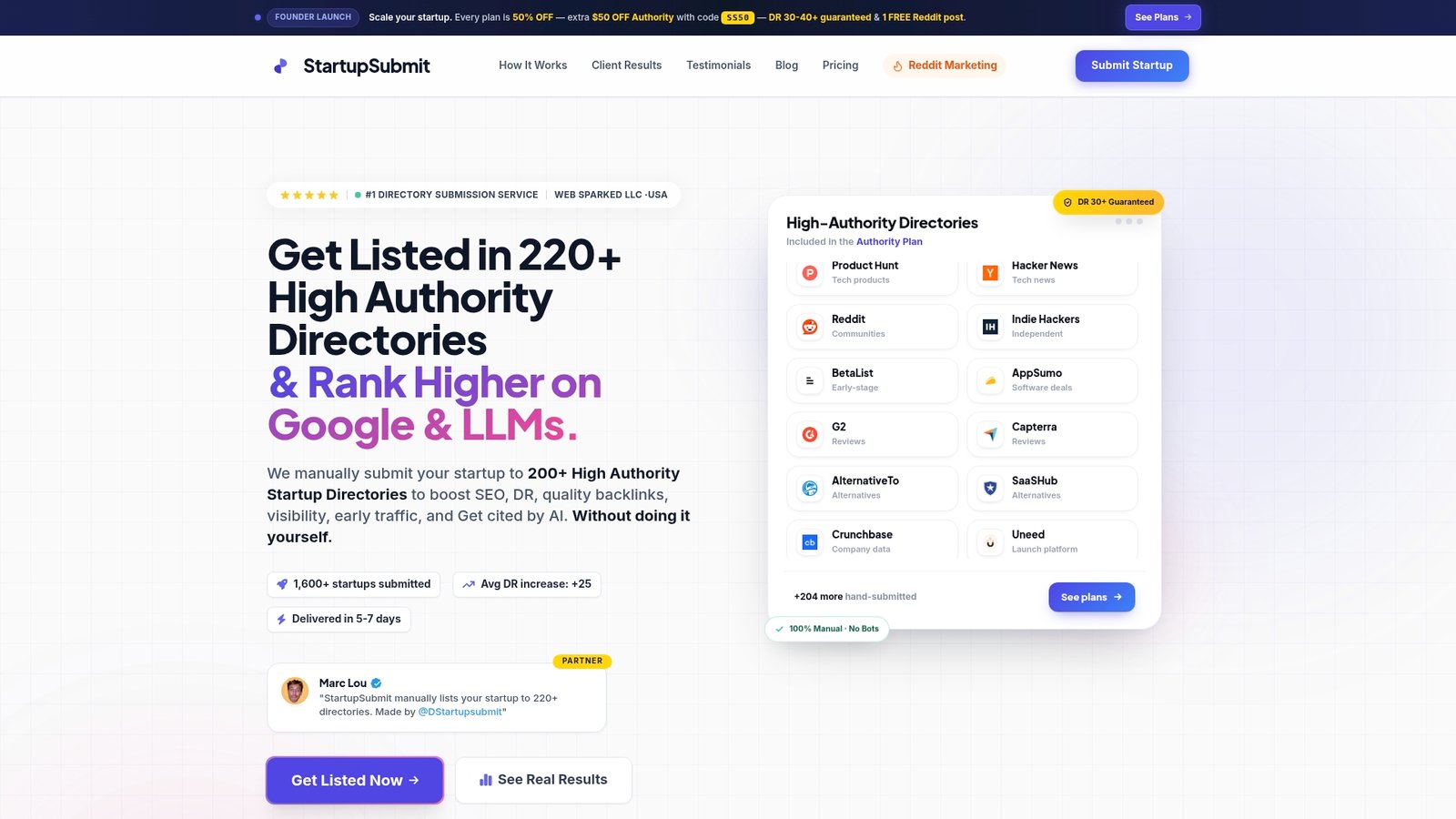
This fits founders who want predictable, higher acceptance rates without spending their own hours on submission forms. Startups using the service have reported gains like a 338% increase in organic traffic after their listings went live, alongside faster domain authority movement. You still get the reporting: which directories accepted you, which are pending, and what each placement delivered. If you’d rather compare it directly against other providers before deciding, see how it stacks up on the StartupSubmit vs LaunchDirectories comparison. Ready to skip the manual form-filling? Submit your startup to 220+ directories and get your placement report back instead of a week lost to copy-pasting the same pitch into dozens of forms.
FAQ
How Many SaaS Directories Should I Submit to First?
Start with five to six fast-win listings, such as Product Hunt, SourceForge, AlternativeTo, and BetaList, before moving to slower, review-driven platforms like G2 or GoodFirms.
Are Free SaaS Directories Worth It?
Yes. Roughly 26 of the 42 major directories reviewed offer genuinely free listings, and several, like SourceForge, carry real traffic and domain authority despite costing nothing.
How Long Does Directory Approval Usually Take?
It varies widely, from 24 to 48 hours on faster platforms to six weeks or more on slower, editorially reviewed sites, so check each directory’s stated queue before planning a launch around it.
Is Manual Directory Submission Better Than Automated Tools?
Manual submissions typically earn higher acceptance rates and stronger backlinks because each listing is tailored rather than templated, which is the core reasoning behind StartupSubmit’s manual approach.
Do Directory Backlinks Actually Help SEO?
They can, particularly when the directory is a living, regularly re-crawled listing with a do-follow link rather than a static page that never updates after approval.