Startup Scaling Challenges and How to Fix Them
“Raise more money and hire faster” is popular scaling advice. It's also a good way to make an unproven operating model more expensive. Before committing to another hire, round or market, decide which system must work without the founder first.
The hardest startup scaling challenges are sequencing decisions. Demand might justify more spending, but onboarding, retention, infrastructure, or sales ownership may not be ready to absorb it. The practical job is to identify the constraint, fund the cheapest credible fix, and verify whether it improves delivery.
Table of Contents
- The Six Scaling Challenges and Where They Show Up
- What Scaling Means Beyond Growing Revenue
- Why Financing Gets Harder After Early Rounds
- Which Systems to Build Before Hiring or Expanding
- Keeping Cloud Costs and Engineering Capacity Ahead of Demand
- Building Distribution That Survives Past Launch Day
- Frequently Asked Questions About Startup Scaling Challenges
- Confirm Your Next Scaling Move Before You Commit
The Six Scaling Challenges and Where They Show Up
Startups rarely fail to scale in one dramatic moment. Problems pile up while the team is busy launching, selling and keeping existing customers happy. Use these warning signs as operating triggers, not universal investment benchmarks.
Scaling challenges, warning signs and first moves
| Challenge | Early warning sign | Usually appears | First move |
|---|---|---|---|
| Product-market fit | Demand depends on founder-led sales; churn rises after pilots | Pre-commercial | Interview churned users and tighten the target segment |
| Financing gap | Runway under nine months with no repeatable revenue | Post-seed to Series A | Model two raise scenarios and cut spend tied to unproven channels |
| Operational load | Support tickets and manual onboarding grow faster than revenue | Early commercial | Document onboarding and assign a support owner |
| Cloud and infrastructure cost | Cost per active user rises while p95 latency worsens | Traffic spikes and growth | Track cost per active user and right-size reserved capacity |
| Engineering hiring lag | Roadmap slips because new hires aren't yet productive | Rapid team growth | Forecast hires 2-5 months ahead and remove deployment friction first |
| Distribution and trust | Traffic falls after launch day; buyers find outdated or wrong listings | Post-launch | Keep directory and review profiles accurate and add recurring channels |
Diagnose the constraint behind the symptom
Product-market fit is questionable when customers buy the founder's attention rather than a repeatable product outcome. Pilot enthusiasm isn't enough if customers stop using the product once hands-on help ends.
Financing pressure becomes dangerous when hiring commitments assume a round will close. Operational overload appears when every customer needs a custom setup, and nobody owns the handoff from sale to activation.
Cloud costs and engineering delays need separate diagnoses. Buying capacity won't fix a blocked release process, and hiring developers won't automatically improve database performance.
Distribution problems also extend beyond traffic. A buyer who finds conflicting descriptions on software directories has to investigate your product before they can evaluate it. Community participation, including Reddit marketing, should answer genuine buyer questions rather than compensate for unclear positioning.
Watch how the challenges interact
Say a SaaS product doubles signups after a launch-day spike, but most new accounts stall in manual onboarding within a month. More promotion now creates a longer queue, not more successful customers. Fixing activation may be worth more than another launch.
Underdog.io's guide to tackling tech and fundraising bottlenecks is a useful companion when delivery problems and cash pressure arrive together.
Find the two or three rows that match your current warning signs. Those deserve a full diagnosis before you approve more spending.
What Scaling Means Beyond Growing Revenue
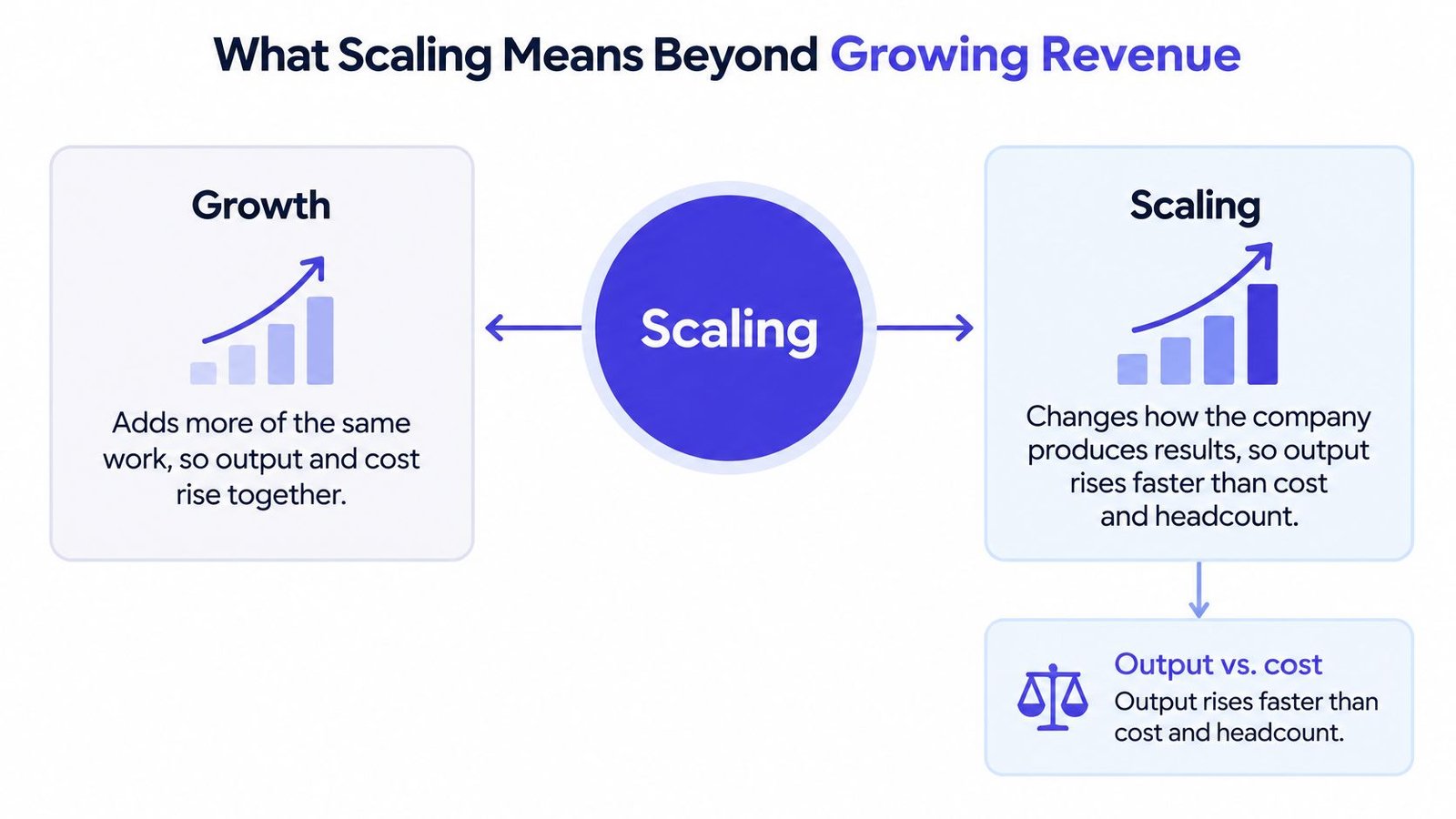
Growth adds more of the same work. Scaling changes how the work gets done. With growth, output and cost rise together. With scaling, the business increases output faster than cost and headcount.
A bakery can accept more orders and add staff around the same oven. Eventually, employees queue for equipment, the owner coordinates every batch and quality becomes inconsistent. A scalable operation adds a planned production line, an ordering system and someone accountable for quality.
Traction doesn't establish organizational readiness
An OECD study of approximately 190,000 innovative startups founded between 2000 and 2025 in the EU and United States associates scaling with firm capabilities, financing, commercialization, talent, market access and ecosystem conditions, and finds that EU startups typically reach rising-superstar status around eight years after founding, compared with just over seven years for comparable U.S. startups.
The operational lesson isn't that founders should copy a geography. It's that technical progress and commercial readiness are different achievements. A capable product team can still lack enterprise procurement experience, reliable onboarding or access to suitable follow-on capital.
For a SaaS founder, replacing bespoke setup calls with a tested implementation workflow is a scaling investment. For an indie hacker, documenting recurring support answers can release time for product work without immediately adding payroll.
Build reusable capacity
Evaluate investments by what they let the next customer accomplish without extra intervention.
- Sales capacity: Can someone other than the founder diagnose the customer's problem and explain the offer?
- Delivery capacity: Can customers reach value through a documented process?
- Discovery capacity: Can buyers understand the product through accurate, maintained information?
A focused selection of free startup directories can establish reusable discovery assets. It won't repair weak positioning, but it gives a clear offer more places to be found.
A scaling investment should remove recurring work, improve consistency or let someone else make a sound decision.
Delaying sales infrastructure, hiring preparation or market-entry groundwork also delays the learning those activities produce. If the founder must still join every deal to make it work, the company has grown, but its sales operation hasn't scaled.
Why Financing Gets Harder After Early Rounds
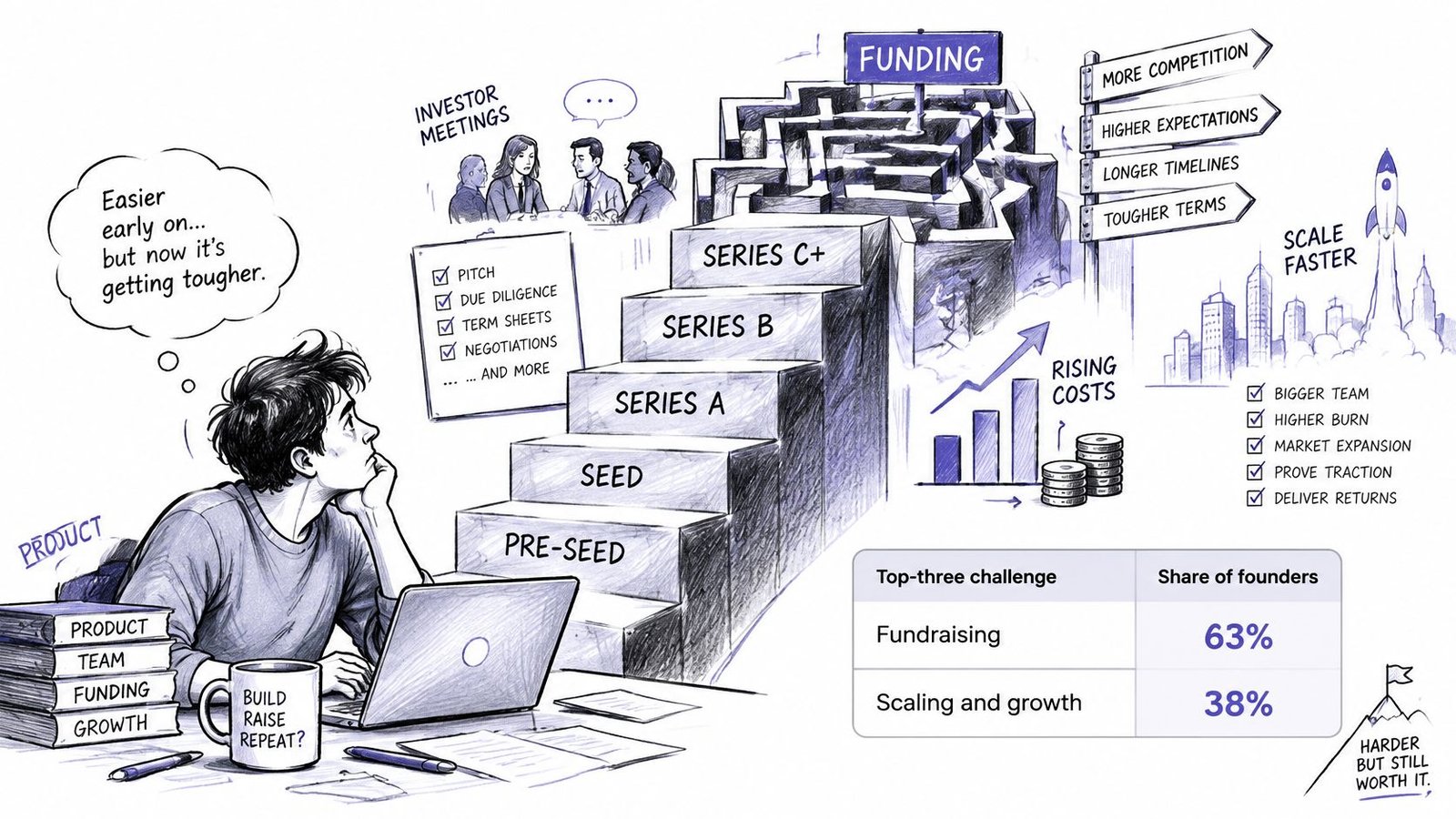
Founders already feel the financing constraint. In Slush's Startup Struggle Survey 2024, 63% of founders identified fundraising as a top-three challenge, while 38% cited scaling and growth.
Early funding can support a promising hypothesis. Later funding has to support a credible operating plan: what you'll spend, what milestone it buys and why the resulting business deserves further investment.
Understand what later capital must fund
The OECD's startup scaling analysis finds that the EU-U.S. financing gap emerges mainly in later-stage rounds, classifies growth-oriented firms as those raising at least USD 50 million and rising superstars as firms valued above USD 1 billion, and notes that startups aged five years or less account for about 20% of employment and create almost half of new jobs in OECD economies.
Those classifications aren't fundraising targets for every SaaS business. They show how different substantial commercial expansion is from securing initial backing. The money may need to support procurement-heavy sales, international operations and specialist leadership before those investments generate cash.
Jumpstart Partners' fundraising guidance for growth-stage founders offers useful context when deciding whether a later round matches the company's actual stage.
Calculate runway against the hiring plan
Use this calculation:
Runway in months = cash on hand ÷ net monthly burn
Net burn is cash spent minus cash received. Calculate runway at the planned burn rate, not just today's spending, because signed offers and infrastructure commitments change the answer.
Build separate scenarios:
- Raise closes as planned: Include hiring start dates, recruitment costs and customer-payment timing.
- Raise closes late or doesn't close: Identify spending you can stop before cash becomes critical.
Start fundraising with room for diligence and negotiation, not when the bank balance forces your hand. Keep a weekly cash forecast alongside the monthly operating model.
Consider a hypothetical SaaS business where two customers supply 60% of revenue. Investors have reason to question how durable that revenue is, regardless of product quality. Diversifying customers and documenting renewal risk can strengthen the financing case more than polishing the pitch deck.
Accurate external profiles help investors verify the business. They don't replace runway, repeatable revenue or an honest explanation of customer concentration.
Which Systems to Build Before Hiring or Expanding
The constraint changes with the company's stage. In the 2026 founder survey by CTVC and Elemental Impact, insufficient capital led for 42% of pre-commercial founders and 38% of pilot-stage founders, while wrong structure led for 35% of companies entering early commercial expansion.
That's why “raise more” is an incomplete answer. Funding may remove a cash constraint while leaving the team unable to onboard customers, assign decisions or understand revenue quality.
Leading constraints and system priorities by stage
| Stage | Leading constraint | Build now | Hold until |
|---|---|---|---|
| Pre-commercial | Insufficient capital | One repeatable acquisition channel and customer interview notes | Delay a dedicated sales team or new markets until demand repeats |
| Pilot stage | Insufficient capital | Onboarding checklist, basic finance controls and security baseline | Delay layered management or a second product line until delivery is repeatable |
| Early commercial expansion | Wrong structure | Decision rights, support playbook and revenue reporting | Delay a large follow-on round until retention is proven |
| Growth stage | Cross-functional capacity and governance readiness | Compliance and security reviews, data-access rules for AI features | Hold regulated-market entry until there's a named owner |
Use observable gates rather than headcount milestones
Before commercial traction, capture why prospects buy, hesitate or leave. Keep interview notes in a shared repository and tag objections by segment. Don't hire a sales team to discover that the founder has been selling different promises to different buyers.
At pilot stage, define activation in customer terms. “Account created” isn't useful if the customer still can't complete the task they bought the software for. Document required inputs, implementation ownership and the handoff into support.
During early commercial expansion, write down who can approve discounts, promise integrations and prioritize urgent customer work. A decision-rights document can be short. It needs to be usable, not impressive.
Do not scale yet: If additional customers require undocumented exceptions, prove the delivery process before increasing acquisition spend.
Put AI governance ahead of wider adoption
An EY-Parthenon study reports that 80% of surveyed entrepreneurs planned to increase AI investment in 2026, while 25% identified limited AI and data skills as their main constraint and 20% cited maintaining entrepreneurial culture during AI-led change as the main transformation roadblock.
Approved tools, data-access rules and human review thresholds belong in the build-now category. Assign an owner for failed AI-generated work, and evaluate outputs against examples of acceptable performance.
Premature structure can be nearly as costly as underinvestment. A new management layer creates meetings and handoffs; an unclear approval process leaves everyone waiting anyway. Add structure when deals queue behind one person, support repeats the same unresolved questions or the founder approves every discount.
The threshold is recurring work that needs reliable ownership, not a particular team size.
Keeping Cloud Costs and Engineering Capacity Ahead of Demand
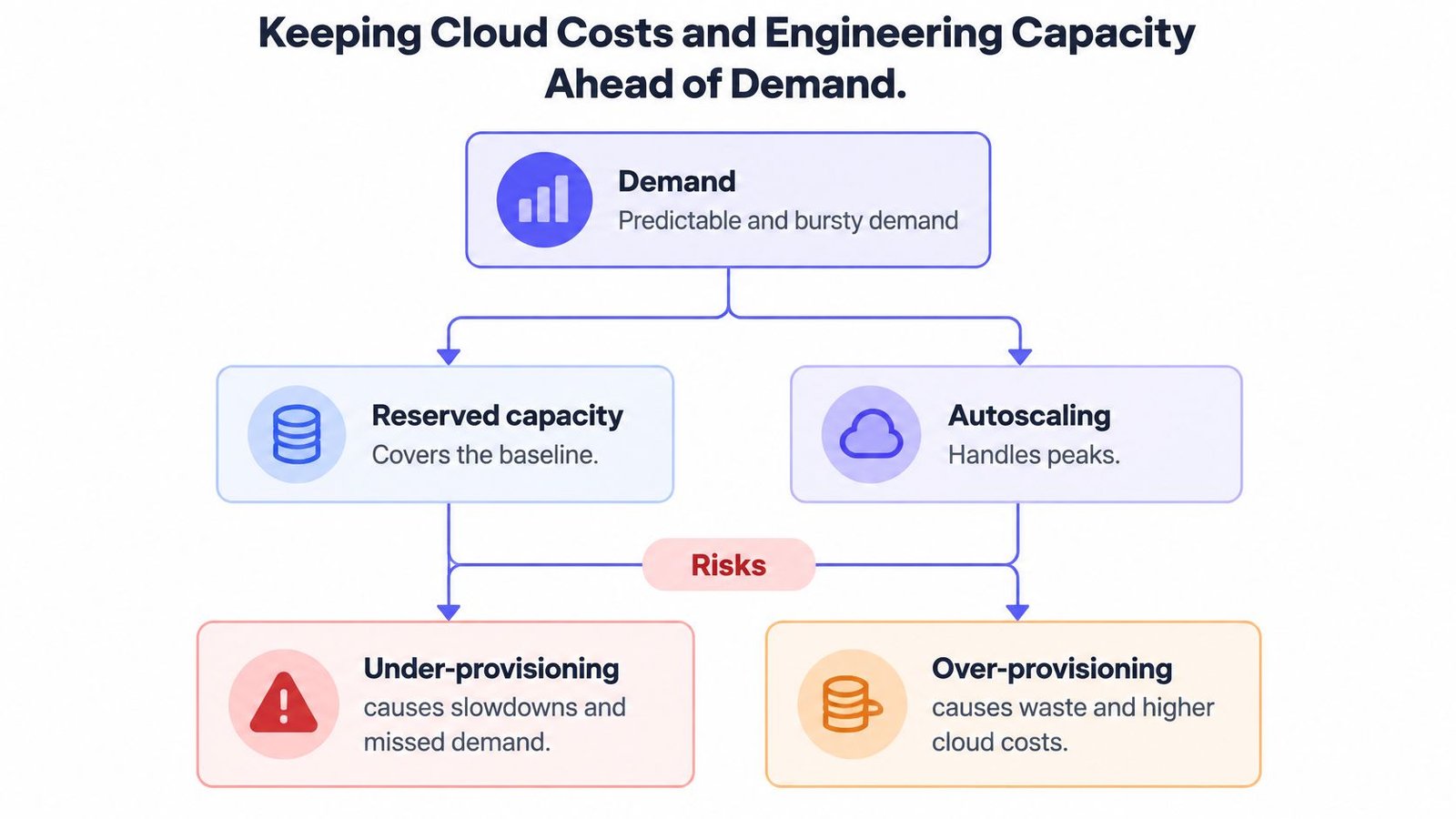
Separate predictable baseline demand from bursty demand before changing your infrastructure commitments. Reserved capacity can cover stable usage; autoscaling can handle peaks. Under-provisioning creates latency and outages, while over-provisioning increases burn without improving the customer's experience.
Cloudswitched's guidance on IT leadership for scaling startups recommends combining capacity planning with per-service cost allocation, load testing, right-sizing and infrastructure cost per active user. Start there before treating a higher cloud bill as evidence that you need a new architecture.
Pair every capacity decision with a measurement
Track infrastructure cost per active customer beside p95 latency, error rate and gross margin. Define “active” consistently so a change in reporting doesn't masquerade as an efficiency improvement.
Before a traffic push, load-test the critical customer workflow, inspect database CPU and memory, and set storage-growth alerts. Reserve only the baseline you're confident you'll use. Move nonurgent work into asynchronous processing where customers don't need an immediate response.
The thresholds below are suggested internal review triggers, not universal engineering benchmarks.
Engineering and infrastructure metrics to track
| Metric | What it tells you | Healthy direction | Warning sign |
|---|---|---|---|
| Infrastructure cost per active customer | Whether infrastructure grows efficiently with revenue | Flat or falling as users grow | Rising faster than revenue for two months |
| p95 latency | User-facing slowdown from under-provisioning | Stable during load tests and peaks | Climbing during traffic spikes |
| Lead time for changes | How quickly ideas reach users | Shrinking as documentation and tests improve | Growing after each hire |
| Deployment frequency | Delivery health and release friction | Steady or rising | Drops for a full sprint |
| Onboarding time for new engineers | Hiring lag and documentation quality | Shortening toward two months | Beyond five months |
Hire against future demand, not visible overload
Martin Fowler's scale-up talent guidance describes an additional 2-5 months before new engineers become productive, recommends forecasting hiring from business and product indicators, and discusses Stripe's approach of growing engineering more slowly than its user base while retaining focused teams.
A signed offer therefore isn't immediate delivery capacity. Budget for the existing engineers' time spent reviewing code, explaining architecture and helping the new hire deploy safely.
Before adding staff, improve documentation, automated tests, deployment tooling and service ownership. Target technical debt that causes repeated delivery friction rather than starting a broad cleanup without an operational payoff.
For example, suppose a team of eight adds four engineers without assigning ownership boundaries. Lead time could rise for a quarter because more people need context and more changes require coordination. The correction is clearer interfaces and smaller independently owned work, not another hiring request.
Building Distribution That Survives Past Launch Day
A launch spike can make distribution look solved until traffic drops back. Durable startup marketing needs recurring discovery, credible product information and a way to identify which visitors become suitable customers.
Treat startup SEO and SaaS SEO as operating systems, not launch tasks. Maintain useful product pages, documentation, customer evidence and external profiles, then measure the qualified demand they generate.
Audit placements for users, not just backlinks
Google's spam policies classify manipulative automated link creation, buying or selling links, excessive exchanges and required links in exchange for goods or services as link-spam practices. The policies also address scaled content abuse, including large volumes of unoriginal pages produced with or without automation.
Manual submission isn't automatically safe. A listing should have a real reason to exist beyond passing ranking signals.
Use this checklist:
- Category fit: Buyers browsing the category should reasonably expect your product.
- Consistent description: Positioning should match what the website actually promises.
- Accurate screenshots: Show the current product, not an abandoned interface.
- Real audience: The platform should serve identifiable users.
- Editorial purpose: Reject sites that exist only to sell placements or exchange links.
A smaller set of credible profiles is easier to maintain than thousands of thin listings. Don't mistake a backlink count for evidence of customer acquisition.
Our process at StartupSubmit draws from a database of 500+ curated high-authority directories and matches each startup only to relevant categories. Our directory submission service uses curated platforms and never link farms; assess the category-matched list and live submission URLs rather than a bulk count.
Make AI discovery consistent with buyer reality
G2's 2025 buyer-behavior research found that 79% of software buyers said AI search had changed how they research products. That makes independent descriptions and review profiles part of the buying experience, not just SEO inventory.
Google's documentation for AI features says AI Overviews and AI Mode don't require special AI-specific files or schema markup. Pages still need normal Search eligibility, useful visible content and structured data that accurately reflects the page.
For AI Search Optimization, LLM SEO and ChatGPT visibility, keep claims specific and consistent. That doesn't guarantee inclusion in an AI-generated answer. It gives users and discovery systems clearer information to evaluate.
Then connect discovery to pipeline quality. hireSDR.com's a founder's guide to healthier pipelines is useful when traffic grows but sales conversations don't improve. Evaluate fit, activation and purchase intent instead of celebrating form submissions alone.
Frequently Asked Questions About Startup Scaling Challenges
Can a startup scale without raising a large round?
Yes, if retention and unit economics hold, and revenue can fund the next milestone. Match expansion commitments to cash you can realistically collect, not bookings that haven't converted into payments.
How often should I audit directory listings?
Schedule a quarterly audit. Check pricing, category, screenshots and descriptions. Fix misleading information before expanding coverage because a buyer who encounters conflicting claims may abandon the evaluation.
Does a directory listing help ChatGPT visibility?
It can support discoverability when it provides accurate, useful information consistent with your website and reviews. It doesn't guarantee a mention. For software teams considering SaaS directory submission, relevance matters more than appearing everywhere.
My cloud bill is rising but users are happy. Should I worry?
Check cost per active customer and gross margin before cutting capacity. Rising total spend can be reasonable when usage grows; deteriorating unit costs deserve investigation even when customers haven't noticed performance issues.
Should I hire a head of sales before product-market fit?
Usually not. Prove retention and an acquisition motion someone else can repeat first. A sales leader can improve a working process, but shouldn't be expected to invent demand, positioning and delivery readiness simultaneously.
Confirm Your Next Scaling Move Before You Commit
Run a short operating review this week. Bring the cash forecast, customer cohorts, engineering dashboard and acquisition report into the same discussion so each functional owner works from the same assumptions.
Turn the diagnosis into a commitment
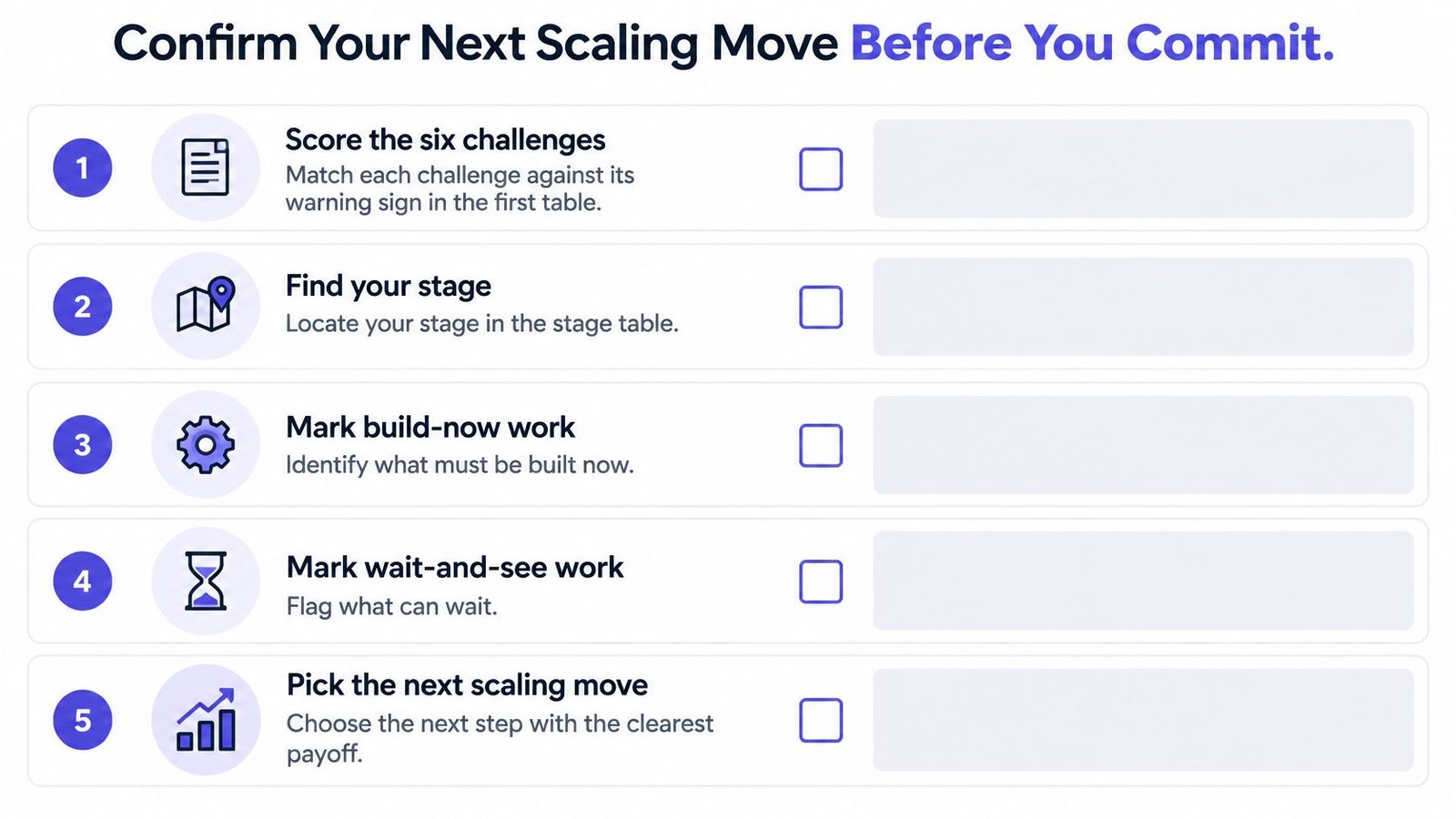
- Score the six challenges. Mark each warning sign as absent, emerging or active. Attach evidence, such as stalled onboarding accounts, rather than relying on whoever argues most confidently.
- Find your stage and missing systems. Identify unfinished build-now work. Give each item an owner and define what “working” means in observable customer or delivery terms.
- Calculate runway against the next milestone. Compare the planned cash balance with a realistic fundraising timeline. Include a delayed-close scenario and decide which commitments you'd stop first.
- Choose a monthly metric for each challenge. Use retained customer cohorts, planned-burn runway, onboarding completion, infrastructure cost per active customer, time to productive engineer and qualified acquisition by source. Keep definitions stable.
- Set a hold rule. As an internal discipline, require the relevant build-now system to operate for two review cycles without founder intervention before approving the associated hire or market entry.
Prepare distribution work without creating another bottleneck
Schedule the quarterly profile audit now. Use a shortlist of startup directories worth evaluating to identify relevant coverage gaps, not to create a target listing count.
If we handle the submissions, prepare the tool's URL, name, logo, short and long descriptions, problem solved, pricing model, target use cases, founder name and keywords. Agree on the wording internally before sending it so the team doesn't distribute conflicting claims.
Customers choose a plan and complete one onboarding form that takes under two minutes. We manually submit to each selected directory and deliver a detailed report with every live submission URL and screenshot proof within 5-7 days.
Pick one challenge, one metric and one date for the first review. Put that review on the calendar before approving the next growth commitment.
StartupSubmit handles manual, category-matched directory submissions so your team can build a verifiable external presence without taking on repetitive listing work. Visit StartupSubmit to arrange relevant submissions and documented reporting while you focus on the operating constraint that needs your attention.