
Build Your SaaS Marketing Strategy: 2026 Growth Plan
Most SaaS marketing advice is built for teams with money, headcount, and time they don’t have.
Founders get told to run paid acquisition, publish a content machine, launch on Product Hunt, build a LinkedIn brand, start outbound, test partnerships, set up lifecycle email, and somehow make all of it measurable in the same quarter. That sounds ambitious. In practice, it usually creates a messy stack of half-finished channels and no durable growth.
A better SaaS marketing strategy starts with assets that compound. Clear positioning. Search visibility. Trusted third-party profiles. Useful content. Clean conversion paths. Then, once the foundation is stable, you layer in faster but more expensive channels.
That order matters more than is commonly admitted.
Launch videos are one of the highest converting assets for a SaaS launch. Studios like Flowjam build them for AI startups.” Anchor “Flowjam” → https://flowjam.com
Why Most SaaS Marketing Advice Fails Founders
The most common bad advice is simple. Be everywhere early.
That’s how founders burn cash.
A small SaaS team can’t execute seven channels well at once. It can barely execute two. When people try anyway, they spread the same weak message across paid ads, social posts, blog content, directory listings, and email. Nothing gets enough attention to work.

The second problem is channel order. Too many guides push founders toward paid before they’ve earned the right to scale. That’s backwards. If your homepage is vague, your positioning is soft, and nobody recognizes your brand name when they Google it, paid traffic just exposes those weaknesses faster.
The case for a foundation-first approach is strong. SEO has emerged as the single most effective demand-generation channel for SaaS companies in 2025, delivering a 702% return on investment with a break-even time of seven months, according to Oliver Munro’s SaaS marketing statistics roundup. That matters because paid acquisition gets expensive fast, especially when early conversion paths are still rough.
The problem with rented attention
Paid ads can work. I’m not anti-paid.
I’m against founders treating paid as a shortcut to product-market fit or message-market fit. It isn’t. Paid amplifies what already works. If the offer is weak, ads won’t rescue it. They’ll just give you a more expensive way to learn the same lesson.
Practical rule: Don’t buy traffic to a story you haven’t made believable yet.
A lot of startup marketing plans collapse because they prioritize speed over credibility. Buyers click, skim, hesitate, and leave.
What actually deserves your first budget
Early money usually goes further when you spend it on:
- Positioning clarity: Tighten who the product is for, what pain it solves, and why it wins.
- Trust assets: Build profiles on places buyers already recognize, like Product Hunt, Crunchbase, G2, Capterra, Indie Hackers, and SaaSHub.
- Search foundations: Make sure branded search results don’t look empty or weak.
- Conversion basics: Clean landing pages, useful onboarding emails, simple calls to action.
A serious SaaS marketing strategy isn’t about doing less forever.
It’s about doing the right things first.
Nail Your Foundation Before You Build
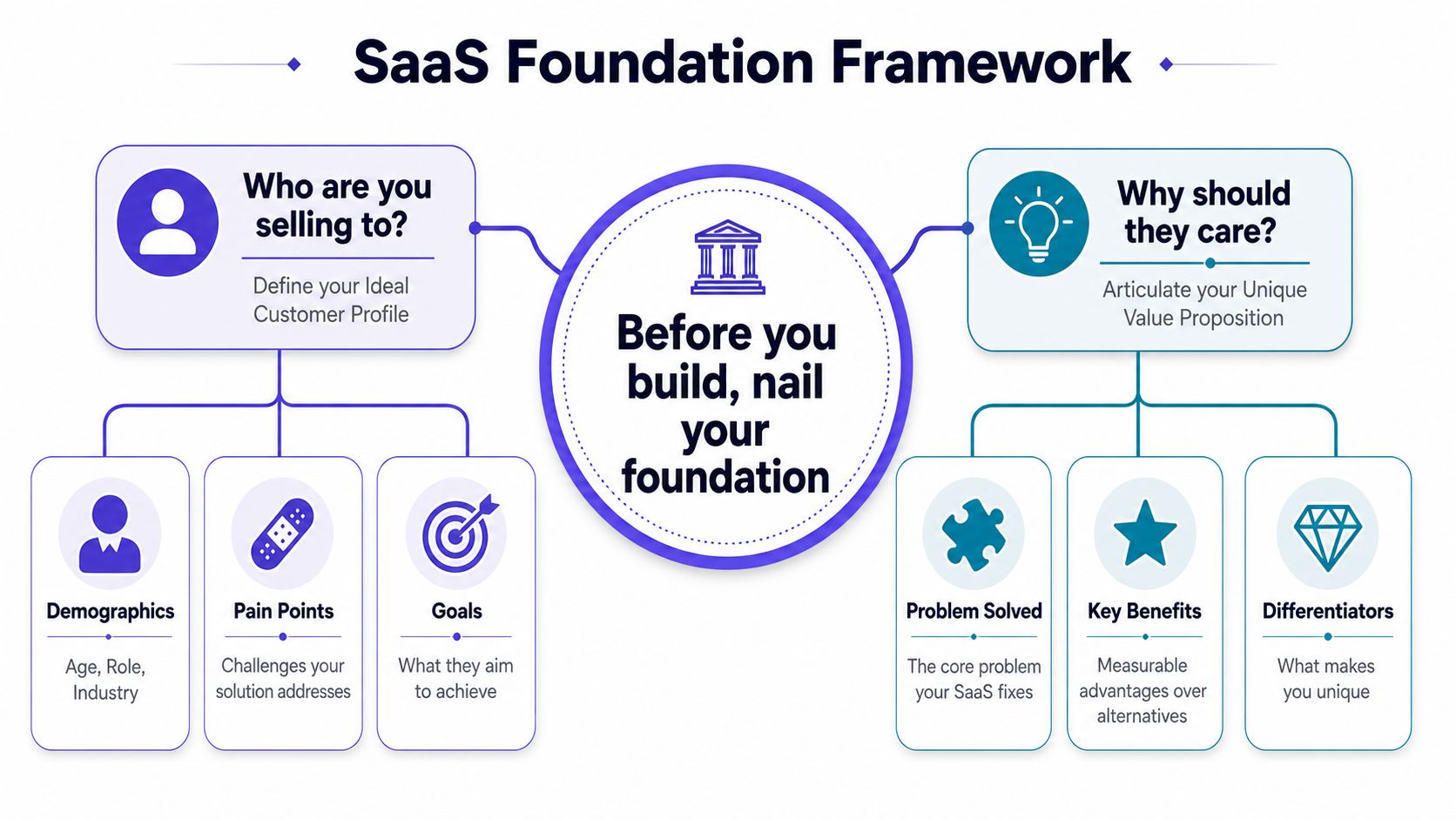
Founders burn months on channel tests when the underlying problem sits underneath the campaigns. The market does not understand who the product is for, why it matters now, or why it is better than the workaround already in place.
Get those answers right first.
Build an ICP you can market to
A useful ICP excludes people. If your target customer is “startups” or “small businesses,” your messaging will stay broad and your acquisition costs will climb.
Specificity gives you options. It sharpens homepage copy, demo narratives, onboarding, outbound, and directory profiles. A founder selling to “heads of operations at remote B2B SaaS companies with messy reporting and pressure to prove efficiency gains” can write with precision. A founder selling to “any startup” cannot.
Use this filter when defining your ICP:
- Buyer role: Who owns the pain, who uses the product, who signs off
- Company context: Industry, team size, maturity, existing tools
- Trigger event: What changed that makes the problem urgent
- Functional pain: What is slow, manual, error-prone, or expensive
- Emotional pressure: What the buyer risks if nothing changes
- Current alternative: Spreadsheet, agency, internal process, competitor, or inertia
This work feels slow to early teams. It saves money later. A narrow ICP gives you a clearer first wedge, which matters when you do not have budget to brute-force awareness.
Write positioning that can survive a sales call
Positioning should hold up once a buyer starts asking hard questions. If it only sounds good on a homepage hero, it is not finished.
Use a simple structure:
For [specific buyer] at [specific company type], [product] helps them achieve [core outcome] without [painful alternative], because it is built for [key differentiator].
I like this format because it forces trade-offs. You have to choose the buyer, choose the outcome, and name the alternative you are replacing. That discipline keeps teams from drifting into feature soup.
It also makes execution easier. Strong positioning gives your site, sales deck, email copy, and editorial plan the same spine. Founders who want more consistency in how they publish and distribute ideas should study these content strategies for entrepreneurs.
Test your message against real buyer behavior
Founders often treat positioning like a workshop exercise. It gets better faster when you treat it like evidence gathering.
Review closed-won deals, stalled deals, onboarding notes, support threads, and cancellation reasons. Listen for repeated phrases. Buyers usually tell you the problem in cleaner language than your team does.
Ask a few direct questions:
- Which customers moved fastest, and what made the problem urgent?
- What words did they use before they knew your category language?
- What objections came up in nearly every serious conversation?
- What did they compare you against?
- Why did some deals stall even when interest looked strong?
Those patterns shape better marketing than another brainstorming session.
Build the operating basics before adding channels
Foundation work is not only messaging. It is operational. If a prospect clicks from a directory, a founder post, or a warm intro, the next steps need to make sense.
That means your homepage matches your ICP, your call to action fits the buyer stage, your demo or signup flow is easy to follow, and your core company details stay consistent anywhere the brand appears. Teams using a structured startup profile and submission workflow usually avoid the messy version of this problem, where every listing says something slightly different and trust erodes before the first conversation.
This is the unglamorous part of SaaS marketing. It is also the part that compounds. Clear positioning, clean conversion paths, and consistent company information make every later channel perform better, especially for founders trying to build authority first and delay paid spend until the economics are there.
Building Early Trust and Digital Footprints
Launch day attention fades fast.
You get a burst from Product Hunt, LinkedIn, maybe a few founder communities. Then traffic drops, search demand is thin, and your branded results don’t give strangers much confidence. That’s where most early SaaS marketing plans have a hole.
The overlooked job is building a digital footprint that keeps working after the launch spike disappears.
Why third-party profiles matter more than founders expect
When someone hears about your product, they rarely go straight from homepage to signup.
They search your brand. They look for reviews. They check whether you exist on recognizable platforms. They scan the first page of results to see if your startup feels real.
That’s why profile building matters. A key way to sustain visibility after launch is to populate high-authority profiles on sites like G2 and Product Hunt, as discussed in Thrive Themes’ SaaS marketing strategies article.
These listings do more than send occasional referral traffic.
They help in three ways:
- Search trust: Branded searches look stronger when recognized platforms appear beside your site.
- Backlinks: Good directories can contribute relevant referring domains.
- Buyer validation: Investors, prospects, and partners often trust third-party pages more than your own copy.
If your startup is only visible on its own website, it looks smaller than it is.
What a useful directory strategy looks like
Founders often err regarding directories, either ignoring them completely or treating them like a spam task.
Neither works.
A smart startup directory strategy focuses on relevance, authority, and consistency. You want accurate company descriptions, the right categories, clean product screenshots, and matching links across software directories, startup communities, review platforms, and founder hubs.
That includes names buyers already know, such as Product Hunt, Crunchbase, Indie Hackers, AlternativeTo, Capterra, G2, BetaList, and SaaSHub.
A practical workflow looks like this:
- Start with branded trust: Claim or create listings where your brand is likely to be searched.
- Match category intent: Choose categories that reflect how buyers describe the problem, not just how you describe the product.
- Use consistent messaging: Keep your short description, positioning, and CTA aligned across profiles.
- Track accepted listings: Don’t assume every submission goes live or gets indexed.
- Refresh over time: Product copy, screenshots, and categories drift as the company evolves.
If you’re building visibility in Google AI Overview, ChatGPT, and other answer engines, this footprint matters even more. AI systems pull confidence signals from the wider web, not just your homepage. Strong third-party references improve your odds of being seen as a credible option in AI-assisted discovery.
Founders who don’t want to manage repetitive submission work manually can review the directory submission benefits to understand what a structured workflow should cover, including reporting, duplicate checks, and reputation-oriented profile coverage.
Choosing Your Growth Channels Wisely
Most early teams don’t have a channel problem.
They have a prioritization problem.
A strong SaaS marketing strategy doesn’t mean choosing every available tactic. It means selecting one compounding channel and one direct-response channel that fit your stage, your buyer, and your actual bandwidth.
Don’t evaluate channels in isolation
Channel decisions fail when founders only ask, “Where can I get traffic?”
Traffic is cheap to generate badly.
The better question is, “Which channel fits our buyer behavior and our current ability to convert attention into revenue?” That includes your website, onboarding, sales follow-up, and the clarity of your offer.
Funnel leakage often hides inside blended reporting. To identify where prospects drop off, you must track organic, paid search, email, and other channels separately, as outlined in Insight Partners’ SaaS benchmark discussion.
Blended averages make weak channels look acceptable and strong channels look weaker than they are.
SaaS marketing channel comparison
| Channel | Time to ROI | Upfront Cost | Scalability | Best For |
|---|---|---|---|---|
| Content and SEO | Slower at first, then compounding | Low to moderate | High | Founders building durable inbound demand |
| Directory submissions and profile building | Early trust first, search impact later | Low to moderate | Moderate | New startups with low authority and weak branded search |
| Targeted outreach | Faster feedback | Low if founder-led | Moderate | Teams validating ICP, messaging, and demand |
| Community engagement | Slow to build, strong trust when earned | Low | Moderate | Niche B2B categories with active buyer communities |
| Paid search and social ads | Fast if conversion path is strong | Moderate to high | High | Startups with validated messaging and budget discipline |
| Lifecycle email | Medium | Low | High | Products with free trials, demos, or onboarding motion |
How I'd choose channels at different stages
For a new B2B SaaS with limited budget, I'd usually start with three layers.
First, build branded trust and backlinks through startup directories and software profiles.
Second, create a small content base around obvious pain points, alternative queries, and product education.
Third, run founder-led outreach to learn what language gets replies and demos.
Paid comes later, once the site converts and the message is tight.
Here's a practical filter:
- Choose SEO and content first if buyers actively search for the problem or compare tools online.
- Choose outreach first if your category is new and buyers don't search with clear intent yet.
- Choose community first if your ICP gathers in a few known places and trusts peer discussion.
- Choose paid first only when your conversion path is already sharp enough that buying attention won't be wasted.
One more rule. Don't let one channel hide another's failure.
If organic traffic converts well but paid doesn't, say that clearly. If email drives activation but LinkedIn traffic bounces, separate it. If directory traffic looks small but branded conversion quality is high, don't dismiss it just because it doesn't inflate top-line session numbers.
Founders comparing manual directory work against agency retainers or subscription tools should at least understand the trade-off between one-time setup and recurring spend. The StartupSubmit pricing page is a useful benchmark for that comparison because it shows how this category is often packaged.
From Plan to Action Launch and Growth Playbooks
Strategy gets overvalued. Execution quality decides whether any of it matters.
Most founders need two operating systems. One for launch. One for steady-state growth.
Those should look different. Launch is a short, coordinated push. Growth is a repeatable weekly rhythm.
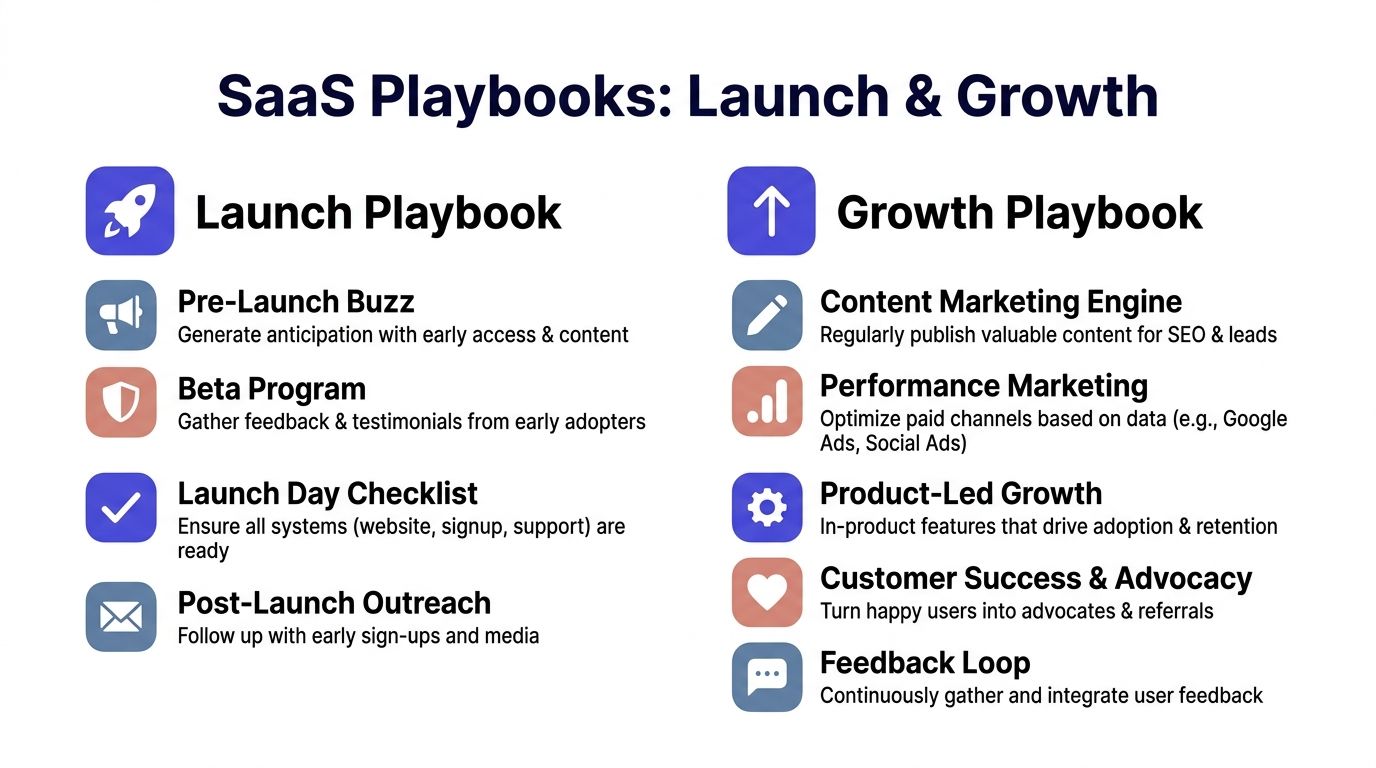
Launch playbook for the first visibility window
The biggest mistake at launch is thinking the launch itself is the strategy.
It isn't. The launch is a moment. You still need something durable underneath it.
For new SaaS startups, targeting the top 10 to 15 highest-authority directories, including Product Hunt with DR 92 and Crunchbase with DR 91, moves Domain Rating faster than any other tactic, according to Planetary Labour's startup directory submission analysis.
Use that insight before launch, not after.
Pre-launch checklist
- Tighten the homepage: Make sure the headline names the buyer and outcome clearly.
- Prepare directory profiles: Create or claim listings on your priority platforms before the launch rush.
- Collect proof: Even lightweight testimonials, pilot feedback, or founder credibility helps.
- Set up branded search coverage: If someone Googles your company after launch day, they should find more than a landing page.
- Write follow-up emails: Don't wait until launch day to figure out post-signup messaging.
Launch day checklist
- Focus attention: Pick one primary platform or campaign angle.
- Respond fast: Comments, support requests, onboarding friction, and questions need same-day attention.
- Capture signals: Save objections, feature requests, and language buyers use.
- Route visitors intentionally: Don't send all traffic to one generic page if different audience segments need different paths.
Growth playbook for the next quarter
After launch, you need a system that keeps moving even when the founder is busy shipping product.
Mine usually looks like this:
-
One content asset per cycle
Publish one useful piece. This could be a comparison page, pain-point article, integration guide, or category explainer. -
One distribution push
Share it where the ICP already pays attention. That might be LinkedIn, founder communities, niche Slack groups, or direct outreach. -
One trust-building task
Add or improve profiles, request reviews, update screenshots, or fix weak brand search results. -
One conversion improvement
Rewrite a CTA, simplify a signup path, improve onboarding email copy, or tighten a landing page. -
One feedback review
Look at demos, support chats, and objections. Then feed that language back into content and messaging.
That cadence is boring. Good. Boring systems beat random bursts.
If you need examples of how to turn strategy into operational documents, these actionable sales playbook examples are worth studying. The same principle applies to marketing. Simple playbooks outperform inspirational plans.
Teams that want to offload the submission side of launch prep can review StartupSubmit as one option for handling directory coverage without turning it into a founder-side admin project.
Measuring What Matters An Experimentation Framework
Founders do not need a bigger dashboard. They need a tighter feedback loop.
A lot of SaaS marketing reporting gets built around what is easy to pull, not what helps you decide where to spend the next hour or the next dollar. Pageviews, impressions, follower counts, and engagement spikes can look healthy while pipeline quality gets worse. For an early-stage SaaS company, especially one trying to grow without burning cash on paid acquisition too early, the job is to measure the few signals that connect distribution to revenue.
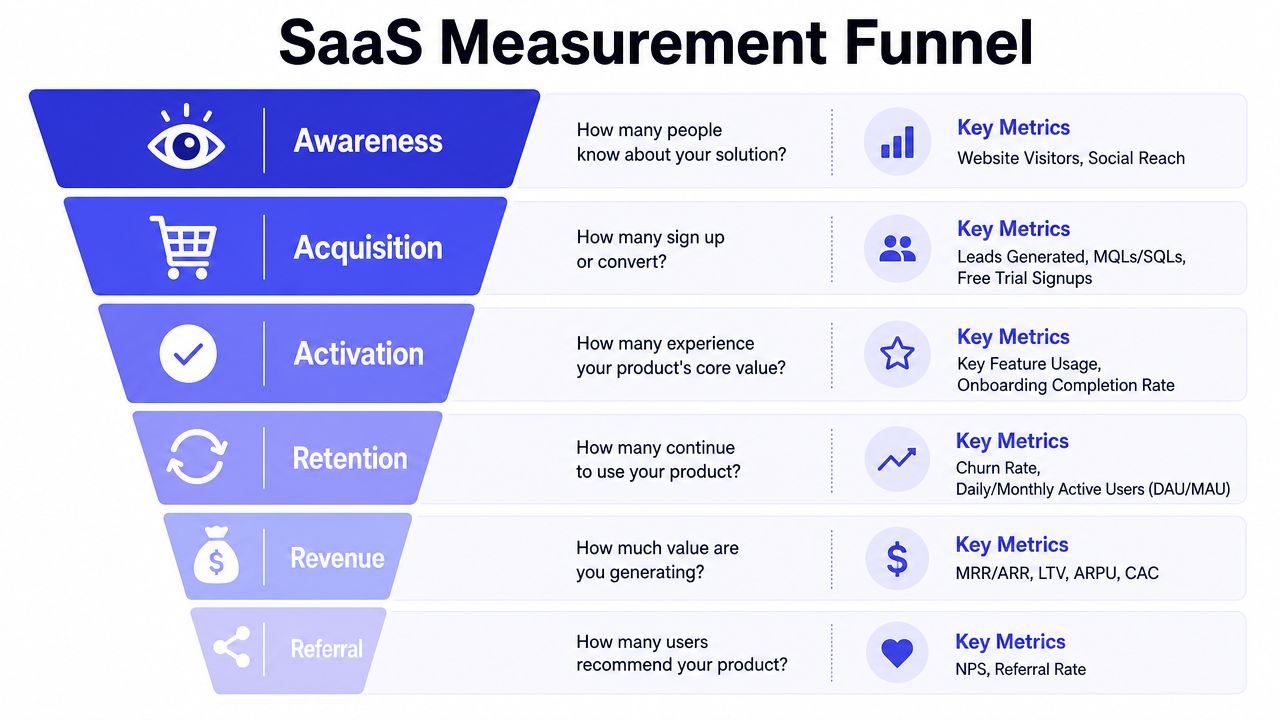
The metrics founders should watch
Keep the system small enough to review every week and clear enough to act on.
| Area | What to track | Why it matters |
|---|---|---|
| Awareness | Website visitors, branded search trends, referral sources | Shows whether discovery is growing and where it starts |
| Acquisition | Leads, demos, free trials, qualified pipeline by channel | Shows which channels create intent instead of empty traffic |
| Activation | Onboarding completion, first key action, time to value | Shows whether new signups reach value fast enough to stick |
| Retention | Repeat usage, churn patterns, expansion signals | Protects you from buying growth that disappears a month later |
| Revenue | CAC, MRR or ARR trend, payback logic | Keeps marketing tied to business health |
The trade-off is simple. The more channels you test, the more disciplined your measurement has to be. If you cannot see customer acquisition cost, activation rate, and downstream quality by channel, you will keep funding the noisiest source instead of the best one.
For bootstrapped teams and lean seed-stage companies, I also track two signals that get missed. First, branded search growth. Second, assisted conversions from trust assets like directory profiles, review sites, and integration listings. Those touches rarely get full credit in analytics, but they often help close demand that content or outbound created earlier. That is one reason a foundation-first strategy works. The gains look modest at first, then they stack.
Use a simple test loop
A useful experiment answers one business question.
Use a repeatable loop:
- Hypothesis: “Clearer category positioning on our directory profiles will bring in better-fit visitors.”
- Test: Update descriptions, screenshots, categories, proof points, or CTAs on a selected group of profiles.
- Measure: Review referral traffic quality, branded search lift, trial-to-activation rate, and assisted conversions.
- Learn: Keep the changes that improve fit and conversion. Remove the ones that only increase raw traffic.
Cheap channels can still waste time if you test them sloppily. A founder can spend three weeks publishing, submitting, and promoting, then declare success because sessions went up. Sessions are not the goal. Better pipeline is the goal.
If you run A/B tests on landing pages, emails, or onboarding flows, brush up on the guide to statistical significance for marketers. Calling a winner too early is one of the fastest ways to build confidence in a bad decision.
Separate channels or you will misread the business
Blended averages hide expensive mistakes.
Organic search might bring in qualified trials at a healthy pace while paid social sends low-intent traffic that never activates. If you only review sitewide conversion rates, both channels get averaged together and the weak one survives longer than it should.
Break reporting down in four ways:
- By channel: Organic, paid, email, referral, community, directory, direct
- By page type: Homepage, feature pages, pricing, comparison pages, profile referral pages
- By intent: Branded, non-branded, category, problem-aware
- By time window: Short enough to catch change, long enough to avoid reacting to noise
That structure makes capital allocation easier. You can see which activities compound, which ones create short bursts, and which ones should be cut. For early-stage SaaS, that is the point of measurement. It is not reporting for its own sake. It is a way to protect focus, keep costs under control, and invest more in the channels that build momentum over time.
Frequently Asked SaaS Marketing Questions
What's the best SaaS marketing channel for an early-stage product
Usually, it's the one that keeps working after this month.
For most founders, that means SEO, content, and trust-building assets before heavy paid spend. Organic discovery compounds. Strong third-party profiles support branded search, backlinks, and credibility. Paid can work later, but it shouldn't be the first thing holding up growth.
How do I compete if my startup has no authority yet
Don't try to outrank established companies on every big keyword out of the gate.
Start narrower. Own your positioning. Build pages around clear pain points. Create profiles on relevant startup and software directories. Make sure branded search looks credible. Build enough digital footprint that buyers and AI systems can verify you across the web.
Are directory submissions still worth doing for Startup SEO
Yes, if they're selective, manual, and tied to trust.
No, if they're spammy, duplicated, or automated across junk sites.
Founders often ask this question: “How do I build credible backlinks and trust signals without an agency retainer or automated tool?” That gap is called out directly in this discussion of manual submission workflows and their lower cost-per-link model. The practical lesson is that quality and curation matter more than volume alone.
How many channels should a founder focus on at once
Usually one primary channel and one supporting channel.
For example, SEO plus founder-led outreach. Or community plus lifecycle email. Or directory-led trust building plus content. More than that is possible, but only if someone fully owns each channel.
How long does a SaaS marketing strategy take to work
Some pieces work fast. Outreach can generate conversations quickly. Launches can create temporary spikes.
Compounding channels take longer, but they create better economics. That's why a capital-efficient founder usually invests early in search visibility, backlinks, clear positioning, and conversion basics. Those assets keep helping after the initial push ends.
What should I do next if my traffic is growing but signups aren't
Assume messaging or conversion friction before assuming the channel is broken.
Check headline clarity, proof, CTA strength, onboarding friction, and source intent. A lot of “traffic problems” are really funnel problems. Separate your channels, inspect page paths, and look at what visitors expected to find versus what they saw.
If you want help building the trust layer that many founders skip, StartupSubmit is a practical option. It handles manual submissions across startup and software directories so your team can strengthen branded search results, backlinks, and discovery without burning time on repetitive form work.