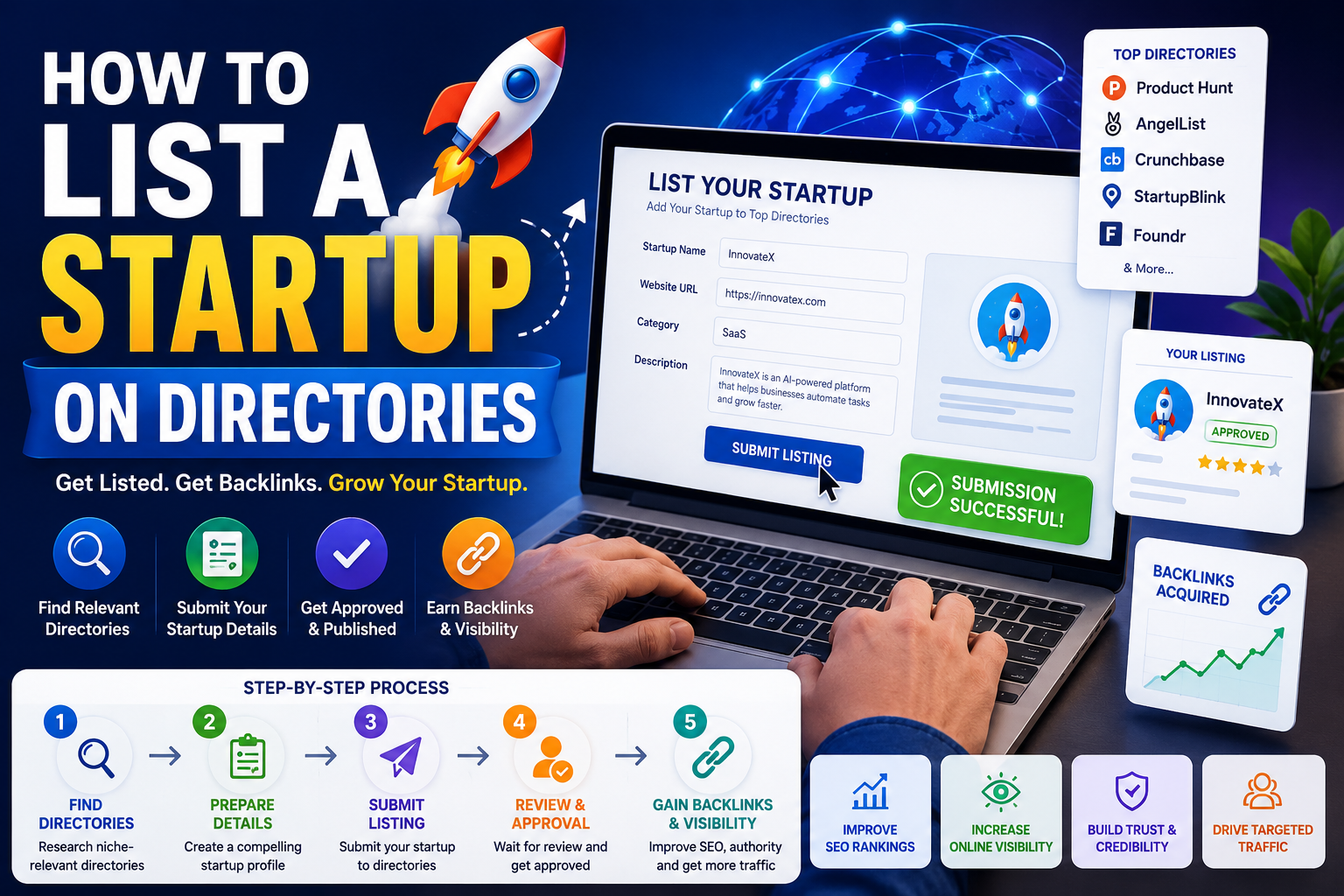
How to List a Startup on Directories: The Complete Founder’s Guide
Most early-stage founders underestimate how much startup directory listing can move the needle on SEO — and how quickly it compounds. You’ve shipped the product. The landing page looks sharp. However, when you check organic traffic a month after launch, the numbers are nearly flat. No domain authority. No backlinks. No signal telling Google your site deserves to rank.
That’s the gap directories fill. When you list your startup across high-authority platforms — think Product Hunt, G2, BetaList, and Indie Hackers — you earn real backlinks, build domain credibility, and place your product in front of buyers who are actively searching for solutions like yours. Services like StartupSubmit exist specifically to handle this process manually, across 250+ directories, so founders don’t have to spend weeks doing it themselves.
This guide covers exactly how to list a startup on directories: what to prepare, which platforms to prioritize, how to write listings that get approved, and how to measure results that actually matter.
Why Directory Listings Matter for Startup SEO
Before diving into tactics, it helps to understand what’s happening under the hood. A backlink from a high-authority directory passes what SEO professionals call “link equity” to your domain — essentially a trust signal that tells search engines your site is legitimate and worth ranking.
Most new startups launch with a Domain Rating (DR) of zero. That makes ranking for competitive keywords nearly impossible without external signals. Domain Rating is Ahrefs’ proprietary metric that measures the strength of a website’s backlink profile on a 0–100 logarithmic scale. Earning backlinks from directories with strong DR scores — some exceed DR 80 — pulls your own score upward over time.
Additionally, directory listings deliver traffic directly. Platforms like G2 and Capterra attract tens of thousands of monthly visitors who are actively comparing tools. Being listed there puts your product in front of high-intent buyers, not just search crawlers.
The DR Impact Founders Actually See
Based on results across 1,500+ startup submissions, founders who complete a full directory submission campaign typically see an average Domain Rating increase of +25 points within 7–14 days of submission. That’s not a slow, year-long grind — it’s a concentrated authority boost that accelerates everything else you’re doing in SEO.
For early-stage startups in the US, Canada, and UK, this kind of early DR gain can be the difference between appearing on page three of Google and breaking into the top ten for long-tail keywords.
What to Prepare Before You Start Submitting
Submitting to directories without preparation is one of the most common mistakes founders make — and it leads directly to rejections, inconsistent listings, and wasted time. Before you touch a single submission form, get these assets ready.
Your Core Startup Profile
Every directory will ask for some combination of the following. Have clean, finalized versions of each:
- Startup name — Exactly as it appears on your website and branding
- Tagline — One punchy sentence (under 160 characters) describing what you do
- Short description — 100–150 words, written for a non-technical reader
- Long description — 300–500 words with natural keyword usage
- Website URL — Your exact homepage URL with no trailing slashes
- Category — The primary product category (SaaS, AI tool, productivity, etc.)
- Logo — High-resolution PNG, minimum 400×400px, with a transparent background
- Screenshots — 3–5 clean product screenshots showing core functionality
- Founding year and team size — Many directories require this
- Pricing model — Free, freemium, paid, or contact-for-pricing
NAP Consistency Is Non-Negotiable
NAP consistency — Name, Address, Phone — is critical across every listing. Even small variations (e.g., “Inc.” vs. “Incorporated”) can dilute your citation signal and confuse search engines. Lock in your exact business details before submitting anywhere, then use those same details every single time.
How to List a Startup on Directories: Step by Step
The submission process itself is straightforward, but the order and approach you take determines whether you build authority or waste effort on low-quality platforms.
Step 1: Prioritize High-Authority Platforms First
Not all directories are equal. Focus your first wave of submissions on platforms with proven domain authority and genuine user bases. Here are the tiers most SaaS and AI founders should target:
Tier 1 — Must-Have Listings:
- Product Hunt — The gold standard for launch visibility; highly influential in the US startup ecosystem
- G2 — The dominant software review platform globally; extremely high DR
- Capterra — Critical for reaching SMB and enterprise buyers
- BetaList — Excellent for pre-launch and early-stage SaaS products
- Indie Hackers — Strong community with a highly engaged founder and bootstrapper audience
Tier 2 — Strong Secondary Listings:
- AlternativeTo — Significant traffic from users comparing software tools
- SaaSHub — Well-indexed by Google; growing authority in the SaaS vertical
- Futurepedia — Essential for AI tools; rapidly growing user base
- There’s An AI For That — High-traffic destination for AI product discovery
Tier 3 — Volume and Niche Directories:
After Tier 1 and Tier 2, expand to niche and general business directories. Many of these offer solid backlink value even if they drive less direct traffic.
Step 2: Write Descriptions That Pass Editorial Review
Most high-authority directories use manual editorial review. Therefore, your description needs to read like editorial content — not marketing copy. Avoid superlatives (“best-in-class,” “revolutionary”), unverifiable claims, and obvious sales language.
Instead, describe what your product does, who it’s for, and what problem it solves. Founders who go through this process find that plain, specific language consistently outperforms promotional writing when it comes to approval rates.
Good example: “[Product] is a project management tool for remote engineering teams that automates sprint planning and surfaces blockers before they delay delivery.”
Weak example: “[Product] is the ultimate project management solution that will transform how your team works forever.”
Step 3: Submit Systematically and Track Everything
Use a simple spreadsheet to log every submission: the directory name, submission date, status (pending / approved / rejected), and the live listing URL once approved. This gives you a running audit of your backlink profile and makes it easy to follow up on pending submissions.
For high-value platforms like Product Hunt, plan your submission date strategically. Launching on a Tuesday, Wednesday, or Thursday typically yields better visibility than a Monday or Friday submission — US audiences are most active mid-week.
The Comparison: Manual Submission vs. Automated Tools
One of the most important decisions founders face is whether to submit manually, use automated tools, or hire a service. Here’s how the options stack up:
| Method | Speed | Quality | Approval Rate | Risk |
| Manual (DIY) | Slow | High | High | Low |
| Automated software | Fast | Low | Low | High (penalties) |
| Managed service | Fast | High | High | Low |
Automated submission software tends to produce generic, templated listings that get flagged or rejected by editorial directories. More importantly, low-quality bulk submissions can attract Google spam penalties that damage rather than build your domain authority.
For most SaaS and AI startups, the practical path is a combination: handle Tier 1 submissions yourself (since they require custom positioning) and use a managed submission service for the remaining 200+ directories. StartupSubmit’s approach — 100% manual submissions across 250+ directories, with results in 7–14 days starting at $99 — is representative of what a quality managed service looks like in this space.
How to Maximize Your Listing Quality
Getting listed is step one. Getting value from the listing requires a little more intention. Here’s what most SaaS teams discover when they audit their directory presence six months after submission:
Listings with complete profiles — filled screenshots, populated category tags, accurate pricing, and regular review responses — consistently outrank incomplete profiles within the same directory. Additionally, directories that allow you to collect reviews (G2, Capterra, Trustpilot) become more valuable over time as social proof accumulates.
A few high-impact upgrades to make after submission:
- Respond to every review, positive or negative, within 48 hours
- Update your listing whenever you ship major features or change pricing
- Request reviews from early customers immediately after onboarding — recency matters
- Add social proof numbers (active users, customers, integrations) as they grow
If you want to understand how directory backlinks actually influence domain authority over time, the mechanics are worth learning before you begin — it helps you prioritize the right platforms.
Measuring the Results of Your Directory Submission Campaign
Don’t submit and forget — directory campaigns are trackable, and the data tells you what to do next.
Primary metrics to monitor over the 30–90 days after submission:
- Domain Rating (DR) via Ahrefs — should increase as listings go live
- Referring domains — track the number of unique domains linking to your site
- Organic keyword rankings — monitor target keywords weekly using a rank tracker
- Referral traffic — check Google Analytics for traffic arriving from specific directories
- Branded search volume — directories can drive branded search growth, especially post-Product Hunt launches
Backlink growth and domain authority are foundational SEO signals that compound over time. A DR increase of +25 in the first month is a strong foundation — but the directories that indexed your site also continue passing value for months and years.
For Australian and New Zealand startups, keep in mind that local-language directories (e.g., StartupAUS listings, regional tech directories) can supplement global platform listings with local relevance signals — useful if your go-to-market targets those regions specifically.
Frequently Asked Questions
Q: How long does it take to see results after listing a startup on directories?
Most founders see measurable Domain Rating gains within 7–14 days of submission, as high-authority directories index quickly. Organic ranking improvements typically follow within 30–60 days, depending on keyword competition and the overall quality of your backlink profile.
Q: How many directories should I submit my startup to?
For meaningful SEO impact, aim for a minimum of 50–100 quality directories. Submissions to 250+ directories — with an emphasis on high-DR platforms — typically produce the strongest results. Quality always outweighs quantity, so prioritize editorial directories over auto-approve sites.
Q: What is the most important startup directory to list on first?
Product Hunt is typically the highest-impact first listing for SaaS and AI startups in the US, Canada, UK, Australia, and New Zealand. It drives direct traffic, builds brand recognition, and carries strong domain authority. Plan your Product Hunt launch carefully — timing and community engagement matter.
Q: Why do directory submissions get rejected?
The most common causes of rejection include: promotional or keyword-stuffed descriptions, inconsistent business information (NAP mismatch), incomplete profiles, broken website URLs at the time of submission, and submitting to the wrong category. Reviewing common rejection reasons before submitting saves significant time.
Q: How do I know if my directory submission campaign is working?
Track four metrics: Domain Rating growth in Ahrefs, referring domain count, referral traffic in Google Analytics, and organic keyword ranking movement. A well-executed campaign across 250+ directories typically produces measurable DR improvement within two weeks and sustained organic ranking gains over the following two to three months.
Where to Go From Here
Listing your startup on directories is one of the highest-leverage early SEO investments you can make — and it’s one of the few growth channels where a one-time effort delivers compounding returns for years. The key is executing it correctly: prepare your profile assets, prioritize high-authority platforms, write editorial-quality descriptions, and track results systematically.
If you want to compress the timeline and skip the manual grind of researching and submitting to 250+ directories individually, StartupSubmit handles the entire process for founders — 100% manually, with no bots, across the directories that actually move the needle. Plans start at $99.
The directory landscape rewards early movers. The sooner your startup is listed, the sooner that domain authority starts compounding.