
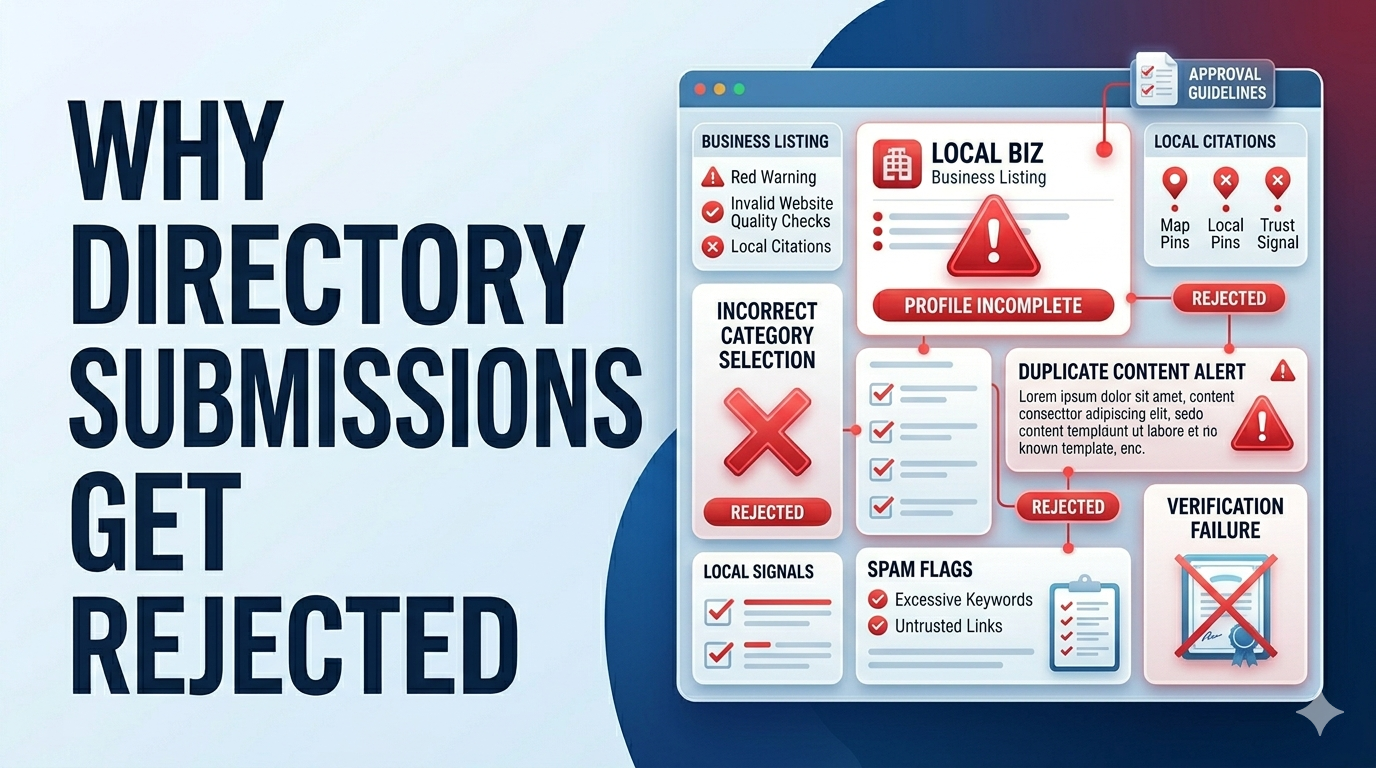
Why Directory Submissions Get Rejected: 2026 Root-Cause Breakdown
Author James Written by an SEO specialist with 10+ years of experience in off-page SEO and citation building. Findings reflect editorial standards and spam-detection patterns observed across high-authority directories in 2026.
Why was my directory submission rejected?
Directory submissions get rejected most often due to duplicate or copy-pasted descriptions, incorrect business categorization, incomplete or inconsistent business information (especially NAP data), submitting too many listings too fast, low website quality, and targeting directories with weak or no editorial Quality Guidelines.
A rejected Business Listing isn’t random bad luck — it’s almost always a diagnosable problem. Directory Rejection has specific, repeatable root causes that editorial reviewers and automated Spam Detection systems are actively trained to catch. This guide works backward from real rejection patterns observed across directories in 2026 to help you identify exactly why your submissions aren’t getting approved — and which root cause applies to your situation.
1. The Six Categories of Directory Rejection
Every Directory Submission Error falls into one of six diagnosable categories. Identifying which category applies to your rejected listings is the fastest path to fixing the underlying problem.
| Category | Root Cause | Most Common In |
| Content Integrity | Duplicate Content, copy-pasted descriptions | High-volume submission campaigns |
| Data Accuracy | NAP Consistency errors, Incorrect Business Information | Multi-location businesses |
| Classification | Category Selection Errors, Business Categorization mismatch | Niche/specialized businesses |
| Velocity & Pattern | Spam Detection triggers from submission speed | Automated/bulk submission tools |
| Asset Quality | Low-Quality Website, broken pages, missing assets | New or under-construction sites |
| Verification Failure | Business Verification Issues, unreachable contact info | Businesses with outdated contact data |
2. Root Cause #1: Duplicate Content Across Listings
The single most frequently cited rejection trigger across 2026 directory guides is Duplicate Content — submitting the exact same description, title, or copy across multiple platforms.
Why This Triggers Rejection
Don’t copy-paste the same text everywhere — duplicate descriptions trigger spam filters built directly into modern directory submission systems. This isn’t a minor stylistic preference; it’s an active detection mechanism.
The problem extends beyond traditional spam filters. AI-driven review systems now cross-reference submitted content and down-weight or flag listings using duplicate phrasing — meaning the same copy-paste habit that worked in 2015 actively works against you in 2026.
How to Diagnose This in Your Own Submissions
Ask yourself: did you write a unique 40-60 word description for each individual directory, or did you reuse the same paragraph across five, ten, or fifty listings? If the latter, Duplicate Content is very likely your rejection cause.
The Fix: Vary the opening sentence, the feature emphasis, and the audience framing for every single submission — even when describing the same business or product.
3. Root Cause #2: NAP Consistency Failures
NAP Consistency — keeping your Name, Address, and Phone number identical everywhere — is one of the most critical factors for Local SEO, and inconsistencies are a direct rejection trigger on Local Citations platforms.
Why This Happens
Businesses often submit slightly different address formats across different listings (“St.” vs. “Street,” a missing suite number, an old phone number that was never updated). Such inconsistencies confuse both directory moderators and search engines, and can directly damage your local SEO campaign.
Diagnostic Questions
- Does your business name appear identically (including punctuation) on your website footer, Google Business Profile, and the directory that rejected you?
- Is the phone number you submitted currently active and monitored?
- Does your address format match exactly, including abbreviations like “Ave.” vs. “Avenue”?
The Fix: Build one master document with your exact, locked NAP format and copy from it every single time — never retype it from memory.
4. Root Cause #3: Category Selection Errors
Category Selection Errors are a frequent, entirely avoidable rejection cause that Business Categorization systems are specifically designed to catch.
Why Reviewers Reject Miscategorized Listings
Misclassification can minimize the success of your submission and might lead to outright rejection. Forcing a listing into the wrong category — even an adjacent or “close enough” one — burns your submission and gets flagged by moderators, since it confuses both the directory’s internal structure and the contextual value search engines assign to the resulting backlink.
How to Avoid This Root Cause
If you’re unsure which category fits, research how similar, already-listed businesses in your exact niche are categorized within that specific directory’s structure before submitting — different directories often use different category taxonomies for the same type of business.
5. Root Cause #4: Submission Velocity and Spam Detection Patterns
A frequently overlooked rejection cause has nothing to do with content quality at all — it’s about timing.
The Velocity Problem
Submitting to hundreds of directories within a short period triggers spam flags. Sudden spikes in submission activity look unnatural to both directory moderators and search engines monitoring for Spam Detection patterns, even when every individual listing is otherwise high quality.
What a Healthy Submission Pace Looks Like
A practical, low-risk pacing strategy is submitting to just 3-5 directories per day over several weeks, rather than blasting fifty submissions in a single day. Slow, steady submission patterns look natural and give you time to track which listings get approved, which get rejected, and why.
Diagnostic Check
If you submitted to a large batch of directories all on the same day or within the same week, velocity-triggered Spam Detection is a realistic explanation for a wave of rejections — even if your content quality was solid.
6. Root Cause #5: Low Website Quality and Trust Signals
Directories don’t just evaluate your submission form — many also evaluate the destination website itself before approving a listing.
What “Low-Quality Website” Means to a Reviewer
Directories prefer websites that are professionally designed, easy to navigate, and offer genuinely meaningful content. Submitting an incomplete, broken, under-construction, or content-thin site significantly reduces your approval chances, regardless of how well-written your directory description is.
Trust Signals Reviewers Check
- Does the site load without errors?
- Is there an “About,” “Contact,” or legitimate business presence visible on the homepage?
- Are there broken links or placeholder/lorem-ipsum content still visible?
- Does the site match the business description provided in the submission?
The Fix: Audit and fix your own website’s basic functionality and Trust Signals before launching any directory submission campaign — submitting a weak site to dozens of directories simultaneously wastes effort across the board.
7. Root Cause #6: Business Verification Failures
For directories requiring Business Verification — particularly Google Business Profile, Yelp, and Bing Places for Business — failure at the verification stage is a distinct and common rejection category separate from content quality issues.
Common Verification Failure Points
| Verification Method | Common Failure Reason |
| Postcard/mail verification | Address doesn’t match physical mail-receiving location |
| Phone verification | Number disconnected, unmonitored, or routes to voicemail only |
| Email verification | Verification email missed, expired, or sent to spam folder |
| Document verification | Business registration documents don’t match submitted name exactly |
Diagnostic Check
If your listing was provisionally accepted but never went fully live, Business Verification Issues — not content quality — are almost certainly the cause. Check spam folders, confirm your phone is monitored, and verify mailing addresses can actually receive mail before resubmitting.
8. Secondary Rejection Cause: Ignoring Directory-Specific Guidelines
Beyond the six major root causes above, a large share of rejections trace back to a single avoidable habit: skipping each directory’s specific Directory Submission Guidelines.
Why This Causes Rejection
Every directory contains its own rules — character limits on titles, restrictions on promotional language, required versus optional fields — and violating them, even unintentionally, leads to Rejected Business Listings. Treating all directories as if they share identical requirements is a common but entirely preventable mistake.
Quick Diagnostic
Before resubmitting anywhere you were rejected, re-read that specific directory’s submission guidelines page in full. Most rejection notices, when sent, reference the exact guideline that was violated.
9. Distinguishing Spammy Submissions From Legitimate Ones
Directories and the search engines that index them increasingly distinguish between Spammy Submissions and legitimate Quality Backlinks using a combination of signals.
Patterns That Read as Spammy
- Identical or near-identical descriptions across many directories (Duplicate Listings)
- Excessive, repeated exact-match keyword phrases in titles or anchor text
- Submitting to directories with no editorial review at all, purely for link volume
- Reciprocal-link directories requiring you to link back in exchange for listing
Patterns That Read as Legitimate
- Unique, audience-specific descriptions per directory
- Natural anchor text variation (brand name, partial match, generic phrases)
- Submission paced over weeks rather than compressed into days
- Selecting directories with genuine Manual Review and visible Quality Guidelines
10. Does Directory Compliance Affect More Than Just Approval?
Directory Compliance — following each platform’s specific rules precisely — affects more than whether a single listing goes live. It also impacts your broader Website Authority and Off-Page SEO profile over time.
The Compounding Effect
Having too many low-quality, rejected, or spam-flagged submission attempts associated with your domain can create a pattern that search engines interpret as evidence of link manipulation — even if many individual listings were never actually approved. Conversely, a smaller number of correctly-completed, fully-compliant submissions builds genuine Trust Signals that compound positively.
The Recommended Scale
Most businesses benefit from a focused set of 30-50 high-quality directory listings rather than mass-submission attempts across hundreds of platforms — a smaller, fully-compliant set consistently outperforms a large, rejection-heavy one.
11. Self-Diagnostic Checklist: Find Your Rejection Cause
Work through this checklist against your most recently rejected submission to identify the likely root cause:
- [ ] Was the description identical or near-identical to another directory submission? → Duplicate Content
- [ ] Did your business name, address, or phone number vary even slightly from other listings? → NAP Consistency failure
- [ ] Did you select a category that was “close” but not exact? → Category Selection Error
- [ ] Did you submit to many directories within the same day or week? → Spam Detection / Velocity issue
- [ ] Does your website have broken pages, missing content, or look unfinished? → Low Website Quality
- [ ] Did you miss a verification email, postcard, or phone call? → Business Verification failure
- [ ] Did you skip reading that specific directory’s submission guidelines? → Directory Compliance violation
Frequently Asked Questions (FAQ)
Why was my directory submission rejected? The most common causes are duplicate or copy-pasted descriptions, NAP inconsistencies, incorrect category selection, submitting too many listings too quickly, poor website quality, or missing a required business verification step. Reviewing the specific rejection notice (if provided) usually points to one of these root causes.
How can I get my directory listing approved? Write a unique description for every submission, ensure your NAP details match exactly across all platforms, select the most accurate category available, pace your submissions over weeks rather than days, and confirm your website is fully functional before submitting.
What are the most common directory submission mistakes? The most common mistakes are duplicate content across multiple listings, incorrect or mismatched business categorization, inconsistent NAP information, ignoring a directory’s specific submission guidelines, and submitting to too many directories within a short timeframe.
Do duplicate listings cause rejection? Yes. Submitting the same business to a directory more than once, or using identical descriptions across many different directories, is a frequently cited rejection trigger and can flag your submissions as spammy.
How long does directory approval take? Approval timelines vary by directory type — instant for low-quality auto-approve sites, hours for phone- or email-verified platforms, and days to weeks for directories with genuine editorial Manual Review processes.
What information is required for directory approval? Most directories require your business name, website URL, a unique description, the correct category, and contact information at minimum. Some directories also require business hours, a logo, supporting images, and formal ownership or Business Verification.
Conclusion
Directory Rejection is rarely arbitrary — it’s almost always traceable to one of a small set of repeatable root causes: Duplicate Content, NAP Consistency failures, Category Selection Errors, submission velocity triggering Spam Detection, Low-Quality Website issues, or Business Verification Issues.
Rather than treating every rejection as a mystery, diagnose it against this framework first. A smaller batch of carefully prepared, fully Directory Compliance-checked submissions to directories with real Quality Guidelines like Google Business Profile, Yelp, and Bing Places for Business will consistently outperform a high-volume approach riddled with avoidable rejections.



You should take part in a contest for one of the greatest sites on the web.
I will recommend this web site!
Please let me know if you’re looking for a author for your weblog.
You have some really good posts and I think I would be a good asset.
If you ever want to take some of the load off, I’d absolutely love to write
some content for your blog in exchange for a link back to mine.
Please send me an e-mail if interested. Thank you!