Local Business Listing: Your Guide to SEO and Trust in 2026
46% of all Google searches are local, and 40% of organic traffic for businesses with physical locations comes from local search according to InMoment's local business listings overview. That changes how you should think about a local business listing. It isn't clerical work. It's infrastructure.
I treat listings like a storefront sign, a reception desk, and a trust badge rolled into one. If the sign shows the wrong hours, the phone number is outdated, or the address points people to the old suite, customers don't blame Google. They blame the business. Search engines do something similar. When they find mismatched business details across the web, they hesitate.
That lesson carries beyond restaurants, clinics, and retail. SaaS and AI startups can borrow a lot from local SEO discipline. Consistent profiles, accurate business data, authoritative directories, and duplicate cleanup all strengthen how a company gets discovered and validated online. For founders trying to build a reliable digital footprint, the operational upside is similar to the listing management benefits described on StartupSubmit's benefits page.
Table of Contents
- Your Digital Welcome Mat to Local Customers
- What Is a Local Business Listing
- The Dual Power of Listings SEO and Customer Trust
- Choosing Your Platforms The Big Three and Beyond
- Optimization Best Practices and Common Mistakes
- Manual Submissions vs Automation Why Human Touch Wins
- Your Actionable Startup Listing Checklist
Your Digital Welcome Mat to Local Customers
A local business listing is often the first real interaction a customer has with a company. Not your homepage. Not your sales deck. The listing.
Someone searches for a dentist, a coworking space, a bakery, or a software company with an office nearby. They see a name, a map pin, hours, reviews, photos, and a call button. In that moment, the listing works like a digital welcome mat. It tells people whether the business is open, legitimate, reachable, and worth the next click.
That sounds simple, but simple things break often. I've seen businesses spend heavily on websites and content while leaving basic listings half-finished or inconsistent. The result isn't dramatic in a cinematic way. It's quieter than that. Fewer calls. More hesitation. More people bouncing to the competitor whose profile looks complete and current.
Practical rule: If your listing creates uncertainty, your competitor's listing gets the click.
The strongest local visibility work usually starts with cleanup, not hacks. Keep the business name, address, phone number, website, categories, and description aligned everywhere. Verify the important profiles. Remove duplicates. Update hours when anything changes. Those steps don't feel glamorous, but they move the needle because they reduce friction for both search engines and buyers.
What Is a Local Business Listing
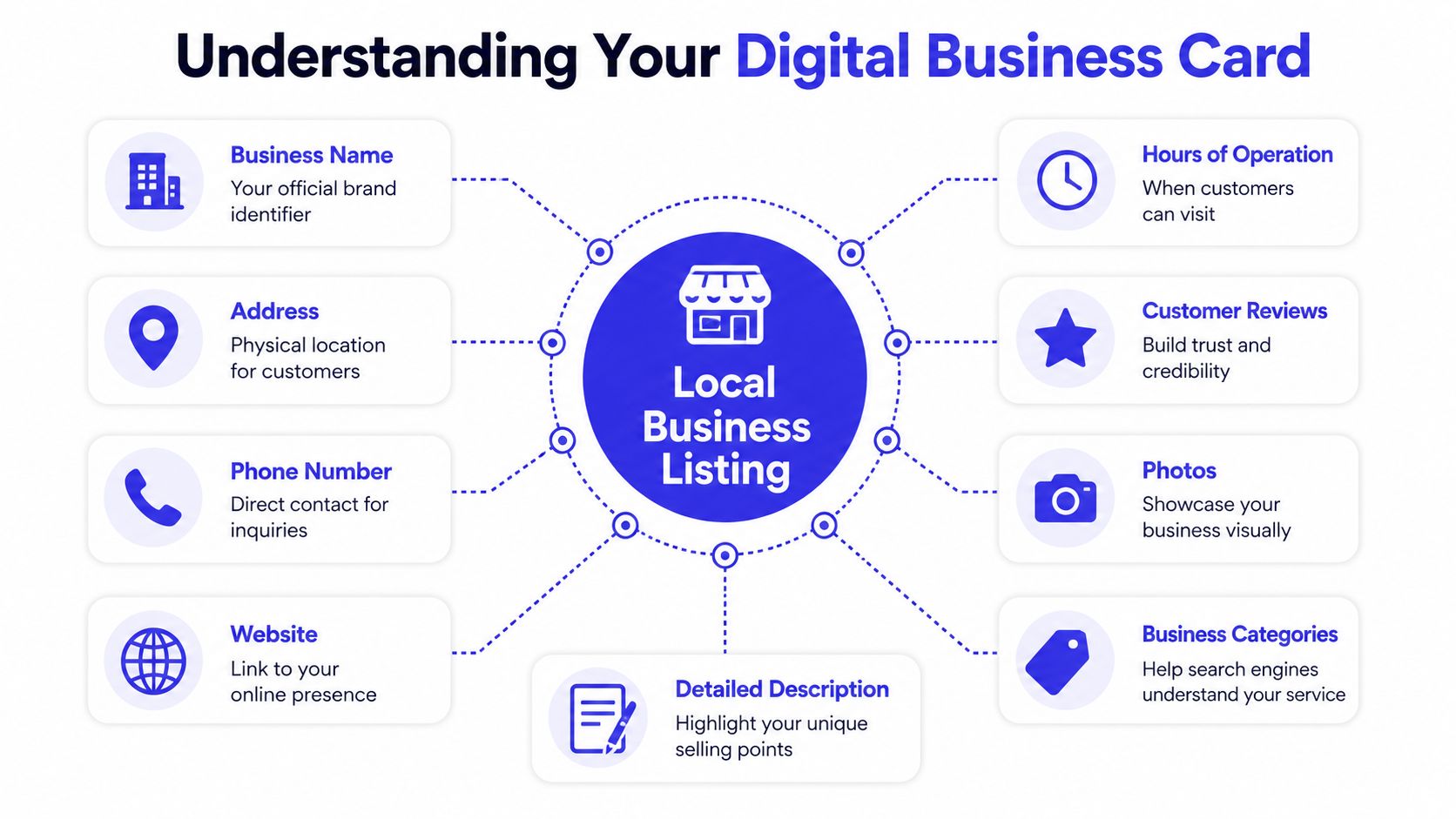
A local business listing is a structured profile that tells search engines, maps, directories, and customers who you are, where you are, what you do, and how to contact you. Think of it as a digital business card that machines can read.
It isn't limited to Google Business Profile. A listing can live on Apple Maps, Bing Places, Yelp, Facebook, industry directories, review platforms, and software marketplaces. The channel changes, but the job stays the same. Each profile helps validate the existence and details of the business.
For SaaS teams that don't think of themselves as "local," the same logic still applies. Search engines and buyers look for consistency across public profiles. That's one reason I pay close attention to the same trust signals highlighted on StartupSubmit's about page, especially when a company is early and still building recognition.
The listing is structured data, not just a profile
Every strong listing includes a core set of fields:
- Business name that matches your canonical brand identity
- Address for physical discovery and verification
- Phone number that routes to the right team
- Website that confirms the official destination
- Business categories that clarify what you offer
- Business description that explains the service clearly
- Hours of operation so customers don't hit a dead end
- Photos and reviews that reinforce legitimacy
These fields do two jobs at once. They help platforms classify the business correctly, and they help people decide whether to engage.
Consistency matters more than cleverness
Most listing problems don't come from missing growth tactics. They come from messy basics.
A company uses one name on Google, a shortened version on Facebook, an old phone number on Yelp, and a different homepage URL on another directory. None of those errors looks catastrophic on its own. Together, they weaken trust.
Complete profiles with accurate information build trust with users and search engines. Incomplete or conflicting profiles create doubt for both.
This is the best practice I've borrowed from local SEO and applied to SaaS profile management too. Use the same company name, website, logo, description, and branding across every listing. If business information changes, update it everywhere, not just on your site.
The Dual Power of Listings SEO and Customer Trust
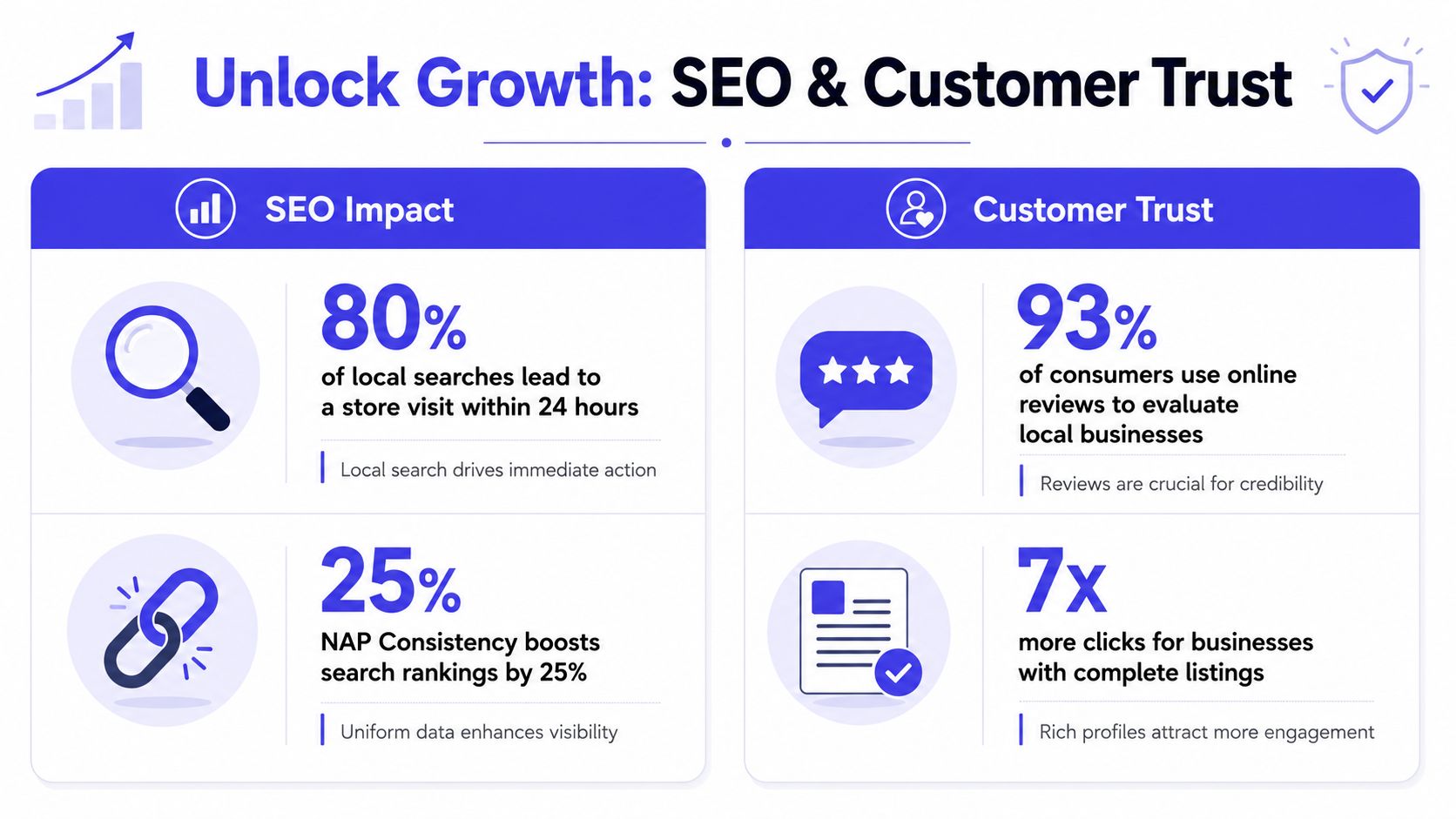
Nearly half of all Google searches have local intent, according to Google local search behavior data summarized by Safari Digital. That is why listings deserve more respect than they usually get. They influence whether you appear in discovery surfaces, and they influence whether a buyer trusts you enough to click, call, or visit.
Why listings influence visibility
Search engines look for confirmation. Your website is your version of the truth. Listings on Google, Apple Maps, Bing, Yelp, Facebook, and relevant directories act like third-party references that support it.
That is why a clean presence on a small set of trusted platforms usually beats submitting to fifty weak directories. Analysts at Whitespark explain that local rankings are shaped by signals such as relevance, prominence, and the consistency of business information across the web in their guide to local search ranking factors. For founders, the practical takeaway is simple. Coverage matters, but accuracy on the platforms that get used matters more.
The revenue impact is not limited to storefronts. SaaS and AI startups miss this point all the time. If you run demos from a city, meet prospects in person, hire locally, attend events, or serve a defined metro area, listings help search engines connect your company to that place. They also help AI systems and map products decide whether your business is real, active, and worth citing. Teams tracking the future of local SEO for AI should pay close attention to citation quality and data consistency for that reason.
I treat listings like identity infrastructure. A homepage tells your story. Listings confirm you exist.
This walkthrough is worth watching if you want a visual explanation of how listings shape local visibility:
Why customers use listings as a trust check
Buyers make fast judgments with limited information. They scan your hours, reviews, photos, category, and whether the profile looks maintained. If any of that feels off, confidence drops before they ever reach your site.
That pattern shows up even more clearly with startups. An early-stage SaaS company may have a polished product page and still look questionable if its Google profile is unclaimed, its address is inconsistent, or support hours are missing. For an AI startup asking prospects to trust a new product, those gaps create unnecessary friction. A complete listing works like a receptionist who answers on the first ring. An incomplete one feels like a locked office door.
| Listing condition | Likely customer reaction |
|---|---|
| Complete, accurate, current | "This looks legitimate and easy to contact." |
| Incomplete but mostly correct | "Maybe they're real, but I'm not fully sure." |
| Outdated or conflicting | "I don't want to waste my time." |
A strong listing lowers the effort required to believe you are real, reachable, and organized.
This is also where execution matters more than theory. Founders usually know they should claim profiles, fix duplicates, and update hours. The bottleneck is time. Services like StartupSubmit are useful because they close that gap between knowing the checklist and getting the work done correctly, without turning listing management into a recurring drain on the team.
Holiday hours, duplicate cleanup, and verification are not cosmetic tasks. They are operating signals that both search systems and customers use to judge reliability.
Choosing Your Platforms The Big Three and Beyond
A strong local listing strategy is mostly a prioritization problem. Founders lose time when they treat every directory like it deserves the same effort.
I group platforms into three buckets: core discovery, broad trust, and niche relevance. That framework matters even more for SaaS and AI startups, where the local signal is not always about foot traffic. It is often about proving the company is real, reachable, and consistently described across the web.
Start with the platforms people already use
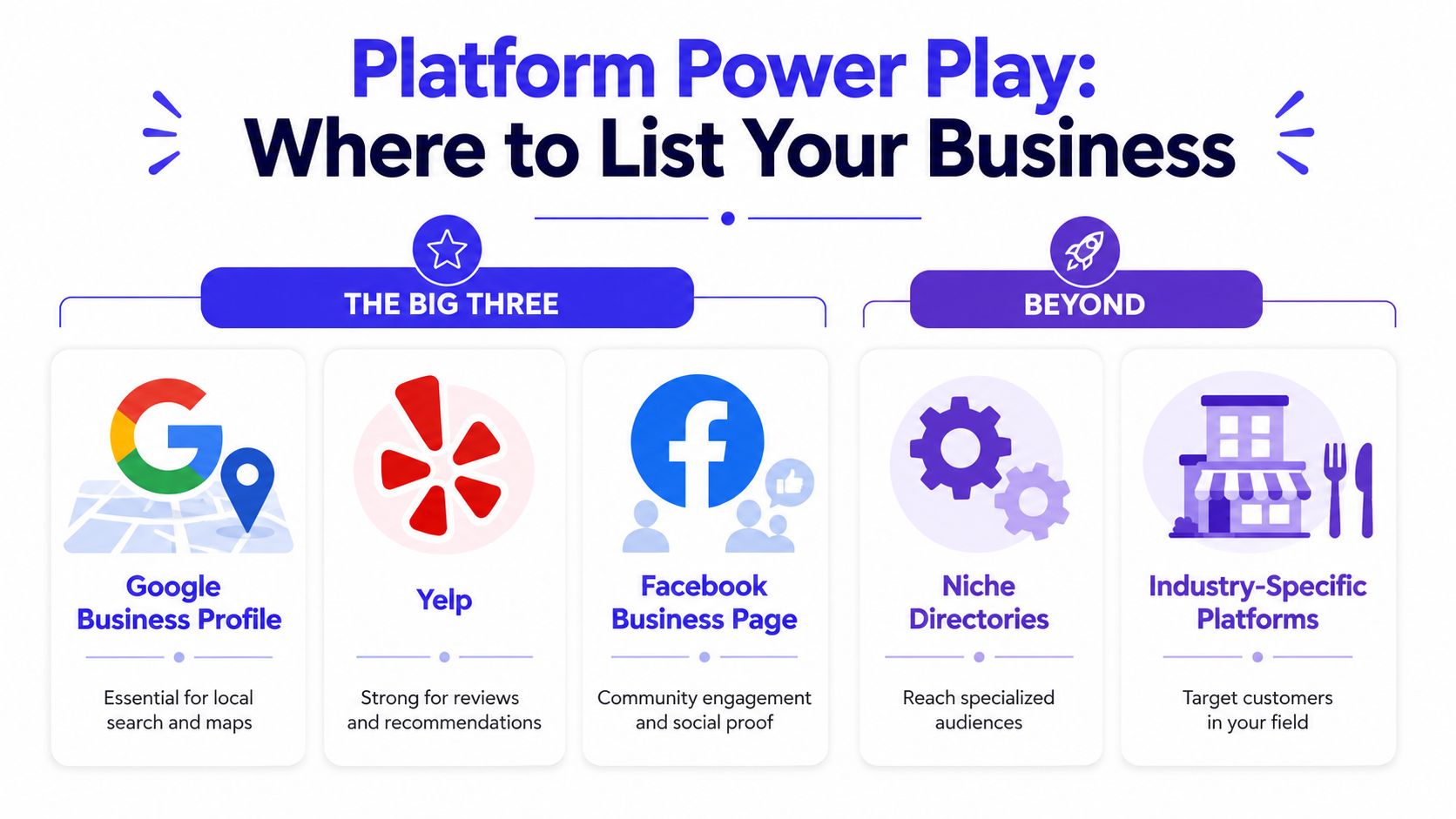
The first layer is simple: Google Business Profile, Bing Places, and Apple Maps. Those platforms influence map visibility, branded searches, and the default tools people use on phones, laptops, and in-car navigation. In many categories, Facebook and Yelp also matter because they rank for business names and give prospects another place to confirm you exist.
| Tier | Platforms | Why they matter |
|---|---|---|
| Core discovery | Google Business Profile, Bing Places, Apple Maps | They shape maps visibility, branded discovery, and default search behavior |
| Broad trust | Facebook, Yelp | They reinforce legitimacy and often rank for branded searches |
| Category-specific | Industry and niche directories | They support relevance and capture higher-intent searches |
The common mistake is volume-first submission. A half-finished Google profile plus 40 weak directory listings is a poor trade.
Then add the directories that match buyer intent
After the core layer is in place, add platforms with real topical relevance.
For a law firm, that may be legal directories. For a restaurant, review and reservation platforms. For SaaS and AI startups, the parallel is software marketplaces, startup communities, product directories, and industry databases where buyers already compare vendors. These listings help with discovery, but they also strengthen entity recognition. Search engines keep seeing the same company tied to the same website, category, and contact details.
That is why local listing work now overlaps with brand and entity SEO. A B2B software company may never rely on walk-in traffic, yet it still benefits from being clearly mapped across trusted platforms. AI search products also need corroborating sources before they confidently summarize or recommend a business. Broad directories help. Relevant niche directories often help more.
A practical selection rule works well here:
- Claim the obvious platforms first. Google, Bing, and Apple should never sit unmanaged.
- Add the sites your buyers already check. If prospects mention G2, Capterra, Product Hunt, Crunchbase, or a regional directory in calls or emails, move it up the list.
- Choose relevance over raw count. Ten credible listings usually do more than fifty low-quality ones.
- Match the category carefully. Wrong taxonomy can weaken relevance even if the rest of the profile is accurate.
Execution is the bottleneck for early-stage teams. Founders usually know which platforms matter. They do not have spare hours to verify profiles, clean duplicates, and format every field correctly. That is the gap services like StartupSubmit help close. They turn a good plan into completed listings without forcing the founding team to spend a week on directory work.
Track the platforms that produce branded search lift, referral visits, and assisted conversions. A simple measurement process matters more than adding another marginal directory. If you need a practical framework, start with mastering SEO tracking.
Optimization Best Practices and Common Mistakes
Most listing gains come from disciplined maintenance. Not from tricks. Not from stuffing keywords into every field. Not from setting up a profile once and forgetting it.
What to do consistently
The best local listing work is repetitive in the right way.
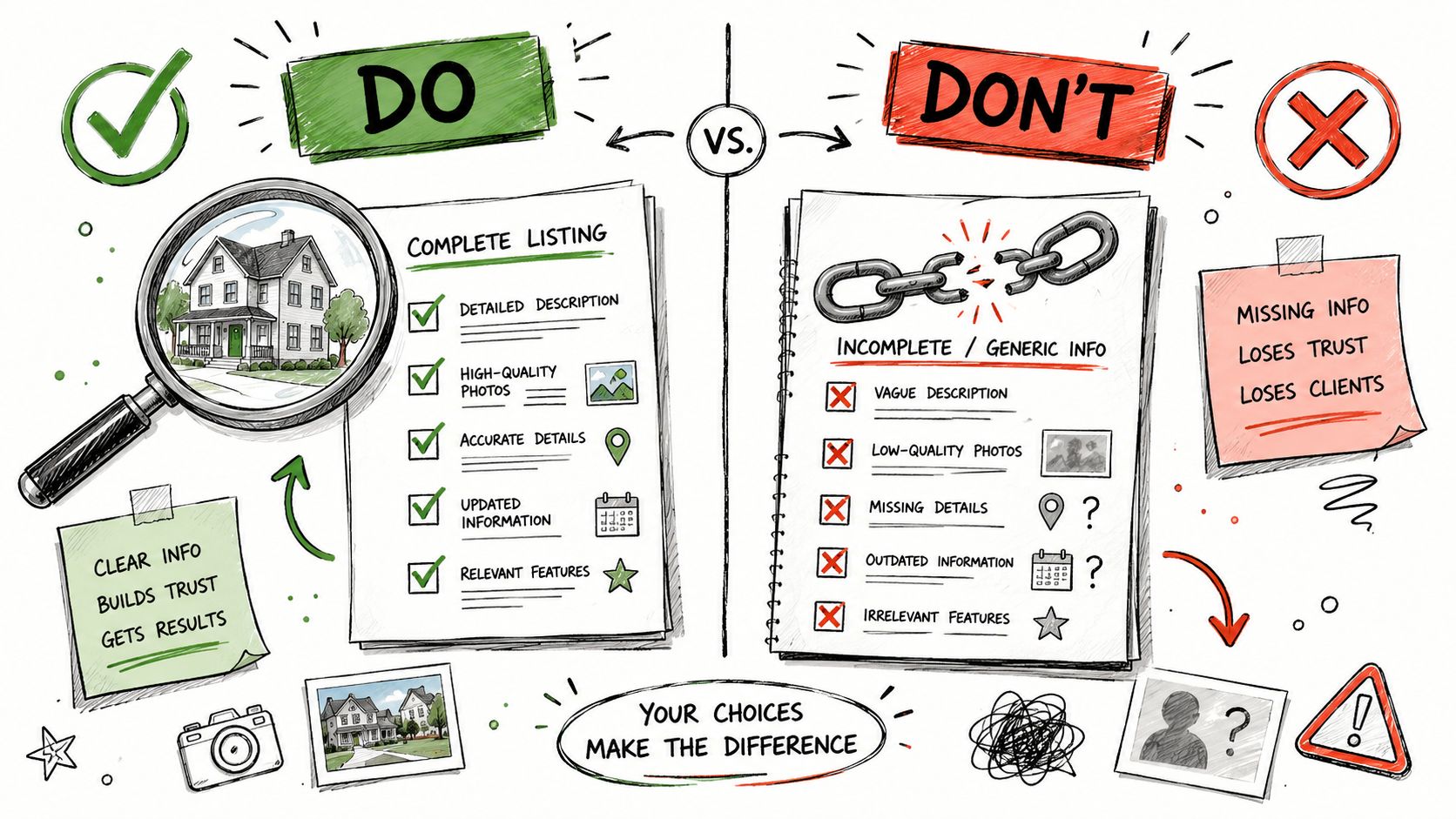
- Claim and verify every priority profile. An unverified listing limits control and leaves room for errors to persist.
- Use one canonical version of your business data. Keep the name, address, phone number, website, categories, and business description consistent everywhere.
- Choose the most specific category available. Broad labels often reduce relevance.
- Fill every meaningful field. Sparse profiles look neglected and leave questions unanswered.
- Audit duplicates regularly. Duplicate listings split trust and create conflicting information.
- Update changes immediately. Hours, addresses, service areas, and URLs drift more often than teams realize.
I also recommend building a simple tracking process. Even a lightweight measurement habit can prevent a lot of waste. If you need a framework for that side of the work, this guide to mastering SEO tracking is a practical companion.
What causes avoidable damage
The problems below are common because they seem harmless in isolation.
Don't optimize listings like ad copy. Optimize them like records that need to be accurate.
Inconsistent business identity
This is the biggest issue. A business name with extra keywords on one profile, an outdated suite number on another, and a different phone number on a third profile creates confusion fast.Duplicate listings left unresolved
Teams often discover duplicates only after rankings dip or customers report wrong details. By then, the cleanup is slower because multiple platforms may have already syndicated the bad data.Keyword stuffing the business name
Adding cities, service terms, or promotional phrases to the official name might look like a shortcut. It usually makes the profile look untrustworthy and harder to standardize elsewhere.Ignoring profile freshness
A listing with stale hours, old images, and outdated descriptions signals neglect. Even when rankings hold, conversions suffer because customers notice the mismatch.
A clean way to manage this is to keep a single source-of-truth document for all public business information. That sounds basic because it is. Basic systems outperform improvised updates every time.
Manual Submissions vs Automation Why Human Touch Wins
There are two ways to expand listing coverage. You can automate aggressively, or you can submit manually with curation. For serious brands, I prefer the second route.
Automation saves clicks but creates risk
Bulk tools are appealing because they compress repetitive work. The problem is that they often optimize for quantity, not judgment. They can push your business data into weak directories, mismatched categories, or low-value networks that add little trust and create more cleanup later.
That matters because the work involved isn't trivial. According to Planetary Labour's analysis of startup directory submissions, manually submitting to 100+ startup directories requires approximately 60 hours of focused labor, and websites that acquire directory backlinks experience a 15% increase in crawl rates from search engines. Founders feel the first number immediately. SEO teams appreciate the second.
If you're evaluating the indexing side of this work in detail, a technical reference like this crawl website api overview can help you think about how sites get discovered and revisited.
Manual work scales better than it sounds
Manual submission wins because humans can make platform-level decisions.
They can check whether a directory is reputable, whether the category is accurate, whether a duplicate already exists, whether the description needs tailoring, and whether the final live page reflects the right business information. That's hard to replicate with a one-click workflow.
I've seen the biggest benefit come from consistency, not immediate spikes. Manual submissions improve local visibility, profile completeness, and referral traffic over time because they create a cleaner, more trustworthy web footprint.
For time-strapped founders, outsourcing the repetitive part can make sense. One option is StartupSubmit's pricing page, which outlines a manual directory submission service for SaaS and AI startups. The model is straightforward: offload the account creation, duplicate checks, categorization, and placement work without relying on bots.
The trade-off is simple. Automation saves labor up front. Manual curation usually produces better long-term data quality.
Your Actionable Startup Listing Checklist
A listing program works best when one person owns it and treats it like operating infrastructure, not a side task. For SaaS and AI startups, that matters more than founders often expect. Prospects still check maps, review sites, and company profiles before they book a demo, evaluate credibility, or decide whether your business looks real enough to trust.
Use this checklist to keep the work focused.
- Set a single source of truth. Finalize the exact business name, address, phone number, website URL, primary category, secondary categories, and short description before you submit anything.
- Claim the highest-impact profiles first. Start with Google Business Profile, Bing Places, Apple Maps, and the review or directory sites your buyers already recognize.
- Finish the fields that affect trust. Add hours, photos, service details, business description, and links. Half-complete profiles often undercut the credibility you were trying to build.
- Check for duplicates before creating new entries. A wrong or outdated profile can split reviews, confuse crawlers, and send leads to the wrong contact details.
- Choose niche directories with intent. SaaS and AI companies do not need to appear everywhere. Focus on platforms that support your category, your geography, or your audience's buying process.
- Set a maintenance schedule. Recheck listings after rebrands, domain changes, phone number updates, office moves, or new review activity.
- Treat AI visibility as an output of clean data. As noted earlier, no founder knows exactly which directories every AI system trusts. The practical move is still the same: keep business data consistent across credible platforms so your company record is easier to verify.
The simple test is this. If someone finds your startup on a directory you forgot about, will they see the same company details they would find on your site, your map listing, and your review profiles?
That consistency does more than support local SEO. It reduces friction in due diligence, improves brand trust, and gives search engines and AI systems fewer reasons to doubt your business data.
If you do not want to spend founder hours on directory research, account setup, duplicate checks, and manual submissions, StartupSubmit is one practical option for SaaS and AI teams that want that work handled through a manual, directory-by-directory process.