
AI Startup Directory Submission: How to Get Listed, Build Backlinks, and Grow Fast
AI Startup Directory Submission: How to Get Listed, Build Backlinks, and Grow Fast
The AI space is crowded. Thousands of AI tools launch every month — and most disappear within weeks because nobody finds them. Building a genuinely useful AI product is no longer enough. Discoverability determines survival. Without it, the best AI tools go unnoticed while less capable ones rank higher simply because their founders understood visibility.
AI startup founders face a unique marketing challenge. They’re competing in the fastest-moving product category online. New tools launch daily. Attention spans are short. And the platforms where buyers discover AI products are expanding fast — from Google to ChatGPT to AI-specific directories that didn’t exist two years ago. AI startup directory submission addresses this challenge directly. A systematic listing campaign builds backlinks, grows Domain Rating, and creates the digital footprint that makes your AI product discoverable across multiple surfaces simultaneously. Founders who want this handled professionally from day one use StartupSubmit, which manages AI startup submissions across 250+ directories manually. Either way, here’s the full strategy.
Why AI Startups Need a Directory Submission Strategy
AI startups face stiffer discovery competition than almost any other product category. Hundreds of new AI tools get listed on directories like Product Hunt every week. Without a proactive submission strategy, your product competes against a flood of others for the same limited discovery windows.
How AI Directory Submission Builds Backlinks and Domain Rating
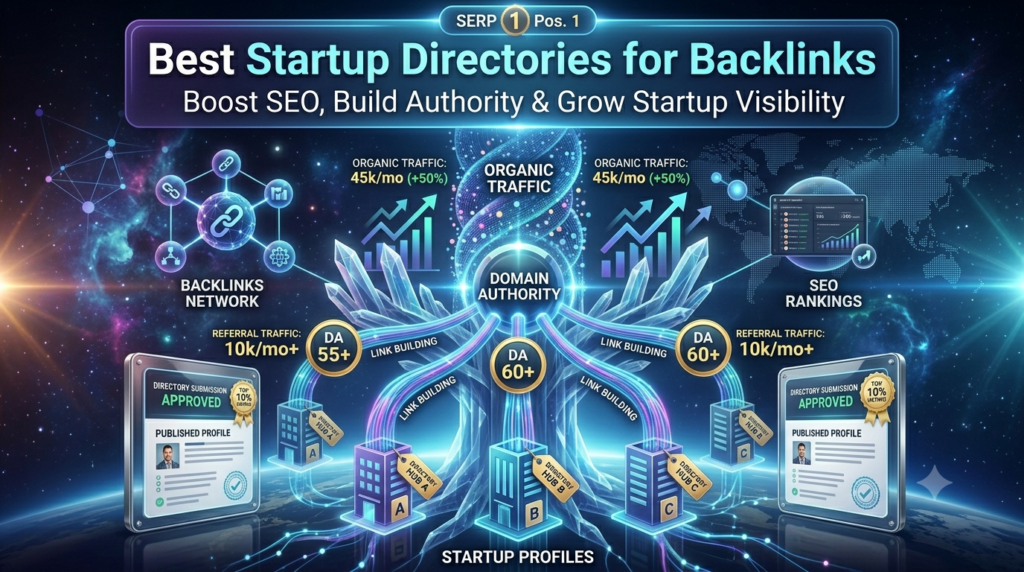
Every directory that lists your AI startup creates a backlink. That backlink signals credibility to Google. Enough credibility signals — from enough authoritative sources — raises your Domain Rating. Higher Domain Rating means your pages rank for relevant searches. That’s the mechanism that turns directory submissions into organic traffic months after the initial listings go live.
Understanding how backlinks build domain authority for new domains clarifies why this matters so urgently for AI startups. New AI tool domains typically start at DR zero. Without deliberate link building, they stay low — which means content marketing underperforms regardless of how well-written the posts are.
Based on results across 1,500+ startup submissions, a full directory campaign produces an average DR increase of +25. That jump typically appears within 7–14 days. For an AI startup launching into a competitive category, that head start significantly changes what’s achievable in organic search within the first 90 days.
Why AI Startup Visibility Is Different From Other SaaS Categories
AI products get discovered on more surfaces than traditional SaaS. Users find AI tools through Google, through AI-specific directories like There’s An AI For That and Futurepedia, through Product Hunt’s dedicated AI category, and increasingly through AI tools like ChatGPT — which surfaces recommendations based on what’s well-documented and widely referenced online.
For a deeper look at how the AI tools market is growing faster than any software category, the competitive context reinforces why early visibility investment is especially high-stakes for AI founders. Early movers who build strong backlink profiles and directory presence establish authority that later entrants struggle to overcome.
Understanding how to market a SaaS startup with proven strategies provides the broader marketing context that sits around your AI directory submission campaign.
Best Platforms for AI Startup Directory Submission
These platforms represent the highest-priority targets for any AI startup directory submission campaign. Some are AI-specific. Others serve the broader startup ecosystem but carry exceptional domain authority and audience quality for AI products.
Product Hunt — Top AI Startup Listing Platform
Product Hunt’s AI category is one of the most-visited sections on the platform. AI tools consistently rank among the highest-upvoted products each week. A well-executed Product Hunt listing earns a DR 90+ backlink, drives thousands of launch-day visitors, and creates the social proof that press and investors look for.
Submit at 12:01 AM Pacific Time on a Tuesday, Wednesday, or Thursday. Prepare your support network at least two weeks in advance. Write a tagline that describes exactly what your AI does — not just the category it belongs to. For a complete breakdown of all the platforms worth targeting, the guide to best directories for SaaS startups to build backlinks covers every platform with DR data and audience detail.
There’s An AI For That — Best AI-Specific Directory
There’s An AI For That (TAAFT) is one of the most-trafficked AI tool directories online. It catalogues thousands of AI products by use case — making it a high-intent discovery platform for users actively searching for a specific AI capability. Getting listed here puts your product in front of buyers who already know what problem they want to solve.
Submit your AI startup with an accurate use-case description. The platform indexes listings by category, so selecting the right tags determines how often your product appears in relevant searches. The domain authority is strong and the backlink value is meaningful.
Futurepedia — Best AI Tool Directory for Discoverability
Futurepedia is one of the largest AI tool directories by traffic volume. Like TAAFT, it organizes AI products by function — image generation, writing, coding, productivity, and dozens of other categories. Appearing in the right Futurepedia category drives consistent referral traffic from users who visit the platform regularly to discover new tools.
Both Futurepedia and TAAFT are free to list on. Together they represent the two most important AI-specific directories for early-stage AI startup marketing.
G2 and Capterra — Best AI Startup Listing for Buyer Traffic
G2 and Capterra attract buyers who are actively comparing software options — including AI tools. As AI products move into enterprise and mid-market purchasing cycles, review platforms are becoming essential for AI startups targeting B2B buyers. A G2 profile with even five authentic reviews can influence enterprise purchase decisions significantly.
Both platforms carry DR above 85. Both are free to list on. Claiming your profiles during launch week earns strong backlinks immediately — and the profiles grow in value as reviews accumulate over time.
BetaList and Indie Hackers — Best AI Directory for Early Adopters
BetaList and Indie Hackers both attract users who actively seek new products before they reach mainstream adoption. For AI startups building a waitlist or gathering early feedback, both platforms deliver motivated early adopters who are predisposed to try something new.
BetaList focuses on pre-launch and recently launched products. Indie Hackers rewards founders who share honest build stories and revenue updates. Submit to both in launch week. Engage actively on Indie Hackers afterward — the community amplifies products whose founders are present and transparent.
AlternativeTo — Best AI Startup Submission for Comparison Traffic
AlternativeTo captures users who have already decided to switch from a competitor. For AI tools competing with established players — OpenAI products, Jasper, Midjourney, and others — appearing in “alternatives to [competitor]” search results delivers high-intent traffic with zero ad spend.
List your AI product and specify which tools it competes with or replaces. The platform is free. Comparison traffic consistently converts at higher rates than general referral traffic because the visitor arrives knowing exactly what they want.
Hacker News — Best AI Startup Listing for Technical Founders
Hacker News has a deep, active interest in AI products — particularly those built by technical founders solving real problems. A Show HN post that gains traction can drive hundreds of targeted visits within hours. More importantly, a Hacker News mention often triggers press pickup from journalists who monitor the platform regularly.
Write your Show HN post with specificity. What does your AI do? What problem prompted it? What makes your technical approach different? The community responds to honesty and technical depth — not marketing language.
AI Startup Directory Submission — How to Prepare Your Assets
AI directories ask for more specific information than general startup directories. Prepare these assets before opening any submission form.
What AI Directories Ask for That General Directories Don’t
Beyond the standard submission assets — product name, tagline, descriptions, logo, screenshots — AI-specific directories typically ask for:
- Use case category — image generation, text generation, coding, productivity, video, audio, etc.
- Pricing model — free, freemium, API-based, or subscription with specific tier details
- API availability — whether developers can integrate your AI via API
- Technology stack — which foundation models your product is built on (GPT-4, Claude, Llama, etc.)
- Target user — individuals, developers, enterprises, or specific professional roles
Having these details ready before starting your submission campaign eliminates the most common source of delays and rejections in AI directory submissions.
How to Write an AI Startup Description That Gets Approved
Generic AI descriptions fail immediately. Directory editors and users alike are reviewing hundreds of AI tools. Vague positioning — “an AI-powered platform for modern teams” — gets ignored or rejected.
Write descriptions that are specific, use-case-focused, and honest about what the product does and doesn’t do. Compare these examples:
- Weak: “AI-powered content creation for marketing teams.”
- Strong: “Generates SEO-optimized blog outlines in 30 seconds — trained on 10,000 top-ranking articles across 50 niches.”
The second version tells the reader exactly what they get. Specificity earns approval from directory editors and clicks from potential users.
How AI Directory Submission Helps With ChatGPT and AI Tool Visibility
This is the dimension most AI startup founders haven’t considered — and it’s becoming increasingly important.
How AI Tools Discover and Recommend Startups
ChatGPT, Claude, Perplexity, and similar AI tools surface product recommendations based on what’s well-documented and widely referenced across the web. When someone asks “what’s a good AI tool for X,” these systems draw on training data and real-time search results that include directory listings, backlinks, and press mentions.
An AI startup with 250+ directory listings, a strong backlink profile, and press coverage creates a large, consistent digital footprint. That footprint makes it more likely to appear in AI-generated recommendations — a discovery channel that barely existed three years ago and is growing faster than traditional search.
Why Backlinks Help AI Startup Marketing Beyond Google
The web’s reference graph is what AI systems train on and search. More backlinks from more authoritative sources means more places your AI startup’s name, description, and URL appear across the web. That presence influences both traditional search rankings and AI recommendation surfaces simultaneously.
Understanding how domain rating influences organic search rankings shows why a +25 DR increase matters beyond just Google — it represents a meaningfully larger web footprint that AI discovery systems can draw on when generating recommendations.
Manual vs Automated AI Directory Submission — What Works
Automated AI directory submission tools promise speed and consistently underdeliver. They submit to low-quality directories, use duplicate descriptions that trigger content filters, and miss AI-specific fields that determine whether listings get approved in the first place.
Google discounts links from low-authority sources. AI-specific directories reject listings with generic or templated descriptions. Both outcomes make automation counterproductive for AI startups.
Manual submission takes more time — but every listing gets a tailored description, correct use-case category, and proper approval. Y Combinator’s advice on manual execution over automation applies directly here. Quality backlinks compound over time. Low-quality ones don’t. Services like StartupSubmit apply this principle across 250+ vetted directories — 100% manual, no bots, no duplicate content — producing consistent DR gains without the penalties automation risks. Plans start at $99 as a one-time payment.
This approach also ensures AI-specific directories receive the tailored descriptions and correct category selections they require — something automated tools routinely get wrong.
AI Startup Directory Submission Checklist
Use this checklist to execute a complete AI startup directory submission campaign:
Asset Preparation (Before Submitting Anywhere)
- Product name — consistent across all platforms
- Tagline — under 60 characters, specific, benefit-focused
- Short description — 50–100 words
- Long description — 200–300 words, unique per major platform
- Logo — PNG, 240×240px minimum
- Screenshots — three to five product interface images
- Demo GIF or video — strongly recommended for AI tools
- Use case category identified for AI directories
- Pricing model documented accurately
- API availability noted if applicable
- Foundation model(s) listed if relevant
Week 1 — AI-Specific Priority Submissions
- Product Hunt (12:01 AM PST, Tuesday–Thursday)
- There’s An AI For That (TAAFT)
- Futurepedia
- Hacker News Show HN (launch day)
- BetaList
- Indie Hackers
Week 2 — Broader Directory Expansion
- G2 profile claimed and completed
- Capterra profile claimed and completed
- AlternativeTo listing published
- 50+ general startup directories submitted
Weeks 3–4 — Scale
- 100–250+ total directory submissions completed
- First G2 or Capterra review requests sent
- DR monitored weekly in Ahrefs or Moz
- First targeted blog post published
For the complete pre-launch and launch-day sequence that supports this directory campaign, the startup launch checklist for AI and SaaS founders covers every action from two weeks before launch through the first 30 days after.
AI directory submission isn’t a one-time task — it’s a campaign. Submitting to eight platforms on launch day builds a foundation. Expanding to 250+ platforms over the following weeks builds the backlink profile and web footprint that makes your AI startup discoverable across Google, AI-specific directories, and the AI recommendation systems where discovery is increasingly happening.
When you’re ready to run a full AI startup directory submission campaign without the manual workload, StartupSubmit handles 250+ vetted submissions manually — delivering an average DR increase of +25 across 1,500+ AI and SaaS startups in 7–14 days. Plans start at $99 as a one-time investment, making professional directory submission accessible from the earliest stage of your AI startup’s growth.
Must visit our website: https://startupsubmit.app
Frequently Asked Questions
What is AI startup directory submission and why does it matter?
AI startup directory submission is the process of listing your AI product on directories, launch platforms, and review sites that catalogue AI tools. Each listing earns a backlink from that platform’s domain, which builds your Domain Rating and improves organic search rankings. AI-specific directories like There’s An AI For That and Futurepedia also drive direct referral traffic from users actively searching for AI tools in your category — making directory submission both an SEO strategy and a direct customer acquisition channel.
Which directories should I submit my AI startup to first?
Prioritize Product Hunt, There’s An AI For That, Futurepedia, and Hacker News during launch week — these four platforms deliver the highest combination of domain authority and AI-specific audience reach. Follow with BetaList, Indie Hackers, G2, Capterra, and AlternativeTo in week two. Then expand to 100–250+ general startup directories over the following three weeks to build the full backlink profile that produces meaningful DR growth.
How does directory submission help AI startup marketing?
Directory submission helps AI startup marketing in three specific ways. First, it builds backlinks that raise Domain Rating — which makes content marketing and SEO viable faster. Second, it creates referral traffic from platforms where your target users actively discover AI tools. Third, it builds the web footprint that AI recommendation systems draw on when suggesting products — making your startup more likely to appear in ChatGPT and similar AI-generated recommendations.
Does submitting to AI directories help with ChatGPT visibility?
Yes — indirectly but meaningfully. ChatGPT and similar AI tools surface recommendations based on what’s widely referenced and documented across the web. An AI startup with listings on dozens of high-authority directories, combined with a strong backlink profile and press coverage, creates a larger and more consistent web presence. That presence increases the likelihood of appearing in AI-generated product recommendations — a growing discovery channel that compounds alongside traditional search visibility.



One point that stood out is that directory submissions are most effective when they’re part of a broader discoverability strategy rather than treated as a one-time SEO task. It also seems worth tracking which listings actually drive referral traffic and engaged users over time, since not every backlink or directory will have the same long-term value.