New Sites: Build 20 to 40 Foundational Backlinks Before Editorial Links
Foundational backlinks are the verifiable, persistent listings, profiles, and mentions that prove a site actually exists and is reachable. If your domain is relatively new or has a limited number of referring domains, build this base layer before you spend a dollar on editorial links or guest posts. Everything else in link building compounds on top of it.
TL;DR:
- Building 20 to 40 verified foundational links from directories, profiles, and mentions in the first two weeks establishes a credible online footprint for new sites.
- Prioritize moderated industry directories, official platform profiles, and resource pages, as they carry the most weight and lasting visibility.
- Avoid automated submissions, duplicate listings, and keyword-stuffed anchor text to prevent making the backlink profile look manufactured or spammy.
- A solid foundational layer accelerates site discovery, enhances the effectiveness of future editorial links, and improves visibility in AI citations.
- Using a manual or managed submission service ensures each listing is unique, persistent, and properly verified, especially for early-stage startups.
Table of Contents
- What Counts as a Foundational Backlink
- Why Foundational Links Matter More Than People Think
- The Main Types of Foundational Links, Ranked by Priority
- How to Build Foundational Backlinks, Step by Step
- The Foundational Backlinks Audit: What to Check Before Buying Editorial Links
- How Manual Directory Submission Builds This Layer in Practice
- Pitfalls That Turn Foundational Link Building Into a Liability
- Where Foundational Links Fit in a Broader SEO Strategy
- What a Foundational Layer Looks Like Over Time
- Sequencing Foundational and Editorial Links: An Editorial View
- Get Your Foundational Layer Built Without the Manual Grind
- Sources
- FAQ
What Counts as a Foundational Backlink
A foundational backlink is any link or citation that a search engine or an AI system can verify, revisit, and reliably associate with your brand name. The link itself does not need a huge Domain Rating. It needs to survive.
Four traits separate a true foundational link from noise:
- Verifiable: the listing includes your real business name, URL, and a description that matches what you actually do.
- Persistent: it stays live for years, not weeks. A directory entry beats a forum post that gets purged in a moderation sweep.
- Retrievable: it appears in a format crawlers and AI retrieval systems can parse cleanly, like plain HTML text rather than a JavaScript-rendered widget.
- Contextual: your brand name sits near real descriptive language, not just a bare URL dropped in a comment.
Typical sources include moderated business directories, LinkedIn and Crunchbase profiles, product marketplace listings, and podcast transcripts that name your company. Each one signals the same thing to Google and to AI models pulling in citations: this business is real, and here is what it does.
Why Foundational Links Matter More Than People Think
The payoff shows up in three places at once. First, directories and profiles give crawlers new paths into your site, which speeds up discovery for a domain with almost no existing footprint. Second, a base of ordinary links makes any later high-authority link look like part of a normal growth pattern instead of an anomaly a spam filter should flag.
Third, and increasingly the reason this matters, foundational links feed AI-generated answers. Relevance, trust, context, co-citation proximity, and retrievability are now central to how systems like ChatGPT and Perplexity decide what to cite, not just how Google ranks a page. A brand mentioned consistently across a dozen directories and profile pages gets co-cited more often than one with a single flashy press hit and nothing underneath it.
One useful benchmark: new sites should aim to build 20 to 40 basic brand and entity links quickly as a safe starting baseline before chasing anything more ambitious. That number is small enough to hit in a couple of weeks and large enough to actually register as a footprint.
The Main Types of Foundational Links, Ranked by Priority
Not every foundational source pulls the same weight. Some rank consensus on link types breaks down foundational sources into a few clear categories, and it helps to work through them in order.
- Moderated business and industry directories. These carry the most weight because a human reviewer approved your listing, which filters out low-quality entries. General directories cover baseline discoverability; niche industry ones (a SaaS directory, an AI tools directory) add topical relevance.
- Official platform profiles. LinkedIn Company Pages, Crunchbase, G2, and your own product listing pages act as anchor points. They rarely disappear, and they are exactly the kind of structured, retrievable format AI systems favor.
- Resource pages, curated lists, and newsletter archives. A mention on a “best tools for X” page or in an archived newsletter issue tends to stay indexed indefinitely and reads as a genuine third-party endorsement.
- Web 2.0 and community footprints. Forum profiles, community posts, and multimedia placements (a podcast appearance with a linked show note) round out the layer. Each source type contributes something different to discovery and long-term retrievability, so skipping a category leaves a visible gap in your footprint.
Directories and profiles come first because they are fastest to secure and hardest to lose. Resource pages and Web 2.0 placements come second, once the baseline exists.
How to Build Foundational Backlinks, Step by Step
Work through these in order. Each one builds on the last.
- Claim your core profiles first (week one). LinkedIn, Crunchbase, G2, industry directories relevant to your category. This is the fastest way to hit that 20 to 40 baseline link count.
- Reclaim unlinked mentions. Search
"your brand name" -site:yourdomain.comand check any press or blog post that names you without linking. Unlinked brand mentions convert into links at a high rate because the publisher already chose to reference you. A two-line email asking them to add the link usually works. - Find and fix broken backlinks pointing at old pages. Tools like Ahrefs or Semrush will show 404s that used to earn links. Redirect the page or reach out to the site to update the URL, and check whether a shuttered competitor left links you can inherit through outreach.
- Pitch resource pages and podcast show notes. These placements last for years once published. Look for “resources” or “tools we use” pages in your niche and offer a one-line description they can paste in directly.
- Verify persistence before moving on. Confirm each new listing has a real description (not a placeholder), that transcripts exist where relevant, and that the page isn’t behind a login wall or JavaScript render that a crawler would miss.
Pro Tip: Before emailing anyone for a reclaimed mention, check whether the page still ranks. A dead page with zero traffic isn’t worth the outreach time, no matter how flattering the mention.
The Foundational Backlinks Audit: What to Check Before Buying Editorial Links
Run this checklist before spending money on guest posts, digital PR, or paid placements. A missing base layer is exactly what makes a sudden high-authority link look purchased instead of earned.
- Is your Google Business Profile claimed, verified, and consistent with your other listings (same name, address, category)?
- Does a branded search for your company name return your own profiles on page one, not just your homepage?
- How many directory citations do you actually have, and do they cover your specific industry, not just general business directories?
- Is your anchor text mostly your brand name or bare URL, with only a small share of exact-match keyword anchors?
- Does your link ambition match your domain age? A three-month-old site with five links pointing to a single high-DR guest post looks engineered.
| Audit item | Pass signal | Fail signal |
|---|---|---|
| Google Business Profile | Claimed, verified, consistent details | Unclaimed or mismatched name/address |
| Branded search footprint | Own profiles rank on page one | Only competitors or directories appear |
| Directory citation count | 20+ relevant citations | Under 10, mostly generic |
| Anchor text mix | Mostly brand/URL anchors | Heavy exact-match keyword anchors |
| Domain age vs. link ambition | Growth matches site history | Sudden high-authority spike on a new domain |
A recommended foundational audit checks Google Business Profile status, citation counts, brand-search footprint, anchor-text distribution, and domain age against link ambition before you move budget toward editorial link building. Fail two or more items, and the fix is more foundational links, not a bigger editorial budget.
How Manual Directory Submission Builds This Layer in Practice
A manual workflow implements every foundational principle directly instead of leaving it to chance. Someone checks for duplicate listings, picks the right category, writes a unique description, and confirms the listing went live and stayed retrievable.
- Manual review avoids the duplicate-entry and thin-profile problems that automated bot submissions routinely create.
- Unique, human-written descriptions per directory reduce the boilerplate-text pattern that makes a footprint look automated.
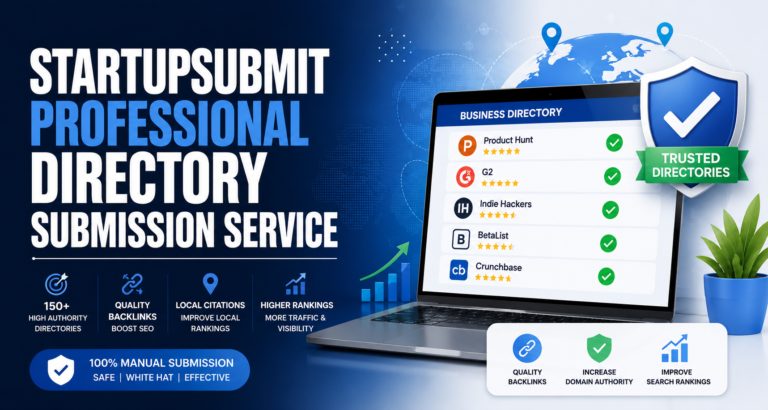
- Startupsubmit reports submissions across 220+ high-authority directories with individual placement reporting, which lets a founder verify each listing actually persisted.
DIY reclaiming and directory submission works fine if you have the time and patience to check each listing by hand. A managed service like Startupsubmit’s directory submission workflow makes more sense when you are launching this month and need the baseline covered fast, without spending a week on category selection and duplicate checks.
Pitfalls That Turn Foundational Link Building Into a Liability
Speed is the enemy here. The fastest way to build 40 foundational links is also the fastest way to get flagged as spam.
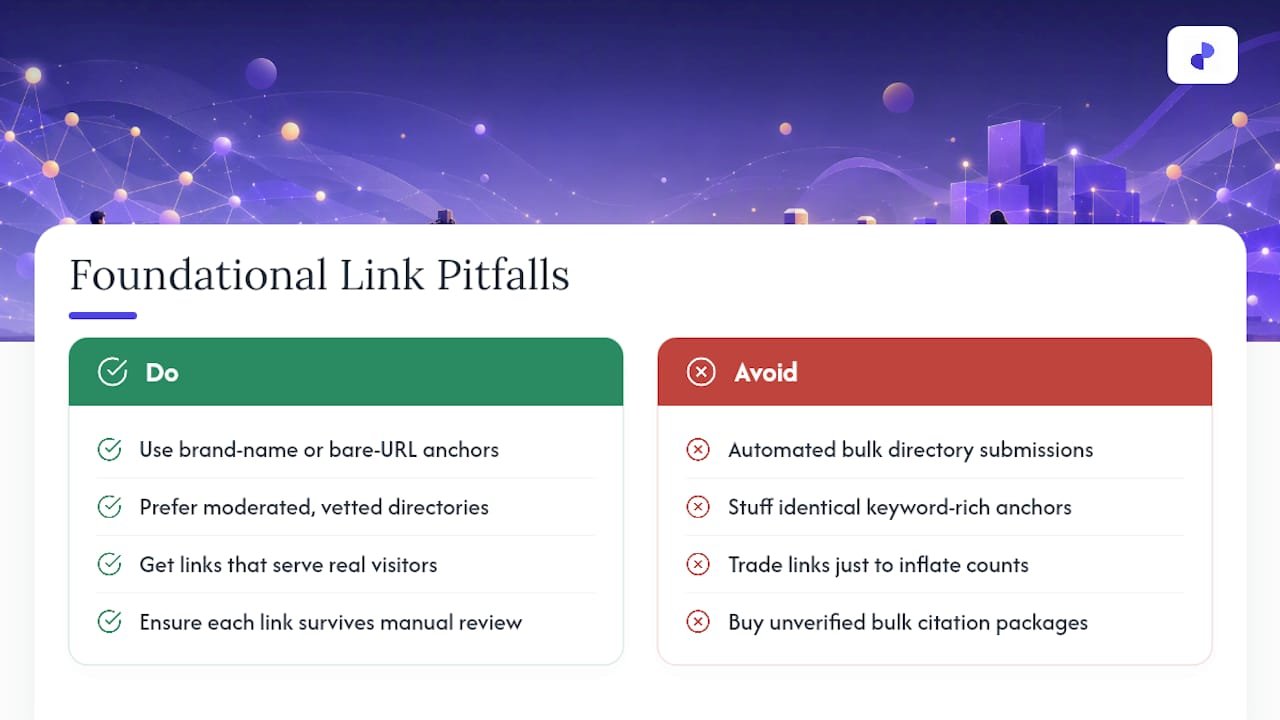
Automated directory submission tools are the biggest offender. They submit the same boilerplate description to hundreds of low-quality, unmoderated directories in one pass. The result is a stack of thin listings on sites nobody visits, with duplicate text that reads as templated to both search engines and any human reviewer who checks. Moderated directories reject these submissions outright; unmoderated ones accept them and add near-zero value while creating a footprint that looks manufactured.
Anchor text stuffing is the second common mistake. A brand-new domain with ten links and eight of them using the exact same keyword-rich anchor text is a pattern algorithms are specifically built to catch. Foundational links should skew heavily toward brand-name and bare-URL anchors, because that is what a naturally mentioned business actually looks like.
Reciprocal link schemes and link exchanges belong on the same list. Trading links purely to inflate a count, rather than because either listing serves a real visitor, tends to get both sites devalued once detected. So does buying bulk citation packages from marketplaces that never verify whether a business is real.
The underlying rule: every foundational link should be able to survive a manual review. If you would be embarrassed explaining a specific placement to someone checking your backlink profile, it doesn’t belong there.
Where Foundational Links Fit in a Broader SEO Strategy
Foundational backlinks are not the whole SEO strategy. They are the floor everything else stands on. Content quality, site speed, and technical crawlability still carry most of the weight for rankings on competitive terms. But without a base layer of verifiable, persistent links, none of that other work gets discovered as fast or trusted as quickly.
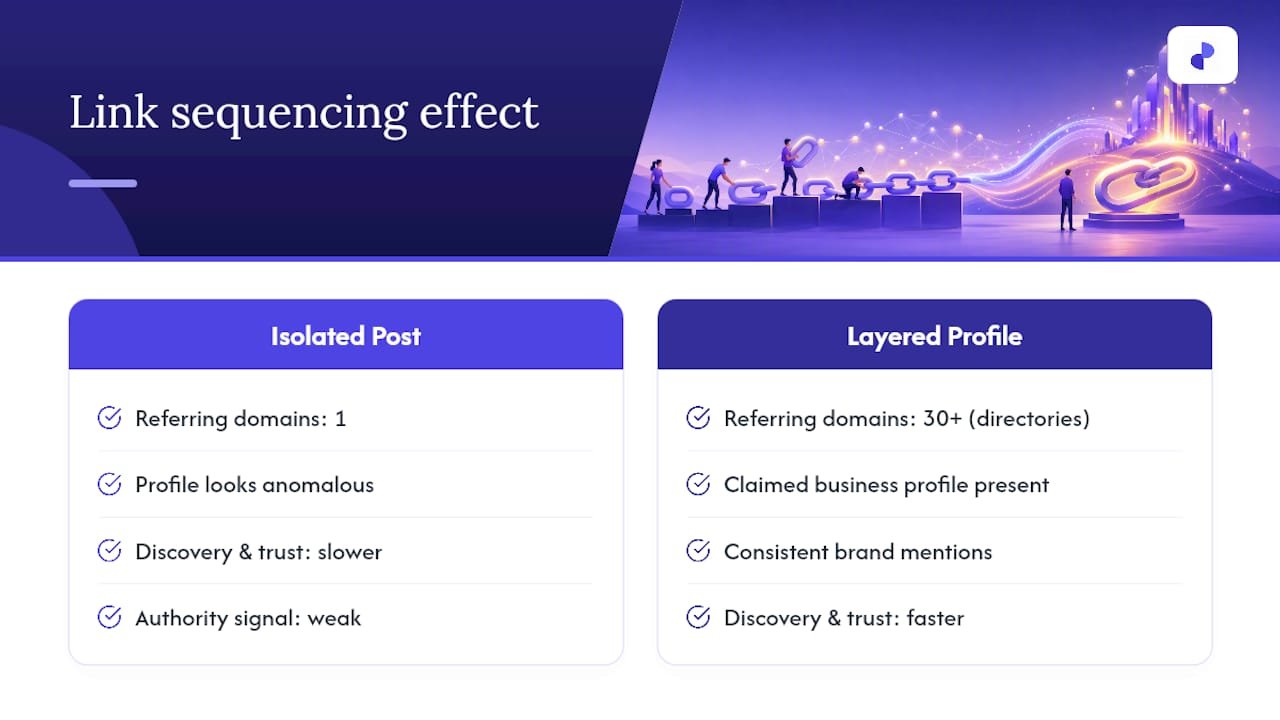
Domain authority metrics from tools like Ahrefs and Moz respond to two things: the number of unique referring domains and the quality signals attached to each one. A pile of 30 foundational links from directories and profiles rarely moves a Domain Rating score dramatically on its own. What it does is create the diversified referring-domain base that makes each subsequent editorial link count for more, because the profile no longer looks like a handful of purchased links sitting on an empty domain.
Think of it as sequencing, not substitution. A site with zero foundational links and one guest post on a DR-70 site looks anomalous. The same guest post sitting on top of 30 directory citations, a claimed Google Business Profile, and consistent brand mentions reads as one more data point in a normal growth curve. Key indicators like authority, relevance, anchor text, placement, and destination all get evaluated in the context of the surrounding profile, not in isolation.
For AI-driven discovery specifically, the layered approach matters even more. Retrieval systems weigh co-citation, the pattern of your brand appearing alongside consistent descriptive language across multiple independent sources. That pattern only exists once the foundational layer is in place.
What a Foundational Layer Looks Like Over Time
The pattern shows up consistently across new-site launches: a founder spends two weeks locking in directory listings, platform profiles, and reclaimed mentions, then shifts attention to content and outreach. Indexing speeds up almost immediately because crawlers have more entry points into the site. Branded search results fill in within a month or two, showing the founder’s own profiles instead of unrelated third-party pages.
The more interesting shift happens later. Sites that skipped the foundational layer and jumped straight to guest posts and digital PR often see those editorial links underperform relative to expectations, because the surrounding profile still looks thin and new. Sites that built the base first tend to see each subsequent link contribute more, since it lands on a profile that already reads as an established, verifiable brand rather than a domain with three links total.
None of this shows up as a single dramatic ranking jump. It shows up as a lower floor for volatility and a faster path to being cited consistently, whether that citation comes from a Google featured snippet or an AI-generated summary pulling from multiple sources that all agree on who you are and what you do.
Sequencing Foundational and Editorial Links: An Editorial View
The common mistake is treating link building as one undifferentiated pile of tactics, when it is really two distinct phases with different goals. Foundational links establish that you exist and can be verified. Editorial links build authority on top of that. Reverse the order and you spend money on a guest post that a profile-thin domain doesn’t have the context to benefit from.
Measure progress with something concrete: track how fast new pages get indexed, whether branded search results fill in with your own profiles, and whether your brand starts showing up in AI-generated answers alongside independent sources. Those three signals tell you the base layer is doing its job before you spend on anything bigger.
— Danish
Get Your Foundational Layer Built Without the Manual Grind
A directory submission service is an option for founders who want the foundational layer covered without spending two weeks manually checking categories and rewriting descriptions across many directory sign-up forms. Every listing should go through a human review process: duplicate checks, category selection, and a unique profile write-up per directory, so the footprint looks like a real business was behind it, not a bot script.
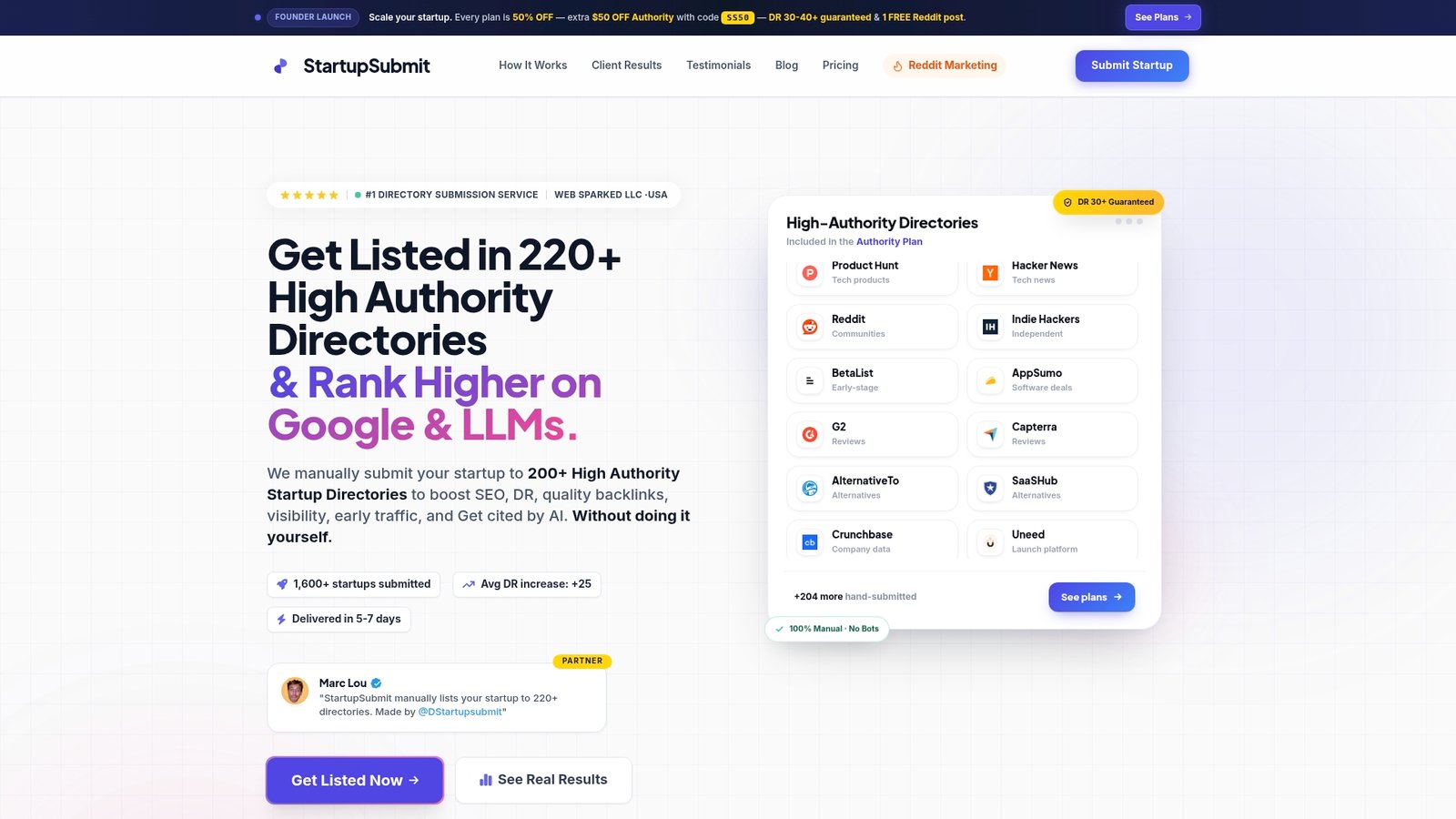
That matters most for early-stage startups launching this quarter, teams with no in-house SEO hire, and anyone who would rather spend the next two weeks on product than on directory forms. Startupsubmit has reported client outcomes including a 338% increase in organic traffic tied to broader directory coverage and improved domain authority within days of submission going live.
If you’re deciding between building this yourself or handing it off, start with the full submission service breakdown to see exactly what gets covered across the 220+ directory network, then check current availability to get your listings started this week.
Sources
- How to Get Backlinks in 2026: 10 Tactics That Actually Work
- Backlinks – Moz Learning Center
- What makes a high-quality backlink – Ahrefs Help
- Foundational links: The hidden infrastructure your website needs before anything else
FAQ
Are Backlinks Still Relevant in 2026?
Yes. Quality backlinks remain central to rankings and now also influence how often a brand gets cited in AI-generated answers, with retrievability and persistence mattering as much as raw authority.
What Is Foundational SEO?
Foundational SEO refers to the basic, verifiable signals that confirm a business exists and is discoverable, including directory citations, claimed platform profiles, and consistent brand mentions, built before pursuing competitive editorial links.
What Is the 80/20 Rule in SEO?
Applied to link building, it means roughly 20% of your link sources, usually a handful of directories, core profiles, and a couple of resource-page mentions, tend to deliver most of the discoverability benefit for a new site, which is why prioritizing that small set first matters more than chasing dozens of low-value placements.
What Are the Main Types of Backlinks?
The main categories are editorial links earned through content or press, foundational links from directories and profiles, resource-page and curated-list mentions, and community or Web 2.0 placements like forum profiles and podcast show notes.
How Many Foundational Links Should a New Site Build First?
A common early target is 20 to 40 basic brand and entity links across directories and profiles within the first two weeks, before shifting budget toward editorial outreach.
Recommended
- StartupSubmit vs Outrank (2026): Honest Directory Submission Service Comparison
- StartupSubmit vs LaunchDirectories (2026): Honest Directory Submission Service Comparison
- StartupSubmit vs AIDirectories (2026): Honest Directory Submission Service Comparison
- Best Startup Directories 2026 — 15 Top Platforms + Full 220+ List