SEO for Directories: Founder’s Practical Playbook
A Google search with an AI Overview produced a traditional-result click in only 8% of searches, compared with 15% without an AI Overview, while links inside the summaries received clicks in only 1% of searches, according to a Pew analysis of 68,879 searches from 900 U.S. adults (Search Engine Land). That changes the job of directory SEO.
A directory listing isn't valuable only because it might pass ranking signals. It can also confirm what your company is called, what it sells, who it's for, where its official website lives, and whether independent platforms describe it consistently. For SaaS and AI startups, that public consistency increasingly matters to search engines, review sites, answer engines, and prospective customers.
The practical question is no longer, “How many directories can I submit to?” It's, “Which external profiles help systems retrieve the right facts about my company, and can I maintain them?” This playbook focuses on that question, from listing copy and category selection to audits, AI search visibility, and the point where another directory becomes a liability.
Why Directory SEO Matters for Startups
Google's PageRank paper was presented in April 1998 at the Seventh International World Wide Web Conference and later published in Computer Networks and ISDN Systems, volume 30, pages 107–117 (an overview of Google and PageRank). Its core idea still applies to directory SEO: a link earns more weight when it comes from an important page, while that page's influence is divided among its outbound links.
That makes directory submissions a poor shortcut to rankings. A large set of weak profiles can create maintenance work without meaningful discovery, referral traffic, or trust. A useful listing matches the product's category, reaches a relevant audience, stays accessible to crawlers, and describes the company accurately.
A respected software directory can support several outcomes at once: discovery, referral visits, entity validation, and a crawlable citation. A neglected directory full of thin or irrelevant pages may provide none of them, regardless of the domain authority score shown by a third-party tool.
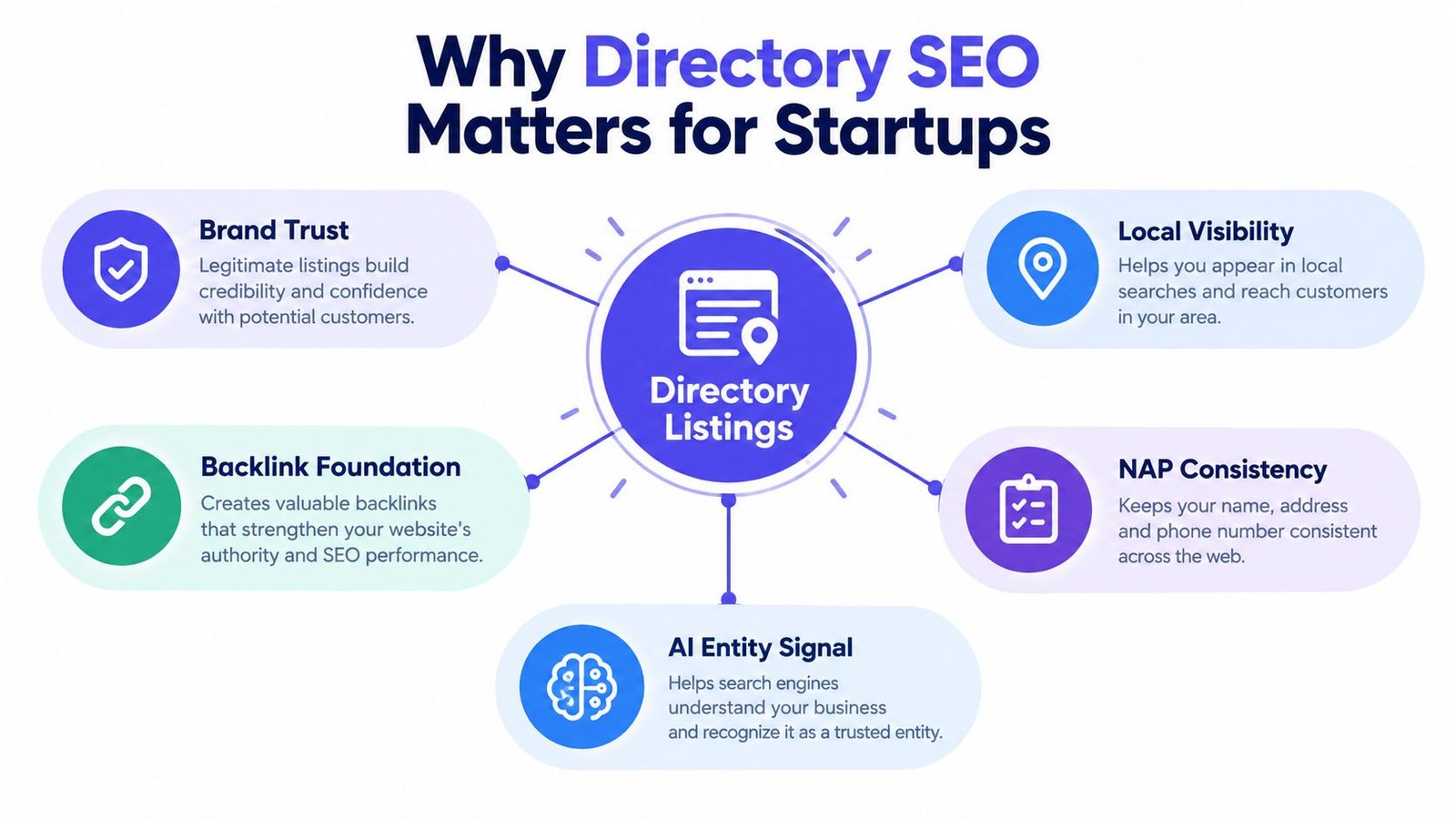
From backlink acquisition to entity building
An entity is the recognizable company, product, founder, organization, or software category that a search system needs to identify. Your website should be the primary source for that identity, but other public profiles can reinforce it. A software review page, a founder profile in a startup community, and a relevant marketplace listing all act as supporting references.
Consistency determines how useful those references are. If one profile describes the company as an “AI meeting assistant,” another calls it a “sales enablement platform,” and a third uses an outdated product name, search systems receive conflicting signals. The issue affects more than branding. It can make the company harder to retrieve correctly for category, product, or brand queries.
Directory history makes the same point from another angle. DMOZ launched in 1998, exceeded 1 million listed URLs in October 1999, surpassed the Yahoo Directory around April 2000, reached approximately 5.17 million sites across 1.017 million categories by April 2013, and had declined to about 3.996 million sites by October 31, 2015 (the history of the directory era). It shut down in 2017. Directories themselves did not vanish; what vanished was the uniform value of just being listed. A platform matters when people, crawlers, or other systems still use and trust its data.
Practical rule: Treat every listing as a public data record first and a potential backlink second.
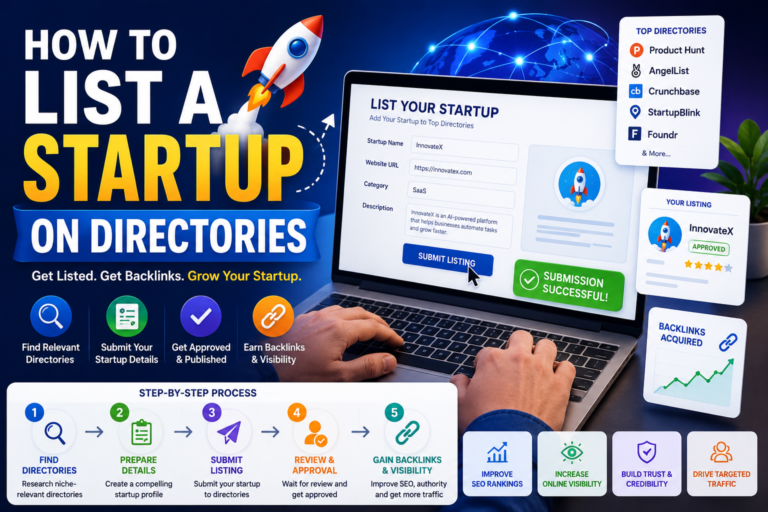
Founders considering a directory submission service should use a selective workflow. Begin with a source-of-truth profile containing the approved company name, product description, category, audience, and canonical URL. Check existing listings, remove duplicates, prioritize directories with genuine SaaS, software, AI, or buyer relevance, and verify each page after publication. Guides such as find the right startup directory can expand the candidate list, but every platform still needs an independent quality check.
Directory SEO works as one layer of a wider growth system. Product launches, review profiles, founder-led content, partnerships, community participation, branded search demand, and a technically sound website reinforce the same company identity. Directory work supports those channels when the listings are accurate and useful. It should not become a submission-counting exercise detached from acquisition and discovery.
Optimizing Your Directory Listings for Impact
A directory profile has limited space, competing listings, and a visitor who needs to understand your product quickly. Strong optimization makes each field precise, useful, and consistent with the website. It does not mean forcing every possible keyword into a short description. A well-maintained profile also gives search engines and AI retrieval systems clearer signals about what the company is, whom it serves, and which category fits it.
Start with the fields that shape discovery
Create a repeatable data sheet before opening submission forms. Record the approved company name, product name, canonical homepage, short description, long description, category, audience, pricing language, founder or company description, support contact, headquarters, and social profiles. Keep this record current. It becomes the reference point for updates and helps prevent small differences from spreading across public listings.
The title should identify the product and its category naturally. “Acme, AI customer-support platform for B2B teams” tells a visitor more than “Best AI Support Software | Customer Service Tool | Helpdesk.” The first version uses relevant language without an unsupported claim or a string of repeated keywords. It also gives retrieval systems clear terms to associate with the company.
Choose the primary category according to the problem the product solves, not the broadest term that attracts attention. A workflow automation tool may fit “business process management” better than a generic “software” category. If a platform supports multiple tags, select the narrowest accurate options first, then add broader ones only when they describe a real use case. A precise category can bring fewer impressions but more relevant discovery.
Write for a hurried buyer
A strong description answers four questions quickly:
- Who is it for? Name the customer type or team.
- What does it do? Describe the core job in plain language.
- What makes it distinct? Include a verifiable capability, workflow, integration, or operating model.
- What should the reader do next? Send the visitor to a useful product or pricing page.
Weak copy says, “A powerful next-generation platform that helps businesses work smarter.” It could describe almost anything. Stronger copy says, “An AI research workspace for product teams that turns interview notes into searchable themes, summaries, and evidence-backed briefs.” The second version gives buyers, crawlers, and retrieval systems concrete nouns and relationships to process.
Do not copy the same paragraph onto every platform. Keep the factual core stable, but change the opening, emphasis, and detail to match the directory. A startup community may care about the founder story and product stage. A review site may need integrations, use cases, deployment model, and support details. A software comparison site may prioritize alternatives, pricing structure, and team size.
Use character limits as an editing constraint
Short fields reward specificity. Remove introductions such as “We are excited to announce” and spend the space on the product, audience, and outcome. Put the clearest value proposition in the first sentence because some directories truncate descriptions in category views.
For a longer profile, use a simple structure:
- One-sentence positioning: product category plus audience.
- Two-sentence explanation: workflow, problem, and differentiating capability.
- Proof or context: integrations, deployment approach, founder expertise, or supported use case.
- Action: a relevant destination URL.
Use a homepage URL when the profile primarily identifies the company. Use a deeper URL when the directory allows it and the destination directly supports the listing claim, such as a pricing, integration, or product page. Keep the visible brand name and destination consistent. Avoid keyword-stuffed anchor text where you control the link.
Images affect trust as well. Use a legible product mark for the logo, a current interface image where screenshots are accepted, and a consistent visual identity across profiles. Do not upload a misleading stock image or an old interface that no longer matches the product. Visual consistency helps a visitor confirm that several listings refer to the same entity.
Run a quick quality test
Before publishing, read the listing without the company name. Could a buyer tell what the product does, who uses it, and where to learn more? Then compare it with the website. The category, product name, pricing language, and URL should not contradict one another.
For local or location-sensitive profiles, check the name, address, and phone information. For global SaaS brands, review the equivalent fields: legal company name, product name, domain, support contact, headquarters, and pricing region. Incorrect directory information frustrates 93% of consumers, according to a BrightLocal survey as cited in Ahrefs' analysis of links and referring domains. The specific fields differ for software companies, but the operating principle is the same. An inaccurate profile weakens trust and can create conflicting entity data.
A manual local citation workflow for consistent listings can be useful even for software companies with regional offices, support hubs, or location-based products. Judge the service by its data controls, duplicate handling, and verification process, not by the number of forms it can submit. The goal is a reliable discovery record that supports people, search engines, and AI systems alike.
Choosing the Right Directories Over Quantity
A directory earns attention when it can produce at least one useful outcome: qualified discovery, brand validation, referral visits, a relevant review, or a credible external reference. A high authority score alone proves none of these. For SaaS teams, the better question is whether the directory helps the right buyer find, verify, and correctly identify the company.
Ahrefs found a correlation between the number of referring domains and organic traffic. Its analysis found little additional correlation from the organic traffic of those referring domains after accounting for the total number of referring domains. The the Ahrefs links and traffic study recommends prioritizing pages with high URL Rating and websites with many referring domains, rather than assuming a directory with high visitor numbers automatically provides more ranking value.
That distinction changes how directory campaigns should be evaluated. A general startup directory may offer broad visibility, while a smaller directory focused on a specific software category may put the product in front of buyers with a clearer need. The second option can also strengthen the consistency of the company's category, product description, and identity across public discovery nodes.
Directory Evaluation Matrix
| Directory Type | Authority Level | Audience Relevance | Maintenance Effort |
|---|---|---|---|
| General software listing | Often established, but uneven across categories and individual pages | Broad software discovery, with weaker contextual fit | Moderate, since categories and product details change |
| Niche software hub | Can range from modest to strong | High when the niche matches the product and buyer | Moderate to high, especially as features evolve |
| Startup-focused community | Varies by platform activity and editorial quality | Strong for founders, early adopters, and launch discovery | Moderate, with community rules and profile updates |
| Review platform | Often useful for buyer validation | High for comparison and purchase-stage research | High when reviews, integrations, and pricing change |
| Abandoned or unmoderated directory | Apparent authority may not reflect current usefulness | Low, even if the domain once attracted attention | High, because outdated or duplicated pages require monitoring |
Evaluate the page, not just the domain
Open several live profile pages before submitting. Check whether they are indexable, whether the directory links to its profiles, whether categories contain real products, and whether recent submissions receive moderation. Search for existing companies by name and category. If profiles fail to appear in search or consist of thin, automatically generated content, the directory has limited practical value.
Assess the platform using these signals:
- Clear editorial controls: The site explains who can submit, what receives review, and how duplicate profiles are handled.
- Useful taxonomy: Categories reflect genuine buyer needs rather than a long list of vague tags.
- Profile durability: Published pages have stable URLs and are not routinely replaced or removed.
- External engagement: Users can compare, review, follow, contact, or otherwise use the information.
- Technical accessibility: Important profiles are crawlable and are not blocked, hidden behind unnecessary interactions, or canonicalized to unrelated URLs.
A small directory with a well-moderated category can outperform a broad platform where the listing is surrounded by irrelevant products. The trade-off is operational effort. Niche sites may require more specific copy, closer review of category placement, or participation in the surrounding community. That work makes sense when the audience has a clear reason to visit and the profile contributes useful, consistent information about the company.
Audit what you already have
Create a spreadsheet containing the directory domain, category, profile URL, indexability status, link attribute, listing owner, last verification date, and referral or branded-search activity. Add a decision column with four options: keep, update, merge, or remove.
Keep a profile when it is relevant, accurate, indexed, and useful to a real audience. Update it when the product name, pricing, category, support contact, or destination URL changes. Merge or remove duplicates when multiple pages represent the same company and create conflicting signals. A directory profile should not remain active just because it already exists.
Founders who need initial candidates can consult this list of best startup directories, then apply their own relevance and maintenance criteria. Treat the list as a starting point. Inspect each platform's live pages, audience, technical setup, and editorial activity before investing submission time.
Directories and the Rise of AI Search
Directory profiles support AI retrieval by placing consistent company facts in several public contexts. They do not guarantee a citation in an AI Overview or an answer from a large language model. Their practical role is to help systems identify the company and describe it accurately while gathering evidence from the open web. Treat each directory as a discovery node, not just another source of backlink volume.

Build one source of truth
Create a canonical company profile on your own website before editing third-party listings. Define the preferred company name, product name, category, concise description, founding facts, audience, primary URL, support details, pricing language, and relevant organization or product relationships.
Adapt that information to each platform without changing the underlying facts. A review site may need a feature-led summary, while a founder community may call for a company story. An AI directory may need a direct explanation of the product category and use case. Vary the prose for the audience, but keep identity data consistent.
Your website should provide accessible, crawlable content and structured data that accurately describes the page. Google says sites do not need a separate AI file, special machine-readable format, or dedicated schema type to appear in AI Overviews. Its guidance emphasizes useful, accessible content that addresses the user's query (Google's documentation for AI features). Schema can clarify relationships and page meaning, but it does not guarantee visibility.
Audit contradictions before adding profiles
A retrieval system might encounter several descriptions of the same startup:
- “AI sales assistant” on the homepage
- “Revenue intelligence platform” on a software directory
- “Automated CRM” on a founder profile
- An old product name on a review site
- A pricing page that no longer matches the directory
Each description may be defensible alone, yet the combined signal reduces precision. Maintain a change log for renamed products, repositioning, new pricing regions, acquired domains, and discontinued features. Update the external profiles that matter most before submitting the company to another batch of directories.
ChatGPT visibility also depends on crawler access. OpenAI states that public websites can appear in ChatGPT search, while inclusion in summaries and snippets depends on allowing OAI-SearchBot to access the site. Sites that block OAI-SearchBot will not appear in ChatGPT search answers, although they may still appear as navigational links (OpenAI's crawler documentation). Directory listings cannot compensate for blocking important first-party pages.
The AI-search version of consistency is simple: the right company should be described with the right facts, wherever a buyer or crawler encounters it.
Traditional SEO reporting tracks rankings, impressions, clicks, and referring domains. AI search adds questions about whether systems associate the product with the intended category, whether external profiles reinforce the company description, and whether brand searches increase after repeated exposure. Track those signals alongside referral traffic and listing accuracy so reporting reflects discovery, not just link acquisition.
For founders building an AI-focused directory strategy, LLM SEO for digital marketers offers a broader view of retrieval beyond conventional backlink acquisition. For hands-off execution, an AI-focused directory submission service can maintain consistent external profiles while the first-party source remains aligned. The operating principle is straightforward: strengthen the company's own pages, keep external facts accurate, and use directories to improve discovery and retrieval accuracy rather than to manufacture link volume.
Avoiding Common Directory SEO Pitfalls
Manual effort does not make every directory placement useful or safe. A founder can still submit a product to an irrelevant site, select an inaccurate category, reuse keyword-heavy copy, or leave an obsolete profile public for years. The main risk is a scattered external record that confuses buyers and weakens how search systems retrieve the company's identity.
Google classifies low-quality directory and bookmark-site links as link spam when they exist mainly to manipulate rankings. Its policy also covers paid links intended to pass ranking credit, excessive reciprocal linking, and automated programs that create links as prohibited practices (Google's spam policies). Properly qualified rel="nofollow" or rel="sponsored" links are not automatically violations, but those attributes cannot make an irrelevant or deceptive listing valuable.
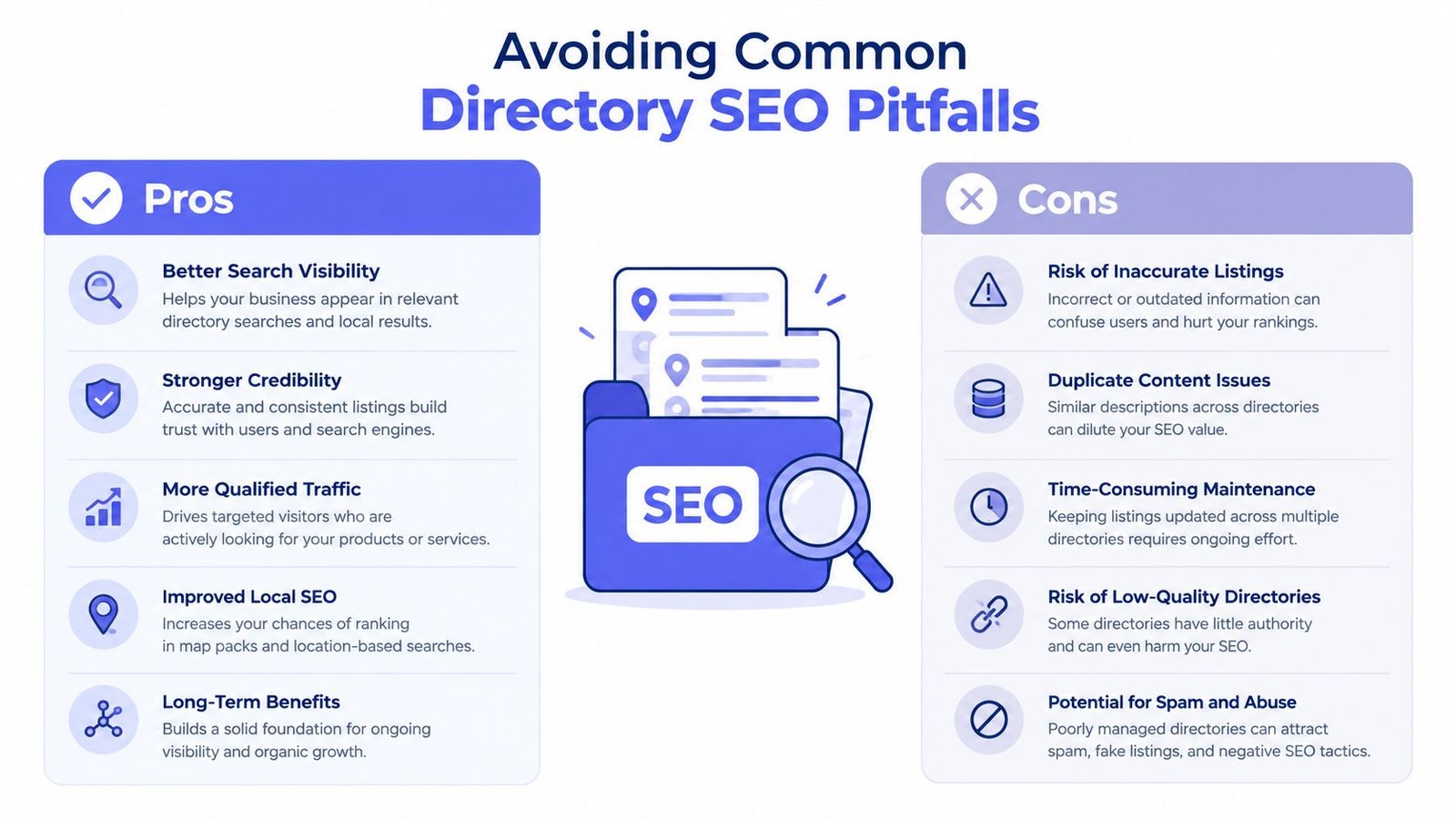
What to reject before submission
Founders working on a budget can start with a curated list of free startup directories and apply this review to every candidate:
- Automated submission networks: Reject systems that publish the same profile across sites your team cannot inspect or maintain.
- Irrelevant categories: Choose the category that accurately describes the product, even if another category has a larger audience.
- Keyword-stuffed titles: Use the recognized company or product name, supported by clear wording rather than a string of search terms.
- Identical descriptions: Keep core facts consistent, but write platform-specific copy that explains the listing's relevance to its audience.
- Purchased ranking credit: Avoid links bought mainly to transfer ranking value.
- Unverified reviews: Do not create fake customer feedback or imply endorsements that do not exist.
- Unmaintained pages: Update, merge, or remove profiles containing obsolete claims, discontinued features, or broken destinations.
Duplicate copy alone does not make a listing harmful. Mass-produced profiles do create a thin external footprint, give visitors little reason to trust one page over another, and reduce the chance that each directory adds useful context. A worthwhile listing should contribute category relevance, audience access, validation, or a clear discovery path.
Know when a listing becomes a liability
Audit every profile with five questions. Is the page indexed? Does the directory serve the product's audience? Does the site show moderation and real use? Is the listing accurate? Can it send a qualified visitor or support branded discovery? One negative answer may call for an update. Several indicate that removal, consolidation, or de-prioritization is reasonable.
Record acceptance separately from performance. An approved submission is not necessarily an indexed page, a useful referral source, or a ranking asset. Track accepted listings against valid submissions, then indexed listings against accepted listings. These measures show whether the constraint is platform approval or visibility after publication.
Compare directory activity with a baseline covering referring-domain quality, branded impressions, non-branded clicks, referral sessions, and assisted conversions over 8 to 12 weeks, using the workflow described in the Google Search spam documentation. Avoid assigning ranking changes to directory links alone. Content updates, technical changes, product demand, competitors, and algorithm updates also affect search performance.
A smaller set of accurate, relevant, maintained profiles gives founders more control than a sprawling collection of neglected pages. Defensible coverage that keeps helping buyers and retrieval systems beats maximum coverage.
Next Steps for Sustainable Directory Growth
Start with an inventory. Search your company name, product name, old brand names, and primary category, then record every profile in a central spreadsheet. Mark duplicates, inaccurate descriptions, broken URLs, unindexed pages, missing categories, and profiles that still describe discontinued features.
Next, create the source-of-truth profile on your website. Approve the exact company and product names, positioning language, categories, pricing terms, support details, and canonical URL. Use that record to update the most relevant directories first, then test new platforms against audience relevance, moderation, indexability, and maintenance effort.
Review published profiles on a recurring schedule. Check important listings after major product or pricing changes, and run a broader audit every few months. Search Console can separate impressions and clicks by page type, while Ahrefs or a similar tool can help monitor referring domains and URL-level links. Keep referral sessions, branded impressions, profile indexing, review activity, and assisted conversions in the same report.
Directory SEO compounds when the data stays accurate. It fails when founders treat submission as a one-time task and never revisit the public record.
StartupSubmit offers manual directory submission for SaaS and AI startups, with profile creation, categorization, duplicate checking, and reporting designed to keep external listings consistent. If you want help building and maintaining a focused directory portfolio, visit StartupSubmit and review the available submission options.