Directory Submission for SEO: What Actually Works in 2026
Most directory advice is a number. Submit to 300 sites, the list posts say, and watch your Domain Rating climb. That advice is why so many founders spend three weeks filling forms and end up with a backlink profile full of pages Google has never crawled, plus a dozen logins they'll never use again.
Directories are neither dead nor a ranking shortcut. They're an entity and citation layer: every approved profile adds one referring domain and one more consistent third-party description of what your company does. Search engines use that layer to check that a business is real. Language models use it to decide what to say when someone asks about your category.
Twelve directories that get indexed beat two hundred that don't. What follows is how to tell which is which before you spend the afternoon.
Table of Contents
- How a Directory Listing Becomes a Ranking Signal
- How to Screen Directories Before You Submit
- Directory Types and Where Each One Fits
- How to Submit a Listing Step by Step
- Tracking Listings and Visibility in AI Search
- Frequently asked questions about directory submission
- Build Your Short List and Submit This Week
How a Directory Listing Becomes a Ranking Signal
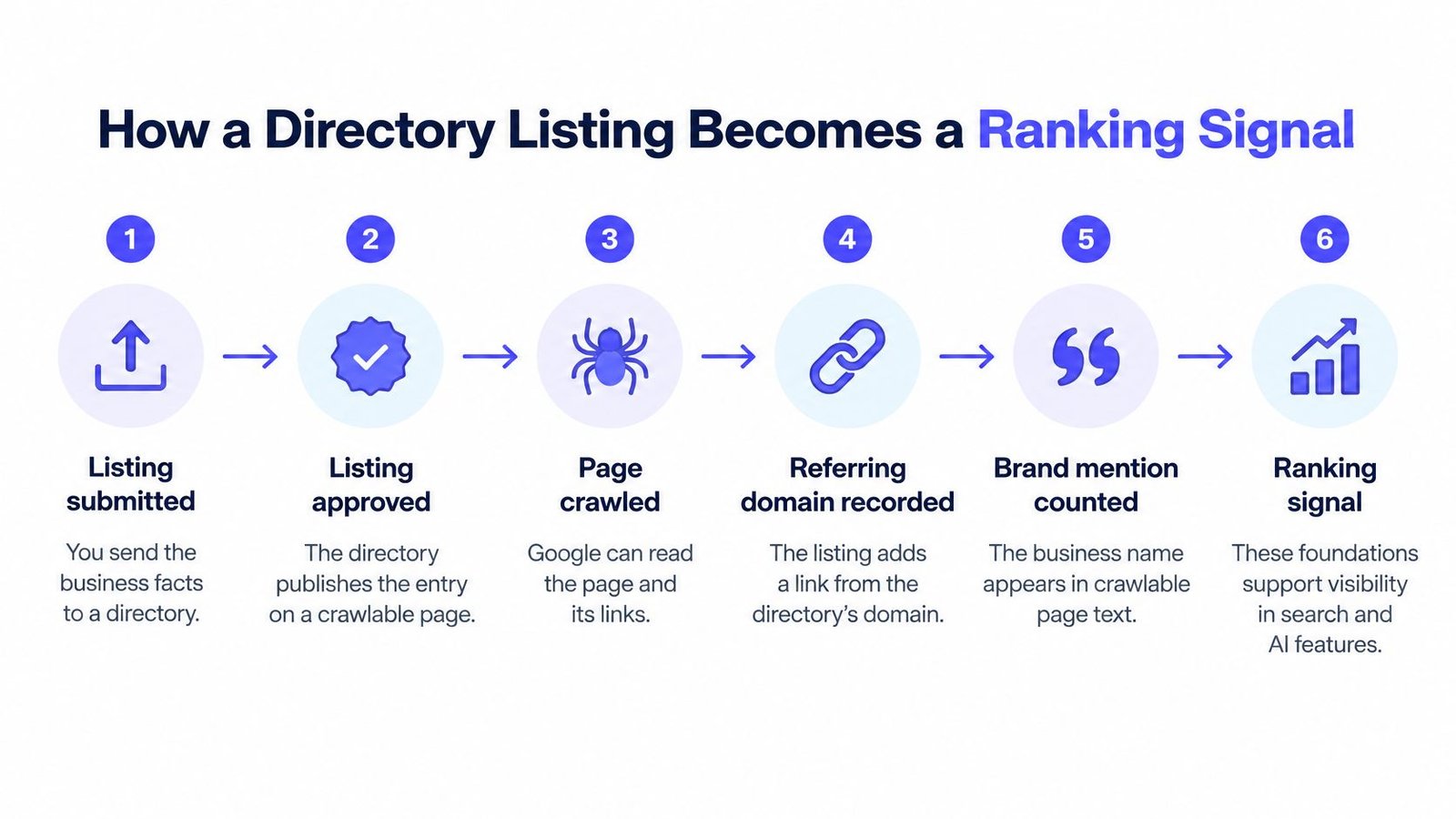
A listing doesn't become a link the moment you press submit. It becomes a link when a crawlable page carrying your URL and brand name goes live and enters Google's index. Three things can break between those two moments, and most campaigns lose listings at one of them.
- You submit. The platform receives your company name, canonical URL, category and description. Nothing counts yet.
- The platform publishes. Your entry lands on a public page. Publishing speed varies wildly. Some software directories push a profile live the same day, others queue submissions for a week or two, and a fair number never reply at all.
- Google crawls and indexes the profile. Until the crawler reads that page and stores it, the link is invisible to the ranking system. This is the step founders skip, and it's the whole reason results feel slow.
- The link starts counting. The directory's domain lands in your referring domain list and your brand name sits in crawlable page text on a third-party site. An approval email tells you a platform accepted your paperwork. It's not proof of value.
The sequence, start to finish, looks like this.
What the first 30 days actually look like
Domain Rating typically starts climbing 14 to 30 days after a batch of listings goes live. That lag isn't mysterious. Referring domains arrive in clumps as directories publish and Google crawls on its own schedule, so the curve steps up rather than sloping. A single listing published on a slow platform can take another two weeks to appear anywhere.
Not every live profile earns attention either. An Ahrefs analysis of search traffic across roughly 14 billion pages found that 96.55% of pages received no Google organic traffic. Plenty of directory profiles live in that majority. The question worth asking isn't "is this domain well known," it's "is this page crawled, read and placed in a category a real buyer browses."
The quieter effect is corroboration. Dozens of profiles repeating the same category, use case and pricing language build a citation graph that language models draw on when someone asks an assistant to recommend a tool like yours. That graph is built from consistency, not volume.
Run one test today. Search your brand name in a private window and note which profiles already appear. Then check three things on each one: the category (is it in the right slot, or dumped in a generic bucket), the URL (does it point to your canonical homepage), and the one-line description (does it still describe the product you ship now). If you have a physical address, the same discipline applies to map and local profiles, and our citation guide for single-location businesses covers the fields that go wrong most often.
How to Screen Directories Before You Submit
The 300-site list is the problem, not the plan. Screening is a five-minute job per platform once you know what you're looking for, and the checklist below catches almost everything.
| Check | Red flag | Positive signal |
|---|---|---|
| Page generation | Autogenerated templates shared across dozens of sites | Unique page structure with original editorial content |
| Outbound links | Excessive links on the profile page with keyword-stuffed anchors | Reasonable link count with relevant, contextual placements |
| Description quality | Thin copy that could fit any product | Specific details about use case, audience and differentiation |
| Editorial standards | No review process, instant approval | Human moderation that rejects low-quality submissions |
| Indexability | Profile URL returns noindex or is blocked by robots.txt | Crawlable page that appears in site search and Google's index |
| User value | No traffic, reviews or engagement signals | Real visitors, reviews or community interaction visible |
What makes a directory acceptable isn't its domain rating. It's whether the page exists for users rather than purely to pass ranking signals. Google Search Central names "low-quality directory or bookmark site links" among manipulative linking practices in its spam policies, right alongside buying and selling links. Read that as a description of a pattern, not a ban on the format. One clean profile on a moderated platform is fine. Two hundred near-identical profiles across a shared template network is the pattern Google is describing.
Link attributes matter less than many assume. The spam policies also note that paid or sponsored placements are acceptable when they carry qualifying attributes such as rel="nofollow" or rel="sponsored", a principle Google restated in a July 2021 link-guidance update asking site owners to qualify commercial, sponsored and affiliate links. A nofollow profile that sends you real visitors is worth keeping. A dofollow link on a junk page isn't worth the ten minutes it took to file.
If you've submitted before, audit what's already out there before you add anything new. Cleaning up stale names, dead URLs and wrong categories is usually the higher-return job, and the guide to fixing inconsistent business directory listings walks through the cleanup order.
Practical rule: if you wouldn't want a prospect, a journalist or an investor to land on that page, skip it.
When you're ready to pick targets rather than reject them, browse software review directories by category first. Relevance is the filter that removes 80% of the list in one pass.
Directory Types and Where Each One Fits
Directories are not interchangeable, and treating them as one long list is where campaigns go sideways. This is the split I plan around.
| Directory type | Examples | Best fit | Main risk |
|---|---|---|---|
| Software review and comparison | G2, Capterra, SaaSHub, AlternativeTo | SaaS products that buyers compare | Thin profile with no reviews or screenshots |
| Startup launch platforms | Product Hunt, BetaList | Products with a launch week and early users | Traffic spike fades within days |
| Founder and builder communities | Indie Hackers | Bootstrapped and indie products | Value depends on real participation |
| Local and map citations | Regional, city and map platforms | Businesses with a physical address | Wrong category or mismatched address |
| Generic web directories | Undifferentiated link lists | Little for a SaaS brand | Thin pages and link spam risk |
Software review and comparison sites earn their place because buyers type "alternatives to" into Google and land there with intent. The profile itself has to do work: screenshots, an accurate pricing line and a category that matches your product, or you've built a page nobody clicks. For a SaaS product this row carries most of the weight in the table, which is why teams that submit your SaaS to directories prioritize review platforms and the sites that rank for comparison searches ahead of everything else. Launch platforms give you a genuine spike and a one-time link. That's worth having on launch day, but the traffic fades within days and the link doesn't compound. Founder communities reward participation over submission, which makes them a poor fit for a team that won't show up.
Local and map citations matter only if you have an address. A wrong category there does more damage than no listing at all. Generic web directories do almost nothing for a SaaS brand in 2026, and the spam exposure isn't worth the hopeful DR bump.
Now the page-level point, which is where directory advice usually stops short. A directory's brand doesn't guarantee that your individual profile gets indexed. In a 2011 analysis, Moz examined a DMOZ category page with a Toolbar PageRank of 8 and found that the specific subcategory page wasn't indexed and offered little practical SEO value; the same review found a Yahoo Directory subcategory with 27 active listings that lacked meaningful indexation. DMOZ itself, the old Open Directory Project, closed in March 2017. Big directory, small listing, no guarantee.
A directory's domain rating describes the directory. Your profile's indexation describes your profile. Only one of them affects you.
What listings do to Domain Rating
What a batch of listings does to Domain Rating depends on how many profiles get indexed at once and whether they land on pages Google crawls. DR movement from indexed placements arrives in steps over weeks, not in a smooth daily climb. Wide jumps tend to coincide with simultaneous indexation, when a group of links gets picked up in the same crawl window. Slow climbs come from platforms that queue submissions or hide profiles behind parameters. Both patterns are normal, which is why a 30-day check tells you more than a 72-hour one.
The type of directory shapes which pattern you get. Review platforms put your profile inside category pages that are already crawled and ranked, so indexation is steadier. Launch platforms index fast and in clusters because the whole page is fresh and heavily linked on day one. Curated startup directories sit in between, since approval queues delay when each profile goes live.
Submissions should go only to curated, editorially reviewed directories, never to link farms or spam networks. That restriction isn't squeamishness, it's the difference between accumulating evidence and accumulating risk.
And the honest limit: no submission campaign guarantees rankings. DR correlates with visibility because better-linked pages tend to earn more attention, but the metric doesn't cause the ranking. Page relevance, search intent and content quality still do the heavy lifting.
Boost Your Startup's Traffic & SEO with up to 200+ Directory Listings
Skip the grind. Our team manually submits your product to relevant, high-authority directories, with screenshot proof for every submission, so you get real users, feedback and lasting backlinks without lifting a finger.
Get Listed TodayHow to Submit a Listing Step by Step
The routine below is deliberately boring. Consistency is what makes the later checks possible.
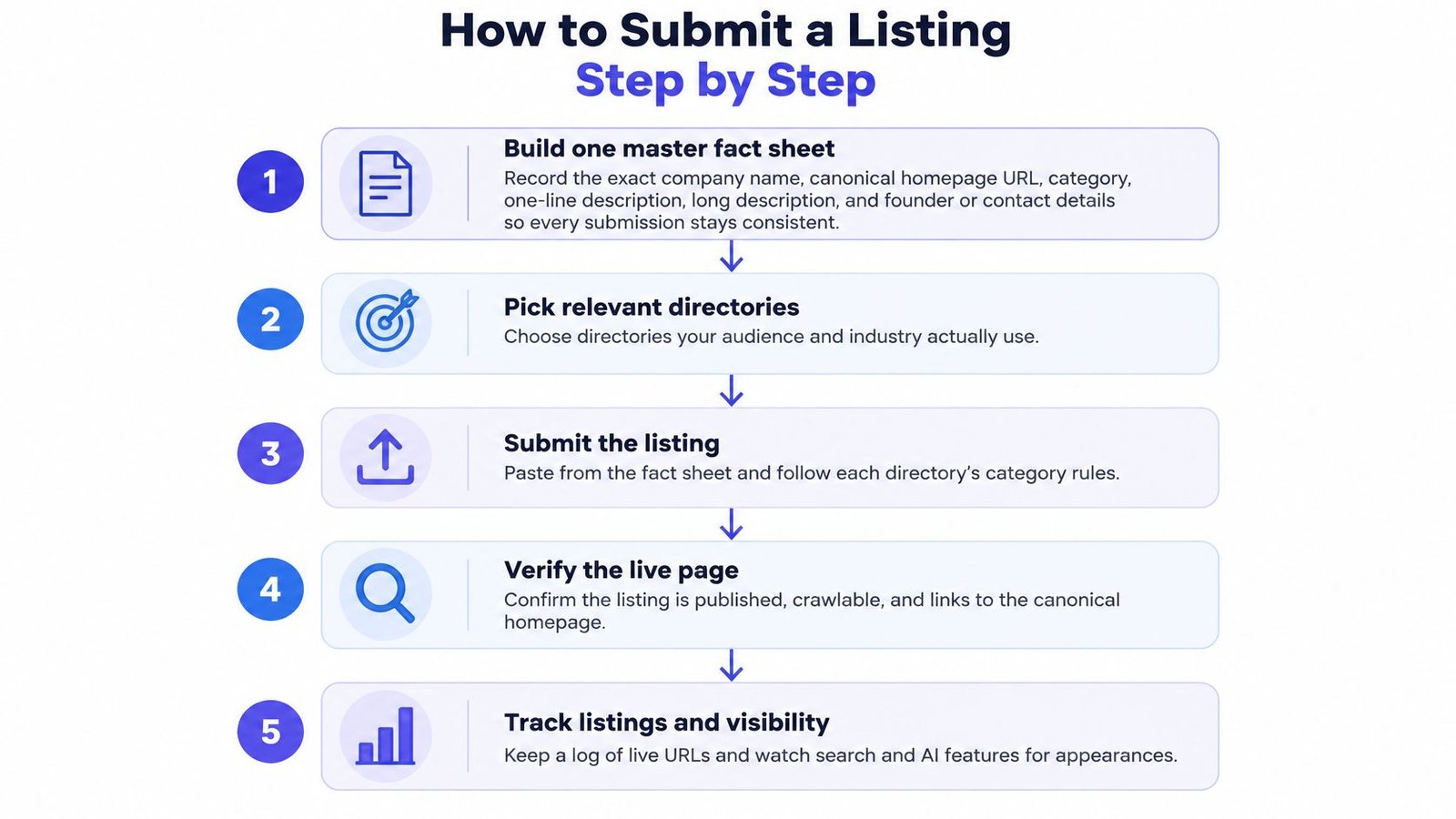
- Build one master fact sheet. Record the exact company name, canonical homepage URL, primary category, one-line description, long description, founder or contact details, logo files and any pricing claim you intend to repeat. Every inconsistency later traces back to a missing or outdated fact sheet.
- Search the platform for an existing listing first. Rebranded and relaunched companies often already have a stale profile. Claim and correct it instead of creating a second one, because two half-right profiles confuse a system more than one wrong profile does.
- Write a unique description per platform. Keep the facts identical and change the wording and emphasis. A review site reader wants integrations and use cases. A founder community wants the story and the stack. Copy-pasting one paragraph across dozens of profiles looks exactly like what it is.
- Choose the most specific category available. "Customer Support Software" beats "Software," and "AI Chatbots" beats both. A precise category strengthens the relevance signal and gets you onto a page real buyers browse.
- Set the target URL deliberately. Send brand references to the homepage. Point a subset at a product, integrations or comparison page when you want that specific URL to accumulate links. Not everything should land on the same page out of habit.
- Submit by hand. No bots, no auto-fill. It's slower, and it's why our own submissions are done manually by our in-house SEO team rather than through a form-filling script.
- Confirm verification and check the page is live. Click the confirmation email, then load the public profile URL and make sure it resolves, shows the right category and links to the canonical page.
- Save a screenshot and the live URL in one log. Do this the same day. Reconstructing which directory approved you three weeks ago is a waste of an afternoon.
The log that makes every later check possible
One spreadsheet, four columns minimum: platform name, live profile URL, submission date and status. Add the link attribute, the target URL and the anchor if you want to compare placements later. That sheet is what you'll open on day 30 to find out which listings are indexed, which are pending and which have disappeared.
Nothing in the log counts as a link until the profile is live and indexed. A pending submission is an open task, not a backlink.
The failure to avoid is the one nobody notices for months: a profile sitting in pending or unverified limbo that you've mentally written off as done. Track it until it's published and indexed, or delete it from the sheet and stop pretending.
Tracking Listings and Visibility in AI Search
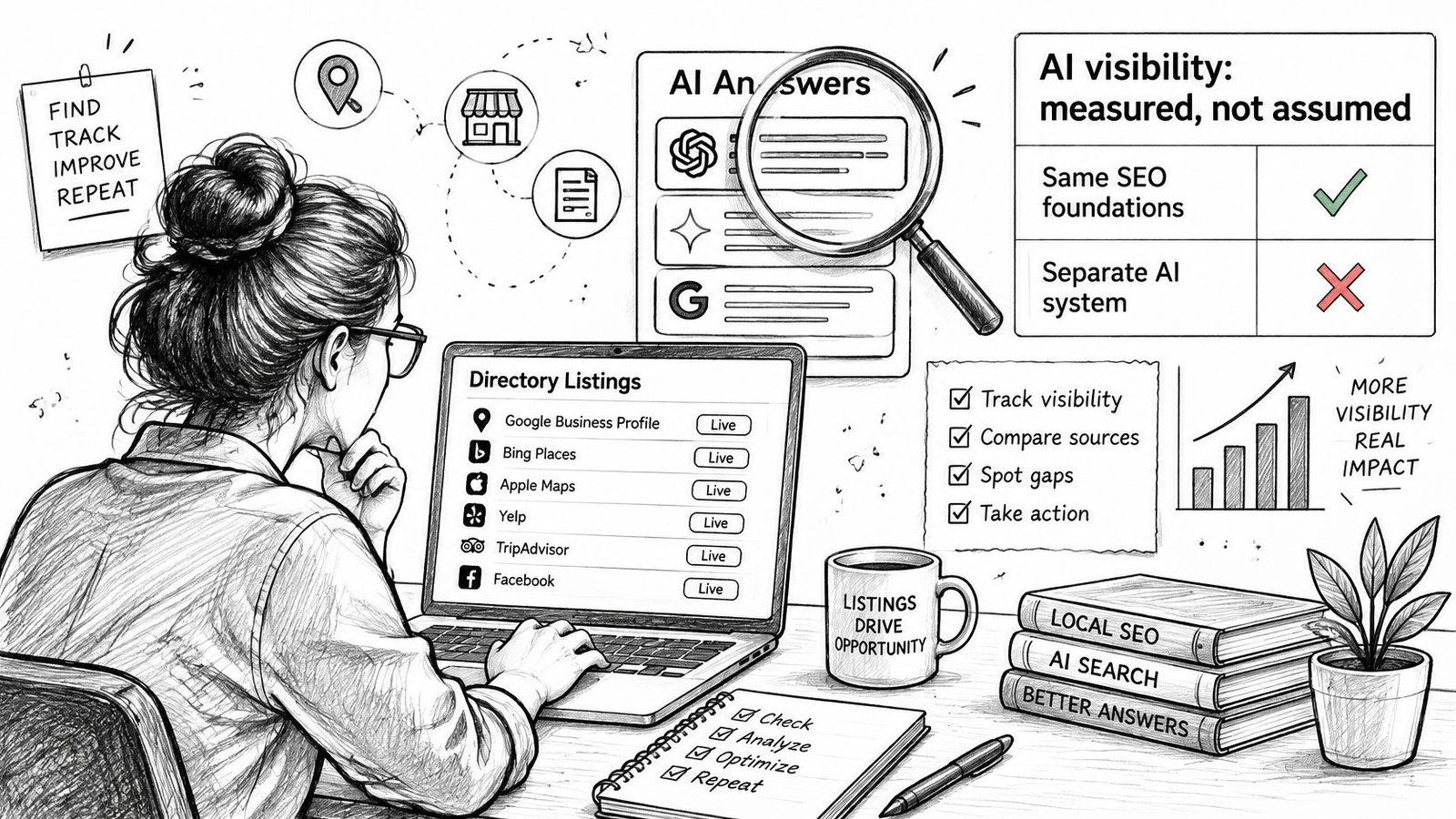
AI visibility gets measured, not assumed. Google's position is that AI Overviews and AI Mode don't need a separate optimization system. The same crawlability, policy compliance and people-first content requirements apply, and pages that appear in AI features are counted in Search Console's Performance report under the Web search type, as documented in Google's guidance on AI features.
That sets the expectation correctly. A directory profile can reinforce what Google and ChatGPT already believe about your company. It can't force a citation, and it won't compensate for a thin product page.
Volume stays modest for now, too. BrightEdge found that AI search still represented less than 1% of referral traffic across its January to August 2025 analysis of AI search visits, while organic search remained the dominant source of traffic and conversions. Directories are worth submitting to because they strengthen that organic layer and the entity record behind it, not because they're an AI-ranking lever.
A monthly check you can finish in ten minutes
| Metric | Where to check | What good looks like |
|---|---|---|
| Indexed listing URLs | Google Search Console URL Inspection | Every live profile is indexed |
| New referring domains | Ahrefs or the Search Console links report | Steady growth from distinct domains |
| Branded query impressions | Search Console Performance report | Rising impressions for the brand name |
| Referral sessions | GA4 referral report | Visits from profiles, not only a launch spike |
| AI description accuracy | Ask ChatGPT, Gemini and Google AI features | Correct category, use case and pricing |
The AI row is the one almost nobody runs. Once a month, open ChatGPT, Gemini and Google's AI features and ask what your product does and who it's for. You're checking three things: whether you get recommended at all, whether the category is right, and whether the pricing line is current. A wrong pricing claim repeated across a dozen profiles gets repeated back to buyers.
Two signals matter more than any single number: rising branded impressions and an AI answer that gets your category right.
Keep the submission report with every accepted URL and a screenshot per directory. Ours includes exactly that for every campaign, and the reason is practical: it makes each check auditable and separates live placements from claims that were never verified. Six months later, when a profile vanishes, the screenshot is how you prove it existed.
If you want a deeper method for the AI side, this guide to measuring AI search visibility covers query sets and share-of-answer tracking. For AI tools specifically, the same evidence pattern applies across tool and model directories, which is the logic behind building profiles that boost AI tool discovery through directories.
Frequently asked questions about directory submission
Do nofollow directory links help SEO
Yes, just not by passing ranking credit. A nofollow profile still supports discovery, referral visits and entity consistency, and those three things are worth having. A nofollow listing on a moderated platform that sends you 20 visitors a month beats a dofollow link on a page stuffed with casino anchors.
How many directories should a new SaaS startup submit to
Start with 10 to 15 platforms that match your category and get crawled. Check indexation and DR movement at day 30 before adding more. Expanding to a second batch is easy. Unpicking a hundred junk profiles later is not.
Can directory submissions improve AI search visibility
They contribute to the citation graph language models read from, but inclusion depends on consistent naming, accurate descriptions and crawlable pages across multiple reputable sources. One profile won't do it. Twenty consistent ones, plus a strong site, give an assistant something to corroborate.
What if my company name or URL changes soon
Pause submissions until the details settle. Inconsistent citations damage entity recognition more than missing listings cost you, and cleaning up a rebrand across 40 profiles is unpleasant. Launch the new name first, then submit.
Build Your Short List and Submit This Week
Five moves, in order.
- Pick 10 to 15 directories using the fit table and the screening checklist. Keep the list in a doc with a column for why each one made it.
- Audit what's already live. Fix every mismatch in name, URL, category and description before you add a single new profile.
- Write the master fact sheet and put it somewhere the whole team can edit, so the next hire doesn't invent a new tagline for the next submission.
- Submit the first batch of about 10, log each URL, and wait 30 days before expanding. Indexation, not approval, is the checkpoint.
- Set a monthly review against the tracking table and re-ask the AI platforms what they think you do.
If the hours are the constraint, StartupSubmit provides manual directory submission and local citation building by a team of SEO specialists, which suits founders who'd rather ship than fill forms. It's not the right fit for a business whose name, address or phone number is about to change, or for anyone who needs immediate Google Maps rankings or guaranteed organic rankings. Start with the StartupSubmit free directory roundup if you want to run the first batch yourself.
The decision is simple enough: submit a small, verified batch, check what got indexed, and let the results decide whether to expand. Chasing the 300-site list before that is just paperwork with extra steps.
StartupSubmit handles the manual side of directory submission for SEO, with a team of SEO specialists submitting startups, SaaS products and AI tools by hand to curated, editorially reviewed directories, then sending you every live URL with a screenshot as proof. If you'd rather spend next month on product than on forms, StartupSubmit will build the entity layer while you ship. Run the first ten listings yourself, then hand over the long tail once you've confirmed the profiles are getting indexed.
Ready to build high-quality backlinks?
We'll manually submit your product to 60 to 200+ directories in 5 to 7 days, with screenshot proof for every submission. No bots, no boring forms, just more time for selling and building.
See pricing & get started →